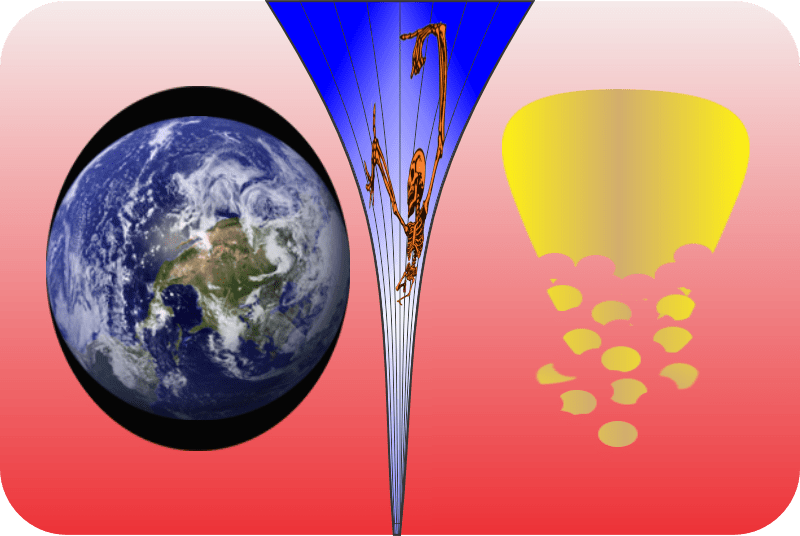
The Spaghettification Zone

Vinnie’s still wincing. “That neutron star pulling all the guy’s joints apart — yuckhh! So that’s spaghettification? I thought that was a black hole thing.”

“Yes and no, in that order. Spaghettification’s a tidal phenomenon associated with lopsided gravity fields, black holes or otherwise. You know what causes the tides, of course.”

“Sure, Sy. The Sun pulls up on the water underneath it.”

“That’s not quite it. The Sun’s direct‑line pull on a water molecule is less than a part per million of the Earth’s. What really happens is that the Sun broadly attracts water molecules north‑south east‑west all across the Sun‑side hemisphere. There’s a general movement towards the center of attraction where molecules pile up. The pile‑up’s what we call the tide.”

“What explains the high tide on the other side of the Earth? You can’t claim the Sun pushes it over there.”

“Of course not. It goes back to our lopsided taste of the Sun’s gravitational field. If it weren’t for the Sun’s pull, sea level would be a nice round circle where centrifugal force balances Earth’s gravity. The Sun’s gravity puts its thumb on the scale for the near side, like I said. It’s weaker on the other side, though — balance over there tilts toward the centrifugal force, makes for a far‑side bulge and midnight tides. We get lopsided forces from the moon’s gravity, too. That generates lunar tides. The solar and lunar cycles combine to produce the pattern of tides we experience. But tides can get much stronger. Ever hear of the Roche effect?”

“Can’t say as I have.”

“Imagine the Earth getting closer to the Sun but ignore the heat. What happens?”

“Sun‑side tides get higher and higher until … the Sun pulls the water away altogether!”

“That’s the idea. In the mid‑1800s Édouard Roche noticed the infinity buried in Newton’s F=GMm/r² equation. He realized that the forces get immense when the center‑to‑center distance, r, gets tiny. ‘Something’s got to give!’ he thought so he worked out the limits. The center‑to‑center force isn’t the critical one. The culprit is the tidal force which arises from the difference in the gravitational strength on either side of an object. When the force difference exceeds the forces holding the object together, it breaks up.”

“Only thing holding the ocean to Earth is gravity.”

“Exactly. Roche’s math applies strictly to objects where gravity’s the major force in play. Things like rubble‑pile asteroids like Bennu and Dimorphos or a black hole sipping the atmosphere off a neighboring blue supergiant star. We relate spaghettification to rubble piles but it can also compete with interatomic electronic forces which are a lot stronger.”
“You’re gonna get quantitative, right?”

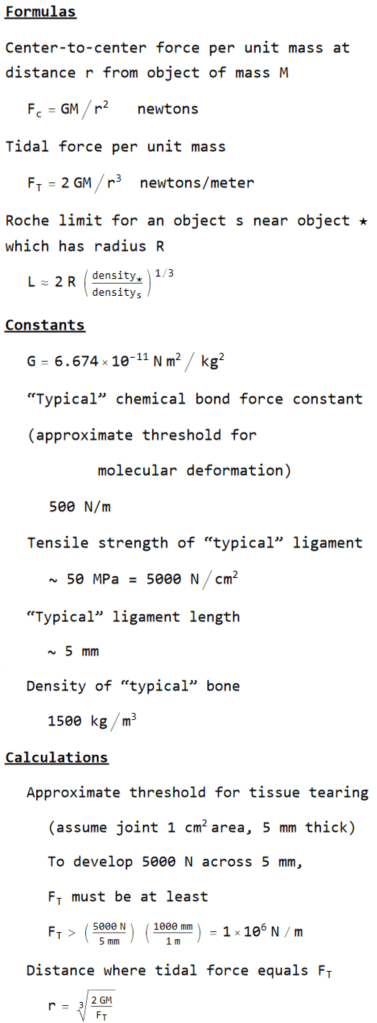
“Of course, that’s how I operate.” <tapping on Old Reliable’s screen> “Okay, suppose Niven’s guy Shaffer is approaching some object from far away. I’ve set up tidal force calculations for some interesting cases. Turns out if you know or can estimate an object’s mass and size, you can calculate its density which is key to Roche’s distance where a rubble pile flies apart. You don’t need density for the other thresholds. Spagettification sets in when tidal force is enough to bend a molecule. That’s about 500 newtons per meter, give or take a factor of ten. I estimated the rip‑apart tidal force to be near the tensile strength of the ligaments that hold your bones together. Sound fair?”

“Fair but yucky.”

“Mm‑hm. So here’s the results.”

“What’s with the red numbers?”

“I knew you’d ask that first. Those locations are inside the central object so they make no sense physically. Funny how Niven picked the only object class where stretch and tear effects actually show up.”

“How come there’s blanks under whatever ‘Sgr A*’ is?”

“Astronomer‑ese for ‘Sagittarius A-star,’ the Milky Way’s super‑massive black hole. Can’t properly calculate its density because the volume’s ill‑defined even though we know the Event Horizon’s diameter. Anyhow, look at the huge difference between the Roche radii and the two thresholds that affect chemical bonds.”

“Hey, Niven’s story had Shaffer going down to like 13 miles, about 20 kilometers. He’d’ve been torn apart before he got there.”

“Roughly.”
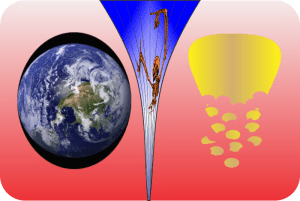
~~ Rich Olcott

SPLASH Splish plink

<chirp, chirp, chirp, chirp> “Moire here. This’d better be good.”

“Hello, Mr Moire. I’m one of your readers.”

“Do you have any idea what time it is?”

“Afraid not, I don’t know what time zone you’re in.”

“It’s three o’clock in the morning! Why are you calling me at this hour?”

“Oh, sorry, it’s mid-afternoon here. Modern communications tech is such a marvel. No matter, you’re awake so here’s my question. I’ve been pondering that micro black hole you’ve featured in the last couple of posts. You convinced me it would have a hard time hitting Earth but then I started thinking about it hitting the Sun. The Sun’s diameter is 100 times Earth’s so it presents 10,000 times more target area, yes? Further, the Sun’s 300,000 times more massive than Earth so it has that much more gravity. Surely the Sun is a more effective black hole attractor than Earth is.”

“That’s a statement, not a question. Worse yet, you’re comparing negligible to extremely negligible and neither one is worth losing sleep over which is what I’m doing now.”

“Wait on, I’ve not gotten to my question yet which is, suppose a black hole did happen to collide with the Sun. What would happen then?”

<yawn> “Depends on the size of the black hole. If it’s supermassive, up in the billion‑sun range, it wouldn’t hit the Sun. Instead, the Sun would hit the black hole but there’d be no collision. The Sun would just sink quietly through the Event Horizon.”

“Wouldn’t it rip apart?”

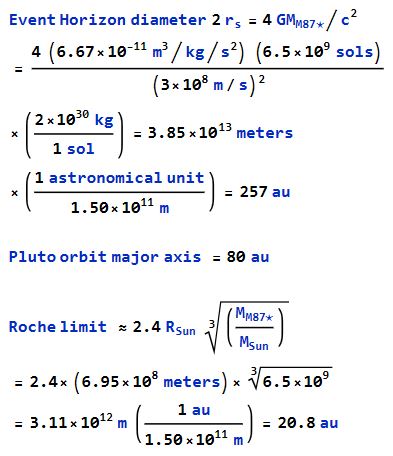
“You’re thinking of those artistic paintings showing great blobs of material being torn away by a black hole’s gravity. Doesn’t work that way, at least not at this size range.” <grabbing Old Reliable from my nightstand and key‑tapping> “Gravitational forces are distance‑dependent. Supermassives are large even by astronomical standards. The M87* black hole, the first one ESA got an image of, has the mass of 6 billion Suns and an Event Horizon three times wider than Pluto’s orbit. The tidal ripping‑apart you’re looking for only happens when the mass centers of two objects approach within Roche’s limit. Suppose a Sun‑sized star flew into M87*’s Event Horizon. Their Roche limit would be 100 astronomical units inside the Event Horizon. If any ripping happened, no evidence could escape to us.”

“Another illusion punctured.”

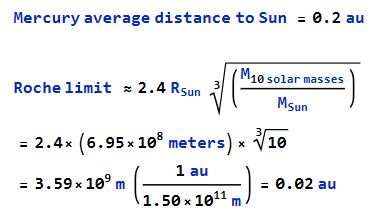
“Don’t give up hope. The next‑smaller size category have masses near our Sun’s. The Event Horizon of a 10‑solar‑mass black hole would be only about 60 kilometers wide. The Roche Zone for an approaching Sun is a million times wider. There’s plenty of opportunity for ferocious ripping on the way in.”

“Somehow that’s a comfort, but my question was about even smaller black holes — micro‑size flyspecks such as you wrote about. What effect would one have on the Sun?”

“You’d think it’d be a simple matter of the micro‑hole, let’s call it Mikey, diving straight to the Sun’s center while gobbling Sun‑stuff in a gluttonous frenzy, getting exponentially bigger and more voracious every second until the Sun implodes. Almost none of that would happen. The Sun’s an incredibly violent place. On initial approach Mikey’d be met with powerful, rapidly moving magnetic fields. If he’s carrying any charge at all they’d give him whip‑crack rides all around the Sun’s mostly‑vacuum outer layers. He might not ever escape down to the Convection Zone.”

“He’d dive if he escaped there or he’s electrically neutral.”

“Mostly not. The Convection Zone’s 200,000-kilometer depth takes up two‑thirds of the Sun’s volume and features hyper‑hurricane winds roaring upward, downward and occasionally sideward. Mikey would be a very small boat in a very big forever storm.”

“But surely Mikey’s density would carry him through to the core.”

“Nope, the deeper you go, the smaller the influence of gravity. Newton proved that inside a massive spherical shell, the net gravitational pull on any small object is zero. At the Sun’s core it’s all pressure, no gravity.”

“Then the pressure will force‑feed mass into Mikey.”

“Not so much. Mikey has jets and and an accretion disk. Their outward radiation pressure sets an upper limit on Mikey’s gobbling speed. The Sun will nova naturally before Mikey has any effect.”

“No worries then.”

~~ Rich Olcott

Holes in A Hole?

Mid-afternoon coffee break time so I head over to Al’s coffee shop. Vinnie’s at his usual table by the door, fiddling with some spilled coffee on the table top. I notice he’s pulled some of it into a ring around a central blob. He looks at it for a moment. His mental gears whirl then he looks up at me. “Hey Sy! Can you have a black hole inside another black hole?”

“That’s an interesting question. Quick answer is, ‘No.’ Longer answer is, ‘Sort of, maybe, but not the way you’re thinking.’ You good with that, Vinnie?”

“You know me better than that, Sy. Pull up a chair and give.”

I wave at Al, who brings me a mug of my usual black mud. “Thanks, Al. You heard Vinnie’s question?”

“Everyone on campus did, Sy. Why the wishy-washy?”

“Depends on your definition of black hole.”

Sky-watcher Al is quick with a response. “It’s a star that collapsed denser than a neutron star.”

Vinne knows me and black holes better than that. “It’s someplace where gravity’s so strong that nothing can get out, not even light.”

“Both right, as far as they go, but neither goes deep enough for Vinnie’s question.”

“You got a better one, I suppose?”

“I do, Vinnie. My definitition is that a black hole is a region of spacetime with such intense gravitation that it wraps an Event Horizon around itself. Al’s collapsed star is one way to create one, but that probably doesn’t account for the Event Horizons around supermassive black holes lurking in galactic cores. Your ‘nothing escapes‘ doesn’t say anything about conditions inside.”

“Thought we couldn’t know what happens inside.”

“Mostly correct, which is why your question is as problematical as you knew it was. Best I can do is lay out possibilities, okay? First possibility is that the outer black hole forms around a pre-existing inner one.”

“Can they do that?”

“In principle. What makes a black hole is having enough mass gathered in close proximity. Suppose you have a black hole floating our there in space, call it Fred, and a neutron star comes sidling by. If the two bodies approach closely enough, the total amount of mass could be large enough to generate a second Event Horizon shell enclosing both of them. How long that’d last is another matter.”

“The outer shell’d go away?”

“No chance of that. Once the shell’s created, the mass is in there and the star is doomed … unless the star’s closest approach matches Fred’s ISCO. That’s Innermost Stable Circular Orbit, about three times Fred’s Event Horizon’s half-diameter if Fred’s not rotating. Then the two bodies might go into orbit around their common center of gravity.”

“How’s rotation come into this?”

“If the mass is spinning, then you’ve got a Kerr black hole, frame-dragging and an ISCO each along and against the spin direction. Oh, wait, I forgot about tidal effects.”

“Like spaghettification, right.”

“Like that but it could be worse. Depending on how tightly neutronium holds itself together, which we don’t know, that close approach might be inside the Roche limit. Fred’s gravity gradient might simply shred the star to grow the black hole’s accretion disk.”

“Grim. You said there’s other possibilities?”

“Sorta like the first one, but suppose the total mass comes from two existing black holes, like the collision that LIGO picked up accidentally back in 2014. Suppose each one is aimed just outside the other’s ISCO. Roche fragmentation wouldn’t happen, I think, because each body’s contents are protected inside its own personal Event Horizon. Uhh … darn, that scheme won’t work and neither will the other one.”

“Why not?”
 ”Why not?”

“Because the diameter of an Event Horizon is proportional to the enclosed mass. The outer horizon’s diameter for the case with two black holes would be exactly the sum of the diameters of the embedded holes. If they’re at ISCO distances apart they’re can’t be close enough to form the outer horizon. For the same reason, I don’t think a neutron star could get close enough, either.”

“No hole in a hole, huh?”

“I’m afraid not.”

~~ Rich Olcott

  • Thanks to Alex and Xander, who asked the question.

Engineering A Black Hole

<bomPAH-dadadadaDEEdah> That weird ringtone on Old Reliable again. Sure enough, the phone function’s caller-ID display says 710‑555‑1701.  “Ms Baird, I presume?”

A computerish voice, aggressive but feminine, with a hint of desperation. “Commander Baird will be with you shortly, Mr Moire. Please hold.”

A moment later, “Hello, Mr Moire.”

“Ms Baird. Congratulations on the promotion.”

“Thank you, Mr Moire. I owe you for that.”

“How so?”

“Your posts about phase-based weaponry got me thinking. I assembled a team, we demonstrated a proof of concept and now Federation ships are being equipped with the Baird‑Prymaat ShieldSaw. Works a treat on Klingon and Romulan shielding. So thank you.”

“My pleasure. Where are you now?”

“I’m on a research ship called the Invigilator. We’re orbiting black hole number 77203 in our catalog. We call it ‘Lonesome‘.”

“Why that name?”

“Because there’s so little other matter in the space nearby. The poor thing barely has an accretion disk.”

“Sounds boring.”

“No, it’s exciting, because it’s so close to a theoretical ideal. It’s like the perfectly flat plane and the frictionless pulley — in real life there are always irregularities that the simple equations can’t account for. For black holes, our only complete solutions assume that the collapsed star is floating in an empty Universe with no impinging gravitational or electromagnetic fields. That doesn’t happen, of course, but Lonesome comes close.”

“But if we understand the theoretical cases and it nearly matches one, why bother with it at all?”

“Engineering reasons.”

“You’re engineering a black hole?”

“In a way, yes. Or at least that’s what we’re working on. We think we have a way to extract power from a black hole. It’ll supply inexhaustible cheap energy for a new Star Fleet anti‑matter factory. “

“I thought the only thing that could escape a black hole’s Event Horizon was Hawking radiation, and it cheats.”

“Gravity escapes honestly. Its intense field generates some unexpected effects. Your physicist Roger Penrose used gravity to explain the polar jets that decorate so many compact objects including black holes. He calculated that if a comet or an atom or something else breakable shatters when it falls into a spinning compact object’s gravitational field, some pieces would be trapped there but under the right conditions other pieces would slingshot outward with more energy than they had going in. In effect, the extra energy would come from the compact object’s angular momentum.”

“And that’s what you’re planning to do? How are you going to trap the expelled pieces?”

“No, that’s not what we’re planning. Too random to be controlled with our current containment field technology. We’re going pure electromagnetic, turning Lonesome into a giant motor‑generator. We know it has a stable magnetic field and it’s spinning rapidly. We’ll start by giving Lonesome some close company. There’s enough junk in its accretion disk for several Neptune‑sized planets. The plan is to use space tugs to haul in the big stuff and Bussard technology for the dust, all to assemble a pair of Ceres-sized planetoids. W’re calling them Pine and Road. We’ll park them in a convenient equatorial orbit in a Lagrange‑stable configuration so Pine, Road and Lonesome stay in a straight line.”

“Someone’s been doing research on old cinema.”

“The Interstellar Movie Database. Anyhow, when the planetoids are out there we string conducting tractor beams between them. If we locate Pine and Road properly, Lonesome’s rotating magnetic field lines will cross the fields at right angles and induce a steady electric current. Power for the anti‑matter synthesizers.”

“Ah, so like Penrose’s process you’re going to drain off some of Lonesome‘s rotational kinetic energy. Won’t it run out?”

Lonesome‘s mass is half again heavier than your Sun’s, Mr Moire. It’ll spin for a long, long time.”

“Umm … that ‘convenient orbit.’ Lonesome‘s diameter is so small that orbits will be pretty speedy. <calculating quickly with Old Reliable> Even 200 million kilometers away you’d circle Lonesome in less than 15 minutes. Will the magnetic field that far out be strong enough for your purposes?”

“Almost certainly so, but the gravimagnetodynamic equations don’t have exact solutions. We’re not going to know until we get there.”

“That’s how research works, all right. Good luck.”

~~ Rich Olcott

Three Perils for a Quest(ion), Part 1

Eddie makes great pizzas but Jeremy thinks they stay in the oven just a little too long.  As he crunched an extra-crispy wedge-edge he mused, “Gravity aside, I wonder what it’d be like to land on a black hole.  I bet it’d be real slippery if it’s as smooth as Mr Moire says.”

Jennie cut in.  “Don’t be daft, lad.  Everyone’s read about the spaceman sliding through the event horizon unaware until it’s too late.  Someone far away sees the bloke’s spacetime getting all distorted but in his local frame of reference everything’s right as rain.  Right, Sy?”

“As rain, Jennie, if all you’re concerned about is relativity.  But Spaceman Jeremy has lots of other things to be concerned about on his way to the event horizon.  Which he couldn’t stand on anyway.”

“Why not, Mr Moire?  I mean, I said ‘gravity aside’ so I ought to be able to stand up.”

“Nothing to stand on, Jeremy.  It’d be like trying to stand on Earth’s orbit.”

“Pull the other one, Sy.  How can they be alike?”

“Both of them are mathematical constructs rather than physical objects.  An orbit is an imaginary line that depicts planet or satellite locations.  An event horizon is an imaginary figure enclosing a region with such intense spacetime curvature that time points inward.  They’re abstract objects, not  concrete ones.  But let’s get back to Jeremy’s black hole evaporation quest.  He’ll have to pass three perils.”

“Ooo, a Quest with Perils —  loverly.  What are the Perils then?”

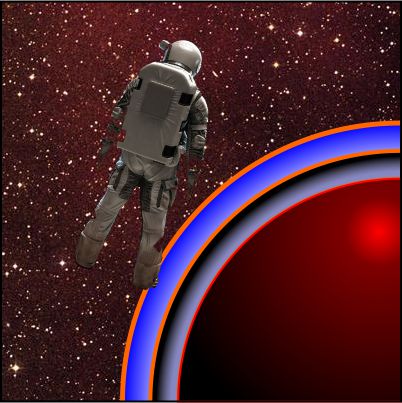
“The Roche Radius, the Photon Sphere and the Firewall.  Got your armor on, Jeremy?”Astronaut and 3xBlack hole

“Ready, Mr Moire.”

“Stand up.  The Roche effect is all about gravitational discrepancy between two points.  The two meter distance between your head and feet isn’t enough for a perceptible difference in downward pull.  However, when we deal with astronomical distances the differences can get significant.  For instance, ocean water on the day side of Earth is closer to the Sun and experiences a stronger sunward pull than water on the night side.”

“Ah, so that’s why we get tides.”

“Right.  Sit, sit, sit.  So in 1849 Édouard Roche wondered how close two objects could get until tidal forces pulled one of them apart.  He supposed the two objects were both just balls of rocks or fluid held together by gravity.  Applying Newton’s Laws and some approximations he got a formula for threshold distance in terms of the big guy’s mass and the little guy’s density.  Suppose you’re held together only by gravity and you’re nearing the Sun feet-first.  Its mass is 2×1030 kg/m³.  Even including your space armor, your average density is about 1.5 kg/m³.  According to Roche’s formula, if you got closer than 8.6×10⁶ kilometers your feet would break away and fall into the Sun before the rest of you would.  Oh, that distance is about 1/7 the radius of Mercury’s orbit so it’s pretty close in.”

“But we’re talking black holes here.  What if the Sun collapses to a black hole?”

“Surprisingly, it’s exactly the same distance.  The primary’s operative property is its mass, not its diameter.  Good thing Jeremy’s really held together by atomic and molecular electromagnetism, which is much stronger than gravity.  Which brings us to his second Peril, the dreaded Photon Sphere.”

“Should I shudder, Sy?”

“Go ahead, Jennie.  The Sphere is another mathematical object, not something physical you’d collide with, Jeremy.  It’s a zero-thickness shell representing where electromagnetic waves can orbit a massive object like a black hole or a neutron star.  Waves can penetrate the shell easily in either direction, but if one happens to fly in exactly along a tangent, it’s trapped on the Sphere.”

“That’s photons.  Why is it a peril to me?”

“Remember that electromagnetism that holds you together?  Photons carry that force.  Granted, in a molecule they’re standing waves rather than the free waves we see with.  The math is impossible, but here’s the Peril.  Suppose one of your particularly important molecules happens to lie tangent to the Sphere while you’re traversing it.  Suddenly, the forces holding that molecule together fly away from you at the speed of light.  And that disruption inexorably travels along your body as you proceed on your Quest.”

[both shudder]

~~ Rich Olcott

Squeezing past Newton’s infinity

One of the most powerful moments in musical theater — Philip Quast Quastin his Les Miz role of Inspector Javert, praising the stars for the steadfastness and reverence for law that they signify for him.  The performance is well worth a listen.

Javert’s certitude came from Newton’s sublimely reliable mechanics — the notion that every star’s and planet’s motion is controlled by a single law, F~(1/r2).  The law says that the attractive force between any pair of bodies is inversely proportional to the square of the distance between their centers.  But as Javert’s steel-clad resolve hid a fatal spark of mercy towards Jean Valjean, so Newton’s clockworks hold catastrophe at their axles.

Newton’s gravity law has a problem.  As the distance approaches zero, the predicted force approaches infinity.  The law demands that nearby objects accelerate relentlessly at each other to collide with infinite force, after which their combined mass attracts other objects.  In time, everything must collapse in a reverse of The Big Bang.

Victor Hugo wrote Les Misérables about 180 years after Newton published his Principia.  A decade before Hugo’s book, Professeur Édouard Roche (pronounced rōsh) solved at least part of Newton’s problem.

Roche realized that Newton had made an important but crucial simplification.  Early in the Principia, he’d proven that for many purposes you can treat an entire object as though all of its mass were concentrated at a single point (the “center of mass”).  But in real gravity problems every particle of one object exerts an attraction for every particle of the other.

That distinction makes no difference when the two objects are far apart.  However, when they’re close together there are actually two opposing forces in play:

  • gravity, which preferentially affects the closest particles, and
  • tension, which maintains the integrity of each structure.

contact_binary_1
Binary star pair demonstrating Roche lobes, image courtesy of Cronodon.com

Roche noted that the gravity fields of any pair of objects must overlap.  There will always be a point on the line between them where a particle will be tugged equally in either direction.  If two bodies are close and one or both are fluid (gases and plasmas are fluid in this sense), the tension force is a weak competitor.  The partner with the less intense gravity field will lose material across that bridge to the other partner. Binary star systems often evolve by draining rather than collision.

Now suppose both bodies are solid.  Tension’s game is much stronger.  Nonetheless, as they approach each other gravity will eventually start ripping chunks off of one or both objects.  The only question is the size of the chunks — friable materials like ices will probably yield small flakes, as opposed to larger lumps made from silicates and other rocky materials.  Roche described the final stage of the process, where the less-massive body shatters completely.  The famous rings of Saturn and the less famous rings of Neptune, Uranus and Jupiter all appear to have been formed by this mechanism.

Roche was even able to calculate how close the bodies need to be for that final stage to occur. The threshold, now called the Roche Limit, depends on the size and mass of each body. You can get more detail here.

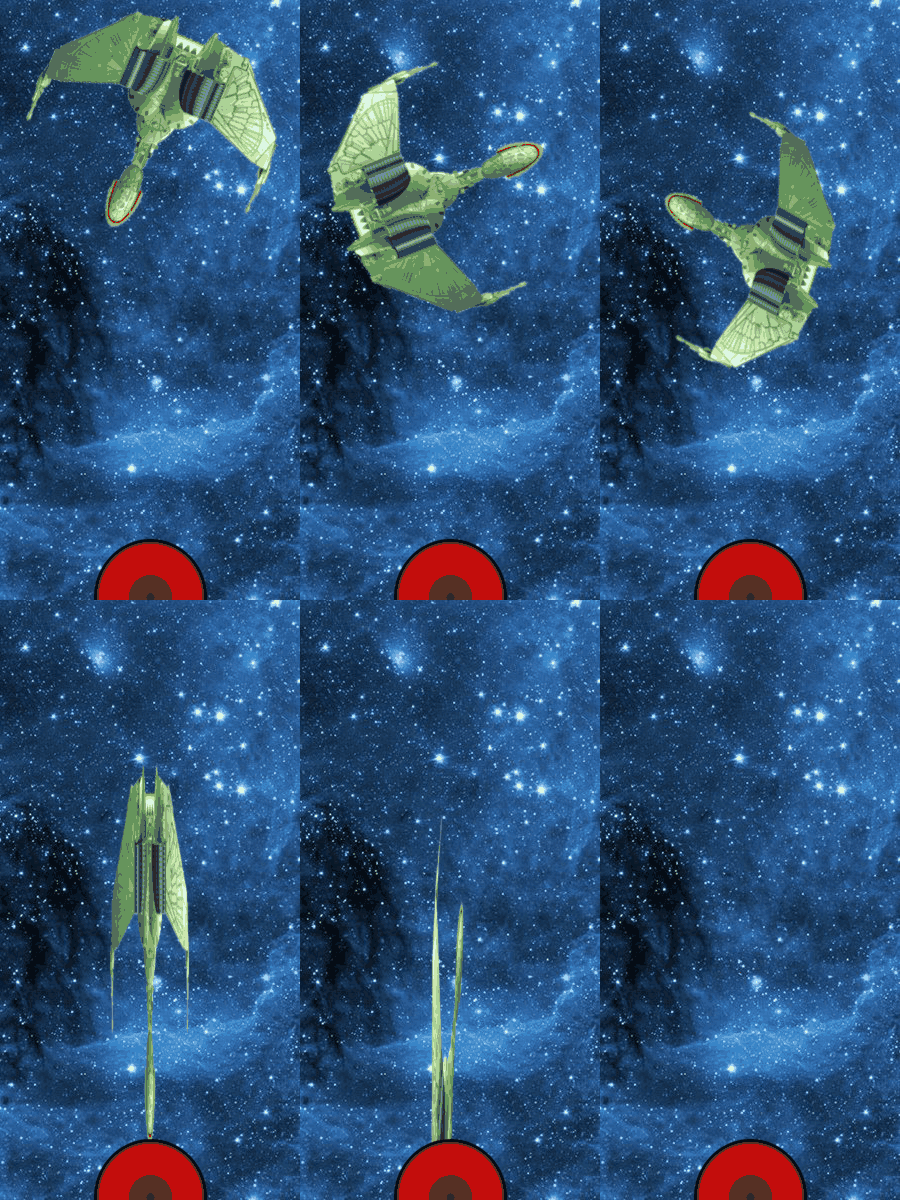
Klingon3And then there’s spaghettification.  That’s a non-relativistic tidal phenomenon that occurs near an extremely dense body like a neutron star or a black hole.  Because these objects pack an enormous amount of mass into a very small volume, the force of gravity at a close-in point is significantly greater than the force just a little bit further out. Any object, say a Klingon Warbird that ignored peril markings on a space map (Klingons view warnings as personal challenges), would find itself stretched like a noodle between high gravity on the side near the black hole and lower gravity on the opposite side.  (In this cartoon, notice how the stretching doesn’t care which way the pin-wheeling ship is pointed.)

Nature abhors singularities.  Where a mathematical model like Newton’s gravity law predicts an infinity, Nature generally says, “You forgot something.”  Newton assumed that objects collide as coherent units.  Real bodies drain, crumble, or deform to slide together.  Look to the apparent singularities to find new physics.

~~ Rich Olcott