Stripes And Solids

“Any other broad-brush Jupiter averages, Cathleen?”

“How about chemistry, Vinnie? Big picture, 84% of Jupiter’s atoms are hydrogen, 16% are helium.”

“Doesn’t leave much room for asteroids and such that fall in.”

“Less than a percent for all other elements. Helium doesn’t do chemistry, so from a distant chemist’s perspective Jupiter and Saturn both look like a dilute hydrogen‑helium solution of every other element. But the solvent’s not a typical laboratory liquid.”

“Hard to think of a gas as a solvent.”

“True, Sy, but chemistry gets strange under high temperatures and pressures.”

“Hey, I always figured Jupiter to be cold ’cause it’s farther from the Sun than us.”

“Good logic, Vinnie, but Jupiter generates its own heat. That’s one reason its weather is different from ours. Earth gets more than 99% of its energy budget from sunlight, especially in the infrared. There’s year‑long solar heating at low latitudes but only half‑years of that near the Poles. The imbalance is behind the temperature disparities that drive our prevailing weather patterns.”

“Jupiter’s not like that?”

“Nope. It gets 30 times less energy from the Sun than Earth does and actually gives off more heat than it receives. Its poles and equator are at virtually the same chilly temperature. There’s a small amount of heat flow from equator to poles, but most of Jupiter’s heat migrates spherically from a 24,000 K fever near its core to its outer layers.”

“What could generate all that heat?”

“Probably several contributors. The dominant one is gravitational potential energy from everything falling inward and banging into everything else. Random rock or atom collisions generate heat. Entropy rules.”

“Sounds reasonable. What’s another?”

“Radioactives. Half of Earth’s internal heating comes from gravity, same mechanism as Jupiter though on a smaller scale. The rest comes from unstable isotopes like uranium, thorium and potassium‑40. Also aluminum‑26, back in the early years, but that’s all gone now. Jupiter undoubtedly ate from the same dinner table. Those fissionable atoms split and release heat whenever they feel like it whether or not they’re collected in one place like in a reactor or bomb. Whatever the origin, Jupiter ferries that heat to the surface and dumps it as infrared radiation.”

“Yeah or else it’d explode or something.”

“Mm-hm. The question is, what are the heat‑carrying channels? They must thread their way through the planet’s structure.”

“It’s just a big ball of gas, how can it have structure?”

“I can help with that, Vinnie. Remember a few years back I wrote about high‑pressure chemistry? Hydrogen gets weird at a million bars‑‑‑”

“Anyone’d get weird after that many bars, Sy.” <heh, heh>

“Ha ha, Vinnie. A bar is pressure equal to one Earth atmosphere. Pressures deep inside Jupiter get into hundreds of megabars. Hydrogen molecules down there are crammed so close together that their electron clouds merge and you have a collection of protons floating in a sea of electron charge. They call it metallic hydrogen, but it’s fluid like mercury, not crystalline. Cathleen, when you refer to Jupiter’s structure you’re thinking layers?”

“That’s right, Sy, but the layers may or may not be arranged like Earth’s crust, mantle, core scheme. A lot of the Juno data is consistent with that — a shell of the atmosphere we see, surrounding a thick layer of increasingly compressed hydrogen‑helium over a core of heavy stuff suspended in metallic hydrogen. About 20% down we think the helium is squeezed out and falls like rain, only to evaporate again at a lower level. The core’s metallic hydrogen may even be solid despite thousand‑degree temperatures — we just don’t know how hydrogen behaves in that regime.”

“What other kind of layering can there be?”

“Experiments have demonstrated that under the right conditions a rapidly spinning fluid can self-organize into a series of concentric rotating cylinders. Maybe Jupiter and the other gas planets follow that model and the stripes show where the cylinders intersect with gravity’s spherical imperative. Coaxial cylinders would account for the equator and poles rotating at different rates. Juno data indicates that Jupiter’s equatorial zone has more ammonia than the rest of its atmosphere. Maybe between‑cylinder winds trap the ammonia and prevent it from mixing with the next deeper cylinder.”

~ Rich Olcott

SPLASH Splish plink

<chirp, chirp, chirp, chirp> “Moire here. This’d better be good.”

“Hello, Mr Moire. I’m one of your readers.”

“Do you have any idea what time it is?”

“Afraid not, I don’t know what time zone you’re in.”

“It’s three o’clock in the morning! Why are you calling me at this hour?”

“Oh, sorry, it’s mid-afternoon here. Modern communications tech is such a marvel. No matter, you’re awake so here’s my question. I’ve been pondering that micro black hole you’ve featured in the last couple of posts. You convinced me it would have a hard time hitting Earth but then I started thinking about it hitting the Sun. The Sun’s diameter is 100 times Earth’s so it presents 10,000 times more target area, yes? Further, the Sun’s 300,000 times more massive than Earth so it has that much more gravity. Surely the Sun is a more effective black hole attractor than Earth is.”

“That’s a statement, not a question. Worse yet, you’re comparing negligible to extremely negligible and neither one is worth losing sleep over which is what I’m doing now.”

“Wait on, I’ve not gotten to my question yet which is, suppose a black hole did happen to collide with the Sun. What would happen then?”

<yawn> “Depends on the size of the black hole. If it’s supermassive, up in the billion‑sun range, it wouldn’t hit the Sun. Instead, the Sun would hit the black hole but there’d be no collision. The Sun would just sink quietly through the Event Horizon.”

“Wouldn’t it rip apart?”

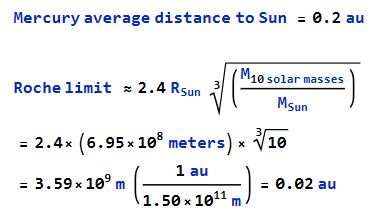
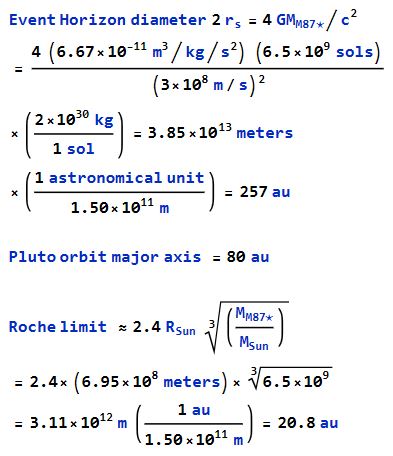
“You’re thinking of those artistic paintings showing great blobs of material being torn away by a black hole’s gravity. Doesn’t work that way, at least not at this size range.” <grabbing Old Reliable from my nightstand and key‑tapping> “Gravitational forces are distance‑dependent. Supermassives are large even by astronomical standards. The M87* black hole, the first one ESA got an image of, has the mass of 6 billion Suns and an Event Horizon three times wider than Pluto’s orbit. The tidal ripping‑apart you’re looking for only happens when the mass centers of two objects approach within Roche’s limit. Suppose a Sun‑sized star flew into M87*’s Event Horizon. Their Roche limit would be 100 astronomical units inside the Event Horizon. If any ripping happened, no evidence could escape to us.”

“Another illusion punctured.”

“Don’t give up hope. The next‑smaller size category have masses near our Sun’s. The Event Horizon of a 10‑solar‑mass black hole would be only about 60 kilometers wide. The Roche Zone for an approaching Sun is a million times wider. There’s plenty of opportunity for ferocious ripping on the way in.”

“Somehow that’s a comfort, but my question was about even smaller black holes — micro‑size flyspecks such as you wrote about. What effect would one have on the Sun?”

“You’d think it’d be a simple matter of the micro‑hole, let’s call it Mikey, diving straight to the Sun’s center while gobbling Sun‑stuff in a gluttonous frenzy, getting exponentially bigger and more voracious every second until the Sun implodes. Almost none of that would happen. The Sun’s an incredibly violent place. On initial approach Mikey’d be met with powerful, rapidly moving magnetic fields. If he’s carrying any charge at all they’d give him whip‑crack rides all around the Sun’s mostly‑vacuum outer layers. He might not ever escape down to the Convection Zone.”

“He’d dive if he escaped there or he’s electrically neutral.”

“Mostly not. The Convection Zone’s 200,000-kilometer depth takes up two‑thirds of the Sun’s volume and features hyper‑hurricane winds roaring upward, downward and occasionally sideward. Mikey would be a very small boat in a very big forever storm.”

“But surely Mikey’s density would carry him through to the core.”

“Nope, the deeper you go, the smaller the influence of gravity. Newton proved that inside a massive spherical shell, the net gravitational pull on any small object is zero. At the Sun’s core it’s all pressure, no gravity.”

“Then the pressure will force‑feed mass into Mikey.”

“Not so much. Mikey has jets and and an accretion disk. Their outward radiation pressure sets an upper limit on Mikey’s gobbling speed. The Sun will nova naturally before Mikey has any effect.”

“No worries then.”

~~ Rich Olcott

A Two-Way Stretch, Maybe

“Okay, Moire, I guess I gotta go with the Big Bang happening, but I still have a problem with it making everything come from a point full of nothing.”

“Back at you, Mr Feder. I have problems with your problem. To begin with, forget about your notion of a point with zero size. There’s some reason to think the Bang started with an event sized on the order of the Planck length, 10-35 meter. That’s small, but it’s not zero.”

“I suppose, but with the whole mass of the Universe crammed in there, ain’t that a recipe for the ultimate black hole? Nothing could get outta there.”

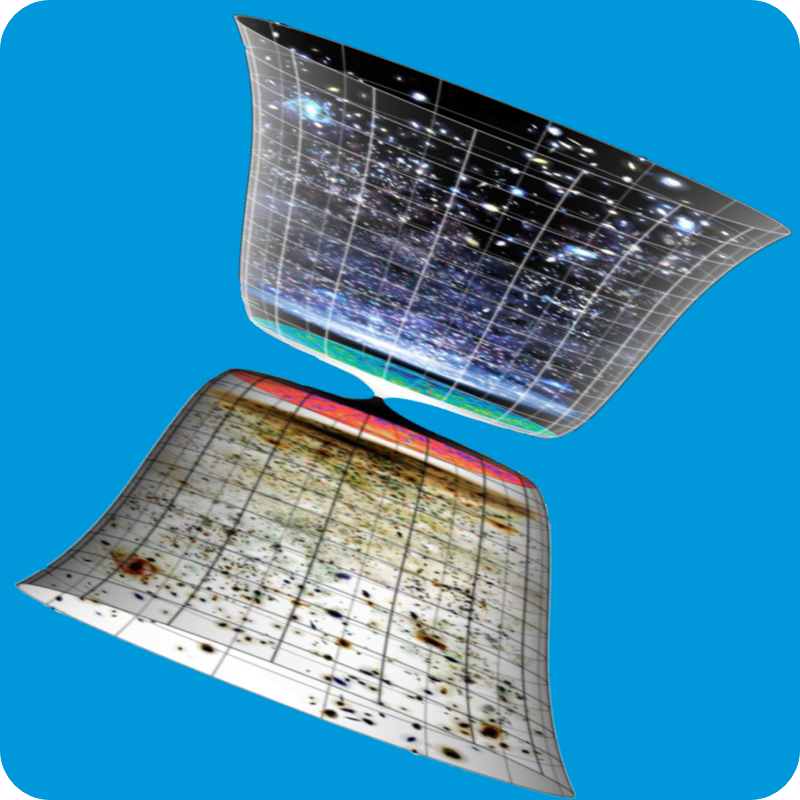
“Nothing needs to. What’s inside is already everything, remember? Besides, there isn’t an outside — space simply doesn’t exist outside of the spacetime the Bang created. Those bell‑shaped ‘Evolution of The Universe‘ diagrams are so misleading. I say that even though I’ve used the diagram myself. It’s just a graph with Time running along the central axis and Space expanding perpendicular to that. People have prettied it up to make it cylindrical and added galaxies and such. The lines just represent how much Space has expanded since the Bang. Unfortunately, people look at the bell as a some kind of boundary with empty space outside, but that’s so wrong.”

“No outside? Hard to wrap your head around.”

“Understandable. Only physicists and mathematicians get used to thinking in those terms and mostly we do it with equations instead of trying to visualize. Our equations tell us the Universe expands at the speed of light plus a bit.”

“Wait, I thought nothing could go faster than the speed of light.”

“True, nothing can traverse space faster than light or gravity, but space itself expands. At large distances it’s doing that faster than light. We actually had to devise two different definitions of distance. ‘Co‑moving distance‘ includes the expansion. ‘Proper distance‘ doesn’t. In another couple billion years, the farthest things we can see today will be co‑moving away so fast that the photons they emit will be carried away faster than they can fly towards us. Those objects will leave our Observable Universe, the spherical bubble that encloses the objects whose light gets a chance to reach us.”

“My head hurts from the expanding. Get back to the Bang thing ’cause it was small. Too small to hold atoms I guess so how can it explode to be everything?”

‘Expand’, not ‘explode‘ — they’re different — but good guess. The Bang’s singularity was smaller than an atom by at least a factor of 1024, but conditions were far too hot in there for atoms to exist, or nuclei, or even protons and neutrons. Informally we call it a quark soup, which is okay because we think quarks are structureless points that can cram to near‑infinite density. We don’t yet know enough Physics for good calculations of temperature, density or much of anything else.”

“That’s a lot of energy, even if it’s not particles. Which is what I’m getting at. I keep hearing you can’t create energy, just transform it, right? So where did the energy come from?”

“That’s a deep question, Mr Feder, and we don’t have an answer or hypothesis or even a firm guess. It gets down to what energy even is — we’re just barely nibbling at the edges of that one. One crazy idea I kind of like is that creating our Universe took zero energy because the process was exactly compensated for by creating an anti‑Universe whose total anti‑energy matches our total energy.”

“Whaddaya mean, anti‑Universe and anti‑energy?”

<deep breath> “You know an atom has negatively‑charged electrons bound to its positively‑charged nucleus, right? Well, the anti‑Universe I’m thinking of has that situation and everything else reversed. Positive electrons, negative nucleus, but also flipped left‑right parities for some electroweak particle interactions. Oh, and time runs backwards which is how anti‑energy becomes a thing. Our Universe and my crazy anti‑Universe emerge at Time Zero from the singularity. Then they expand in opposite directions along the Time axis. Maybe the quarks and their anti‑quarks got sorted out at the flash‑point, I dunno.”

“So there’s an anti‑me out there somewhere?”

“I wouldn’t go that far.”

~~ Rich Olcott

Science or Not-science?

Vinnie trundles up to Jeremy’s gelato stand. “I’ll take a Neapolitan, one each chocolate, vanilla and strawberry.”

“Umm… Eddie forgot to order more three-dip cones and I’m all out. I can give you three separate cones or a dish.”

“The dish’ll be fine, way less messy. Hey, Sy, I got a new theory.”

“Mm… Unless you’ve got a lot of firm evidence it can’t be a theory. Could be a conjecture or if it’s really good maybe a hypothesis. What’s your idea?”

“Thing is, Sy, there can’t be any evidence. Ever. That’s the fun of it.”

“Conjecture, then. C’mon, out with it.”

“Well, you remember all that stuff about how time bends toward a black hole’s mass and that’s how gravity works?”

“Sure, except it’s not just black holes. Time bends the same way toward every mass, it’s just more intense with black holes.”

“Understood. Anyway, we talked once about how stars collapse to form black holes but that’s only up to a certain size, I forget what—”

“Ten to fifteen solar masses. Beyond that the collapse goes supernova and doesn’t leave much behind but dust.”

“Right. So you said we don’t know how to make size‑30 black holes like the first pair that LIGO found.”

“We’ve got a slew of hypotheses but the jury’s still out.”

“That’s what I hear. Well, if we don’t even know that much then we for‑sure don’t know how to make the supermassive black hole the science magazines say we’ve got in the middle of the Milky Way.”

“We’ve found that nearly every galaxy has one, some a lot bigger than ours. Why that’s true is one of the biggest mysteries in astrophysics.”

“And I know the answer! What if those supermassive guys started out as just big lumps of dark matter and then they wrapped themselves in more dark matter and everything else?”

“Cute idea, but the astronomy data says we can account for galaxy shapes and behavior if they’re embedded at the center of a spherical halo of dark matter.”

“Not a problem, Sy. Look at the numbers. Our superguy is a size‑4‑million, right? The whole Milky Way’s a billion times heavier than that. Tuck an extra billionth into the middle of the swirl and the stars wouldn’t see the difference.”

“Okay, but there’s more data that says dark matter spreads itself pretty evenly, doesn’t seem to clump up like you need it to.”

“Yeah, but maybe there’s two kinds, one kind clumpy and the other kind not. Only way to find out is to look inside a superguy but time blocks information flow out of there. So no‑one can say I’m wrong!”

“But sir, that’s not science!”

“Why not, kid?”

“The unit my philosophy class did on Popper.”

“The stuff you sniff or the penguins guy?”

“Neither, Karl Popper the philosopher. Dr Crom really likes Popper’s work so we spent a lot of time reading him. Popper was one of the Austrian intellectuals the Nazis chased out when they took power in the 1930s. Popper traveled around, wound up in New Zealand where he wrote his Open Society book that shredded Hegel and Marx. Those sections were fun reading even if they were wordy. Anyway, one of Popper’s big things was the demarcation problem, how to tell the difference between what’s a scientific assertion and what’s not. He decided the best criterion was if there’s a way to prove the assertion false. Not whether it was false but whether it could at least be tested. I was surprised by how many goofy things the Greeks said that would qualify as Popper‑scientific even though they were just made up and have been proven wrong.”

“Well there you go, Vinnie. Physics and the Universe don’t let us see into a supermassive black hole, therefore your idea isn’t testable even in principle. Jeremy’s right, it’s not scientific even though it’s all dressed up in a Science suit.”

“I can still call it a conjecture, though, right, Sy?”

“Conjecture it is. Might even be true, but we’ll never know unless we somehow find out something about dark matter that surprises us. We’ve been surprised a lot, though, so don’t give up hope.”

~~ Rich Olcott

Tilting at Black Holes

“What’s the cause-effect-time thing got to do with black holes and information?”

“We’re getting there, Al. What happens to spacetime near a black hole?”

“Everybody knows that, Sy, spacetime gets stretched and squeezed until there’s infinite time dilation at the Event Horizon.”

“As usual, Vinnie, what everybody knows isn’t quite what is. Yes, Schwarzschild’s famous solution includes that Event Horizon infinity but it’s an artifact of his coordinate system. Al, you know about coordinate systems?”

“I’m a star-watcher, Sy. Sure, I know about latitude and longitude, declination and right ascension, all that stuff no problem.”

“Good. Well, Einstein wrote his General Relativity equations using generalized coordinates, like x,y,z but with no requirement that they be straight lines or at right angles. Schwarzschild solved the equations for a non‑rotating sphere so naturally he used spherical coordinates — radius, latitude and longitude. Since then other people have solved the equations for more complicated cases using more complicated coordinate systems. Their solutions don’t have that infinity.”

“No infinity?”

“Not that one, anyhow. The singularity at the hole’s geometric center is a real thing, not an artifact. So’s a general Event Horizon, but it’s not quite where Schwarzschild said it should be and it doesn’t have quite the properties that everybody thinks they know it has. It’s still weird, though.”

“How so?”

“First thing you have to understand is that when you get close to a black hole, you don’t feel any different. Except for the spaghettification, of course.”

“It’s frames again, ain’t it?”

“With black holes it’s always frames, Vinnie. If you’re living in a distorted space you won’t notice it. Whirl a meter‑long sword around, you’d always see it as a meter long. A distant observer would see you and everything around you as being distorted right along with your space. They’ll see that sword shrink and grow as it passes through different parts of the distortion.”

“Weird.”

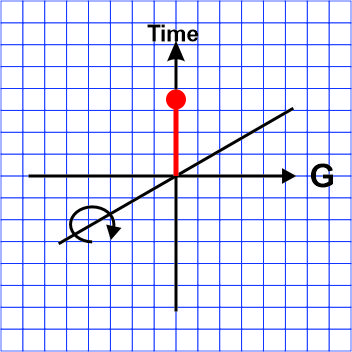
“We’re just getting started, Al. Time’s involved, too. <grabbing a paper napkin and sketching> Here’s three axes, just like x,y,z except one’s time, the G one points along a gravity field, and the third one is perpendicular to the other two. By the way, Al, great idea, getting paper napkins printed like graph paper.”

“My location’s between the Physics and Astronomy buildings, Sy. Gotta consider my clientele. Besides, I got a deal on the shipment. What’s the twirly around that third axis?”

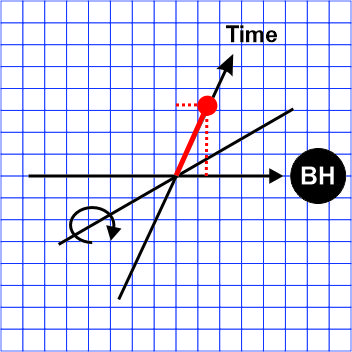
“It’s a reminder that there’s a couple of space dimensions that aren’t in the picture. Now suppose the red ball is a shuttlecraft on an exploration mission. The blue lines are its frame. The thick vertical red line shows it’s not moving because there’s no spatial extent along G. <another paper napkin, more sketching> This second drawing is the mothership’s view from a comfortable distance of the shuttlecraft near a black hole.”

“You’ve got the time axis tilted. What’s that about?”

“Spacetime being distorted by the black hole. You’ve heard Vinnie and me talk about time dilation and space compression like they’re two different phenomena. Thing is, they’re two sides of the same coin. On this graph that shows up as time tilted to mix in with the BH direction.”

“How about those twirly directions?”

“Vinnie, you had to ask. In the simple case where everything’s holding still and you’re not too close to the black hole, those two aren’t much affected. If the big guy’s spinning or if the Event Horizon spans a significant amount of your sky, all four dimensions get stressed. Let’s keep things simple, okay?”

“Fine. So the time axis is tilted, so what?”

“We in the distant mothership see the shuttlecraft moving along pure tilted time. The shuttlecraft doesn’t. The dotted red lines mark its measurements in its blue‑line personal frame. Shuttlecraft clocks run slower than the mothership’s. Worse, it’s falling toward the black hole.”

“Can’t it get away?”

“Al, it’s a shuttlecraft. It can just accelerate to the left.”

“If it’s not too close, Vinnie. The accelerative force it needs is the product of both masses, divided by the distance squared. Sound familiar?”

“That’s Newton’s Law of Gravity. This is how gravity works?”

“General Relativity cut its teeth on describing that tilt.”

~~ Rich Olcott

A Thumbtack in A Needlestack

“What’re the odds?”

“Odds on what, Vinnie?”

“A gazillion galaxies out there, only 41 lensing galaxy clusters, but one of them shows us a singleton star. I mean, what’s special about that star? What are the odds?”

I can’t help it. “Astronomical, Vinnie.”

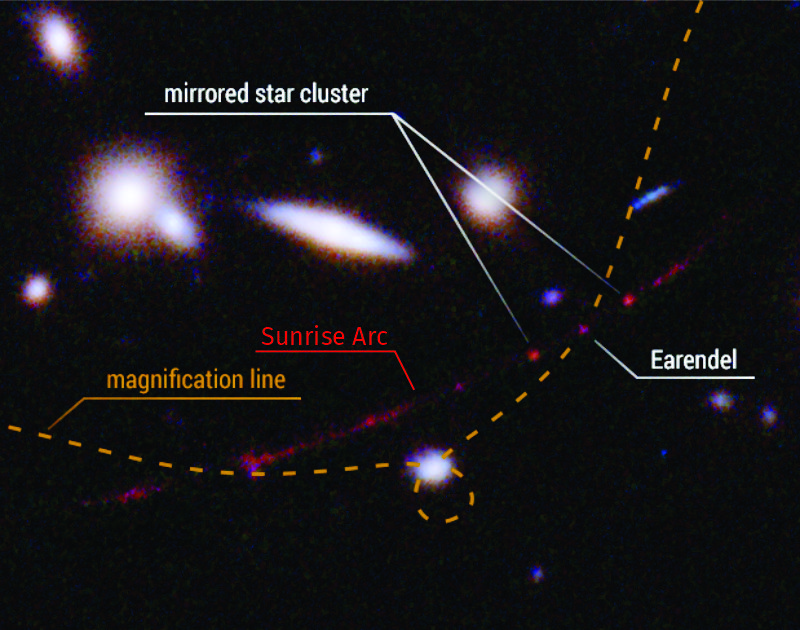
Cathleen punches my shoulder, hard. “Sy Moire, you be ashamed of yourself. That pun was ancient a century ago. Vinnie, the odds are better than they seem. We didn’t just stumble on Earendel and the Sunrise Arc, we found them in a highly targeted Big Data search for things just like that — objects whose light was extremely stretched and also gravitationally bent in our direction. The Arc’s lensing galaxy cluster has a spherical effect, more or less, so it also acts on light from other far-away objects and sends it in other directions. It even bends an image of our Milky Way towards Earendel’s galaxy.”

“I call weaseling — you used ‘more or less‘.”

“Guilty as charged, Vinnie. A nice, spherical black hole is the simplest case of gravitational lensing — just one mass at the center of its simple light‑bending gravity field. Same thing for a single star like our Sun. Clusters are messy. Tens or hundreds of billion‑star galaxies, scattered at random angles and random positions about their common center of mass. The combined gravity field is lumpy, to say the least. Half of that research paper is devoted to techniques for estimating the field and its effects on light in the region around the Arc.”

“I guess they had to get 3D positions for all the galaxies in the cluster. That’d be a lot of work.”

“It would, Al, but that’s beyond what current technology can do. Instead, they used computer models to do — get this, Sy — curve fitting.”

<chuckle> “Good one, Cathleen.”

“What’s so funny?”

“There’s a well-established scientific technique called ‘curve fitting.’ You graph some data and try to find an equation that does a respectable job of running through or at least near your data points. Newton started it, of course. Putting it in modern terms, he’d plot out some artillery data and say, ‘Hmm, that looks like a parabola H=h+v·t+a·t2. I wonder what values of h, v and a make the H-t curve fit those measurements. Hey, a is always 32 feet per second per second. Cool.’ Or something like that. Anyhow, Cathleen’s joke was that the researchers used curve fitting to fit the Sunrise Arc’s curve, right?”

“They did that, Sy. The underlying physical model, something called ‘caustic optics,’ says that—”

“Caustic like caustic soda? I got burnt by that stuff once.”

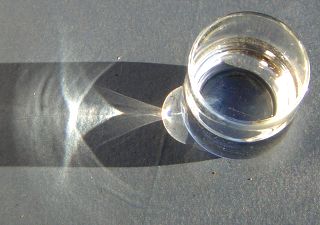
Image by Heiner Otterstedt,
under the Creative Commons Attribution-Share Alike 3.0 Unported license

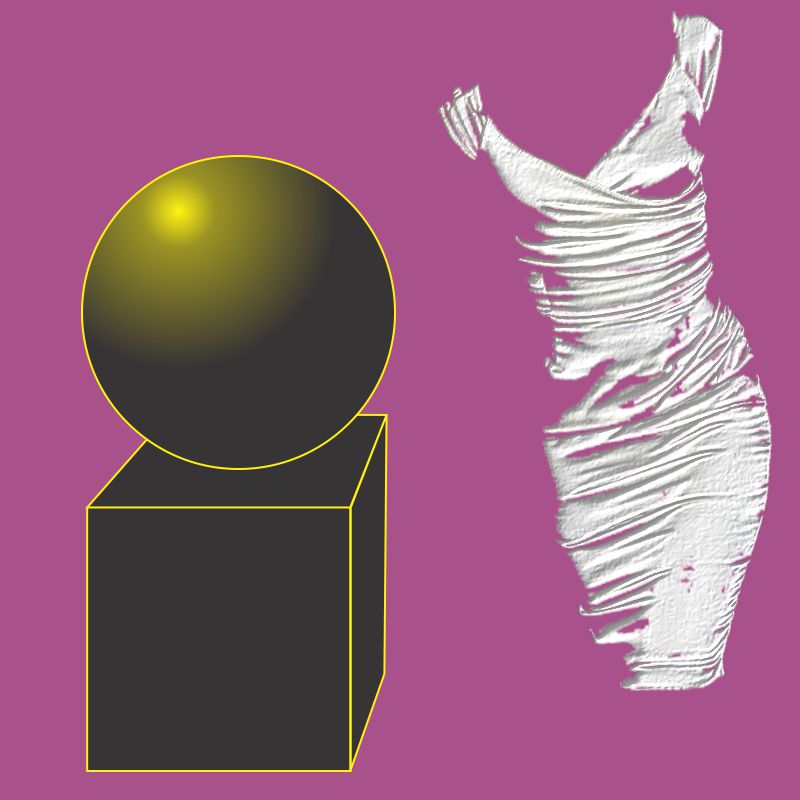
“That’s the old name for sodium hydroxide, Vinnie. It’s a powerful chemical and yeah, it can give you trouble if you’re not careful. That name and caustic optics both come from the Greek word for burning. The optics term goes back to using a lens as a burning glass. See those focused patterns of light next to your water glass? Each pattern is a caustic. The Arc’s lensing cluster’s like any light‑bender, it’s enclosed in a caustic perimeter. Light passing near the perimeter gets split, the two parts going to either side of the perimeter. The Earendel team’s curve‑fitting project asked, ‘Where must the caustic perimeter be to produce these duplicate galaxy images neighboring the Arc?‘ The model even has that bulge from the gravity of a nearby foreground galaxy.”

“And the star?”

“Earendel seems to be smack on top of the perimeter. Any image touching that special line is intensified way beyond what it ought to be given the source’s distance from us. It’s a pretty bright star to begin with, though. Or maybe two stars.”

“Wait, you don’t know?”

“Not yet. This study pushed the boundaries of what Hubble can do for us. We’re going to need JWST‘s infrared instruments to nail things down.”

Al’s in awe. “Wow — that caustic’s sharp enough to pick one star out of a galaxy.”

“Beat the astronomical odds, huh?”

Adapted from a public-domain image.
Credit: Science: NASA / ESA / Brian Welch (JHU) / Dan Coe (STScI); Image processing: NASA / ESA / Alyssa Pagan (STScI)

~~ Rich Olcott

Which Way Is Up?

“OK, Moire, the Attitude Control System’s reaction wheels swing James Webb Space Telescope through whatever angle changes it wants, but how does ACS know what direction JWST‘s at to begin with? Does it go searching through that million‑star catalog to find something that matches?”

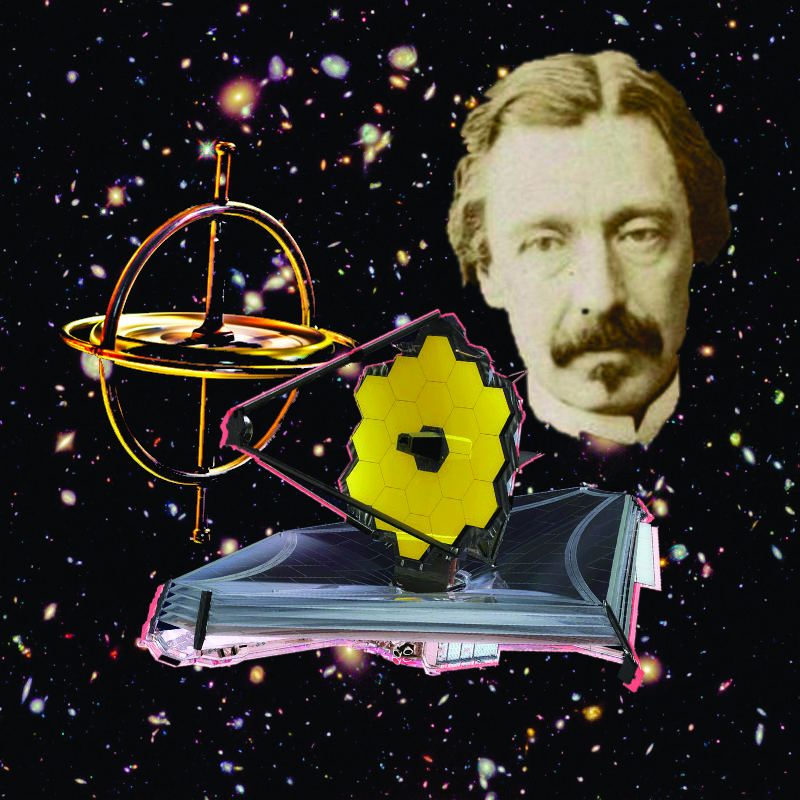
“Hardly, Mr Feder, that’d be way too much work for a shipboard computer. No, ACS consults the orientations maintained by a set of gyroscopes that are mounted on JWST‘s framework. Each one points along an unvarying bearing relative to the Universe, no matter how the satellite’s situated.”

“Gyroscopes? Like the one I had as a kid? Winding the string around the axle was a pain and then however hard I pulled the string I couldn’t keep one going for more than half a minute. It always wobbled anyway. Bad choice.”

“Not the JWST choice, NASA mostly doesn’t do toys. Actually, the gyroscope you remember has a long and honorable history. Gimbals have been known and used in one form or another for centuries. A few researchers mounted a rotor inside a gimbal set for various purposes in the mid‑1800s, but it was Léon Foucault who named his gadget a gyroscope when he used one for a public demonstration of the Earth’s rotation. People used to go to lectures like we go to a show. Science was popular in those days.”

“Wait — Foucault? The pendulum guy?”
 ”Wait — Foucault? The knife‑edge test guy?”

“Our science museum used to have a big pendulum. I loved to watch it knock down those domino thingies one by one as it turned around its circle. Then they took it out to make room for another dinosaur or something.”

“Yup. A museum’s most precious resource is floorspace. That weight swinging on a long wire takes up a lot of square feet. Foucault’s pendulum was another of his Earth‑rotation demonstrations, just a year after the gyroscope show. Yeah, Al, same guy — Foucault invented that technique you use to check your telescope mirrors. He pioneered a lot of Physics. He showed that the absorption spectrum of a gas when a light shines through it matches the spectrum it emits when you heat it up. His lightspeed measurement came within one percent of our currently accepted value. ”

Astronomer Cathleen shakes her head. “Imagine, 200 years after Kepler and Newton, yet people in Foucault’s day still needed convincing that the Earth is a globe floating in space. A century and a half later some still do. <sigh> Funny, isn’t it, how Foucault was working at the same time on two such different phenomena.”

“Not so different, Cathleen. Both demonstrate the same underlying principle — inertia relates to the Universe and doesn’t care about local conditions. Foucault was really working on inertia. He made use of two different inertial effects for his demonstrations. By the way, Mr Feder, the pendulum doesn’t turn. The Earth turns beneath the pendulum to bring those domino thingies into target position.”

“That’s hard to believe.”

“Could be why his demonstrations used two different phenomena. Given 19th Century technology, those were probably his best options.”

“If only he’d had lasers, huh?”

“One kind of modern gyroscope is laser‑based. Uses photons going around a ring. Actually, photons or pulses of them going around the same ring in opposite directions. When the ring itself rotates, the photons or pulses going against the rotation encounter the Start point sooner than their opposites do. Time the difference and you can figure the rotation rate. Unfortunately, Foucault didn’t have lasers or the exquisite timing devices we have today. But that’s not the kind of gyroscope JWST carries, anyway.”

“OK, I’ll bite. What does it use?”

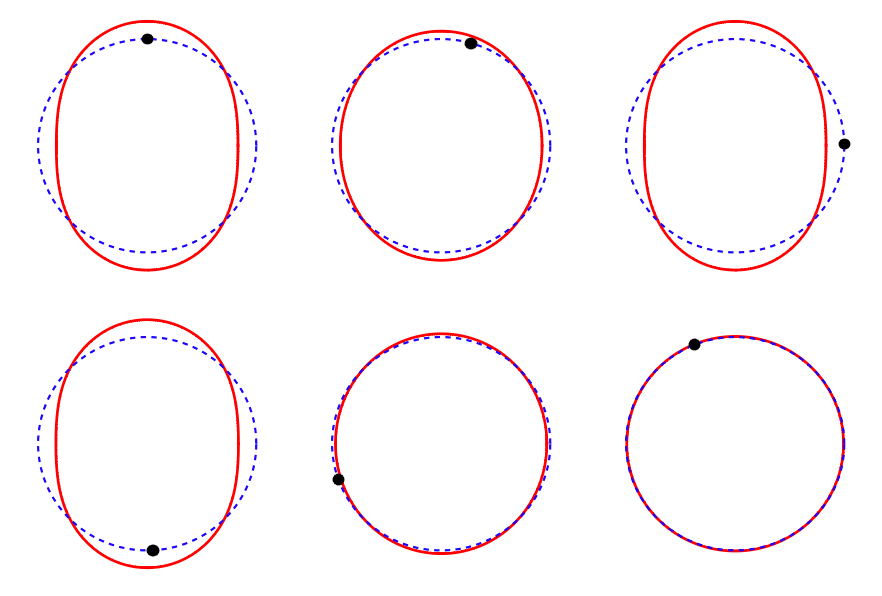
“The slickest one yet, Al. If you carefully tap the rim of a good wine glass it’ll vibrate like the red line here. The dotted blue circle’s the glass at rest. Under the right conditions inertia holds the planes of vibration steady even if the glass itself rotates. People have figured out how to use that principle to build extremely accurate. reliable and low‑maintenance gyroscopes for measuring and stabilizing rotations. JWST carries a set.”

“Nothing to lubricate, eh?”

Portrait of Léon Foucault from Wikimedia under Creative Commons Attribution 3.0 Unported license.

~~ Rich Olcott

Edged Things and Smooth Things

Yeughh, Sy, that whirling, the entire Universe spinning around me in every direction at once.”

“Well, you were at a point of spherical symmetry, Anne.”

“There’s that word ‘symmetryagain. Right side matches left side, what else is there to say?”

“A whole lot, especially after the mathematicians and physicists started playing with the basic notion.”

“Which is?”

“Being able to execute a transformation without making a relevant difference.”

“Relevant?”

“To the context. Swapping the king of spades for the king of hearts would be relevant in some card games but not others, right? If it doesn’t affect the play or the scoring, swapping those two when no‑one’s looking would be a legitimate symmetry operation. Spin a snowflake 60° and it looks the same unless you care exactly where each molecule is. That’s rotational symmetry, but there’s lots of geometric symmetry operations — reflections, inversions, glides, translations—”

“Translation is a symmetry operation?”

“In this connection, ‘translation‘ means movement or swapping between two different places in space. The idea came from crystals. Think of a 3D checkerboard, except the borderlines aren’t necessarily perpendicular. Perfect crystals are like that. Every cube‑ish cell contains essentially the same arrangement of atoms. In principle you could swap the contents of any two cells without making a difference in any of the crystal’s measurable properties. That’d be a translation symmetry operation.”

“Glides make me think of ice skating.”

“The glide operation makes me think of a chess knight’s move — a translation plus a reflection across the translation path. Think of wet footprints crossing a dry floor. That’s one example of combining operations to create additional symmetries. You can execute 48 unique symmetry operations on a cube even without the translation‑related ones. In my grad school’s crystallography class they taught us about point group and wallpaper and space group symmetries. It blew me away — beautiful in both mathematical and artistic senses. You’ve seen M C Escher’s art?”

“Of course, I love it. I pushed into his studio once to watch him work but he spotted me and shouted something Dutch at me. I’ve wondered what he thought when I pushed out of there.”

“His pieces drew heavily on geometric symmetries. So did Baroque art, music and architecture.”

“Music? Oh, yes — they had motifs and whole sections you could swap, and rhythm patterns and tunes you could read forwards and backwards like in a mirror… We’ve come a long way from snowflake symmetry, haven’t we?”

“We’re just getting started. Here’s where the Physics folks generalized the idea. Your unfortunate experience in space is right on the edge of what most people consider as symmetry. Were you impressed with the cube’s 48 operations?”

“I suppose. I haven’t had time to think about it.”

“A sphere has an infinite number. You could pick any of an infinite number of lines through its center. Each is an axis for an infinite number of rotational symmetries. Times two because there’s an inversion point at the center so the rotation could go in either direction. Then each line is embedded in an infinite number of reflection planes.”

“Goodness, no wonder I was dizzy. But it’s still geometry. What was the edge that the physicists went past?”

“The border between step‑at‑a‑time discrete symmetries and continuous ones. Rotate that snowflake 60° and you’ve got a match; anything not a multiple of 60° won’t pair things up. Across the border, some of the most important results in modern Physics depend on continuous symmetries.”

“How can you even have a continuous symmetry?”

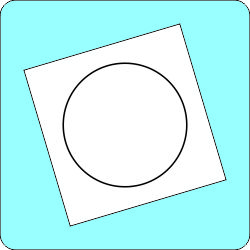
“Here, I’ll draw a circle on this square of paper. I can rotate the square by 90, 180 or 270 degrees and everything’s just the way it was. But if the square’s not relevant because we’re only interested in the circle, then I can rotate the paper by any amount I like and it’s a no‑difference transformation, right?”

“Continuous like on an infinite line but it’s wrapped around.”

“Exactly, and your infinite line is another example — any translation along that line, by a mile or a millimeter, is a perfectly good symmetry operation.”

“Ooo, and time, too. I experience time as an infinite line.”

“So does everyone. but most only travel in one direction.”

~~ Rich Olcott

Space Potatoes

“Uncle Sy, what’s the name of the Moon face that’s just a sliver?”

“It’s called a crescent, Teena, and it’s ‘phase,’ not ‘face’. Hear the z-sound?”

“Ah-hah, one of those spelling things, huh?”

“I’m afraid so. What brought that question up?”

“I was telling Bratty Brian about the Moon shadows and he said he saw a cartoon about something that punched a hole in the Moon and left just the sliver.”

“Not going to happen, Sweetie. Anything as big as the Moon, Mr Newton’s Law of Gravity says that it’ll be round, mostly, except for mountains and things.”

“Cause there’s something really heavy in the center?”

“No, and that’s probably what shocked people the most back in those days. They had Kings and Emperors, remember, and a Pope who led all the Christians in Europe. People expected everything to have some central figure in charge. That’s why they argued about whether the center of the Universe was the Earth or the Sun. Mr Newton showed that you don’t need anything at all at the center of things.”

“But then what pulls the things together?”

“The things themselves and the rules they follow. Remember the bird murmuration rules?”

“That was a long time ago, Uncle Sy. Umm… wasn’t one rule that each bird in the flock tries to stay about the same distance from all its neighbors?”

“Good memory. That was one of the rules. The others were to fly in the same general direction as everybody else and to try stay near the middle of the flock. Those three rules pretty much kept the whole flock together and protected most of the birds from predators. Mr Newton had simpler rules for rocks and things floating in space. His first rule was. ‘Keep going in the direction you’ve been going unless something pulls you in another direction.’ We call that inertia. The second rule explained why rocks fly differently than birds do.”

“Rocks don’t fly, Uncle Sy, they fall down.”

“Better to think of it as flying towards other things. Instead of the safe‑distance rule, Mr Newton said, ‘The closer two things are, the harder they pull together.’ Simple, huh?”

“Oh, like my magnet doggies.”

“Yes, exactly like that, except gravity always attracts. There’s no pushing away like magnets do when you turn one around. Suppose that back when the Solar System was being formed, two big rocks got close. What would happen?”

“They’d bang together.”

“And then?”

“They’d attract other rocks and more and more. Bangbangbangbang!”

“Right. What do you suppose happens to the energy from those bangs? Remember, we’re out in space so there’s no air to carry the sound waves away.”

“It’d break the rocks into smaller rocks. But the energy’s still there, just in smaller pieces, right?”

“The most broken-up energy is heat. What does that tell you?”

“The rock jumble must get … does it get hot enough to melt?”

“It can So now suppose there’s a blob of melted rock floating in space, and every atom in the melted rock is attracted to every other atom. Pretend you’re an atom out at one end of the blob.”

“I see as many atoms to one side as to the other so I’m gonna pull in towards the middle.”

“And so will all the other atoms. What shape is that going to make the blob?”

“Ooooh. Round like a planet. Or the Sun. Or the Moon!”

“So now tell me what would happen if someone punched a hole in the Moon?”

“All the crumbles at the crescent points would get pulled in towards the middle. It wouldn’t be a crescent any more!”

“Exactly. Mind you, if it doesn’t melt it may not be spherical. Melted stuff can only get round because molten atoms are free to move.”

“Are there not-round things in space?”

“Lots and lots. Small blobs couldn’t pull themselves spherical before freezing solid. They could be potato‑shaped, like the Martian moons Phobos and Deimos. Some rocks came together so gently that they didn’t melt. They just stuck together, like Asteroid Bennu where our OSIRIS-REx spacecraft sampled.”

“Space has surprising shapes, huh?”

“Space always surprises.”

~~ Rich Olcott

  • Thanks to Xander and Alex who asked the question.

Three Shades of Dark

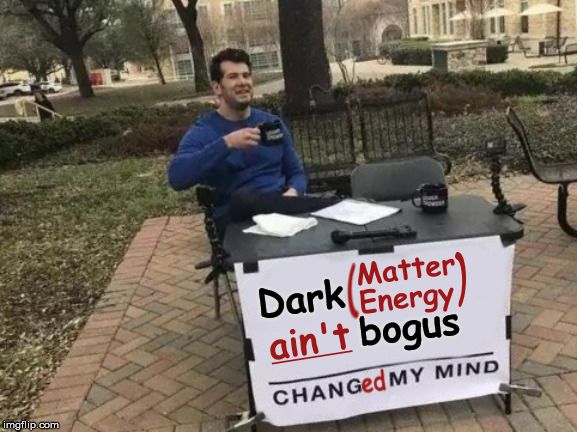
The guy’s got class, I’ll give him that. Astronomer-in-training Jim and Physicist-in-training Newt met his challenges so Change-me Charlie amiably updates his sign.

But he’s not done. “If dark matter’s a thing, how’s it different from dark energy? Mass and energy are the same thing, right, so dark energy’s gotta be just another kind of dark matter. Maybe dark energy’s what happens when real matter that fell into a black hole gets squeezed so hard its energy turns inside out.”

Jim and Newt just look at each other. Even Cap’n Mike’s boggled. Someone has to start somewhere so I speak up. “You’re comparing apples, cabbages and fruitcake. Yeah, all three are food except maybe for fruitcake, but they’re grossly different. Same thing for black holes, dark matter and dark energy — we can’t see any of them directly but they’re grossly different.”

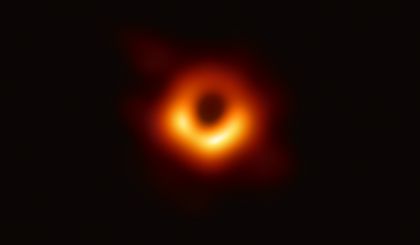
EHT's image of the black hole at the center of the Messier 87 galaxy
Black hole and accretion disk, image by the Event Horizon Telescope Collaboration

Vinnie’s been listening off to one side but black holes are one of his hobbies. “A black hole’s dark ’cause its singularity’s buried inside its event horizon. Whatever’s outside and somehow gets past the horizon is doomed to fall towards the singularity inside. The singularity itself might be burn-your-eyes bright but who knows, ’cause the photons’re trapped. The accretion disk is really the only lit-up thing showing in that new EHT picture. The black in the middle is the shadow of the horizon, not the hole.”

Jim picks up the tale. “Dark matter’s dark because it doesn’t care about electromagnetism and vice-versa. Light’s an electromagnetic wave — it starts when a charged particle wobbles and it finishes by wobbling another charged particle. Normal matter’s all charged particles — negative electrons and positive nuclei — so normal matter and light have a lot to say to each other. Dark matter, whatever it is, doesn’t have electrical charges so it doesn’t do light at all.”

“Couldn’t a black hole have dark matter in it?”

“From what little we know about dark matter or the inside of a black hole, I see no reason it couldn’t.”

“How about normal matter falls in and the squeezing cooks it, mashes the pluses and minuses together and that’s what makes dark matter?”

“Great idea with a few things wrong with it. The dark matter we’ve found mostly exists in enormous spherical shells surrounding normal-matter galaxies. Your compressed dark matter is in the wrong place. It can’t escape from the black hole’s gravity field, much less get all the way out to those shells. Even if it did escape, decompression would let it revert to normal matter. Besides, we know from element abundance data that there can’t ever have been enough normal matter in the Universe to account for all the dark matter.”

Newt’s been waiting for a chance to cut in. “Dark energy’s dark, too, but it works in the opposite direction from the other two. Gravity from normal matter, black holes or otherwise, pulls things together. So does gravity from dark matter which is how we even learned that it exists. Dark energy’s negative pressure pulls things apart.”

“Could dark energy pull apart a black hole or dark matter?”

Big Cap’n Mike barges in. “Depends on if dark matter’s particles. Particles are localized and if they’re small enough they do quantum stuff. If that’s what dark matter is, dark energy can move the particles apart. My theory is dark matter’s just ripples across large volumes of space so dark energy can change how dark matter’s spread around but it can’t break it into pieces.”

Vinnie stands up for his hobby. “Dark energy can move black holes around, heck it moves galaxies, but like Sy showed us with Old Reliable it’s way too weak to break up black holes. They’re here for the duration.”

Newt pops him one. “The duration of what?”

“Like, forever.”

“Sorry, Hawking showed that black holes evaporate. Really slowly and the big ones slower than the little ones and the temperature of the Universe has to cool down a bit more before that starts to get significant, but not even the black holes are forever.”

“How long we got?”

“Something like 10106 years.”

“That won’t be dark energy’s fault, though.”

~~ Rich Olcott