Elementary History

<chirp, chirp> “Moire here.”

“Hi, Sy, it’s Susan.”

“Well, hello. Good to hear from you. What’s up?”

“I’m out here on my back porch, fooling around on my laptop. It’s too nice to work in the lab today.”

“I agree with you. I’m outside, too, enjoying the Springtime. What’s your fooling around?”

“I found a discovery date list for all the chemical elements. Guess which element was the first that humanity worked with in pure form?”

“Mmm, I’d say carbon, in charcoal.”

“Nope, it’s copper.”

“Copper?”

“Mm-hm. Or maybe gold. They both occur as the raw metal but copper’s more common. There was a Copper Age before the Bronze age. The dates are fuzzy because they depend on what the archaeologists find after site scavengers have been there. I’m sending you the first few rows from the list.

Cumulative
Count
Element
(Symbol)
Atomic
number
Estimated
years ago
1Copper (Cu)2910000
2Lead (Pb)826000
3Carbon (C)65750
4Silver (Ag)475000
5Tin (Sn)505000
6Antimony (Sb)515000
7Gold (Au)794500
8Iron (Fe)264000
9Mercury (Hg)803500
10Sulfur (S)162500

“You can win most of them from the right ore with relatively simple processing. It makes sense they’re the ones we got to first.”
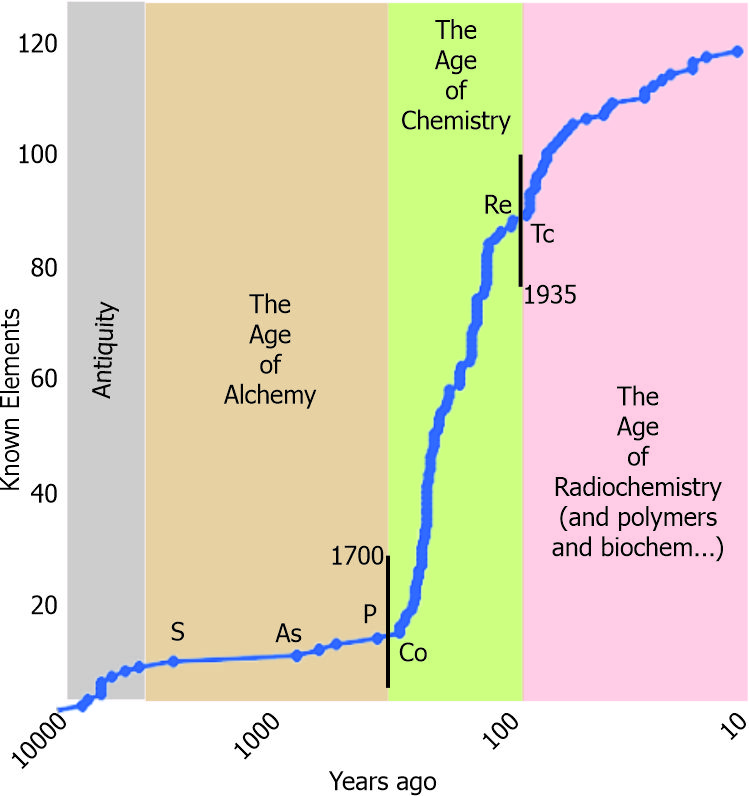
“Susan, I’m surprised it took a thousand years to realize you can get sulfur from cinnabar ore at the same time you’re cooking the mercury out of it. I wouldn’t want to be downwind from that process or most of the rest.”

“Sure not. I’ll bet there just wasn’t much interest in sulfur until the alchemists started playing with it. Anyhow, I dumped the element data into a spreadsheet and got some fun facts when I graphed it. Look at this. Eight thousand years for 10 elements through sulfur, then 1800 years of nothing. Arsenic doesn’t show up until the Thirteenth Century when I guess royalty started using it to poison each other. And phosphorus — have you read Neal Stephenson’s Baroque Cycle trilogy?”

“Yes, and I know the episode you’re thinking of, where the hero routed a gang at night by coating himself with glowing phosphorus and bursting out of a cave pretending to be a demon. Stephenson put a lot of words into describing how factories obtained mercury and phosphorus back then.”

“Stephenson puts a lot of words into most everything nerdy. That’s why I enjoy reading him. Oh-ho, now I know how you knew about cinnabar being the source for mercury.”

“Hey, Susan, I don’t only do Physics, but yeah, that was from another Baroque Cycle episode. … Looking at your graph here — things certainly took off at the start of the Eighteenth Century.”

“Yes, indeed. Seventy-four elements, everything that’s not radioactive plus a couple that are. I get a chuckle from cobalt being the first element in that wave after phosphorus. You know the story?”

“What story is that?”

“Seventeenth Century miners kept digging up nasty rocks that emitted poisonous gas when smelted along with the desirable copper and nickel ores. They called the bad stuff kobald Oren, German for ‘goblin ores.’ When a Swedish chemist finally purified the material he simply re-spelled the adjective and called the metal cobalt. I love the linkage with Stephenson’s fictional phosphorus-covered demon.”

“Cute. Why the break between rhenium and technitium?”

“That second wave after 1935 is all radioactives. Funny how the timing paralleled Seaborg’s research career even though he never got involved with technitium, the first artificially-produced element. Imagine being the discoverer of ten different elements.”

“Seaborg practically invented that funny bottom row of the Periodic Table, didn’t he?”

“Oh, yes. Not only did he discover or co-discover more than half of those elements, he was the one who proposed setting off the entire group as Actinides, in parallel with the Lanthanides above them. Oh, that reminds me, I meant to show you the other display I built. You’ve probably never seen one like this.”
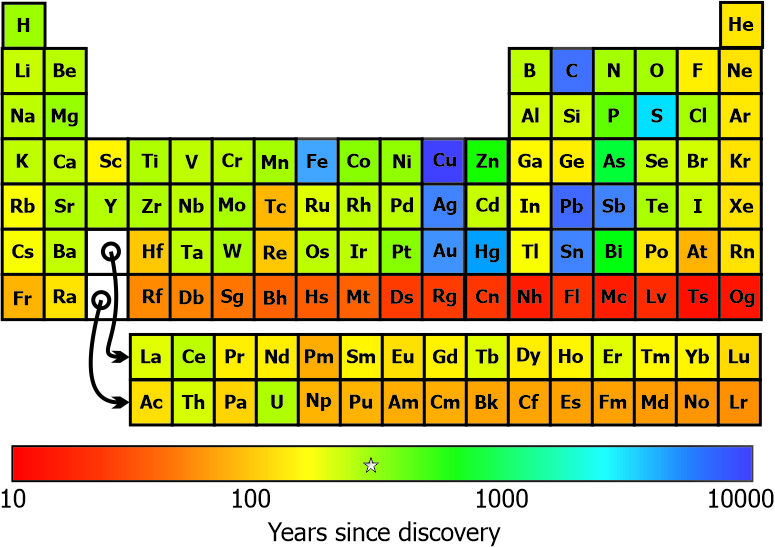
“Whoa, you’ve colored each element block by how long we’ve known about it. That’s not the kind of thing you can do with crayons.”

“No, I had to do some programming to get the right tints.”

“What’s the little star for in the middle of the scale?”

“That’s when Mendeleev first proposed the Table, smack in the logarithmic center of my timeline. Don’t you love it?”

~~ Rich Olcott

Getting over The Hill

“You guys want refills? You look like you’re gonna be here a while.”

“Yes, thanks, Al. Your lattes are sooo good. And can we have some more paper napkins?”

“Sure, but don’t let ’em blow away or nothin’, OK? I hate havin’ to pick up the place.”

“They’ll stay put. Just a half-cup of mud for me, thanks.”

The Spring breeze has picked up a little so we hitch our chairs closer together. Susan reaches for a paper napkin, draws a curve. “Here’s another pattern you haven’t featured yet, Sy. It’s in every chemist’s mind when they think about reactions.”

“OK, I suppose this is molecules A and B on one side of some sort of wall and molecule C on the other.”

“It’ll be clearer if I label the axes. It’s a reaction between A and B to make C. The horizontal axis isn’t a distance, it’s a measure of the reaction’s progress toward completion. Beginning molecules to the left, completed reaction to the right, transition in the middle, see? The vertical axis is energy. We say the reaction is energetically favored because C is lower than A and B separately.”

“Then what’s the wall?”

“We call it the barrier. It’s some additional dollop of energy that allows the reaction happen. Maybe A or B have to be reconfigured before they can form an A~B transition state. That’s common in carbon chemistry, for instance. Carbon usually has four bonds, but you can get five‑bonded transition states. They usually don’t last very long, though.”

“Right, carbon and its neighbors prefer the tetrahedral shape. Five‑bonded carbon distorts the stable electron clouds. Heat energy shoves things into position, I suppose.”

“Often but hardly always. Especially for large molecules, heat’s more likely to jostle things out of position than put them together. That’s what cooking does.”

“The curve reminds me of particle accelerator physics, except it takes way more energy to overcome nuclear forces when you mash sub‑atomic thingies together.”

“Oh, yes, very similar in terms of that general picture — except that the C side could be multiple emitted particles.”

“So your sketch covers a processes everywhere, not just Chemistry. They all have different barrier profiles, then?”

“Of course. My drawing was just to give you the idea. Some barriers are high, some are low, either side may rise or fall exponentially or by some power of the distance, some are lumpy, it all depends. Some are even flat.”

“Flat, like no resistance at all?”

“Oh, yes. Hypergolic rocket fuel pairs ignite spontaneously when they mix. Water and alkali metals make flames — have you seen that video of metallic sodium dumped into a lake and exploding like mad? Awesome!”

“I can imagine, or maybe not. If heat energy doesn’t get molecules over that barrier, what does?”

“Catalysts, mostly. Some do their thing by capturing the reactants in adjacent sites, maybe doing a little geometry jiggling while they’re at it. Some play games with the electron states of one or both reactants. Anyhow, what they accomplish is speeding up a reaction by replacing the original barrier with one or more lower ones.”

“Wait, reaction speed depends on the barrier height? I’d expect either go or no‑go.”

“No, it’s usually more complicated than that. Umm … visualize tossing a Slinky toy into the air. Your toss gives it energy. Part of the energy goes into lifting it against Earth’s gravity, part into spinning motion and part into crazy wiggles and jangling, right? But if you toss just right, maybe half of the energy goes into just stretching it out. Now suppose there’s a weak spot somewhere along the spring. Most of your tosses won’t mess with the spot, but a pure stretch toss might have enough energy to break it apart.”

“Gotcha, the transition barrier might be a probability thing depending on how the energy’s distributed within A and B. Betcha tunneling can play a part, too.”

“Mm? Oh, of course, you’re a Physics guy so you know quantum. Yes, some reactions depend upon electrons or hydrogen atoms tunneling through a barrier, but hardly ever anything larger than that. Whoops, I’m due back at the lab. See ya.”

<inaudible> “Oh, I hope so.”

~~ Rich Olcott

The Edge of Pinkness

Susan Kim takes a sip of her mocha latte. eyes me over the rim. “That’s quite a set of patterns you’ve gathered together, Sy, but you’ve left out a few important ones.”

“Patterns?”

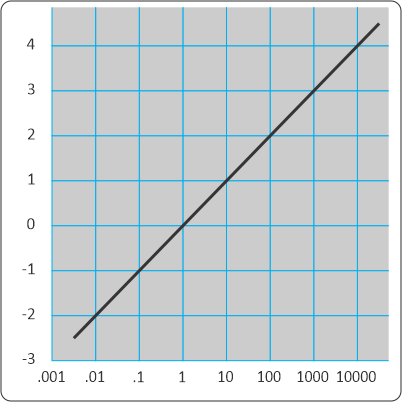
A log-linear plot

“Regularities we’ve discovered in Nature. You’ve written about linear and exponential growth, the Logistic Curve that describes density‑limited growth, sine waves that wobble up and down, maybe a couple of others down‑stack, but Chemistry has a couple I haven’t seen featured in your blog.”

“Such as?”

“Log-linear relationships are a biggie. We techies use them a lot to handle phenomena with a wide range. Rather than write 1,000,000,000 or 109, we sometimes just write 9, the base‑10 logarithm. The pH scale for acid concentration is my favorite example. It goes from one mole per liter down to ten micro‑nanomoles per liter. That’s 100 to 10-14. We just drop the minus sign and use numbers between 0 and 14. Fifteen powers of ten. Does Physics have any measurements that cover a range like that?”

“A handful, maybe, in theory. The limitation is in confirming the theory across a billion-fold range or wider. Atomic clocks that are good down to the nanosecond are our standards for precision, but they aren’t set up to count years. Mmmm … the Stefan‑Boltzmann Law that links an object’s electromagnetic radiation curve to its temperature — our measurements cover maybe six or seven powers of ten and that’s considered pretty good.”

“Pikers.” <but I like the way she grins when she says it>

“I took those Chemistry labs long ago. All I remember was acids were colorless and bases were pink. Or maybe the other way around.”

“You’ve got it right for the classic phenolphthalein indicator, but there are dozens of other indicators that have different colors at different acidities. I’ll tell you a secret — phenolphthalein doesn’t kick over right at pH 7, the neutral point. It doesn’t turn pink until the solution’s about ten times less acidic, near pH 8.”

Adapted from this file by Damitr, CC BY-SA 4.0

“So all my titrations were off by a factor of ten?”

“Oh, no, that’s not how it works. I’m going to use round numbers here, and I’ll skip a couple of things like the distinction between concentration and activity. Student lab exercises generally use acid and base concentrations on the order of one molar. For most organic acids, that’d give a starting pH near 1 or 2, way over on the sour side. In your titration you’d add base, drop by drop, until the indicator flips color. At that point you conclude the amounts of acid and base are equivalent, not by weight but by moles. If you know the base concentration you can calculate the acid.”

“That’s about what I recall, right.”

“Now consider that last drop. One drop is about 50 microliters. With a one‑molar base solution, that drop holds 50 nanomoles. OK?”

<I scribble on a paper napkin> “Mm-hm, that looks right.”

“Suppose there’s about 50 milliliters of solution in the flask. Because we’re considering the last drop, the solution in the flask must have become nearly neutral, say pH 6. That means the un‑neutralized acid concentration was 10-6 moles per liter, or one micromolar. Fifty milliliters at one micromolar concentration is, guess what, 50 nanomoles. Your final drop neutralizes the last of the acid sample.”

“So the acid concentration goes to zero?”

“Water’s not that cooperative. Water molecules themselves act like acids and bases. An H2O molecule can snag a hydrogen from another H2O giving an H3O+ and an OH. Doesn’t happen often, but with 55½ moles of water per liter and 6×10²³ molecules per mole there’s always a few of those guys hanging around. Neutral water runs 10-7 moles per liter of each, which is why neutral pH is 7. Better yet, the product of H3O+ and OH concentrations is always 10-14 so if you find one you can calculate the other. Take our titration for example. One additional drop adds 50 nanomoles more base. In 50 milliliters of solution that’s roughly 10-6+10-7 molar OH. Call it 1.1×10⁻⁶, which implies 0.9×10⁻⁸ molar H3O+. Log of that and drop the minus sign, you’re a bit beyond pH 8 which sends phenolphthalein into the pink side. Your titration’s good.”

I eye her over my mug of black mud. “A gratifying indication.”

~~ Rich Olcott

The Latte Connection

An early taste of Spring’s in the air so Al’s set out tables in front of his coffee shop. I’m enjoying my usual black mud when the Chemistry Department’s Susan Kim passes by carrying her usual mocha latte. “Hi, Sy, mind if I take the socially distant chair at your table?”

“Be my guest, Susan. What’s going on in your world?”

“I’ve been enjoying your hysteresis series. It took me back to Physical Chemistry class. I’m intrigued by how you connected it to entropy.”

“How so?”

“I think of hysteresis as a process, but entropy is a fixed property of matter. If I’m holding twelve grams of carbon at room temperature, I know what its entropy is.”

“Mmm, sorta. Doesn’t it make a difference whether the carbon’s a 60‑carat diamond or just a pile of soot?”

“OK, I’ll give you that, the soot’s a lot more random than the diamond so its entropy is higher. The point remains, I could in principle measure a soot sample’s heat capacity at some convenient temperature and divide that by the temperature. I could repeat that at lower and lower temperatures down to near absolute zero. When I sum all those measurements I’ll have the entropy content of the sample at my starting temperature.”

“A classical definition, just what I’d expect from a chemist. But suppose your soot spills out of its test tube and the breeze spreads it all over the neighborhood. More randomness, higher entropy than what you measured, right?”

“Well, yes. I wouldn’t have a clue how to calculate it, but that goes way beyond Carnot’s and Clausius’ original concept.”

“So entropy has at least a thin linkage with history and hysteresis. To you chemists, though, an element or compound is timeless — lead or water have always been lead or water, and their physical constants are, well, constant.”

“Not quite true, Sy. Not with really big molecules like proteins and DNA and rubber and some plastics. Squirt a huge protein like catalase through a small orifice and its properties change drastically. It might not promote any reaction, much less the one Nature designed it for. Which makes me think — Chemistry is all about reactions and they take time and studying what makes reactions run fast or slow is a big part of the field. So we do pay attention to time.”

“Nice play, Susan! You’re saying small molecules aren’t complex enough to retain memories but big ones are. I’ll bet big molecules probably exhibit hysteresis.”

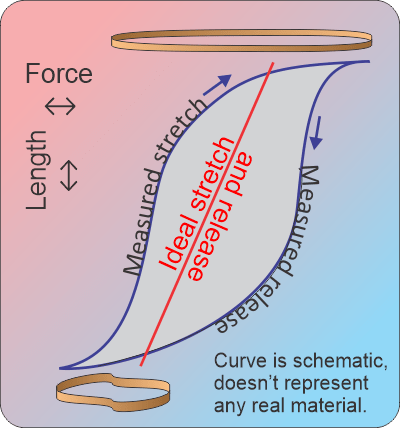
“Sure they do. Rubber molecules are long-chain polymers. Quickly stretch a rubber band to its limit, hold it there a few seconds then let go. Some of the molecular strands lock into the stretched configuration so the band won’t immediately shrink all the way down to its original size. There’s your molecular memory.”

“And a good example it is — classic linear Physics. How much force you exert, times the distance you applied it through, equals the energy you expended. Energy’s stored in the rubber’s elasticity when you stretch it, and the energy comes back out on release.”

“Mostly right, Sy. You actually have to put in more energy than you get out — Second Law of Thermodynamics, of course — and the relationship’s not linear. <rummaging into purse> Thought I had a good fat rubber band somewhere … ah‑hah! Here, stretch this out while you hold it against your forehead. Feel it heat up briefly? Now keep checking for heat while you relax the band.”

“Hey, it got cold for a second!”

“Yep. The stretched-out configuration is less random so its entropy and heat capacity are lower than the relaxed configuration’s. The stretched band had the same amount of heat energy but with less heat required per degree of temperature, that amount of energy made the band hotter. Relaxing the band let its molecules get less orderly. Heat capacity went back up. temperature went back down.”

“Mmm-HM. My hysteresis diagram’s upward branch is stretch energy input and the downward branch is elastic energy output. The energy difference is the area inside the hysteresis curve, which is what’s lost to entropy in each cycle and there we have your intriguing entropy‑hysteresis connection. Still intrigued?”

“Enough for another latte.”

~~ Rich Olcott

Only a H2 in A Gilded Cage

“OK, Susan, you’ve led us through doing high-pressure experiments with the Diamond Anvil Cell and you’ve talked about superconductivity and supermagnetism. How do they play together?”

“It’s early days yet, Sy, but Dias and a couple of other research groups may have brought us a new kind of superconductivity.”

“Another? You talked like there’s only one.”

“It’s one of those ‘depends on how you look at it‘ things, Al. We’ve got ‘conventional‘ superconductors and then there are the others. The conventional ones — elements like mercury or lead, alloys like vanadium‑silicon — are the model we’ve had for a century. Their critical temperatures are generally below 30 kelvins, really cold. We have a 60‑year‑old Nobel‑winning theory called ‘BCS‘ that’s so good it essentially defines conventional superconductivity. BCS theory is based on quantum‑entangled valence electrons.”

“So I guess the unconventional ones aren’t like that, huh?”

“Actually, there seem to be several groups of unconventionals, none of which quite fit the BCS theory. Most of the groups have critical temperatures way above what BCS says should be the upper limit. There are iron‑based and heavy‑metals‑based groups that use non‑valence electrons. There are a couple of different carbon‑based preparations that are just mystical. There’s a crazy collection of copper oxide ceramics that can contain five or more elements. Researchers have come up with theories for each of them, but the theories aren’t predictive — they don’t give dependable optimization guidelines.”

“Then how do they know how to make one of these?”

“Old motto — ‘Intuition guided by experience.’ There are so many variables in these complex systems — add how much of each ingredient, cook for how long at what temperature and pressure, chill the mix quickly or anneal it slowly, bathe it in an electrical or magnetic field and if so, how strong and at what point in the process… Other chemists refer to the whole enterprise as witch’s‑brew chemistry. But the researchers do find the occasional acorn in the grass.”

“I guess the high‑pressure ploy is just another variable then?”

“It’s a little less random than that, Sy. If you make two samples of a conventional superconductor, using different isotopes of the same element, the sample with the lighter isotope has the higher critical temperature. That’s part of the evidence for BCS theory, which says that electrons get entangled when they interact with vibrations in a superconductor. At a given temperature light atoms vibrate at higher frequency than heavy ones so there’s more opportunity for entanglement to get started . That set some researchers thinking, ‘We’d get the highest‑frequency vibrations from the lightest atom, hydrogen. Let’s pack hydrogens to high density and see what happens.'”

“Sounds like a great idea, Susan.”

“Indeed, Al, but not an easy one to achieve. Solid metallic hydrogen should be the perfect case. Dias and his group reported on a sample of metallic hydrogen a couple of years ago but they couldn’t tell if it was solid or liquid. This was at 5 megabars pressure and their diamonds broke before they could finish working up the sample. Recent work has aimed at using other elements to produce a ‘hydrogen‑rich’ environment. When Dias tested H2S at 1.5 megabar pressure, they found superconductivity at 203 kelvins. Knocked everyone’s socks off.”

“Gold rush! Just squeeze and chill every hydrogen‑rich compound you can get hold of.”

“It’s a little more complicated than that, Sy. Extreme pressures can force weird chemistry. Dias reported that shining a green laser on a pressurized mix of hydrogen gas with powdered sulfur and carbon gave them a clear crystalline material whose critical temperature was 287 kelvins. Wow! A winner, for sure, but who knows what the stuff is? Another example — the H2S that Dias loaded into the DAC became H3S under pressure.”

“Wait, three hydrogens per sulfur? But the valency rules—”

“I know, Sy, the rules say two per sulfur. Under pressure, though, you get one unattached molecule of H2 crammed into the space inside a cage of H2S molecules. It’s called a clathrate or guest‑host structure. The final formula is H2(H2S)2 or H3S. Weird, huh? Really loads in the hydrogen, though.”

“Jupiter has a humungous magnetic field and deep‑down it’s got high‑density hydrogen, probably metallic. Hmmm….”

~~ Rich Olcott

Futile? Nope, Just Zero

“Megabar superconductivity.”

“Whoa, Susan. Too much information, too few words. Could you unpack that, please?”

“No problem, Sy. A bar is the barometric pressure (get it?) at sea level. A megabar is—”

“A million atmospheres, right?”

“Right, Al. So Ranga Dias and his crew were using their Diamond Anvil Cells to put their chemical samples under million-atmosphere pressures while they tested for superconductivity—”

“Like Superman uses?”

“Is he always like this, Sy?”

“Just when he gets excited, Susan. The guy loves Science, what can I say?”

“Sorry, Susan. So what makes conductivity into superconductivity?”

“Excellent question, Al. Answering it generated several Nobel Prizes and we still don’t have a complete explanation. I can tell you the what but I can’t give you a firm why. Mmm… what do you know about electrical resistance?”

“Just what we got in High School General Science. We built a circuit with a battery and a switch and an unknown resistor and a meter to measure the current. We figured the resistance from the voltage divided by the current. Or maybe the other way around.”

“You got it right the first try. The voltage drop across a resistor is the current times the resistance, V=IR so V/I=R. That’s for ordinary materials under ordinary conditions. But early last century researchers found that for many materials, if you get them cold enough the resistance is zero.”

“Zero? But … if you put any voltage across something like that it could swallow an infinite amount of current.”

“Whoa, Al, what’s my motto about infinities?”

“Oh yeah, Sy. ‘If your theory contains an infinity, you’ve left out physics that would stop that.’ So what’d stop an infinite current here?”

“The resistor wasn’t the only element in your experimental circuit. Internal resistance within the battery and meter would limit the current. Those 20th-century researchers had to use some clever techniques to measure what they had. Back to you, Susan.”

“Thanks, Sy. I’m going to remember that motto. Bottom line, Al, superconductors have zero resistance but only under the right conditions. You start with your test material, with a reasonable resistance at some reasonable temperature, and then keep measuring its resistance as you slowly chill it. If it’s willing to superconduct, at some critical temperature you see the resistance abruptly drop straight down to zero. The critical temperature varies with different materials. The weird thing is, once the materials are below their personal critical temperature all superconductors behave the same way. It’s seems to be all about the electrons and they don’t care what kind of atom they rode in on.”

“Wouldn’t copper superconduct better than iron?”

“Oddly enough, pure copper doesn’t superconduct at all. Iron and lead both superconduct and so do some weird copper-containing oxides. Oh, and superconductivity has another funny dependency — it’s blocked by strong magnetic fields, but on the other hand it blocks out weaker ones. Under normal conditions, a magnetic field can penetrate deep into most materials. However, a superconducting piece of material completely repels the field, forces the magnetic lines to go around it. That’s called the Meissner effect and it’s quantum and—”

“How’s it work?”

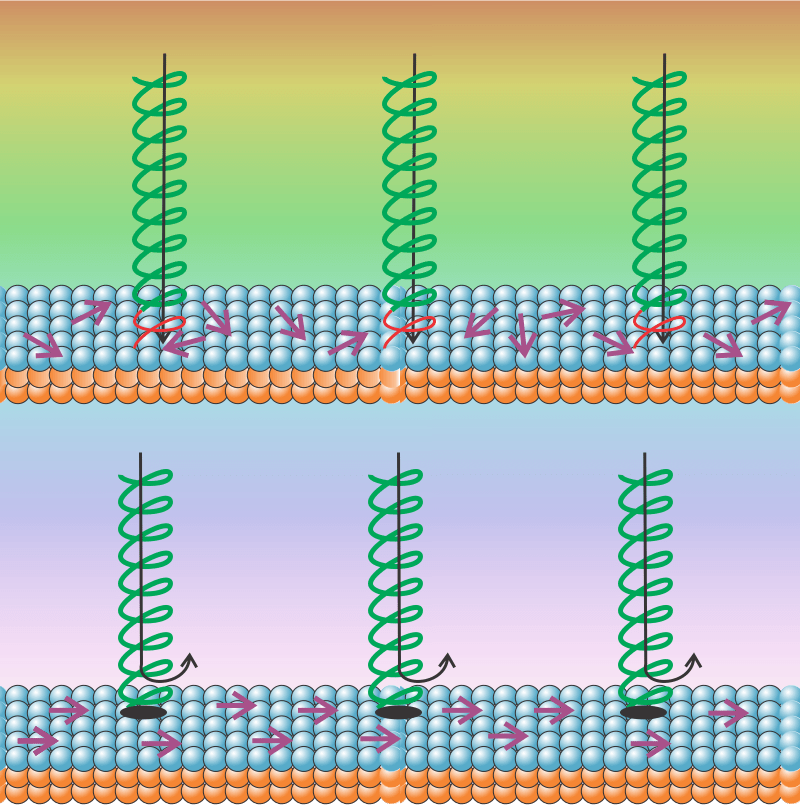
“Even though we’ve got a good theory for the materials with low critical temperature, the copper oxides and such are still a puzzle. Here’s a diagram I built for one of my classes…”

“The top half is the ordinary situation, like in a copper wire. Most of the current is carried by electrons near the surface, but there’s a lot of random motion there, electrons bouncing off of impurities and crystal defects and boundaries. That’s where ordinary conduction’s resistance comes from. Compare that with the diagram’s bottom half, a seriously simplified view of superconduction. Here the electrons act like soldiers on parade, all quantum‑entangled with each other and moving as one big unit.”

“The green spirals?”

“They represent an imposed magnetic field. See the red bits diving into the ordinary conductor? But the superconducting parade doesn’t make space for the circular motion that magnetism tries to impose. The force lines just bounce off. Fun fact — the supercurrent itself generates a huge magnetic field but only outside the superconductor.”

“How ’bout that? So how is megabar superconductivity different?”

~~ Rich Olcott

Diamonds in The Tough

“Excuse me, they said there’s a coffee shop over here somewhere. Could you please point me to it?”

“Sure. Al’s place is right around the next corner, behind the Physics building. I’ll walk you over there.”

“Oh, I don’t want to bother you.”

“No bother, it’s my coffee time anyway. Hi, Al, new customer for you.”

“Hi, Sy. What’ll it be, Ms … ?”

“I’m Susan, Susan Kim. A mocha latte, please, Al. And you’re Sy …?”

“Moire. Sy Moire, Consulting Physicist. Who’s the ‘they’ that told you about Al’s?”

“An office staffer in the Chemistry Department. I just joined the research faculty over there.”

Al’s ears perk up. “A chemist, at last! For some reason they don’t show up over here very much.”

“Hah, I bet it’s because they’re used to drinking lab coffee from beakers.”

“As a matter of fact, Sy, I do have a coffee beaker. A glass‑worker friend added a very nice handle to a 500‑milliliter beaker for me. It’s not unpacked yet which is why I was looking for a coffee shop. This latte is very good, Al, better than lab coffee any day.”

“Thanks. So what’s the news in Science, guys?”

“Mmm… On Mars, the Insight mission‘s ‘mole’ thermal probe has finally buried itself completely, on its way down we hope to its targeted 5‑meter depth. And the OSIRIS‑REx mission to Asteroid Bennu successfully collected maybe a little too much asteroid sample. One rock fragment blocked the sampler’s lid like a bit of souvenir sticking out of a tourist’s carry‑on bag. Fortunately the engineers figured out how to stow the stuff more neatly for the two‑year trip back home. How about in the Chemistry world, Susan?”

“Hmm… Ranga Dias and his team at the University of Rochester used a diamond anvil cell to—”

“Wait — a diamond anvil? Like the Village Blacksmith but made of diamond?”

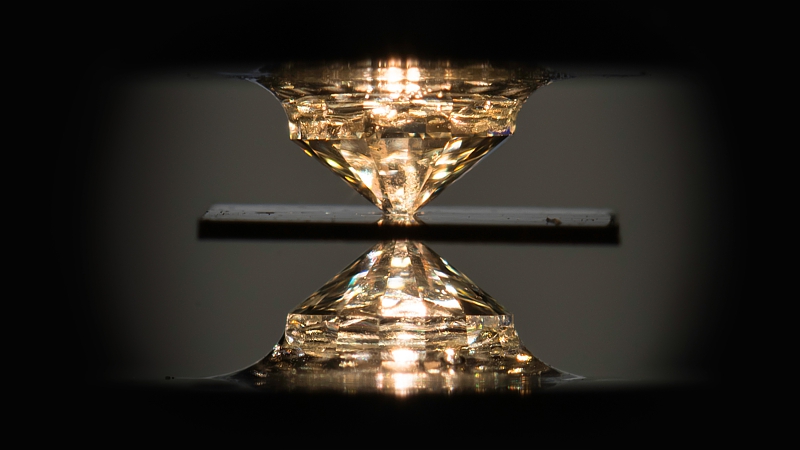
“No, Al, nothing like that. Diamond is the hardest substance we know of, right? A DAC uses a pair of quarter‑carat gem‑quality diamonds pushing against each other to create a small volume of crazy high pressure in the space between them, up into the million‑atmosphere range. Here, I’ve got a gorgeous photo of one on my phone…

Diamond anvil cell, photo by J. Adam Fenster / University of Rochester

“To give you an idea of the scale, that square black gasket between the two diamonds is a piece of rhenium metal foil that’s a quarter of a millimeter thick. The reaction vessel itself is a hole they spark-drilled through the gasket. This is teeny, nanoliter chemistry.”

“OK, they’re small diamonds, but .. DIAMONDS! I bet they crack some of them. That’s got to be ex‑PENsive, our tax dollars going CRUNCH!.”

“Not really. You’re right, some do crack, up around the seven million atmosphere mark. But here’s the fun part — the researchers don’t pay market price for those diamonds. They come from the government’s stock of smuggled goods that Customs agents have confiscated at the border.”

“Why go to all that trouble? What’s wrong with test tubes and beakers?”

“Because not all chemistry takes place at atmospheric pressure, Sy. High pressure crams molecules closer together. They get in each other’s way, maybe deform each other enough to react in ways that they wouldn’t under conditions we’d call ‘normal.’ Even water has something like 17 different forms of ice under different pressure‑temperature conditions. The whole discipline of high‑pressure chemistry got started because the seismologists needed to know how minerals transform, melt, flow and react under stress. The thing about diamond is that it doesn’t transform, melt, flow or react.”

“Oo, oo, you can see through a diamond, sorta. I’ll betcha people pipe laser beams down them, right?”

“Absolutely, Al. Before lasers came along researchers were using regular light and optics to track events in a pressurized DAC. Lasers and fiber optics completely changed the game. Not just for observation — you can use intense light to heat things up, get them even closer to deep‑Earth conditions.”

“I suppose chemists are like physicists — once a new tool becomes available everybody dives in to play.”

“You know it. There’s thousands of papers out there detailing work that used a DAC.”

“So what did Dias report on?”

~~ Rich Olcott