Atoms are solar systems? Um, no…

Suddenly there’s a hubbub of girlish voices to one side of the crowd.  “Go on, Jeremy, get up there.”  “Yeah, Jeremy, your theory’s no crazier than theirs.”  “Do it, Jeremy.”

Sure enough, the kid’s here with some of his groupies.  Don’t know how he does it.  He’s a lot younger than the grad students who generally present at these contests, but he’s got guts and he grabs the mic.

“OK, here’s my Crazy Theory.  The Solar System has eight planets going around the Sun, and an oxygen atom has eight electrons going around the nucleus.  Maybe we’re living in an oxygen atom in some humongous Universe, and maybe there are people living on the electrons in our oxygen atoms or whatever.  Maybe the Galaxy is like some huge molecule.  Think about living on an electron in a uranium atom with 91 other planets in the same solar system and what happens when the nucleus fissions.  Would that be like a nova?”

There’s a hush because no-one knows where to start, then Cathleen’s voice comes from the back of the room.  Of course she’s here — some of the Crazy Theory contest ring-leaders are her Astronomy students.  “Congratulations, Jeremy, you’ve joined the Honorable Legion of Planetary Atom Theorists.  Is there anyone in the room who hasn’t played with the idea at some time?”

No-one raises a hand except a couple of Jeremy’s groupies.

“See, Jeremy, you’re in good company.  But there are a few problems with the idea.  I’ll start off with some astronomical issues and then the physicists can throw in some more.  First, stars going nova collapse, they don’t fission.  Second, compared to the outermost planet in the Solar System, how far is it from the Sun to the nearest star?”

A different groupie raises her hand and a calculator.  “Neptune’s about 4 light-hours from the Sun and Alpha Centauri’s a little over 4 light-years, so that would be … the 4’s cancel, 24 hours times 365 … about 8760 times further away than Neptune.”

“Nicely done.  That’s a typical star-to-star distance within the disk and away from the central bulge.  Now, how far apart are the atoms in a molecule?”

“Aren’t they pretty much touching?  That’s a lot closer than 8760 times the distance.”

“Yes, indeed, Jeremy.  Anyone else with an objection?  Ah, Maria.  Go ahead.”

“Yes, ma’am.  All electrons have exactly the same properties, ¿yes? but different planets, they have different properties.  Jupiter is much, much heavier than Earth or Mercury.”

Astrophysicist-in-training Jim speaks up.  “Different force laws.  Solar systems are held together by gravity but at this level atoms are held together by electromagnetic forces.”

“Carry that a step further, Jim.  What does that say about the geometry?”

“Gravity’s always attractive.  The planets are attracted to the Sun but they’re also attracted to each other.  That’ll tend to pull them all into the same plane and you’ll get a flat disk, mostly.  In an atom, though, the electrons or at least the charge centers repel each other — four starting at the corners of a square would push two out of the plane to form a tetrahedron, and so forth.  That’s leaving aside electron spin.  Anyhow, the electronic charge will be three-dimensional around the nucleus, not planar.  Do you want me to go into what a magnetic field would do?”

“No, I think the point’s been made.  Would someone from the Physics side care to chime in?”

“Synchrotron radiation.”

“Good one.  And you are …?”

“Newt Barnes.  I’m one of Dr Hanneken’s students.”

“Care to explain?”

“Sure.  Assume a hydrogen atom is a little solar system with one electron in orbit around the nucleus.  Any time a charge moves it radiates waves into the electromagnetic field.  The waves carry forces that can compel other charged objects to move.  The distance an object moves, times the force exerted, equals the amount of energy expended by the wave.  Therefore the wave must carry energy and that energy must have come from the electron’s motion.  After a while the electron runs out of kinetic energy and falls into the nucleus.  That doesn’t actually happen, so the atom’s not a solar system.”

Jeremy gets general applause when he waves submission, then the crowd’s chant resumes…

.——<“Amanda! Amanda! Amanda!”>Bohr and Bohr atom

~~ Rich Olcott

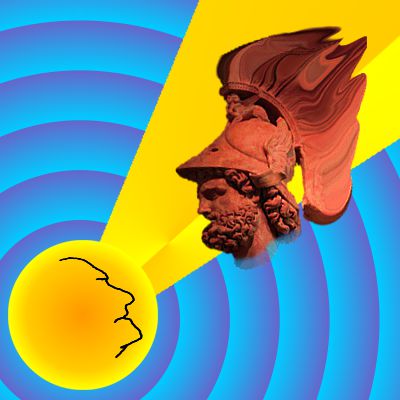
Helios versus Mars, Planetary Version

Al waves me over the moment I step through the door of his coffee shop.  “Sy, ya gotta squeeze into the back room.  The grad students are holding another Crazy Theory contest and they’re having a blast.  I don’t know enough science to keep up with ’em but you’d love it.  Here’s your coffee.”

“Thanks, Al.  I’ll see what’s going on.”

The Crazy Theory contest is a hallowed Al’s Coffee Shop tradition — a “seminar” where grad students present their weirdest ideas in competition.  Another tradition (Al is strong on this one) is that the night’s winner has to sweep up the thrown spitballs and crumpled paper napkins at the end of the presentations.  I weave my way in just as the girl at the mic finishes her pitch with, “… and that’s why Spock and horseshoe crabs both have green blood!”

Some in the crowd start chanting “Amanda!  Amanda!  Amanda!”  She’s already reaching for the Ceremonial Broom when Jim steps up to the mic and waves for quiet.  “Wanna hear how the Sun oxidized Mars and poisoned it for us?”

Helios and Mars
Helios and Mars
Mars image adopted from photo by Mark Cartwright
Creative Commons license
Attribution-NonCommercial-ShareAlike

Voice from the crowd — <“The Sun did what?”>

“You remember titration from school chem lab?”

.——<“Yeah, you put acid in a beaker and you drip in a base until the solution starts to turn red.”>

“What color is Mars?”

.——<“Red!”>

“Well, there you are.”

.——<“Horse-hockey!  What’s that got to do with the Sun or what you said about poison?”>

“Look at what our rovers and orbiters found on Mars — atmosphere only 1% of Earth’s but even that’s mostly CO2, no liquid water at the surface, rust-dust everywhere, soil’s loaded with perchlorate salts.  My Crazy Theory can explain all of that.”

.——<“Awright, let’s hear it!”>

“Titration’s all about counting out chemical species.  Your acid-base indicator pinked when you’d neutralized your sample’s H+ ions by adding exactly the right number of OH– ions to turn them all into H2O, right?  So think about Mars back in the day when it had liquid water on the ground and water vapor in the atmosphere.  Along comes solar radiation, especially the hard ultra-violet that blows apart stratospheric H2O molecules.  ZOT!  Suddenly you’ve got two free hydrogen atoms and an oxygen floating around.  Then what happens?”

It’s a tough crowd.  <“We’re dying to hear!  Get on with it!”>

“The hydrogens tie up as an H2 molecule.  The escape velocity on Mars is well below the speed of H2 molecules at any temperature above 40K, so those guys abandon Mars for the freedom of Space.  Which leaves the oxygen atom behind, hungry for electrons and ready to oxidize anything it can get close to.”

They’re starting to come along.  <“Wouldn’t the oxygen form O2 and fly away too?”>

“Nowhere near as quickly.  An O2 molecule is 16 times heavier than an H2 molecule.  At a given temperature it moves 1/4 as fast and mostly stays on-planet where it can chew up the landscape.”

.——<“How could an atom do that?”>

“It’s a chain process.  First step for the O is to react with something else in the atmosphere — make an oxidizing molecule like ozone or hydrogen peroxide.  That diffuses down to ground level where it can eat rocks.”

.——<“Wait, ‘eat rocks’!!?!  How does that happen?”>

“Look, most rocks are basically lattices of double-negative oxide ions with positive metal ions tucked in between to balance the charge.  Surface oxide ions can’t be oxidized by an ozone molecule, but they can transmit electron demand down to the metal ions immediately underneath.  An iron2+ ion gets oxidized to iron3+, one big step towards rust-dust.  The charge change disrupts the existing oxide lattice pattern and that piece of the rock erodes a little.”

.——<“What about the poison?”>

“Back when Mars had oceans, they had to have lots of chloride ions floating around to be left behind when the ocean dried up.  Ozone converts chloride to perchlorate, ClO4–, which is also a pretty good oxidizer.  Worse, it’s the right size and charge to sneak into your thyroid gland and mess it up.  Poison for sure.  Chemically, solar radiation raised the oxidation state of the whole planet.”

One lonely voice — “Nice try, Jim” — but then the chant returns…

.——<“Amanda!  Amanda!  Amanda!”>

~~ Rich Olcott
Goldilocks Zone and The Three Gazillion Bears

“Tell me a bedtime story, Uncle Sy.”

“OK, Teena, what kind of story?”

“One with bears in it.  Nice bears.”

“Hmm…  How about ‘Goldilocks Zone and The Three Gazillion Bears’?”

“Gazillion?  Is that what kind of a bear they are?”

“No, that’s a number word.  It means ‘more than you could ever hope to count.’  Like a million but way way more.”

“But if you can’t count them, how do you know there are three times that many?”

“You’ll see, have patience.”

“Little girls don’t have patience, Uncle Sy, I wanna hear the story.  Wait, water bears?”

“Mm-hm, they’re a different kind of bear.”

“What’s different about them, and what do they do with water?  I bet they swim.”

“Why yes, they do.  In fact, they spend most of their time in water or at least being wet.  Another thing that’s special about them is that they’re tiny, about the size of the smallest dot you can see on your Mommy’s computer screen here.”
waterbear 1“If they’re so small, why are they called bears?”

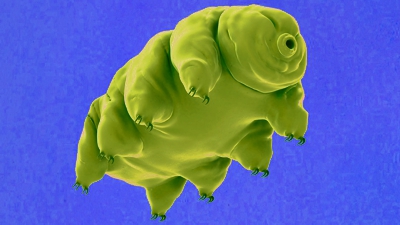
“Take a look.  Doesn’t she look kind of like a nice bear?”

“She’s got too many legs.”

“She’s got just the right number for water bears.”

“And she’s green.”

“Well, yes, but the picture’s kind of pretend and doesn’t show proper colors.  She’s so small she’s almost transparent.  She eats particles of algae and such, so maybe in real life she might be sort of green.”

“I like the way she’s smiling.  She reminds me of …  the fat man in the Laurel-n-Hardy movie you showed me last Saturday.”

“Oliver Hardy?  Yeah, I can see that.  Except the smiley bit is actually a wrinkle.  Her mouth is the round thing that looks like a nose.”

“That’s silly.  If her nose is her mouth how can she breathe?”

“Through her skin.  Animals can do that if they’re very small.”

“How else is she different?”

“Well, her kind’s one of Earth’s oldest animals.  Scientists have found water bear fossils over 500 million years old, twice as old as the oldest dinosaur.”

“Older than dinosaurs!”

“But the big thing and the big puzzle is, they’re amazingly rugged little beasties.  They live all over the world — high on mountaintops, at the bottom of the sea, next to ice at the South Pole and next to boiling hot springs.  In experiments, water bears have survived doses of chemicals and radiation that would kill most other creatures.  Astronauts on the ISS even exposed dried-out water bears to the vacuum of space.  The little guys just got happy-active again when they were brought back inside and dunked in some water.”

“What’s the puzzle?”

“Why are they so tough?  They make special molecules that protect them against dehydration and radiation and toxins even though they live in wet environments that don’t get irradiated and rarely get poisoned.  Fish and insects that evolved in lightless caves stopped using energy to make eyes they don’t need.  Why or even how have water bears held onto all that specialized protective DNA for hundreds of millions of years?”

“Does anybody know the answer?”

“Nope.  Some people have guessed that because water bears can survive exposure to space, maybe they came to Earth from another planet somewhere.  Maybe some advanced civilization sprayed water bears out into the Universe to spread life around.  Doesn’t that sound spooky?”

“Ooohh, yeah.  I like that.  Water bears from space!”

“But it gets better.  Maybe there’s different kinds of water bears for different kinds of planets.  That’s where Goldilocks Zones come in.  What did Goldilocks say about the porridge?”

“This bowl’s too hot and this bowl’s too cold, but this bowl is j-u-s-t right!”Water bears and planet“Yup, and that’s one way astronomers can classify planets.  Earth’s in the Goldilocks Zone for liquid water, essential for life as we know it.  Saturn’s moon Titan might support some other kind of life in its cold hydrocarbon seas.  If that’s the case, there’d be a much colder Goldilocks Zone for that kind of life.  Maybe there’s another, hotter Goldilocks Zone for life that’s happy in molten silica.  And maybe there’s water bears designed for each kind of Goldilocks Zone.”

“Mommy, Uncle Sy’s being silly again.”

“Nighty-night, Teena-girl.  Sweet dreams.”

“Nighty-night.”

~~ Rich Olcott

Buttered Cats — The QM perspective

You may have heard recently about the “buttered cat paradox,” a proposition that starts from two time-honored claims:

  • Cats always land on their feet.
  • Buttered toast always lands buttered side down.

“The paradox arises when one considers what would happen if one attached a piece of buttered toast (butter side up) to the back of a cat, then dropped the cat from a large height. …
“[There are those who suggest] that the experiment will produce an anti-gravity effect. They propose that as the cat falls towards the ground, it will slow down and start to rotate, eventually reaching a steady state of hovering a short distance from the ground while rotating at high speed as both the buttered side of the toast and the cat’s feet attempt to land on the ground.”

~~ en.wikipedia.org/wiki/Buttered_cat_paradox

After extensive research (I poked around with Google a little), I’ve concluded that no-one has addressed the situation properly from the quantum mechanical perspective. The cat+toast system in flight clearly meets the Schrödinger conditions — we cannot make an a priori prediction one way or the other so we must consider the system to be in a 50:50 mix of both positions (cat-up and cat-down).

In a physical experiment with a live cat it’s probable that cat+toast actually would be rotating. As is the case with unpolarized light, we must consider the system’s state to be a 50:50 mixture of clockwise and counter-clockwise rotation about its roll axis (defined as one running from the cat’s nose to the base of its tail). Poor kitty would be spinning in two opposing directions at the same time.

Online discussions of the problem have alluded to some of the above considerations. Some writers have even suggested that the combined action of the two opposing adages could generate infinite rotational acceleration and even anti-gravity effects. Those are clearly incorrect conclusions – the concurrent counter-rotations would automatically cancel out any externally observable effects. As to the anti-gravity proposal, not even Bustopher Jones is heavy enough to bend space like a black hole. Anyway, he has white spats.

However, the community appears to have completely missed the Heisenbergian implications of the configuration.

The Heisenberg Uncertainty Principle declares that it’s impossible to obtain simultaneous accurate values for two paired variables such as a particle’s position and momentum. The better the measurement of one variable, the less certain you can be of the other, and vice-versa. There’s an old joke about a cop who pulled a physicist to the side of the road and angrily asked her, “Do you have any idea how fast you were going?”  “I’m afraid not, officer, but I know exactly where I am.”

It’s less commonly known that energy and time are another such pair of variables – the stronger the explosion, the harder it is to determine precisely when it started.

Suppose now that our cat+toast system is falling slowly, perhaps in a low-gravity environment. The landing, when it finally occurs, will be gentle and extend over an arbitrarily long period of time. Accordingly, the cat will remain calm and may not even awake from its usual slumberous state.

Tom and toastBy contrast, suppose that cat+toast falls rapidly. The resulting impact will occur over a very small duration. As we would expect from Heisenberg’s formulation, the cat will become really really angry and with strong probability will attack the researcher in a highly energetic manner.

From a theoretical standpoint therefore, we caution experimentalists to take proper precautions in preparing a laboratory system to test the paradox.

Next week – Getting more certain about Heisenberg

~~ Rich Olcott