Engineering A Black Hole

<bomPAH-dadadadaDEEdah> That weird ringtone on Old Reliable again. Sure enough, the phone function’s caller-ID display says 710‑555‑1701.  “Ms Baird, I presume?”

A computerish voice, aggressive but feminine, with a hint of desperation. “Commander Baird will be with you shortly, Mr Moire. Please hold.”

A moment later, “Hello, Mr Moire.”

“Ms Baird. Congratulations on the promotion.”

“Thank you, Mr Moire. I owe you for that.”

“How so?”

“Your posts about phase-based weaponry got me thinking. I assembled a team, we demonstrated a proof of concept and now Federation ships are being equipped with the Baird‑Prymaat ShieldSaw. Works a treat on Klingon and Romulan shielding. So thank you.”

“My pleasure. Where are you now?”

“I’m on a research ship called the Invigilator. We’re orbiting black hole number 77203 in our catalog. We call it ‘Lonesome‘.”

“Why that name?”

“Because there’s so little other matter in the space nearby. The poor thing barely has an accretion disk.”

“Sounds boring.”

“No, it’s exciting, because it’s so close to a theoretical ideal. It’s like the perfectly flat plane and the frictionless pulley — in real life there are always irregularities that the simple equations can’t account for. For black holes, our only complete solutions assume that the collapsed star is floating in an empty Universe with no impinging gravitational or electromagnetic fields. That doesn’t happen, of course, but Lonesome comes close.”

“But if we understand the theoretical cases and it nearly matches one, why bother with it at all?”

“Engineering reasons.”

“You’re engineering a black hole?”

“In a way, yes. Or at least that’s what we’re working on. We think we have a way to extract power from a black hole. It’ll supply inexhaustible cheap energy for a new Star Fleet anti‑matter factory. “

“I thought the only thing that could escape a black hole’s Event Horizon was Hawking radiation, and it cheats.”

“Gravity escapes honestly. Its intense field generates some unexpected effects. Your physicist Roger Penrose used gravity to explain the polar jets that decorate so many compact objects including black holes. He calculated that if a comet or an atom or something else breakable shatters when it falls into a spinning compact object’s gravitational field, some pieces would be trapped there but under the right conditions other pieces would slingshot outward with more energy than they had going in. In effect, the extra energy would come from the compact object’s angular momentum.”

“And that’s what you’re planning to do? How are you going to trap the expelled pieces?”

“No, that’s not what we’re planning. Too random to be controlled with our current containment field technology. We’re going pure electromagnetic, turning Lonesome into a giant motor‑generator. We know it has a stable magnetic field and it’s spinning rapidly. We’ll start by giving Lonesome some close company. There’s enough junk in its accretion disk for several Neptune‑sized planets. The plan is to use space tugs to haul in the big stuff and Bussard technology for the dust, all to assemble a pair of Ceres-sized planetoids. W’re calling them Pine and Road. We’ll park them in a convenient equatorial orbit in a Lagrange‑stable configuration so Pine, Road and Lonesome stay in a straight line.”

“Someone’s been doing research on old cinema.”

“The Interstellar Movie Database. Anyhow, when the planetoids are out there we string conducting tractor beams between them. If we locate Pine and Road properly, Lonesome’s rotating magnetic field lines will cross the fields at right angles and induce a steady electric current. Power for the anti‑matter synthesizers.”

“Ah, so like Penrose’s process you’re going to drain off some of Lonesome‘s rotational kinetic energy. Won’t it run out?”

Lonesome‘s mass is half again heavier than your Sun’s, Mr Moire. It’ll spin for a long, long time.”

“Umm … that ‘convenient orbit.’ Lonesome‘s diameter is so small that orbits will be pretty speedy. <calculating quickly with Old Reliable> Even 200 million kilometers away you’d circle Lonesome in less than 15 minutes. Will the magnetic field that far out be strong enough for your purposes?”

“Almost certainly so, but the gravimagnetodynamic equations don’t have exact solutions. We’re not going to know until we get there.”

“That’s how research works, all right. Good luck.”

~~ Rich Olcott

Question Time

Cathleen unmutes her mic. “Before we wrap up this online Crazy Theories contest with voting for the virtual Ceremonial Broom, I’ve got a few questions here in the chat box. The first question is for Kareem. ‘How about negative evidence for a pre-mammal civilization? Played-out mines, things like that.‘ Kareem, over to you.”

“Thanks. Good question but you’re thinking way too short a time period. Sixty‑six million years is plenty of time to erode the mountain a mine was burrowing into and take the mining apparatus with it.

“Here’s a different kind of negative evidence I did consider. We’re extracting coal now that had been laid down in the Carboniferous Era 300 million years ago. At first, I thought I’d proved no dinosaurs were smart enough to dig up coal because it’s still around where we can mine it. But on second thought I realized that sixty-six million years is enough time for geological upthrust and folding to expose coal seams that would have been too deeply buried for mining dinosaurs to get at. So like the Silurian Hypothesis authors said, no conclusions can be drawn.”

“Nice response, Kareem. Jim, this one’s for you. ‘You said our observable universe is 93 billion lightyears across, but I’ve heard over and over that the Universe is 14 billion years old. Did our observable universe expand faster than the speed of light?‘”

“That’s a deep space question, pun intended. The answer goes to what we mean when we say that the Hubble Flow expands the Universe. Like good Newtonian physicists, we’re used to thinking of space as an enormous sheet of graph paper. We visualize statements like, ‘distant galaxies are fleeing away from us‘ as us sitting at one spot on the graph paper and those other galaxies moving like fireworks across an unchanging grid.

“But that’s not the proper post-Einstein way to look at the situation. What’s going on is that we’re at our spot on the graph paper and each distant galaxy is at its spot, but the Hubble Flow stretches the graph paper. Suppose some star at the edge of our observable universe sent out a photon 13.7 billion years ago. That photon has been headed towards us at a steady 300000 kilometers per second ever since and it finally reached an Earth telescope last night. But in the meantime, the graph paper stretched underneath the photon until space between us and its home galaxy widened by a factor of 3.4.

“By the way, it’s a factor of 3.4 instead of 6.8 because the 93 billion lightyear distance is the diameter of our observable universe sphere, and the photon’s 13.7 billion lightyear trip is that sphere’s radius.

“Mmm, one more point — The Hubble Flow rate depends on distance and it’s really slow on the human‑life timescale. The current value of the Hubble Constant says that a point that’s 3×10¹⁹ kilometers away from us is receding at about 70 kilometers per second. To put that in perspective, Hubble Flow is stretching the Moon away from us by 3000 atom‑widths per year, or about 1/1300 the rate at which the Moon is receding because of tidal friction.”

“Nice calculation, Jim. Our final question is for Amanda. ‘Could I get to one of the other quantum tracks if I dove into a black hole and went through the singularity?‘”

“I wouldn’t want to try that but let’s think about it. Near the structure’s center gravitational intensity compresses mass-energy beyond the point that the words ‘particle’ and ‘quantum’ have meaning. All you’ve got is fields fluctuating wildly in every direction of spacetime. No sign posts, no way to navigate, you wouldn’t be able to choose an exit quantum track. But you wouldn’t be able to exit anyway because in that region the arrow of time points inward. Not a sci‑fi story with a happy ending.”

“<whew> Alright, folks, time to vote. Who presented the craziest theory? All those in favor of Kareem, click on your ‘hand’ icon. … OK. Now those voting for Jim? … OK. Now those voting for Amanda? … How ’bout that, it’s a tie. I guess for each of you there’s a parallel universe where you won the virtual Ceremonial Broom. Congratulations to all and thanks for such an interesting evening. Good night, everyone.”

~~ Rich Olcott

Too Many Schrödingers

Cathleen takes back control of the conference software. “Thanks, Jim. OK, the final contestant in our online Crazy Theories contest is the winner of our last face-to-face event where she told us why Spock and horseshoe crabs both have green blood. You’re up, Amanda.”

“Thanks, and hello out there. I can’t believe Jim and I are both talking about parallel universes. It’s almost like we’re thinking in parallel, right?”

<Jim’s mic is muted so he makes gagging motions>

“We need some prep work before I can talk about the Multiverse. I’m gonna start with this heat map of North America at a particular time. Hot in the Texas panhandle, cool in British Columbia, no surprise. You can do a lot with a heat map — pick a latitude and longitude, it tells you the relative temperature. Do some arithmetic on the all numbers and you can get average temperature, highs and lows, front strength in degrees per mile, lots of stuff like that.

“You build this kind of map by doing a lot of individual measurements. If you’re lucky you can summarize those measurements with a function, a compact mathematical expression that does the same job — pick a latitude and longitude, it tells you the value. Three nice things about functions — they take up a lot less space than a map, you can use straightforward mathematical operations on them so getting statistics is less work than with a map, and you can form superpositions by adding functions together.”

Cathleen interrupts. “Amanda, there’s a question in the chat box. ‘Can you give an example of superposition?’

“Sure. You can superpose simple sine‑wave functions to describe chords for sound waves or blended colors for light waves, for instance.

“Now when we get to really small‑scale thingies, we need quantum calculations. The question is, what do quantum calculations tell us? That’s been argued about for a hundred years because the values they generate are iffy superpositions. Twenty percent of this, eighty percent of that. Everybody’s heard of that poor cat in Schrödinger’s box.

“Many researchers say the quantum values are relative probabilities for observing different results in an experiment — but most of them carefully avoid worrying about why the answers aren’t always the same. Einstein wanted to know what Bohr was averaging over to get his averages. Bohr said it doesn’t matter, the percentages are the only things we can know about the system and it’s useless to speculate further.

“Hugh Everett thought bigger. He suggested that the correct quantum function for an observation should include experiment and experimenter. He took that a step further by showing that a proper quantum function would need to include anyone watching the experimenter and so on. In fact, he proposed, maybe there’s just one quantum function for the entire Universe. That would have some interesting implications.

“Remember Schrödinger’s catbox with two possible experimental results? Everett would say that his universal quantum function contains a superposition of two component sub-functions — happy Schrödinger with a live kitty and sad Schrödinger with a disposal problem. Each Schrödinger would be quite certain that he’d seen the definite result of a purely random operation. Two Schrödingers in parallel universes going forward.

“But in fact there’d be way more than two. When Schrödinger’s eye absorbs a photon, or maybe doesn’t, that generates another pair of universes. So do the quantum events that occur as his nerve cells fire, or don’t. Each Schrödinger moves into the future embedded in a dense bundle of parallel universes.”

Cathleen interrupts. “Another question. ‘What about conservation of mass?‘”

“Good question, whoever asked that. Everett doesn’t address that explicitly in his thesis, but I think he assumed the usual superposition math. That always includes a fix‑up step so that the sum of all the pieces adds up to unity. Half a Schrödinger mass on one track and half on the other. Even as each of them splits again and again and again the total is still only one Schrödinger‑mass. There’s other interpretation — each Schrödinger’s universe would be independent of the others so there’s no summing‑up to generate a conservation‑of‑mass problem. Your choice.

“Everett traded quantum weirdness for a weird Universe. Not much of a trade-off, I think.”

~~ Rich Olcott

Worlds Enough And Time Reversed

Cathleen unmutes her mic. “Thanks, Kareem. Our next Crazy Theory presentation is from one of my Cosmology students, Jim.”

“Thanks, Cathleen. Y’all have probably heard about how Relativity Theory and Quantum Mechanics don’t play well together. Unfortunately, people have mixed the two of them together with Cosmology to spawn lots of Crazy Theories about parallel universes. I’m going to give you a quick look at a couple of them. Fasten your seat belt, you’ll need it.

“The first theory depends on the idea that the Universe is infinitely large and we can only see part of it. Everything we can see — stars, galaxies, the Cosmic Microwave Background — they all live in this sphere that’s 93 billion lightyears across. We call it our Observable Universe. Are there stars and galaxies beyond the sphere? Almost certainly, but their light hasn’t been in flight long enough to reach us. By the same token, light from the Milky Way hasn’t traveled far enough to reach anyone outside our sphere.

“Now suppose there’s an alien astronomer circling a star that’s 93 billion lightyears away from us. It’s in the middle of its observable universe just like we’re in the middle of ours. And maybe there’s another observable universe 93 billion lightyears beyond that, and so on to infinity. Oh, by the way, it’s the same in every direction so there could be an infinite number of locally-observable universes. They’re all in the same space, the same laws of physics rule everywhere, it’s just that they’re too far apart to see each other.

“The next step is a leap. With an infinite number of observable universes all following the same physical laws, probability says that each observable universe has to have twins virtually identical to it except for location. There could be many other people exactly like you, out there billions of lightyears away in various directions, sitting in front of their screens or jogging or whatever. Anything you might do, somewhere out there there’s at least one of you doing that. Or maybe a mirror image of you. Lots of yous in lots of parallel observable universes.”

“I don’t like that theory, on two grounds. First, there’s no way to test it so it’s not science. Second, I think it plays fast and loose with the notion of infinity. There’s a big difference between ‘the Universe is large beyond anything we can measure‘ and ‘the Universe is infinite‘. If you’ve been reading Sy Moire’s stuff you’ve probably seen his axiom that if your theory contains an infinity, you’ve left out physics that would stop that. Right, Cathleen?”

Cathleen unmutes her mic. “That quote’s good, Jim.”

“Thanks, so’s the axiom. So that’s one parallel universe theory. OK, here’s another one and it doesn’t depend on infinities. The pop‑science press blared excitement about time‑reversal evidence from the ANITA experiment in Antarctica. Unfortunately, the evidence isn’t anywhere as exciting as the reporting has been.

“The story starts with neutrinos, those nearly massless particles that are emitted during many sub‑atomic reactions. ANITA is one kind of neutrino detector. It’s an array of radio receivers dangling from a helium‑filled balloon 23 miles up. The receivers are designed to pick up the radio waves created when a high‑energy neutrino interacts with glacier ice, which doesn’t happen often. Most of the neutrinos come in from outer space and tell us about solar and stellar activity. However, ANITA detected two events, so‑called ‘anomalies,’ that the scientists can’t yet explain and that’s where things went nuts.

“Almost as soon as the ANITA team sent out word of the anomalies, over three dozen papers were published with hypotheses to account for them. One paper said maybe the anomalies could be interpreted as a clue to one of Cosmology’s long‑standing questions — why aren’t there as many antiprotons as protons? A whole gang of hypotheses suggest ways that maybe something in the Big Bang directed protons into our Universe and antiprotons into a mirror universe just like ours except charges and spacetime are inverted with time running backwards. There’s a tall stack of maybes in there but the New York Post and its pop‑sci allies went straight for the Bizarro parallel universe conclusion. Me, I’m waiting for more data.”

~~ Rich Olcott

Smart Dinosaurs?

<chirp, chirp> “Moire here, what can I do for you while staying six feet away?”

“Hi, Sy, this is Cathleen. you’re invited to to an experiment.”

“What sort of experiment?”

“You’ve been to a few of our ‘Crazy Theory’ events. We can’t do those now, of course, but we’re trying it online. Interested?”

“Sounds like fun. Email me the details and I’ll dial in.”


“Hi, everyone, welcome to our first-ever online ‘Crazy Theories’ seminar. I’m afraid it’ll be a bit different from our traditional affairs. Everyone but the presenter’s on mute so don’t bother shouting encouragement or booing. Any spitballs or wadded-up paper napkins you throw you get to clean up. As always at the end we’ll take a vote to award the Ceremonial Broom for the craziest theory. Type your questions and comments in the chat box; we’ll get to them after the presenter finishes. Everybody got all that? OK, our first presenter is from my Planetology class. Go ahead, Kareem.”

“Hey, everybody. I’m Kareem and my Crazy Theory isn’t mine, personally, but it’s the one that got me into Planetology class. Its was in this science fiction novel I read a couple of years ago. The story’s complicated and has a lot of science that I didn’t understand, but the part that caught my imagination was his idea that what killed off the dinosaurs was smart dinosaurs.”

<consults notes>

“A little history first. In the late 1970s two scientists named Alvarez discovered that all around the Earth there’s a thin layer of soil with more than ten times the normal amount of an element called iridium. They found that the layer was 66 million years old, which just matched the end of the Cretaceous Era when the last of the dinosaurs died off. They knew that some meteorites have a lot of iridium so in 1980 they suggested that a meteor strike must have done the deed.

“That idea was so controversial that John McLoughlin came up with his own explanation and based his book on it. He supposed that about 66 million years ago evolution produced intelligent dinosaurs that took over the planet the way that we humans have in our time. They weren’t huge like T‑rex but they were big enough to use Triceratops as draft and meat animals and smart enough to develop lots of iridium‑based technology like we use copper. Anyway, they got into a world war and that was what wiped everything out and left behind the traces of iridium.”

<gulps down soda>

“McLaughlin’s book came out in 1988. Since than we’ve learned that the Alvarez guys were basically right although there was some other stuff going on, too. But the book got me thinking that maybe there could have been a world‑wide civilization and the only things left after 66 million years were bones and this trace of a metal they used. Humans have only been around for like a hundred thousand years and we’ve only been doing metals big‑time for a few hundred which is teeny compared to a million years. A paleontologist wouldn’t even be able to detect a time period that small. So my Crazy Theory is, maybe there were smart dinosaurs or something and we just haven’t found evidence for them.”

<burp>

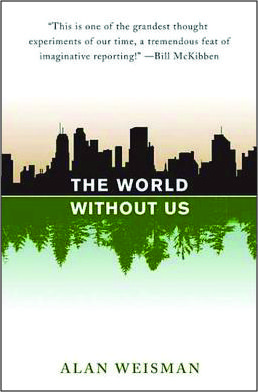
“Ever since then I’ve kept an eye out for publications about what a vanished civilization might leave behind for us to discover. In this book Weisman lays out survival times for our civilization’s stuff — plastic, houses, roads and so on. Pretty much everything but Mount Rushmore and the Chunnel will have dissolved or eroded away much sooner than a million years. Really readable if you want more details.”

<more soda>

“I also found a paper, ‘The Silurian Hypothesis,’ that took a more technical approach. Their big library research project pulled results from scores of geologic isotope analysis and fossil survey reports looking for ancient times that resemble Earth’s sudden change since the start of the Industrial Age — climate, species declines, whatever. They found about a dozen, but as they said, ‘the known unique markers might not be indicative, while the (perhaps) more expected markers are not sufficient.’ In other words, my Crazy Theory might be crazy. Or maybe not.”

~~ Rich Olcott

Joke Time

<Note to reader — Doing a little Spring cleaning. Here’s a collection of short takes to lighten your mood in these trying times…>


Dark Matter and Dark Energy walked into a bar. No-one noticed.


A baffled young student of Chemistry
Got their enthalpy mixed with their entropy.
         ”Thy’re surely confusing me
         And evilly abusing me
With their Gibbs and their Helmholz free energy.”


Elliptical definitions are even less informative than circular definitions. That’s why politicians prefer them.


There’s an old and well-established (but good-natured) rivalry between major segments of humanity’s Science enterprise. A Mathematician might proclaim that

  • Mathematics is the Queen of the Sciences.
  • Physics is noisy Mathematics.
  • Chemistry is smelly Physics.
  • Biology is squishy Chemistry.
  • Psychology is congealed Biology.
  • Sociology is imprecise Psychology.
  • Archaeology is dusty Sociology.
  • Paleontology is unfocused Archaeology.
  • Geology is Paleontology that you’ve stubbed your toe on.

whereas Chemists would point to the typical number of objects in a study

  • Chemistry — 6×10²³
  • Cell biology — 106 to 109
  • Astronomy — between 8 and a trillion, depending on specialty
  • Whole-body Biology — dozens to hundreds
  • Physics has trouble when there are more than 3
  • Cosmology — one.

Statistics are what we used before we had computer graphics.


Paleontologists have announced the discovery of a previously unknown fossil homid, Homo eructus, also known as “Spitting Man.” The body had been interred along with a copious supply of status goods — shell and polished-stone necklaces, a blade weapon, etc., but also unexpectedly numerous containers of chewing tobacco and a tin cup, hence the species name.


I’d like to thank whoever thought up this call-and-response…
     WHAT DO WE WANT?
         TIME TRAVEL!
     WHEN DO WE WANT IT?
         IT DOESN’T MATTER!


One friend says that coconuts are mammals because they have fur and give milk. Another friend maintains that they’re shellfish. She writes, “Wikipedia says shellfish are ‘exoskeleton-bearing aquatic invertebrates used as food‘. Their husk is the exoskeleton, they’re obviously invertebrates because they have no spine, and they’re aquatic when floating in water or blended into cocktails.”


If the human body is the result of Intelligent Design, how come it’s impossible to reach that itchy spot in the middle of one’s back?


Combining my physics studies and my observations as a museum docent I’ve concluded that there are three ultimate speeds in the Universe
 * the speed of sound
 * the speed of light
 * the speed of a toddler when your back is turned.


The letter “A” is common in English, but you can count from zero to nine-hundred ninety-nine without encountering an “A“. On the other hand, the letter “Z” is uncommon but in Zero it’s at the head of the number line. If you want to cover something from A to Z, you have to count backwards.


Speaking of “Z,” “zero” is the only formal number word that contains a “z.” “Zillion” and “bazillion” don’t count.


I had a really good walk-off line, but that was at 3:00 am and it’s gone.
Dang, I hate it when that happens.
Don’t forget to tip the wait staff.

~~ Rich Olcott

The Decade Isn’t Over Yet

My father was a man of firmly held opinions, although he would be quick to say they were conclusions. Trained as a physicist, he lived a career in chemistry because in the Depression you took what you could get. Never hesitating to carry his sciences into the public forum, he wrote many Letters to The Editor on topics from the chemical hazards of powering automobile air bags with sodium azide, to the optimal size of a wine glass, to the historical connection between Hitler’s Navy sowing the North Sea with mines and the rise of industrial vitamin D production in the US.

He once suggested that the best location for highly radioactive nuclear waste would be the already-radioactive Chernobyl reserve in the thenSoviet Ukraine. Obvious when you think about it, except for the geopolitical part.

Dad enjoyed tweaking the bureaucrats. When he mustered out of the Navy at the end of WWII, he was given a letter stating that because of his extensive top-secret radar know-how, he was to hold himself in readiness should the nation have to call him back to duty. Many years later and in his eighties, he wrote a letter to the Secretary of the Navy. In it he said that his technical skills had deteriorated over the decades and therefore he requested relief from the obligation. He never told me whether or not he’d heard back.

A frequent target of his disdain was the herd of natural foods enthusiasts who abhor “ingesting chemicals.” “We are made of chemicals.” he wrote. “The only thing that is free of chemicals is a perfect vacuum.” He held that the phrase “organic salt” is an oxymoron when applied to any preparation of sodium chloride. I can only imagine his reaction to the displays that advertise gluten-free water.

Dad and I worked on different aspects of the Y2K Problem. From mid-1996 through the first month of January 2000 I and lots of other IT colleagues spent most of our working hours making sure that the wheels of our society wouldn’t grind to a halt because the various gears failed to mesh properly. All that work worked, but because we were successful the rest of society decided Y2K had been no big deal. If only they knew.

Meanwhile, my Dad had a different Y2K concern. He expressed it in this note which appeared in multiple publications:

To The Editor:
 There seems to be friction about naming the final year of the current century and/or the first year of the next decade.
 Those who affirm that 2001 is the beginning of the new century are absolutely correct. There was no year 0.
 Also, there is a substantial group who want to celebrate the year 2000.
 OK, the year twenty-naught-naught is the end of the present decade, century, millennium. We can and should have celebrations for the end of world wars, the end of holocausts, the end of homelessness, the end (hopefully) of drugs, reckless driving, etc.
 Even 1999 has been headlined. Let it be the year of preparation for the next two celebratory years. Those who want to capitalize on the final year of the present decade and the first year of the coming century can use 1999 for planning, organizing and even rehearsing the functions anticipated.
 The three-year spectacle will satisfy a substantial majority of those who seem to be unhappily vocal, one way or the other. Let’s make peace.

  • 1999: On your marks.
  • 2000: Get set.
  • 2001: Go.

~~ Irwin Olcott

Just to show how firmly he held to his calendrical conclusion — despite a medical condition that would have felled a less-determined man, Dad held on until Jan 10, 2001 because he wanted to live into the 21st Century. His initials, “I.O.,” drew his attention on the number ten. We in the family think that’s why he stayed with us until the tenth of the month, although there was some mention of waiting that long for tax purposes. Knowing him, it could have been some of both.

In my opinion, Dad had the right of it. The year 2020 will not be the start of the 21st Century’s second third decade, it will be the end of its first second. May the year and the following ones go well with you.

~~ Rich Olcott

Eyes on The Size

An excellent Fall day, perfect for a brisk walk around the park’s goose-governed lake. Suddenly there’s a goose-like yawp behind me. “Hey Moire, wait up, I got a question!”

“Afternoon, Mr Feder. What’s your question today?”

“You know how the Moon’s huge just after it gets over the horizon but then it gets small? How do they make it do that?”

“Well, ‘they’ is you, Mr Feder, except that nothing physically changes.”

“Whaddaya mean, I seen it change size every time there’s a full moon.”

“That’s what it looks like, but think it through. We’re here in the Midwest, two hours away from your folks back home in Fort Lee. Back when you lived there, did the Moon ever suddenly grow and then shrink when it was two hours up into the sky?”

“Um, no, just at the horizon. So you’re saying it’s one of them optical delusions?”

“Something like that. Here, I’ve got a video on Old Reliable. See how the disk stays the same size but it looks bigger in comparison to the railroad tracks? Your brain expects the tracks to be parallel lines despite the perspective, right, so it compensates by thinking the Moon must be wider when it’s next to them. In the real world you’ve looking at the Moon past trees or buildings, but the false perspective principle applies whether the horizon’s relatively close or far away.”

“Whaddaya mean, close or far horizon? It’s the edge of how far I can see and that’s always the same.”

“Oh, hardly, Mr Feder. You ever visit the Empire State Building’s observation deck?”

“Sure.”

“How about deep-sea fishing, out of sight of land?”

“Aw, that’s a blast, when you hook one of those big guys and you’re –“

“I’m sure you enjoyed it, but did you look around while you were waiting for a strike?”

“Yeah, nothin’ else to do but yammer and drink beer.”

“Mm-hm. So could you see as far from the boat’s deck as you could from the building’s deck?”

“Hey, you’re right. A lot farther from high up. They say on a clear day you can see 80 miles from the Empire State Building — nowhere near that from the boat, believe me. ‘S why they put those decks up there, I guess. How far up do I gotta be to see the whole world, I wonder.”

“Quick answer is, infinitely far away.”

“Wait, those astronauts got that ‘Blue Marble’ picture from the Moon and it showed the whole day side.”

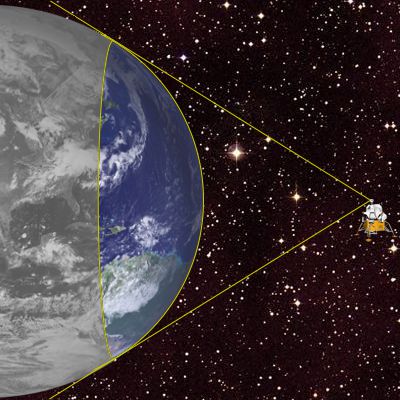
“Take a closer look someday. It shows Antarctica but essentially nothing north of the 45th parallel. The limit’s set by the points on the planet where lines from your eye just graze the planet’s surface. The astronauts in this LEM, for instance, are about an Earth-radius away. They’d be able to see the Atlantic Ocean and a little bit of Brazil, but neither of the poles and no part of the USA.”

“Gimme a sec … yeah, I see how that works. So that ‘how high up you are‘ thing keeps going all the way out into space. There’s probably some complicated formula for it, right?”

“Not that complicated, just d=(h²+2Rh), where h is your height above the surface and R is the radius of the planet you’re looking at. Plug in the numbers and d gives you your distance to the horizon. For that LEM, for example, h is one Earth radius and R is one radius, so those straight lines are 3=1.73 Earth radii long.”

“How about the line on top of the ocean?”

“That’s a little more complicated.” <more tapping on Old Reliable> “Says here that line stretches exactly one-third of the Earth’s circumference.”

“You can do that with other planets?”

“Sure. Mars, for instance. It has the tallest volcano in the Solar System, Olympus Mons. Depending on where you’re measuring from it’s about 22 kilometers high. I’ll put that into the formula with Mars’ radius, 3389 kilometers, and … OK, if you’re standing on top, your horizon is 387 kilometers away. That’s like looking halfway across France. Mars’ big canyon Vallis Marinaris has 7-kilometer cliffs. There are places where the opposite wall is way beyond the cliff-top’s 96-mile horizon.”

“That beats the Empire State Building.”

~~ Rich Olcott

Fierce Roaring Beast

A darkish day calls for a fresh scone so I head for Al’s coffee shop. Cathleen’s there with some of her Astronomy students. Al’s at their table instead of his usual place behind the cash register. “So what’s going on with these FRBs?”

She plays it cool. “Which FRBs, Al? Fixed Rate Bonds? Failure Review Boards? Flexible Reed Baskets?”

Jim, next to her, joins in. “Feedback Reverb Buffers? Forged Razor Blades?
Fennel Root Beer?”

I give it a shot. “Freely Rolling Boulders? Flashing Rapiers and Broadswords? Fragile Reality Boundary?”

“C’mon, guys. Fast Radio Bursts. Somebody said they’re the hottest thing in Astronomy.”

Cathleen, ever the teacher, gives in. “Well, they’re right, Al. We’ve only known about them since 2007 and they’re among the most mystifying objects we’ve found out there. Apparently they’re scattered randomly in galaxies all over the sky. They release immense amounts of energy in incredibly short periods of time.”

“I’ll say.” Vinnie’s joins the conversation from the next table. “Sy and me, we been talking about using the speed of light to measure stuff. When I read that those radio blasts from somewhere last just a millisecond or so, I thought, ‘Whatever makes that blast happen, the signal to keep it going can’t travel above lightspeed. From one side to the other must be closer than light can travel in a millisecond. That’s only 186 miles. We got asteroids bigger than that!'”

“300 kilometers in metric.” Jim’s back in. “I’ve played with that idea, too. The 70 FRBs reported so far all lasted about a millisecond within a factor of 3 either way — maybe that’s telling us something. The fastest way to get lots of energy is a matter-antimatter annihilation that completely converts mass to energy by E=mc².  Antimatter’s awfully rare 13 billion years after the Big Bang, but suppose there’s still a half-kilogram pebble out there a couple galaxies away and it hits a hunk of normal matter. The annihilation destroys a full kilogram; the energy release is 1017 joules. If the event takes one millisecond that’s 1020 watts of power.”

“How’s that stand up against the power we receive in an FRB signal, Jim?”

“That’s the thing, Sy, we don’t have a good handle on distances. We know how much power our antennas picked up, but power reception drops as the square of the source distance and we don’t know how far away these things are. If your distance estimate is off by a factor of 10 your estimate of emitted power is wrong by a factor of 100.”

“Ballpark us.”

<sigh> “For a conservative estimate, say that next-nearest-neighbor galaxy is something like 1021 kilometers away. When the signal finally hits us those watts have been spread over a 1021-kilometer sphere. Its area is something like 1049 square meters so the signal’s power density would be around 10-29 watts per square meter. I know what you’re going to ask, Cathleen. Assuming the radio-telescope observations used a one-gigahertz bandwidth, the 0.3-to-30-Jansky signals they’ve recorded are about a million million times stronger than my pebble can account for. Further-away collisions would give even smaller signals.”

Looking around at her students, “Good self-checking, Jim, but for the sake of argument, guys, what other evidence do we have to rule out Jim’s hypothesis? Greg?”

“Mmm… spectra? A collision like Jim described ought to shine all across the spectrum, from radio on up through gamma rays. But we don’t seem to get any of that.”

“Terry, if the object’s very far away wouldn’t its shorter wavelengths be red-shifted by the Hubble Flow?”

“Sure, but the furthest-away one we’ve tagged so far is nearer than z=0.2. Wavelengths have been stretched by 20% or less. Blue light would shift down to green or yellow at most.”

“Fran?”

“We ought to get even bigger flashes from antimatter rocks and asteroids. But all the signals have about the same strength within a factor of 100.”

“I got an evidence.”

“Yes, Vinnie?”

“That collision wouldn’t’a had a chance to get started. First contact, blooie! the gases and radiation and stuff push the rest of the pieces apart and kill the yield. That’s one of the problems the A-bomb guys had to solve.”

Al’s been eaves-dropping, of course. “Hey, guys. Fresh Raisin Bread, on the house.”

~~ Rich Olcott

Friendly Resting Behemoths

A Force-to-Force Meeting

The Crazy Theory contest is still going strong in the back room at Al’s coffee shop. I gather from the score board scribbles that Jim’s Mars idea (one mark-up says “2 possible 2 B crazy!“) is way behind Amanda’s “green blood” theory.  There’s some milling about, then a guy next to me says, “I got this, hold my coffee,” and steps up to the mic.  Big fellow, don’t recognize him but some of the Physics students do — “Hey, it’s Cap’n Mike at the mic.  Whatcha got for us this time?”

“I got the absence of a theory, how’s that?  It’s about the Four Forces.”

Someone in the crowd yells out, “Charm, Persuasiveness, Chaos and Bloody-mindedness.”

“Nah, Jennie, that’s Terry Pratchett’s Theory of Historical Narrative.  We’re doing Physics here.  The right answer is Weak and Strong Nuclear Forces, Electromagnetism, and Gravity, with me?  Question is, how do they compare?”

Another voice from the crowd. “Depends on distance!”

“Well yeah, but let’s look at cases.  Weak Nuclear Force first.  It works on the quarks that form massive particles like protons.  It’s a really short-range force because it depends on force-carrier particles that have very short lifetimes.  If a Weak Force carrier leaves its home particle even at the speed of light which they’re way too heavy to do, it can only fly a small fraction of a proton radius before it expires without affecting anything.  So, ineffective anywhere outside a massive particle.”

It’s a raucous crowd.  “How about the Strong Force, Mike?”

.  <chorus of “HOO-wah!”>

“Semper fi that.  OK, the carriers of the Strong Force —”

.  <“Naa-VY!  Naaa-VY!”>

.  <“Hush up, guys, let him finish.”>

“Thanks, Amanda.  The Strong Force carriers have no mass so they fly at lightspeed, but the force itself is short range, falls off rapidly beyond the nuclear radius.  It keeps each trio of quarks inside their own proton or neutron.  And it’s powerful enough to corral positively-charged particles within the nucleus.  That means it’s way stronger inside the nucleus than the Electromagnetic force that pushes positive charges away from each other.”

“How about outside the nucleus?”

“Out there it’s much weaker than Electromagnetism’s photons that go flying about —”

.  <“Air Force!”>

.  <“You guys!”>

“As I was saying…  OK, the Electromagnetic Force is like the nuclear forces because it’s carried by particles and quantum mechanics applies.  But it’s different from the nuclear forces because of its inverse-square distance dependence.  Its range is infinite if you’re willing to wait a while to sense it because light has finite speed.  The really different force is the fourth one, Gravity —”

.  <“Yo Army!  Ground-pounders rock!”>

“I was expecting that.  In some ways Gravity’s like Electromagnetism.  It travels at the same speed and has the same inverse-square distance law.  But at any given distance, Gravity’s a factor of 1038 punier and we’ve never been able to detect a force-carrier for it.  Worse, a century of math work hasn’t been able to forge an acceptable connection between the really good Relativity theory we have for Gravity and the really good Standard Model we have for the other three forces.  So here’s my Crazy Theory Number One — maybe there is no connection.”

.  <sudden dead silence>

“All the theory work I’ve seen — string theory, whatever — assumes that Gravity is somehow subject to quantum-based laws of some sort and our challenge is to tie Gravity’s quanta to the rules that govern the Standard Model.  That’s the way we’d like the Universe to work, but is there any firm evidence that Gravity actually is quantized?”

.  <more silence>

“Right.  So now for my Even Crazier Theories.  Maybe there’s a Fifth Force, also non-quantized, even weaker than Gravity, and not bound by the speed of light.  Something like that could explain entanglement and solve Einstein’s Bubble problem.”

.  <even more silence>

“OK, I’ll get crazier.  Many of us have had what I’ll call spooky experiences that known Physics can’t explain.  Maybe stupid-good gambling luck or ‘just knowing’ when someone died, stuff like that.  Maybe we’re using the Fifth Force in action.”

.  <complete pandemonium>
four forces plus 1

~ Rich Olcott


Note to my readers with connections to the US National Guard, Coast Guard, Merchant Marine and/or Public Health Service — Yeah, I know, but one can only stretch a metaphor so far.