A log by any other name

“Hey, Mr Moire?”

“Yes, Jeremy?”

“What we did with logarithms and exponents.  You showed me how my Dad’s slide-rule uses powers of 10, but we did that compound interest stuff with powers of 1.1.  Does that mean we could make a slide-rule based on powers of any number?”

“Sure could, in principle, but it’d be a lot harder to use.  A powers-of-ten model works well with scientific notation.  Suppose you want to calculate the number of atoms in 5.3 grams of carbon.  Remember Avagadro’s number?”

“Ohhh, yeah, chem class etched that into my brain.  It’s 6.02×10²³ atoms per gram atomic weight.  Carbon’s atomic weight is 12, so the atom count would be (5.3 grams)×(6.02×10²³ atoms / 12 grams), whatever that works out to be.”

“Nicely set up.  With the slide-rule you’d do the 5.3×6.02/12 part, then take care of the ten-powers in your head or on a scrap of paper.  It’d be ugly to do that with a slide-rule based on powers of π, for example.  Although, once you get away from the slide-rule it’s perfectly possible to do log-and-exponent calculations on other bases.  A couple of them are real popular.  Base-2, for instance.”2-10-e logs

“Powers of two?  Oh, binary!   2, 4, 8, 16, like that.  And 1/2, 1/4, 1/8.  Hard to imagine what a base-2 slide-rule would look like — zero at one end, I suppose, and one at the other and lots of fractions in-between.”

“Well, no.  Is there a zero on your Dad’s base-10 slide-rule there?”

“Uh, no, the C scale has a one at each end.”

“The left-hand ‘1’ can stand for one or ten or a thousand or a thousandth.  Whatever you pick for it, the right-hand ‘1’ stands for ten times that.”

“Ah, then a base-2 slide-rule would also have ones at either end in binary but they’d mean numbers that differ by a factor of two.  But there’d still be a bunch of fractions in-between, right?”

“Right, but no zero anywhere.  Why not?”

“Oh, there’s no power-of-two that equals zero.”

“No power-of-anything that equals zero.  Except zero, of course, but zero-to-anything is still zero so that’s not much use for calculating.  On the other hand, anything to the zero power is 1 so log(1)=0 in every base system.”

“You said a couple of popular bases.  What’s the other one?”

“Euler’s number e=2.71828…  It’s actually closely related to that compound interest calculation you did.  There’s several ways to compute e, but the most relevant for us is the limit of [1+(1/n)]n as n gets very large.  Try that on your spreadsheet app.”

“OK, I’m loading B1 with =(1+(1/C1))^C1 and I’ll try different numbers in C1.  One hundred gives me 2.7048, a thousand gives me 2.7169 (diminishing returns, hey) — ah, a million sure enough comes up with 2.71828.”

“There you go.  Changing C1 to even bigger values would get you even closer to e‘s exact value but it’s one of those irrationals like π so you can only get better and better approximations.  You see the connection between that formula and the $×[1+(rate/n)]n formula?”

“Sure, but what use is it?  If that’s the e formula the rate is 100%.”

“You can think of e as what happens when growth is compounded continuously.  It’s not often used in retail financial applications, but it’s everywhere in advanced math and physics.  I don’t want to get too much into that because calculus, but here’s one specialness.  The exponential function ex is the only one whose slope at every point is equal to its value there.”

“Nice.  But we’ve been talking logs.  Are base-e logarithms special?”

“So special that they’ve got their own name — natural logarithms, as opposed to common logarithms, the base-10 kind that power slide-rules.  They’ve even got their own abbreviations — ln(x) or loge(x) as opposed to log(x) or log10(x).”

“What makes them ‘natural’?”

“That’s harder to answer.  The simplest way is to point out that you can convert a log on one base to any other base.  For instance, ln(10)=2.303 therefore e2.303=10=101.  So log10 of any number x is 2.303 times ln(x) and ln(x)=log10(x)/2.303.  There are loads of equations that look simple and neat in terms of ln but get clumsy if you have to plug in 2.303 everywhere.”

“Don’t want to be clumsy.”

~~ Rich Olcott

Powers to The People

“You say logarithms and exponents have to do with growth, Mr Moire?”Log Exp and slide rule captioned

“Mm-hm.  Did they teach you about compound interest in that Modern Living class, Jeremy?”

“Yessir.  Like if I took out a loan of say $10,000 at 10% interest, I’d owe $11,000 at the end of the first year and, um…, $12,100 after two years because the 10% applies to the interest, too.”

“Nice mental arithmetic.  So what you did was multiply that base amount by 1+10% the first year and (1+10%)² the second, right?”

“Well, that’s not the way I thought of it, but that’s the way it works out, alright.”

“So it’d be (1+10%)³ the third year and in general (1+rate)n after n years, assuming you don’t make any payments.”

“Sure.”

“OK, how do we have to revise that formula if the interest is compounded daily and you get lucky and pay it off in a lump sum after 19 months?”

“Can I use your whiteboard?”

“Go ahead.”

“OK, first thing to change is the rate, because the 10% was for the whole year.  We need to use 10%/365 inside those parentheses.  But then we’re counting time by days instead of years.  Each day we multiply the previous amount by another (1+10%/365), which makes the exponent be the number of days the loan is out, which is 19 times whatever the average number of days in a month is.”

“Why not just use 19×(365÷12)?”

“Can we do that?  In an exponent?”

“Perfectly legal, done in all the best circles.”

“So what we’ve got is
10000×[1+(10%/365)]19×(365÷12).”

“Try poking that into your smartphone’s spreadsheet app and format it for dollars.”

“In spreadsheet-ese that’d be
=10000*(1+(0.1/365))^(19*(365/12)).
Hah!  The app took it, and comes up with … $11,715.31.  Lemme try that with two years that’s 24 months.  Now it’s $12,213.69.  Hey, that’s $123 more than two years compounded once-a-year.  Compounding more often generates more interest, doesn’t it?”

“Which is why daily compounding is the general rule in consumer lending.  But there’s a couple more lessons to be learned here.  One, you can do full-on arithmetic inside an exponent.  That’s what the log log scales are for on a slide rule.  Two, the expression you worked up has the form
base×(growth factor)(time function).
Any time you’re modeling something that grows or shrinks in some percentage-wise fashion, you’re going to have exponential expressions like that.”

“Hey, I tried compounding more often and it didn’t make much difference.  I put in 3650 instead of 365 and it only added 30¢ to the total.”

“Which gives me an idea.  Load up cells A1:A7 in your spreadsheet with this series: 1, 3, 10, 30, 100, 300, 1000.  Got it?”

“Ahhh … OK.  Now what?”

“Now load cell B1 with +10000*(1+(0.1/A1))^(24*(A1/12)).”

“Says $12,100.”

“Fine.  Now copy that cell down through B7.”

“Hmm…  The answers go up but by less and less.”

“Right.  Now highlight A1:B7 and tell your spreadsheet to generate a scatter plot connected by straight lines.”

“Gimme a sec … OK.  The line goes straight up, then straight across almost.”

“Final step — click on the x-axis and tell the program to use a logarithmic scale.”diminishing returns

“Hey, the x-numbers scrunch and wrap like on the A, B and K scales on Dad’s slide-rule.”

“Which is what you’d expect, right?  They both use logarithmic scales.  The slide-rule uses logarithms to do its arithmetic thing.  The graphing software lets you use logarithms to display big numbers together with small numbers.  But the neat thing about this graph is that it shows two different flavors of a general pattern.  Adding something, say 20, to a number to the left on the x-axis moves you a longer distance than adding the same amount somewhere over on the right.  That’s diminishing returns.”

“Look, the heeling-over curve shows diminishing returns from compounding interest more and more often.”

Exploding returns“Good.  Now copy A1:A7 by value into C1:C7 and generate a scatter plot of B1:C7. This time apply the logarithmic scale to the y-axis. This’ll show us how often we’d need to compound to get the yield on the x-axis.”

“Whoa, it blows up, like there’s no way to get up to $12,300.”

“Call it exploding returns.  Increasing the exponent increases the growth factor’s impact.  Beyond a threshold, a small change in the growth factor can make a huge difference in the result.”

“Seriously huge.”

“Exponentially huge.”

~~ Rich Olcott

Log-rhythmic gymnastics

I recognized the knock.  “Come on in, Jeremy, the door’s open.”

“Hi, Mr Moire.  Can you believe this weather?  Did Miss Anne like her gelato?  What’s this funny ruler thing that my Dad sent me?  He said they used it to send men to the moon.”

log rhythm

“No, yes, it’s called a slide rule, and he’s right — back in the 1960s engineers used slip-sticks like that when they couldn’t get to a four-function mechanical calculator.  Now, though, they’re about as useful as a cast-iron bath towel.  Kind of a shame, because the slide rule is based on mathematical principles that are fundamental to just about all of mathematical physics.”

“Like what?”

“The use of exponents, for one.  Add exponents to multiply, subtract to divide.  Quick — what’s 100×100×100?”

“Uhh…  Ten million?”

“Nup.  But if I recast that as 102×102×102=102+2+2?”

“106.  Oh, that’s a million.”

“See how easy?  We’ve known that kind of arithmetic since Archimedes.  The big advance was in the early 1600s when John Napier realized that the exponents didn’t have to be integers.  Take square roots, for example.  What’s the square root of 100?”

“Ten.”

“Sure — √100=√(102)=102/2=101=10.  Now write √10 with exponents.”

“Would it be 101/2?”

“Let’s see.  Do you have a spreadsheet app on that tablet you carry?”

“Sure.”

“OK, bring it up.  Poke =10^(0.5) into cell A1, and =A1^2 into A2.  What do you get?”

“Gimme a sec … the first cell says 3.162278 and the second says … exactly 10.”

“Or as exact as that software is set up for.  So what we’ve got is that 0.5 is a perfectly good power of ten, and exponent arithmetic works the same with it and all the other rational numbers that it does with integers.  Too big a leap, or are you OK with that?”

“OK, I suppose, but what does that have to do with this gadget getting people to the Moon?”

“Take a good look at at the C scale, the lowest one on the middle ruler that slides back and forth.  Are the numbers evenly spaced out?”

“No, they’re stretched out at the low end, scrunched together at the high end.”Slide rule 3“Look for 3.16 on there.  You read it like a ruler — the number before the decimal point shows as a digit, then you locate the fractional part with the high and low vertical lines.”

“Got it.  About halfway across.”

“It’s exactly on center if that’s a good slide rule.  A number’s distance along the scale should be proportional to the exponent of 10 (we call it the logarithm) that gives you that number.  The C scale’s left end is 1.0, its right end is 10.0, and 3.162 is halfway.”

“Ah, I see how it works.  Adding distances is like adding exponents.  So if I want to multiply 2 by 3 I slide the middle ruler until its 1 is against 2 on the D scale, then I look for 3 on the C scale and, yes! it’s right next to 6 on the D scale!  Oh and the A and B scales wrap twice in the same distance so they must be logarithms for squares?  Hah, there’s 10 on B right above where I found 3.16 on C.  K wraps three times so it must be cubes, but why did they call it K?”

“Blame the Germans, who spell ‘cube‘ with a ‘k‘.  What do you suppose CI does?”

“Hmm, it runs backwards.  Adding with CI would be like subtracting distances which would be like dividing, so … I’ll bet it’s ‘C-Inverse‘!”

“You win the mink-lined frying pan.  So you see how even a simple 5- or 6-scale device can do a lot of calculation.  The really fancy ones had as many as a dozen scales on each side, ready for doing trigonometry, compound interest, all kinds of things.  That’s the quick compute power the rocket engineers used back in the 50s.”

“Logarithms did all that, eh?”

“Yup, that and the inverse operation, exponentiation.  Of course, you don’t have to build your log and exponent system around 10.  If you’re into information theory you might use powers of 2.  If you’re doing physics or pure math you’re probably going to use a different base, Euler’s number e=2.71828.  Looks weird, but it’s really useful because calculus.”

“So logarithms do calculating.  You said something about physical principles?”

“Calculating growth, for instance…”

~~ Rich Olcott

Keep calm and stay close to home

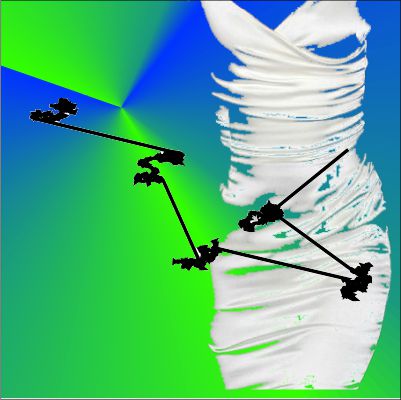
Again with the fizzing sound.  Her white satin still looked good.  A little travel-worn, but on her that looked even better.  Her voice still sounded like molten silver — “Hello.”White satin and drunkard walk
“Hello, Anne.  Where you been?”

“You wouldn’t believe.  I don’t believe.  I’ve got to get some control over this.”

“What’s the problem?”

“I never know where I’ll be next.  Or when.  Or even how it’ll look when I get there.  We’ve met before, haven’t we?”

“Yes, we have, and you told me your memory works in circles.  We figured out that when you ‘push,’ you relocate to a reality with a different probability.”

“But it could also be a different time.  Future, past, it’s so confusing.  Sometimes I meet myself and I don’t know whether I’m coming or going.  We never know what to say to each other.  It’s horrible way to be.”

“It sounds awful.  Here, have a tissue.  So, how can I help you?”

“You do theory stuff.  Can you physics a way to let me steer through all this?”

<fizzing sound> Another Anne appeared, next to my file cabinet on the far side of the office.  “Don’t mind me, just passing through.”  <more fizzing>  She flickered away.  My ears itched a little.

“See?  And she always knows more than I do, except when I know more than she does.”

“I’m beginning to get the picture.  Mind if I ask you a few questions?”

“Anything, if it’ll help solve this.”

“When you time-hop, do you use the same kind of ‘push’ feeling that sends you to different probabilities?”

“No-o, it’s a little different, but not much.”

“We found that you have to ‘push’ harder to get to a less-probable reality.  Is there the same kind of difference between past and future hopping?”

“Now you mention it, yes!  It’s always easier to jump to the future.  I have to struggle sometimes when I get too far ahead of myself.”

“Can you do time and probability together?”

“Hard to say.  When I hop I mostly just try to work out when I am, much less whether things are odd.”

“Give it a shot.  Try a couple of ‘nearby places’ and come back here/now.  Just use tiny ‘pushes.’ I don’t want you to get lost again.”

“Me neither.  OK, here I go.” <prolonged flickering and fizzing> “Is this the right place?  I tried a couple of hops here in your office, and <charming blush> stole some of your papers.  Here.”

“Perfect, Anne, objective evidence is always best.  Let’s see…  Yep, this report is one I finished a week ago, looks OK, and this one … I recognize the name of a client I’ve not yet hooked, but the spelling!  The letter ‘c’ isn’t there at all — ‘rekognize,’ ‘sirkle,’ ‘siense’ — that’s low probability for sure.”

“Actually, it felt like higher probability.”

“Whatever.  One more question.  I gather that most of your hops are more-or-less good ones but every once in a while you drop into a complete surprise, something you’re totally not used to.”

“Uh-huh.”

“I’ll bet the surprises happen when you’re in a jam and do a get me out of here jump.”

“Huh!  I’d not made that connection, but you’re right.”

“I think I’ve got the picture.  When you ‘push,’ you somehow displace yourself on a surface that has two dimensions — time and probability.  You move around in those two dimensions independently from how you move in 3-D space.  I take it you’re comfortable dong that but you want more control over it, right?”

“Mmm, yeah.  It’s kind of my special superpower, you know?  I don’t want to give it up entirely.”

“Good, because I wouldn’t know how to make that happen for you.  Best I can do is give you some strategy coaching, OK?”

“That’d be a big help.”Drunkard
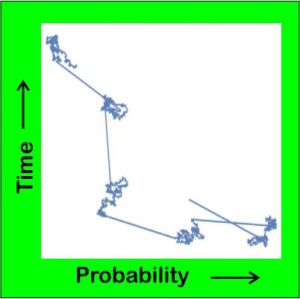
“Stay calm.”

“That’s it?  Where’s the physics in that?”

“Ever hear of the Drunkard’s Walk?”

“I’ve seen a few.”

“Well, you’re doing one.”

“Beg pardon?”

“It’s math talk for a stepwise process where every step goes in a random direction.  Your problem is that some of the steps are way too big.  Keep the steps small and you’ll stay in familiar territory.”

<molten silver, coming closer> “Like … here?”

“Stay calm.”

~~ Rich Olcott

Through The Looking Glass, Darkly

The Acme Building is quiet on summer evenings.  I was in my office, using the silence to catch up on paperwork.  Suddenly I heard a fizzing sound.  Naturally I looked around.  She was leaning against the door frame.

White satin looked good on her, and she looked good in it.  A voice like molten silver — “Hello, Mr Moire.”White satin and chessboard 1

“Hello yourself.  What can I do for you?”

“I’m open to suggestions, but first you can help me find myself.”

“Excuse me, but you’re right here.  And besides, who are you?”

“Not where I am but when I am.  Anne.”

“You said it right the first time.”

“No, no, my name is Anne.  At the moment.  I think.  Oh, it’s so confusing when your memory works in circles but not very well.  Do you have the time?”

“Well, I was busy, but you’re here and much more interesting.”

“No, I mean, what time is it?”

I showed her my desk clock — date, time, even the phase of the moon.

“Half past gibbous already?  Oh, bread-and-butter…”

“Wait — circles?  Time’s one-dimensional.  Clock readings increase or decrease, they don’t go sideways.”

“You don’t know Time as well as I do, Mr Moire.  It’s a lot more complicated than that.  Time can be triangular, haven’t you noticed?”

“Can’t say as I have.”

“That paperwork you’re working on, are you near a deadline?”

“Nah.”

“And given that expanse of time, you feel free to permit distractions.  There are so many distractions.”

“You’re very distracting.”

“Thank you, I guess.  But suppose you had an important deadline coming up tomorrow.   That broad flow of possibilities at the beginning of the project has narrowed to just two — finish or don’t finish.  Your Time has closed in on you.”

“So you’re saying we can think of Time as two-dimensional.  The second dimension being…?”

“I don’t know.  I just go there.  That’s the problem.”

“Hmm… When you do, do you feel like you’re turning left or right?”

“No turning or moving forward or backward.  Generally I have to … umm… ‘push’ like I’m going uphill, but that only works if there’s a ‘being pushed’ when I get past that.  Otherwise I’m back where I started, whatever that means.”

“What do you see?  What changes during the episode?”

“Little things. <brief fizzing sound.  She … flickered.>  Like ‘over there’ you’re wearing a bright green T-shirt instead of what you’re wearing here.  And you’re using pen-and-paper instead of that laptop.  Green doesn’t suit you.”

“I know, which is why there’s nothing green in my wardrobe, here.  But that gives me an idea.  Did you always have to ‘push’ to get ‘over there’?”

“Usually.”

“Fine.  OK, I’m going to flip this coin.  While it’s in the air, ‘push’ just lightly and come back to tell me which way the coin fell.”

<fizzing> “Heads.”

“It’s tails here.  OK, we’re going to do that again but this time ‘push’ much harder.”

<louder fizzing> “That was weird.  Your coin rolled off the desk and landed on edge in a crack in the floor so it’s not heads or tails.”

“AaaHAH!”Coins 1

“?”

“Your ‘over theres’ have different levels of probability than ‘over here.’  They’re different realities.  Actually, I’ll bet you travel across ranges of probability.  Or tunnel through them, maybe.  That’d why you have to ‘push’ to get past something that’s less probable in order to get to something that’s more probable.  Like getting past a reality where the coin can just hang in the air or fly apart.”

“I’ve done that.  Once I sneezed while ‘pushing’ and wound up sitting at a tea party where the cream and sugar just refused to stir into the tea.  When I ‘pushed’ from there I practically fell into a coffee shop where the coffee was well-behaved.”

“Case closed.  Now I can answer your question.  Spacewise, you’re in my office on the twelfth floor.  Timewise, I just showed you my clock.  As for which reality, you’re in one with a very high probability because, well, you’re here.”

“So provincial.  Oh, Mr Moire, how little you know.” <fizzing>

On the 12th floor of the Acme Building, high above the city, one man still tries to answer the Universe’s persistent questions — Sy Moire, Physics Eye.

~~ Rich Olcott

How Many Ways Can You Look at The Sky?

Cathleen and I were discussing her TRAPPIST-1 seminar in Al’s coffee shop when a familiar voice boomed over the room’s chatter.

“Hey, Cathleen, I got questions.”

“Vinnie?”

“Yeah, Sy, he hangs out with the Astronomy crew sometimes.  You know him, too, huh?”

“From way back.  Long story.”

“What’re your questions, Vinnie?”

“I missed the start of your talk, Cathleen, but why so much hype about this TRAPPIST-1 system?  We’ve already found 3,500 stars with planets, right, and some of them have several.  What’s so special here?”

“You’re right, Vinnie, Kepler-90 has seven planets, just like TRAPPIST-1. (brandishes a paper napkin)  But that star’s more than 60 times further from us than TRAPPIST-1 is.  It’s just too far away for us to be able to learn much more about the planets than their masses and orbital characteristics.  This new system’s only 40 lightyears away, close enough that we’ve got a hope of seeing what’s in the planetary atmospheres.”

(another paper napkin)  “That ties in with the second thing that’s special.  The star’s surface temperature, 2550ºK, is so low that even though its planets orbit very close in, three of them are probably in the Goldilocks Zone.  They’re not too hot and not too cold for liquid water to exist on their surface.  IF there’s liquid water on one of them and IF there’s something living there, we should be able to detect traces of that biochemistry in the planet’s atmosphere.”

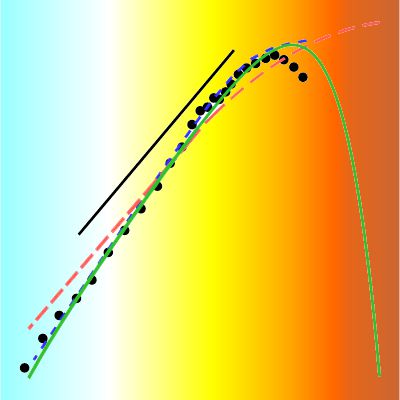
Star demographics
Observational data (dots) and four different models
of star count (vertical axis) versus temperature.
Hotter stars are to the left.

(napkin #3)  “The third special thing is that TRAPPIST-1 is the first-known planet-hosting star in its category — ultra-cool dwarf stars burning below 2700°K.  Finding those stars is hard — they’re small and dim.  No-one really knows how many there are compared to the other categories.  Some models say they should be rare, other models suggest they could be as common as G-type stars like our Sun.  IF there’s lots of ultra-cool dwarfs and IF they generally have planets like G-type stars do, then the category’s a new prime target for exoplanet hunters seeking life-signs.”

“Why’s that?”

“Because it’s easier to spot a small planet around a small star than around a big one.  Transits across TRAPPIST-1 dim its light by 1% or so.  A TRAPPIST-1 planet transiting our Sun would dim it by 1/100th of that.  The same problem hinders planet-finding methods fishing for stars that wobble because a planet’s orbiting around it.”

“Alright, I get that TRAPPIST-1 is special.  My other question is, I heard the part of your talk where you figured the odds on seeing its transits, but you lost me with the word steradian.  My dictionary says that’s an area on a sphere divided by the square of the sphere’s radius. What would that get me?  Where’d your numbers come from?”

“You need one additional piece of information.  If you take any sphere’s total surface area and divide that by r², you’ll always get 4π steradians.  You can use that to convert between absolute surface area and fraction of the sphere.  Mmm…  Sy, you own some land outside of town, yes?”

“A little.”

“And you have mineral rights?”

“Oh, yeah, that’s why I bought it.”

“And they go how far down?”

“All the way to the center of the Earth.”

“So your claim’s actually a pyramid 6370 kilometers deep.  When I moved here I learned it’s impolite to ask how much land someone has.  For round numbers I’ll assume 40 acres, which is about 1,000 square meters.  (tapping keys on her smartphone)  The Earth’s radius is 6.37×10⁶ meters, so Sy’s claim is 1,000/(6.37×106)2 = 2.47×10⁻¹¹ steradians.  Divide 4π by that and you get … 5.08×10¹¹.  So Earth’s entire surface has room for 5.08×10¹¹ patches matching Sy’s.  Visualize 5.08×10¹¹ pyramids pointing in every direction from Earth’s center.  Now extend each pyramid outward to define a separate patch of sky.  Got that picture, Vinnie?”viewing cones

“Sort of.”

“TRAPPIST-1 is 3.74×10¹⁷ meters away.  TRAPPIST-1h’s orbit is a near-circle whose radius is 9.45×10⁹ meters.  It covers π(9.45×10⁹)2/(3.74×1017)2 = 2.00×10⁻¹⁵ steradians on a sphere centered on us. Divide 4π by 2.00×10-15 …  6.27×10¹⁵ sky-patches the size of TRAPPIST-1h’s orbit.  They had to pick the right patch to find TRAPPIST-1.”

“Long odds.”

“Yep.”

~~ Rich Olcott

Superluminal Superman

Comic book and movie plotlines often make Superman accelerate up to lightspeed and travel backward in time.  Unfortunately, well-known fundamental Physics principles forbid that.  But suppose Green Lantern or Dr Strange could somehow magic him past the Lightspeed Barrier.  Would that let him do his downtimey thing?

Light_s hourglass
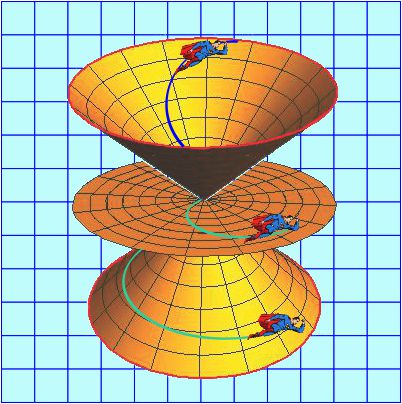
Light’s Hourglass

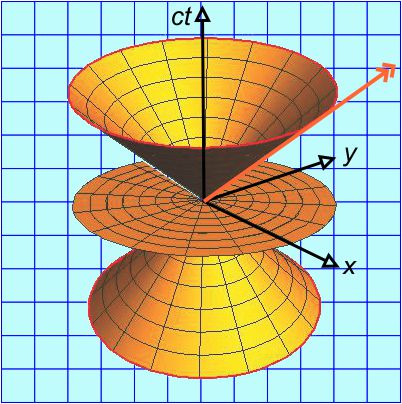
A quick review of Light’s Hourglass.  According to Einstein we live in 4D spacetime.  At any moment you’re at a specific time t relative to some origin time t=0 and a specific 3D location (x,y,z) relative to a spatial origin (0,0,0).  Your spacetime address is (ct,x,y,z) where c is the speed of light.  This diagram shows time running vertically into the future, plus two spatial coordinates x and y.  Sorry, I can’t get z into the diagram so pretend it’s zero.

The two cones depict all the addresses which can communicate with the origin using a flash of light.  Any point on either cone is at just the right distance d=√(x²+y²+z²) to match the distance that light can travel in time t.  The bottom cone is in the past, which is why we can see the light from old stars.  The top cone is in the future, which is why we can’t see light from stars that aren’t born yet.

If he obeys the Laws of Physics as we know them, Superman can travel anywhere he wants to inside the top cone.  He goes upward into the future at the rate of one second per second, just like anybody.  On the way, he can travel in space as far from (ct,0,0,0) as he likes so long as it’s not farther than the distance that light can travel the same route at his current t.

From our perspective, the Hourglass is a stack of circles (spheres in 3D space) centered on (ct,0,0,0).  From Supey’s perspective at time t he’s surrounded by a figure with radius ct that Physics won’t let him break through.  That’s his Lightspeed Barrier, like the Sonic Barrier but 900,000 times faster.

Suppose Green Lantern has magicked Supey up to twice lightspeed along the x-axis.  At moment t, he’s at (ct,2ct,0,0), twice as far as light can get.  In the diagram he’s outside the top cone but above the central disk.

Now GL pours on the power to accelerate Superman.  Each increment gets the Man of Steel closer to that disk.  He’s always “above” it, though, because he’s still moving into the future.  Only if he were to get to infinite speed could he reach the disk.

However, at infinite speed he’d go anywhere/everywhere instantaneously which would be confusing to even his Kryptonian intellect.  On the way he might run into things (stars, black holes,…) with literally zero time to react.

But the plotlines have Tall-Dark-and-Muscular flying into the past, breaching that disk and traveling downwards into the bottom cone.  Can GL make that happen?

Enter the Lorentz correction.  If you have rest mass m0 and you’re traveling at speed v, your effective mass is m=m0/√[1-(v/c)²]. That raises a couple of issues when you exceed lightspeed.

Suppose GL decelerates Superluminal Supey down towards lightspeed.  The closer he approaches c from higher speeds, the smaller that square root gets and the greater the effective mass.  It’s the same problem Superman faced when accelerating up to lightspeed.  That last mile per second down to c requires an infinite amount of braking energy — the Lightspeed Barrier is impermeable in both directions.

The other problem is that if v>c there’s a negative number inside that square root.    Above lightspeed, your effective mass becomes Bombelli-imaginary.  Remember Newton’s famous F=m·a?  Re-arrange it to a=F/m.  A real force applied to an object with imaginary mass produces an imaginary acceleration.  “Imaginary” in Physics generally means “perpendicular in some sense” and remember we’re in 4D here with time perpendicular to space.

GL might be able to shove Superman downtime, but he’d have to

  1. squeeze inward at hiper-lightspeed with exactly the same force along all three spatial dimensions, to make sure that “perpendicular” is only along the time axis
  2. start Operation Squish at some time in his own future to push towards the past.

Nice trick.  Would Superman buy in?

~~ Rich Olcott

Superman flying at lightspeed? Umm… no

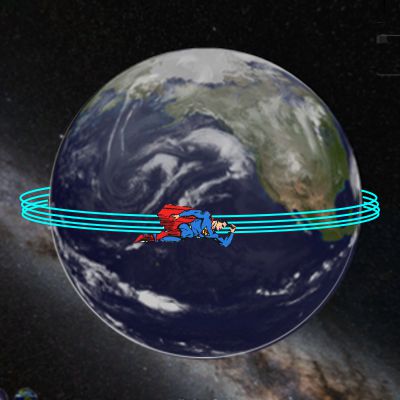
Back when I was in high school I did a term paper for some class (can’t remember which) ripping the heck out of Superman physics.  Yeah, I was that kind of kid.  If I recall correctly, I spent much of it slamming his supposed vision capabilities — they were fairly ludicrous even to a HS student and that was many refreshes of the DC universe ago.FTL SupermanBut for this post let’s consider a trope that’s been taken off the shelf again and again since those days, even in the movies.  This rendition should get the idea across — Our Hero, in a desperate effort to fix a narrative hole the writers had dug themselves into, is forced to fly around the Earth at faster-than-light speeds, thereby reversing time so he can patch things up.
So many problems…  Just for starters, the Earth is 8000 miles wide, Supey’s what, 6’6″?, so on this scale he shouldn’t fill even a thousandth of a pixel.  OK, artistic license.  Fine.

Second problem, only one image of the guy.  If he’s really passing us headed into the past we should see two images, one coming in feet-first from the future and the other headed forward in both space and time.  Oh, and because of the Doppler effect the feet-first image should be blue-shifted and the other one red-shifted.

Of course both of those images would be the wrong shape.  The FitzGerald-Lorentz Contraction makes moving objects appear shorter in the direction of motion.  In other words, if the Man of Steel were flying just shy of the speed of light then 6’6″ tall would look to us more like a disk with a short cape.

Tall-Dark-And-Muscular has other problems to solve on his way to the past.  How does he get up there in the first place?  Back in the day, DC explained that he “leaped tall buildings in a single bound.”   That pretty much says ballistic high-jump, where all the energy comes from the initial impulse.  OK, but consider the rebound effects on the neighborhood if he were to jump with as much energy as it would take to orbit a 250-lb man.  People would complain.

Remember Einstein’s famous E=mc²?  That mass m isn’t quite what most people think it is.  Rather, it’s an object’s rest mass m0 modified by a Lorentz correction to account for the object’s kinetic energy.   In our hum-drum daily life that correction factor is basically 1.00000…   When you get into the lightspeed ballpark it gets bigger.

Here’s the formula with the Lorentz correction in red: m=m0/√[1-(v/c)2].  The square root nears zero as Superman’s velocity v approaches lightspeed c.  When the divisor gets very small the corrected mass gets very large.  If he got to the Lightspeed Barrier (where v=c) he’d be infinitely massive.

So you’ve got an infinite mass circling the Earth about 7 times a second — ocean tides probably couldn’t keep up, but the planet would be shaking enough to fracture the rock layers that keep volcanoes quiet.  People would complain.

Of course, if he had that much mass, Earth and the entire Solar System would be orbiting him.

On the E side of Einstein’s equation, Superman must attain that massive mass by getting energy from somewhere.  Gaining that last mile/second on the way to infinity is gonna take a lot of energy.

But it’s worse.  Even at less than lightspeed, the Kryptonian isn’t flying in a straight line.  He’s circling the Earth in an orbit.  The usual visuals show him about as far out as an Earth-orbiting spacecraft.  A GPS satellite’s stable 24-hour orbit has a 26,000 mile radius so it’s going about 1.9 miles/sec.  Superman ‘s traveling about 98,000 times faster than that.  Physics demands that he use a powered orbit, continuously expending serious energy on centripetal acceleration just to avoid flying off to Vega again.

The comic books have never been real clear on the energy source for Superman’s feats.  Does he suck it from the Sun?  I sure hope not — that’d destabilize the Sun and generate massive solar flares and all sorts of trouble.

Not even the DC writers would want Superman to wipe out his adopted planet just to fix up a plot point.

~~ Rich Olcott

Light’s hourglass

Terry Pratchett’s anthropomorphic character Death (who always speaks in UPPER CASE with a voice that sounds like tombstones falling) has a thing about hourglasses.  So do physicists, but theirs don’t have sand in them.  And they don’t so much represent Eternity as describe it.  Maybe.

The prior post was all about spacetime events (an event is the combination of a specific (x,y,z) spatial location with a specific time t) and how the Minkowski diagram divides the Universe into mutually exclusive pieces:

  • “look but don’t touch” — the past, all the spacetime events which could have caused something to happen where/when we are
  • “touch but don’t look” — the future, the events where/when we can cause something to happen
  • “no look, no touch” — the spacelike part that’s so far away that light can’t reach us and we can’t reach it without breaching Einstein’s speed-of-light constraint
  • “here and now” — the tiny point in spacetime with address (ct,x,y,z)=(0,0,0,0)

Light_s hourglassLast week’s Minkowski diagram was two-dimensional.  It showed time running along the vertical axis and Pythagorean distance d=√(x²+y²+z²) along the horizontal one.  That was OK in the days before computer graphics, but it  loaded many different events onto the same point on the chart.  For instance, (0,1,0,0), (0,-1,0,0), (0,0,1,0) and (0,0,0,1) (and more) are all at d=1.

This chart is one dimension closer to what the physicists really think about.  Here we have x and y along distinct axes.  The z axis is perpendicular to all three, and if you can visualize that you’re better at it than I am.  The xy plane (and the xyz cube if you’re good at it) is perpendicular to t.

That orange line was in last week’s diagram and it means the same thing in this one.  It contains events that can use light-speed somehow to communicate with the here-and-now event.  But now we see that the line into the future is just part of a cone (or a hypercone if you’re good at it).

If we ignite a flash of light at time t=0, at any positive time t that lightwave will have expanded to a circle (or bubble) with radius d=c·t. The circles form the “future” cone.

Another cone extends into the past.  It’s made up of all the events from which a flash of light at time at some negative t would reach the here-and-now event.

The diagram raises four hotly debated questions:

  • Is the pastward cone actually pear-shaped?  It’s supposed to go back to The Very Beginning.  That’s The Big Bang when the Universe was infinitesimally small.  Back then d for even the furthest event from (ct,0,0,0) should have been much smaller than the nanometers-to-lightyears range of sizes we’re familiar with today.  But spacetime was smaller, too, so maybe everything just expanded in sync once we got past Cosmic Inflation.  We may never know the answer.
  • What’s outside the cones?  You think what you see around you is right now?  Sorry.  If the screen you’re reading this on is a typical 30 inches or so distant, the light you’re seeing left the screen 2½ nanoseconds ago.  Things might have changed since then.  We can see no further into the Universe than 14 billion lightyears, and even that only tells us what happened 14 billion years ago.  Are there even now other Earth-ish civilizations just 15 billion lightyears away from us?  We may never know the answer.
  • How big is “here-and-now”?  We think of it as a size=zero mathematical point, but there are technical grounds to think that the smallest possible distance is the Planck length, 1.62×10⁻³⁵ meters.  Do incidents that might affect us occur at a smaller scale than that?  Is time quantized?  We may never know the answers.
  • Do the contents of the futureward cone “already” exist in some sense, or do we truly have free will?  Einstein thought we live in a block universe, with events in future time as fixed as those in past time.  Other thinkers hold that neither past not future are real.  I like the growing block alternative, in which the past is real and fixed but the future exists as maybes.  We may never know the answer.

~~ Rich Olcott

You can’t get there from here

In this series of posts I’ve tried to get across several ideas:

  • By Einstein’s theories, in our Universe every possible combination of place and time is an event that can be identified with an “address” like (ct,x,y,z) where t is time, c is the speed of light, and x, y and z are spatial coordinates
  • The Pythagorean distance between two events is d=√[(x1-x2)2+(y1-y2)2+(z1-z2)2]
  • The Minkowski interval between two events is √[(ct1-ct2)2 – d2]
  • When i=√(-1) shows up somewhere, whatever it’s with is in some way perpendicular to the stuff that doesn’t involve i

That minus sign in the third bullet has some interesting implications.  If the time term is bigger then the spatial term, then the interval (that square root) is a real number.  On the other hand, if the time term is smaller, the interval is an imaginary number and therefore is in some sense perpendicular to the real intervals.

We’ll see what that means in a bit.  But first, suppose the two terms are exactly equal, which would make the interval zero.  Can that happen?

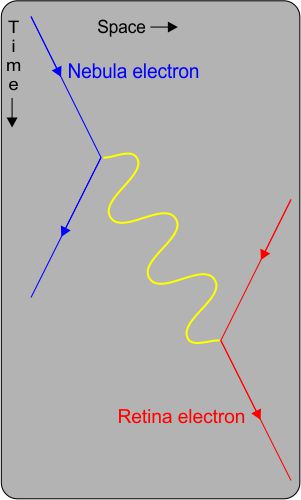
Sure, if you’re a light wave.  The interval can only be zero if d=(ct1-ct2).  In other words, if the distance between two events is exactly the distance light would travel in the elapsed time between the same two events.

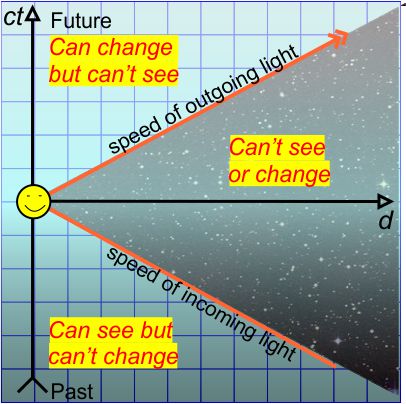
In this Minkowski diagram, we’ve got two number lines.  The real numbers (time) run vertically (sorry, I know we had the imaginary line running upward in a previous post, but this is the way that Minkowski drew it).  Perpendicular to that, the line of imaginary numbers (distance) runs horizontally, which is why that starscape runs off to the right.Minkowski diagram
The smiley face is us at the origin (0,0,0,0).  If we look upwards toward positive time, that’s the future at our present location.  Looking downward to negative time is looking into the past.  Unless we move (change x and/or y and/or z), all the events in our past and future have addresses like (ct,0,0,0).

What about all those points (events) that aren’t on the time axis?  Pick one and use its address to figure the interval between it and us.  In general, the interval will be a complex number, part real and part imaginary, because the event you picked isn’t on either axis.

The two orange lines are special.  Each of them is drawn through all the events for which the distance is equal to ct.  All the intervals between those events and us are zero.  Those are the events that could be connected to us by a light beam.

The orange connections go one way only — someone in our past (t less than zero) can shine a light at us that we’ll see when it reaches us.  However, if someone in our future tried to shine a light our way, well, the passage of time wouldn’t allow it (except maybe in the movies).  Conversely, we can shine a light at some spatial point (x,y,z) at distance d=√(x2+y2+z2) from us, but those photons won’t arrive until the event in our future at (d,x,y,z).

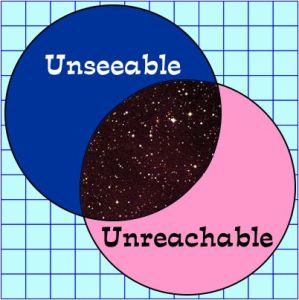
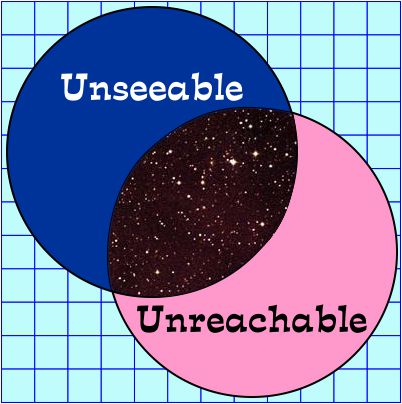
space VennThe rest of the Minkowski diagram could do for a Venn diagram.  We at (0,0,0,0) can do something that will cause something to happen at (ct,x,y,z) to the left of the top orange line.  However, we won’t be able to see that effect until we time-travel forward to its t.  That region is “reachable but not seeable.”
Similarly, events to the left of the bottom orange line can affect us (we can see stars, for instance) but they’re in our past and we can’t cause anything to happen then/there.  The region is “seeable but not reachable.”

Then there’s the overlap, the segment between the two orange lines.  Events there are so far away in spacetime that the intervals between them and us are imaginary (in the mathematical sense).  To put it another way, light can’t get here from there.  Neither can cause and effect.

Physicists call that third region space-like, as opposed to the two time-like regions.  Without a warp drive or some other way around Einstein’s universal speed limit, the edge of “space-like” will always be The Final Frontier.

~~ Rich Olcott