To Swerve And Project

A crisp Fall dawn, crisp fallen leaves under my feet as I jog the path by the park’s lake.

“Hey! Moire! How about these red sunrises and sunsets? Remind you of Mars?”

“Morning, Mr Feder. Not much, and definitely not dawn or dusk. Those tend more to blue, as a matter of fact.”

“Waitaminnit, Moire. I seen that Brad Pitt Martian movie, him driving hisself all alone across that big plain — the place is blood‑red.”

“Think a minute, Mr Feder. If he was all alone, who was running the cameras?”

“Uhhh, right. Movie. Yeah, they were really on Earth so they could director the lighting and all. But they said they’d scienced the … heck out of it.”

“Oh they did, better than most movies, but artistic license took over in a couple of places. People expect Mars to be red, not mostly clay colored like it really is, so the producers served up red.”

“Wait, I remember the conversation about Earth is blue because of the oceans and Mars is red because of its rusty atmosphere. So what’s with the sky colors?”

“Looking up at sunlight through an atmosphere is very different from looking down at the surface. It all has to do with how what’s in the atmosphere interacts with sunlight. Take Earth’s blue sky, for instance.”

“My favorite color.”

“Sure it is. OK, the Sun’s disk takes up much less than 1% of the sky but that’s enough to give us all our sunlight photons. A fraction of them run into something on the way down to Earth’s surface. What happens depends on how big the something is compared to the photon wavelength. Much larger things, maybe an airplane, completely block the photons and we get a shadow.”

“Obviously.”

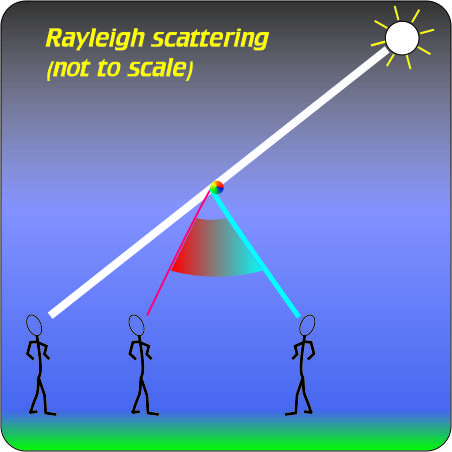
“Yeah, but life’s more interesting for smaller somethings. For things like air molecules and dust particles that are much smaller than the the wavelength of visible light, the waves generally swerve around the particle. How much they swerve depends on the wavelength — extreme blue light bends about ten times more than extreme red light for the same scattering particle. So suppose there’s a kid a few miles away from us looking at the sky while we’re looking at it here. There’s a sunbeam with a rainbow‑load of photons headed for the kid, but there are dust particles in the way. Get the picture?”

“Sure, sure, get on with it.”

“So some of the light swerves. The red swerves a little but the blue light swerves ten times as much, enough that it heads straight for us. What color do we see when we look in that direction?”

“Blue, of course.”

“Blue everywhere in the lit‑up sky except when we look straight at the Sun.”

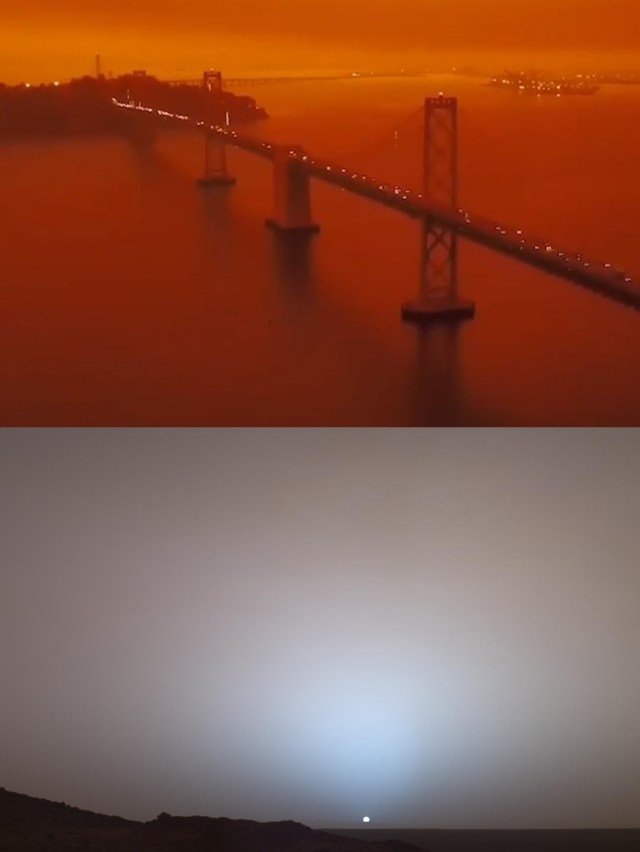
“What about these pretty red sunsets and the red skies over the wildfires?”

“Two different but related phenomena. Sunsets first. An incoming photon with just the right wavelength may simply be absorbed by a molecule. Doesn’t happen often, but there’s lots of molecules. Turns out that oxygen and ozone absorb blue light more strongly than red light. When we’re looking horizontally towards a sunset we’re looking through many more oxygen molecules than when we look vertically. We see the red part of a blue‑filtered version of that swerve rainbow.”

“And the fire skies?”

“The fires released huge amounts of fine smoke particles, just the right size for color‑scattering. Blue light swerves again and again until it’s either absorbed or shot out to space. Red light survives.”

Upper image – Golden Gate Bay under fiery skies, Sept 2020
Lower image – Sunset from Gusev Crater, Mars
Credit: NASA/JPL/Texas A&M/Cornell

“So what’s different about Mars?”

“Three things — Mars dust is different from Earth’s, its atmosphere is a lot thinner, and there’s practically no atmospheric water or oxygen. Rusty Mars dust is the size of smoke particles. With no rain or snow to settle out the dust, it stays aloft all the time. Rust is red because it absorbs blue light and reflects only the red part. With less diffused sunlight, Mars’ sky is basically the black of space overlaid with a red tint. Sunsets are blue‑ish because what blue light there is can travel further.”

“Earth skies are better.”

~~ Rich Olcott

Traffic Control

Jeremy Yazzie @jeremyaz
hi @symoire, this is jeremy. ive been reading about the osiris‑rex mission to astrroid bennu and how they’re bringing back a sample – so complicated – fancy robot arm, n2 squirter, air‑cleaner thingy – y not just vacuum the dust or pick up a rock?


Sy Moire @symoire
@jeremyaz – quick answer is that Bennu and OSIRIS-REx are already surrounded by the vacuum of space. Sample collectors can’t suck any harder that that. I’ll email you a more complete answer later


Hi, Sy, can you believe this weather? Temps last week were twice today’s high.

Not to a physicist, Sis.
Those 90s and today’s 45 are just Fahrenheit
scale numbers.
Can’t do ratios between them, “twice” does not compute.
I don’t suppose it would help if we went centigrade and said last week’s highs were around 35 and today it’s 5?

No, that’s worse, today’s down by 85% from last week.

Centigrade’s another scale you can’t do ratio arithmetic in. Kelvins is the way to go.
Temp in K tracks the average molecular kinetic energy.
Starts at zero where nothing’s moving and rises in proportion.
Last week’s highs ran around 308 K, today is 278 K.
Today we’re only 10% cooler than last week.

Physicists! Grrrr. However you measure the weather, it still feels cold. No picnic this weekend ;^(


From: Sy Moire <sy@moirestudies.com>
To: Jeremy Yazzie <jeremyaz@college.edu>
Subj: OSIRIS-REx

Jeremy –

OK, now I’m back at the office I’ve got better tech for writing long answers.

First, the “grab a rock” idea has several issues

  • If you pick up a rock, you only have that rock, says nothing about any of its neighbors or the subsurface material it might have smacked into. Dust should be a much better representation of the whole asteroid.
  • The rock might not be willing to be picked up. When the scientists and engineers were planning the OSIRIS‑REx mission, they didn’t know Bennu’s texture — could be one solid rock or a bunch of middle‑size rocks firmly cemented together or a loose “rubble pile” of all‑size rocks and dust held together by gravity alone, or anything in between.
  • Have you ever played one of those arcade games where you try to pick up a toy with a suspended claw gadget and all you’ve got is a couple of control knobs and a button? Picking up a specific rock, even a willing one, is hard when you’re a robot operating 15 light‑minutes away from the home office.

So dust it is, but how to plan dust collection in low gravity when you know nothing about the texture? Something like a whisk broom and dust pan would work unless the surface is too uneven. Something like a drill or disk sander would be good, except to use either one you need a solid footing to work from or else you go spinning one way when the tool spins the other. (That was a problem on the International Space Station.) The Hayabusa2 mission to asteroid Ryugu used a high‑velocity impactor to create dust, but a bad ricochet or shrapnel could kill the OSIRIS‑REx mission. The planners decided that best alternative was puff‑and‑grab.

So why not an astronautical Roomba that just sucks in the dust? The thing about vacuum is that it’s a place where gas molecules aren’t. Suppose you’re a gas molecule. You’re surrounded by your buddies, all in motion and bouncing off of each other like on a crowded 3‑D dance floor. You stay more‑or‑less in place because you’re being hit more‑or‑less equally from every direction. Suddenly there’s a vacuum to one side. You’re not hit as much over there so that’s the direction you and a bunch of your buddies move. If you encounter a dust particle, it picks up your momentum and moves toward the emptiness where it could be trapped in somebody’s filter.

The planners decided to capture dust particles by entraining them in a flow of gas molecules through a filter. To make gas flow you need more gas on one side then the other. Gas molecules being few and far between in space, the obvious place to put your pusher gas is inside the filter. Hence the nitrogen squirt technique and the “air‑cleaner thingy.”

— Sy

Diagram of TAGSAM in operation
Adapted from asteroidmission.org/?attachment_id=1699
Credit: University of Arizona

~~ Rich Olcott

Free Energy, or Not

From: Richard Feder <rmfeder@fortleenj.com>
To: Sy Moire <sy@moirestudies.com>
Subj: Questions

What’s this about “free energy”? Is that energy that’s free to move around anywhere? Or maybe the vacuum energy that this guy said is in the vacuum of space that will transform the earth into a wonderful world of everything for free for everybody forever once we figure out how to handle the force fields and pull energy out of them?


From: Sy Moire <sy@moirestudies.com>
To: Richard Feder <rmfeder@fortleenj.com>

Subj: Re: Questions

Well, Mr Feder, as usual you have a lot of questions all rolled up together. I’ll try to take one at a time.

It’s clear you already know that to make something happen you need energy. Not a very substantial definition, but then energy is an abstract thing it took humanity a couple of hundred years to get our minds around and we’re still learning.

Physics has several more formal definitions for “energy,” all clustered around the ability to exert force to move something and/or heat something up. The “and/or” is the kicker, because it turns out you can’t do just the moving. As one statement of the Second Law of Thermodynamics puts it, “There are no perfectly efficient processes.”

For example, when your car’s engine burns a few drops of gasoline in the cylinder, the liquid becomes a 22000‑times larger volume of hot gas that pushes the piston down in its power stroke to move the car forward. In the process, though, the engine heats up (wasted energy), gases exiting the cylinder are much hotter than air temperature (more wasted energy) and there’s friction‑generated heat all through the drive train (even more waste). Improving the drive train’s lubrication can reduce friction, but there’s no way to stop energy loss into heated-up combustion product molecules.

Two hundred years of effort haven’t uncovered a usable loophole in the Second Law. However, we have been able to quantify it. Especially for practically important chemical reactions, like burning gasoline, scientists can calculate how much energy the reaction product molecules will retain as heat. The energy available to do work is what’s left.

For historical reasons, the “available to do work” part is called “free energy.” Not free like running about like ball lightning, but free in the sense of not being bound up in jiggling heated‑up molecules.

Vacuum energy is just the opposite of free — it’s bound up in the structure of space itself. We’ve known for a century that atoms waggle back and forth within their molecules. Those vibrations give rise to the infrared spectra we use for remote temperature sensing and for studying planetary atmospheres. One of the basic results of quantum mechanics is that there’s a minimum amount of motion, called zero‑point vibration, that would persist even if the molecule were frozen to absolute zero temperature.

There are other kinds of zero‑point motion. We know of two phenomena, the Casimir effect and the Lamb shift, that can be explained by assuming that the electric field and other force fields “vibrate” at the ultramicroscopic scale even in the absence of matter. Not vibrations like going up and down, but like getting more and less intense. It’s possible that the same “vibrations” spark radioactive decay and some kinds of light emission.

Visualize space being marked off with a mesh of cubes. In each cube one or more fields more‑or‑less periodically intensify and then relax. The variation strength and timing are unpredictable. Neighboring squares may or may not sync up and that’s unpredictable, too.

The activity is all governed by yet another Heisenberg’s Uncertainty Principle trade‑off. The stronger the intensification, the less certain we can be about when or where the next one will happen.

What we can say is that whether you look at a large volume of space (even an atom is ultramicroscopicly huge) or a long period of time (a second might as well be a millennium), on the average the intensity is zero. All our energy‑using techniques involve channeling energy from a high‑potential source to a low‑potential sink. Vacuum energy sources are everywhere but so are the sinks and they all flit around. Catching lightning in a jar was easy by comparison.

Regards,
Sy Moire.

~~ Rich Olcott

Too Many Schrödingers

Cathleen takes back control of the conference software. “Thanks, Jim. OK, the final contestant in our online Crazy Theories contest is the winner of our last face-to-face event where she told us why Spock and horseshoe crabs both have green blood. You’re up, Amanda.”

“Thanks, and hello out there. I can’t believe Jim and I are both talking about parallel universes. It’s almost like we’re thinking in parallel, right?”

<Jim’s mic is muted so he makes gagging motions>

“We need some prep work before I can talk about the Multiverse. I’m gonna start with this heat map of North America at a particular time. Hot in the Texas panhandle, cool in British Columbia, no surprise. You can do a lot with a heat map — pick a latitude and longitude, it tells you the relative temperature. Do some arithmetic on the all numbers and you can get average temperature, highs and lows, front strength in degrees per mile, lots of stuff like that.

“You build this kind of map by doing a lot of individual measurements. If you’re lucky you can summarize those measurements with a function, a compact mathematical expression that does the same job — pick a latitude and longitude, it tells you the value. Three nice things about functions — they take up a lot less space than a map, you can use straightforward mathematical operations on them so getting statistics is less work than with a map, and you can form superpositions by adding functions together.”

Cathleen interrupts. “Amanda, there’s a question in the chat box. ‘Can you give an example of superposition?’

“Sure. You can superpose simple sine‑wave functions to describe chords for sound waves or blended colors for light waves, for instance.

“Now when we get to really small‑scale thingies, we need quantum calculations. The question is, what do quantum calculations tell us? That’s been argued about for a hundred years because the values they generate are iffy superpositions. Twenty percent of this, eighty percent of that. Everybody’s heard of that poor cat in Schrödinger’s box.

“Many researchers say the quantum values are relative probabilities for observing different results in an experiment — but most of them carefully avoid worrying about why the answers aren’t always the same. Einstein wanted to know what Bohr was averaging over to get his averages. Bohr said it doesn’t matter, the percentages are the only things we can know about the system and it’s useless to speculate further.

“Hugh Everett thought bigger. He suggested that the correct quantum function for an observation should include experiment and experimenter. He took that a step further by showing that a proper quantum function would need to include anyone watching the experimenter and so on. In fact, he proposed, maybe there’s just one quantum function for the entire Universe. That would have some interesting implications.

“Remember Schrödinger’s catbox with two possible experimental results? Everett would say that his universal quantum function contains a superposition of two component sub-functions — happy Schrödinger with a live kitty and sad Schrödinger with a disposal problem. Each Schrödinger would be quite certain that he’d seen the definite result of a purely random operation. Two Schrödingers in parallel universes going forward.

“But in fact there’d be way more than two. When Schrödinger’s eye absorbs a photon, or maybe doesn’t, that generates another pair of universes. So do the quantum events that occur as his nerve cells fire, or don’t. Each Schrödinger moves into the future embedded in a dense bundle of parallel universes.”

Cathleen interrupts. “Another question. ‘What about conservation of mass?‘”

“Good question, whoever asked that. Everett doesn’t address that explicitly in his thesis, but I think he assumed the usual superposition math. That always includes a fix‑up step so that the sum of all the pieces adds up to unity. Half a Schrödinger mass on one track and half on the other. Even as each of them splits again and again and again the total is still only one Schrödinger‑mass. There’s other interpretation — each Schrödinger’s universe would be independent of the others so there’s no summing‑up to generate a conservation‑of‑mass problem. Your choice.

“Everett traded quantum weirdness for a weird Universe. Not much of a trade-off, I think.”

~~ Rich Olcott

The Sound of Money

<chirp, chirp> “Moire, here, there’ll be a late-night surcharge for this call.”

“Hiya, Sy, it’s me, Vinnie. Got a minute? I wanna run something past you.”

“Sure, if it’s interesting enough to keep me awake.”

“It’s that Physics-money hobby horse you’ve been riding. I think I’ve got another angle on it for you.”

“Really? Shoot.”

“OK, a while ago you and me and Richard Feder talked about waves and how light waves and sound waves are different because light waves make things go up-and-down while the waves go forward but sound waves go back-and-forth.”

“Transverse waves versus compression waves, uh-huh.”

“Yeah and when you look close at a sound wave what you see is individual molecules don’t travel. What happens is like in a pool game where one ball bumps another ball and it stops but the bumped ball moves forward and the first ball maybe even moves back a little.”

“The compression momentum carries forward even though the particles don’t, right.”

“And that means that sound waves only travel as fast as the air molecules can move back and forth which is a lot slower than light waves which move by shaking the electric field. I got that, but why doesn’t sound move a lot faster in something like iron where the atoms don’t have to move?”

“Oh, it does, something like 200 times faster than in air. There’s a couple of factors in play. It all goes back to Newton —”

“Geez, he had a hand in everything Physics, didn’t he?”

“Except for electromagnetism and nuclear stuff. The available technology was just too primitive to let him experiment in those areas. Anyway, Newton discovered a formula connecting the speed of sound in a medium to its density. Like his Law of Gravity, it worked but he didn’t know why it worked. Also like gravity, we’ve got a better idea now.”

“What’s the better idea?”

“The key notions weren’t even invented until decades after Newton’s Principia was published. The magic words are the particulate nature of matter and intermolecular stiffness.”

“Hah?”

“One at a time. Newton was a particle guy to an extent. He believed that light is made of particles, but he didn’t take the next step to thinking of all matter as being made of particles. But it is, and the particles interact with each other. Think of it as stickiness. How effective the stickiness is depends on the temperature and which molecules you’re talking about. Gas molecules have so much kinetic energy relative to their sticky that they mostly just bounce off each other. In liquids and solids the molecules stay close enough together that the stickiness acts like springs. The springs may be more or less stiff depending on which molecules or ions or atoms are involved.”

“I see where you’re going. Stuff with stiffer springs doesn’t move as much as looser stuff at the same temperature; sound goes faster through a solid than through a liquid or gas. That’s what Newton figured out, huh?”

“No, he just measured and said, basically, ‘here’s the formula.‘ Just like with gravity, he didn’t suggest why the numbers were what they were. <yawn> So, you called with an idea about sound and money physics.”

“Right. Got off the track there, but this was helpful. What got me started was some newscaster saying how the Paycheck Protection Program is dumping money into the economy during the pandemic. My first thought was, ‘Haw, that’s gotta be a splash!‘ Then I imagined this pulse of money sloshing back and forth like a wave and that led me to sound waves and then I kept going. No dollar bill moves around that much, but when people spend them that’s like the compression wave moving out.”

“Interesting idea, Vinnie. From a Physics perspective, the question is, ‘How fast does the wave move?’ It’s another temperature‑versus‑stickiness thing.”

“Yeah, I figure money velocity measures the economy like temperature measures molecule motion. Money velocity goes up with inflation. If the velocity’s high people spend their money because why not.”

“Yup. From the government’s perspective the whole purpose of economic stimulation is getting the cash flowing again. Their problem is locating the money velocity kickover point.”

~~ Rich Olcott

Spare Change And Silly Putty

“Ok, Sy, you said Pascal explained the ‘water seeks its level‘ thing before Newton got a chance to. Newton was so smart, though — how’d Pascal beat him to it?”

“Pass me a strawberry scone, Al, and I’ll tell you why.”

“Anything for free food, eh, Sy? Alright, here.”

“Oferpitysake, Al, add it to my tab like always. Too much hassle putting on this face mask just to walk from my car to the scones. Pascal had a 20‑year head start — did his hydrostatics work when Newton wasn’t even in his teens. Unfortunately, Pascal died when Newton was only half-way through college. Whoa, if only Pascal had been alive and productive in France while Newton was in his science years in England and Leibniz was churning at everything in northern Germany. What advances might they have made arguing with each other? Where would our Math and Physics be today?”

“They didn’t like each other?”

“Newton didn’t like anybody. He and Leibniz feuded for decades over who invented calculus. Pascal and Leibniz probably would have gotten along fine — Leibniz could make nice with everyone except Newton. Come to think of it, Newton and Pascal had a lot in common. Newton was a preemie and Pascal was seriously ill for the first year of his life, never got much better. Newton wrote his first formal paper at 22; Pascal publicly proved that vacuums exist by creating some when he was 24. On the flip side, Pascal was 33 when he presented his studies of what we now call the Pascal Triangle but Newton waited until he was 44 to publish his Principia. And each of them spent much of the final quarter of his life on religious, even mystical matters.”

“So did Newton and Pascal both do much about money and water?”

“Not about the combination, though both had a lot to do about each one. Newton was Master of England’s Royal Mint and spent much of his time in office chasing down counterfeiters. Pascal wasn’t a gambler but Fermat was and the two of them teamed up to invent the probability theories that power today’s gaming, finance and insurance industries. So there’s that. Pascal and Newton both pioneered the science of fluids but from different perspectives. Pascal looked at static situations — comparing atmospheric pressure at two different altitudes, that sort of thing. Newton, as usual, studied change — in this case how fluids flow.”

“Pour water into a pipe and it pours out the other end. What’s to study?”

“Measuring how fast it pours and how that’s affected by the pressure and the pipe and what’s being poured. Newton explored the motion of fluids in exhausting detail in Book II of his Principia. As you’d expect, he found that the flow rate of water or any of the other fluids he investigated rises with the pressure and with the cross-sectional area of the pipe. Being Newton, though, he also also considered forces that resist flow. Think about it — the pipe itself doesn’t move and neither does the layer of fluid right next to the pipe’s walls. The flow rate ramps up from zero at the walls to full-on at the center of the pipe. The ramp-up rate depends on the fluid’s viscosity, another concept that Newton discovered or invented depending on how you look at it. Viscosity measures the drag force the slower layers exert on their faster neighbors. Fluids like molasses are viscous because their molecules are really good at grabbing onto molecules in the layers next door.”

“Where’s money fit into this picture?”

“I’m getting to that. Newton thought that each kind of fluid had its own viscosity, always the same. Not quite — temperature makes a difference and there’s non‑Newtonian materials like Silly Putty whose viscosity depends on how fast you yank on them. But the weirdest non‑Newtonian fluid is ultra‑low‑temperature liquid helium. It’s a superfluid and has zero viscosity. The helium atoms experience absolutely no drag from their neighbors and can sneak through the tiniest cracks. Money does the same, right? Each dime and dollar flows with no drag from its cousins.”

“Money’s a superfluid?”

“Yup. Think how it leaks out of your pocket.”

“Uh-huh. … Hey, Sy, about that tab…”

~~ Rich Olcott

A Turn to The Urn

Working under social distancing rules, Al’s selling coffee from a drive-up cart in front of his shop — urns, paper cups, everything at arms length. No cash register, credit or debit transactions only. “Give me my usual, Al. I miss the mugs; your brews just don’t taste the same in paper.”

“I know, Sy, but what can you do? Say, I’ve been reading your stuff with the sort‑of overlaps between Physics and Economics. Beyond your usual orbital? <heh, heh>”

“Very funny, Al. Yeah, a little, but it’s giving me some new perspectives on old ground.”

“Oh, yeah? What’s next?”

“Fluid mechanics, for instance. Ever notice how many money terms relate to water? ‘Cash flow,’ of course, but there’s also ‘liquidity,’ ‘frozen assets,’ ‘drowning in debt,’ a long list, so I decided to chase that metaphor, see how well it holds up. There’s a lot of Physics on your coffee cart, for instance.”

“Well, it’s heavy, I’ll tell you that.”

“Sure, but how about that glass tube that tells you how full the urn is? The Egyptians were using the principle thousands of years ago but Pascal put it on a firm theoretical basis before Newton got a chance to.”

“There’s theory in that thing?”

“Sure. There’s a pipe from the urn to the little tube, right, so all the liquid is connected. Pascal proved that the pressure on every little packet of fluid anywhere in a connected system has to be the same, otherwise fluid would flow to wherever the pressure is least and even things out. Pressure at the bottom of any skinny vertical column comes from atmospheric pressure plus the pull of gravity on the liquid in that column. It takes 33 feet of water to balance normal atmospheric pressure. For columns the size of your urn gravity’s contribution is less than 3% of atmospheric so the atmosphere rules. Pressure on the tube is the same as pressure on the urn so the two have to be at the same height. When the urn’s low, the tube’s low because Physics.”

“Cool, though when you look at it that way it seems obvious.”

“The good explanations often are. It takes a Pascal or a Newton to make it obvious.”

“So what’s this got to do with Economics?”

“Pascal’s principle supplied a fundamental assumption about how market‑based systems are supposed to work. Not with water, but with money — and instead of pressure there’s profit potential. The idea is that just like water will flow everywhere in a connected system until the pressure is equalized, money will flow everywhere in an economy until no‑one thinks they can make more profit in one place than in another. It’s more complicated than your coffee urn, though.”

“I expect so — lots more opportunities.”

“Well, yes, but the force‑equivalent is more complicated, too. Gravity and atmospheric pressure both exert force in the same direction. When you’re considering an investment, what do you think about?”

“The net profit, of course — how much I could make against what it’ll cost me to get in.”

“How about risk?”

“Three guesses why I’m doing this no-cash. I know what you mean though — like what if this electric cord overheats and burns the place down. Not likely, I checked the wire gauge and the circuit box.”

“Good strategy — look at all the things that can go wrong and address what you can control. But there’s uncontrolables, right? From an Economics perspective, you need to put each risk in money terms. Take the likelihood that something bad will happen, multiply by the monetary loss if it does happen and you get monetary risk you’ve got to figure against that expected net profit. My point is that the Economics version of Pascal’s principle has to take account of forces that pull money towards an investment option AND forces that push money away.”

“Two-way stretch, huh?”

“Absolutely. Take a look at a stock or bond prospectus some day. You’ll see risk categories you’ve never even heard of. Bond analysts have a field day with that kind of stuff. Their job is to calculate likely growth and cash yield against likely risk and come up with a price.”

“Risky business.”

“Always the joker, Al.”

~~ Rich Olcott

Something of Interest

“OK, Sy, I get how money is sorta like Physics ‘energy‘ except you can’t create energy but you can create money. And I get how Economics ‘velocity of money‘ and Physics ‘velocity don’t have much to do with each other. Your ‘Money Physics‘ phrase doesn’t make much sense unless you’ve got something with more overlap than that.”

“You’re a tough man, Vinnie. How about the word ‘exponential‘?”

“Means something goes up really fast. What about it?”

“Well, first off that’s not really what it means and that’s one of my personal peeves, thank you very much. Yes, quantities can increase exponentially, but not necessarily rapidly, and they can also decrease exponentially, either fast or slow. It’s a math thing.”

“Alright, I got myself into this. You’re gonna tell me how that works and it probably involves equations.”

“You made the phone call, I’m just sitting here, but you’re good, no equations just arithmetic. Ten times ten’s a hundred, right, and you can write that either 10×10 or 10², OK? The little two is the exponent, tells you how many factors to multiply together.”

“And 10 with a little three makes a thousand and ten with a little … six makes a million. See, it goes up really fast.”

“Depends on what the base number is. I’ve sent a tabulation to your phone…”

Exp’t 10 2 99% 100% 101%
2 100 4 98.01% 100% 102.01%
3 1 000 8 97.03% 100% 103.03%
4 10 000 16 96.06% 100% 104.06%
5 100 000 32 95.10% 100% 105.10%
6 1 000 000 64 94.15% 100% 106.15%
7 10 000 000 128 93.21% 100% 107.21%

“What’s all that?”

“Well, the top-row headers are just numbers I multiplied by themselves according to some exponents, and the first column is the series of exponents I used. Like we said, 10² is a hundred and so on down the second column. Number 2 multiplied by itself according to the same exponents gave me the third column and you see the products don’t grow anywhere near as fast. Do you see how the growth rate depends on the number that’s being multiplied and re‑multiplied?”

“No problem. What about the other columns?”

“Start with the fifth column. What’s 100% of 100%?”

“All of it.”

“And 100% of 100% of 100%?”

“I get it — no change no matter the exponent.”

“Absolutely. Now compare that to the 99% and 101% columns that give you the effect of a 1% growth factor. As you’d expect, very little change in either one, but there’s a lesson in the 99% column. It’s exponential by definition, but the results go down, not up. By the way, both of those are such small factors that the results are practically linear. You need to get beyond 15% factors for visible curvature in the usual graphs.”

“OK, so exponential says some arithmetic factor gets applied again and again. What’s that got to do with Physics or Economics?”

“Ever since Newton, Physics has been the study of change, all different kinds. Gradually we’ve built up a catalog of change patterns. Newton pointed out the simplest one in his first Law of Motion — constant velocity, say in meters per second. Plot cumulative distance moved against time and you get a rising straight line. His Second Law implies another simple pattern, constant acceleration. That’s one where velocity’s line rises linearly but distance goes up as the square of the time traveled. But Newton never tackled another very simple, very common pattern.”

“I thought Newton did everything.”

“Not the case. He was an amazing geometer, but to handle this pattern you need algebraic tools like the ones Leibniz was developing. Newton would rather have dunked his arm in boiling rancid skunk oil than do that. It took another century or so until the Bernoulis and Euler beat that problem into the ground.”

“So what’s the simple pattern?”

“Suppose instead of a quantity increasing by some absolute number of thingies per second, it increases by some constant percentage. That’s uncommon in the kinds of mechanical phenomena that Newton studied but it does happen. Say you’re a baby planet in the middle of a dust cloud. Get 15% bigger, you’re 15% better at attracting even more dust. Biological things do that a lot — the more bugs or bacteria you’ve got, the faster they multiply and that’s usually at a constant percentage-per-time rate. Exponential growth in a nutshell.”

“Planets, bugs, what’s that got to do with Economics?”

“Ever hear of ‘compound interest‘?”

“Low rates on bank accounts, high rates on credit cards, compounded. Gotcha.”

“Inflation does compounding, too.”

~~ Rich Olcott

The Solid Gold Bath Towel

“C’mon, Sy, I heard weaseling there — ‘velocity‑based thinking‘ ain’t the same as velocity numbers.”

“Guilty as charged, Vinnie. The centuries-old ‘velocity of money‘ notion has been superceded for a half-century, but the theory’s still useful in the right circumstances. It’s like Newton’s Law of Gravity that way, except we’ve been drifting away from Newton for a full century.”

“What, gravity doesn’t work any more?”

“Sure it does, and most places the force is exactly what Newton said it should be — proportional to the mass divided by the distance. But it goes wrong when the mass‑to‑distance ratio gets huge, say close to a star or a black hole. That’s when we move up to Einstein’s theory. It includes Newton’s Law as a special case but it covers the high-ratio cases more exactly and accounts for more phenomena.”

“Just for grins, how about when the ratio is tiny?”

“We don’t know. Some cosmologists have suggested that’s what dark energy is about. Maybe when galaxies get really far apart, they’re not attracted to each other quite as much as Newton’s Law says.”

“I suppose the money theories have problems at high and low velocities?”

“That’s one pair of problems. Money velocity is proportional to nominal traffic divided by money supply. Suppose an average currency unit changes hands thousands of times a day. That says people don’t have confidence that money will buy as much tomorrow as it could today. They’ve got hyperinflation.”

“Ah, and at the low end it’d be like me putting Eddie’s autographed $20 in a frame on my wall. No spend, no traffic, zero velocity.”

“Right, but for the economy it’d be everyone putting all their money under their mattresses. Money that’s frozen in place doesn’t do anything except maybe make someone feel good. It’s like water in a stream, it has to be flowing to be useful in generating power.”

“Wait, you used a word back there, ‘nominal.’ What’s that about?”

“Good ears. It points up another important distinction between Physics and Economics. Suppose you’re engineering a mill at that stream and you measure water flow in cubic meters per second. Kinetic energy is mass times velocity squared and power is energy per unit time. If you know water’s density in kilograms per cubic meter you can calculate the stream’s available water power. Density is key to finding mass from volume when volume’s easy to measure, or volume from easily‑measured mass.”

“OK, so what’s that got to do with ‘nominal‘?”

“In economic situations, money is easy to measure — it’s just the price paid — but value is a puzzle. In fact, people say that understanding the linkage between price and value is the central problem of Economics. There’s a huge number of theories out there, with good counter-examples for every one of them. For example, consider the solid gold bath towel.”

“What a stupid idea. Thing like that couldn’t dry you off in the desert.”

“True, but it’s made out of a rare material and some people think rarity makes value. In the right setting it’d be beautiful and there are certainly people who think beauty makes value. A lot of person‑time would be required to create it and some people think labor input is what makes value. The people who think utility makes value would give that towel very low marks. Of course, if you’ve already got plenty of bath towels you’re not about to buy another one so you don’t care.”

“So how do they decide what its price should be?”

“Depends on where you are. Many countries use a supply‑demand auction system that measures value by what people are willing to pay. Planned‑economy countries set prices by government edict. Other countries use a mixed system where the government sets prices for certain commodities like bread and fuel but everything else is subject to haggling. Whatever system’s in use, ‘nominal‘ traffic is the total of all transaction prices and that’s supposed to measure value.”

“Velocity’s supposed to be money supply divided into value flow but we can’t use value so we fake it with money flow?”

“You got it. Then the government tries to manage the money supply so velocity’s in a sweet spot.”

“Sounds rickety.”

“Yup.”

~~ Rich Olcott

The Flight of George’s Dollar

<chirp, chirp> “Moire here.”

“Hi, Sy, it’s Vinnie. Eddie just dropped off my pizza order —”

“What did you get?”

“My usual, large with extra pepperoni. Anyhow, Eddie said you guys were talking about Money Physics which has me curious. I don’t suppose it’s about how young George Washington couldn’t have thrown that silver dollar across the Potomac.”

“It couldn’t have been a US dollar because they didn’t exist yet and it couldn’t have been the Potomac because it’s a mile wide and probably nothing of the sort happened anyway. You’re right, though. What I’m calling Money Physics is about the parallels and differences between Economics and Newtonian Physics. Remember that $20 bill your dice‑playing won from Eddie a while ago and he signed it?”

“Yeah, that was fun. I was hot that night.”

“Well, the other day I used that very same bill to pay Eddie for pizza.”

“How’d you get it?”

“We figured you used the bill to pay down your tab at Al’s —”

“That’s right.”

“And he used it to buy some old astronomy magazines from me. I paid it to Eddie to complete the circle. ‘Whoa,’ I thought. ‘The velocity of money, like in Economics.”

“There’s a word I know from flight school. Velocity’s a vector, combines speed and direction. Speed would be how quick money changes hands, of course, but how do you attach a direction to that and what do you figure from the vectors?”

“Their equivalent to speed isn’t what you think it is and there’s no notion of direction. The ghost that’s left is the concept that ‘velocity of money‘ should describe how often a unit of currency is reused. The problems start popping up when you try to measure that. Economists grew up thinking about first‑purchase productivity so their metrics exclude a lot of what we’d consider economic activity. That traveling $20, for instance. How many transactions would you say it went through?”

“Eddie to me to Al to you to Eddie. Four.”

“Sorry, the productivity right answer is one. Eddie didn’t buy anything from you when he lost those bets. Your debt to Al was already outstanding. Al bought used goods from me. The only transaction that counts in the productivity calculation was my paying for what came fresh from Eddie’s pizza oven.”

“Dice games don’t count? How about bank fees or talking to my lawyer, stuff like that?”

“Oh, there’s lots of controversial questions, especially in view of our economy turning from mostly farm and manufacturing to mostly services and now we’re paying attention to environmental costs. ‘Reuse, repurpose, recycle‘ doesn’t enter into the productivity equation, and neither does installing a pollution control system except for the initial purchase price. Do you own stock, maybe in a pension plan?”

“Not as much as I’d like, especially recently.”

“I know the feeling. When you bought your shares, the brokerage fee counted as services but economists argue about the cost of the shares themselves. There are loads of what-abouts like that. Bottom line is that trying to track money movement at the transaction level just doesn’t work.”

“So what did they do?”

“Fell back to country-level aggregate numbers which are very rough by Physics standards. Add up the total economic traffic in dollars, divide by the size of the money supply, that’s the number of times an average dollar must have changed hands, OK?”

“Gimme a sec … that sounds right.”

“So how do you evaluate each part of the fraction? Some people measure economic activity indirectly by summing up transactions, maybe by looking at sales tax revenue data. That’s the spend side. Or you could look at the income side using payroll or income tax data and supposing that people spend everything they pull in. It’s not a hard think to find holes in both of those, but suppose you come up with a number somehow. That gets divided by the money supply, which we understand a little better but not much. Do the arithmetic and you have a dollars-to-dollars ratio, not somethings-per-time. No physicist would call that a velocity, but what can you do?”

“You got me, but who cares?”

“The Fed cares, because velocity‑based thinking helps drive their policy decisions.”

~~ Rich Olcott