The Top Choice

Al grabs me as I step into his coffee shop. “Sy, ya gotta stop Vinnie, he’s using up paper napkins again, and he’s making a mess!”

Sure enough, there’s Vinnie at his usual table by the door. He’s got a kid’s top, a big one, spinning on a little stand. He’s methodically dropping crumpled-up paper wads onto it and watching them fly off onto the floor. “Hey, Vinnie, what’s the project?”

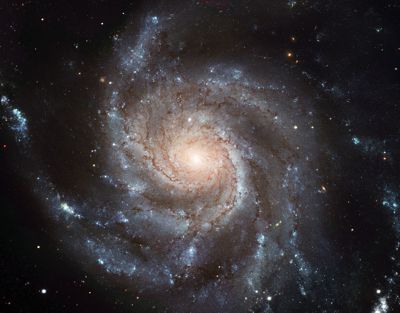
“Hi, Sy. I’m trying to figure how come these paper balls are doing a circle but when they fly off they always go in a straight line, at least at first. They got going-around momentum, right, so how come they don’t make a spiral like stars in a galaxy?”

Astronomy professor Cathleen’s standing in the scone line. She never misses an opportunity to correct a misconception. “Galaxy stars don’t spray out of the center in a spiral, Vinnie. Like planets going around a star, stars generally follow elliptical orbits around the galactic center. A star that’s between spiral arms now could be buried in one ten million years from now. The spiral arms appear because of how the orbits work. One theory is that the innermost star orbits rotate their ellipse axes more quickly than the outer ones and the spirals form where the ellipses pile up. Other theories have to do with increased star formation or increased gravitational attraction within the pile-up regions. Probably all three contribute to the structures. Anyhow, spirals don’t form from the center outward.”

My cue for some physics. “What happens in a galaxy is controlled by gravity, Vinnie, and gravity doesn’t enter into what you’re doing. Except for all that paper falling onto Al’s floor. There’s no in-plane gravitational or electromagnetic attraction in play when your paper wads leave the toy. Newton would say there’s no force acting to make them follow anything other than straight lines once they break free.”

“What about momentum? They’ve got going-around momentum, right, shouldn’t that keep them moving spirally?”

I haul out Old Reliable for a diagram. “Thing is, your ‘going-around momentum,’ also known as ‘angular momentum,’ doesn’t exist. Calm down, Vinnie, I mean it’s a ‘fictitious force‘ that depends on how you look at it.”

“Is this gonna be frames again?”

“Yup. Frames are one of our most important analytical tools in Physics. Here’s your toy and just for grins I’ve got it going around counterclockwise. That little white circle is one of your paper wads. In the room’s frame that wad in its path is constantly converting linear momentum between the x-direction and the y-direction, right?”

“East-West to North-South and back, yeah, I get that.”

“Such a mess to calculate. Let’s make it easier. Switch to the perspective of a frame locked to the toy. In that frame the wad can move in two directions. It can fly away along the radial direction I’ve called r, or it can ride along sideways in the s-direction.”

“So why hasn’t it flown away?”

“Because you put some spit on it to make it stick — don’t deny it, I saw you. While it’s stuck, does it travel in the r direction?”

“Nope, only in the s direction. Which should make it spiral like I said.”

“I’m not done yet. One of Newton’s major innovations was the idea of infinitesimal changes, also known as little-bits. The s-direction is straight, not curved, but it shifts around little-bit by little-bit as the top rotates. Newton’s Laws say force is required to alter momentum. What force influences the wad’s s-momentum?”

“Umm … that line you’ve marked c.”

“Which is the your spit’s adhesive force between the paper and the top. The wad stays stuck until the spit dries out and no more adhesion so no more c-force. Then what happens?”

“It flies off.”

“In which direction?”

“Huh! In the r-direction.”

“And in a straight line, just like Newton said. What you called ‘going-around momentum’ becomes ‘radial momentum’ and there’s no spiraling, right?”

“I guess you’re right, but I miss spirals.”

Al comes over with a broom. “Now that’s settled, Vinnie, clean up!”

~~ Rich Olcott

  • Thanks for the question, Jen Keeler. Stay tuned.
Maybe even smaller?

There’s a sofa in my office. Sometimes it’s used to seat some clients for a consultation, sometimes I use it for a nap. This evening Anne and I are sitting on it, close together, after a meal of Eddie’s Pizza d’amore.

“I’ve been thinking, Sy. I don’t want to use my grow-shrink superpower very much.”

“Fine with me, I like the size you are. Why’d you decide that?”

“I remember Alice saying, ‘Three inches is such a wretched height to be.’ She was thinking about what her cat would do to her at that height. I’m thinking about what an amoeba might do to me if I were down to bacteria-size and I wouldn’t be able to see it coming because I’d be too small to see light. It would be even messier further down.”

“Well, mess is the point of quantum mechanics — all we get is the averages because it’s all chaos at the quantum level. Bohr would say we can’t even talk about what’s down there, but you’d be in the thick of it.”

She shudders delicately, leans in tighter. <long, very friendly pause> “Where’d that weird number come from, Sy?”

“What weird number?”

“Ten-to-the-minus-thirty-fifth. You mentioned it as a possible bottom to the size range.”

Now you’re asking?”

“I’ve got this new superpower, I need to think about stuff.  Besides, we’ve finished the pizza.”

<sigh> “This conversation reminds me of our elephant adventure.  Oh well.  Umm. It may have started on a cold, wet afternoon. You know, when your head’s just not up to real work so you grab a scratchpad and start doodling? I’ll bet Max Planck was in that state when he started fiddling with universal constants, like the speed of light and his own personal contribution ħ, the quantum of action.”

“He could change their values?”

“No, of course not. But he could combine them in different ways to see what came out. Being a proper physicist he’d make sure the units always came out right. I’m not sure which unit-system he worked in so I’ll just stick with SI units, OK?”

“Why should I argue?”

“No good reason to. So… c is a velocity so its units are meters per second. Planck’s constant ħ is energy times time, which you can write either as joule-seconds or kilogram-meter² per second. He couldn’t just add the numbers together because the units are different. However, he could divide the one by the other so the per-seconds canceled out. That gave him kilogram-meters, which wasn’t particularly interesting. The important step was the next one.”

“Don’t keep me in suspense.”

“He threw Newton’s gravitational constant G into the mix. Its units are meter³ per kilogram per second². ‘Ach, vut a mess,’ he thought, ‘but maybe now ve getting somevere. If I multiply ħ by G the kilograms cancel out und I get meter5 per second³. Now … Ah! Divide by c³ vich is equal to multiplying by second³/meter³ to cancel out all the seconds and ve are left mit chust meter² vich I can take the square root uff. Wunderbar, it is simply a length! How ’bout that?‘”

“Surely he didn’t think ‘how ’bout that?‘”

“Maybe the German equivalent. Anyway, doodling like that is one of the ways researchers get inspirations. This one was so good that (Għ/c³)=1.6×10-35 meter is now known as the Planck length. That’s where your ten-to-the-minus-thirty-fifth comes from.”

“That’s pretty small. But is it really the bottom?”

“Almost certainly not, for a couple of different reasons. First, although the Planck formula looks like a fundamental limit, it’s not. In the same report Planck re-juggled his constants to define the Planck mass (ħc/G)=2.2×10-8 kilograms or 22 micrograms. Grains of sand weight less than that. If Planck’s mass isn’t a limit, Planck’s length probably isn’t either. Before you ask, the other reason has to do with relativity and this is not the time for that.”

“Mmm … so if space is quantized, which is where we started, the little bits probably aren’t Planck-sized?”

“Who knows? But my guess is, no, probably much smaller.”

“So I wouldn’t accidentally go out altogether like a candle then. That’s comforting to know.”

My turn to shudder. <another long, friendly pause>.

~~Rich Olcott

Small, yes, but how small?

Another quiet summer afternoon in the office. As I’m finishing up some paperwork I hear a fizzing sound I’d not heard in a while. “Hello, Anne, welcome back. Where’ve you been?”

Her white satin looks a bit speckled somehow but her voice still sounds like molten silver. “I’m not sure, Sy. That’s what I’ve come to you about.”

“Tell me about it.”

“Well, after we figured out that I can sort of ‘push’ myself across time and probability variation I realized that the different ‘pushes’ felt like different directions, kind of. When I go backward and forward in time it feels a little like falling backward or forward. Not really, but that’s the best way I can describe it. Moving to a different probability is a little like going left or right. So I wondered, what about up and down?”

“And I gather you tried that.”

“Sure, why not? What good’s a superpower if you don’t know what you can do with it? When I ‘push’ just a little upward thIS HAPPENS.”

“Whoa, watch out for the ceiling fan! Shrink back down again before you break the furniture or something.”

“Oh, I won’t, I’ve learned to be careful when I resize. Good thing I was outside and all by myself the first time I tried it. Took some practice to control how how much my size changes by how light or heavy I ‘pushed’.”

“I think I can see where this is going.”

“Mm-hm, it’s good to know what the limits are, right? I’ve got a pretty good idea of what would happen if I got huge. What I want to know is, what’ll I be getting into if I try ‘pushing’ down as hard as I can?”

“Kinda depends on how far down you go. I’m assuming your retinas scale their sensitivity with your size. When you get bigger do green things look blue and yellow things look green and so forth?”

“Yeah, orange juice had this weird yellow color. Tasted OK, though.”

“Right. So when you get smaller the colors you perceive will shift the other way, to shorter wavelengths — at first, yellow things will look red, blue things will look yellow and you’ll see ultraviolet as blue. When you get a thousand times smaller than normal, most things will look black because there’s not much X-ray illumination unless you’re close to a badly-shielded Crookes tube.”

“Good thing this ‘push’ ability also gave me some kind of extra feel-sense that’s not sight. Sometimes when I try to ‘push’ it ‘feels’ blocked until I move around a little. After the ‘push’ I see a wall or something I would have jumped into.”

“That’s a relief. I was wondering how you’d navigate when you’re a million times smaller than normal, at the single-cell level, or a million times smaller than that when you’d be atom-sized.”

“Then what comes?”

“Mmm… one more factor of a thousand would get you down to about the size of an atomic nucleus, but below that things get real fuzzy. It’s hard to get experimental data in the sub-nuclear size range because any photon with a wavelength that short is essentially an extremely-high-energy gamma ray, better at blowing nuclei apart than measuring them. Theory says you’d encounter nuclei as roiling balls of protons and neutrons, but each of those is a trio of quarks which may or may not be composed of even smaller things.”

“Is that the end of small?”

“Maybe not. Some physicists think space is quantized at scales near 10—35 meter. If they’re wrong then there’s no end.”

“Quantized?”

Quantized means something is measured out in whole numbers. Electric charge is quantized, for instance, because you can have one electron, two electrons, and so on, but you can’t have 1½ electrons. Some physicists think it’s possible that space itself is quantized. The basic idea is to somehow label each point in space with its own set of whole numbers.  There’d be no vacant space between points, just like there’s no whole number between two adjacent whole numbers.”

“So how small can I get?”

“Darned if I know.”

~~ Rich Olcott

Thanks to Jerry Mirelli for his thoughts that inspired this post and the next.

Fly High, Silver Bird

“TANSTAAFL!” Vinnie’s still unhappy with spacecraft that aren’t rocket-powered. “There Ain’t No Such Thing As A Free Lunch!”

“Ah, good, you’ve read Heinlein. So what’s your problem with Lightsail 2?”

“It can’t work, Sy. Mostly it can’t work. Sails operate fine where there’s air and wind, but there’s none of that in space, just solar wind which if I remember right is just barely not a vacuum.”

Astronomer-in-training Jim speaks up. “You’re right about that, Vinnie. The solar wind’s fast, on the order of a million miles per hour, but it’s only about 10-14 atmospheres. That thin, it’s probably not a significant power source for your sailcraft, Al.”

“I keep telling you folks, it’s not wind-powered, it’s light-powered. There’s oodles of sunlight photons out there!”

“Sure, Al, but photons got zero mass. No mass, no momentum, right?”

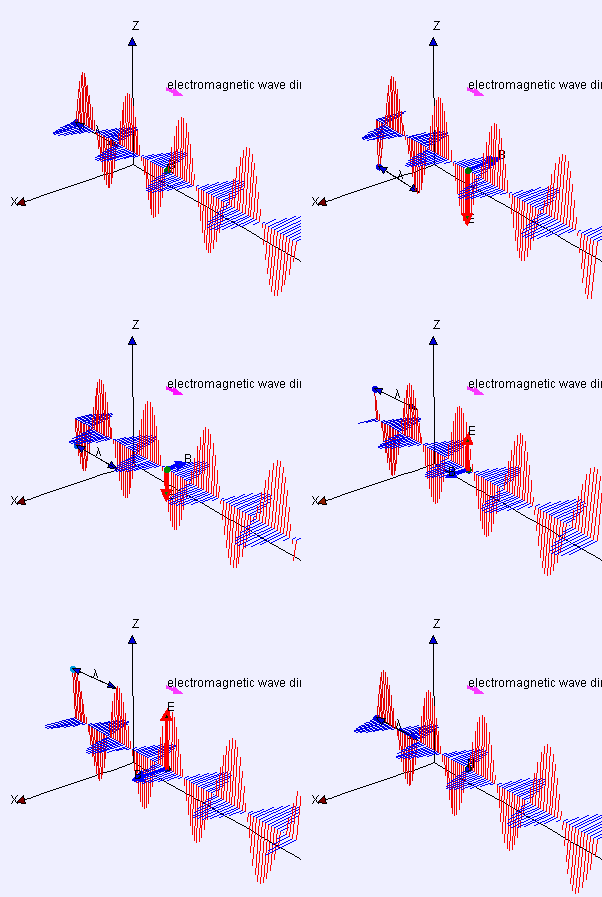
Plane-polarized electromagnetic wave in motion
Plane-polarized electromagnetic wave
Electric (E) field is red
Magnetic (B) field is blue
(Image by Loo Kang Wee and Fu-Kwun Hwang from Wikimedia Commons)

My cue to enter. “Not right, Vinnie. Experimental demonstrations going back more than a century show light exerting pressure. That implies non-zero momentum. On the theory side … you remember when we talked about light waves and the right-hand rule?”

“That was a long time ago, Sy. Remind me.”

“… Ah, I still have the diagram on Old Reliable. See here? The light wave is coming out of the screen and its electric field moves electrons vertically. Meanwhile, the magnetic field perpendicular to the electric field twists moving charges to scoot them along a helical path. So there’s your momentum, in the interaction between the two fields. The wave’s combined action delivers force to whatever it hits, giving it momentum in the wave’s direction of travel. No photons in this picture.”

Astrophysicist-in-training Newt Barnes dives in. “When you think photons and electrons, Vinnie, think Einstein. His Nobel prize was for his explanation of the photoelectric effect. Think about some really high-speed particle flying through space. I’m watching it from Earth and you’re watching it from a spaceship moving along with it so we’ve each got our own frame of reference.”

“Frames, awright! Sy and me, we’ve talked about them a lot. When you say ‘high-speed’ you’re talking near light-speed, right?”

“Of course, because that’s when relativity gets significant. If we each measure the particle’s speed, do we get the same answer?”

“Nope, because you on Earth would see me and the particle moving through compressed space and dilated time so the speed I’d measure would be more than the speed you’d measure.”

“Mm-hm. And using ENewton=mv² you’d assign it a larger energy than I would. We need a relativistic version of Newton’s formula. Einstein said that rest mass is what it is, independent of the observer’s frame, and we should calculate energy from EEinstein²=(pc)²+(mc²)², where p is the momentum. If the momentum is zero because the velocity is zero, we get the familiar EEinstein=mc² equation.”

“I see where you’re going, Newt. If you got no mass OR energy then you got nothing at all. But if something’s got zero mass but non-zero energy like a photon does, then it’s got to have momentum from p=EEinstein/c.”

“You got it, Vinnie. So either way you look at it, wave or particle, light carries momentum and can power Lightsail 2.”

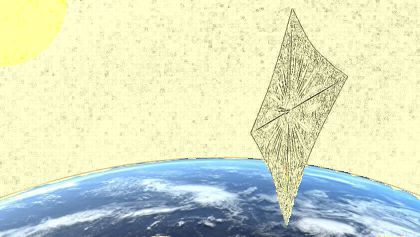
Lightsail 2 flying over Earth, against a yellow background
Adapted from image by Josh Spradling / The Planetary Society

“Question is, can sunlight give it enough momentum to get anywhere?”

“Now you’re getting quantitative. Sy, start up Old Reliable again.”

“OK, Newt, now what?”

“How much power can Lightsail 2 harvest from the Sun? That’ll be the solar constant in joules per second per square meter, times the sail’s area, 32 square meters, times a 90% efficiency factor.”

“Got it — 39.2 kilojoules per second.”

“That’s the supply, now for the demand. Lightsail 2 masses 5 kilograms and starts at 720 kilometers up. Ask Old Reliable to use the standard circular orbit equations to see how long it would take to harvest enough energy to raise the craft to another orbit 200 kilometers higher.”

“Combining potential and kinetic energies, I get 3.85 megajoules between orbits. That’s only 98 seconds-worth. I’m ignoring atmospheric drag and such, but net-net, Lightsail 2‘s got joules to burn.”

“Case closed, Vinnie.”

~~ Rich Olcott

Sail On, Silver Bird

Big excitement in Al’s coffee shop. “What’s the fuss, Al?”

Lightsail 2, Sy. The Planetary Society’s Sun-powered spacecraft. Ten years of work and some luck and it’s up there, way above Hubble and the ISS, boosting itself higher every day and using no fuel to do it. Is that cool or what?”

“Sun-powered? Like with a huge set of solar panels and an electric engine?”

“No, that’s the thing. It’s got a couple of little panels to power its electronics and all, but propulsion is all direct from the Sun and that doesn’t stop. Steady as she goes, Skipper, Earth to Mars in weeks, not months. Woo-hoo!”

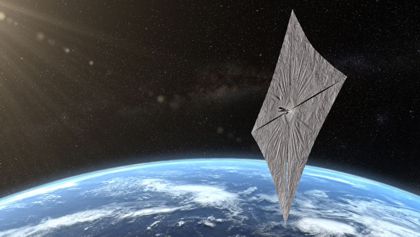
Image by Josh Spradling / The Planetary Society

Never the rah-rah type, Big Vinnie throws shade from his usual table by the door. “It didn’t get there by itself, Al. SpaceX’s Falcon Heavy rocket did the hard work, getting Lightsail 2 and about 20 other thingies up to orbit. Takes a lot of thrust to get out of Earth’s gravity well. Chemical rockets can do that, puny little ion drives and lightsails can’t.”

“Yeah, Vinnie, but those ‘puny’ guys could lead us to a totally different travel strategy.” A voice from the crowd, astrophysicist-in-training Newt Barnes. “Your big brawny rocket has to burn a lot of delta-v just to boost its own fuel. That’s a problem.”

Al looks puzzled. “Delta-v?”

“It’s how you figure rocket propellant, Al. With a car you think about miles per gallon because if you take your foot off the gas you eventually stop. In space you just keep going with whatever momentum you’ve got. What’s important is how much you can change momentum — speed up, slow down, change direction — and that depends on the propellant you’re using and the engine you’re putting it through. All you’ve got is what’s in the tanks.”

Al still looks puzzled. I fill in the connection. “Delta means difference, Al, and v is velocity which covers both speed and direction so delta-v means — “

“Got it, Sy. So Vinnie likes big hardware but bigger makes for harder to get off the ground and Newt’s suggesting there’s a limit somewhere.”

“Yup, it’s gotten to the point that the SpaceX people chase an extra few percent performance by chilling their propellants so they can cram more into the size tanks they use. I don’t know what the limit is but we may be getting close.”

Newt’s back in. “Which is where strategy comes in, Vinnie. Up to now we’re mostly using a ballistic strategy to get to off-Earth destinations, treating the vehicle like a projectile that gets all its momentum at the beginning of the trip. But there’s really three phases to the trip, right? You climb out of a gravity well, you travel to your target, and maybe you make a controlled landing you hope. With the ballistic strategy you burn your fuel in phase one while you’re getting yourself into a transfer orbit. Then you coast on momentum through phase two.”

“You got a better strategy?”

“In some ways, yeah. How about applying continuous acceleration throughout phase two instead of just coasting? The Dawn spacecraft, for example, was rocket-launched out of Earth’s gravity well but used a xenon-ion engine in continuous-burn mode to get to Mars and then on to Vesta and Ceres. Worked just fine.”

“But they’re such low-thrust –“

“Hey, Vinnie, taking a long time to build up speed’s no problem when you’re on a long trip anyway. Dawn‘s motor averaged 1.8 kilometer per second of delta-v — that works out to … about 4,000 miles per hour of increased speed for every hour you keep the motor running. Adds up.”

“OK, I’ll give you the ion motor’s more efficient than a chemical system, but still, you need that xenon reaction mass to get your delta-v. You still gotta boost it up out of the well. All you’re doing with that strategy is extend the limit.”

Al dives back in. “That’s the beauty of Lightsail, guys. No delta-v at all. Just put it up there and light-pressure from the Sun provides the energy. Look, I got this slick video that shows how it works.”

Video courtesy of The Planetary Society.

~~ Rich Olcott

The Big Chill

Jeremy gets as far as my office door, then turns back. “Wait, Mr Moire, that was only half my question. OK, I get that when you squeeze on a gas, the outermost molecules pick up kinetic energy from the wall moving in and that heats up the gas because temperature measures average kinetic energy. But what about expansion cooling? Those mist sprayers they set up at the park, they don’t have a moving outer wall but the air around them sure is nice and cool on a hot day.”

“Another classic Jeremy question, so many things packed together — Gas Law, molecular energetics, phase change. One at a time. Gas Law’s not much help, is it?”

“Mmm, guess not. Temperature measures average kinetic energy and the Gas Law equation P·V = n·R·T gives the total kinetic energy for the n amount of gas. Cooling the gas decreases T which should reduce P·V. You can lower the pressure but if the volume expands to compensate you don’t get anywhere. You’ve got to suck energy out of there somehow.”

Illustrations adapted from drawings by Trianna

“The Laws of Thermodynamics say you can’t ‘suck’ heat energy out of anything unless you’ve got a good place to put the heat. The rule is, heat energy travels voluntarily only from warm to cold.”

“But, but, refrigerators and air conditioners do their job! Are they cheating?”

“No, they’re the products of phase change and ingenuity. We need to get down to the molecular level for that. Think back to our helium-filled Mylar balloon, but this time we lower the outside pressure and the plastic moves outward at speed w. Helium atoms hit the membrane at speed v but they’re traveling at only (v-w) when they bounce back into the bulk gas. Each collision reduces the atom’s kinetic energy from ½m·v² down to ½m·(v-w)². Temperature goes down, right?”

“That’s just the backwards of compression heating. The compression energy came from outside, so I suppose the expansion energy goes to the outside?”

“Well done. So there has to be something outside that can accept that heat energy. By the rules of Thermodynamics, that something has to be colder than the balloon.”

“Seriously? Then how do they get those microdegree above absolute zero temperatures in the labs? Do they already have an absolute-zero thingy they can dump the heat to?”

“Nope, they get tricky. Suppose a gas in a researcher’s container has a certain temperature. You can work that back to average molecular speed. Would you expect all the molecules to travel at exactly that speed?”

“No, some of them will go faster and some will go slower.”

“Sure. Now suppose the researcher uses laser technology to remove all the fast-moving molecules but leave the slower ones behind. What happens to the average?”

“Goes down, of course. Oh, I see what they did there. Instead of the membrane transmitting the heat away, ejected molecules carry it away.”

“Yup, and that’s the key to many cooling techniques. Those cooling sprays, for instance, but a question first — which has more kinetic energy, a water droplet or the droplet’s molecules when they’re floating around separately as water vapor?”

“Lessee… the droplet has more mass, wait, the molecules total up to the same mass so that’s not the difference, so it’s droplet velocity squared versus lots of little velocity-squareds … I’ll bet on the droplet.”

“Sorry, trick question. I left out something important — the heat of vaporization. Water molecules hold pretty tight to each other, more tightly in fact than most other molecular substances. You have to give each molecule a kick to get it away from its buddies. That kick comes from other molecules’ kinetic energy, right? Oh, and one more thing — the smaller the droplet, the easier for a molecule to escape.”

“Ah, I see where this is going. The mist sprayer’s teeny droplets evaporate easy. The droplets are at air temperature, so when a molecule breaks free some neighbor’s kinetic energy becomes what you’d expect from air temperature, minus break-free energy. That lowers the average for the nearby air molecules. They slow their neighbors. Everything cools down. So that’s how sprays and refrigerators and such work?”

“That’s the basic principle.”

“Cool.”

~ Rich Olcott

Thanks to Mitch Slevc for the question that led to this post.

The Hot Squeeze

A young man’s knock, eager yet a bit hesitant.

“C’mon in, Jeremy, the door’s open.”

“Hi, Mr Moire. How’s your Summer so far? I got an ‘A’ on that black hole paper, thanks to your help. Do you have time to answer a question now that Spring term’s over?”

“Hi, Jeremy. Pretty good, congratulations, and a little. What’s your question?”

“I don’t understand about the gas laws. You squeeze a gas, you raise its temperature, but temperature’s the average kinetic energy of the molecules which is mass times velocity squared but mass doesn’t change so how does the velocity know how big the volume is? And if you let a gas expand it cools and how does that happen?”

“A classic Jeremy question. Let’s take it a step at a time, big-picture view first. The Gas Law says pressure times volume is proportional to the amount of gas times the temperature, or P·V = n·R·T where n measures the amount of gas and R takes care of proportionality and unit conversions. Suppose a kid gets on an airplane with a balloon. The plane starts at sea level pressure but at cruising altitude they maintain cabins at 3/4 of that. Everything stays at room temperature, so the balloon expands by a third –“

Kid drawing of an airplane with a red balloon
Adapted from a drawing by Xander

“Wait … oh, pressure down by 3/4, volume up by 4/3 because temperature and n and R don’t change. OK, I’m with you. Now what?”

“Now the plane lands at some warm beach resort. We’re back at sea level but the temp has gone from 68°F back home to a basky 95°F. How big is the balloon? I’ll make it easy for you — 68°F is 20°C is 293K and 95°F is 35°C is 308K.”

“Volume goes up by 308/293. That’s a change of 15 in about 300, 5% bigger than back home.”

“Nice estimating. One more stop on the way to the molecular level. Were you in the crowd at Change-me Charlie’s dark matter debate?”

“Yeah, but I didn’t get close to the table.”

“Always a good tactic. So you heard the part about pressure being a measure of energy per unit of enclosed volume. What does that make each side of the Gas Law equation?”

“Umm, P·V is energy per volume, times volume, so it’s the energy inside the balloon. Oh! That’s equal to n·R·T but R‘s a constant and n measures the number of molecules so T = P·V/n·R makes T proportional to average kinetic energy. But I still don’t see why the molecules speed up when you squeeze on them. That just packs the same molecules into a smaller volume.”

“You’re muddling cause and effect. Let’s try to tease them apart. What forces determine the size of the balloon?”

“I guess the balance between the outside pressure pushing in, versus the inside molecules pushing out by banging against the skin. Increasing their temperature means they have more energy so they must bang harder.”

“And that increases the outward pressure and the balloon expands until things get back into balance. Fine, but think about individual molecules, and let’s pretend that we’ve got a perfect gas and a perfect balloon membrane — no leaks and no sticky collisions. A helium-filled Mylar balloon is pretty close to that. When things are in balance, molecules headed outward approach the membrane with some velocity v and bounce back inward with the same velocity v though in a different direction. Their kinetic energy before hitting the membrane is ½m·v²; after the collision the energy’s also ½m·v² so the temperature is stable.”

“But that’s at equilibrium.”

“Right, so let’s increase the outside pressure to squeeze the balloon. The membrane closes in at some speed w. Out-bound molecules approach the membrane with velocity v just as before but the membrane’s speed boosts the bounce. The ‘before’ kinetic energy is still ½m·v² but the ‘after’ value is bigger: ½m·(v+w)². The total and average kinetic energy go up with each collision. The temperature boost comes from the energy we put into the squeezing.”

“So the heating actually happens out at the edges.”

“Yup, the molecules in the middle don’t know about it until hotter molecules collide with them.”

“The last to learn, eh?.”

“Always the case.”

~~ Rich Olcott

Thanks to Mitch Slevc for the question that led to this post.

Seesaw to The Stars

I look around the playground. “Where’s the seesaw, Teena?”

“They took it away. That’s good ’cause I hated that thing!”

“Why’s that, Sweetie?”

“I never could play right on it. Almost never. Sometimes there’d be a kid my size on the other end and that worked OK, but a lot of times a big kid got on the other end and bounced me up in the air. The first time I even fell off and they laughed.”

“Well, I can understand that. I’m sure you’ve been nicer than that to the littler kids.”

“Uh-huh, except for Bratty Brian, but he liked it when I bounced him. He called it ‘going to the Moon’.”

“I can understand that, too. If things go just right you come off your seat and float like an astronaut for a moment. I bet he held onto the handles tight.”

“Yeah, I just wasn’t ready for it the first time.”

“Y’know, there’s another way that Brian’s bounces were like a rocket trip to somewhere. They went through the same phases of acceleration and deceleration.”

“Uncle Sy, you know you’re not allowed to use words like that around me without ‘splaining them.”

“Mmm, they both have to do with changing speed. Suppose you’re standing still. Your speed is zero, right? When you start moving your speed isn’t zero any more and we say you’ve accelerated. When you slow down again we say you’re decelerating. Make sense?”

“So when Bratty Brian gets on the low end of the seesaw he’s zero. When I squinch down at my end he accelerates –“

“Right, that’s like the boost phase of a rocket trip.”

“… And when he’s floating at the very top –“

“Like astronauts when they’re coasting, sort of but not really.”

“… And then they decelerate when they land. Bratty Brian did, too. I guess deceleration is like acceleration backwards. But why such fancy words?”

“No-one paid much attention to acceleration until Mr Newton did. He changed Physics forever when he said that all accelerations involve a force of some kind. That thought led him to the whole idea of gravity as a force. Ever since then, when physicists see something being accelerated they look for the force that caused it and then they look for what generated the force. That’s how we learned about electromagnetism and the forces that hold atoms together and even dark matter which is ultra-mysterious.”

“Ooo, I love mysteries! What did Mr Newton tell us about this one?”

“Nothing, directly, but his laws gave us a clue about what to look for. Tell me what forces were in play during Brian’s ‘moon flight’.”

“Let’s see. He accelerated up and then he accelerated down. I guess while he was on the seesaw seat at the beginning the up-acceleration came from an up-force from his end of the board. And the down-acceleration came from gravity’s force. But the gravity force is there all along, isn’t it?”

“Good point. What made the difference is that your initial force was greater than gravity’s so Brian went up. When your force stopped, gravity’s force was all that mattered so Brian came back down again.”

“So it’s like a tug-of-war, first I won then gravity won.”

“Exactly. Now how about the forces when you were on the merry-go-round?”

“OK. Gravity’s always there so it was pulling down on me. The merry-go-round was pushing up?”

“Absolutely. A lot of people think that’s weird, but whatever we stand on pushes up exactly as hard as gravity pulls us down. Otherwise we’d sink into the ground or fly off into space. What about other forces?”

“Oh, yeah, Mr Newton’s outward force pushed me off until … holding the handles made the inward force to keep me on!”

“Nice job! Now think about a galaxy, millions of stars orbiting around like on a merry-go-round. They feel an outward force like you did, and they feel an inward force from gravity so they all stay together instead of flying apart. But…”

“But?”

“Mr Newton’s rules tell us how much gravity the stars need to stay together. The astronomers tell us that there aren’t enough stars to make that much gravity. Dark matter supplies the extra.”

~~ Rich Olcott

Conversation of Energy

Teena’s next dash is for the slide, the high one, of course. “Ha-ha, Uncle Sy, beat you here. Look at me climbing up and getting potential energy!”

“You certainly did and you certainly are.”

“Now I’m sliding down all kinetic energy, wheee!” <thump, followed by thoughtful pause> “Uncle Sy, I’m all mixed up. You said momentum and energy are like cousins and we can’t create or destroy either one but I just started momentum coming down and then it stopped and where did my kinetic energy go? Did I break Mr Newton’s rule?”

“My goodness, those are good questions. They had physicists stumped for hundreds of years. You didn’t break Mr Newton’s Conservation of Momentum rule, you just did something his rule doesn’t cover. I did say there are important exceptions, remember.”

“Yeah, but you didn’t say what they are.”

“And you want to know, eh? Mmm, one exception is that the objects have to be big enough to see. Really tiny things follow quantum rules that have something like momentum but it’s different. Uhh, another exception is the objects can’t be moving too fast, like near the speed of light. But for us the most important exception is that the rule only applies when all the energy to make things move comes from objects that are already moving.”

“Like my marbles banging into each other on the floor?”

“An excellent example. Mr Newton was starting a new way of doing science. He had to work with very simple systems and and so his rules were very simple. One Sun and one planet, or one or two marbles rolling on a flat floor. His rules were all about forces and momentum, which is a combination of mass and speed. He said the only way to change something’s momentum was to push it with a force. Suppose when you push on a marble it goes a foot in one second and has a certain momentum. If you push it twice as hard it goes two feet in one second and has twice the momentum.”

“What if I’ve got a bigger marble?”

“If you have a marble that’s twice as heavy and you give it the one-foot-per-second speed, it has twice the momentum. Once there’s a certain amount of momentum in one of Mr Newton’s simple systems, that’s that.”

“Oh, that’s why I’ve got to snap my steelie harder than the glass marbles ’cause it’s heavier. Oh!Oh!And when it hits a glass one, that goes faster than the steelie did ’cause it’s lighter but it gets the momentum that the steelie had.”

“Perfect. You Mommie will be so proud of you for that thinking.”

“Yay! So how are momentum and energy cousins?”

“Cous… Oh. What I said was they’re related. Both momentum and kinetic energy depend on both mass and speed, but in different ways. If you double something’s speed you give it twice the momentum but four times the amount of kinetic energy. The thing is, there’s only a few kinds of momentum but there are lots of kinds of energy. Mr Newton’s Conservation of Momentum rule is limited to only certain situations but the Conservation of Energy rule works everywhere.”

“Energy is bigger than momentum?”

“That’s one way of putting it. Let’s say the idea of energy is bigger. You can get electrical energy from generators or batteries, chemical energy from your muscles, gravitational energy from, um, gravity –“

“Atomic energy from atoms, wind energy from the wind, solar energy from the Sun –“

“Cloud energy from clouds –“

“Wait, what?”

“Just kidding. The point is that energy comes in many varieties and they can be converted into one another and the total amount of energy never changes.”

“Then what happened to my kinetic energy coming down the slide? I didn’t give energy to anything else to make it start moving.”

“Didn’t you notice the seat of your pants getting hotter while you were slowing down? Heat is energy, too — atoms and molecules just bouncing around in place. In fact, one of the really good rules is that sooner or later, every kind of energy turns into heat.”

“Big me moving little atoms around?”

“Lots and lots of them.”

~~ Rich Olcott

Conversation of Momentum

Teena bounces out of the sandbox, races over to the playground’s little merry-go-round and shoves it into motion. “Come help turn this, Uncle Sy, I wanna go fast!” She leaps onto the moving wheel and of course she promptly falls off. The good news is that she rolls with the fall like I taught her to do.

“Why can’t I stay on, Uncle Sy?”

“What’s your new favorite word again?”

“Mmmo-MMENN-tumm. But that had to do with swings.”

“Swings and lots of other stuff, including merry-go-rounds and even why you should roll with the fall. Which, by the way, you did very well and I’m glad about that because we don’t want you getting hurt on the playground.”

“Well, it does hurt a little on my elbow, see?”

“Let me look … ah, no bleeding, things only bend where they’re supposed to … I think no damage done but you can ask your Mommie to kiss it if it still hurts when we get home. But you wanted to know why you fell off so let’s go back to the sandbox to figure that out.”

<scamper!> “I beat you here!”

“Of course you did. OK, let’s draw a big arc and pretend that’s looking down on part of the merry-go-round. I’ll add some lines for the spokes and handles. Now I’ll add some dots and arrows to show what I saw from over here. See, the merry-go-round is turning like this curvy arrow shows. You started at this dot and jumped onto this dot which moved along and then you fell off over here. Poor Teena. So you and your momentum mostly went left-to-right.”

“But that’s not what happened, Uncle Sy. Here, I’ll draw it. I jumped on but something tried to push me off and then I did fall off and then I rolled. Poor me. Hey, my arm doesn’t hurt any more!”

“How about that? I’ve often found that thinking about something else makes hurts go away. So what do you think was trying to push you off? I’ll give you a hint with these extra arrows on the arc.”

“That looks like Mr Newton’s new directions, the in-and-out direction and the going-around one. Oh! I fell off along the in-and-out direction! Like I was a planet and the Sun wasn’t holding me in my orbit! Is that what happened, I had out-momentum?”

“Good thinking, Teena. Mr Newton would say that you got that momentum from a force in the out-direction. He’d also say that if you want to stand steady you need all the forces around you to balance each other. What does that tell you about what you need to do to stay on the merry-go-round?”

“I need an in-direction force … Hah, that’s what I did wrong! I jumped on but I didn’t grab the handles.”

“Lesson learned. Good.”

“But what about the rolling?”

“Well, in general when you fall it’s nearly always good to roll the way your body’s spinning and only try to slow it down. People who put out an arm or leg to stop a fall often stress it and and maybe even tear or break something.”

“That’s what you’ve told me. But what made me spin?”

“One of Mr Newton’s basic principles was a rule called ‘Conservation of Momentum.’ It says that you can transfer momentum from one thing to another but you can’t create it or destroy it. There are some important exceptions but it’s a pretty good rule for the cases he studied. Your adventure was one of them. Look back at the picture I drew. You’d built up a lot of going-around momentum from pushing the merry-go-round to get it started. You still had momentum in that direction when you fell off. Sure enough, that’s the direction you rolled.”

“Is that the ‘Conversation of Energy’ thing that you and Mommie were talking about?”

“Conservation. It’s not the same but it’s closely related.”

“Why does it even work?”

“Ah, that’s such a deep question that most physicists don’t even think about it. Like gravity, Mr Newton described what inertia and momentum do, but not how they work. Einstein explained gravity, but I’m not convinced that we understand mass yet.”

~~ Rich Olcott