A Nightcap And Secrets

“A coffee nightcap, Sy? It’s decaf so Teena can have some.”

“Sounds good, Sis.”

“Why didn’t Mr Einstein like entanglement, Uncle Sy? Thanks, Mom. A little more cream in it, please.”

“I’ll bet it has to do with the instant-effect aspect, right, Sy?”

“Thanks, Sis, and you’re right as usual. All of Relativity theory rests on the claim that nothing, not light or gravity or causality itself, can travel faster than light in a vacuum. There’s good strong arguments and evidence to support that, but Einstein himself proved that entanglement effects aren’t constrained to lightspeed. Annoyed him no end.”

“Well, your coin story‘s very nice, but it’s just a story. Is there evidence for entanglement?”

“Oh, yes, though it was fifty years after Einstein’s entanglement paper before our technology got good enough to do the experiments. Since then a whole industry of academics and entrepreneurs has grown up to build and apply devices that generate entangled systems.”

“Systems?”

“Mm-hm. Most of the work has been done with pairs of photons, but people have entangled pairs of everything from swarms of ultra‑cold atoms to electrons trapped in small imperfect diamonds. It’s always a matter of linking the pair members through some shared binary property.”

“Binary! I know what that is. Brian has a computer toy he lets me play with. You tell it where to drive this little car and it asks for decisions like left‑right or go‑stop and they’re all yes or no and the screen shows your answer as ‘0’or ‘1’ and that’s binary, right?”

“Absolutely, Teena. The entangled thingies are always created in pairs, remember? Everything about each twin is identical except for that one property, like the two coin metals, so it’s yes, no, or some mixture. Cars can’t do mixtures because they’re too big for quantum.”

“What kinds of properties are we talking about? It’s not really gold and silver, is it?”

“No, you’re right about that, Sis. Transmutation takes way too much power. Entangled quantum states have little or no energy separation which is one reason the experiments are so hard. Photons are the easiest to work with so that’s where most of the entanglement work has been done. Typically the process splits a laser beam into two rays that have contrasting polarizations, say vertical and horizontal. Or the researchers might work with particles like electrons that you can split into right‑ and left‑handed spin. Whatever, call ’em ones and zeroes, you’ve got a bridge between quantum and computing.”

“Brian says binary can do secret codes.”

“He’s right about that. Codes are about hiding information. Entanglement is real good at hiding quantum information behind some strict rules. Rule one is, if you inspect an entangled particle, you break the entanglement.”

“Sounds reasonable. When you measure it you make it part of a big system and it’s not quantum any more.”

“Right, Sis. Rule two, an entanglement only links pairs. No triples or broadcasts. Rule three is for photons — you can have two independent ways to inspect a property, but you need to use the same way for both photons or you’ve got a 50% chance of getting a mismatch.”

“Oho! I see where the hiding comes in. Hmm… From what I’ve read, encryption’s big problem is guarding the key. I think those three rules make a good way to do that. Suppose Rocky and Bullwinkle want to protect their coded messages from Boris Badinoff. They share a series of entangled photon pairs. and they agree to a measurement protocol based on the published daily prices for a series of stocks — for each photon in a series, measure it with Method 1 if the corresponding price is an odd number, Method 2 if it’s even. Rocky measures his photon. If he measures a ‘1’ then Bullwinkle sees a ‘0’ for that photon and he knows Rocky saw a ‘1.’ Rocky encrypts his message using his measured bit string. Bullwinkle flips his bit string and decrypts.”

“Brilliant. Even if Boris knows the proper sequence of measurements, if he peeks at an entangled photon that breaks the entanglement. When Bullwinkle decodes gibberish Rocky has to build another key. Your Mom’s a very smart person, Teena.”

~ Rich Olcott

Tiramisu And Gemstones

“Sis, you say there’s dessert?”

“Of course there is, Sy. Teena, please bring in the tray from the fridge.”

“Tiramisu! You did indeed go above and beyond. Thank you, Teena. Your Mom’s question must be a doozey.”

“I’ll let you enjoy a few spoonfulls before I hit you with it.” <minutes with spoon noises and yumming> “Okay. tell me about entanglement.”

“Whoa! What brought that on?”

“I’ve seen the word bandied about in the popular science press—”

“And pseudoscience—”

“Well, yes. I’m writing something where the notion might come in handy if it makes sense.”

“How can you tell what’s pseudoscience?”

“Good question, Teena. I look for gee-whiz sentences, especially ones that include weasely words like ‘might‘ and ‘could.’ Most important, does the article make or quote big claims that can’t be disproven? I’d want to see pointers to evidence strong enough to match the claims. A respectable piece would include comments from other people working in the same field. Things like that.”

“What your Mom said, and also has the author used a technical term like ‘energy‘ or ‘quantum‘ but stretched it far away from its home base? Usually when they do that and you have even an elementary idea what the term really means, it’s pretty clear that the author doesn’t understand what they’re writing about. That goes double for a lot of what you’ll see on YouTube and social media in general. It’s just so easy to put gibberish up there because there’s no‑one to contradict a claim, or if there is, it’s too late because the junk has already spread. ‘Entanglement‘ is just the latest buzzword to join the junk‑science game.”

“So what can you tell us about entanglement that’s non‑junky?”

“First thing is, it’s strictly a microscopic phenomenon, molecule‑tiny and smaller. Anything you read about people or gemstones being entangled, you can stop reading right there unless it’s for fun.”

“Weren’t Rapunzel and the prince entangled?

“They and all the movie’s other characters were tangled up in the story, yes, but that’s not the kind of entanglement your Mom’s asking about. This kind seems to involve something that Einstein called ‘spooky action at a distance‘. He didn’t like it.”

“‘Seems to‘?”

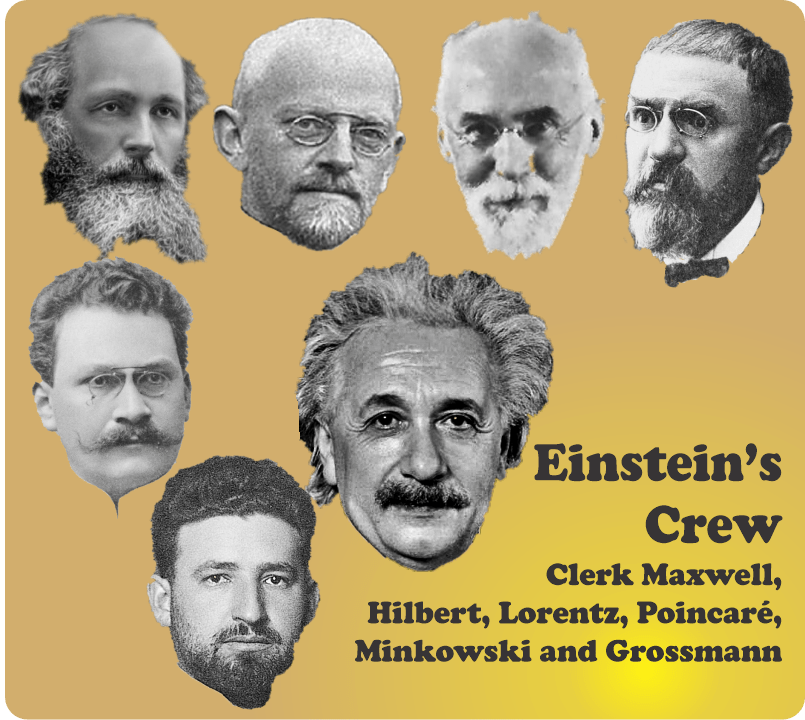
“Caught me, Sis, but it’s an important point. You make a system do something by acting on it, right? We’re used to actions where force is transmitted by direct contact, like hitting a ball with a bat. We’ve known how direct contact works with solids and fluids since Newton. We’ve extended the theory to indirect contact via electric and other fields thanks to Maxwell and Einstein and a host of other physicists. ‘Action at a distance‘ is about making something happen without either direct or indirect contact and that’s weird.”

“Can you give us an example?”

“How about an entanglement story? Suppose there’s a machine that makes coins, nicely packaged up in gift boxes. They’re for sweethearts so it always makes the coins in pairs, one gold and one silver. These are microscopic coins so quantum rules apply — every coin is half gold and half silver until its box is opened, at which point it becomes all one pure metal.”

“Like Schrödinger’s asleep‑awake kitty‑cat!”

“Exactly, Teena. So Bob buys a pair of boxes, keeps one and gives the other to Alice before he flies off in his rocket to the Moon. Quantum says both coins are both metals. When he lands, he opens his box and finds a silver coin. What kind of coin does Alice have?”

“Gold, of course.”

“For sure. Bob’s coin‑checking instantly affected Alice’s coin a quarter‑million miles away. Spooky, huh?”

“But wait a minute. Alice’s coin doesn’t move. It’s not like Bob pushed on it or anything. The only thing that changed was its composition.”

“Sis, you’ve nailed it. That’s why I said ‘seems to‘. Entanglement’s not really action at a distance. No energy or force is exerted, it’s simply an information thing about quantum properties. Which, come to think of it, is why there’s no entanglement of people or gemstones. Even a bacterium has billions and billions of quantum‑level properties. Entanglement‑tweaking one or two or even a thousand atoms won’t affect the object as a whole.”

~~ Rich Olcott

The Frame Game

A familiar footstep outside my office, “C’mon in, Vinnie, the door’s open.”

“Hi, Sy, how ya doin’?”

“Can’t complain. Yourself?”

“Fine, fine. Hey, I been thinking about something you said while Al and us were talking about rockets and orbits and such. You remember that?”

“We’ve done that in quantity. What statement in particular?”

“It was about when you’re in the ISS, you still see like 88% of Earth’s gravity. But I seen video of those astronauts just floating around in the station. Seems to me those two don’t add up.”

“Hah! We’re talking physics of motion here. What’s the magic word?”

“You’re saying it’s frames? I thought black holes did that.”

“Black holes are an extreme example, but frame‑thinking is an essential tool in analyzing any kind of relative motion. Einstein’s famous ‘happy thought‘ about a man in a free‑falling elevator—”

“Whoa, why is that a happy thought? I been nervous about elevators ever since that time we got stuck in one.”

“At least it wasn’t falling, right? Point is, the elevator and whoever’s in it agree that Newton’s First Law of Motion is valid for everything they see in there.”

“Wait, which Law is that?”

“‘Things either don’t move or else they move at a steady pace along a straight line.’ Suppose you’re that guy—”

“I’d rather not.”

“… and the elevator is in a zero‑gravity field. You take something out of your pocket, put it the air in front of you and it stays there. You give it a tap and it floats away in a straight line. Any different behavior means that your entire frame — you, the elevator and anything else in there — is being accelerated by some force. Let’s take two possibilities. Case one, you and the elevator are resting on terra firma, tightly held by the force of gravity.”

“I like that one.”

“Case two, you and the elevator are way out in space, zero‑gravity again, but you’re in a rocket under 1-g acceleration. Einstein got happy because he realized that you’d feel the same either way. You’d have no mechanical way to distinguish between the two cases.”

“What’s that mean, mechanical?”

“It excludes sneaky ways of outside influence by magnetic fields and such. Anyhow, Einstein’s insight was key to extending Newton’s First Law to figuring acceleration for an entire frame. Like, for instance, an orbiting ISS.”

“Ah, you’re saying that floating astronauts in an 88% Earth-gravity field is fine because the ISS and the guys share the frame feeling that 88% but the guys are floating relative to that frame. But down here if we could look in there we’d see how both kinds of motion literally add up.”

“Exactly. It’s just much easier to think about only one kind at a time.”

“Wait. You said the ISS is being accelerated. I thought it’s going a steady 17500 miles an hour which it’s got to do to stay 250 miles up.”

“Is it going in a straight line?”

“Well, no, it’s going in a circle, mostly, except when it has to dodge some space junk.”

“So the First Law doesn’t apply. Acceleration is change in momentum, and the ISS momentum is constantly changing.”

“But it’s moving steady.”

“But not in a straight line. Momentum is a vector that points in a specific direction. Change the direction, you change the momentum. Newton’s Second Law links momentum change with force and acceleration. Any orbiting object undergoes angular acceleration.”

“Angular acceleration, that’s a new one. It’s degrees per second per second?”

“Yup, or radians. There’s two kinds, though — orbiting and spinning. The ISS doesn’t spin because it has to keep its solar panels facing the Sun.”

“But I’ve seen sci-fi movies set in something that spins to create artificial gravity. Like that 2001 Space Odyssey where the guy does his running exercise inside the ship.”

“Sure, and people have designed space stations that spin for the same reason. You’d have a cascade of frames — the station orbiting some planet, the station spinning, maybe even a ballerina inside doing pirouettes.”

“How do you calculate all that?”

“You don’t. You work with whichever frame is useful for what you’re trying to accomplish.”

“Makes my head spin.”

~~ Rich Olcott

Science or Not-science?

Vinnie trundles up to Jeremy’s gelato stand. “I’ll take a Neapolitan, one each chocolate, vanilla and strawberry.”

“Umm… Eddie forgot to order more three-dip cones and I’m all out. I can give you three separate cones or a dish.”

“The dish’ll be fine, way less messy. Hey, Sy, I got a new theory.”

“Mm… Unless you’ve got a lot of firm evidence it can’t be a theory. Could be a conjecture or if it’s really good maybe a hypothesis. What’s your idea?”

“Thing is, Sy, there can’t be any evidence. Ever. That’s the fun of it.”

“Conjecture, then. C’mon, out with it.”

“Well, you remember all that stuff about how time bends toward a black hole’s mass and that’s how gravity works?”

“Sure, except it’s not just black holes. Time bends the same way toward every mass, it’s just more intense with black holes.”

“Understood. Anyway, we talked once about how stars collapse to form black holes but that’s only up to a certain size, I forget what—”

“Ten to fifteen solar masses. Beyond that the collapse goes supernova and doesn’t leave much behind but dust.”

“Right. So you said we don’t know how to make size‑30 black holes like the first pair that LIGO found.”

“We’ve got a slew of hypotheses but the jury’s still out.”

“That’s what I hear. Well, if we don’t even know that much then we for‑sure don’t know how to make the supermassive black hole the science magazines say we’ve got in the middle of the Milky Way.”

“We’ve found that nearly every galaxy has one, some a lot bigger than ours. Why that’s true is one of the biggest mysteries in astrophysics.”

“And I know the answer! What if those supermassive guys started out as just big lumps of dark matter and then they wrapped themselves in more dark matter and everything else?”

“Cute idea, but the astronomy data says we can account for galaxy shapes and behavior if they’re embedded at the center of a spherical halo of dark matter.”

“Not a problem, Sy. Look at the numbers. Our superguy is a size‑4‑million, right? The whole Milky Way’s a billion times heavier than that. Tuck an extra billionth into the middle of the swirl and the stars wouldn’t see the difference.”

“Okay, but there’s more data that says dark matter spreads itself pretty evenly, doesn’t seem to clump up like you need it to.”

“Yeah, but maybe there’s two kinds, one kind clumpy and the other kind not. Only way to find out is to look inside a superguy but time blocks information flow out of there. So no‑one can say I’m wrong!”

“But sir, that’s not science!”

“Why not, kid?”

“The unit my philosophy class did on Popper.”

“The stuff you sniff or the penguins guy?”

“Neither, Karl Popper the philosopher. Dr Crom really likes Popper’s work so we spent a lot of time reading him. Popper was one of the Austrian intellectuals the Nazis chased out when they took power in the 1930s. Popper traveled around, wound up in New Zealand where he wrote his Open Society book that shredded Hegel and Marx. Those sections were fun reading even if they were wordy. Anyway, one of Popper’s big things was the demarcation problem, how to tell the difference between what’s a scientific assertion and what’s not. He decided the best criterion was if there’s a way to prove the assertion false. Not whether it was false but whether it could at least be tested. I was surprised by how many goofy things the Greeks said that would qualify as Popper‑scientific even though they were just made up and have been proven wrong.”

“Well there you go, Vinnie. Physics and the Universe don’t let us see into a supermassive black hole, therefore your idea isn’t testable even in principle. Jeremy’s right, it’s not scientific even though it’s all dressed up in a Science suit.”

“I can still call it a conjecture, though, right, Sy?”

“Conjecture it is. Might even be true, but we’ll never know unless we somehow find out something about dark matter that surprises us. We’ve been surprised a lot, though, so don’t give up hope.”

~~ Rich Olcott

Wait For It

“So, Jeremy, have I convinced you that there’s poetry in Physics?”

“Not quite, Mr Moire. Symbols can carry implications and equation syntax is like a rhyme scheme, okay, but what about the larger elements we’ve studied like forms and metaphors?”

“Forms? Hoo boy, do we have forms! Books, theses, peer-reviewed papers, conference presentations, poster sessions, seminars, the list goes on and that’s just to show results. Research has forms — theoretical, experimental, and computer simulation which is sort of halfway between. Even within the theory division we have separate forms for solving equations to get mathematically exact solutions, versus perturbation techniques that get there by successive approximations. On the experimental side—”

“I get the picture, Mr Moire. Metaphorically there’s lots of poetry in Physics.”

“Sorry, you’re only partway there. My real point is that Physics is metaphor, a whole cascade of metaphors.”

“Ha, that’s a metaphor!”

“Caught me. But seriously, Science in general and Physics in particular underwent a paradigm shift in Galileo’s era. Before his century, a thousand years of European thought was rooted in Aristotle’s paradigm that centered on analysis and deduction. Thinkers didn’t much care about experiment or observing the physical world. No‑one messed with quantitative observations except for the engineers who had to build things that wouldn’t fall down. Things changed when Tycho Brahe and Galileo launched the use of numbers as metaphors for phenomena.”

“Oh, yeah, Galileo and the Leaning Tower experiment.”

“Which may or may not have happened. Reports differ. Either way, his ‘all things fall at the same speed‘ conclusion was based on many experimental trials where he rolled balls of different material, sizes and weights down a smooth trough and timed each roll.”

“That’d have to be a long trough. I read how he used to count his pulse beats to measure time. One or two seconds would be only one or two beats, not much precision.”

“True, except that he used water as a metaphor for time. His experiments started with a full jug of water piped to flow into an empty basin which he’d weighed beforehand. His laboratory arrangement opened a valve in the water pipe when he released the ball. It shut the valve when the ball crossed a finish line. After calibration, the weight of released water represented the elapsed time, down to a small fraction of a second. Distance divided by time gave him speed and he had his experimental data.”

“Pretty smart.”

“His genius was in devising quantitative challenges to metaphor‑based suppositions. His paradigm of observation, calculation and experimental testing far outlasted the traditionalist factions who tried to suppress his works. Of course that was after a century when Renaissance navigators and cartographers produced maps as metaphors for oceans and continents.”

“Wait, Mr Moire. In English class we learned that a metaphor says something is something else but an analogy is when you treat something like something else. Water standing for time, measurements on a map standing for distances — aren’t those analogies rather than metaphors?”

“Good point. But the distinction gets hazy when things get abstract. Take energy, for example. It’s not an object or even a specific kind of motion like a missile trajectory or an ocean wave. Energy’s a quantity that we measure somewhere somehow and then claim that the same quantity is conserved when it’s converted or transferred somewhere else. That’s not an analogy, it’s a metaphor for a whole parade of ways that energy can be stored or manifested. Thermodynamics and quantum mechanics depend on that metaphor. You can’t do much anywhere in Physics without paying some attention to it. People worry about that, though.”

“Why’s that?”

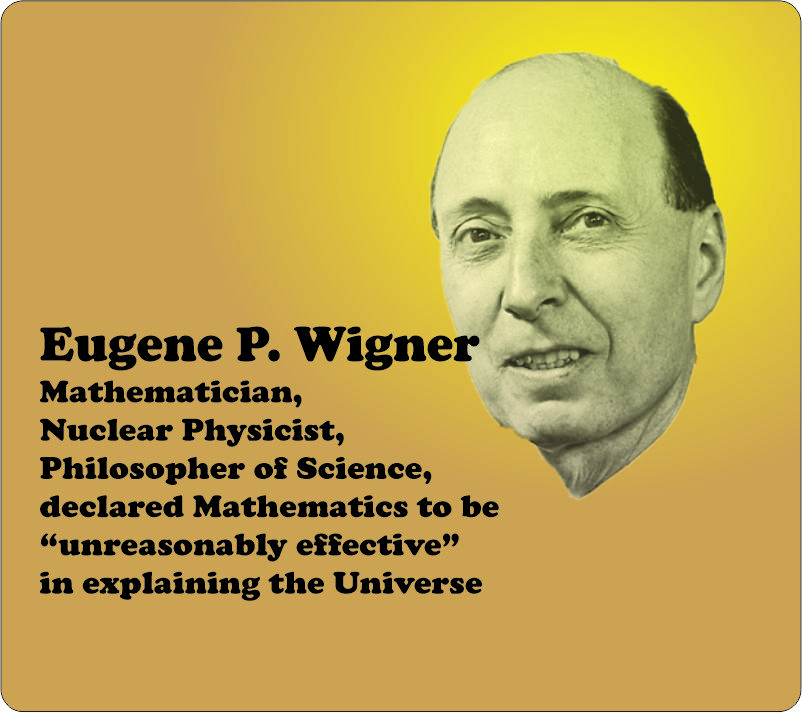
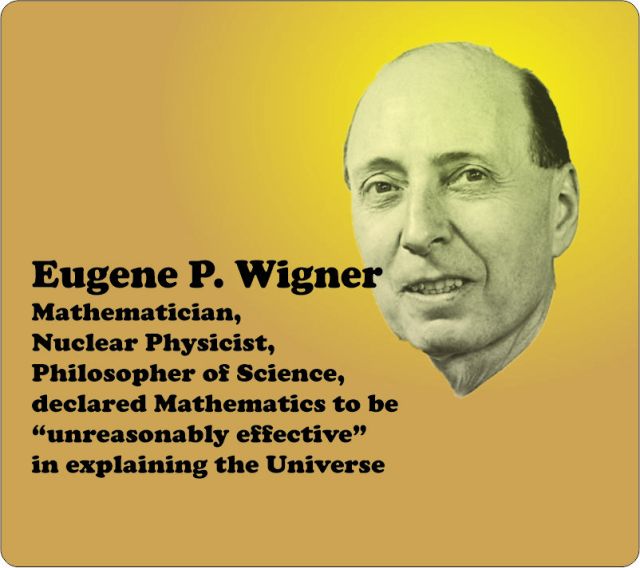
“We don’t really understand why energy and our other fundamental metaphors work as well as they do. No metaphor is perfect, there are always discrepancies, but Physics turns out to be amazingly exact. Chemistry equations balance to within the accuracy of their measuring equipment. Biology’s too complex to mathematize but they’re making progress. Nobel Prize winner Eugene Wigner once wrote a paper entitled, ‘The Unreasonable Effectiveness of Mathematics in The Natural Sciences.’ It’s a concern.”

“Well, after all that, there’s only one thing to say. If you’re in Physics, metaphors be with you.”

~~ Rich Olcott

Imagine A Skyrocket Inside A Black Hole

Vinnie’s never been a patient man. “We’re still waiting, Sy. What’s the time-cause-effect thing got to do with black holes and information?”

“You’ve got most of the pieces, Vinnie. Put ’em together yourself.”

“Geez, I gotta think? Lessee, what do I know about black holes? Way down inside there’s a huge mass in a teeny singularity space. Gravity’s so intense that relativity theory and quantum mechanics both give up. That can’t be it. Maybe the disk and jets? No, ’cause some holes don’t have them, I think. Gotta be the Event Horizon which is where stuff can’t get out from. How’m I doing, Sy?”

“You’re on the right track. Keep going.”

“Okay, so we just talked about how mass scrambles spacetime, tilts the time axis down to point towards where mass is so axes stop being perpendicular and if you’re near a mass then time moves you even closer to it unless you push away and that’s how gravity works. That’s part of it, right?”

“As rain. So mass and gravity affect time, then what?”

“Ah, Einstein said that cause‑and‑effect runs parallel with time ’cause you can’t have an effect before what caused it. You’re saying that if gravity tilts time, it’ll tilt cause‑and‑effect?”

“So far as we know.”

“That’s a little weasel-ish.”

“Can’t help it. The time‑directed flow of causality is a basic assumption looking for counter‑examples. No‑one’s come up with a good one, though there’s a huge literature of dubious testimonials. Something called a ‘closed timelike curve‘ shows up in some solutions to Einstein’s equations for extreme conditions like near or inside a black hole. Not a practical concern at our present stage of technology — black holes are out of reach and the solutions depend on weird things like matter with negative mass. So anyhow, what happens to causality where gravity tilts time?”

“I see where you’re going. If time’s tilted toward the singularity inside a black hole, than so is cause‑and‑effect. Nothing in there can cause something to happen outside. Hey, bring up that OVR graphics app on Old Reliable, I’ll draw you a picture.”

“Sure.”

“See, way out in space here this circle’s a frame where time, that’s the red line, is perpendicular to the space dimensions, that’s the black line, but it’s way out in space so there’s no gravity and the black line ain’t pointing anywhere in particular. Red line goes from cause in the middle to effect out beyond somewhere. Then inside the black hole here’s a second frame. Its black line is pointing to where the mass is and time is tilted that way too and nothing’s getting away from there.”

“Great. Now add one more frame right on the border of your black hole. Make the black line still point toward the singularity but make the red line tangent to the circle.”

“Like this?”

“Perfect. Now why’d we put it there?”

“You’re saying that somewhere between cause-effect going wherever and cause-effect only going deeper into the black hole there’s a sweet spot where it doesn’t do either?”

“Exactly, and that somewhere is the Event Horizon. Suppose we’re in a mothership and you’re in our shuttlecraft in normal space. You fire off a skyrocket. Both spacecraft see sparks going in every direction. If you dive below an Event Horizon and fire another skyrocket, in your frame you’d see a normal starburst display. If we could check that from the mothership frame, we’d see all the sparks headed inward but we can’t because they’re all headed inward. All the sparkly effects take place closer in.”

“How about lighting a firework on the Horizon?”

“Good luck with that. Mathematically at least, the boundary is infinitely thin.”

“So bottom line, light’s trapped inside the black hole because time doesn’t let the photons have an effect further outward than they started. Do I have that right?”

“For sure. In fact, you can even think of the hole as an infinite number of concentric shells, each carrying a causality sign reading ‘Abandon hope, all ye who enter here‘. So what’s that say about information?”

“Hah, we’re finally there. Got it. Information can generate effects. If time can trap cause‑effect, then it can trap information, too.”

~~ Rich Olcott

Tilting at Black Holes

“What’s the cause-effect-time thing got to do with black holes and information?”

“We’re getting there, Al. What happens to spacetime near a black hole?”

“Everybody knows that, Sy, spacetime gets stretched and squeezed until there’s infinite time dilation at the Event Horizon.”

“As usual, Vinnie, what everybody knows isn’t quite what is. Yes, Schwarzschild’s famous solution includes that Event Horizon infinity but it’s an artifact of his coordinate system. Al, you know about coordinate systems?”

“I’m a star-watcher, Sy. Sure, I know about latitude and longitude, declination and right ascension, all that stuff no problem.”

“Good. Well, Einstein wrote his General Relativity equations using generalized coordinates, like x,y,z but with no requirement that they be straight lines or at right angles. Schwarzschild solved the equations for a non‑rotating sphere so naturally he used spherical coordinates — radius, latitude and longitude. Since then other people have solved the equations for more complicated cases using more complicated coordinate systems. Their solutions don’t have that infinity.”

“No infinity?”

“Not that one, anyhow. The singularity at the hole’s geometric center is a real thing, not an artifact. So’s a general Event Horizon, but it’s not quite where Schwarzschild said it should be and it doesn’t have quite the properties that everybody thinks they know it has. It’s still weird, though.”

“How so?”

“First thing you have to understand is that when you get close to a black hole, you don’t feel any different. Except for the spaghettification, of course.”

“It’s frames again, ain’t it?”

“With black holes it’s always frames, Vinnie. If you’re living in a distorted space you won’t notice it. Whirl a meter‑long sword around, you’d always see it as a meter long. A distant observer would see you and everything around you as being distorted right along with your space. They’ll see that sword shrink and grow as it passes through different parts of the distortion.”

“Weird.”

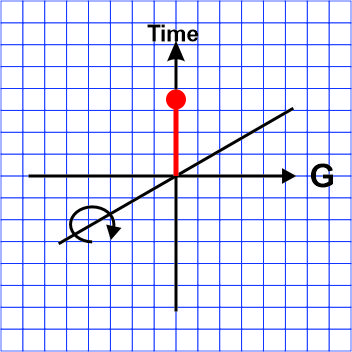
“We’re just getting started, Al. Time’s involved, too. <grabbing a paper napkin and sketching> Here’s three axes, just like x,y,z except one’s time, the G one points along a gravity field, and the third one is perpendicular to the other two. By the way, Al, great idea, getting paper napkins printed like graph paper.”

“My location’s between the Physics and Astronomy buildings, Sy. Gotta consider my clientele. Besides, I got a deal on the shipment. What’s the twirly around that third axis?”

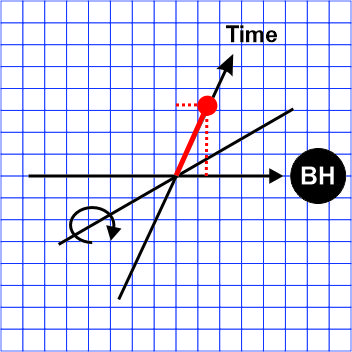
“It’s a reminder that there’s a couple of space dimensions that aren’t in the picture. Now suppose the red ball is a shuttlecraft on an exploration mission. The blue lines are its frame. The thick vertical red line shows it’s not moving because there’s no spatial extent along G. <another paper napkin, more sketching> This second drawing is the mothership’s view from a comfortable distance of the shuttlecraft near a black hole.”

“You’ve got the time axis tilted. What’s that about?”

“Spacetime being distorted by the black hole. You’ve heard Vinnie and me talk about time dilation and space compression like they’re two different phenomena. Thing is, they’re two sides of the same coin. On this graph that shows up as time tilted to mix in with the BH direction.”

“How about those twirly directions?”

“Vinnie, you had to ask. In the simple case where everything’s holding still and you’re not too close to the black hole, those two aren’t much affected. If the big guy’s spinning or if the Event Horizon spans a significant amount of your sky, all four dimensions get stressed. Let’s keep things simple, okay?”

“Fine. So the time axis is tilted, so what?”

“We in the distant mothership see the shuttlecraft moving along pure tilted time. The shuttlecraft doesn’t. The dotted red lines mark its measurements in its blue‑line personal frame. Shuttlecraft clocks run slower than the mothership’s. Worse, it’s falling toward the black hole.”

“Can’t it get away?”

“Al, it’s a shuttlecraft. It can just accelerate to the left.”

“If it’s not too close, Vinnie. The accelerative force it needs is the product of both masses, divided by the distance squared. Sound familiar?”

“That’s Newton’s Law of Gravity. This is how gravity works?”

“General Relativity cut its teeth on describing that tilt.”

~~ Rich Olcott

Cause, Effect And Time

We’re still at Vinnie’s table by the door of Al’s coffee shop. “Long as we’re talking about black holes, Sy, I read in one of my astronomy magazines that an Event Horizon traps information the same way it traps light. I understand how gravity makes escape velocity for photons go beyond lightspeed, but how does that trap information?”

“Well, to start with, Al, you understand wrong. The whole idea of escape velocity applies to massive objects like rockets that feel the force of gravity. Going up they trade kinetic energy for potential energy; given enough kinetic energy they escape. Photons have zero mass — the only way gravity influences them is by bending the spacetime they fly through.”

“Does the bending also affect information or is that something else?”

Minkowski’s spacetime diagram…

“Fair question, but it’ll take some background to answer it. Good thing I’ve got Old Reliable and my graphics files along. Let’s start with this one. Vinnie’s seen a lot of spacetime graphs like this, Al, but I don’t think you have. Time runs upward, distance runs sideward, okay? Naming a specific time and location specifies an event, just like a calendar entry. Draw a line between two events; the slope is the speed you have to go to get from one to the other.”

“Just the distance, you’re not worrying about direction?”

“Good question. You’re thinking space is 3D and this picture shows only one space dimension. Einstein’s spacetime equations take account of all four dimensions mixing together, which is one reason they’re so hard to solve except in special cases. For where we’re going, distance will be enough, okay?”

“Not gonna argue.”

… compartmentalized by Einstein’s speed limit …

“Now we roll in Einstein’s speed limit. Relativity says that nothing can go faster than light. On a Minkowski diagram like this we draw the lightspeed slope at a 45″ angle. Any physical motion has a slope more vertical than that.”

“Huh?”

“See, Al, you’re going one second per second along time, right? If you’re not making much progress distance‑wise, you don’t do much on Sy’s sideways axis. You move mostly up.”

“Exactly, Vinnie. The bottom and top sections are called ‘timelike‘ because, well, they’re mostly like time.”

“Are the other two sections spacelike?”

“Absolutely. You can’t get from ‘Here & Now‘ to the ‘Too far to see‘ event without going faster than light. Einstein said that’s a no‑no. Suppose that event’s a nova, ‘Now‘ but far away. Astronomers will have to just wait until the nova’s light reaches them at ‘Here‘ but at a later ‘Now.’ Okay, Vinnie, here’s a graphic you haven’t seen yet.”

… and re-interpreted in terms of causality.

“Looks pretty much the same, except for that arrow. What’s cause and effect got to do with time?”

“I don’t want to get into the metaphysical weeds here. There’s a gazillion theories about time — the Universe is expanding and that drives time; entropy always increases and that drives time; time is an emergent property of the underlying structure of the Universe, whatever that means. From an atomic, molecular, mechanical physics point of view, time is the result of causes driving effects. Causes always come first. Your finger bleeds after you cut it, not before. Cause‑effect runs along the time axis. Einstein showed us that cause‑effect can’t travel any faster than lightspeed.”

“That’s a new one. How’d he figure that?”

“Objects move objects to make things happen. They can’t move faster than lightspeed because of the relativity factor.”

“What if the objects are already touching?”

“Your hand and that cup are both made of atoms and it’s really their electric fields that touch. Shifting fields are limited by lightspeed, too.”

“So you’re saying that cause-effect is timelike.”

“Got it in one. Einstein would say causality is not only timelike, but exactly along the time axis. That’s one big reason he was so uncomfortable about action at a distance — a cause ‘Here‘ having an effect ‘There‘ with zero time elapsed would be a horizontal line, pure spacelike, on Minkowski’s graph. Einstein invented the principle of entanglement as a counterexample, thinking it impossible. He’d probably be shocked and distressed to see that today we have experimental proof of entanglement.”

~~ Rich Olcott

Holes in A Hole?

Mid-afternoon coffee break time so I head over to Al’s coffee shop. Vinnie’s at his usual table by the door, fiddling with some spilled coffee on the table top. I notice he’s pulled some of it into a ring around a central blob. He looks at it for a moment. His mental gears whirl then he looks up at me. “Hey Sy! Can you have a black hole inside another black hole?”

“That’s an interesting question. Quick answer is, ‘No.’ Longer answer is, ‘Sort of, maybe, but not the way you’re thinking.’ You good with that, Vinnie?”

“You know me better than that, Sy. Pull up a chair and give.”

I wave at Al, who brings me a mug of my usual black mud. “Thanks, Al. You heard Vinnie’s question?”

“Everyone on campus did, Sy. Why the wishy-washy?”

“Depends on your definition of black hole.”

Sky-watcher Al is quick with a response. “It’s a star that collapsed denser than a neutron star.”

Vinne knows me and black holes better than that. “It’s someplace where gravity’s so strong that nothing can get out, not even light.”

“Both right, as far as they go, but neither goes deep enough for Vinnie’s question.”

“You got a better one, I suppose?”

“I do, Vinnie. My definitition is that a black hole is a region of spacetime with such intense gravitation that it wraps an Event Horizon around itself. Al’s collapsed star is one way to create one, but that probably doesn’t account for the Event Horizons around supermassive black holes lurking in galactic cores. Your ‘nothing escapes‘ doesn’t say anything about conditions inside.”

“Thought we couldn’t know what happens inside.”

“Mostly correct, which is why your question is as problematical as you knew it was. Best I can do is lay out possibilities, okay? First possibility is that the outer black hole forms around a pre-existing inner one.”

“Can they do that?”

“In principle. What makes a black hole is having enough mass gathered in close proximity. Suppose you have a black hole floating our there in space, call it Fred, and a neutron star comes sidling by. If the two bodies approach closely enough, the total amount of mass could be large enough to generate a second Event Horizon shell enclosing both of them. How long that’d last is another matter.”

“The outer shell’d go away?”

“No chance of that. Once the shell’s created, the mass is in there and the star is doomed … unless the star’s closest approach matches Fred’s ISCO. That’s Innermost Stable Circular Orbit, about three times Fred’s Event Horizon’s half-diameter if Fred’s not rotating. Then the two bodies might go into orbit around their common center of gravity.”

“How’s rotation come into this?”

“If the mass is spinning, then you’ve got a Kerr black hole, frame-dragging and an ISCO each along and against the spin direction. Oh, wait, I forgot about tidal effects.”

“Like spaghettification, right.”

“Like that but it could be worse. Depending on how tightly neutronium holds itself together, which we don’t know, that close approach might be inside the Roche limit. Fred’s gravity gradient might simply shred the star to grow the black hole’s accretion disk.”

“Grim. You said there’s other possibilities?”

“Sorta like the first one, but suppose the total mass comes from two existing black holes, like the collision that LIGO picked up accidentally back in 2014. Suppose each one is aimed just outside the other’s ISCO. Roche fragmentation wouldn’t happen, I think, because each body’s contents are protected inside its own personal Event Horizon. Uhh … darn, that scheme won’t work and neither will the other one.”

“Why not?”
 ”Why not?”

“Because the diameter of an Event Horizon is proportional to the enclosed mass. The outer horizon’s diameter for the case with two black holes would be exactly the sum of the diameters of the embedded holes. If they’re at ISCO distances apart they’re can’t be close enough to form the outer horizon. For the same reason, I don’t think a neutron star could get close enough, either.”

“No hole in a hole, huh?”

“I’m afraid not.”

~~ Rich Olcott

  • Thanks to Alex and Xander, who asked the question.

Footprints in The Glasses

I think he sometimes lies in wait for me like a cheetah crouching to ambush prey. No, more like a frog. Today I’m on my daily walk when suddenly — “Hey Moire, I got questions!”

Yeah, more like a frog. “Morning, Mr Feder. Out early today, aren’t you?”

“It’s gonna be hot today so I figured you’d walk the park early. I like it down here by the lake.”

Yup, definitely a frog. “Well, what can I do for you?”

“I’m wearing these new glasses, okay?”

“I can see that. Very … stylish.”

“So I read what you wrote about how light slows down when it goes through stuff and I wonder, does the light slow down enough going through these glasses that I might not see a bus in time? And how does stuff slow down light anyway?”

<drawing Old Reliable from its holster> “That first question is quantitative so let’s gather the numbers. The speed of light in vacuum is about 186 000 miles per second, that’s 300 megameters per second or 300 millimeters per nanosecond. Metric system conversions are kinda fun, aren’t they?”

“Hang on — megameters per second is meters per microsecond, take it down another thousand top and bottom…. I guess that’s okay.”

“Old Reliable doesn’t lie. Alright, your eyeglass lenses look like they’re a couple of millimeters thick. I’ll call it three millimeters to make the numbers pretty. If your lenses were vacuum space a short light pulse would pass through in 0.01 nanosecond, okay?”

“Not that thick, but go on.”

“The slow‑down factor is technically called the refractive index. Old Reliable says that eyeglass refractive indexes typically run about 1.5 so with the slow‑down our light pulse would take 0.015 nanosecond instead of 0.01. Is that enough increase to affect your rection time significantly? Let’s see … Says here that a typical nerve impulse travels at about 50 meters per second. Keeping the numbers pretty I’ll guess that between your eye and the vision centers in the back of your brain is about 2 inches or 5 centimeters. You good with that?”

“Not that short, but anything for pretty numbers. Go on.”

“Five centimeters is 0.05 meters, at 50 meters per second comes to 0.001 second. Slowing down that pulse lengthens your reaction time from 0.001 second to 0.001 000 000 015 second. Not enough of a difference to worry about.”

“But how come it slows at all seeing as I’ve heard it’s mostly empty space between the atoms?”

“There’s empty and there’s empty. You’re thinking of little solar‑system atoms, aren’t you, with particle electrons orbiting the nucleus and what space is left is vacuum. We’ve known for a century that it’s not that way. The electrons aren’t particles, they’re fuzzy blobs, and the volume around them is chock full of lumpy electric field. The incoming lightwave, really an electromagnetic wave, doesn’t see one electron here and another one way over there and free passage in between. Nope, it interacts with the whole field and that’s where the slow‑down happens.”

“Lots of quantum jumps and like that, huh?”

“No quantum jumps unless your glasses are tinted. Mmm… You ever run along the seashore?”

“I’m from Jersey. Of course I have.”

 Time periodicity at a point,
 space periodicity at a moment.

“Visualize running across hard sand and suddenly you hit a patch of soft sand. You keep your feet oscillating up and down at the same rate, but you make less progress along the beach. Your footprints get closer together, right?”

“Sometimes I fall down. So?”

“Something similar happens with a lightwave. It repeats in time like your foot going up and down and it repeats in space like your footprints in the sand. The wave’s energy changes with repeat time. When light passes through an electric field like the one inside clear, colorless glass, the field doesn’t absorb energy — no change in repeat time. What does happen is the field squeezes the peak‑to‑peak distance. The wave acts like your footprints getting closer together. Less distance divided by the same time means lower speed. The wave slows down inside the glass.”

“Does light ever fall down?”

“Only if its energy quantum matches an absorber’s gap.”

~~ Rich Olcott