Conversation of Energy

Teena’s next dash is for the slide, the high one, of course. “Ha-ha, Uncle Sy, beat you here. Look at me climbing up and getting potential energy!”

“You certainly did and you certainly are.”

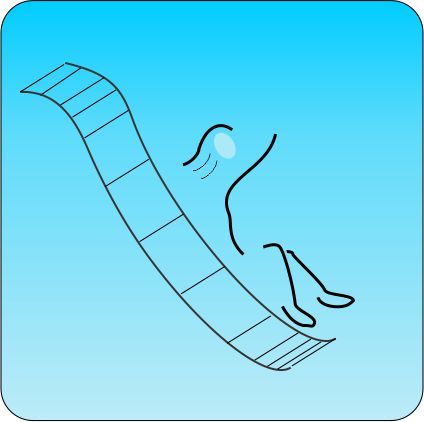
“Now I’m sliding down all kinetic energy, wheee!” <thump, followed by thoughtful pause> “Uncle Sy, I’m all mixed up. You said momentum and energy are like cousins and we can’t create or destroy either one but I just started momentum coming down and then it stopped and where did my kinetic energy go? Did I break Mr Newton’s rule?”
“My goodness, those are good questions. They had physicists stumped for hundreds of years. You didn’t break Mr Newton’s Conservation of Momentum rule, you just did something his rule doesn’t cover. I did say there are important exceptions, remember.”

“Yeah, but you didn’t say what they are.”

“And you want to know, eh? Mmm, one exception is that the objects have to be big enough to see. Really tiny things follow quantum rules that have something like momentum but it’s different. Uhh, another exception is the objects can’t be moving too fast, like near the speed of light. But for us the most important exception is that the rule only applies when all the energy to make things move comes from objects that are already moving.”

“Like my marbles banging into each other on the floor?”

“An excellent example. Mr Newton was starting a new way of doing science. He had to work with very simple systems and and so his rules were very simple. One Sun and one planet, or one or two marbles rolling on a flat floor. His rules were all about forces and momentum, which is a combination of mass and speed. He said the only way to change something’s momentum was to push it with a force. Suppose when you push on a marble it goes a foot in one second and has a certain momentum. If you push it twice as hard it goes two feet in one second and has twice the momentum.”

“What if I’ve got a bigger marble?”

“If you have a marble that’s twice as heavy and you give it the one-foot-per-second speed, it has twice the momentum. Once there’s a certain amount of momentum in one of Mr Newton’s simple systems, that’s that.”

“Oh, that’s why I’ve got to snap my steelie harder than the glass marbles ’cause it’s heavier. Oh!Oh!And when it hits a glass one, that goes faster than the steelie did ’cause it’s lighter but it gets the momentum that the steelie had.”

“Perfect. You Mommie will be so proud of you for that thinking.”

“Yay! So how are momentum and energy cousins?”

“Cous… Oh. What I said was they’re related. Both momentum and kinetic energy depend on both mass and speed, but in different ways. If you double something’s speed you give it twice the momentum but four times the amount of kinetic energy. The thing is, there’s only a few kinds of momentum but there are lots of kinds of energy. Mr Newton’s Conservation of Momentum rule is limited to only certain situations but the Conservation of Energy rule works everywhere.”

“Energy is bigger than momentum?”

“That’s one way of putting it. Let’s say the idea of energy is bigger. You can get electrical energy from generators or batteries, chemical energy from your muscles, gravitational energy from, um, gravity –“

“Atomic energy from atoms, wind energy from the wind, solar energy from the Sun –“

“Cloud energy from clouds –“

“Wait, what?”

“Just kidding. The point is that energy comes in many varieties and they can be converted into one another and the total amount of energy never changes.”

“Then what happened to my kinetic energy coming down the slide? I didn’t give energy to anything else to make it start moving.”

“Didn’t you notice the seat of your pants getting hotter while you were slowing down? Heat is energy, too — atoms and molecules just bouncing around in place. In fact, one of the really good rules is that sooner or later, every kind of energy turns into heat.”

“Big me moving little atoms around?”

“Lots and lots of them.”

~~ Rich Olcott

Conversation of Momentum

Teena bounces out of the sandbox, races over to the playground’s little merry-go-round and shoves it into motion. “Come help turn this, Uncle Sy, I wanna go fast!” She leaps onto the moving wheel and of course she promptly falls off. The good news is that she rolls with the fall like I taught her to do.

“Why can’t I stay on, Uncle Sy?”

“What’s your new favorite word again?”

“Mmmo-MMENN-tumm. But that had to do with swings.”

“Swings and lots of other stuff, including merry-go-rounds and even why you should roll with the fall. Which, by the way, you did very well and I’m glad about that because we don’t want you getting hurt on the playground.”

“Well, it does hurt a little on my elbow, see?”

“Let me look … ah, no bleeding, things only bend where they’re supposed to … I think no damage done but you can ask your Mommie to kiss it if it still hurts when we get home. But you wanted to know why you fell off so let’s go back to the sandbox to figure that out.”

<scamper!> “I beat you here!”

“Of course you did. OK, let’s draw a big arc and pretend that’s looking down on part of the merry-go-round. I’ll add some lines for the spokes and handles. Now I’ll add some dots and arrows to show what I saw from over here. See, the merry-go-round is turning like this curvy arrow shows. You started at this dot and jumped onto this dot which moved along and then you fell off over here. Poor Teena. So you and your momentum mostly went left-to-right.”

“But that’s not what happened, Uncle Sy. Here, I’ll draw it. I jumped on but something tried to push me off and then I did fall off and then I rolled. Poor me. Hey, my arm doesn’t hurt any more!”

“How about that? I’ve often found that thinking about something else makes hurts go away. So what do you think was trying to push you off? I’ll give you a hint with these extra arrows on the arc.”

“That looks like Mr Newton’s new directions, the in-and-out direction and the going-around one. Oh! I fell off along the in-and-out direction! Like I was a planet and the Sun wasn’t holding me in my orbit! Is that what happened, I had out-momentum?”

“Good thinking, Teena. Mr Newton would say that you got that momentum from a force in the out-direction. He’d also say that if you want to stand steady you need all the forces around you to balance each other. What does that tell you about what you need to do to stay on the merry-go-round?”

“I need an in-direction force … Hah, that’s what I did wrong! I jumped on but I didn’t grab the handles.”

“Lesson learned. Good.”

“But what about the rolling?”

“Well, in general when you fall it’s nearly always good to roll the way your body’s spinning and only try to slow it down. People who put out an arm or leg to stop a fall often stress it and and maybe even tear or break something.”

“That’s what you’ve told me. But what made me spin?”

“One of Mr Newton’s basic principles was a rule called ‘Conservation of Momentum.’ It says that you can transfer momentum from one thing to another but you can’t create it or destroy it. There are some important exceptions but it’s a pretty good rule for the cases he studied. Your adventure was one of them. Look back at the picture I drew. You’d built up a lot of going-around momentum from pushing the merry-go-round to get it started. You still had momentum in that direction when you fell off. Sure enough, that’s the direction you rolled.”

“Is that the ‘Conversation of Energy’ thing that you and Mommie were talking about?”

“Conservation. It’s not the same but it’s closely related.”

“Why does it even work?”

“Ah, that’s such a deep question that most physicists don’t even think about it. Like gravity, Mr Newton described what inertia and momentum do, but not how they work. Einstein explained gravity, but I’m not convinced that we understand mass yet.”

~~ Rich Olcott
A Momentous Occasion

<creak> Teena’s enjoying her new-found power in the swings. “Hey, Uncle Sy? <creak> Why doesn’t the Earth fall into the Sun?”

“What in the world got you thinking about that on such a lovely day?”

“The Sun gets in my eyes when I swing forward <creak> and that reminded me of the time we saw the eclipse <creak> and that reminded of how the planets and moons are all floating in space <creak> and the Sun’s gravity’s holding them together but if <creak> the Sun’s pulling on us why don’t we just fall in?” <creak>

“An excellent question, young lady. Isaac Newton thought about it long and hard back when he was inventing Physics.”

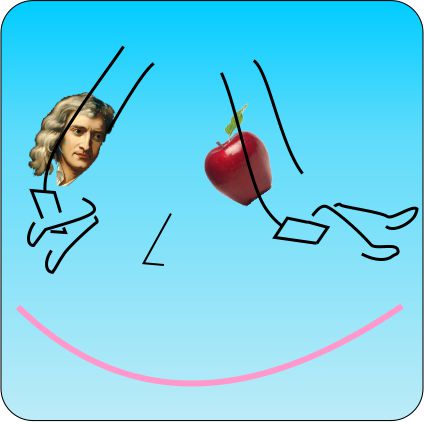
“Isaac Newton? Is he the one with all the hair and a long, skinny nose and William Tell shot an arrow off his head?”

“Well, you’ve described his picture, but you’ve mixed up two different stories. William Tell’s apple story was hundreds of years before Newton. Isaac’s apple story had the fruit falling onto his head, not being shot off of it. That apple got him thinking about gravity and how Earth’s gravity pulling on the apple was like the Sun’s gravity pulling on the planets. When he was done explaining planet orbits, he’d also explained how your swing works.”

“My swing works like a planet? No, my swing goes back and forth, but planets go round and round.”

“Jump down and we can draw pictures over there in the sandbox.”

<thump!! scamper!> “I beat you here!”

“Of course you did. OK, what’s your new M-word?”

“Mmmo-MMENN-tummm!”

“Right. Mr Newton’s Law of Inertia is about momentum. It says that things go in a straight line unless something interferes. It’s momentum that keeps your swing going.”

“B-u-u-t, I wasn’t going in a straight line, I was going in part of a circle.”

“Good observing, Teena, that’s exactly right. Mr Newton’s trick was that a really small piece of a circle looks like a straight line. Look here. I’ll draw a circle … and inside it I’ll put a triangle… and between them I’ll put a hexagon — see how it has an extra point halfway between each of the triangle’s points? — and up top I’ll put the top part of whatever has 12 sides. See how the 12-thing’s sides are almost on the circle?”

“Ooo, that’s pretty! Can we do that with a square, too?”

“Sure. Here’s the circle … and the square … and an octagon … and a 16-thing. See, that’s even closer to being a circle.”

“Ha-ha — ‘octagon’ — that’s like ‘octopus’.”

“For good reason. An octopus has eight arms and an octagon has eight sides. ‘Octo-‘ means ‘eight.’ So anyway, Mr Newton realized that his momentum law would apply to something moving along that tiny straight line on a circle. But then he had another idea — you can move in two directions at once so you can have momentum in two directions at once.”

“That’s silly, Uncle Sy. There’s only one of me so I can’t move in two directions at once.”

“Can you move North?”

“Uh-huh.”

“Can you move East?”

“Sure.”

“Can you move Northeast?”

“Oh … does that count as two?”

“It can for some situations, like planets in orbit or you swinging on a swing. You move side-to-side and up-and-down at the same time, right?”

“Uh-huh.”

“When you’re at either end of the trip and as far up as you can get, you stop for that little moment and you have no momentum. When you’re at the bottom, you’ve got a lot of side-to-side momentum across the ground. Anywhere in between, you’ve got up-down momentum and side-to-side momentum. One kind turns into the other and back again.”

“So complicated.”

“Well, it is. Newton simplified things with revised directions — one’s in-or-out from the center, the other’s the going-around angle. Each has its own momentum. The swing’s ropes don’t change length so your in-out momentum is always zero. Your angle-momentum is what keeps you going past your swing’s bottom point. Planets don’t have much in-out momentum, either — they stay about their favorite distance from the Sun.”

“Earth’s angle-momentum is why we don’t fall in?”

“Yep, we’ve got so much that we’re always falling past the Sun.”

~~ Rich Olcott
Swinging into Physics

A gorgeous Spring day, perfect for taking my 7-year-old niece to the park. We politely say “Hello” to the geese and then head to the playground. Of course she runs straight to the swing set. “Help me onto the high one, Uncle Sy!”

“Why that one, Teena? Your feet won’t reach the ground and you won’t be able to kick the ground to get going.”

“The high one goes faster,”

“How do you know that?”

“I saw some kids have races and the kid on the high swing always did more back-and-forths. Sometimes it was a big kid, sometimes a little kid but they always went faster.”

“Good observing, Sweetie. OK, upsy-daisy — there you are.”

“Now give me pushes.”

“I’m not doing all the work. Tell you what, I’ll give you a start-up shove and then you pump to keep swinging.”

“But I don’t know how!”

“When you’re going forward, lean way back and put your feet up as high as you can. Then when you’re going backward, do the opposite — lean forward and bend your knees way back. Now <hnnnhh!> try it.

<creak … creak> “Hey, I’m doing it! Wheee!”

<creak> “Good job, you’re an expert now.”

“How’s it work, Uncle Sy?”

“It’s a dance between kinetic energy, potential energy and momentum.”

“I’m just a little kid, Uncle Sy, I don’t know what any of those things are.”

“Mmm… Energy is what makes things move or change. You know your toy robot? What happens when its batteries run down?”

“It stops working, silly, until Mommie puts its battery in the charger overnight and then it works again.”

“Right. Your robot needs energy to move. The charger stores energy in the battery. Stored energy is called potential which is like ‘maybe,’ because it’s not actually making something happen. When the robot gets its full-up battery back and you press its GO button, the robot can move around and that’s kinetic energy. ‘Kinetic’ is another word for ‘moving.'”

“So when I’m running around that’s kinetic energy and when I get tired and fall asleep I’m recharging my potential energy?”

“Exactly. You’re almost as smart as your Mommie.”

“An’ when I’m on the swing and it’s moving, that’s kinetic.”

“You’ve got part of it. Watch what’s happening while you swing. Are you always moving?”

<creak … creak> “Ye-e—no! Between when I swing up and when I come down, I stop for just a teeny moment at the top. And I stop again between backing up and going forward. Is that when I’m potential?”

“Sort of, except it’s not you, it’s your swinging-energy that’s all potential at the top. Away from the top you turn potential energy into kinetic energy, going faster and faster until you’re at the bottom. That’s when you go fastest because all your potential energy has become kinetic energy. As you move up from the bottom you slow down because you’re turning your kinetic energy back into potential energy.”

<creak> “Back and forth, potential to kinetic to potential, <creak> over and over. Wheee! Mommie would say I’m recycling!”

“Yes, she would.”

<creak> “Hey, Uncle Sy, how come I don’t stop at the bottom when I’m all out of potential?”

“Ah. What’s your favorite kind of word?”

M-words! I love M-words! Like ‘murmuration‘ and ‘marbles.'”

“Well, I’ve got another one for you — momentum.”

“Oh, that’s yummy — mmmo-MMMENN-tummmm. What’s it mean?”

“It’s about how things that are moving in a straight line keep moving along that line unless something else interferes. Or something that’s standing still will just stay there until something gives it momentum. When we first sat you in the swing you didn’t go anywhere, did you?”

“No, ’cause my toes don’t reach down to the ground and I can’t kick to get myself started.”

“That would have been one way to get some momentum going. When I gave you that push, that’s another way.”

“Or I could wear a jet-pack like Tony Stark. Boy, that’d give me a LOT of momentum!”

“Way too much. You’d wrap the swing ropes round the bar and you’d be stuck up there. Anyway, when you swing past the bottom, momentum is what keeps you going upward.”

“Yay, momentum!” <creak>

~~ Rich Olcott

The Pretty-good Twenty-nine

Time for coffee and a scone. As I step into Al’s coffee shop he’s taking his Jupiter poster down from behind the cash register.

“Hey, Al, I liked that poster. You decide you prefer plain wall?”

“Nah, Sy, I got a new one here. Help me get it up over the hook.”

A voice from behind us. “Ya got it two degrees outta plumb, clockwise.” Vinnie, of course. Al taps the frame to true it up.

Teachers, click here to download a large-format printable copy.

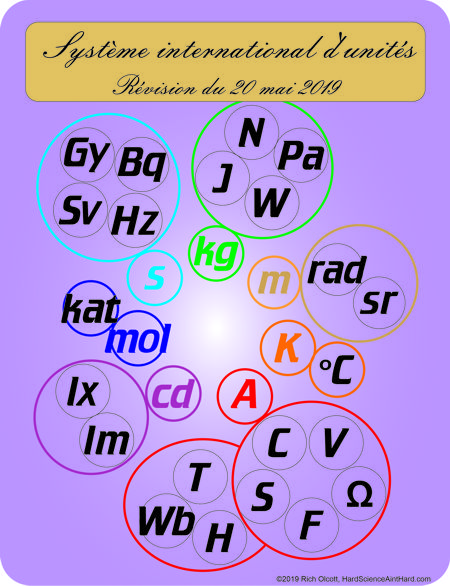
“Hey, Sy, in the middle, that’s the same seven units we just finished talking about — amps for electric current, kelvins for temperature, meters for length, kilograms for mass, seconds for time, moles for counting atoms and such, and that candela one you don’t like. What’s all the other bubbles about? For that matter, what’s the poster about, Al?”

“What it’s about, Vinnie, is on May 20 the whole world goes to a new set of measurement standards, thanks to some international bureau.”

Le Bureau International des Poids et Mesures.” It’s Newt Barnes in from the Physics building. “The bubbles in that central ring are the BIPM’s selections for fundamental standards. Each one’s fixed by precisely defined values of one or more universal physical constants. For instance, a ruler calibrated on Earth will match up perfectly with one calibrated on Mars because both calibrations depend on the wavelength of radiation from a cesium-based laser and that’s the same everywhere.”

“How about the other bubbles and the rings around them?”

“They’re all derived quantities, simple combinations of the fundamental standards.”

“Hey, I see one I recognize. That °C has gotta be degrees centigrade ’cause it’s right next to kelvins. Centigrade’s the same as kelvins plus , uh, 273?”

“There you go, Al. What’s ‘rad’ and ‘sr’, Newt?”

“Symbols for radian and steradian, Vinnie. They both measure angles like degrees do, but they fit the BIPM model because they’re ratios of lengths and length is one of the fundamentals. Divide a circle’s circumference by its radius and what do you get?”

“Twice pi.”

“Right, call it 2π radians and that’s a full circle. Half a circle is π radians, a right angle is π/2 radians and so on. Works for any size circle, right? Anyone remember the formula for the area of a sphere?”

“4πr2, right?”

“Exactly. If you divide any sphere’s area by the square of its radius you get 4π steradians. Any hemisphere is 2π steradians and so on. Steradians are handy for figuring things like light and gravity that decrease as the square of the distance.”

Something occurs to me. “I’m looking at those bigger bubbles that enclose the derived quantities. Seems to me that each one covers a major area of physical science. The green one with newtons for force, pascals for pressure, joules for energy and watts for power — that’d be Newtonian physics. The red circle with volts plus coulombs for charge, ohms for resistance, farads for capacitance, siemens for electrical conductance — all that’s electronics. Add in henries for inductance, webers for magnetic flux and teslas for flux density and you’ve got Maxwellian electromagnetism.”

“You’re on to something, Sy. Chemistry’s there with moles and katals, also known as moles per second, for catalytic activity. How does your idea fit the cluster attached to seconds?”

“They’re all per-second rates, Newt. The hertz is waves per second for periodic things like sound or light-as-a-wave. The other three are about radioactivity — bequerels is fissions per second; grays and sieverts are measures of radiation exposure per kilogram.”

“Vinnie says you don’t like candelas, so you probably don’t like lumens or luxes either. What’s your gripe with them?”

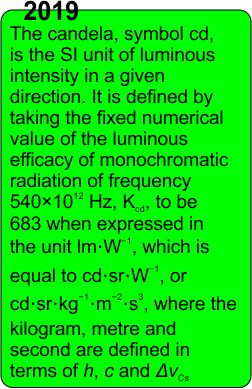
“All three are supposed to quantify visible light from a source, as opposed to the total emission at all wavelengths. But the definition of ‘visible’ zeros in on one wavelength in the green because that’s where most people are most sensitive. Candelas aren’t valid for a person who’s color-blind in the green, nor for something like a red laser that has no green lightwaves. I call bogosity, and lumens and luxes are both candela-based.”

“These 29 standards are as good on Mars as they are here on Earth?”

“That’s the plan.”

~~ Rich Olcott

The Magnificent Seven

“Hey, Sy, you said there’s seven fundamental standards. We’ve talked about the second and the meter and the kilogram and the ampere. What’s left?”

“The mole, the kelvin and the candela, Al. They’re all kinda special-purpose but each has its charms. The mole, for instance, is cute and fuzzy and has its very own calendar date.”

“You’re pulling our legs, Sy. A cute unit of measure? No way.”

“Hear me out, Vinnie. How many shoes in a dozen pairs?”

“Huh? Two dozen, that’s twenty-four.”

“Sure, but it’s easier to work in dozens. How many hydrogen atoms in a dozen H2O molecules?”

“Two dozen, of course. Are we going somewhere here?”

“Next step. A mole is like a dozen on steroids, about 6×10²³ whatevers. How many hydrogen atoms in a mole of H2O molecules?”

“Two moles, I suppose, or 12×1023.”

“You got the idea.”

“Cute.”

“A-hah! Gotcha for one.”

“Fair hit. How about the fuzzy part and the date?”

“The fuzzy has to do with isotopes. Every element has an atomic number and an atomic weight. The atomic number counts protons in the nucleus –all atoms of an element have the same atomic number. But different isotopes of an element have different numbers of neutrons. The ‘weight’ is protons plus neutrons, averaged across the isotopes. If you’re holding a mole of an element, you’re holding its atomic weight in grams. The fuzzy happens because samples of an element from different sources can have different mixtures of isotopes. You may have some special diamonds that contain nothing but carbon-12. A mole of those atoms masses exactly 12 grams. My sample is enriched with 10% of carbon-13. Mole-for-mole, my carbon is a tad heavier than yours. In fact, 6×10²³ of my atoms mass 12.10 grams. That’s an extreme example but you get the idea.”

“Fuzzy, a little, OK. And the date thing?”

“June 23 is Mole Day, celebrated by Chemistry teachers everywhere.”

“What’s the kelvin about then?”

“Temperature. And most solid-state electronics. Zero kelvin is absolute zero, the coldest temperature something can get, when the maximum heat has been sucked out and all its atoms have minimum vibrational energy. From there you heat it up degree by degree until you get to where water can co-exist as liquid, solid and water vapor. It used to be the standard to call that temperature 273.16 K.”

“Used to be? Water doesn’t do that any more?”

“Oh, it still does, but the old standard had problems. It used five different ‘official’ techniques and 16 different calibration checks to cover the range from 3 K up to the melting point of copper. Some of those standards, like the melting pressure of helium-3, are not only inconvenient but expensive. Others led to measured intermediate temperatures that disagree depending on which direction you’re going. The defined standards did nothing for the plasma people who work above 1500 K. It was a mess.”

“So how does the new standard fix that?”

“It exploits new tech, especially in solid-state science. The Boltzmann constant, kB, is sort of the quantum of heat capacity at the microscopic level. The product kBT is a threshold energy. Practically everything that happens at the quantum level depends on the ratio of some process energy divided by kBT. If the ratio’s high the process runs; if it’s low, nothing. In-between, the response is predictably temperature-dependent. Thanks to a plethora of new solid-state thermal sensors that depend on that logic, we now have a handle on the range from microkelvins to kilokelvins and above.”

“Pretty good. What’s the last one?”

“It’s the one I’m least happy about, the candela. It’s a unit for how bright a light source is, sort-of. Take the source’s power output at all optical frequencies and ‘correct’ that by how much each frequency would stimulate a mathematically modeled ‘standard human eye.’ Isolate the ‘corrected’ watts at 555 nanometers, multiply by Kcd=683. It’s a time-hallowed metric that lighting designers depend upon, but it skips over little things like we actually see with rod cells and three kinds of cone cells, none of which match the standard curve. Kcd is just too human-centered to be a universal constant.”

“Humans ain’t universal. We’re not even on Mars.”

“Yet.”

~~ Rich Olcott

Beautiful Realization

“Whaddaya mean, Sy, ‘charge and resistance and voltage all playing beautiful together‘? How’s that beautiful?”

“It is when they play together in a Kibble Balance, Vinnie. That beautifully-designed device solved the realization problem for two of the revised fundamental standards of measurement. Here’s the one for electricity.”

“That’s odd. It says ‘electric current’ but the number’s about charge. And I don’t see anything in there about voltage or resistance.”

“True. The electronic charge e is one of our universal constants. It and the speed of light and Planck’s constant h are the same on Mars as they are here on Earth. Take a cesium-based laser from Earth to Mars and its frequency doesn’t change. That’s why the revisions are measure-anywhere standards, no need to carry something to Paris to compare it to a physical object.”

“This is another one of those definition tricks, isn’t it? Like the cesium frequency — we defined the second by saying it’s the time required for so-and-so many waves of that light beam. Here, it’s not like someone measured the charge in coulombs, it’s we’re gonna make the coulomb exactly big enough so when we do measure an electron it’ll match up.”

“You’re not wrong, Vinnie, but it’s not quite that arbitrary. Lots of people did measure the electron against the old standard. This number represents the most accurate estimate across all the measurements. The standards board just froze it there. It’s the same strategy they took with the other six fundamental standards — each of them sits on top of a well-known constant.”

“Like Newton’s gravitational constant?”

“Sorry, Al, not that one. It’s universal, alright, but it’s only known to four significant figures, nowhere near the 8-or-better level the metrologists demand.”

“So tell us about the beauty part, Sy.”

I grab some paper napkins from the dispenser at our table. Al gives me a look. In his opinion Vinnie uses way too many of those and he doesn’t want it to spread. “Just using what I need to make a point, Al. Vinnie, I know you like pictures better than algebra but bear with me.”

“Yeah, you went through the kilogram thing pretty quick what with the garlic and all.”

“Oooh, yeah.” <scribbling on the first napkin> “Well anyway, here’s a sketch of the Kibble Balance rigged for weighing but let’s just pay attention to the parts in the dark blue oval. That zig-zag line labeled RK is a resistor that exploits the quantum Hall effect. Quantum math says its resistance is given by RK=h/e2. That’s exactly 25812.80756 ohms.”

“That a lot more digits than gravity.”

“Nice catch, Al. Now the second component in the oval is a quantum voltmeter. If you put a voltage V across it, the Josephson junction inside passes an alternating current whose frequency is f=V/CJ, where CJ=h/2e.” <scribbling on the second napkin> “Put another way. the frequency tells you the voltage from V=f×CJ and that’s the same as V=f×h/2e.” <scribbling on the third napkin> “The current iW going through RK is V/RK and that’s going to be iW=(f×CJ)/(RK)=f×(CJ/RK)=f×(h/2e)/(h/e2)=(f/2)×e. You with me?”

“Gimme a minute… You’re saying that the current is going to be half some frequency, which we can measure, times the charge on an electron. Yeah, that makes sense, ’cause the current is electrons and you got us counting electrons. Hey, wait, what happened to the h?”

“Canceled out in the fraction, just the way that e canceled out in the fraction for the kilogram.”

“Cute.”

“Better than cute, it’s beautiful. The same equipment, the Kibble Balance plus a gravimeter, gives you the realization of a kilogram depending only on h, AND the realization of the ampere depending only on e. Once you know the standards for time, which depends only on that cesium frequency, and for length, which depends only on time and the speed of light, you can get standards for mass and electric current in the NIST lab here on Earth or up on Mars or anywhere.”

“Almost anywhere.”

“What’s your exception?”

“In space, where there’s no gravity.”

“Einstein covered that with his Equivalence Principle.”

~~ Rich Olcott

The Currant Affair

Al has a new sign up at his coffee shop, “Scone of the day — Current.” He chuckles when I quietly point out the spelling error. “I know how to spell currant, Sy. I’m just gonna enjoy telling people that whatever I’m taking from the oven is the current flavor.” I’m high-fiving him for that, just as Vinnie slams in and yells out, “Hey, Al, you got your sign spelled wrong. Got any cranberry ones in there?”

Al gives me a look. I shrug. Vinnie starts in on me. “Hey, Sy, that was pretty slick what that Kibble guy did. All the measurements and calculations had the mass standard depending on three universal constants but then suddenly there was only two.”

Al pricks up his ears. “Universal constants, Sy?”

“We think so. Einstein said that the speed of light c is the same everywhere. That claim has withstood a century of testing so the International Bureau of Weights and Measures took that as their basis when they redefined the meter as the standard of length. Planck’s constant h is sometimes called the quantum of action. It shows up everywhere in quantum-related phenomena and appears to be fundamental to the way the Universe works. Bryan Kibble’s team created a practical way to have a measure-anywhere standard of mass and it just happens to depend only on having good values for c and h.”

“What’s the one that Vinnie said dropped out?”

“I knew you’d ask that, Al. It’s e, the charge on an electron. The proton and every other sub-atomic particle we’ve measured has a charge that’s some integer multiple of e. Sometimes the multiplier is one, sometimes it’s zero, sometimes it’s a negative, but e appears to be a universal quantum of charge. Millikan’s oil drop experiment is the classic example. He measured the charge on hundreds of ionized droplets floating in an electric field between charged plates. Every droplet held some integer multiple between 1 and 150 of 1.6×10⁻¹⁹ Coulomb.”

“That’s a teeny bit of electricity. I remember from Ms Kendall’s class that one coulomb is one ampere flowing for one second. Then a microampere flowing for a microsecond is, uhh, 6 million electrons. How did they make that countable?”

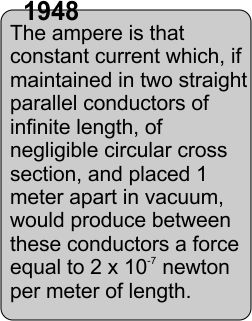
“Ah, you’ve just touched on the ‘realization problem,’ which is not about getting an idea but about making something real, turning a definition into a practical measurement. Electrical current is a good example. Here’s the official definition from 60 years ago. See any problems with it, Vinnie?”

“Infinitely long wires that are infinitely thin? Can’t do it. That’s almost as goofy as that 1960 definition of a second. And how does the force happen anyway?”

“The force comes from electrons moving in each wire electromagnetically pushing on the electrons in the other wire, and that’s a whole other story. The question here is, how could you turn those infinities into a real measurement?”

“Lemme guess. In the 1960 time standard they did a math trick to model a fake Sun and based the second on how the fake Sun moves. Is this like that, with fake wires?”

“Nice shot, Vinnie. One of the methods worked like that — take a pair of wires with a known resistance, bend them along a pair of parabolas or some other known curve set close together, apply a voltage and measure the force. Then you use Maxwell’s equations to ‘correct’ the force to what it would have been with the infinite wires the right distance apart. Nobody was comfortable with that.”

“Not surprised — too many ways to do it wrong, and besides, that’s an awfully small force to measure.”

“Absolutely. Which is why there were so many competing standards, some dating back to the 1860s when we were still trying to figure out what electricity is. Some people used a standard resistor R and the voltage V from a standard chemical cell. Then they defined their standard current I from I=V/R. Some measured power P and calculated I2=P/R. Other people standardized charge from the electrostatic force F=q1q2/r2 between two charged objects; they defined current as charge passed per second. It was a huge debate.”

“Who won?”

“Charge and R and V, all playing together and it’s beautiful.”

~~ Rich Olcott

Revenge of The Garlic Calzone

“So what’s the next two steps?” Vinnie asks.

“I’m thinking a dose of the pink stuff and a glass of milk. That garlic calzone’s just not giving up.”

“Nah, we were talking about the new mass standard and how it uses a Kibble Balance protocol you said had three steps but you only got to the gravity-measuring step. You wanna talk to take your mind off your gut, do some more of that.”

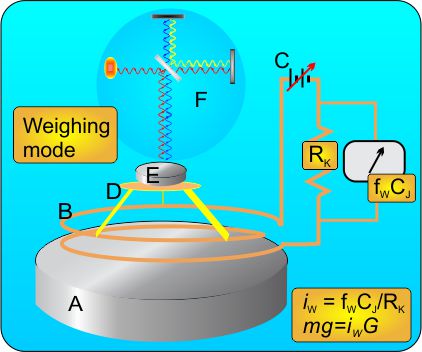
“<burp-sigh> OK, assume we did an accurate measurement of gravity’s acceleration g right next to the Balance.” <pulling Old Reliable from its holster...> “Here’s the device in the protocol’s second step, ‘weighing mode’. Bottom to top we’ve got a permanent magnet A and a coil of wire B that’s hooked up to some electronics. The coil floats in the magnetic field because it’s carrying an electric current from that adjustable power source C. The balance’s test pan D rides on the coil and supports our target mass E. Up top, laser interferometer F keeps track of the test pan’s position. Got all that?”

“Mass goes in the pan, got it.”

“Good. You adjust the current through the coil until the interferometer tells you the test pan is floating motionless. Here’s where the electronics come into play. The same current goes through resistor RK, a quantum Hall effect device chilling in a magnetic field and a bath of liquid helium. Quantum math says its resistance is h/e², where e is the charge on an electron and h is Planck’s constant. Those’re both universals like Einstein’s lightspeed c. RK comes to 25812.807557 ohms. You remember the V-I-R diagram?”

“Once Ms Kendall drills it into your brain it’s there forever. Volts equals current in amps times resistance in ohms.”

“Yep. In the Kibble Balance we evaluate the coil’s balancing current by measuring the voltage drop across RK. The voltmeter uses a Josephson junction, another quantum thingie. At a voltage V the junction passes a small alternating current whose frequency is f=V/CJ, where CJ=h/2e. Count the frequency and you can calculate the voltage. DivideV by RK to get the current iW going through the resistor. Everything here meets the count-based, stable, reproducible-anywhere standard.”

“I suppose the w suffixes mean ‘weigh mode’ and m in the bottom equation is the mass. Makes sense that heavier masses need more current to float them. What’s G?”

“Hold on, I got another burp coming … <bo-o-o-O-O-ORP!>”

“Impressive.”

“Thanks, I suppose. G rolls up all those geometry factors — size, shape and power of the magnet and so forth — that you complained about when I said ‘motor-generator.’ We take care of that in the third step. Here’s the diagram for that.”

“Looks pretty much the same.”

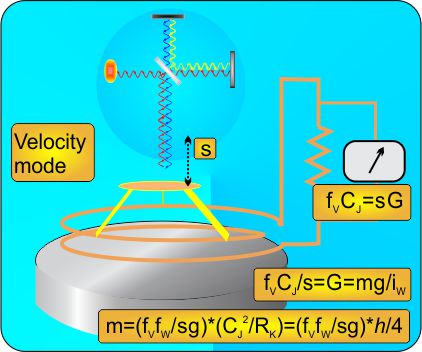
“We took out the target mass and the power source, and see, there’s v-subscripts for ‘velocity mode.’ We move the coil vertically while
the atomic clock ticks and the interferometer tracks the pan’s position. That lets us calculate speed s. The coil moving through the magnetic field generates a voltage V=fvCj=sG. Because the geometry factor G is identical between modes, the linkage between coil speed and output power is exactly the same as the linkage between current and input power. That’s the middle equation — velocity-mode voltage divided by speed equals weighing-mode force divided by current.”

“That’s weird.”

“But true, and so elegant. Every variable in that equation save the mass comes from a high-accuracy, high-precision reproducible standard. That makes mass a measure-anywhere dimension, too. But wait, there’s more.”

“Too much math already.”

“Just a little more. Plug all these equations together and you get the bottom one. That’s exciting.”

“Doesn’t look exciting to me.”

“It goes back to the universal constants thing. The first factor in th middle is a ratio of count-derived quantities. Plug the quantum definitions into the second factor and you get CJ²/RK=(h²/4e²)(e²/h)=h/4. What that says is mass is expressible in units of Planck’s constant. That’s deep stuff! What’s exciting is that the standards people used that result in defining the kilogram.”

“Well, blow me down. And one more of your garlic burps or any more math just might.”

~~ Rich Olcott

The Case of The Garlic Calzone

I’m on an after-lunch hike through the park, trying to digest one of Pizza Eddie’s roasted garlic calzones. Vinnie’s walking a path that joins mine. “Hey, Sy. Whoa, lemme get upwind of you. You did the garlic calzone again, huh?”

“Yeah, and this time Eddie went two cloves over the line and didn’t roast them enough. Talk to me, take my mind off it, OK?”

“Sure. Uhhh… Let’s get back to kilograms which I got started on from a magazine article saying they’re chucking the old kilogram for something better. We were talking about that but got sidelined with measuring time and distance. So what’s the better thing?”

“They weren’t really sidelines, Vinnie, they were setting-up exercises. The technical world needs a set of measurement standards that are stable and precisely reproducible anywhere, any time. The old kilogram, the IPK, isn’t any of that. It’s a polished cylinder of platinum-iridium alloy in a Paris vault. You can’t reproduce it exactly, just very close. All you can do is bring a candidate object to Paris, measure the mass difference between it and the IPK, and then carry your newly-certified junior standard home to calibrate other masses on down the line. And hope you don’t scratch yours or get fingermarks on it en route.”

“But if we’re talking mass, why did time and distance standards even come into the conversation?”

“Several becauses. High-accuracy time measurement is fundamental to all the modern standards; much of the laser technology that supports the new time standard also plays into the other revised standards; and the time standard is the simplest one to describe and implement. No matter where you are, you can build a cesium-atom maser and fire it up. Start counting peaks in the maser beam and when you reach the defined number you’ve been counting for exactly one second. <burp> Excuse me.”

“You’re ‘scused. Yeah, the distance thing is pretty simple, too, now they’ve defined the speed of light as a standard. Is the mass standard that simple?”

“Nowhere near. In fact, it’s easier to describe the technique than to explain why it meets the requirements. It depends upon an apparatus called the Kibble Balance, named in honor of the late Bryan Kibble who devoted two decades of his life to perfecting the machine. Like with the spring balance we talked about, you estimate an object’s mass by comparing the force of gravity on it to some opposing force that you can quantify. The object in question goes on the Balance’s test pan. The opposing ‘pan’ is essentially a motor-generator, just a permanent magnet and a moving coil of wire.”

“Alright, I know enough about motors to see that’s complicated. To figure the balance of forces you gotta know the magnet’s strength and geometry, the coil’s resistance and geometry and speed, the voltage across it, the current through it… They’re none of them exact numbers. And you gotta account for how gravity can be different somewhere else like on Mars. Hard to see how that’s much of an improvement.”

“That’s the beauty of it. Kibble’s machine and measurement protocol are designed so that many of the finicky quantities drop out of the calculation. What’s left is high-accuracy counting-type numbers.”

“Measurement protocol? It’s not just ‘load the test pan and read a dial’?”

“Nope, it’s a three-step process. First step is to measure g, the acceleration of gravity in the Kibble room. Galileo showed all masses accelerate the same so any mass will do. National standards labs can’t just take a value from a book. At their level of rigor g has measurably different values on different floors of the building. You need a high-accuracy gravimeter — a vertical evacuated pipe with a laser interferometer pointing up from the bottom. Drop a mirrored test mass down the pipe while an atomic clock records exactly when the falling mass passes each of hundreds of checkpoints. Two adjacent distance-time pairs gives you one velocity, two adjacent velocity-time pairs gives you one acceleration, average them all together. <BURP!> You got any antacid tablets?”

“Do I look like somebody with a first aid kit in my purse? Don’t answer that. Here.”

“Thanks. No more garlic calzones, ever.”

~~ Rich Olcott