Gozer, The Stay Puft Black Hole

We’re downstairs at Eddie’s Pizza.  Vinnie orders his usual pepperoni.  In memory of Sam Panapoulos, I order a Hawaiian.  Then we’re back to talking black holes.

“I been thinking, Sy.  These regular-size black holes, the ones close to the Sun’s mass, we got a lot of ’em?”

“I’ve seen an estimate of 50,000 in the Milky Way Galaxy so you could say they’re common.  That’s one way to look at it.  The other way is to compare 50,000 with the 250 billion stars in the galaxy.  One out of 5,000,000 is a black hole, so they’re rare.  Your choice, Vinnie.”

“But all three confirmed LIGO signals were the next bigger size range, maybe 10 to 30 solar masses; two of ’em hittin’ each other and they’ve all been more than a billion lightyears away.  How come LIGO doesn’t see the little guys that are close to us?”

“Darn good question.  Lessee… OK, I’ve got several possibilities.  Maybe the close-in little guys do collide, but the signal’s too weak for us to detect.  But we can put numbers to that.  In each LIGO event we’ve seen, the collision released about 10% of their 40-to-60-Sun total mass-energy in the form of gravitational waves.  LIGO’s just barely able to detect that, right?”

“They were excited they could, yeah.”

“So if a pair of little-guy black holes collided they’d release about 10% of two makes 0.2 solar masses worth of energy.  That’d be way below our detection threshold if the collision is a billion light-years away.  But we’re asking about collisions inside the Milky Way.  Suppose the collision happened near the center, about 26,000 lightyears from us.  Signal strength grows as the square of how close the source is, so multiply that ‘too weak to detect’ wave by (1 billion/26000)² =15×1012, fifteen quadrillion.  LIGO’d be deafened by a signal that strong.”

“But LIGO’s OK, so we can rule that out.  Next guess.”

“Maybe the signal’s coming in at the wrong frequency.  The equations say that just before a big-guy collision the two objects circle each other hundreds of times a second.  That frequency is in the lower portion of the 20-20,000 cycles-per-second human audio range.  LIGO’s instrumentation was tuned to pick up gravitational waves between 30 and 7,000.  Sure enough, LIGO recorded chirps that were heard around the world.”

“So what frequency should LIGO be tuned to to pick up little-guy collisions?”

“We can put numbers to that, too.  Physics says that at a given orbit radius, revolution frequency varies inversely with the square root of the mass.   The big-guy collisions generated chirps between 100 and 400 cps.  Little guy frequencies would be f2/f50=√(50/2)=5 times higher, between 500 and 2000 cps.  Well within LIGO’s range.”

“We don’t hear those tweets so that idea’s out, too.  What’s your third try?”

“Actually I like this one best.  Maybe the little guys just don’t collide.”

“Why would you like that one?”

“Because maybe it’s telling us something.  It could be that they don’t collide simply because they’re surrounded by so many other stars that they never meet up.  But it also could be that binary black holes, the ones that are fated to collide with each other, are the only ones that can grow beyond 10 solar masses.  And I’ve got a guess about how that could happen.”

“Alright, give.”

“Let’s start with how to grow a big guy.  Upstairs we talked about making little guys.  When a star’s core uses up one fuel, like hydrogen, there’s an explosive collapse that sets off a hotter fuel, like helium, until you get to iron which doesn’t play.  At each step, unburnt fuel outside the core gets blown away.  If the final core’s mass is greater than about three times the Sun’s you wind up with a black hole.  But how about if you don’t run out of fuel?”

“How can that happen?  The star’s got what it’s got.”Binary protoBHs

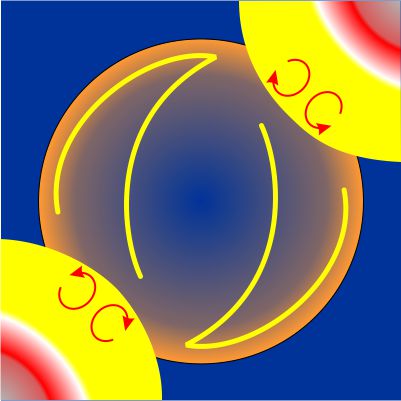
“Not if it’s got close neighbors that also expel unburnt fuel in their own burn-collapse cycles.  Grab their cast-off fuel and your core can get heavier before you do your next collapse.  Not impossible in a binary or cluster where all the stars are roughly the same age.  Visualize kids tossing marshmallows into each other’s mouths.”

“Or paying for each other’s pizzas.  And it’s your turn.”

~~ Rich Olcott
Prelude to A Waltz

An excited knock, but one I recognize.  In comes Vinnie, waving his fresh copy of The New York Times.

“LIGO‘s done it again!  They’ve seen another black hole collision!”

“Yeah, Vinnie, I’ve read the Abbott-and-a-thousand paper.  Three catastrophic collisions detected in less than two years.  The Universe is starting to look like a pretty busy place, isn’t it?”

“And they all involve really big black holes — 15, 20, even 30 times heavier than the Sun.  Didn’t you once say black holes that size couldn’t exist?”

“Well, apparently they do.  Of course the physicists are busily theorizing how that can happen.  What do you know about how stars work, Vinnie?”

“They get energy from fusing hydrogen atoms to make helium atoms.”

“So far, so good, but then what happens when the hydrogen’s used up?”

“They go out, I guess.”

“Oh, it’s a lot more exciting than that. Does the fusion reaction happen everywhere in the star?”

“I woulda said, ‘Yes,’ but since you’re asking I’ll bet the answer is,  ‘No.'”

“Properly suspicious, and you’re right.  It takes a lot of heat and pressure to force a couple of positive nuclei close enough to fuse together despite charge repulsion.  Pressures near the outer layers are way too low for that.  For our Sun, for instance, you need to be 70% of the way to the center before fusion really kicks in.  So you’ve got radiation pressure from the fusion pushing everything outward and gravity pulling everything toward the center.  But what’s down there?  Here’s a hint — hydrogen’s atomic weight is 1, helium’s is 4.”

“You’re telling me that the heavier atoms sink to the center?”

“I am.”

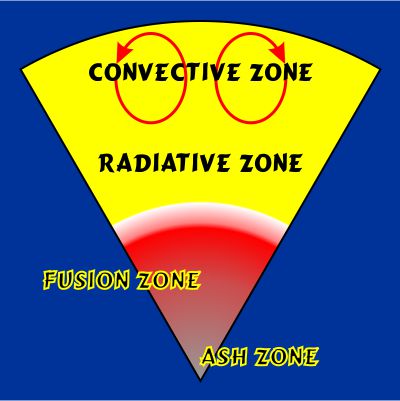
“So the center builds up a lot of helium.  Oh, wait, helium atoms got two protons in there so it’s got to be harder to mash them together than mashing hydrogens, right?”Star zones
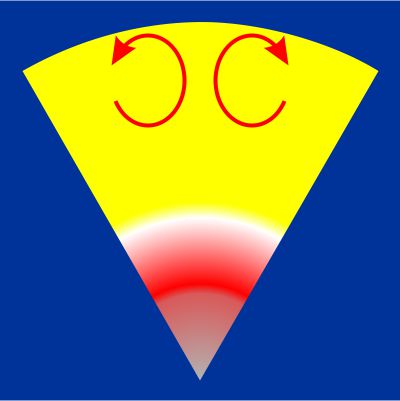
“And that’s why that region’s marked ash zone in this sketch.  Wherever conditions are right for hydrogen fusion, helium’s basically inert.  Like ash in a campfire it just sinks out of the way.  Now the fire goes out.  What would you expect next?”

“Radiation pressure’s gone but gravity’s still there … everything must slam inwards.”

“Slam is an excellent word choice, even though the star’s radius is measured in thousands of miles.  What’s the slam going to do to the helium atoms?”

“Is it strong enough to start helium fusion?”

“That’s where I’m going.  The star starts fusing helium at its core.  That’s a much hotter reaction than hydrogen’s.  When convective zone hydrogen that’s still falling inward meets fresh outbound radiation pressure, most of the hydrogen gets blasted away.”

“Fusing helium – that’s a new one on me.  What’s that make?”

“Carbon and oxygen, mostly.  They’re as inert during the helium-fusion phase as helium was when hydrogen was doing its thing.”

“So will the star do another nova cycle?”

“Maybe.  Depends on the core’s mass.  Its gravity may not be intense enough to fuse helium’s ashes.  In that case you wind up with a white dwarf, which just sits there cooling off for billions of years.  That’s what the Sun will do.”

“But suppose the star’s heavy enough to burn those ashes…”

“The core’s fresh light-up blows away infalling convective zone material.  The core makes even heavier atoms.  Given enough fuel, the sequence repeats, cycling faster and faster until it gets to iron.  At each stage the star has less mass than before its explosion but the residual core is more dense and its gravity field is more intense.  The process may stop at a neutron star, but if there was enough fuel to start with, you get a black hole.”

“That’s the theory that accounts for the Sun-size black holes?”

“Pretty much.  I’ve left out lots of details, of course.  But it doesn’t account for black holes the size of 30 Suns — really big stars go supernova and throw away so much of their mass they miss the black-hole sweet spot and terminate as a neutron star or white dwarf.  That’s where the new LIGO observation comes in.  It may have clued us in on how those big guys happen.”

“That sketch looks like a pizza slice.”

“You’re thinking dinner, right?”

“Yeah, and it’s your turn to buy.”

~~ Rich Olcott

Three Perils for a Quest(ion), Part 3

“Things are finally slowing down.  You folks got an interesting talk going, mind if I join you?  I got biscotti.”

“Pull up a chair, Eddie.  You know everybody?”

“You and Jeremy, yeah, but the young lady’s new here.”

“I’m Jennie, visiting from England.”

“Pleased to meetcha.  So from what I overheard, we got Jeremy on some kinda Quest to a black hole’s crust.  He’s passed two Perils.  There’s a final one got something to do with a Firewall.”

“One minor correction, Eddie.  He’s not going to a crust, because a black hole doesn’t have one.  Nothing to stand on or crash into, anyway.  He’s headed to its Event Horizon, which is the next best thing.  If you’re headed inward, the Horizon marks the beginning of where it’s physically impossible to get out.”

“Hotel California, eh?”

“You could say that.  The first two Perils had to do with the black hole’s intense gravitational field.  The one ahead has to do with entangled virtual particles.”

“Entangled is the Lucy-and-Ethel thing you said where two particles coordinate instant-like no matter how far apart they are?”

“Good job of overhearing, there, Eddie.  Jeremy, tell him abut virtual particles.”

“Umm, Mr Moire and I talked about a virtual particle snapping into and out of existence in empty space so quickly that the long-time zero average energy isn’t affected.”

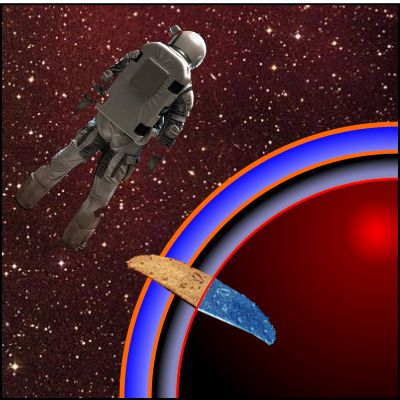
“What we didn’t mention then is that when a virtual pair is created, they’re entangled.  Furthermore, they’re anti-particles, which means that each is the opposite of the other — opposite charge, opposite spin, opposite several other things.  Usually they don’t last long — they just meet each other again and annihilate, which is how the average energy stays at zero.  Now think about creating a pair of virtual particles in the black hole’s intense gravitational field where the creation event sends them in opposite directions.”Astronaut and semi-biscotto
“Umm… if they’re on opposite paths then one’s probably headed into the Horizon and the other is outbound. Is the outbound one Hawking radiation?  Hey, if they’re entangled that means the inbound one still has a quantum connection with the one that escaped!”

“Wait on.  If they’re entangled and something happening to one instantaneously affects its twin, but the gravity difference gives each a different rate of time dilation, how does that work then?”

“Paradox, Jennie!  That’s part of what the Firewall is about.  But it gets worse.  You’d think that inbound particle would add mass to the black hole, right?”

“Surely.”

“But it doesn’t.  In fact, it reduces the object’s mass by exactly each particle’s mass.  That ‘long-time zero average energy‘ rule comes into play here.  If the two are separated and can’t annihilate, then one must have positive energy and the other must have negative energy.  Negative energy means negative mass, because of Einstein’s mass-energy equivalence.  The positive-mass twin escapes as Hawking radiation while the negative-mass twin joins the black hole, shrinks it, and by the way, increases its temperature.”

“Surely not, Sy.  Temperature is average kinetic energy.  Adding negative energy to something has to decrease its temperature.”

“Unless the something is a black hole, Jennie.  Hawking showed that a black hole’s temperature is inversely dependent on its mass.  Reduce the mass, raise the temperature, which is why a very small black hole radiates more intensely than a big one.  Chalk up another paradox.”

“Two paradoxes.  Negative mass makes no sense.  I can’t make a pizza with negative cheese.  People would laugh.”

“Right.  Here’s another.  Suppose you drop some highly-structured object, say a diamond, into a black hole.  Sooner or later, much later really, that diamond’s mass-energy will be radiated back out.  But there’s no relationship between the structure that went in and the randomized particles that come out.  Information loss, which is totally forbidden by thermodynamics.  Another paradox.”

“The Firewall resolves all these paradoxes then?”

“Not really, Jennie.  The notion is that there’s this thin layer of insanely intense energetic interactions, the Firewall, just outside of the Event Horizon.  That energy is supposed to break everything apart — entanglements, pre-existing structures, quantum propagators (don’t ask), everything, so what gets through the horizon is mush.  Many physicists think that’s bogus and a cop-out.”

“So no Firewall Peril?”

“Wanna take the chance?”

~~ Rich Olcott

Three Perils for a Quest(ion), Part 1

Eddie makes great pizzas but Jeremy thinks they stay in the oven just a little too long.  As he crunched an extra-crispy wedge-edge he mused, “Gravity aside, I wonder what it’d be like to land on a black hole.  I bet it’d be real slippery if it’s as smooth as Mr Moire says.”

Jennie cut in.  “Don’t be daft, lad.  Everyone’s read about the spaceman sliding through the event horizon unaware until it’s too late.  Someone far away sees the bloke’s spacetime getting all distorted but in his local frame of reference everything’s right as rain.  Right, Sy?”

“As rain, Jennie, if all you’re concerned about is relativity.  But Spaceman Jeremy has lots of other things to be concerned about on his way to the event horizon.  Which he couldn’t stand on anyway.”

“Why not, Mr Moire?  I mean, I said ‘gravity aside’ so I ought to be able to stand up.”

“Nothing to stand on, Jeremy.  It’d be like trying to stand on Earth’s orbit.”

“Pull the other one, Sy.  How can they be alike?”

“Both of them are mathematical constructs rather than physical objects.  An orbit is an imaginary line that depicts planet or satellite locations.  An event horizon is an imaginary figure enclosing a region with such intense spacetime curvature that time points inward.  They’re abstract objects, not  concrete ones.  But let’s get back to Jeremy’s black hole evaporation quest.  He’ll have to pass three perils.”

“Ooo, a Quest with Perils —  loverly.  What are the Perils then?”

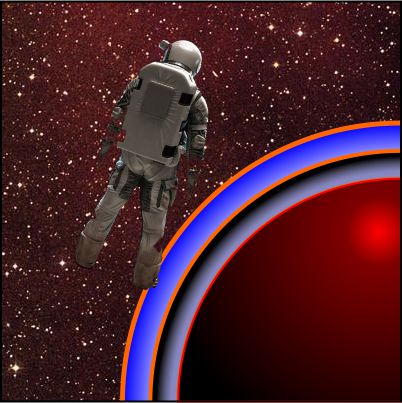
“The Roche Radius, the Photon Sphere and the Firewall.  Got your armor on, Jeremy?”Astronaut and 3xBlack hole

“Ready, Mr Moire.”

“Stand up.  The Roche effect is all about gravitational discrepancy between two points.  The two meter distance between your head and feet isn’t enough for a perceptible difference in downward pull.  However, when we deal with astronomical distances the differences can get significant.  For instance, ocean water on the day side of Earth is closer to the Sun and experiences a stronger sunward pull than water on the night side.”

“Ah, so that’s why we get tides.”

“Right.  Sit, sit, sit.  So in 1849 Édouard Roche wondered how close two objects could get until tidal forces pulled one of them apart.  He supposed the two objects were both just balls of rocks or fluid held together by gravity.  Applying Newton’s Laws and some approximations he got a formula for threshold distance in terms of the big guy’s mass and the little guy’s density.  Suppose you’re held together only by gravity and you’re nearing the Sun feet-first.  Its mass is 2×1030 kg/m³.  Even including your space armor, your average density is about 1.5 kg/m³.  According to Roche’s formula, if you got closer than 8.6×10⁶ kilometers your feet would break away and fall into the Sun before the rest of you would.  Oh, that distance is about 1/7 the radius of Mercury’s orbit so it’s pretty close in.”

“But we’re talking black holes here.  What if the Sun collapses to a black hole?”

“Surprisingly, it’s exactly the same distance.  The primary’s operative property is its mass, not its diameter.  Good thing Jeremy’s really held together by atomic and molecular electromagnetism, which is much stronger than gravity.  Which brings us to his second Peril, the dreaded Photon Sphere.”

“Should I shudder, Sy?”

“Go ahead, Jennie.  The Sphere is another mathematical object, not something physical you’d collide with, Jeremy.  It’s a zero-thickness shell representing where electromagnetic waves can orbit a massive object like a black hole or a neutron star.  Waves can penetrate the shell easily in either direction, but if one happens to fly in exactly along a tangent, it’s trapped on the Sphere.”

“That’s photons.  Why is it a peril to me?”

“Remember that electromagnetism that holds you together?  Photons carry that force.  Granted, in a molecule they’re standing waves rather than the free waves we see with.  The math is impossible, but here’s the Peril.  Suppose one of your particularly important molecules happens to lie tangent to the Sphere while you’re traversing it.  Suddenly, the forces holding that molecule together fly away from you at the speed of light.  And that disruption inexorably travels along your body as you proceed on your Quest.”

[both shudder]

~~ Rich Olcott

The Thin Edge of Infinity

Late in the day, project’s half done but it’s hungry time.  I could head home for a meal and drive back, but instead I board the elevator down to Eddie’s Pizza on the second floor.  The door opens on 8 and Jeremy gets on, with a girl.

“Oh, hi, Mr. Moire.  Didja see I hit a triple in the last game?  What if the Sun became a black hole?  This is that English girl I told you about.”

“Hello, Jennie.”

“Wotcha, Sy.”

“You know each other?”

“Ra-ther.  He wrote me into his blog a year ago.  You were going on about particles then, right, Sy?”

“Right, Jennie, but that was particles confined in atoms.  Jeremy’s interested in larger prey.”

“So I hear.”

The elevator lets us out at Eddie’s place.  We luck into a table, order and resume talking.  I open with, “What’s a particle?”

“Well, Sy, your post with Jeremy says it’s an abstract point with a minimal set of properties, like mass and charge, in a mathematical model of a real object with just that set of properties.”

“Ah, you’ve been reading my stuff.  That simplifies things.  So when can we treat a black hole like a particle?  Did you see anything about that in my archives, Jennie?”

“The nearest I can recall was Professor ‘t Hooft’s statement.  Ermm… if the Sun’s so far away that we can calculate planetary orbits accurately by treating it as a point, then we’re justified in doing so.”

“And if the Sun were to suddenly collapse to a black hole?”

“It’d be a lot smaller, even more like a point.  No change in gravity then.  But wouldn’t Earth be caught up in relativity effects like space compression?’

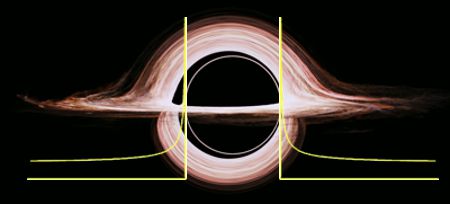
“Not unless you’re really close.  Space compression around a non-rotating (Schwarzchild) black hole scales by a factor that looks like Schwarzchild factor, where D is the object’s diameter and d is your distance from it.  Suppose the Sun suddenly collapsed without losing any mass to become a Schwarzchild object.  The object’s diameter would be a bit less than 4 miles.  Earth is 93 million miles from the Sun so the compression factor here would be [poking numbers into my smartphone] 1.000_000_04.  Nothing you’d notice.  It’d be 1.000_000_10 at Mercury.  You wouldn’t see even 1% compression until you got as close as 378 miles, 10% only inside of 43 miles.  Fifty percent of the effect shows up in the last 13 miles.  The edge of a black hole is sharper than this pizza knife.”Knife-edges
“How about if it’s spinning?  Ms Plenum referred me to a reading about frame-dragging.”

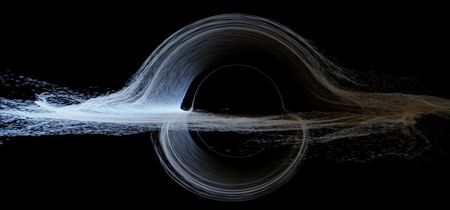
“Ah, Jeremy, you’re thinking of Gargantua, the Interstellar movie’s strangely lopsided black hole.  I just ran across this report by Robbie Gonzalez.  He goes into detail on why the image is that way, and why it should have looked more like this picture.  Check out the blueshift on the left and the shift into the infra-red on the right.”

better Gargantua
A more accurate depiction of Gargantua.  Image from
James, et al., Class. Quantum Grav. 32 (2015) 065001 (41pp),
licensed under CC BY-NC-ND 3.0

[both] “Awesome!”

“So it’s the spin making the weirdness then, Sy?”

“Yes, ma’am.  If Gargantua weren’t rotating, then the space around it would be perfectly spherical.  As Gonzalez explains, the movie’s plotline needed an even more extreme spacetime distortion than they could get from that.  Dr Kip Thorne, their physics guru, added more by spinning his mathematical model nearly up to the physical limit.”

“I’ll bite, Mr Moire.  What’s the limit?”

“Rotating so fast that points on the equator would be going at lightspeed.  Can’t do that.  Anyhow, extreme spin alters spacetime distortion, which goes from spherical to pumpkin-shaped with a twist.  The radial scaling changes form, too, from Schwarzchild factor to Kerr factor.  A is proportional to spin.  When A is small (not much spin) or the distance is large those A/d² terms essentially vanish relative to the others and the scaling looks just like the simple almost-a-point Schwarzchild case.  When A is large or the distance is small the A/d² terms dominate top and bottom, the factor equals 1 and there’s dragging but no compression.  In the middle, things get interesting and that’s where Dr Thorne played.”

“So no relativity jolt to Earth.”

“Yep.”

“Here’s your pizzas.”

“Thanks, Eddie.”

[sounds of disappearing pizza]

~~ Rich Olcott

No-hair today, grown tomorrow

It was a classic May day, perfect for some time by the lake in the park.  I was watching the geese when a squadron of runners stampeded by.   One of them broke stride, dashed my way and plopped down on the bench beside me.  “Hi, Mr Moire. <pant, pant>”

“Afternoon, Jeremy.  How are things?”

“Moving along, sir.  I’ve signed up for track, I think it’ll help my base-running,  I’ve met a new girl, she’s British, and that virtual particle stuff is cool but I’m having trouble fitting it into my black hole paper.”

“Here’s one angle.  Nobelist Gerard ‘t Hooft said, ‘A particle is fundamental when it’s useful to think of it as fundamental.‘  In that sense, a black hole is a fundamental particle.  Even more elementary than atoms, come to think of it.”

“Huh?”

“It has to do with the how few numbers you need to completely specify the particle.  You’d need a gazillion terabytes for just the temperatures in the interior and oceans and atmosphere of Earth.  But if you’re making a complete description of an isolated atom you just need about two dozen numbers — three for position, three for linear momentum, one for atomic number (to identify which element it represents), one for its atomic weight (which isotope), one for its net charge if it’s been ionized, four more for nuclear and electronic spin states, maybe three or four each for the energy levels of its nuclear and electronic configuration.  So an atom is simpler than the Earth”

“And for a black hole?”

“Even simpler.  A black hole’s event horizon is smooth, so smooth that you can’t distinguish one point from another.  Therefore, no geography numbers.  Furthermore, the physics we know about says whatever’s inside that horizon is completely sealed off from the rest of the universe.  We can’t have knowledge of the contents, so we can’t use any numbers to describe it.  It’s been proven (well, almost proven) that a black hole can be completely specified with only eleven numbers — one for its total mass-energy, one for its electric charge, and three each for position, linear momentum and angular momentum.  Leave out the location and orientation information and you’ve got three numbers — mass, charge, and spin.  That’s it.”

“How about its size or it temperature?”

“Depends how you measure size.  Event horizons are spherical or nearly so, but the equations say the distance from an event horizon to where you’d think its center should be is literally infinite.  You can’t quantify a horizon’s radius, but its diameter and surface area are both well-defined.  You can calculate both of them from the mass.  That goes for the temperature, too.”

“How about if it came from antimatter instead of matter?”

“Makes no difference because the gravitational stresses just tear atoms apart.”

“Wait, you said, ‘almost proven.’  What’s that about?”no hair 1

“Believe it or not, the proof is called The No-hair Theorem.  The ‘almost’ has to do with the proof’s starting assumptions.  In the simplest case, zero change and zero spin and nothing else in the Universe, you’ve got a Schwarzchild object.  The theorem’s been rigorously proven for that case — the event horizon must be perfectly spherical with no irregularities — ‘no hair’ as one balding physicist put it.”

“How about if the object spins and gets charged up, or how about if a planet or star or something falls into it?”

“Adding non-zero spin and charge makes it a Kerr-Newman object.  The theorem’s been rigorously proven for those, too.  Even an individual infalling mass has only a temporary effect.  The black hole might experience transient wrinkling but we’re guaranteed that the energy will either be radiated away as a gravitational pulse or else simply absorbed to make the object a little bigger.  Either way the event horizon goes smooth and hairless.”

“So where’s the ‘almost’ come in?”

“Reality.  The region near a real black hole is cluttered with other stuff.  You’ve seen artwork showing an accretion disk looking like Saturn’s rings around a black hole.  The material in the disk distorts what would otherwise be a spherical gravitational field.  That gnarly field’s too hairy for rigorous proofs, so far.  And then Hawking pointed out the particle fuzz…”

~~ Rich Olcott

Questions, Meta-questions and Answers

<We rejoin Sy and Vinnie in the library stacks…> “Are you boys discussing me?”

<unison> “Oh, hi, Ramona.”

“Actually no, Ramona, we were discussing relativistic time dilation.”

“I know that, Sy, I’ve been reading your posts. Now I’ve got a question.”

“But how…?  Never mind.  Guess I’d better watch my writing.  What can I do for you?”

“You and Vinnie have been going on about kinetic time dilation and gravitational time dilation like they’re two separate things, right?”

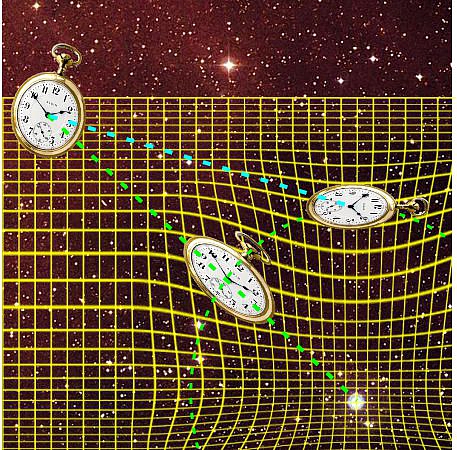
“That’s how we’ve treated them, right, but the textbooks do the same.  The velocity-dependent time-stretch equation, tslow/tfast = √[1-(v²/c²)], comes out of Einstein’s Special Theory of Relativity. The gravity-dependent equation, tslow/tfast = √[1-(2G·M/r·c²)], came from his General Theory of Relativity.”

“But there’s no rule that says an object can’t be moving rapidly while it’s in a gravitational field, is there?  That Endurance spacecraft orbiting the black hole in the Interstellar movie certainly seemed to be in that situation.”

“No question, Ramona.  General Relativity’s just more, er, general.”

“Fine, but shouldn’t they work together?”

That got Vinnie started.  “Yeah, Sy, I started this with LIGO and gravity but you and those space shuttles got me into this speed thing.  How do you bridge ’em?”

“Not easily.  Einstein set the rules of the game when he wrote down his fundamental equations.  Physicists and mathematicians have been trying to solve them ever since.  Schwarzchild found the first solution within a year after the equations hit the streets, but he did the simplest possible system — a non-rotating spherical object with no electrical charge and alone in the Universe.  It took another half-century before Kerr and friends figured out how to handle rotating spheres with an electric charge, but even those objects are assumed to be isolated from all other masses.  Mm … how do you figure velocity, Vinnie?”

“Distance divided by time, easy.”

“Not quite that easy.  The equations say that if you’re close to a massive object, space gets compressed, time gets stretched, and the time and space dimensions get scrambled.  Literally.  Time near a Schwarzchild object points inward as you approach the sphere’s center, and don’t ask me how to visualize that.  A Kerr object has a belt around its equator where time runs backwards.  Craziness.”

“Well, how about if I’m not that close?”

“That’s easier to answer, Ramona.  Suppose the three of us are each flying at safe distances from some heavy object with mass M.  I’m farthest away so I’m holding the fastest clock.  We’ll compare Vinnie’s and your clocks to mine.  OK?”3-clocks

“Sure, why not?”

“Fine.  Now, Vinnie, you’re closer in, resting on the direct line between me and the object.  You’re at distance r from it.  How fast does your clock run?”

“Uhhh…  We’re both on that same radial line so we’re in the same inertial frame, no kinetic effect.  I suppose you see it ticking slower because of the gravitational effect.”

“M-hm, and my clock ticks how often between ticks of yours?”

“You want the equation, huh?  All right, it’s tvinnie/tsy = √[1-(2G·M/r·c²)].”

“You’re reading my mind with those subscripts.  Now, Ramona, you’re at that same distance from the object but you’re in orbit around it.  Measured against Vinnie’s position you’ve got velocity v.  How fast is his clock ticking compared to yours?”

“Mmm…  We’re at the same level in the gravity field, so the gravitational thing makes no difference.  So … tramona/tvinnie = √[1-(v²/c²)].  Aaand, he’d see my clock running slow by the same amount. That’s weird.”

“Weird but true.  Last step — Ramona, you’re deeper in the gravitational field and you’re speeding away from me, so tramona/tsy=(tramona/tvinnie)*(tvinnie/tsy)=√[1-(2G·M/r·c²)]*√[1-(v²/c²)] covers both.”

“OK, that’s settled.  Back to Vinnie’s original question.  LIGOs are set in concrete, their velocities are zero so LIGO signals are all about gravity, right?”

“Right.”

Ramona links arms with him.  “Let’s go dancing.”  Then she gives me the eye.  “Sugarlumps, Sy?  Really?”

On the 12th floor of the Acme Building, high above the city, one man still tries to answer the Universe’s persistent questions — Sy Moire, Physics Eye.

~~ Rich Olcott

Throwing a Summertime curve

All cats are gray in the dark, and all lines are straight in one-dimensional space.  Sure, you can look at a garden hose and see curves (and kinks, dammit), but a short-sighted snail crawling along on it knows only forward and backward.  Without some 2D notion of sideways, the poor thing has no way to sense or cope with curvature.

Up here in 3D-land we can readily see the hose’s curved path through all three dimensions.  We can also see that the snail’s shell has two distinct curvatures in 3D-space — the tube has an oval cross-section and also spirals perpendicular to that.

But Einstein said that our 3D-space itself can have curvature.  Does mass somehow bend space through some extra dimension?  Can a gravity well be a funnel to … somewhere else?

No and no.  Mathematicians have come up with a dozen technically different kinds of curvature to fit different situations.  Most have to do with extrinsic non-straightness, apparent only from a higher dimension.  That’s us looking at the hose in 3D.

Einstein’s work centered on intrinsic curvature, dependent only upon properties that can be measured within an object’s “natural” set of dimensions.Torus curvature

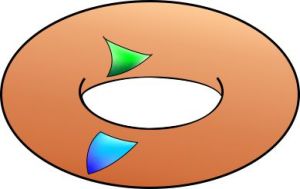
On a surface, for instance, you could draw a triangle using three straight lines.  If the figure’s interior angles sum up to exactly 180°, you’ve got a flat plane, zero intrinsic curvature.  On a sphere (“straight line” = “arc from a great circle”) or the outside rim of a doughnut, the sum is greater than 180° and the curvature is positive.
Circle curvatures
If there’s zero curvature and positive curvature, there’s gotta be negative curvature, right?  Right — you’ll get less-than-180° triangles on a Pringles chip or on the inside rim of a doughnut.

Some surfaces don’t have intersecting straight lines, but you can still classify their curvature by using a different criterion.  Visualize our snail gliding along the biggest “circle” he/she/it (with snails it’s complicated) can get to while tethered by a thread pinned to a point on the surface. Divide the circle’s circumference by the length of the thread.  If the ratio’s equal to 2π then the snail’s on flat ground.  If the ratio is bigger than 2π,  the critter’s on a saddle surface (negative curvature). If it’s smaller, then he/she/it has found positive curvature.

In a sense, we’re comparing the length of a periphery and a measure of what’s inside it.  That’s the sense in which Einsteinian space is curved — there are regions in which the area inside a circle (or the volume inside a sphere) is greater than or less than what would be expected from the size of its boundary.

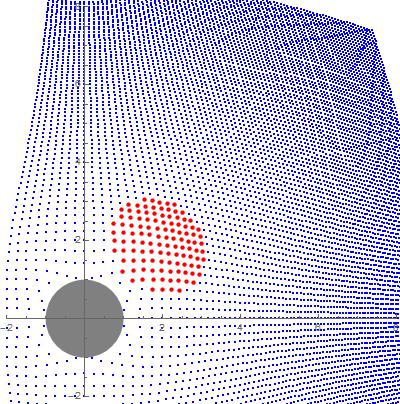
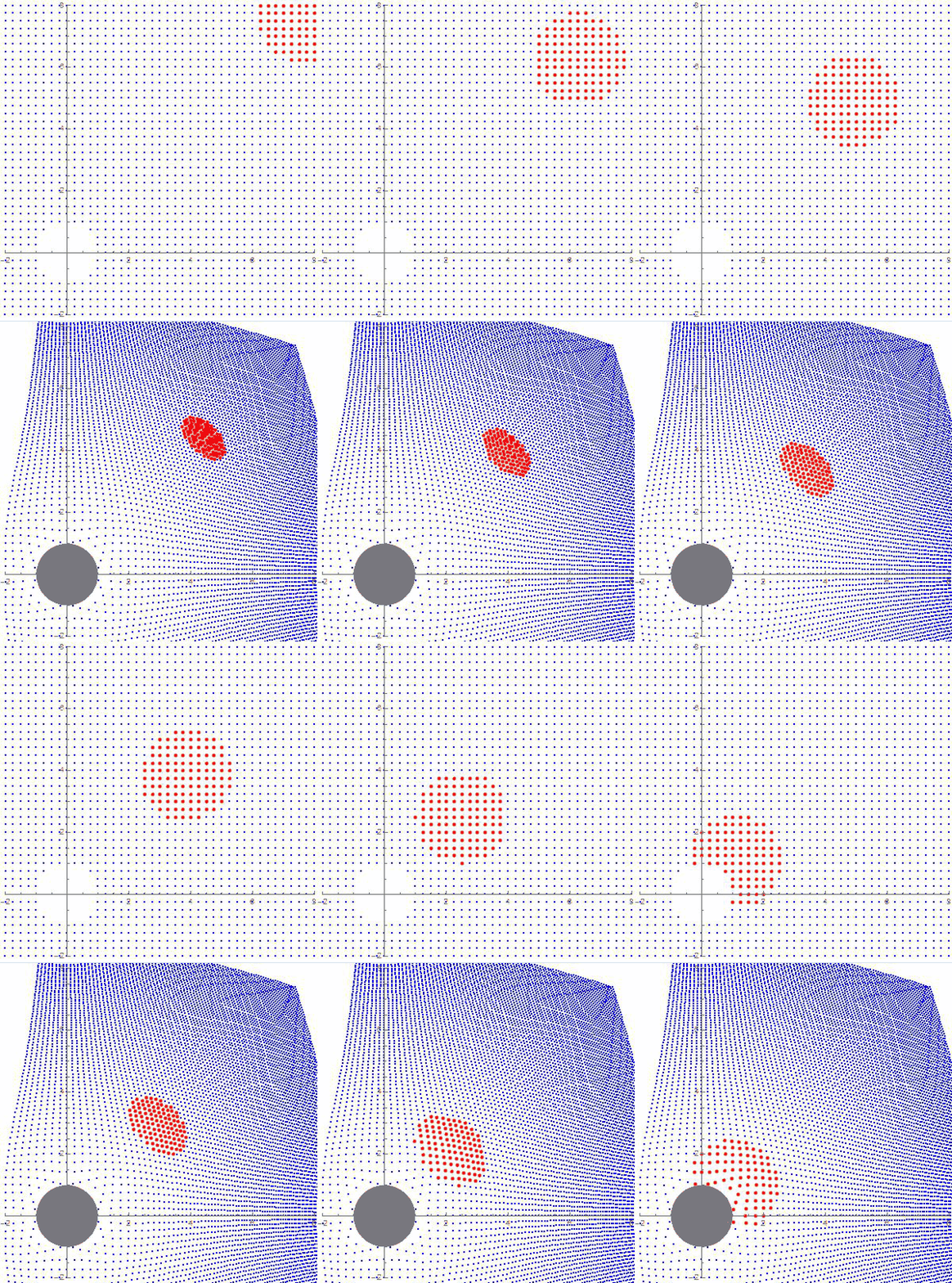
Here’s an example.  The upper panel’s dotted grid represents a simple flat space being traversed by a “disk.”  See how the disk’s location has no effect on its size or shape.  As a result, dividing its circumference by its radius always gives you 2π.Curvature 3

In the bottom panel I’ve transformed* the picture to represent space in the neighborhood of a black hole (the gray circle is its Event Horizon) as seen from a distance.  Close-up, every row of dots would appear straight.  However, from afar the disk’s apparent size and shape depend on where it is relative to the BH.

By the way, the disk is NOT “falling” into the BH.  This is about the shape of space itself — there’s no gravitational attraction or distortion by tidal spaghettification.

Visually, the disk appears to ooze down one of those famous 3D parabolic funnels.  But it doesn’t — all of this activity takes place within the BH’s equatorial plane, a completely 2D place.  The equations generate that visual effect by distorting space and changing the local distance scale near our massive object.  This particular distortion generates positive curvature — at 90% through the video, the disk’s C/r ratio is about 2% less than 2π.

As I tell Museum visitors, “miles are shorter near a black hole.”

~~ Rich Olcott

* – If you’re interested, here are the technical details.  A Schwarzchild BH, distances as multiples of the EH radius.  The disk (diameter 2.0) is depicted at successive time-free points in the BH equatorial plane.  The calculation uses Flamm’s paraboloid to convert each grid point’s local (r,φ) coordinates to (w,φ) to represent the spatial configuration as seen from r>>w.

Another slice of π, wrapped up in a Black Hole crust

Last week a museum visitor wondered, “What’s the volume of a black hole?”  A question easier asked than answered.

Let’s look at black hole (“BH”) anatomy.  If you’ve seen Interstellar, you saw those wonderful images of “Gargantua,” the enormous BH that plays an essential role in the plot.  (If you haven’t seen the movie, do that.  It is so cool.)

A BH isn’t just a blank spot in the Universe, it’s attractively ornamented by the effects of its gravity on the light passing by:

Gargantua 2c
Gargantua,
adapted from Dr Kip Thorne’s book, The Science of “Interstellar”

Working from the outside inward, the first decoration is a background starfield warped as though the stars beyond had moved over so they could see us past Gargantua.  That’s because of gravitational lensing, the phenomenon first observed by Sir Arthur Eddington and the initial confirmation of Einstein’s Theory of General Relativity.

No star moved, of course.  Each warped star’s light comes to us from an altered angle, its lightwaves bent on passing through the spatial compression Gargantua imposes on its neighborhood.  (“Miles are shorter near a BH” — see Gravitational Waves Are Something Else for a diagrammatic explanation.)

Moving inward we come to the Accretion Disc, a ring of doomed particles destined to fall inward forever unless they’re jostled to smithereens or spat out along one of the BH’s two polar jets (not shown).  The Disc is hot, thanks to all the jostling.  Like any hot object it emits light.

Above and below the Disc we see two arcs that are actually images of the Accretion Disc, sent our way by more gravitational lensing.  Very close to a BH there’s a region where passing light beams are bent so much that their photons go into orbit.  The disc’s a bit further out than that so its lightwaves are only bent 90o over (arc A) and under (arc B) before they come to us.

By the way, those arcs don’t only face in our direction.  Fly 360o around Gargantua’s equator and those arcs will follow you all the way.  It’s as though the BH were embedded in a sphere of lensed Disclight.

Which gets us to the next layer of weirdness.  Astrophysicists believe that most BHs rotate, though maybe not as fast as Gargantua’s edge-of-instability rate.  Einstein’s GR equations predict a phenomenon called frame dragging — rapidly spinning massive objects must tug local space along for the ride.  The deformed region is a shell called the Ergosphere.

Frame dragging is why the two arcs are asymmetrical and don’t match up.  We see space as even more compressed on the right-hand side where Gargantua is spinning away from us.  Because the effect is strongest at the equator, the shell should really be called the Ergospheroid, but what can you do?

Inside the Ergosphere we find the defining characteristic of a BH, its Event Horizon, the innermost bright ring around the central blackness in the diagram.  Barely outside the EH there may or may not be a Firewall, a “seething maelstrom of particles” that some physicists suggest must exist to neutralize the BH Information Paradox.  Last I heard, theoreticians are still fighting that battle.

The EH forms a nearly spherical boundary where gravity becomes so intense that the escape velocity exceeds the speed of light.  No light or matter or information can break out.  At the EH, the geometry of spacetime becomes so twisted that the direction of time is In.  Inside the EH and outside of the movies it’s impossible for us to know what goes on.

Finally, the mathematical models say that at the center of the EH there’s a point, the Singularity, where spacetime’s curvature and gravity’s strength must be Infinite.  As we’ve seen elsewhere, Infinity in a calculation is Nature’s was of saying, “You’ve got it wrong, make a better model.”

So we’re finally down to the volume question.  We could simply measure the EH’s external diameter d and plug that into V=(πd3)/6.  Unfortunately, that forthright approach misses all the spatial twisting and compression — it’s a long way in to the Singularity.  Include those effects and you’ve probably got another Infinity.

Gargantua’s surface area is finite, but its volume may not be.

~~ Rich Olcott

Circular Logic

We often read “singularity” and “black hole” in the same pop-science article.  But singularities are a lot more common and closer to us than you might think. That shiny ball hanging on the Christmas tree over there, for instance.  I wondered what it might look like from the inside.  I got a surprise when I built a mathematical model of it.

To get something I could model, I chose a simple case.  (Physicists love to do that.  Einstein said, “You should make things as simple as possible, but no simpler.”)

I imagined that somehow I was inside the ball and that I had suspended a tiny LED somewhere along the axis opposite me.  Here’s a sketch of a vertical slice through the ball, and let’s begin on the left half of the diagram…Mirror ball sketch

I’m up there near the top, taking a picture with my phone.

To start with, we’ll put the LED (that yellow disk) at position A on the line running from top to bottom through the ball.  The blue lines trace the light path from the LED to me within this slice.

The inside of the ball is a mirror.  Whether flat or curved, the rule for every mirror is “The angle of reflection equals the angle of incidence.”  That’s how fun-house mirrors work.  You can see that the two solid blue lines form equal angles with the line tangent to the ball.  There’s no other point on this half-circle where the A-to-me route meets that equal-angle condition.  That’s why the blue line is the only path the light can take.  I’d see only one point of yellow light in that slice.

But the ball has a circular cross-section, like the Earth.  There’s a slice and a blue path for every longitude, all 360o of them and lots more in between.  Every slice shows me one point of yellow light, all at the same height.  The points all join together as a complete ring of light partway down the ball.  I’ve labeled it the “A-ring.”

Now imagine the ball moving upward to position B.  The equal-angles rule still holds, which puts the image of B in the mirror further down in the ball.  That’s shown by the red-lined light path and the labeled B-ring.

So far, so good — as the LED moves upward, I see a ring of decreasing size.  The surprise comes when the LED reaches C, the center of the ball.  On the basis of past behavior, I’d expect just a point of light at the very bottom of the ball (where it’d be on the other side of the LED and therefore hidden from me).

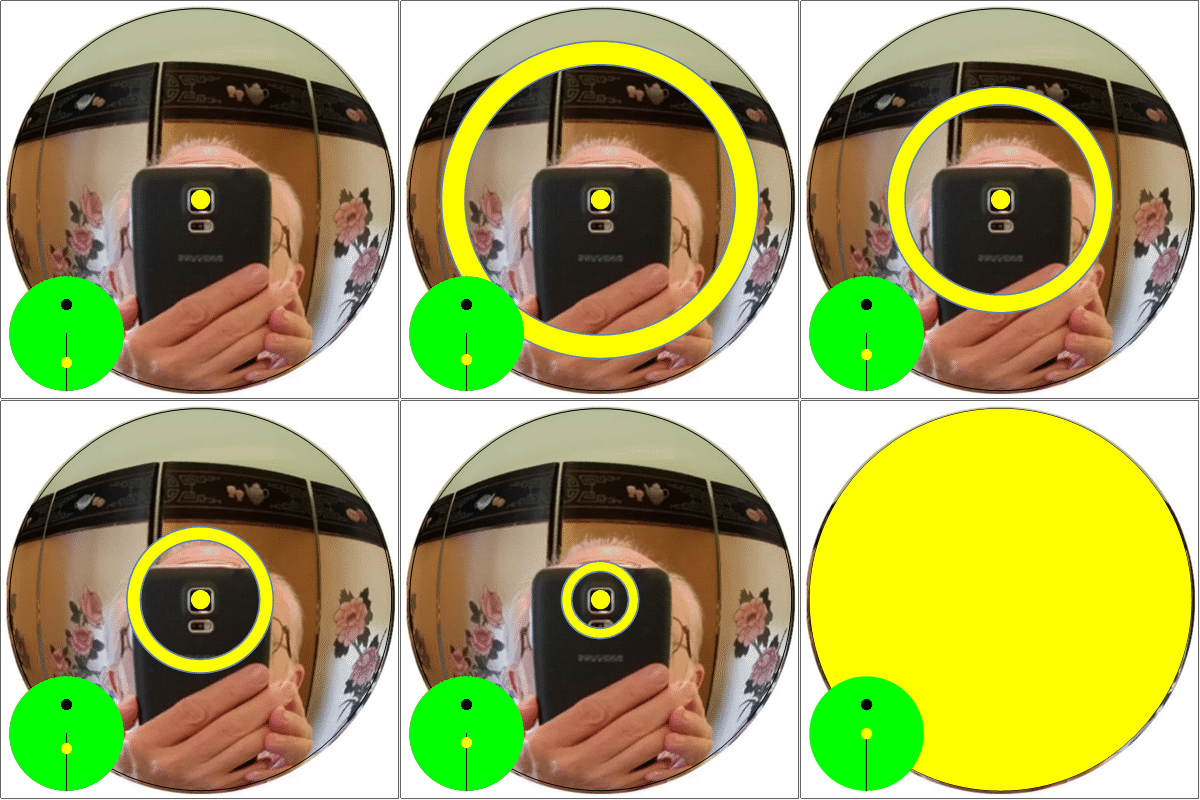
Nup, doesn’t happen.  Here’s the simulation.  The small yellow disk is the LED, the ring is the LED’s reflected image, the inset green circle shows the position of the LED (yellow) and the camera (black), and that’s me in the background, taking the picture…g6z

The entire surface suddenly fills with light — BLOOIE! — when the LED is exactly at the ball’s center.  Why does that happen?  Scroll back up and look at the right-hand half of the diagram.  When the ball is exactly at C, every outgoing ray of light in any direction bounces directly back where it came from.  And keeps on going, and going and going.  That weird display can only happen exactly at the center, the ball’s optical singularity, that special point where behavior is drastically different from what you’d expect as you approach it.

So that’s using geometry to identify a singularity.  When I built the model* that generated the video I had to do some fun algebra and trig.  In the process I encountered a deeper and more general way to identify singularities.

<Hint> Which direction did Newton avoid facing?

* – By the way, here’s a shout-out to Mathematica®, the Wolfram Research company’s software package that I used to build the model and create the video.  The product is huge and loaded with mysterious special-purpose tools, pretty much like one of those monster pocket knives you can’t really fit into a pocket.  But like that contraption, this software lets you do amazing things once you figure out how.

~~ Rich Olcott