The Fellowship of A Ring

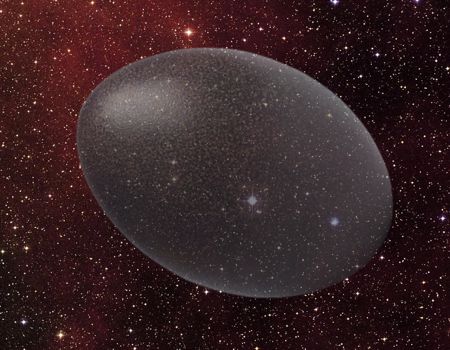
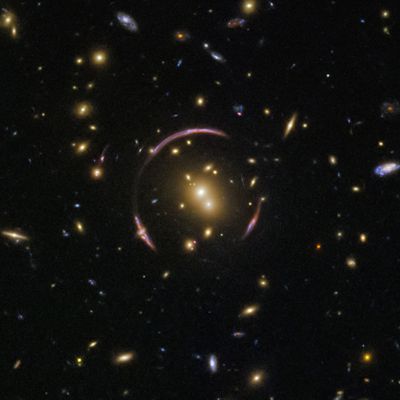
Einstein ring 2018
Hubble photo from NASA’s Web site

Cathleen and I are at a table in Al’s coffee shop, discussing not much, when Vinnie comes barreling in.  “Hey, guys.  Glad I found you together.  I just saw this ‘Einstein ring’ photo.  They say it’s some kind of lensing phenomenon and I’m thinking that a lens floating out in space to do that has to be yuuuge.  What’s it made of, and d’ya think aliens put it there to send us a message?”

Astronomer Cathleen rises to the bait.  I sit back to watch the fun.  “No, Vinnie, I don’t.  We’re not that special, the rings aren’t signals, and the lenses aren’t things, at least not in the way you’re thinking.”

“There’s more than one?”

“Hundreds we know of so far and it’s early days because the technology’s still improving.”

“How come so many?”

“It’s because of what makes the phenomenon happen.  What do you know about gravity and light rays?”

Me and Sy talked about that a while ago.  Light rays think they travel in straight lines past a heavy object, but if you’re watching the beam from somewhere else you think it bends there.”

I chip in.  “Nice summary, good to know you’re storing this stuff away.”Gravitational lens 1

“Hey, Sy, it’s why I ask questions is to catch up.  So go on, Cathleen.”

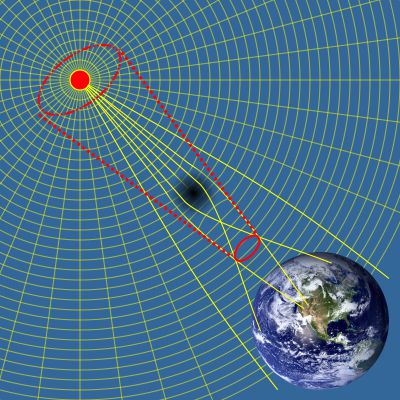
She swings her laptop around to show us a graphic.  “So think about a star far, far away.  It’s sending out light rays in every direction.  We’re here in Earth and catch only the rays emitted in our direction.  But suppose there’s a black hole exactly in the way of the direct beam.”

“We couldn’t see the star, I get that.”

“Well, actually we could see some of its light, thanks to the massive black hole’s ray-bending trick. Rays that would have missed us are bent inward towards our telescope.  The net effect is similar to having a big magnifying lens out there, focusing the star’s light on us.”

“You said, ‘similar.’  How’s it different?”Refraction lens

“In the pattern of light deflection.  Your standard Sherlock magnifying lens bends light most strongly at the edges so all the light is directed towards a point.  Gravitational lenses bend light most strongly near the center.  Their light pattern is hollow.  If we’re exactly in a straight line with the star and the black hole, we see the image ‘focused’ to a ring.”

“That’d be the Einstein ring, right?”

“Yes, he gets credit because he was the one who first set out the equation for how the rays would converge.  We don’t see the star, but we do see the ring.  His equation says that the angular size of the ring grows as the square root of the deflecting object’s mass.  That’s the basis of a widely-used technique for measuring the masses not only of black holes but of galaxies and even larger structures.”

“The magnification makes the star look brighter?”

“Brighter only in the sense that we’re gathering photons from a wider field then if we had only the direct beam.  The lens doesn’t make additional photons, probably.”

Suddenly I’m interested.  “Probably?”

“Yes, Sy, theoreticians have suggested a couple of possible effects, but to my knowledge there’s no good evidence yet for either of them.  You both know about Hawking radiation?”

“Sure.”

“Yup.”

“Well, there’s the possibility that starlight falling on a black hole’s event horizon could enhance virtual particle production.  That would generate more photons than one would expect from first principles.  On the other hand, we don’t really have a good handle on first principles for black holes.”

“And the other effect?”

“There’s a stack of IFs under this one.  IF dark matter exists and if the lens is a concentration of dark matter, then maybe photons passing through dark matter might have some subtle interaction with it that could generate more photons.  Like I said, no evidence.”

“Hundreds, you say.”

“Pardon?”

“We’ve found hundreds of these lenses.”

“All it takes is for one object to be more-or-less behind some other object that’s heavy enough to bend light towards us.”

“Seein’ the forest by using the trees, I guess.”

“That’s a good way to put, it, Vinnie.”

~~ Rich Olcott

Far out, man

Egg in the UniverseThe thing about Al’s coffee shop is that there’s generally a good discussion going on, usually about current doings in physics or astronomy.  This time it’s in the physicist’s corner but they’re not writing equations on the whiteboard Al put up over there to save on paper napkins.  I step over there and grab an empty chair.
“Hi folks, what’s the fuss about?”

“Hi, Mr Moire, we’re arguing about where the outer edge of the Solar System is.  I said it’s Pluto’s orbit, like we heard in high school — 325 lightminutes from the Sun.”

The looker beside him pipes up.  “Jeremy, that’s just so bogus.”  Kid keeps scoring above his level, don’t know how he does it.  “Pluto doesn’t do a circular orbit, it’s a narrow ellipse so average distance doesn’t count.  Ten percent of the time Pluto’s actually closer to the Sun than Neptune is, and that’s only 250 lightminutes out.”

Then the looker on his other side chimes in.  Doing good, kid.  “How about the Kuiper Belt?  A hundred thousand objects orbiting the Sun out to maybe twice Neptune’s distance, so it’s 500 lightminutes.”

Third looker, across the table.  You rock, Jeremy.  “Hey, don’t forget the Scattered Disk, where the short-period comets drop in from.  That goes out to 100 astronomical units, which’d be … 830 lightminutes.”

One of Cathleen’s Astronomy grad students can’t help diving in despite he’s only standing nearby, not at the table.  “Nah, the edge is at the heliopause.”

<several voices> “The what?”

“You know about the solar wind, right, all the neutral and charged particles that get blown out of the Sun?  Mass-density-wise it’s a near-vacuum, but it’s not nothing.  Neither is the interstellar medium, maybe a few dozen hydrogen and helium atoms per cubic meter but that adds up and they’re not drifting on the same vector the Sun’s using.  The heliopause is the boundary where the two flows collide.  Particles in the solar wind are hot, relatively speaking, compared to the interstellar medium.  Back in 2012, our outbound spacecraft Voyager 1 detected a sharp drop in temperature at 121 astronomical units.  You guys are talking lightminutes so that’d be <thumb-pokes his smartphone> how about that? almost exactly 1000 lightminutes out.  So there’s your edge.”

Now Al’s into it.  “Hold on, how about the Oort Cloud?”

“Mmm, good point.  Like this girl said <she bristles at being called ‘girl’>, the short-period comets are pretty much in the ecliptic plane and probably come in from the Scattered Disk.  But the long-period comets seem to come in from every direction.  That’s why we think the Cloud’s a spherical shell.  Furthermore, the far points of their orbits generally lie in the range between 20,000 and 50,000 au’s, though that outer number’s pretty iffy.  Call the edge at 40,000 au’s <more thumb-poking> that’d be 332,000 lightminutes, or 3.8 lightdays.”

“Nice job, Jim.”  Cathleen speaks up from behind him.  “But let’s think a minute about why that top number’s iffy.”

“Umm, because it’s dark out there and we’ve yet to actually see any of those objects?”

“True.  At 40,000 au’s the light level is 1/40,000² or 1/1,600,000,000 the sunlight intensity we get on Earth.  But there’s another reason.  Maybe that ‘spherical shell’ isn’t really a sphere.”

I have to ask.  “How could it not be?  The Sun’s gravitational field is spherical.”

“Right, but at these distances the Sun’s field is extremely weak.  The inverse-square law works for gravity the same way it does for light, so the strength of the Sun’s gravitational field out there is also 1/1,600,000,000 of what keeps the Earth on its orbit.  External forces can compete with that.”

“Yeah, I get that, Cathleen, but 3.8 lightdays is … over 400 times closer than the 4½ lightyear distance to the nearest star.  The Sun’s field at the Cloud is stronger than Alpha Centauri’s by at least a factor of 400 squared.”

“Think bigger, Sy.  The galactic core is 26,000 lightyears away, but it’s the center of 700 billion solar masses.  I’ve run the numbers.  At Jim’s Oort-Cloud ‘edge’ the Galaxy’s field is 11% as strong as the Sun’s.  Tidal forces will pull the outer portion of the Cloud into an egg shape pointed to the center of the Milky Way.”

Jeremy’s agog.  “So the edge of the Solar System is 1,000 times further than Pluto?  Wow!”

“About.”

“Maybe.”

~~ Rich Olcott

Meanwhile, back at the office

Closing time.  Anne and I stroll from Al’s coffee shop back to the Acme Building.  It’s a clear night with at least 4,500 stars, but Anne’s looking at the velvet black between them.

“What you said, Sy, about the Universe not obeying Conservation of Energy — tell me more about that.”

“Aaa-hmmm … OK.  You’ve heard about the Universe expanding, right?”

“Ye-es, but I don’t know why that happens.”

“Neither do the scientists, but there’s pretty firm evidence that it’s happening, if only at the longest scales.  Stars within galaxies get closer together as they radiate away their gravitational energy.  But the galaxies themselves are getting further apart, as far out as we can measure.”

“What’s that got to do with Conservation of Energy?”

“Well, galaxies have mass so they should be drawn together by gravity the way that gravity pulls stars together inside galaxies.  But that’s not what’s happening.  Something’s actively pushing galaxies or galaxy clusters away from each other.  Giving the something a name like ‘dark energy‘ is just an accounting gimmick to pretend the First Law is still in effect at very large distances — we don’t know the energy source for the pushing, or even if there is one.  There’s a separate set of observations we attribute to a ‘dark energy‘ that may or may not have the same underlying cause.  That’s what I was talking about.”Fading white satin

We’re at the Acme Building.  I flash my badge to get us past Security and into the elevator.  As I reach out to press the ’12’ button she puts her hand on my arm.  “Sy, I want to see if I understand this entropy-elephant thing.  You said entropy started as an accounting gimmick, to help engineers keep track of fuel energy escaping into the surroundings.  Energy absorbed at one temperature they called the environment’s heat capacity.  Total energy absorbed over a range of temperatures, divided by the difference in temperature, they called change in entropy.”

The elevator lets us out on my floor and we walk to door 1217.  “You’ve got it right so far, Anne.  Then what?”

“Then the chemists realized that you can predict how lots of systems will work from only knowing a certain set of properties for the beginning and end states.  Pressure, volume, chemical composition, whatever, but also entropy.  But except for simple gases they couldn’t predict heat capacity or entropy, only measure it.”

My key lets us in.  She leans back against the door frame.  “That’s where your physicists come in, Sy.  They learned that heat in a substance is actually the kinetic energy of its molecules.  Gas molecules can move around, but that motion’s constrained in liquids and even more constrained in solids.  Going from solid to liquid and from liquid to gas absorbs heat energy in breaking those constraints.  That absorbed heat appears as increased entropy.”

She’s lounging against my filing cabinet.  “The other way that substances absorb heat is for parts of molecules to rotate and vibrate relative to other parts.  But there are levels.  Some vibrations excite easier than others, and many rotations are even easier.  In a cold material only some motions are active.  Rising temperature puts more kinds of motion into play.  Heat energy spreads across more and more sub-molecular absorbers.”

She’s perched on the edge of my desk.  “Here’s where entropy as possibility-counting shows up.  More heat, more possibilities, more entropy.  Now we can do arithmetic and prediction instead of measuring.  Anything you can count possibilities for you can think about defining an entropy for, like information bits or black holes or socks.  But it’ll be a different entropy, with its own rules and its own range of validity.  … And…”Riding the Elephant

She’s looming directly over me.  Her dark eyes are huge.

“And…?”

When we first met, Sy, you asked what you could do for me.  You’ve helped me see that when I travel across time and probability I’m riding the Entropy Elephant.  I’d like to show my appreciation.  Can you think of a possibility?”

A dark night, in a city that knows how to keep its secrets.  On the 12th floor of the Acme Building, one man still tries to answer the Universe’s persistent questions — Sy Moire, Physics Eye.

~~ Rich Olcott

Thoughts of Chair-man Moire

My apples and orange peels question, Sy,  isn’t that the same as Jeremy’s?  What’s the connection between heat capacity and counting?”

“You’re right, Anne.  Hmm.  Say, Al, all your coffee shop tables came with four chairs apiece, right?”

“Yup, four-tops every one, even in the back room.”

“You neaten them all up, four to a table, in the morning?”

“The night before.  There’s never time in the morning, customers demand coffee first thing.”

“But look, we’ve got six people seated at this table.  Where’d the extra chairs come from?”

“Other tables, of course.  Is this going somewhere?”

“Almost there.  So in fact the state of the room at any time will have some random distribution of chairs to tables.  You know on the average there’ll be four at a table, but you don’t know the actual distribution until you look, right?”

“Hey, we’re counting again.  You’re gonna say that’s about entropy ’cause the difference between four at a table and some other number is all random and there’s some formula to calculate entropy from that.”elephants and chairs

“True, Vinnie, but we’re about to take the next step.  How did these chairs wind up around this table?”

“We pulled them over, Mr. Moire.”

“My point is, Jeremy, we spent energy to get them here.  The more chairs that are out of position — ”

“The higher the entropy, but also the more energy went into the chairs.  It’s like that heat capacity thing we started with, the energy that got absorbed rather than driving the steam engine.”

“Awright, Anne!” from Jeremy <Jennie bristles a bit>, “and if all the chairs are in Al’s overnight position it’s like absolute zero.  Hey, temperature is average kinetic energy per particle so can we say that the more often a chair gets moved it’s like hotter?”

Jennie breaks in.  “Not a bit of it, Jeremy!  The whole metaphor’s daft.  We know temperature change times heat capacity equals the energy absorbed, right, and we’ve got a link between energy absorption and entropy, right, but what about if at the end of the day all the chairs accidentally wind up four at a table?  Entropy change is zero, right, but customers expended energy moving chairs about all day and Al’s got naught to set straight.”

“Science in action, I love it!  Anne and Jeremy, you two just bridged a gap it took Science a century to get across.  Carnot started us on entropy’s trail in 1824 but scientists in those days weren’t aware of matter’s atomic structure.  They knew that stuff can absorb heat but they had no inkling what did the absorbing or how that worked.  Thirty years later they understood simple gases better and figured out that average kinetic energy per particle bit.  But not until the 1920s did we have the quantum mechanics to show how parts of vibrating molecules can absorb heat energy stepwise like a table ‘absorbing’ chairs.  Only then could we do Vinnie’s state-counting to calculate entropies.”

“Yeah, more energy, spread across more steps, hiding more details we don’t know behind an average, more entropy.  But what about Jennie’s point?”

“Science is a stack of interconnected metaphors, Vinnie.  Some are better than others.  The trick is attending to the boundaries where they stop being valid.  Jennie’s absolutely correct that my four-chair argument is only a cartoon for illustrating stepwise energy accumulation.  If Al had a billion tables instead of a dozen or so, the odds on getting everything back to the zero state would disappear into rounding error.”

“How does black hole entropy play into this, Sy?”TSE classical vs BH

“Not very well, actually.  Oh, sure, the two systems have similar structures.  They’ve each got three inter-related central quantities constrained by three laws.  Here, I’ve charted them out on Old Reliable.”

“OK, their Second and Third Laws look pretty much the same, but their First Laws don’t match up.”

“Right, Al.  And even Bekenstein pointed out inconsistencies between classic thermodynamic temperature and what’s come to be called Hawking temperature.  Hawking didn’t agree.  The theoreticians are still arguing.  Here’s a funny one — if you dig deep enough, both versions of the First Law are the same, but the Universe doesn’t obey it.”

“That’s it, closing time.  Everybody out.”

~~ Rich Olcott

Taming The Elephant

Suddenly they were all on the attack.  Anne got in the first lick.  “C’mon, Sy, you’re comparing apples and orange peel.  Your hydrogen sphere would be on the inside of the black hole’s event horizon, and Jeremy’s virtual particles are on the outside.”

[If you’ve not read my prior post, do that now and this’ll make more sense.  Go ahead, I’ll wait here.]white satin and 5 elephantsJennie’s turn — “Didn’t the chemists define away a whole lot of entropy when they said that pure elements have zero entropy at absolute zero temperature?”
Then Vinnie took a shot.  “If you’re counting maybe-particles per square whatever for the surface, shouldn’t you oughta count maybe-atoms or something per cubic whatever for the sphere?”

Jeremy posed the deepest questions. “But Mr Moire, aren’t those two different definitions for entropy?  What does heat capacity have to do with counting, anyhow?”

Al brought over mugs of coffee and a plate of scones.  “This I gotta hear.”

“Whew, but this is good ’cause we’re getting down to the nub.  First to Jennie’s point — Under the covers, Hawking’s evaluation is just as arbitrary as the chemists’.  Vinnie’s ‘whatever’ is the Planck length, lP=1.616×10⁻³⁵ meter.  It’s the square root of such a simple combination of fundamental constants that many physicists think that lP2=2.611×10-70 m², is the ‘quantum of area.’  But that’s just a convenient assumption with no supporting evidence behind it.”

“Ah, so Hawking’s ABH=4πrs2 and SBH=ABH/4 formulation with rs measured in Planck-lengths, just counts the number of area-quanta on the event horizon’s surface.”

“Exactly, Jennie.  If there really is a least possible area, which a lot of physicists doubt, and if its size doesn’t happen to equal lP2, then the black hole entropy gets recalculated to match.”

“So what’s wrong with cubic those-things?”

“Nothing, Vinnie, except that volumes measured in lP3 don’t apply to a black hole because the interior’s really four-dimensional with time scrambled into the distance formulas.  Besides, Hawking proved that the entropy varies with half-diameter squared, not half-diameter cubed.”

“But you could still measure your hydrogen sphere with them and that’d get rid of that 1033 discrepancy between the two entropies.”

“Not really, Vinnie.  Old Reliable calculated solid hydrogen’s entropy for a certain mass, not a volume.”

“Hawking can make his arbitrary choice, Sy, he’s Hawking, but that doesn’t let the chemists off the scaffold.  How did they get away with arbitrarily defining a zero for entropy?”

“Because it worked, Jennie.  They were only concerned with changes — the difference between a system’s state at the end of a process, versus its state at the beginning.  It was only the entropy difference that counted, not its absolute value.”

“Hey, like altitude differences in potential energy.”

“Absolutely, Vinnie, and that’ll be important when we get to Jeremy’s question.  So, Jennie, if you’re only interested in chemical reactions and if it’s still in the 19th Century and the world doesn’t know about isotopes yet, is there a problem with defining zero entropy to be at a convenient set of conditions?”

“Well, but Vinnie’s Second Law says you can never get down to absolute zero so that’s not convenient.”

“Good point, but the Ideal Gas Law and other tools let scientists extrapolate experimentally measured properties down to extremely low temperatures.  In fact, the very notion of absolute zero temperature came from experiments where the volume of a  hydrogen or helium gas sample appears to decrease linearly towards zero at that temperature, at least until the sample condenses to a liquid.  With properly calibrated thermometers, physical chemists knocked themselves out measuring heat capacities and entropies at different temperatures for every substance they could lay hands on.”

“What about isotopes, Mr Moire?  Isn’t chlorine’s atomic weight something-and-a-half so there’s gotta be several of kinds of chlorine atoms so any sample you’ve got is a mixture and that’s random and that has to have a non-zero entropy even at absolute zero.”

“It’s 35.4, two stable isotopes, Jeremy, but we know how to account for entropy of mixing and anyway, the isotope mix rarely changes in chemical processes.”

“But my apples and orange peels, Sy — what does the entropy elephant do about them?”

~~ Rich Olcott

The Battle of The Entropies

(the coffee-shop saga continues)  “Wait on, Sy, a black hole is a hollow sphere?”

I hadn’t noticed her arrival but there was Jennie, standing by Vinnie’s table and eyeing Jeremy who was sill eyeing Anne in her white satin.white satin and 2 elephants“That’s not quite what I said, Jennie.  Old Reliable’s software and and I worked up a hollow-shell model and to my surprise it’s consistent with one of Stephen Hawking’s results.  That’s a long way from saying that’s what a black hole is.”

“But you said some physicists say that.  Have they aught to stand on?”

“Sort of.  It’s a perfect case of ‘depends on where you’re standing.'”

Vinnie looked up.  “It’s frames again, ain’t it?”

“With black holes it’s always frames, Vinnie.  Hey, Jeremy, is a black hole something you could stand on?”

“Nosir, we said the hole’s event horizon is like Earth’s orbit, just a mathematical marker.  Except for the gravity and  the  three  Perils  Jennie and you and me talked about, I’d slide right through without feeling anything weird, right?”

“Good memory and just so.  In your frame of reference there’s nothing special about that surface — you wouldn’t experience scale changes in space or time when you encounter it.  In other frames, though, it’s special.  Suppose we’re standing a thousand miles away from a solar-size black hole and Jeremy throws a clock and a yardstick into it.  What would we see?”

“This is where those space compression and time dilation effects happen, innit?”

“You bet, Jennie.  Do you remember the formula?”

“I wrote it in my daybook … Ah, here it is —Schwarzchild factorMy notes say D is the black hole’s diameter and d is another object’s distance from its center.  One second in the falling object’s frame would look like f seconds to us.  But one mile would look like 1/f miles.  The event horizon is where d equals the half-diameter and f goes infinite.  The formula only works where the object stays outside the horizon.”

“And as your clock approaches the horizon, Jeremy…?”

“You’ll see my clock go slower and slower until it sto —.  Oh.  Oh!  That’s why those physicists think all the infalling mass is at the horizon, the stuff falls towards it forever and never makes it through.”

“Exactly.”

“Hey, waitaminute!  If all that mass never gets inside, how’d the black hole get started in the first place?”

“That’s why it’s only some physicists, Vinnie.  The rest don’t think we understand the formation process well enough to make guesses in public.”

“Wait, that formula’s crazy, Sy.  If something ever does get to where d is less than D/2, then what’s inside the square root becomes negative.  A clock would show imaginary time and a yardstick would go imaginary, too.  What’s that about?”

“Good eye, Anne, but no worries, the derivation of that formula explicitly assumes a weak gravitational field.  That’s not what we’ve got inside or even close to the event horizon.”

“Mmm, OK, but I want to get back to the entropy elephant.  Does black hole entropy have any connection to the other kinds?”

Strutural, mostly.  The numbers certainly don’t play well together.  Here’s an example I ran up recently on Old Reliable.  Say we’ve got a black hole twice the mass of the Sun, and it’s at the Hawking temperature for its mass, 12 billionths of a Kelvin.  Just for grins, let’s say it’s made of solid hydrogen.  Old Reliable calculated two entropies for that thing, one based on classical thermodynamics and the other based on the Bekenstein-Hawking formulation.”Entropy calculations“Wow, Old Reliable looks up stuff and takes care of unit conversions automatically?”

“Slick, eh, Jeremy?  That calculation up top for Schem is classical chemical thermodynamics.  A pure sample of any element at absolute zero temperature is defined to have zero entropy.  Chemical entropy is cumulative heat capacity as the sample warms up.  The Hawking temperature is so close to zero I could treat heat capacity as a constant.

“In the middle section I calculated the object’s surface area in square Planck-lengths lP², and in the bottom section I used Hawking’s formula to convert area to B-H entropy, SBH.  They disagree by a factor of 1033.”

A moment of shocked silence, and then…

~~ Rich Olcott

Rockfall

<continued>  The coffee shop crowd had gotten rowdy in response to my sloppy physics, but everyone hushed when I reached for my holster and drew out Old Reliable.  All had heard of it, some had seen it in action — a maxed-out tablet with customized math apps on speed-dial.

“Let’s take this nice and slow.  Suppose we’ve got an non-charged, non-spinning solar-mass black hole.  Inside its event horizon the radius gets weird but let’s pretend we can treat the object like a simple sphere.  The horizon’s half-diameter, we’ll call it the radius, is rs=2G·M/c²G is Newton’s gravitational constant, M is the object’s mass and c is the speed of light.  Old Reliable says … about 3 kilometers.  Question is, what happens when we throw a rock in there?  To keep things simple, I’m going to model dropping the rock gentle-like, dead-center and with negligible velocity relative to the hole, OK?”

<crickets>

“Say the rock has the mass of the Earth, almost exactly 3×10⁻⁶ the Sun’s mass.  The gravitational potential energy released when the rock hits the event horizon from far, far away would be E=G·M·m/rs, which works out to be … 2.6874×1041 joules.  What happens to that energy?”falling rock and black hole

rs depends on mass, Mr Moire, so the object will expand.  Won’t that push on what’s around it?”

“You’re thinking it’d act like a spherical piston, Jeremy, pushing out in all directions?”

“Yeah, sorta.”

“After we throw in a rock with mass m, the radius expands from rs to rp=2G·(M+m)/c².  I set m to Earth’s mass and Old Reliable says the new radius is … 3.000009 kilometers.  Granted the event horizon is only an abstract math construct, but suppose it’s a solid membrane like a balloon’s skin.  When it expands by that 9 millimeters, what’s there to push against?  The accretion disk?  Those rings might look solid but they’re probably like Saturn’s rings — a collection of independent chunks of stuff with an occasional gas molecule in-between.  Their chaotic orbits don’t have a hard-edged boundary and wouldn’t notice the 9-millimeter difference.  Inward of the disk you’ve got vacuum.  A piston pushing on vacuum expends zero energy.  With no pressure-volume work getting done that can’t be where the infall energy goes.”

“How about lift-a-weight work against the hole’s own gravity?”

“That’s a possibility, Vinnie.  Some physicists maintain that a black hole’s mass is concentrated in a shell right at the event horizon.  Old Reliable here can figure how much energy it would take to expand the shell that extra 9 millimeters.  Imagine that simple Newtonian physics applies — no relativistic weirdness.  Newton proved that a uniform spherical shell’s gravitational attraction is the same as what you’d get from having the same mass sitting at the shell’s geometric center.  The gravitational pull the shell exerts on itself originally was E=G·M²/rs.  Lifting the new mass from rs to rp will cost ΔE=G·(M+m)²/r– G·M²/rs.  When I plug in the numbers…  That’s interesting.”

Vinnie’s known me long enough to realize “That’s interesting” meant “Whoa, I certainly didn’t expect THAT!

“So what didja expect and whatcha got?”

“What I expected was that lift-it-up work would also be just a small fraction of the infall energy and the rest would go to heat.  What I got for ΔE here was 2.6874×1041 joules, exactly 100% of the input.  I wonder what happens if I use a bigger planet.  Gimme a second … OK, let’s plot a range …  How ’bout that, it’s linear!”ep-es

“Alright, show us!”

All the infall energy goes to move the shell’s combined mass outward to match the expanded size of the event horizon.  I’m amazed that such a simple classical model produces a reasonable result.”

“Like Miss Plenum says, Mr Moire, sometimes the best science comes from surprises.”

“I wouldn’t show it around, Jeremy, except that it’s consistent with Hawking’s quantum-physics result.”

“How’s that?”

“Remember, he showed that a black hole’s temperature varies as 1/M.  We know that temperature is ΔE/ΔS, where the entropy change ΔS varies as .  We’ve just found that ΔE varies as M.  The ΔE/ΔS ratio varies as M/M²=1/M, just like Hawking said.”

Then Jennie got into the conversation.

~~ Rich Olcott

Red Harvest

<continued> Al’s coffee shop was filling up as word got around about Anne in her white satin.  I saw a few selfie-takers in the physics crowd surreptitiously edge over to get her into their background.  She was busy thinking so she didn’t notice.  “The entropy-elephant picture is starting to come together, Sy.  We started out with entropy measuring accumulated heat capacity in a steam engine.”

“That’s where Carnot started, yes.”

“But when Jeremy threw that hot rock into the black hole” <several in the astronomy crew threw startled looks at Jeremy>, “its heat energy added to the black hole’s mass, but it should have added to the black hole’s entropy, too.  ‘Cause of Vinnie’s Second Law.”white satin and black hole 3

Vinnie looked up.  “Ain’t my Second Law, it’s thermodynamics’ Second Law.  Besides, my version was ‘energy’s always wasted.’  Sy’s the one who turned that into ‘entropy always increases.'”

“So anyway, black holes can’t have zero entropy like people used to think.  But if entropy also has to do with counting possibilities, than how does that apply to black holes?  They have only one state.”

“That’s where Hawking got subtle.  Jeremy, we’ve talked about how the black hole’s event horizon is a mathematical abstraction, infinitely thin and perfectly smooth and all that.”

“Yessir.”

“Hawking moved one step away from that abstraction.  In essence he said the  event horizon is surrounded by a thin shell of virtual particles.  Remember them, Jeremy?”

“Uh-huh, that was on my quest to the event horizon.  Pairs of equal and opposite virtual particles randomly appear and disappear everywhere in space and because they appear together they’re entangled and if one of them dips into the event horizon then it doesn’t annihilate its twin which — Oh!  Random!  So what’s inside the event horizon may have only one state, so far as we know, but right outside the horizon any point may or may not be hosting, can I call it an orphan particle?  I’ll bet that uncertainty give rise to the entropy, right?”

<finger-snaps of approval from the physics side of the room>

“Well done, Jeremy!  ‘Orphan’ isn’t the conventional term but it gets the idea across.”

“Wait, Sy.  You mentioned that surface area and entropy go together and now I see why.  The larger the area, the more room there is for those poor orphans.  When Jeremy’s rock hit the event horizon and increased the black hole’s mass, did the surface area increase enough to allow for the additional entropy?” <more finger-snapping>

“Sure did, Anne.  According to Hawking’s calculation, it grew by exactly the right amount.  Mass and area both grow as the square of the diameter.”

“How come not the radius?”

“Well , Vinnie, the word ‘radius‘ is tricky when you’re discussing black holes.  The event horizon is spherical and has a definite diameter — you could measure it from the outside.  But the sphere’s radius extends down to the singularity and is kind of infinite and isn’t even strictly speaking a distance.  Space-time is twisted in there, remember, and that radial vector is mostly time near its far end.  On the other hand, you could use ‘radius‘ to mean ‘half the diameter‘ and you’d be good for calculating effects outside the event horizon.”

“OK, that’s the entropy-area connection, but how does temperature tie in with surface gravity?”

“They’re both inversely dependent on the black hole’s mass.  Let’s take surface gravity first, and here when I say ‘r‘ I’m talking ‘half-diameter,‘ OK?”

“Sure.”

“Good.  Newton taught us that an object with mass M has a gravitational attraction proportional to M/r².  That still holds if you’re not inside the event horizon.  Now, the event horizon’s r is also proportional to the object’s mass so you’ve got M/M² which comes to 1/M.  With me?”

“Yeah.”

“Hawking used quantum physics to figure the temperature thing, but here’s a sloppy short-cut.  Anne, remember how we said that entropy is approximately heat capacity divided by temperature?”

“Mm-hmm.”

“The shell’s energy is mostly heat and proportional to M.  We’ve seen the shell’s entropy is proportional to .  The temperature is heat divided by entropy.  That’s proportional to M/M² which is the same 1/M as surface gravity.” <boos from all sides>. “Hey, I said it was sloppy.”

~~ Rich Olcott

Rockin’ Round The Elephant

<continued…>  “That’s what who said?  And why’d he say that?”

“That’s what Hawking said, Al.  He’s the guy who first applied thermodynamic analysis to black holes.  Anyone happen to know the Three Laws of Thermodynamics?”

Vinnie pipes up from his table by the coffee shop door.  “You can’t win.  You can’t even break even.  But you’ll never go broke.”

“Well, that’s one version, Vinnie, but keep in mind all three of those focus on energy.  The First Law is Conservation of Energy—no process can create or destroy energy, only  transform it, so you can’t come out ahead.  The Second Law is really about entropy—”

“Ooo, the elephant!”white satin and black hole 2

“Right, Anne.  You usually see the Second Law stated in terms of energy efficiency—no process can convert energy to another form without wasting some of it. No breaking even.  But an equivalent statement of that same law is that any process must increase the entropy of the Universe.”

“The elephant always gets bigger.”

“Absolutely.  When Bekenstein and Hawking thought about what would happen if a black hole absorbed more matter, worst case another black hole, they realized that the black hole’s surface area had to follow the same ‘Never decrease‘ rule.”

“Oh, that Hawking!  Hawking radiation Hawking!  The part I didn’t understand, well one of the parts, in that “Black Holes” Wikipedia article!  It had to do with entangled particles, didn’t it?”

“Just caught up with us, eh, Jeremy?  Yes, Stephen Hawking.  He and Jacob Bekenstein found parallels between what we can know about black holes on the one hand and thermodynamic quantities on the other.  Surface area and entropy, like we said, and a black hole’s mass acts mathematically like energy in thermodynamics.  The correlations were provocative ”

“Mmm, provocative.”

“You like that word, eh, Anne?  Physicists knew that Bekenstein and Hawking had a good analogy going, but was there a tight linkage in there somewhere?  It seemed doubtful.”

“Nothin’ to count.”

“Wow, Vinnie.  You’ve been reading my posts?”

“Sure, and I remember the no-hair thing.  If the only things the Universe can know about a black hole are its mass, spin and charge, then there’s nothing to figure probabilities on.”

“Exactly.  The logic sequence went, ‘Entropy is proportional to the logarithm of state count, there’s only one state, log(1) equals zero,  so the entropy is zero.’  But that breaks the Third Law.  Vinnie’s energy-oriented Third Law says that no object can cool to absolute zero temperature.  But an equivalent statement is that no object can have zero entropy.”

“So there’s something wrong with black hole theory, huh?”

“Which is where our guys started, Vinnie.  Being physicists, they said, ‘Suppose you were to throw an object into a black hole.  What would change?’

“Its mass, for one.”

“For sure, Jeremy.  Anything else?”

“It might not change the spin, if you throw right.”

“Spoken like a trained baseball pitcher.  Turns out its mass governs pretty much everything about a black hole, including its temperature but not spin or charge.  Once you know the mass you can calculate its entropy, diameter, surface area, surface gravity, maximum spin, all of that.  Weird, though, you can’t easily calculate its volume or density — spatial distortion gets in the way.”

“So what happens to all those things when the mass increases?”

“As you might expect, they change.  What’s interesting is how each of them change and how they’re linked together.  Temperature, for instance, is inversely proportional to the mass and vice-versa.  Suppose, Jeremy, that you threw two big rocks, both the same size, into a black hole.  The first rock is at room temperature and the other’s a really hot one, say at a million degrees.   What would each do?”

“The first one adds mass so from what you said it’d drop the temperature.  The second one has the same mass, so I don’t see, wait, temperature’s average kinetic energy so the hot rock has more energy than the other one and Einstein says that energy and mass are the same thing so the black hole gets more mass from the hot rock than from the cold one so its temperature goes down … more?  Really?”

“Yup.  Weird, huh?”

“How’s that work?”

“That’s what they asked.”

~~ Rich Olcott

Schrödinger’s Elephant

Al’s coffee shop sits right between the Astronomy and Physics buildings, which is good because he’s a big Science fan.  He and Jeremy are in an excited discussion when Anne and I walk in.  “Two croissants, Al, and two coffees, black.”

“Comin’ up, Sy.  Hey, you see the news?  Big days for gravitational astronomy.”

Jeremy breaks in.  “There’s a Nobel Prize been announced —”

“Kip Thorne the theorist and Barry Barish the management guy —”

“and Rainer Weiss the instrumentation wizard —”

“shared the Physics prize for getting LIGO to work —”

“and it saw the first signal of a black hole collision in 2015 —”

“and two more since —”

“and confirmed more predictions from relativity theory —”

“and Italy’s got their Virgo gravitational wave detector up and running —”

“And Virgo and our two LIGOs, —”

“Well, they’re both aLIGOs now, being upgraded and all —”

“all three saw the same new wave —”

“and it’s another collision between black holes with weird masses that we can’t account for.  Who’s the lady?”

“Al, this is Anne.  Jeremy, close your mouth, you’ll catch a fly.”  (Jeremy blushes, Anne twinkles.)  “Anne and I are chasing an elephant.”

“Pleased to meetcha, Anne.  But no livestock in here, Sy, the Health Department would throw a fit!”

I grin.  “That’s exactly what Eddie said.  It’s an abstract elephant, Al.  We’ve been discussing entropy. Which is an elephant because it’s got so many aspects no-one can agree on what it is.  It’s got something to do with heat capacity, something to do with possibilities you can’t rule out, something to do with signals and information.  And Hawking showed that entropy also has something to do with black holes.”

“Which I don’t know much about, fellows, so someone will have to explain.”

Jeremy leaps in.  “I can help with that, Miss Anne, I just wrote a paper on them.”

“Just give us the short version, son, she can ask questions if she wants a detail.”

“Yessir.  OK, suppose you took all the Sun’s mass and squeezed it into a ball just a few miles across.  Its density would be so high that escape velocity is faster than the speed of light so an outbound photon just falls back inward and that’s why it’s black.  Is that a good summary, Mr Moire?”

“Well, it might be good enough for an Internet blog but it wouldn’t pass inspection for a respectable science journal.  Photons don’t have mass so the whole notion of escape velocity doesn’t apply.  You do have some essential elements right, though.  Black holes are regions of extreme mass density, we think more dense than anywhere else in the Universe.  A black hole’s mass bends space so tightly around itself that nearby light waves are forced to orbit its region or even spiral inward.  The orbiting happens right at the black hole’s event horizon, its thin shell that encloses the space where things get really weird.  And Anne, the elephant stands on that shell.”white satin and black hole“Wait, Mr Moire, we said that the event horizon’s just a mathematical construct, not something I could stand on.”

“And that’s true, Jeremy.  But the elephant’s an abstract construct, too.  So abstract we’re still trying to figure out what’s under the abstraction.”

“I’m trying to figure out why you said the elephant’s standing there.”

“Anne, it goes back to the event horizon’s being a mathematical object, not a real one.  Its spherical surface marks the boundary of the ultimate terra incognita.  Lightwaves can’t pass outward from it, nor can anything material, not even any kind of a signal.  For at least some kinds of black hole, physicists have proven that the only things we can know about one are its mass, spin and charge.  From those we can calculate some other things like its temperature, but black holes are actually pretty simple.”

“So?”

“So there’s a collision with Quantum Theory.  One of QT’s fundamental assumptions is that in principle we can use a particle’s current wave function to predict probabilities for its future.  But the wave function information disappears if the particle encounters an event horizon.  Things are even worse if the particle’s entangled with another one.”

“Information, entropy, elephant … it’s starting to come together.”

“That’s what he said.”

~~ Rich Olcott