Should These Three Be Alike?

“What’s all the hubbub in the back room, Al? I’m a little early for my afternoon coffee break and your shop’s usually pretty quiet about now.”

“It’s Cathleen’s Astronomy class, Sy. The department double-booked their seminar room so she asked to use my space until it’s straightened out.”

“Think I’ll eavesdrop.” I slide in just as she’s getting started.

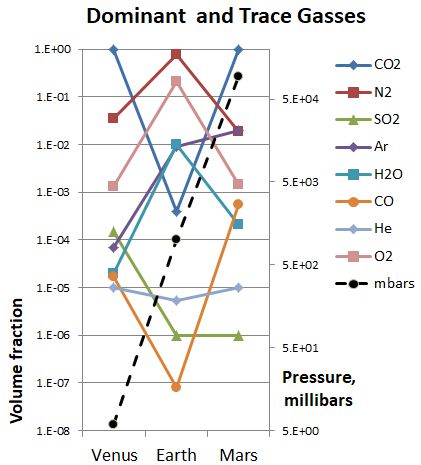
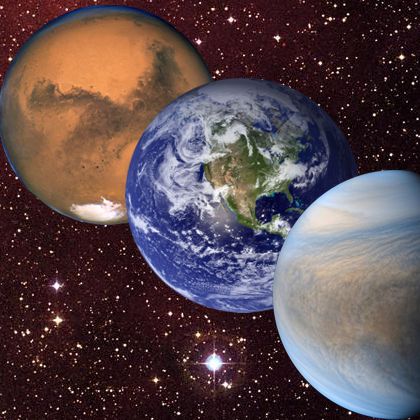
“OK, folks, settle. Last class I challenged you with a question. Venus and Mars both have atmospheres that are dominated by carbon dioxide with a little bit of nitrogen. Earth is right in between them. How come its atmosphere is so different? I gave each of you a piece of that to research. Jeremy, you had the null question. Should we expect Earth’s atmosphere to be about the same as the other two?”

Venus coudtops image by Damia Bouic
JAXA / ISAS / DARTS / Damia Bouic

“I think so, ma’am, on the basis of the protosolar nebula hypothesis. The –“

“Wait a minute, Jeremy. Sy, I saw you sneak in. Jeremy, explain that term to him.”

“Yes’m. Uh, a nebula is a cloud of gas and dust out in space. It could be what got shot out of an exploding star or it could be just a twist in a stream of stuff drifting through the Galaxy. If the twist kinks up, gravity pulls the material on either side of the kink towards the middle and you get a rotating disk. Most of what’s in the disk falls towards its center. The accumulated mass at the center lights up to be a star. Meanwhile, what’s left in the disk keeps most of the original angular momentum but it doesn’t whirl smoothly. There’s going to be local vortices and they attract more stuff and grow up to be planets. That’s what we think happens, anyway.”

“Good summary. So what does that mean for Mars, Venus and the Earth?”

“Their orbits are pretty close together, relative to the disk’s radius, so they ought to have encountered about the same mixture of heavy particles and light ones while they were getting up to size. The light ones would be gas atoms, mostly hydrogen and helium. Half the other atoms are oxygen and they’d react to produce oxides — water, carbon monoxide, grains of silica and iron oxide. And oxygen and nitrogen molecules, of course.”

“Of course. Was gravity the only actor in play there?”

“No-o-o, once the star lit up its photons and solar wind would have pushed against gravity.”

“So three actors. Would photons and solar wind have the same effect? Anybody?”

Silence, until astrophysicist-in-training Newt Barnes speaks up. “No, they’d have different effects. The solar wind is heavy artillery — electrons, protons, alpha particles. They’ll transfer momentum to anything they hit, but they’re more likely to hit a large particle like a dust grain than a small one like an atom. On average, the big particles would be pushed away more.”

“And the photons?”

“A photon is selective — it can only transfer momentum to an atom or molecule that can absorb exactly the photon’s energy. But each kind of atom has its own set of emission and absorption energies. Most light emitted by transitions within hydrogen atoms won’t be absorbed by anything but another hydrogen atom. Same thing for helium. The Sun’s virtually all hydrogen and helium. The photons they emit would move just those disk atoms and leave the heavier stuff in place.”

“That’s only part of the photon story.”

“Oh? Oh, yeah. The Sun’s continuous spectrum. The Sun is hot. Heat jiggles whole ions. Those moving charges produce electromagnetic waves just like charge moving within an atom, but heat-generated waves can have any wavelength and interact with anything. They can bake dust particles and decompose compounds that contain volatile atoms. Then those atoms get swept away in the general rush.”

“Which has the greater effect, solar wind or photons?”

“Hard to say without doing the numbers, but I’d bet on the photons. The metal-and-silicate terrestrial planets are close to the Sun, but the mostly-hydrogen giants are further out.”

“All that said, Jeremy, what’s your conclusion?”

“It sure looks like Earth’s atmosphere should be intermediate between Mars and Venus. How come it’s not?”

~~ Rich Olcott

Sail On, Silver Bird

Big excitement in Al’s coffee shop. “What’s the fuss, Al?”

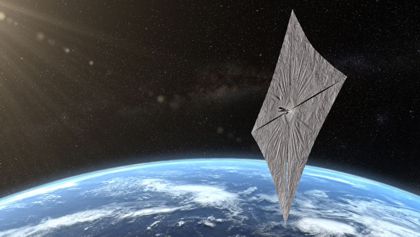
Lightsail 2, Sy. The Planetary Society’s Sun-powered spacecraft. Ten years of work and some luck and it’s up there, way above Hubble and the ISS, boosting itself higher every day and using no fuel to do it. Is that cool or what?”

“Sun-powered? Like with a huge set of solar panels and an electric engine?”

“No, that’s the thing. It’s got a couple of little panels to power its electronics and all, but propulsion is all direct from the Sun and that doesn’t stop. Steady as she goes, Skipper, Earth to Mars in weeks, not months. Woo-hoo!”

Image by Josh Spradling / The Planetary Society

Never the rah-rah type, Big Vinnie throws shade from his usual table by the door. “It didn’t get there by itself, Al. SpaceX’s Falcon Heavy rocket did the hard work, getting Lightsail 2 and about 20 other thingies up to orbit. Takes a lot of thrust to get out of Earth’s gravity well. Chemical rockets can do that, puny little ion drives and lightsails can’t.”

“Yeah, Vinnie, but those ‘puny’ guys could lead us to a totally different travel strategy.” A voice from the crowd, astrophysicist-in-training Newt Barnes. “Your big brawny rocket has to burn a lot of delta-v just to boost its own fuel. That’s a problem.”

Al looks puzzled. “Delta-v?”

“It’s how you figure rocket propellant, Al. With a car you think about miles per gallon because if you take your foot off the gas you eventually stop. In space you just keep going with whatever momentum you’ve got. What’s important is how much you can change momentum — speed up, slow down, change direction — and that depends on the propellant you’re using and the engine you’re putting it through. All you’ve got is what’s in the tanks.”

Al still looks puzzled. I fill in the connection. “Delta means difference, Al, and v is velocity which covers both speed and direction so delta-v means — “

“Got it, Sy. So Vinnie likes big hardware but bigger makes for harder to get off the ground and Newt’s suggesting there’s a limit somewhere.”

“Yup, it’s gotten to the point that the SpaceX people chase an extra few percent performance by chilling their propellants so they can cram more into the size tanks they use. I don’t know what the limit is but we may be getting close.”

Newt’s back in. “Which is where strategy comes in, Vinnie. Up to now we’re mostly using a ballistic strategy to get to off-Earth destinations, treating the vehicle like a projectile that gets all its momentum at the beginning of the trip. But there’s really three phases to the trip, right? You climb out of a gravity well, you travel to your target, and maybe you make a controlled landing you hope. With the ballistic strategy you burn your fuel in phase one while you’re getting yourself into a transfer orbit. Then you coast on momentum through phase two.”

“You got a better strategy?”

“In some ways, yeah. How about applying continuous acceleration throughout phase two instead of just coasting? The Dawn spacecraft, for example, was rocket-launched out of Earth’s gravity well but used a xenon-ion engine in continuous-burn mode to get to Mars and then on to Vesta and Ceres. Worked just fine.”

“But they’re such low-thrust –“

“Hey, Vinnie, taking a long time to build up speed’s no problem when you’re on a long trip anyway. Dawn‘s motor averaged 1.8 kilometer per second of delta-v — that works out to … about 4,000 miles per hour of increased speed for every hour you keep the motor running. Adds up.”

“OK, I’ll give you the ion motor’s more efficient than a chemical system, but still, you need that xenon reaction mass to get your delta-v. You still gotta boost it up out of the well. All you’re doing with that strategy is extend the limit.”

Al dives back in. “That’s the beauty of Lightsail, guys. No delta-v at all. Just put it up there and light-pressure from the Sun provides the energy. Look, I got this slick video that shows how it works.”

Video courtesy of The Planetary Society.

~~ Rich Olcott

Lemon, Vanilla, Cinnamon

Al claims that lemon’s a Summertime flavor, which is why his coffee shop’s Scone Flavor of the Month in July is lemon even though it doesn’t go well with his coffee. “Give me one of those lemon scones, Al, and an iced tea. It’s a little warm out there this morning.”

“Sure thing, Sy. Say, what’s the latest science-y thing up in the sky?”

“Oh, there’s a bunch, Al. The Japanese Hayabusa-2 spacecraft collected another sample from asteroid Ryugu. NASA’s gravity-sniffer GRAIL lunar orbiter found evidence for a huge hunk of metallic material five times larger than the Big Island of Hawai’i buried deep under the Moon’s South Pole-Aitken Basin. The Insight Mars lander’s seismometer heard its first Marsquake —“

“Quit yanking my chain, Sy. Anything about Jupiter?”

“Gotcha, Al. I know Jupiter’s your favorite planet. As it happens I do have some Jupiter news for you.”

“The Juno orbiter’s still working, I hope.”

“Sure, sure, far as I know. It’s about to make its 13th close flyby of Jupiter, and NASA administrators have green-lighted the mission to continue until July 2021. Lots of data for the researchers to work on for years. Here’s a clue — what’re the top three things that everyone knows about Jupiter?”

“It’s the biggest planet, of course, and it’s got those stripes and the Great Red Spot. Has the planet gotten smaller somehow?”

“No, but the stripes and the Red Spot are acting weird. Had you heard about that?”

“No, just that the Spot’s huge and red and been there for 400 years.”

“Mmm, we’re not sure about the 400 years. But yes, it’s huge.”

“Four times wider than Earth, right?”

“Hasn’t been that big for a long time. Back in the 1870s telescope technology gave the astronomers that ‘four Earths wide‘ estimate. But the Spot’s shrunk in the last 150 years.”

“A whole lot?”

“Last measurement I saw, it’s just barely over one Earth wide. Seems to have gotten a bit taller, though, and maybe deeper.”

“Taller and deeper? Huh, that’s a new one. I always thought of the Spot as just this big oval ring on Jupiter’s surface.”

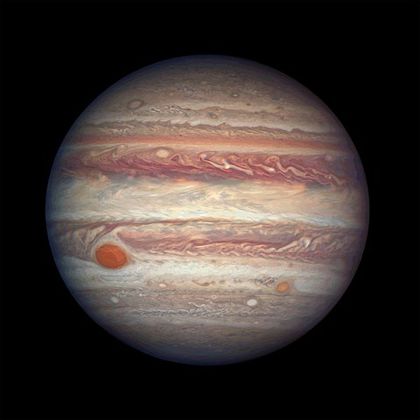
“Everyone has that bogus idea of Jupiter as a big smooth sphere with stripes and ovals and swirls painted on it. Don’t forget, we’re looking down at cloud tops, like those satellite pictures we get looking down at a storm system on Earth. From space, one of our hurricanes looks like a spirally disk centered on a dark spot. That dark spot isn’t in the clouds, it’s actually the top of the ocean, miles below the clouds. If you were a Martian working with photos from a telescope on Phobos, you’d be hard-put to figure that out. You need 3-D perspective to get planets right.”

Jupiter image courtesy ESA/Hubble

“Those stripes and stuff aren’t Jupiter’s surface?”

“As far as we can tell, Jupiter doesn’t have a surface. The hydrogen-helium atmosphere just gets denser and denser until it acts like a liquid. There’s a lot of pressure down there. Juno recently gave us evidence for a core that’s a fuzzy mix of stony material and maybe-metallic maybe-solid hydrogen but if that mush is real it’s only 3% of the planet’s mass. Whatever, it’s thousands of miles below what we see. Jupiter’s anything but smooth.”

“Lumps and bumps like this bubbly scone, huh?”

“More organized than that, more like corduroy or a coiled garden hose. The white stripes are hundreds of miles higher-up than the brown stripes so north-to-south it’s like a series of extreme mountain ranges and valleys. The Great Red Spot reaches up maybe 500 miles further.”

“Does that have to do with what they’re made of?”

“It has everything to do with that, we think. You know Earth’s atmosphere has layers, right?”

“Yeah, the stratosphere’s on top, then you got the weather layer where the clouds are.”

“Close enough. Jupiter has all that and more. Thanks to the Galileo probe we know that Jupiter’s ‘weather layer’ has a topmost blue-white cloud layer of ammonia ice particles, a middle red-to-brown layer containing compounds of ammonia and sulfur, and a bottommost white-ish layer of water clouds. The colors we see depend on which layer is exposed where.”

“But why’re they stripey?”

~~ Rich Olcott

The Prints of Darkness

There’s a commotion in front of Al’s coffee shop. Perennial antiestablishmentarian Change-me Charlie’s set up his argument table there and this time the ‘establishment’ he’s taking on is Astrophysics. Charlie’s an accomplished chain-yanker and he’s working it hard. “There’s no evidence for dark matter, they’ve never found any of the stuff and there’s tons of no-dark-matter theories to explain the evidence.”

Big Cap’n Mike’s shouts from the back of the crowd. “What they’ve been looking for and haven’t found is particles. By my theory dark matter’s an aspect of gravity which ain’t particles so there’s no particles for them to find.”

Astronomer-in-training Jim spouts off right in Charlie’s face. “Dude, you can’t have it both ways. Either there’s no evidence to theorize about, or there’s evidence.”

Physicist-in-training Newt Barnes takes the oppo chair. “So what exactly are we talking about here?”

“That’s the thing, guy, no-one knows. It’s like that song, ‘Last night I saw upon the stair / A little man who wasn’t there. / He wasn’t there again today. / Oh how I wish he’d go away.‘ It’s just buzzwords about a bogosity. Nothin’ there.”

I gotta have my joke. “Oh, it’s past nothing, it’s a negative.”

“Come again?”

“The Universe is loaded with large rotating but stable structures — solar systems, stellar binaries, globular star clusters, galaxies, galaxy clusters, whatever. Newton’s Law of Gravity accounts nicely for the stability of the smallest ones. Their angular momentum would send them flying apart if it weren’t for the gravitational attraction between each component and the mass of the rest. Things as big as galaxies and galaxy clusters are another matter. You can calculate from its spin rate how much mass a galaxy must have in order to keep an outlying star from flying away. Subtract that from the observed mass of stars and gas. You get a negative number. Something like five times more negative than the mass you can account for.”

“Negative mass?”

“Uh-uh, missing positive mass to combine with the observed mass to account for the gravitational attraction holding the structure together. Zwicky and Rubin gave us the initial object-tracking evidence but many other astronomers have added to that particular stack since then. According to the equations, the unobserved mass seems to form a spherical shell surrounding a galaxy.”

“How about black holes and rogue planets?”

Newt’s thing is cosmology so he catches that one. “No dice. The current relative amounts of hydrogen, helium and photons say that the total amount of normal matter (including black holes) in the Universe is nowhere near enough to make up the difference.”

“So maybe Newton’s Law of Gravity doesn’t work when you get to big distances.”

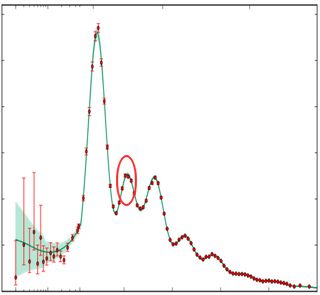
“Biggest distance we’ve got is the edge of the observable Universe. Jim, show him that chart of the angular power distribution in the Planck satellite data for the Cosmological Microwave Background.” <Jim pulls out his smart-phone, pulls up an image.> “See the circled peak? If there were no dark matter that peak would be a valley.”

Charlie’s beginning to wilt a little. “Ahh, that’s all theory.”

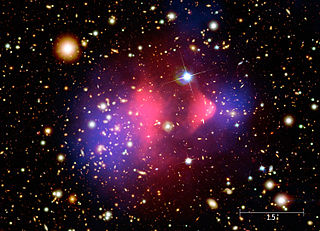
The Bullet Cluster ( 1E 0657-56 )

<Jim pulls up another picture.> “Nope, we’ve got several kinds of direct evidence now. The most famous one is this image of the Bullet Cluster, actually two clusters caught in the act of colliding head-on. High-energy particle-particle collisions emit X-rays that NASA’s Chandra satellite picked up. That’s marked in pink. But on either side of the pink you have these blue-marked regions where images of further-away galaxies are stretched and twisted. We’ve known for a century how mass bends light so we can figure from the distortions how much lensing mass there is and where it is. This picture does three things — it confirms the existence of invisible mass by demonstrating its effect, and it shows that invisible mass and visible mass are separate phenomena. I’ve got no pictures but I just read a paper about two galaxies that don’t seem to be associated with dark matter at all. They rotate just as Newton would’ve expected from their visible mass alone. No surprise, they’re also a lot less dense without that five-fold greater mass squeezing them in.”

“You said three.”

“Gotcha hooked, huh?

~~ Rich Olcott

The Pretty-good Twenty-nine

Time for coffee and a scone. As I step into Al’s coffee shop he’s taking his Jupiter poster down from behind the cash register.

“Hey, Al, I liked that poster. You decide you prefer plain wall?”

“Nah, Sy, I got a new one here. Help me get it up over the hook.”

A voice from behind us. “Ya got it two degrees outta plumb, clockwise.” Vinnie, of course. Al taps the frame to true it up.

Teachers, click here to download a large-format printable copy.

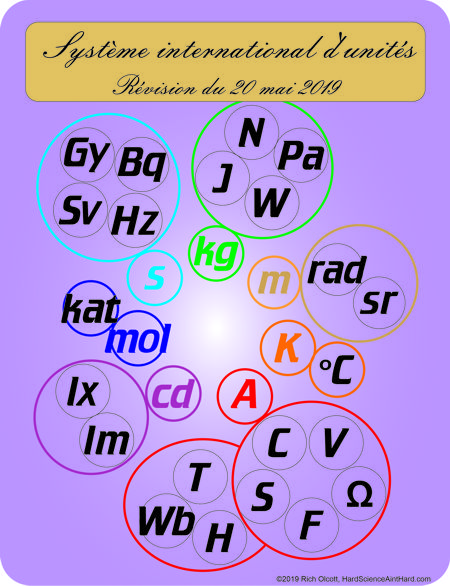
“Hey, Sy, in the middle, that’s the same seven units we just finished talking about — amps for electric current, kelvins for temperature, meters for length, kilograms for mass, seconds for time, moles for counting atoms and such, and that candela one you don’t like. What’s all the other bubbles about? For that matter, what’s the poster about, Al?”

“What it’s about, Vinnie, is on May 20 the whole world goes to a new set of measurement standards, thanks to some international bureau.”

Le Bureau International des Poids et Mesures.” It’s Newt Barnes in from the Physics building. “The bubbles in that central ring are the BIPM’s selections for fundamental standards. Each one’s fixed by precisely defined values of one or more universal physical constants. For instance, a ruler calibrated on Earth will match up perfectly with one calibrated on Mars because both calibrations depend on the wavelength of radiation from a cesium-based laser and that’s the same everywhere.”

“How about the other bubbles and the rings around them?”

“They’re all derived quantities, simple combinations of the fundamental standards.”

“Hey, I see one I recognize. That °C has gotta be degrees centigrade ’cause it’s right next to kelvins. Centigrade’s the same as kelvins plus , uh, 273?”

“There you go, Al. What’s ‘rad’ and ‘sr’, Newt?”

“Symbols for radian and steradian, Vinnie. They both measure angles like degrees do, but they fit the BIPM model because they’re ratios of lengths and length is one of the fundamentals. Divide a circle’s circumference by its radius and what do you get?”

“Twice pi.”

“Right, call it 2π radians and that’s a full circle. Half a circle is π radians, a right angle is π/2 radians and so on. Works for any size circle, right? Anyone remember the formula for the area of a sphere?”

“4πr2, right?”

“Exactly. If you divide any sphere’s area by the square of its radius you get 4π steradians. Any hemisphere is 2π steradians and so on. Steradians are handy for figuring things like light and gravity that decrease as the square of the distance.”

Something occurs to me. “I’m looking at those bigger bubbles that enclose the derived quantities. Seems to me that each one covers a major area of physical science. The green one with newtons for force, pascals for pressure, joules for energy and watts for power — that’d be Newtonian physics. The red circle with volts plus coulombs for charge, ohms for resistance, farads for capacitance, siemens for electrical conductance — all that’s electronics. Add in henries for inductance, webers for magnetic flux and teslas for flux density and you’ve got Maxwellian electromagnetism.”

“You’re on to something, Sy. Chemistry’s there with moles and katals, also known as moles per second, for catalytic activity. How does your idea fit the cluster attached to seconds?”

“They’re all per-second rates, Newt. The hertz is waves per second for periodic things like sound or light-as-a-wave. The other three are about radioactivity — bequerels is fissions per second; grays and sieverts are measures of radiation exposure per kilogram.”

“Vinnie says you don’t like candelas, so you probably don’t like lumens or luxes either. What’s your gripe with them?”

“All three are supposed to quantify visible light from a source, as opposed to the total emission at all wavelengths. But the definition of ‘visible’ zeros in on one wavelength in the green because that’s where most people are most sensitive. Candelas aren’t valid for a person who’s color-blind in the green, nor for something like a red laser that has no green lightwaves. I call bogosity, and lumens and luxes are both candela-based.”

“These 29 standards are as good on Mars as they are here on Earth?”

“That’s the plan.”

~~ Rich Olcott

The Currant Affair

Al has a new sign up at his coffee shop, “Scone of the day — Current.” He chuckles when I quietly point out the spelling error. “I know how to spell currant, Sy. I’m just gonna enjoy telling people that whatever I’m taking from the oven is the current flavor.” I’m high-fiving him for that, just as Vinnie slams in and yells out, “Hey, Al, you got your sign spelled wrong. Got any cranberry ones in there?”

Al gives me a look. I shrug. Vinnie starts in on me. “Hey, Sy, that was pretty slick what that Kibble guy did. All the measurements and calculations had the mass standard depending on three universal constants but then suddenly there was only two.”

Al pricks up his ears. “Universal constants, Sy?”

“We think so. Einstein said that the speed of light c is the same everywhere. That claim has withstood a century of testing so the International Bureau of Weights and Measures took that as their basis when they redefined the meter as the standard of length. Planck’s constant h is sometimes called the quantum of action. It shows up everywhere in quantum-related phenomena and appears to be fundamental to the way the Universe works. Bryan Kibble’s team created a practical way to have a measure-anywhere standard of mass and it just happens to depend only on having good values for c and h.”

“What’s the one that Vinnie said dropped out?”

“I knew you’d ask that, Al. It’s e, the charge on an electron. The proton and every other sub-atomic particle we’ve measured has a charge that’s some integer multiple of e. Sometimes the multiplier is one, sometimes it’s zero, sometimes it’s a negative, but e appears to be a universal quantum of charge. Millikan’s oil drop experiment is the classic example. He measured the charge on hundreds of ionized droplets floating in an electric field between charged plates. Every droplet held some integer multiple between 1 and 150 of 1.6×10⁻¹⁹ Coulomb.”

“That’s a teeny bit of electricity. I remember from Ms Kendall’s class that one coulomb is one ampere flowing for one second. Then a microampere flowing for a microsecond is, uhh, 6 million electrons. How did they make that countable?”

“Ah, you’ve just touched on the ‘realization problem,’ which is not about getting an idea but about making something real, turning a definition into a practical measurement. Electrical current is a good example. Here’s the official definition from 60 years ago. See any problems with it, Vinnie?”

“Infinitely long wires that are infinitely thin? Can’t do it. That’s almost as goofy as that 1960 definition of a second. And how does the force happen anyway?”

“The force comes from electrons moving in each wire electromagnetically pushing on the electrons in the other wire, and that’s a whole other story. The question here is, how could you turn those infinities into a real measurement?”

“Lemme guess. In the 1960 time standard they did a math trick to model a fake Sun and based the second on how the fake Sun moves. Is this like that, with fake wires?”

“Nice shot, Vinnie. One of the methods worked like that — take a pair of wires with a known resistance, bend them along a pair of parabolas or some other known curve set close together, apply a voltage and measure the force. Then you use Maxwell’s equations to ‘correct’ the force to what it would have been with the infinite wires the right distance apart. Nobody was comfortable with that.”

“Not surprised — too many ways to do it wrong, and besides, that’s an awfully small force to measure.”

“Absolutely. Which is why there were so many competing standards, some dating back to the 1860s when we were still trying to figure out what electricity is. Some people used a standard resistor R and the voltage V from a standard chemical cell. Then they defined their standard current I from I=V/R. Some measured power P and calculated I2=P/R. Other people standardized charge from the electrostatic force F=q1q2/r2 between two charged objects; they defined current as charge passed per second. It was a huge debate.”

“Who won?”

“Charge and R and V, all playing together and it’s beautiful.”

~~ Rich Olcott

Fierce Roaring Beast

A darkish day calls for a fresh scone so I head for Al’s coffee shop. Cathleen’s there with some of her Astronomy students. Al’s at their table instead of his usual place behind the cash register. “So what’s going on with these FRBs?”

She plays it cool. “Which FRBs, Al? Fixed Rate Bonds? Failure Review Boards? Flexible Reed Baskets?”

Jim, next to her, joins in. “Feedback Reverb Buffers? Forged Razor Blades?
Fennel Root Beer?”

I give it a shot. “Freely Rolling Boulders? Flashing Rapiers and Broadswords? Fragile Reality Boundary?”

“C’mon, guys. Fast Radio Bursts. Somebody said they’re the hottest thing in Astronomy.”

Cathleen, ever the teacher, gives in. “Well, they’re right, Al. We’ve only known about them since 2007 and they’re among the most mystifying objects we’ve found out there. Apparently they’re scattered randomly in galaxies all over the sky. They release immense amounts of energy in incredibly short periods of time.”

“I’ll say.” Vinnie’s joins the conversation from the next table. “Sy and me, we been talking about using the speed of light to measure stuff. When I read that those radio blasts from somewhere last just a millisecond or so, I thought, ‘Whatever makes that blast happen, the signal to keep it going can’t travel above lightspeed. From one side to the other must be closer than light can travel in a millisecond. That’s only 186 miles. We got asteroids bigger than that!'”

“300 kilometers in metric.” Jim’s back in. “I’ve played with that idea, too. The 70 FRBs reported so far all lasted about a millisecond within a factor of 3 either way — maybe that’s telling us something. The fastest way to get lots of energy is a matter-antimatter annihilation that completely converts mass to energy by E=mc².  Antimatter’s awfully rare 13 billion years after the Big Bang, but suppose there’s still a half-kilogram pebble out there a couple galaxies away and it hits a hunk of normal matter. The annihilation destroys a full kilogram; the energy release is 1017 joules. If the event takes one millisecond that’s 1020 watts of power.”

“How’s that stand up against the power we receive in an FRB signal, Jim?”

“That’s the thing, Sy, we don’t have a good handle on distances. We know how much power our antennas picked up, but power reception drops as the square of the source distance and we don’t know how far away these things are. If your distance estimate is off by a factor of 10 your estimate of emitted power is wrong by a factor of 100.”

“Ballpark us.”

<sigh> “For a conservative estimate, say that next-nearest-neighbor galaxy is something like 1021 kilometers away. When the signal finally hits us those watts have been spread over a 1021-kilometer sphere. Its area is something like 1049 square meters so the signal’s power density would be around 10-29 watts per square meter. I know what you’re going to ask, Cathleen. Assuming the radio-telescope observations used a one-gigahertz bandwidth, the 0.3-to-30-Jansky signals they’ve recorded are about a million million times stronger than my pebble can account for. Further-away collisions would give even smaller signals.”

Looking around at her students, “Good self-checking, Jim, but for the sake of argument, guys, what other evidence do we have to rule out Jim’s hypothesis? Greg?”

“Mmm… spectra? A collision like Jim described ought to shine all across the spectrum, from radio on up through gamma rays. But we don’t seem to get any of that.”

“Terry, if the object’s very far away wouldn’t its shorter wavelengths be red-shifted by the Hubble Flow?”

“Sure, but the furthest-away one we’ve tagged so far is nearer than z=0.2. Wavelengths have been stretched by 20% or less. Blue light would shift down to green or yellow at most.”

“Fran?”

“We ought to get even bigger flashes from antimatter rocks and asteroids. But all the signals have about the same strength within a factor of 100.”

“I got an evidence.”

“Yes, Vinnie?”

“That collision wouldn’t’a had a chance to get started. First contact, blooie! the gases and radiation and stuff push the rest of the pieces apart and kill the yield. That’s one of the problems the A-bomb guys had to solve.”

Al’s been eaves-dropping, of course. “Hey, guys. Fresh Raisin Bread, on the house.”

~~ Rich Olcott

Friendly Resting Behemoths

Holes in The Ground — Big Ones

Al’s stacking chairs on tables, trying to close his coffee shop, but Mr Richard Feder (of Fort Lee, NJ) doesn’t let up on Jim.  “What’s all this about Gale Crater or Mount Sharp that Curiosity‘s running around?  Is it a crater or a mountain?  How about it’s a volcano?  How do you even tell the difference?”

That’s a lot of questions but Jim’s got game.  “Gale is an impact crater, about three and a half billion years old.  The impacting meteorite must have hit hard, because Mount Sharp’s in the middle of Gale.”

Mud drop
Adapted from a photo
by Davide Restivo, Aarau, Switzerland
[CC BY-SA 2.0] via Wikimedia Commons
“How’s that follow?”

“Have you ever watched a rain drop hit a puddle?  It forces the puddle water downward and then the water springs back up again to form a peak.  The same general process  happens when a meteorite hits a rocky surface except the solid peak doesn’t flatten out like water does.  We know that’s the way many meteor craters on the Moon and here on Earth were formed.  We’re pretty sure it’s what happened at Gale — the core of Mount Sharp (formal astronomers call it Aeolis Mons) is probably that kind of peak.”

“Only the core?  What about the rest of it?”

“That’s what Curiosity has been digging into.”  <I have to smile — Jim’s not one to do puns on purpose.>  “The rover’s found evidence that the core’s wrapped up in lots of sedimentary clays, sulfates, hematites and other water-derived minerals of a sort that wouldn’t be there unless Gale had once been a lake like Oregon’s Crater Lake.  That in turn says that Mars once had liquid water on its surface.  That’s why everyone got so excited when those results came in.”

“Oregon’s Crater Lake was from a meteorite?”

“Oops, bad example.  No, that one’s a water-filled volcanic caldera.”

“How do you know?  Any chance its volcano will blow?”

“The best evidence, of course, is the mineralogy.  Volcanoes are made of igneous rocks — lava, tefra and everything in between.  Impact craters are made of whatever was there when the meteorite hit, although the heat and the pressure spike transform a lot of it into some metamorphic form.”

“But you can’t check for that on Mars or the Moon.”

“Mostly not, you’re right, so we have to depend on other clues.  Most volcanoes, for instance, are above the local landscape; most impact structures are below-level.  There are other subtler tests, like the pattern and distance that ejecta were thrown away from the event.  In general we can be 95-plus percent sure whether we’re looking at a volcano or an impact crater.  And no, it won’t any time soon.”

“What won’t do what?”

“You asked whether Crater Lake’s volcano will erupt.  Mount Mazama blew up 7700 years ago and it’s essentially been dormant ever since.”

“There’s some weasel-wording back there — most volcanoes do this, most impacts do that.  What about the exceptions?”

“Those generally have to do with size.  The really enormous features are often hard to even recognize, much less classify.  On Mars, for instance the Northern Lowlands region is significantly smoother than most of the rest of the planet.  Some people think that’s because it’s a huge lava flow that obliterated older impact structures.  Other people think the Lowlands is old sea bottom, smooth because meteorites would have splashed water instead of raising rocky craters.”

Labeled Mars map 420
Mars map from NASA/JPL/GSFC

“I’ll bet ocean.”

“There’s more.  You’ve heard about Olympus Mons on Mars being the Solar System’s biggest volcano, but that’s really only by height.  Alba Mons lies northeast of Olympus and is far huger by volume — 600 million cubic miles of rock but it’s only 4 miles high.  Average slope is half a degree — you’d never notice the upward grade if you walked it.  Astronomers thought Alba was just a humungous plain until they got detailed height data from satellite measurements.”

“The other one’s more than 4 miles high?”

“Oh, yeah.  Olympus Mons rises about 13.5 miles from the base of its surrounding cliffs.  That’s more than the jump from the bottom of the Mariana Trench to the top of Mount Everest.”

“Things on Mars are big, alright.”

~~ Rich Olcott


Why Is Mars Red But Earth Is Blue?

The grad students’ Crazy Theory Contest event at Al’s coffee shop is breaking up.  Amanda’s flaunting the Ceremonial Broom she won with her ‘Spock and the horseshoe crabs‘ theory.  Suddenly a voice from behind me outroars the uproar.  “Hey, Mars guy, I got questions.”

Jim looks up and I look around.  Sure enough, it’s Mr Richard Feder.  I start with the introductions but he barrels right along.  “People call Mars the Red Planet, but I seen NASA pictures and it’s brown, right?  All different kinds of brown, with splotches.  There’s even one picture with every color in the rainbow.  What’s with that and what color is Mars really?”

Jim’s a newly-fledged grad student so I step in to give him a chance to think.  “That rainbow picture, Mr Feder, did it have a circular purple spot about a third of the way up from the bottom and was it mostly blue along the top?”

“Yeah, sounds about right.”

“That’s a NASA topographic map, color-coded for relative elevations, purple for low areas to red high-up.  The blue area is the Northern Lowlands surrounding the North Pole, and that purple spot is Hellas Basin, a huge meteor crater billions of years old.  It’s about 5 miles deep which is why they did it in purple.  The map colors have nothing to do with the color of the planet.”

“About your question, Mr …. Feder is it?”

“Yeah, kid, Richard Feder, Fort Lee, New Jersey.”

“Good to meet you, sir.  The answer to your question is, ‘It depends.’  Are you looking down from space or looking around on the surface?  And where are you looking?  Come to think of it, when are you looking?”

“All I’m asking is, is it red or not?  Why make it so complicated?”

“Because it is complicated.  A few months ago Mars had a huge dust storm that covered the whole planet.  At the surface it was far darker than a cloudy moonless night on Earth.  From space it was a uniform butterscotch color, no markings at all.”

“OK, say there’s no dust in the air.”

“Take away all the floating dust and it almost wouldn’t be Mars any more.  The atmosphere’s only 1% of Earth’s and most of that is CO2 — clear and colorless.”

“So what would we see looking down at the surface?”

“Uh … you’re from New Jersey, right?  What color is New Jersey’s surface?”

<a little defensively> “We got a lot of trees and farms, once you get away from all the buildings along the coast and the Interstates, so it’s green.”

“Mars doesn’t have trees, farms, buildings or roads.  What color is New Jersey underneath all that?”

“The farmland soil’s black of course, and the Palisades cliffs near me are, too.  Down-state to the south we got sand-colored sand on the beaches and clay-colored clay.”

“Mars has clay, the Curiosity rover confirmed that, and it’s got basalt like your cliffs, but it has no soil.”

“Huh? How could it not have soil?  That’s just ground-up rocks, right, and Mars has rocks.”

“Soil’s way more then that, Mr Feder.  If all you have is ground-up rocks, it’s regolith.  The difference is the organic material that soil has and regolith doesn’t — rotted vegetable matter, old roots, fungus, microorganisms.  All that makes the soil black and helps it hold moisture and generally be hospitable to growing things.  So far as we know, Mars has none of that.  We’ve found igneous, sedimentary and metamorphic rocks just like on Earth; we’ve found clays, hematites and gypsum that had to have been formed in a watery environment.  But so far no limestone — no fossilized shelly material like that would indicate life.”

“What you’re saying is that Mars colors look like Earth colors except no plants.  So why do astronomers call Earth a ‘pale blue marble’ but Mars is ‘the red planet’?”

“Earth looks pale blue from space.  The blue is the dominant color reflected from the 70% of Earth’s surface that’s ocean-covered.  It’s pale because of white light reflected from our clouds of water vapor.  Mars lacks both.  What Mars does have is finely-divided iron oxide dust, always afloat above the surface.”

“Mars looks red ’cause it’s atmosphere is rusty?”

“Yessir.”Earth and Mars

~~ Rich Olcott

A Force-to-Force Meeting

The Crazy Theory contest is still going strong in the back room at Al’s coffee shop. I gather from the score board scribbles that Jim’s Mars idea (one mark-up says “2 possible 2 B crazy!“) is way behind Amanda’s “green blood” theory.  There’s some milling about, then a guy next to me says, “I got this, hold my coffee,” and steps up to the mic.  Big fellow, don’t recognize him but some of the Physics students do — “Hey, it’s Cap’n Mike at the mic.  Whatcha got for us this time?”

“I got the absence of a theory, how’s that?  It’s about the Four Forces.”

Someone in the crowd yells out, “Charm, Persuasiveness, Chaos and Bloody-mindedness.”

“Nah, Jennie, that’s Terry Pratchett’s Theory of Historical Narrative.  We’re doing Physics here.  The right answer is Weak and Strong Nuclear Forces, Electromagnetism, and Gravity, with me?  Question is, how do they compare?”

Another voice from the crowd. “Depends on distance!”

“Well yeah, but let’s look at cases.  Weak Nuclear Force first.  It works on the quarks that form massive particles like protons.  It’s a really short-range force because it depends on force-carrier particles that have very short lifetimes.  If a Weak Force carrier leaves its home particle even at the speed of light which they’re way too heavy to do, it can only fly a small fraction of a proton radius before it expires without affecting anything.  So, ineffective anywhere outside a massive particle.”

It’s a raucous crowd.  “How about the Strong Force, Mike?”

.  <chorus of “HOO-wah!”>

“Semper fi that.  OK, the carriers of the Strong Force —”

.  <“Naa-VY!  Naaa-VY!”>

.  <“Hush up, guys, let him finish.”>

“Thanks, Amanda.  The Strong Force carriers have no mass so they fly at lightspeed, but the force itself is short range, falls off rapidly beyond the nuclear radius.  It keeps each trio of quarks inside their own proton or neutron.  And it’s powerful enough to corral positively-charged particles within the nucleus.  That means it’s way stronger inside the nucleus than the Electromagnetic force that pushes positive charges away from each other.”

“How about outside the nucleus?”

“Out there it’s much weaker than Electromagnetism’s photons that go flying about —”

.  <“Air Force!”>

.  <“You guys!”>

“As I was saying…  OK, the Electromagnetic Force is like the nuclear forces because it’s carried by particles and quantum mechanics applies.  But it’s different from the nuclear forces because of its inverse-square distance dependence.  Its range is infinite if you’re willing to wait a while to sense it because light has finite speed.  The really different force is the fourth one, Gravity —”

.  <“Yo Army!  Ground-pounders rock!”>

“I was expecting that.  In some ways Gravity’s like Electromagnetism.  It travels at the same speed and has the same inverse-square distance law.  But at any given distance, Gravity’s a factor of 1038 punier and we’ve never been able to detect a force-carrier for it.  Worse, a century of math work hasn’t been able to forge an acceptable connection between the really good Relativity theory we have for Gravity and the really good Standard Model we have for the other three forces.  So here’s my Crazy Theory Number One — maybe there is no connection.”

.  <sudden dead silence>

“All the theory work I’ve seen — string theory, whatever — assumes that Gravity is somehow subject to quantum-based laws of some sort and our challenge is to tie Gravity’s quanta to the rules that govern the Standard Model.  That’s the way we’d like the Universe to work, but is there any firm evidence that Gravity actually is quantized?”

.  <more silence>

“Right.  So now for my Even Crazier Theories.  Maybe there’s a Fifth Force, also non-quantized, even weaker than Gravity, and not bound by the speed of light.  Something like that could explain entanglement and solve Einstein’s Bubble problem.”

.  <even more silence>

“OK, I’ll get crazier.  Many of us have had what I’ll call spooky experiences that known Physics can’t explain.  Maybe stupid-good gambling luck or ‘just knowing’ when someone died, stuff like that.  Maybe we’re using the Fifth Force in action.”

.  <complete pandemonium>
four forces plus 1

~ Rich Olcott


Note to my readers with connections to the US National Guard, Coast Guard, Merchant Marine and/or Public Health Service — Yeah, I know, but one can only stretch a metaphor so far.