Helios versus Mars, Planetary Version

Al waves me over the moment I step through the door of his coffee shop.  “Sy, ya gotta squeeze into the back room.  The grad students are holding another Crazy Theory contest and they’re having a blast.  I don’t know enough science to keep up with ’em but you’d love it.  Here’s your coffee.”

“Thanks, Al.  I’ll see what’s going on.”

The Crazy Theory contest is a hallowed Al’s Coffee Shop tradition — a “seminar” where grad students present their weirdest ideas in competition.  Another tradition (Al is strong on this one) is that the night’s winner has to sweep up the thrown spitballs and crumpled paper napkins at the end of the presentations.  I weave my way in just as the girl at the mic finishes her pitch with, “… and that’s why Spock and horseshoe crabs both have green blood!”

Some in the crowd start chanting “Amanda!  Amanda!  Amanda!”  She’s already reaching for the Ceremonial Broom when Jim steps up to the mic and waves for quiet.  “Wanna hear how the Sun oxidized Mars and poisoned it for us?”

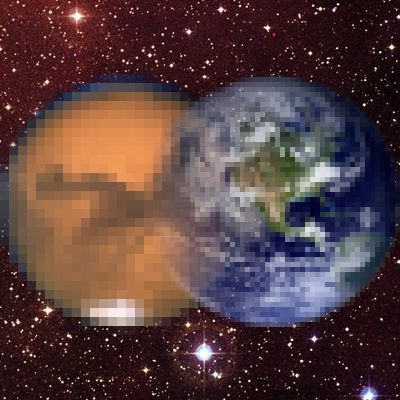
Helios and Mars
Helios and Mars
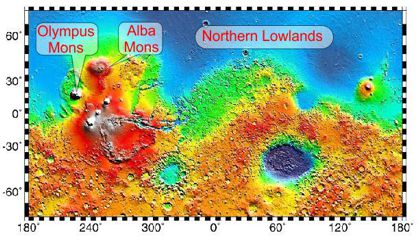
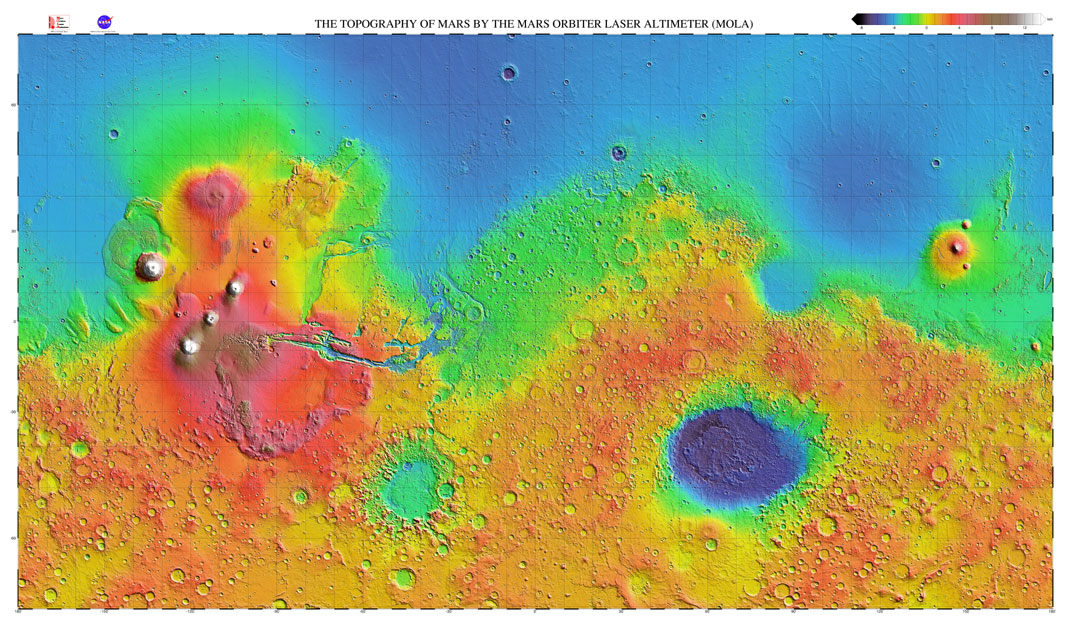
Mars image adopted from photo by Mark Cartwright
Creative Commons license
Attribution-NonCommercial-ShareAlike

Voice from the crowd — <“The Sun did what?”>

“You remember titration from school chem lab?”

.——<“Yeah, you put acid in a beaker and you drip in a base until the solution starts to turn red.”>

“What color is Mars?”

.——<“Red!”>

“Well, there you are.”

.——<“Horse-hockey!  What’s that got to do with the Sun or what you said about poison?”>

“Look at what our rovers and orbiters found on Mars — atmosphere only 1% of Earth’s but even that’s mostly CO2, no liquid water at the surface, rust-dust everywhere, soil’s loaded with perchlorate salts.  My Crazy Theory can explain all of that.”

.——<“Awright, let’s hear it!”>

“Titration’s all about counting out chemical species.  Your acid-base indicator pinked when you’d neutralized your sample’s H+ ions by adding exactly the right number of OH ions to turn them all into H2O, right?  So think about Mars back in the day when it had liquid water on the ground and water vapor in the atmosphere.  Along comes solar radiation, especially the hard ultra-violet that blows apart stratospheric H2O molecules.  ZOT!  Suddenly you’ve got two free hydrogen atoms and an oxygen floating around.  Then what happens?”

It’s a tough crowd.  <“We’re dying to hear!  Get on with it!”>

“The hydrogens tie up as an H2 molecule.  The escape velocity on Mars is well below the speed of H2 molecules at any temperature above 40K, so those guys abandon Mars for the freedom of Space.  Which leaves the oxygen atom behind, hungry for electrons and ready to oxidize anything it can get close to.”

They’re starting to come along.  <“Wouldn’t the oxygen form O2 and fly away too?”>

“Nowhere near as quickly.  An O2 molecule is 16 times heavier than an H2 molecule.  At a given temperature it moves 1/4 as fast and mostly stays on-planet where it can chew up the landscape.”

.——<“How could an atom do that?”>

“It’s a chain process.  First step for the O is to react with something else in the atmosphere — make an oxidizing molecule like ozone or hydrogen peroxide.  That diffuses down to ground level where it can eat rocks.”

.——<“Wait, ‘eat rocks’!!?!  How does that happen?”>

“Look, most rocks are basically lattices of double-negative oxide ions with positive metal ions tucked in between to balance the charge.  Surface oxide ions can’t be oxidized by an ozone molecule, but they can transmit electron demand down to the metal ions immediately underneath.  An iron2+ ion gets oxidized to iron3+, one big step towards rust-dust.  The charge change disrupts the existing oxide lattice pattern and that piece of the rock erodes a little.”

.——<“What about the poison?”>

“Back when Mars had oceans, they had to have lots of chloride ions floating around to be left behind when the ocean dried up.  Ozone converts chloride to perchlorate, ClO4, which is also a pretty good oxidizer.  Worse, it’s the right size and charge to sneak into your thyroid gland and mess it up.  Poison for sure.  Chemically, solar radiation raised the oxidation state of the whole planet.”

One lonely voice — “Nice try, Jim” — but then the chant returns…

.——<“Amanda!  Amanda!  Amanda!”>

~~ Rich Olcott

Cube Roots

Cathleen steps into at Al’s for her morning coffee-and-scone.  “Heard you guys talking neutrinos so I’ll bet Al got you started with something about IceCube.  Isn’t it an awesome project?  Imagine instrumenting a cubic kilometer of ice, and at the South Pole!”

“Ya got me, Cathleen.  It knocked me out that anyone would even think of building it.  Where did the idea come from, anyhow?”

“I don’t know specifically, but it’s got a lot of ancestors, going back to the Wilson Cloud Chamber in the 1920s.”

“Oh, the cloud chamber!  Me and my brother did one for the Science Fair — used dry ice and some kind of alcohol in a plastic-covered lab dish if I remember right, and we set it next to one of my Mom’s orange dinner plates.  Spooky little ghost trails all over the place.”

“That’s basically what the first ones were.  An incoming particle knocks electrons out of vapor molecules all along its path.  The path is visible because the whole thing is so cold that other vapor molecules condense to form micro-droplets around the ions.  Anderson’s cloud chambers were good enough to get him a Nobel Prize for discovering the positron and muon.  But table-top devices only let you study low-energy particles — high-energy ones just shoot through the chamber and exit before they do anything interesting.”

“So the experimenters went big?”

“Indeed, Sy, massive new technologies, like bubble chambers holding thousands of gallons of liquid hydrogen or something else that reacts with neutrinos.  But even those experiments had a problem.”

“And that was…?”

FirstNeutrinoEventAnnotated 2
Adapted from public domain image
courtesy of Argonne National Laboratory

“They all depended on photography to record the traces.  Neutrino-hunting grad students had to measure everything in the photos, because neutrinos don’t make traces — you only find them by finding bigger particles that were disturbed just so.  The work got really intense when the astrophysicists got into the act, trying to understand why the Sun seemed to be giving off only a third of the neutrinos it’s supposed to.  Was the Sun going out?”

“Wait, Cathleen, how’d they know how many neutrinos it’s supposed to make?”

“Wow, Vinnie, you sure know how to break up a narrative, but it’s a fair question.  OK, quick answer.  We know the Sun’s mostly made of hydrogen and we know how much energy it gives off per second.  We’ve figured out the nuclear reactions it must be using to generate that energy.  The primary process combines four hydrogen nuclei  to make a helium nucleus.  Each time that happens you get a certain amount of energy, which we know, plus two neutrinos.  Do the energy arithmetic, multiply the number of heliums per second by two and you’ve got the expected neutrino output.”

“So is the Sun going out?”

“As usual, Al cuts to the chase.  No, Al, it’s still got 5 billion years of middle age ahead of it.  The flaw in the argument was that we assumed that our detectors were picking up all the neutrinos.”

“My mutations!”

“Yes, Vinnie.  Our detector technology at the time only saw electron neutrinos.  The Sun’s reactions emit electron neutrinos.  But the 93-million mile trip to Earth gave those guys plenty of time to oscillate through muon neutrino to tau neutrino and back again.  All we picked up were the ones that had gone through an integer number of cycles.”

“We changed technology, I take it?”

“Right again, Sy.  Instead of relying on nuclear reactions initiated by electron neutrinos, we went so spark chambers — crossed grids of very fine electrified wire in a box of argon gas.  Wherever a passing neutrino initiated an ionization, zap! between the two wires closest to that point.  Researchers could computerize the data reduction.  Turns out that all three neutrino flavors are pretty good at causing ionizations so the new tech cleared up the Solar Paradox, but only after we solved a different problem — the new data was point-by-point.  Working back from those points to the traces took some clever computer programming.”

“Ah, I see the connection with IceCube.  It doesn’t register traces, either, just the points where those sensors see the Cherenkov flashes.  It’s like a spark chamber grown big.”

“Cubic-kilometer big.”

~~ Rich Olcott

Bigger than you’d think

Al’s coffee shop, the usual mid-afternoon crowd of chatterers and laptop-tappers.  Al’s walking his refill rounds, but I notice he’s carrying a pitcher rather than his usual coffee pot.  “Hey, Al, what’s with the hardware?”

“Got iced coffee here, Sy.  It’s hot out, people want to cool down.  Besides, this is in honor of IceCube.”

“Didn’t realize you’re gangsta fan.”

“Nah, not the rapper, the cool experiment down in the Antarctic.  It was just in the news.”

“Oh?  What did they say about it?”

“It’s the biggest observatory in the world, set up to look for the tiniest particles we know of, and it uses a cubic mile of ice which I can’t think how you’d steer it.”

A new voice, or rather, a familiar one. “One doesn’t, Al.”
Neutrino swirl 1“Hello, Jennie.  Haven’t seen you for a while.”
“I flew home to England to see my folks.  Now I’m back here for the start of the Fall term.  I’ve already picked a research topic — neutrinos.  They’re weird.”

“Hey, Jennie, why are they so tiny?”

“It’s the other way to, Al.  They’re neutrinos because they’re so tiny.  Sy would say that for a long time they were simply an accounting gimmick to preserve the conservation laws.”

“I would?”

“Indeed.  People had noticed that when uranium atoms give off alpha particles to become thorium, the alpha particles always have about the same amount of energy.  The researchers accounted for that by supposing that each kind of nucleus has some certain quantized amount of internal energy.  When one kind downsizes to another, the alpha particle carries off the difference.”

“That worked well, did it?”

“Oh, yes, there are whole tables of nuclear binding energy for alpha radiation.  But when a carbon-14 atom emits a beta particle to become nitrogen-14, the particle can have pretty much any amount of energy up to a maximum.  It’s as though the nuclear quantum levels don’t exist for beta decay.  Physicists called it the continuous beta-spectrum problem and people brought out all sorts of bizarre theories to try to explain it.  Finally Pauli suggested maybe something we can’t see carries off energy and leaves less for the beta.  Something with no charge and undetectable mass and the opposite spin from what the beta has.”

“Yeah, that’d be an accounting gimmick, alright.  The mass disappears into the rounding error.”

“It might have done, but twenty years later they found a real particle.  Oh, I should mention that after Pauli made the suggestion Fermi came up with a serious theory to support it.  Being Italian, he gave the particle its neutrino name because it was neutral and small.”

“But how small?”

“We don’t really know, Al.  We know the neutrino’s mass has to be greater than zero because it doesn’t travel quite as fast as light does.  On the topside, though, it has to be lighter than than a hydrogen atom by at least a factor of a milliard.”

“Milliard?”

“Oh, sorry, I’m stateside, aren’t I?  I should have said a billion.  Ten-to-the-ninth, anyway.”

“That’s small.  I guess that’s why they can sneak past all the matter in Earth like the TV program said and never even notice.”

This gives me an idea.  I unholster Old Reliable and start to work.

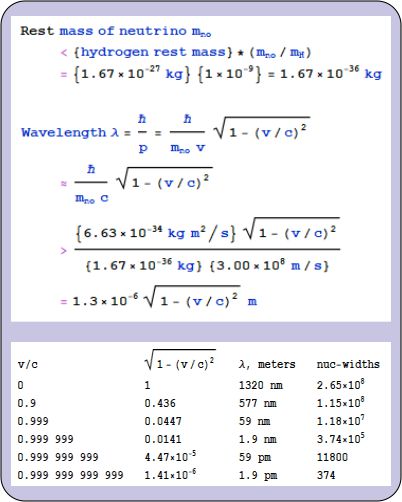
“Be right with you… <pause> … Jennie, I noticed that you were being careful to say that neutrinos are light, rather than small.  Good careful, ’cause ‘size’ can get tricky at this scale.  In the early 1920s de Broglie wrote that every particle is associated with a wave whose wavelength depends on the particle’s momentum.  I used his formula, together with Jennie’s upper bound for the neutrino’s mass, to calculate a few wavelength lower bounds.Neutrino wavelength calcMomentum is velocity times mass.  These guys fly so close to lightspeed that for a long time scientists thought that neutrinos are massless like photons.  They’re not, so I used several different v/c ratios to see what the relativistic correction does.  Slow neutrinos are huge, by atom standards.  Even the fastest ones are hundreds of times wider than a nucleus.”

“With its neutrino-ness spread so thin, no wonder it’s so sneaky.”

“That may be part of it, Al.”

“But how do you steer IceCube?”

~~ Rich Olcott

Rhythm Method

A warm Summer day.  I’m under a shady tree by the lake, watching the geese and doing some math on Old Reliable.  Suddenly a text-message window opens up on its screen.  The header bar says 710-555-1701.  Old Reliable has never held a messaging app, that’s not what I use it for.  The whole thing doesn’t add up.  I type in, Hello?

Hello, Mr Moire.  Remember me?

Suddenly I do.  That sultry knowing stare, those pointed ears.  It’s been a yearHello, Ms Baird.  What can I do for you?

Another tip for you, Mr Moire.  One of my favorite star systems — the view as you approach it at near-lightspeed is so ... meaningful.  Your astronomers call it PSR J0337+1715.

So of course I head over to Al’s coffee shop after erasing everything but that astronomical designation.  As I hoped, Cathleen and a few of her astronomy students are on their mid-morning break.  Cathleen winces a little when she sees me coming.  “Now what, Sy?  You’re going to ask about blazars and neutrinos?”

I show her Old Reliable’s screen.  “Afraid not, Cathleen, I’ll have to save that for later.  I just got a message about this star system.  Recognize it?”

“Why, Sy, is that a clue or something?  And why is the lettering in orange?”

“Long story.  But what can you tell me about this star system?”

“Well, it’s probably one of the most compact multi-component systems we’re ever going to run across.  You know what compact objects are?”

“Sure.  When a star the size of our Sun exhausts most of its hydrogen fuel, gravity wins its battle against heat.  The star collapses down to a white dwarf, a Sun-full of mass packed into a planet-size body.  If the star’s a bit bigger it collapses even further, down to a neutron star just a few miles across.  The next step would be a black hole, but that’s not really a star, is it?”

“No, it’s not.  Jim, why not?”

“Because by definition a black hole doesn’t emit light.  A black hole’s accretion disk or polar jets might, but not the object itself.”

“Mm-hm.  Sy, your ‘object’ is actually three compact objects orbiting  around each other.  There’s a neutron star with a white dwarf going around it, and another white dwarf swinging around the pair of them.  Vivian, does that sound familiar?”

“That’s a three-body system, like the Moon going around the Earth and both going around the Sun.  Mmm, except really both white dwarfs would go around the neutron star because it’s heaviest and we can calculate the motion like we do the Solar System.”

“Not quite.  We can treat the Sun as motionless because it has 99% of the mass.  J0337+1715’s neutron star doesn’t dominate its system as much as the Sun does ours.  That outermost dwarf has 20% of its system’s mass.  Phil, what does that suggest to you?”

“It’d be like Pluto and Charon.  Charon’s got 10% of their combined mass and so Pluto and Charon both orbit a point 10% of the way out from Pluto.  From Earth we see Pluto wobbling side to side around that point.  So the neutron star must wobble around the point 20% outward towards the heavy dwarf.  Hey, star-wobble is how we find exoplanets.  Is that what this is about, Mr Moire?  Did someone measure its red-shift behavior?”PSR J0337+1715Cathleen saves me from answering.  “Not quite.  The study Sy’s chasing is actually a cute variation on red-shift measurements.  That ‘PSR‘ designation means the neutron star is a pulsar.  Those things emit electromagnetic radiation pulses with astounding precision, generally regular within a few dozen nanoseconds.  If we receive slowed-down pulses then the object’s going away; sped-up and it’s approaching, just like with red-shifting.  The researchers  derived orbital parameters for all three bodies from the between-pulse durations.  The heavy dwarf is 200 times further out than the light one, for instance.  Not an easy experiment, but it yielded an important result.”
My ears perk up.  “Which was…?”

“The gravitational force between the pulsar and each dwarf was within six parts per million of what Newton’s Laws prescribe.  That observation rules out whole classes of theories that tried to explain galaxies and galaxy clusters without invoking dark matter.”

Cool, huh?

Uh-huh.

~~ Rich Olcott

Quartetto for Rubber Ruler

Suddenly Al’s standing at our table.  “Hey guys, I heard you talking about spectroscopy and stuff and figured you could maybe ‘splain something I read.  Here’s some scones and I brought a fresh pot of coffee..”

“Thanks, Al.  What’s the something?  I’m sure Cathleen can ‘splain.”

“Syyy…”

“It’s this article talking about some scientists going down to Australia to use really old light to look for younger light and it’s got something to do with dark matter and I’m confused.”

“You’re talking about the EDGES project, right?”

“Yeah, I’m pretty sure they said ‘EDGES’ in the article.”

“OK, first we need some background on the background, that really old light you mentioned.  The Cosmic Microwave Background is the oldest light in the Universe, photons struggling out of the white-hot plasma fog that dominated most of the first 377,000 years after the Big Bang.”

“Wait a minute, ‘plasma fog’?”

“Mm-hm.  In those early years the Universe was all free electrons and nuclei colliding with photons and each other.  No photon could travel more than a few centimeters before being blocked by some charged particle.  The Universe had to expand and cool down to 4,000K or so before electrons and nuclei could hold together as atoms and the fog could lift.”

“Cathleen showed me an intensity-frequency plot for those suddenly-free photons.  It was a virtually perfect blackbody curve, identical within a couple parts per million everywhere in the sky.  The thing is, the curve corresponds to a temperature of only 2.73K.  Its peak is in the microwave region, hence the CMB moniker, nestled in between far infrared and HF radio.”

“I thought she said that the fog lifted at 4,000K, Sy.  That’s a lot different from 2-whatever.”

Wavelength-stretching, Vinnie, remember?  Universe expansion stretches the photon waves we measure temperatures with, the further the longer just like Hubble said.  The CMB’s the oldest light in the Universe, coming to us from 13.4 billion lightyears away.  The stretch factor is about 1100.”

“Vinnie, that 2.7K blackbody radiation is the background to the story.  Think of it as a spherical shell around the part of the Universe we can see.  There are younger layers inside that shell and older layers beyond it.”

“What could be outside the Universe, Cathleen?”

“Hey, Al, I carefully said, ‘the part of the Universe we can see.’  I’m quite sure that the Universe extends beyond the spatial volume we have access to, but light from out there hasn’t had a chance to get to us yet.  Going outward from our CMB sphere there’s that 337,000-year-deep shell of electron-nucleus fog.  Beyond that, 47,000 years-worth of quark soup and worse, out to the Big Bang itself.  Coming inward from the CMB we see all the things we know of that have to do with atoms.”

“Like galaxies?”

“Well, not immediately, they took a billion years to build up.  First we had to get through the Dark Ages when there weren’t any photons in the visible light range.  We had huge clouds of hydrogen and helium atoms but virtually all of them were in the ground state.  The CMB photons running around were too low-energy to get any chemistry going, much less nuclear processes.  The Universe was dark and cooling until gravitational attraction made clumps of gas dense enough to light up and become stars.  That’s when things got going.”

“How’d that make a difference?”Blackbody spectrum with notch

“A ground state hydrogen atom’s lowest available empty energy level is way above what a CMB photon could supply.  Those Dark Age atoms were essentially transparent to the prevailing electromagnetic radiation.  But when starlight came along it excited some atoms so that they could also absorb CMB light.  See the notch on the long-wavelength side of this blackbody curve?  It marks the shadow of starlit hydrogen clouds against the CMB’s glow.  The notch wavelength indicates when the absorption started.  Its position suggests that some stars lit up as early as 180 million years after the Big Bang.”

“Suggests, huh?”

“Mm-hm.  There are other interpretations.  That’s where the fun comes in, both on the theory side and the get-more-data side.  Like looking at different times.”

“Different times?”

“Every wavelength represents a different stretch factor and a different depth into the past.”

~~ Rich Olcott

Zarzuela for Rubber Ruler

“Hey, Cathleen, if the expansion of the Universe stretches light’s wavelengths, how do you know when you see a color in a star what you’re looking at?”

“Excuse me, Professor, but your office-mate said you’d be here at the coffee shop and I have a homework question.”

“Good heavens, look at the time!  It’s my office hours, I should be over there.  Oh well, you’re here, Maria, what’s the question?”

“You showed us this chart and asked us to write an essay on it.  I don’t know where to begin.”Temp and BB peak

“Ah.  Hang on, Vinnie, this bears on your question, too.  OK, Maria, what can you tell me about the chart?”

“Well, there are five peaked curves, labeled with different temperatures.  Can I assume the green curve peaks, too, not continuing straight up?”

“Yes.  What else?”

“The horizontal axis, sorry I don’t know the word —”

“abscissa”

“Oh, we have almost the same word in Spanish!  Anyhow, the abscisa says it shows wavelengths.  It goes from a tenth of a nanometer to maybe 10 micrometers.  The chart must have to do with light, because sound waves can’t get that short.  The … ordinada…?”

“Ordinate”

“Thank you.  The ordinate says ‘Intensity’ so the chart must show light spectra at different temperatures.  But there’s only one peak at each temperature.”

“Is that Kirchhoff’s ‘continuous spectrum,’ Cathleen?”

“Right, Vinnie, a smoothly-varying cascade of every wavelength, photons arising from heat-generated motion of charged particles.”

Ah, ya lo veo — this is blackbody spectra given off by hot objects.  You showed us one in class and here we have several.”

“Good, Maria.  Now —”

“But all the peaks look exactly the same, Cathleen.  The hot objects ought to be brighter.  A really hot flame, you can’t even look at it.  Something’s phony.”

“Good eye, Vinnie.  I divided each curve in the graph by its peak height to put them all on an even footing.  That’s why the axis is labeled ‘Intensity profile‘ instead of ‘Intensity.'”

“I’ve got a different issue, Cathleen.  Hot objects have more energy to play with.  Shouldn’t the hotter peaks spread over a wider wavelength range?  These are all the same width.”

“I think I know the answer to that one, Mr Moire.  In class la profesora showed us how the blackbody curve’s equation has two factors, like B=W*X.  The W factor depends only on wavelength and grows bigger as the wavelength gets smaller.  That’s the ‘ultraviolet catastrophe,’ right, ma’am?”

“Mm-hm.  Go on, Maria.”

“But the X factor gets small real fast as the wavelength gets small.  In fact, it gets small so fast that it overpowers W‘s growth — the W*X product gets small, too.  Do you have that movie you showed us on your laptop there, ma’am?”

“Sure.  Here it is…”Blackbody peaks 1

“OK, the blue line is that W factor.  Oh, by the way, the ordinate scale here is logarithmic, so the value at the left end of the blue line is 1027/106 or about 1021 times bigger than it is at the right end even though it looks like a straight line.  The green line is that temperature-dependent factor.  See how it pulls down the orange lines’ values for cold objects, but practically goes away for very hot objects?”

“Yeah, that shows it real good, right, Sy?  That orange peak moves to the left just like Cathleen’s picture shows.  It answers your question, too.”

“It does, Vinnie?  How so?”

“‘Cause the peaks get broader as they get higher.  It’s like the intensity at the, umm, microwave end hardly changes at all and the whole rest of the curve swings up and out from there.”

“Keep in mind, guys, that we’re talking really large numbers here.  Vinnie’s ‘hardly changes at all’ is actually a factor of 40,000 or so.  Those pretty peaks in my homework chart are only pretty because the spread-out tails are so small relative to the peaks.”

“Alright, Cathleen, but how does Maria’s question tie in with mine?”

“They both hinge on wavelength.  The blackbody equation lets us measure a star’s temperature by looking at its color.  Do you have enough to start on that essay, Maria?”

“Yes, ma’am.  Gracias.”

De nada.  Now run along and get to work on it.”

~~ Rich Olcott

Trio for Rubber Ruler

“It’s all about how lightwaves get generated and then what happens.”

Sy and me talked about that, Cathleen.  Lightwaves come from jiggling electrons, right?”

“Any kind of charged particles, Vinnie, but there’s different ways that can happen.  Each leads to its own kind of spectrum.”

“Different kinds of spectrum?  Do you mean like visible versus infrared and ultraviolet, Cathleen?”

“No, I don’t, Sy.  I’m referring to the thing’s overall appearance in every band.  A hundred and fifty years ago Kirchoff pointed out that light from a source can have lines of color, lines without color, or a smooth display without lines.”

“Like that poster that Al put up between the physicist and astronomer corners?”  (We’re still chatting at a table in Al’s coffee shop.  I’m on my fourth scone.)

Astroruler with solar spectrum
Based on N.A.Sharp, NOAO/NSO/Kitt Peak FTS/AURA/NSF

“Kind of.  That’s based on a famous image created at Kitt Peak Observatory.  In the background there you see a representation of what Kirchoff called a continuous or black-body spectrum, where all the colors fade smoothly into each other in classic rainbow order.  You’re supposed to ignore the horizontal dark lines.”

“And the vertical lines?”

“They form what Kirchoff called an absorption spectrum.  Each dark vertical represents an isolated color that we don’t get from the Sun.”

“You’re saying we get all the other colors but them, right?”

“Exactly, Vinnie.  The Sun’s chromosphere layer filters those specific wavelengths before they get from the deeper photosphere out into space.”

“Complicated filter.”

“Of course.  The Sun contains most of the elements lighter than nickel.  Each kind of atom absorbs its own collection of frequencies.”

“Ah, that’s the quantum thing that Sy and me talked about, right, Sy?”

“Mm-hm.  We only did the hydrogen atom, but the same principles apply.  An electromagnetic wave tickles an atom.  If the wave delivers exactly the right amount of energy, the atom’s chaotic storm of electrons resonates with the energy and goes a different-shaped storm.  But each kind of atom has a limited set of shapes.  If the energy doesn’t match the energy difference between a pair of levels, there’s no absorption and the wave just passes by.”

“But I’ll bet the atom can’t hold that extra energy forever.”

“Good bet, Vinnie.  The flip side of absorption is emission.  I expect that Cathleen has an emission spectrum somewhere on her laptop there.”Emission spectrum“You’re right, Sy.  It’s not a particularly pretty picture, but it shows that nice strong sodium doublet in the yellow and the broad iron and hydrogen lines down in the green and blue.  I’ll admit it, Vinnie, this is a faked image I made to show my students what the solar atmosphere would look like if you could turn off the photosphere’s continuous blast of light.  The point is that the atoms emit exactly the same sets of colors that they absorb.”

“You do what you gotta do, Cathleen.  But tell me, if each kind of atom does only certain colors, where’s that continuous rainbow come from?  Why aren’t we only getting hydrogen colors?”

“Kirchoff didn’t have a clue on that, Vinnie.  It took 50 years and Einstein to solve it.  Not just where the light comes from but also its energy-wavelength profile.”

“So where does the light come from?”

“Pure heat.  You can get a continuous spectrum from a hot wire, molten lava, a hole through the wall of a hot oven, even the primordial chaos of the Big Bang.  It doesn’t matter what kind of matter you’re looking at, the profile just depends on the temperature.  You know that temperature measures the kinetic energy stored in particle random motion, Vinnie?”

“Well, I wouldn’t have put it that way, but yeah.”

“Well, think about the Sun, just a big ball of really hot atoms and electrons and nuclei, all bouncing off each other in frantic motion.  Every time one of those changes direction it affects the electromagnetic field, jiggles it as you say.  The result of all that jiggling is the continuous spectrum.  Absorption and emission lines come from electrons that are confined to an atom, but heat motion is unconfined.”

“How about hot metal?”

“The atoms are locked in their lattice, but heat jiggles the whole lattice.”

~~ Rich Olcott

The Fellowship of A Ring

Einstein ring 2018
Hubble photo from NASA’s Web site

Cathleen and I are at a table in Al’s coffee shop, discussing not much, when Vinnie comes barreling in.  “Hey, guys.  Glad I found you together.  I just saw this ‘Einstein ring’ photo.  They say it’s some kind of lensing phenomenon and I’m thinking that a lens floating out in space to do that has to be yuuuge.  What’s it made of, and d’ya think aliens put it there to send us a message?”

Astronomer Cathleen rises to the bait.  I sit back to watch the fun.  “No, Vinnie, I don’t.  We’re not that special, the rings aren’t signals, and the lenses aren’t things, at least not in the way you’re thinking.”

“There’s more than one?”

“Hundreds we know of so far and it’s early days because the technology’s still improving.”

“How come so many?”

“It’s because of what makes the phenomenon happen.  What do you know about gravity and light rays?”

Me and Sy talked about that a while ago.  Light rays think they travel in straight lines past a heavy object, but if you’re watching the beam from somewhere else you think it bends there.”

I chip in.  “Nice summary, good to know you’re storing this stuff away.”Gravitational lens 1

“Hey, Sy, it’s why I ask questions is to catch up.  So go on, Cathleen.”

She swings her laptop around to show us a graphic.  “So think about a star far, far away.  It’s sending out light rays in every direction.  We’re here in Earth and catch only the rays emitted in our direction.  But suppose there’s a black hole exactly in the way of the direct beam.”

“We couldn’t see the star, I get that.”

“Well, actually we could see some of its light, thanks to the massive black hole’s ray-bending trick. Rays that would have missed us are bent inward towards our telescope.  The net effect is similar to having a big magnifying lens out there, focusing the star’s light on us.”

“You said, ‘similar.’  How’s it different?”Refraction lens

“In the pattern of light deflection.  Your standard Sherlock magnifying lens bends light most strongly at the edges so all the light is directed towards a point.  Gravitational lenses bend light most strongly near the center.  Their light pattern is hollow.  If we’re exactly in a straight line with the star and the black hole, we see the image ‘focused’ to a ring.”

“That’d be the Einstein ring, right?”

“Yes, he gets credit because he was the one who first set out the equation for how the rays would converge.  We don’t see the star, but we do see the ring.  His equation says that the angular size of the ring grows as the square root of the deflecting object’s mass.  That’s the basis of a widely-used technique for measuring the masses not only of black holes but of galaxies and even larger structures.”

“The magnification makes the star look brighter?”

“Brighter only in the sense that we’re gathering photons from a wider field then if we had only the direct beam.  The lens doesn’t make additional photons, probably.”

Suddenly I’m interested.  “Probably?”

“Yes, Sy, theoreticians have suggested a couple of possible effects, but to my knowledge there’s no good evidence yet for either of them.  You both know about Hawking radiation?”

“Sure.”

“Yup.”

“Well, there’s the possibility that starlight falling on a black hole’s event horizon could enhance virtual particle production.  That would generate more photons than one would expect from first principles.  On the other hand, we don’t really have a good handle on first principles for black holes.”

“And the other effect?”

“There’s a stack of IFs under this one.  IF dark matter exists and if the lens is a concentration of dark matter, then maybe photons passing through dark matter might have some subtle interaction with it that could generate more photons.  Like I said, no evidence.”

“Hundreds, you say.”

“Pardon?”

“We’ve found hundreds of these lenses.”

“All it takes is for one object to be more-or-less behind some other object that’s heavy enough to bend light towards us.”

“Seein’ the forest by using the trees, I guess.”

“That’s a good way to put, it, Vinnie.”

~~ Rich Olcott

Far out, man

Egg in the UniverseThe thing about Al’s coffee shop is that there’s generally a good discussion going on, usually about current doings in physics or astronomy.  This time it’s in the physicist’s corner but they’re not writing equations on the whiteboard Al put up over there to save on paper napkins.  I step over there and grab an empty chair.

“Hi folks, what’s the fuss about?”

“Hi, Mr Moire, we’re arguing about where the outer edge of the Solar System is.  I said it’s Pluto’s orbit, like we heard in high school — 325 lightminutes from the Sun.”

The looker beside him pipes up.  “Jeremy, that’s just so bogus.”  Kid keeps scoring above his level, don’t know how he does it.  “Pluto doesn’t do a circular orbit, it’s a narrow ellipse so average distance doesn’t count.  Ten percent of the time Pluto’s actually closer to the Sun than Neptune is, and that’s only 250 lightminutes out.”

Then the looker on his other side chimes in.  Doing good, kid.  “How about the Kuiper Belt?  A hundred thousand objects orbiting the Sun out to maybe twice Neptune’s distance, so it’s 500 lightminutes.”

Third looker, across the table.  You rock, Jeremy.  “Hey, don’t forget the Scattered Disk, where the short-period comets drop in from.  That goes out to 100 astronomical units, which’d be … 830 lightminutes.”

One of Cathleen’s Astronomy grad students can’t help diving in despite he’s only standing nearby, not at the table.  “Nah, the edge is at the heliopause.”

<several voices> “The what?”

“You know about the solar wind, right, all the neutral and charged particles that get blown out of the Sun?  Mass-density-wise it’s a near-vacuum, but it’s not nothing.  Neither is the interstellar medium, maybe a few dozen hydrogen and helium atoms per cubic meter but that adds up and they’re not drifting on the same vector the Sun’s using.  The heliopause is the boundary where the two flows collide.  Particles in the solar wind are hot, relatively speaking, compared to the interstellar medium.  Back in 2012, our outbound spacecraft Voyager 1 detected a sharp drop in temperature at 121 astronomical units.  You guys are talking lightminutes so that’d be <thumb-pokes his smartphone> how about that? almost exactly 1000 lightminutes out.  So there’s your edge.”

Now Al’s into it.  “Hold on, how about the Oort Cloud?”

“Mmm, good point.  Like this girl said <she bristles at being called ‘girl’>, the short-period comets are pretty much in the ecliptic plane and probably come in from the Scattered Disk.  But the long-period comets seem to come in from every direction.  That’s why we think the Cloud’s a spherical shell.  Furthermore, the far points of their orbits generally lie in the range between 20,000 and 50,000 au’s, though that outer number’s pretty iffy.  Call the edge at 40,000 au’s <more thumb-poking> that’d be 332,000 lightminutes, or 3.8 lightdays.”

“Nice job, Jim.”  Cathleen speaks up from behind him.  “But let’s think a minute about why that top number’s iffy.”

“Umm, because it’s dark out there and we’ve yet to actually see any of those objects?”

“True.  At 40,000 au’s the light level is 1/40,000² or 1/1,600,000,000 the sunlight intensity we get on Earth.  But there’s another reason.  Maybe that ‘spherical shell’ isn’t really a sphere.”

I have to ask.  “How could it not be?  The Sun’s gravitational field is spherical.”

“Right, but at these distances the Sun’s field is extremely weak.  The inverse-square law works for gravity the same way it does for light, so the strength of the Sun’s gravitational field out there is also 1/1,600,000,000 of what keeps the Earth on its orbit.  External forces can compete with that.”

“Yeah, I get that, Cathleen, but 3.8 lightdays is … over 400 times closer than the 4½ lightyear distance to the nearest star.  The Sun’s field at the Cloud is stronger than Alpha Centauri’s by at least a factor of 400 squared.”

“Think bigger, Sy.  The galactic core is 26,000 lightyears away, but it’s the center of 700 billion solar masses.  I’ve run the numbers.  At Jim’s Oort-Cloud ‘edge’ the Galaxy’s field is 11% as strong as the Sun’s.  Tidal forces will pull the outer portion of the Cloud into an egg shape pointed to the center of the Milky Way.”

Jeremy’s agog.  “So the edge of the Solar System is 1,000 times further than Pluto?  Wow!”

“About.”

“Maybe.”

~~ Rich Olcott

Meanwhile, back at the office

Closing time.  Anne and I stroll from Al’s coffee shop back to the Acme Building.  It’s a clear night with at least 4,500 stars, but Anne’s looking at the velvet black between them.

“What you said, Sy, about the Universe not obeying Conservation of Energy — tell me more about that.”

“Aaa-hmmm … OK.  You’ve heard about the Universe expanding, right?”

“Ye-es, but I don’t know why that happens.”

“Neither do the scientists, but there’s pretty firm evidence that it’s happening, if only at the longest scales.  Stars within galaxies get closer together as they radiate away their gravitational energy.  But the galaxies themselves are getting further apart, as far out as we can measure.”

“What’s that got to do with Conservation of Energy?”

“Well, galaxies have mass so they should be drawn together by gravity the way that gravity pulls stars together inside galaxies.  But that’s not what’s happening.  Something’s actively pushing galaxies or galaxy clusters away from each other.  Giving the something a name like ‘dark energy‘ is just an accounting gimmick to pretend the First Law is still in effect at very large distances — we don’t know the energy source for the pushing, or even if there is one.  There’s a separate set of observations we attribute to a ‘dark energy‘ that may or may not have the same underlying cause.  That’s what I was talking about.”Fading white satin

We’re at the Acme Building.  I flash my badge to get us past Security and into the elevator.  As I reach out to press the ’12’ button she puts her hand on my arm.  “Sy, I want to see if I understand this entropy-elephant thing.  You said entropy started as an accounting gimmick, to help engineers keep track of fuel energy escaping into the surroundings.  Energy absorbed at one temperature they called the environment’s heat capacity.  Total energy absorbed over a range of temperatures, divided by the difference in temperature, they called change in entropy.”

The elevator lets us out on my floor and we walk to door 1217.  “You’ve got it right so far, Anne.  Then what?”

“Then the chemists realized that you can predict how lots of systems will work from only knowing a certain set of properties for the beginning and end states.  Pressure, volume, chemical composition, whatever, but also entropy.  But except for simple gases they couldn’t predict heat capacity or entropy, only measure it.”

My key lets us in.  She leans back against the door frame.  “That’s where your physicists come in, Sy.  They learned that heat in a substance is actually the kinetic energy of its molecules.  Gas molecules can move around, but that motion’s constrained in liquids and even more constrained in solids.  Going from solid to liquid and from liquid to gas absorbs heat energy in breaking those constraints.  That absorbed heat appears as increased entropy.”

She’s lounging against my filing cabinet.  “The other way that substances absorb heat is for parts of molecules to rotate and vibrate relative to other parts.  But there are levels.  Some vibrations excite easier than others, and many rotations are even easier.  In a cold material only some motions are active.  Rising temperature puts more kinds of motion into play.  Heat energy spreads across more and more sub-molecular absorbers.”

She’s perched on the edge of my desk.  “Here’s where entropy as possibility-counting shows up.  More heat, more possibilities, more entropy.  Now we can do arithmetic and prediction instead of measuring.  Anything you can count possibilities for you can think about defining an entropy for, like information bits or black holes or socks.  But it’ll be a different entropy, with its own rules and its own range of validity.  … And…”Riding the Elephant

She’s looming directly over me.  Her dark eyes are huge.

“And…?”

When we first met, Sy, you asked what you could do for me.  You’ve helped me see that when I travel across time and probability I’m riding the Entropy Elephant.  I’d like to show my appreciation.  Can you think of a possibility?”

A dark night, in a city that knows how to keep its secrets.  On the 12th floor of the Acme Building, one man still tries to answer the Universe’s persistent questions — Sy Moire, Physics Eye.

~~ Rich Olcott