Bridging A Paradox

<chirp, chirp> “Moire here.”

“Hi, Sy. Vinnie. Hey, I’ve been reading through some of your old stuff—”

“That bored, eh?”

“You know it. Anyhow, something just don’t jibe, ya know?”

“I’m not surprised but I don’t know. Tell me about it.”

“OK, let’s start with your Einstein’s Bubble piece. You got this electron goes up‑and‑down in some other galaxy and sends out a photon and it hits my eye and an atom in there absorbs it and I see the speck of light, right?”

“That’s about the size of it. What’s the problem?”

“I ain’t done yet. OK, the photon can’t give away any energy on the way here ’cause it’s quantum and quantum energy comes in packages. And when it hits my eye I get the whole package, right?”

“Yes, and?”

“And so there’s no energy loss and that means 100% efficient and I thought thermodynamics says you can’t do that.”

“Ah, good point. You’ve just described one version of Loschmidt’s Paradox. A lot of ink has gone into the conflict between quantum mechanics and relativity theory, but Herr Johann Loschmidt found a fundamental conflict between Newtonian mechanics, which is fundamental, and thermodynamics, which is also fundamental. He wasn’t talking photons, of course — it’d be another quarter-century before Planck and Einstein came up with that notion — but his challenge stood on your central issue.”

“Goody for me, so what’s the central issue?”

“Whether or not things can run in reverse. A pendulum that swings from A to B also swings from B to A. Planets go around our Sun counterclockwise, but Newton’s math would be just as accurate if they went clockwise. In all his equations and everything derived from them, you can replace +t with ‑t to make run time backwards and everything looks dandy. That even carries over to quantum mechanics — an excited atom relaxes by emitting a photon that eventually excites another atom, but then the second atom can play the same game by tossing a photon back the other way. That works because photons don’t dissipate their energy.”

“I get your point, Newton-style physics likes things that can back up. So what’s Loschmidt’s beef?”

“Ever see a fire unburn? Down at the microscopic level where atoms and photons live, processes run backwards all the time. Melting and freezing and chemical equilibria depend upon that. Things are different up at the macroscopic level, though — once heat energy gets out or randomness creeps in, processes can’t undo by themselves as Newton would like. That’s why Loschmidt stood the Laws of Thermodynamics up against Newton’s Laws. The paradox isn’t Newton’s fault — the very idea of energy was just being invented in his time and of course atoms and molecules and randomness were still centuries away.”

“Micro, macro, who cares about the difference?”

“The difference is that the micro level is usually a lot simpler than the macro level. We can often use measured or calculated micro‑level properties to predict macro‑level properties. Boltzmann started a whole branch of Physics, Statistical Mechanics, devoted to carrying out that strategy. For instance, if we know enough about what happens when two gas molecules collide we can predict the speed of sound through the gas. Our solid‑state devices depend on macro‑level electric and optical phenomena that depend on micro‑level electron‑atom interactions.”

“Statistical?”

“As in, ‘we don’t know exactly how it’ll go but we can figure the odds…‘ Suppose we’re looking at air molecules and the micro process is a molecule moving. It could go left, right, up, down, towards or away from you like the six sides of a die. Once it’s gone left, what are the odds it’ll reverse course?”

“About 16%, like rolling a die to get a one.”

“You know your odds. Now roll that die again. What’s the odds of snake‑eyes?”

“16% of 16%, that’s like 3 outa 100.”

“There’s a kajillion molecules in the room. Roll the die a kajillion times. What are the odds all the air goes to one wall?”

“So close to zero it ain’t gonna happen.”

“And Boltzmann’s Statistical Mechanics explained why not.”

“Knowing about one molecule predicts a kajillion. Pretty good.”

San Francisco’s Golden Gate Bridge, looking South
Photo by Rich Niewiroski Jr. / CC BY 2.5

~~ Rich Olcott

The Edges of The Universe

<chirp, chirp> “Moire here.”

“Um, Uncle Sy?”

“Hi, Teena! I didn’t know you knew my phone number. It’s past your bedtime. How are you? Is everything OK?”

“I’m fine. Mommie dialed you for me. I had a question she said you could answer better than her and that would be my bedtime story.”

“Your Mommie’s a very smart person in several ways. What’s your question?”

“Where’s the edge of the Universe?”

“Whoa! Where’d that question come from?”

“Well, I was lying on my bed and I thought, the edge of me is my skin and the edge of my room is the walls and the edge of our block is the street but I don’t know what any of the bigger edges are so I asked Mommie and she said to ask you. She’s writing something.”

“Of course she is. One answer is you’re smack on an edge, but some people think that’s a wrong answer so let’s talk about all the edges, OK?”

“On an edge??!? I’m in the middle of my bed.”

“Hey, I heard you sit up. Lie back down, this is supposed to be a bedtime story so we’re supposed to be calm, OK? All right, now. Once upon a time —”

“Really?”

“Yes, really. Now hush and let me start. Once upon a time, people thought that the sky was a solid bowl or maybe a curtain that came down all the way to meet the Earth just over the horizon, and that was the edge of the Universe. But then people started traveling and they realized that the horizon moved when they did.”

“Like rainbows.”

“Exactly like rainbows. Eventually they’d traveled everywhere they could walk. As they went they made maps. According to the maps, the world they knew about was surrounded by ocean so the edge of the Universe was the ocean.”

“Except for Moana’s people that crossed the ocean.”

“Right, but even they only went from island to island. Their version of a map was as flat as the paper maps the European and Chinese explorers used.”

“But the world is really round like my world ball.”

“Yes, it is. It took humans a long time to accept that, because it meant their world couldn’t be all there is. A round world would have to float in space. Think about this — what’s the edge of our world?”

“Umm … the air?”

“Very good, sweetie. Way up, 60 miles high, the air gets so thin that we call that height the Edge of Space.”

“That’s the inside edge of space. Where’s the outside edge of space?”

“It’s moved outward as our astronomers have gotten better at looking far away. For a long time they thought that the outermost stars in our Milky Way galaxy marked the edge of the Universe. Then an astronomer named Edwin Hubble—”

“Oh, like the Hubble Space Telescope that made the pretty pictures in my ‘Stronomy book!”

“Mm-hm, the Hubble was named for him because he did such important work. Anyway, he showed that what people thought were stardust clouds inside the Milky Way were actually other galaxies like ours but far, far away. With the Hubble and other telescopes we’ve pushed out our known Universe to … I don’t even know the name of such a big number.”

“So that’s the edge?”

“We don’t think so, but we don’t know. Maybe space and galaxies go on forever, maybe galaxies peter out but space goes on, maybe something weird. But there’s a special ‘direction’ that we think does have an edge, maybe two.”

<yawn> “What’s that?”

“Time. One edge was the Big Bang, fourteen billion years ago. We’re pretty sure of that one. The scientists and philosophers argue about whether there’s another edge.”

“Wouldn’t jus’ be f’rever?”

“Mr Einstein thought it would. In fact, he thought that the future is as solidly real as the past is and we’re just watching from the windows of a train rolling along the time tracks.”

“Don’ like that, wanna do diffren’ things.”

“Me, too, sweetie. I prefer the idea that the future doesn’t exist yet; we’re on the front edge of time, building as we go. Dream about that, OK?”

“Okayyyyyy

~~ Rich Olcott

Question Time

Cathleen unmutes her mic. “Before we wrap up this online Crazy Theories contest with voting for the virtual Ceremonial Broom, I’ve got a few questions here in the chat box. The first question is for Kareem. ‘How about negative evidence for a pre-mammal civilization? Played-out mines, things like that.‘ Kareem, over to you.”

“Thanks. Good question but you’re thinking way too short a time period. Sixty‑six million years is plenty of time to erode the mountain a mine was burrowing into and take the mining apparatus with it.

“Here’s a different kind of negative evidence I did consider. We’re extracting coal now that had been laid down in the Carboniferous Era 300 million years ago. At first, I thought I’d proved no dinosaurs were smart enough to dig up coal because it’s still around where we can mine it. But on second thought I realized that sixty-six million years is enough time for geological upthrust and folding to expose coal seams that would have been too deeply buried for mining dinosaurs to get at. So like the Silurian Hypothesis authors said, no conclusions can be drawn.”

“Nice response, Kareem. Jim, this one’s for you. ‘You said our observable universe is 93 billion lightyears across, but I’ve heard over and over that the Universe is 14 billion years old. Did our observable universe expand faster than the speed of light?‘”

“That’s a deep space question, pun intended. The answer goes to what we mean when we say that the Hubble Flow expands the Universe. Like good Newtonian physicists, we’re used to thinking of space as an enormous sheet of graph paper. We visualize statements like, ‘distant galaxies are fleeing away from us‘ as us sitting at one spot on the graph paper and those other galaxies moving like fireworks across an unchanging grid.

“But that’s not the proper post-Einstein way to look at the situation. What’s going on is that we’re at our spot on the graph paper and each distant galaxy is at its spot, but the Hubble Flow stretches the graph paper. Suppose some star at the edge of our observable universe sent out a photon 13.7 billion years ago. That photon has been headed towards us at a steady 300000 kilometers per second ever since and it finally reached an Earth telescope last night. But in the meantime, the graph paper stretched underneath the photon until space between us and its home galaxy widened by a factor of 3.4.

“By the way, it’s a factor of 3.4 instead of 6.8 because the 93 billion lightyear distance is the diameter of our observable universe sphere, and the photon’s 13.7 billion lightyear trip is that sphere’s radius.

“Mmm, one more point — The Hubble Flow rate depends on distance and it’s really slow on the human‑life timescale. The current value of the Hubble Constant says that a point that’s 3×10¹⁹ kilometers away from us is receding at about 70 kilometers per second. To put that in perspective, Hubble Flow is stretching the Moon away from us by 3000 atom‑widths per year, or about 1/1300 the rate at which the Moon is receding because of tidal friction.”

“Nice calculation, Jim. Our final question is for Amanda. ‘Could I get to one of the other quantum tracks if I dove into a black hole and went through the singularity?‘”

“I wouldn’t want to try that but let’s think about it. Near the structure’s center gravitational intensity compresses mass-energy beyond the point that the words ‘particle’ and ‘quantum’ have meaning. All you’ve got is fields fluctuating wildly in every direction of spacetime. No sign posts, no way to navigate, you wouldn’t be able to choose an exit quantum track. But you wouldn’t be able to exit anyway because in that region the arrow of time points inward. Not a sci‑fi story with a happy ending.”

“<whew> Alright, folks, time to vote. Who presented the craziest theory? All those in favor of Kareem, click on your ‘hand’ icon. … OK. Now those voting for Jim? … OK. Now those voting for Amanda? … How ’bout that, it’s a tie. I guess for each of you there’s a parallel universe where you won the virtual Ceremonial Broom. Congratulations to all and thanks for such an interesting evening. Good night, everyone.”

~~ Rich Olcott

Too Many Schrödingers

Cathleen takes back control of the conference software. “Thanks, Jim. OK, the final contestant in our online Crazy Theories contest is the winner of our last face-to-face event where she told us why Spock and horseshoe crabs both have green blood. You’re up, Amanda.”

“Thanks, and hello out there. I can’t believe Jim and I are both talking about parallel universes. It’s almost like we’re thinking in parallel, right?”

<Jim’s mic is muted so he makes gagging motions>

“We need some prep work before I can talk about the Multiverse. I’m gonna start with this heat map of North America at a particular time. Hot in the Texas panhandle, cool in British Columbia, no surprise. You can do a lot with a heat map — pick a latitude and longitude, it tells you the relative temperature. Do some arithmetic on the all numbers and you can get average temperature, highs and lows, front strength in degrees per mile, lots of stuff like that.

“You build this kind of map by doing a lot of individual measurements. If you’re lucky you can summarize those measurements with a function, a compact mathematical expression that does the same job — pick a latitude and longitude, it tells you the value. Three nice things about functions — they take up a lot less space than a map, you can use straightforward mathematical operations on them so getting statistics is less work than with a map, and you can form superpositions by adding functions together.”

Cathleen interrupts. “Amanda, there’s a question in the chat box. ‘Can you give an example of superposition?’

“Sure. You can superpose simple sine‑wave functions to describe chords for sound waves or blended colors for light waves, for instance.

“Now when we get to really small‑scale thingies, we need quantum calculations. The question is, what do quantum calculations tell us? That’s been argued about for a hundred years because the values they generate are iffy superpositions. Twenty percent of this, eighty percent of that. Everybody’s heard of that poor cat in Schrödinger’s box.

“Many researchers say the quantum values are relative probabilities for observing different results in an experiment — but most of them carefully avoid worrying about why the answers aren’t always the same. Einstein wanted to know what Bohr was averaging over to get his averages. Bohr said it doesn’t matter, the percentages are the only things we can know about the system and it’s useless to speculate further.

“Hugh Everett thought bigger. He suggested that the correct quantum function for an observation should include experiment and experimenter. He took that a step further by showing that a proper quantum function would need to include anyone watching the experimenter and so on. In fact, he proposed, maybe there’s just one quantum function for the entire Universe. That would have some interesting implications.

“Remember Schrödinger’s catbox with two possible experimental results? Everett would say that his universal quantum function contains a superposition of two component sub-functions — happy Schrödinger with a live kitty and sad Schrödinger with a disposal problem. Each Schrödinger would be quite certain that he’d seen the definite result of a purely random operation. Two Schrödingers in parallel universes going forward.

“But in fact there’d be way more than two. When Schrödinger’s eye absorbs a photon, or maybe doesn’t, that generates another pair of universes. So do the quantum events that occur as his nerve cells fire, or don’t. Each Schrödinger moves into the future embedded in a dense bundle of parallel universes.”

Cathleen interrupts. “Another question. ‘What about conservation of mass?‘”

“Good question, whoever asked that. Everett doesn’t address that explicitly in his thesis, but I think he assumed the usual superposition math. That always includes a fix‑up step so that the sum of all the pieces adds up to unity. Half a Schrödinger mass on one track and half on the other. Even as each of them splits again and again and again the total is still only one Schrödinger‑mass. There’s other interpretation — each Schrödinger’s universe would be independent of the others so there’s no summing‑up to generate a conservation‑of‑mass problem. Your choice.

“Everett traded quantum weirdness for a weird Universe. Not much of a trade-off, I think.”

~~ Rich Olcott

The Solid Gold Bath Towel

“C’mon, Sy, I heard weaseling there — ‘velocity‑based thinking‘ ain’t the same as velocity numbers.”

“Guilty as charged, Vinnie. The centuries-old ‘velocity of money‘ notion has been superceded for a half-century, but the theory’s still useful in the right circumstances. It’s like Newton’s Law of Gravity that way, except we’ve been drifting away from Newton for a full century.”

“What, gravity doesn’t work any more?”

“Sure it does, and most places the force is exactly what Newton said it should be — proportional to the mass divided by the distance. But it goes wrong when the mass‑to‑distance ratio gets huge, say close to a star or a black hole. That’s when we move up to Einstein’s theory. It includes Newton’s Law as a special case but it covers the high-ratio cases more exactly and accounts for more phenomena.”

“Just for grins, how about when the ratio is tiny?”

“We don’t know. Some cosmologists have suggested that’s what dark energy is about. Maybe when galaxies get really far apart, they’re not attracted to each other quite as much as Newton’s Law says.”

“I suppose the money theories have problems at high and low velocities?”

“That’s one pair of problems. Money velocity is proportional to nominal traffic divided by money supply. Suppose an average currency unit changes hands thousands of times a day. That says people don’t have confidence that money will buy as much tomorrow as it could today. They’ve got hyperinflation.”

“Ah, and at the low end it’d be like me putting Eddie’s autographed $20 in a frame on my wall. No spend, no traffic, zero velocity.”

“Right, but for the economy it’d be everyone putting all their money under their mattresses. Money that’s frozen in place doesn’t do anything except maybe make someone feel good. It’s like water in a stream, it has to be flowing to be useful in generating power.”

“Wait, you used a word back there, ‘nominal.’ What’s that about?”

“Good ears. It points up another important distinction between Physics and Economics. Suppose you’re engineering a mill at that stream and you measure water flow in cubic meters per second. Kinetic energy is mass times velocity squared and power is energy per unit time. If you know water’s density in kilograms per cubic meter you can calculate the stream’s available water power. Density is key to finding mass from volume when volume’s easy to measure, or volume from easily‑measured mass.”

“OK, so what’s that got to do with ‘nominal‘?”

“In economic situations, money is easy to measure — it’s just the price paid — but value is a puzzle. In fact, people say that understanding the linkage between price and value is the central problem of Economics. There’s a huge number of theories out there, with good counter-examples for every one of them. For example, consider the solid gold bath towel.”

“What a stupid idea. Thing like that couldn’t dry you off in the desert.”

“True, but it’s made out of a rare material and some people think rarity makes value. In the right setting it’d be beautiful and there are certainly people who think beauty makes value. A lot of person‑time would be required to create it and some people think labor input is what makes value. The people who think utility makes value would give that towel very low marks. Of course, if you’ve already got plenty of bath towels you’re not about to buy another one so you don’t care.”

“So how do they decide what its price should be?”

“Depends on where you are. Many countries use a supply‑demand auction system that measures value by what people are willing to pay. Planned‑economy countries set prices by government edict. Other countries use a mixed system where the government sets prices for certain commodities like bread and fuel but everything else is subject to haggling. Whatever system’s in use, ‘nominal‘ traffic is the total of all transaction prices and that’s supposed to measure value.”

“Velocity’s supposed to be money supply divided into value flow but we can’t use value so we fake it with money flow?”

“You got it. Then the government tries to manage the money supply so velocity’s in a sweet spot.”

“Sounds rickety.”

“Yup.”

~~ Rich Olcott

Wave As You Go By

A winter day, a bit nippy and windy enough to raise scattered whitecaps on the park lake. Apparently neither the geese nor Mr Richard Feder (of Fort Lee, NJ) enjoy that — the geese are standing on the shore and he’s huddled down on a bench as I pass. “Hey Moire, I gotta question.”

“Mr Feder. I’m trying to keep warm. If you want answers you’ll have to jog along.”

“Oh, alright <oof>. OK, watching those waves got me thinking. They keep going because the wind pushes on ’em, right? So what pushes on sound waves and light waves? If something pushes hard enough on a sound wave does it speed up enough to be a light wave?”

“So many questions. Are you sure you’ve got enough wind?”

“Ha, ha. I’ve been working out a little.”

“We’ll see. Well, first, nothing needs to push on a wave once it’s started. They travel on their own momentum.”

“Then why do these waves die away when the wind stops?”

“You’ve got two things going on there, on different time scales. When the wind stops blowing it stops making new waves. Actually, winds rarely stop all at once, they taper off. It looks like waves are dying away but really you just see smaller and smaller waves. Inside a single wave, though, friction takes its toll.”

“Friction? Waves rub against each other? That’s not what’s going on here — they keep their distance unless different groups run crosswise and then they all just keep going.”

Turbulence in a water wave

“Not friction between waves, friction within a wave. There’s a lot of turbulence inside a water wave — the wind piles up surface molecules on one side, gravity and surface tension move the other side’s molecules downward, and the ones inside are pulled in every direction. All that helter-skelter motion randomizes the wave’s momentum and converts the wave’s energy to heat. When that’s gone, the wave’s gone.”

“So how’s sound different from that?”

“Lots of ways. To begin with, wind and gravity move molecules up and down perpendicular to the wave’s direction of travel. Sound waves aren’t affected by gravity. They move molecules back and forth parallel to the wave’s direction.”

“But they still die out, right? Turn to heat and all that?”

“Absolutely, Mr Feder. How fast a wave dies out depends on what heat-conversion processes are in play. In a water wave gravity and surface tension work together to smooth things out. Neither’s active in sound waves. The only way a sound wave can lose energy is through random collisions between molecules that aren’t in sync with the wave. Could be the wave hits a mushy object or maybe it just gets buried in other waves.”

“Like at a football game, when everyone’s shouting but all you hear is the roar.”

“Pretty good example, Mr Feder.”

“So how’s a light wave different?”

“Light waves don’t even need molecules. The electromagnetic field near a particle is the net effect of all the attractions and repulsions it feels from all other charged particles everywhere in the Universe. When some charged particle somewhere moves, that changes the field. The change is transmitted throughout the field as a wave traveling at the speed of light.”

“What makes it die away?”

“It doesn’t. On a dark, clear night your eyes can see stars a quintillion miles away. Astronomers with their instruments can detect objects millions of times further away.”

“No smoothing out? How come?”

“That’s a very deep question, Mr Feder, one that really bothered Einstein. You’d think a photon’s wave would get fainter the further it spreads. In fact, it delivers all its energy to the first charged particle it can interact with, no matter how far it had traveled. Weird, huh?”

“Weird, all right. So we got these three very different things — they start different, they push different, they got different speeds, they die different, but we call them all waves. Why’s that?”

“They’re all waves because they’re all patterns that transmit energy and momentum across space. Physicists have found general rules that apply to the patterns, whatever the wave type. Equations that work for one kind work for many others, too.”

Gravity waves?”

“And gravitational waves.”

~~ Rich Olcott

The Jet and The Plane

“OK, Sy, I get your point about a black hole being more than a mystical event horizon hiding whatever’s inside it. I’ll give you it’s a structure with a trapped-light shell and a pumpkin-donut belt around that –“

“… if it’s rotating, Vinnie…”

“– if it’s rotating, but what does all that have to do with those huge jets coming out of the poles instead of the equator where they belong?”

Suddenly Newt Barnes, astrophysicist in training, is standing by our table. “You guys are talking my research topic, just the hottest thing in astrophysics these days. Those jets were the subject of over a thousand papers last year. Mind if I sit in?”

“Of course not.” “We’re all ears.”

“Well, there’s a couple more layers to peel before we can make a maybe connection. Vinnie, what’s the weirdest thing about those jets?”

“Like I said, they’re huge — millions of lightyears long.”

“True, but other structures are huge, too — galaxy superclusters, for instance. The real weirdness is how narrow the jets are — less than a degree wide, and they’ve maintained that tight geometry while they’ve grown for millions of years. We still don’t know what’s in a jet. If it’s a beam of charged particles you’d think they’d repel each other and spread out almost immediately. If the particles are uncharged they’d bang into each other and into the prevailing interstellar medium. Random collisions would spread the beam out maybe a little slower than a charged-particle beam but still. A photon beam would be more stable but you’d need a really good collimating mechanism at the jet’s base to get the waves all marching so precisely.”

“What’s left, dark matter?”

“Almost certainly not. Many jets emit huge quantities of electromagnetic radiation at all frequencies from radio up through X-rays and beyond. Dark matter doesn’t do electromagnetism. No, jets are somehow created from normal stuff. The question is, how is it kept under such tight control?”

“The other question is, where’s all that stuff coming from if nothing can escape outta the event horizon?”

“Ah, that has to do with yet another part of the structure — the accretion disk.”

“What they got that orange picture of, right? Big ring like Saturn’s.”

“Well, similar shape, but different origin, different composition and very different dynamics. Saturn’s rings are mostly water-ice, built up from the debris of ice-moons that collided or were pulled apart by tidal forces. A black hole’s accretion disk is made up of planets, dust particles, atoms, whatever junk was unfortunate enough to be too close when the black hole passed by. Pick any incoming object and call it Freddie. Unless Freddie and the event horizon’s core are on an exact collision course, Freddie gets swept up by the disk.”

“Then what happens?”

“Freddie collides with something already in the disk. Lots of somethings. Each collision does two things. One, Freddie and the something break into smaller pieces. Two, some of Freddie’s gravitational potential energy relative to the core is converted to heat, making the collision debris package hotter than Freddie and the something were to begin with. After a while, Freddie gets ground down to atoms or smaller and they’re all really hot, radiating intensely just like Planck and Einstein said they would.”

“So we got a ring like Saturn’s, like I said.”

“Only sort of. Saturn has half-a-dozen distinct rings. They shine by reflected sunlight, the middle ring is brightest and broadest, and the innermost ring is dark and skinny. Our only direct accretion disk image so far is a one blurry view, but the object shines with its own light and in theory the disk isn’t segmented. There should be just one ring and it’d be brightest at a sharp inner edge.”

“Why’s that?”

“The light’s produced by hot particles. Heat generation’s most intense where the gravity well is steepest. That’s nearest the core. For a non-spinning black hole the threshold is one-sixth of the horizon’s diameter. If Freddie gets knocked the slightest bit closer than that it’s doomed to fall the rest of the way in. The edge is closer-in if the hole’s rotating but then Freddie has an interesting time. Relatively.”

“Gonna be frames again, right?”

“Yeah.”

~~ Rich Olcott

Fly High, Silver Bird

“TANSTAAFL!” Vinnie’s still unhappy with spacecraft that aren’t rocket-powered. “There Ain’t No Such Thing As A Free Lunch!”

“Ah, good, you’ve read Heinlein. So what’s your problem with Lightsail 2?”

“It can’t work, Sy. Mostly it can’t work. Sails operate fine where there’s air and wind, but there’s none of that in space, just solar wind which if I remember right is just barely not a vacuum.”

Astronomer-in-training Jim speaks up. “You’re right about that, Vinnie. The solar wind’s fast, on the order of a million miles per hour, but it’s only about 10-14 atmospheres. That thin, it’s probably not a significant power source for your sailcraft, Al.”

“I keep telling you folks, it’s not wind-powered, it’s light-powered. There’s oodles of sunlight photons out there!”

“Sure, Al, but photons got zero mass. No mass, no momentum, right?”

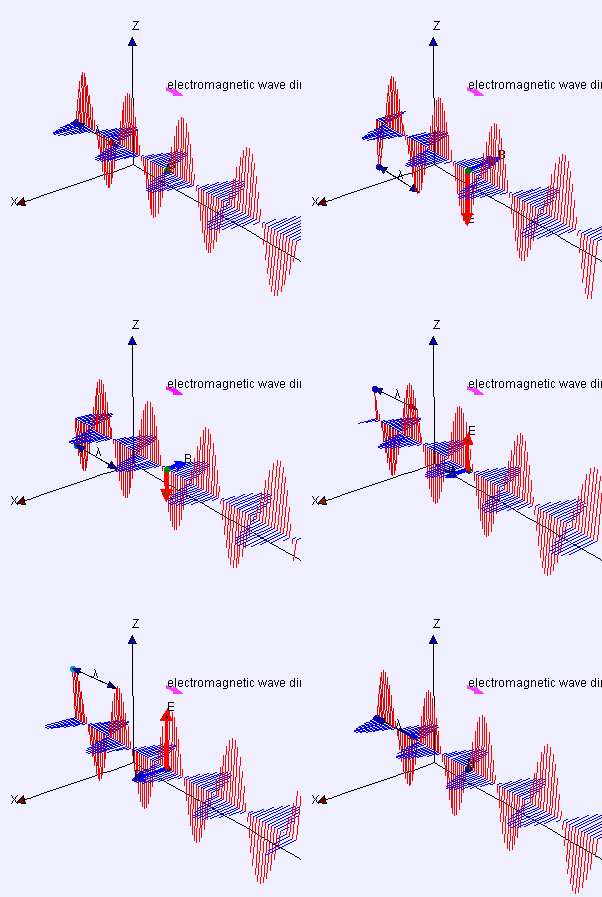
Plane-polarized electromagnetic wave in motion
Plane-polarized electromagnetic wave
Electric (E) field is red
Magnetic (B) field is blue
(Image by Loo Kang Wee and Fu-Kwun Hwang from Wikimedia Commons)

My cue to enter. “Not right, Vinnie. Experimental demonstrations going back more than a century show light exerting pressure. That implies non-zero momentum. On the theory side … you remember when we talked about light waves and the right-hand rule?”

“That was a long time ago, Sy. Remind me.”

“… Ah, I still have the diagram on Old Reliable. See here? The light wave is coming out of the screen and its electric field moves electrons vertically. Meanwhile, the magnetic field perpendicular to the electric field twists moving charges to scoot them along a helical path. So there’s your momentum, in the interaction between the two fields. The wave’s combined action delivers force to whatever it hits, giving it momentum in the wave’s direction of travel. No photons in this picture.”

Astrophysicist-in-training Newt Barnes dives in. “When you think photons and electrons, Vinnie, think Einstein. His Nobel prize was for his explanation of the photoelectric effect. Think about some really high-speed particle flying through space. I’m watching it from Earth and you’re watching it from a spaceship moving along with it so we’ve each got our own frame of reference.”

“Frames, awright! Sy and me, we’ve talked about them a lot. When you say ‘high-speed’ you’re talking near light-speed, right?”

“Of course, because that’s when relativity gets significant. If we each measure the particle’s speed, do we get the same answer?”

“Nope, because you on Earth would see me and the particle moving through compressed space and dilated time so the speed I’d measure would be more than the speed you’d measure.”

“Mm-hm. And using ENewton=mv² you’d assign it a larger energy than I would. We need a relativistic version of Newton’s formula. Einstein said that rest mass is what it is, independent of the observer’s frame, and we should calculate energy from EEinstein²=(pc)²+(mc²)², where p is the momentum. If the momentum is zero because the velocity is zero, we get the familiar EEinstein=mc² equation.”

“I see where you’re going, Newt. If you got no mass OR energy then you got nothing at all. But if something’s got zero mass but non-zero energy like a photon does, then it’s got to have momentum from p=EEinstein/c.”

“You got it, Vinnie. So either way you look at it, wave or particle, light carries momentum and can power Lightsail 2.”

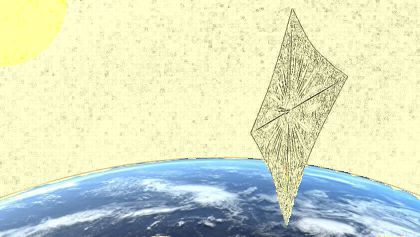
Lightsail 2 flying over Earth, against a yellow background
Adapted from image by Josh Spradling / The Planetary Society

“Question is, can sunlight give it enough momentum to get anywhere?”

“Now you’re getting quantitative. Sy, start up Old Reliable again.”

“OK, Newt, now what?”

“How much power can Lightsail 2 harvest from the Sun? That’ll be the solar constant in joules per second per square meter, times the sail’s area, 32 square meters, times a 90% efficiency factor.”

“Got it — 39.2 kilojoules per second.”

“That’s the supply, now for the demand. Lightsail 2 masses 5 kilograms and starts at 720 kilometers up. Ask Old Reliable to use the standard circular orbit equations to see how long it would take to harvest enough energy to raise the craft to another orbit 200 kilometers higher.”

“Combining potential and kinetic energies, I get 3.85 megajoules between orbits. That’s only 98 seconds-worth. I’m ignoring atmospheric drag and such, but net-net, Lightsail 2‘s got joules to burn.”

“Case closed, Vinnie.”

~~ Rich Olcott

Conversation of Momentum

Teena bounces out of the sandbox, races over to the playground’s little merry-go-round and shoves it into motion. “Come help turn this, Uncle Sy, I wanna go fast!” She leaps onto the moving wheel and of course she promptly falls off. The good news is that she rolls with the fall like I taught her to do.

“Why can’t I stay on, Uncle Sy?”

“What’s your new favorite word again?”

“Mmmo-MMENN-tumm. But that had to do with swings.”

“Swings and lots of other stuff, including merry-go-rounds and even why you should roll with the fall. Which, by the way, you did very well and I’m glad about that because we don’t want you getting hurt on the playground.”

“Well, it does hurt a little on my elbow, see?”

“Let me look … ah, no bleeding, things only bend where they’re supposed to … I think no damage done but you can ask your Mommie to kiss it if it still hurts when we get home. But you wanted to know why you fell off so let’s go back to the sandbox to figure that out.”

<scamper!> “I beat you here!”

“Of course you did. OK, let’s draw a big arc and pretend that’s looking down on part of the merry-go-round. I’ll add some lines for the spokes and handles. Now I’ll add some dots and arrows to show what I saw from over here. See, the merry-go-round is turning like this curvy arrow shows. You started at this dot and jumped onto this dot which moved along and then you fell off over here. Poor Teena. So you and your momentum mostly went left-to-right.”

“But that’s not what happened, Uncle Sy. Here, I’ll draw it. I jumped on but something tried to push me off and then I did fall off and then I rolled. Poor me. Hey, my arm doesn’t hurt any more!”

“How about that? I’ve often found that thinking about something else makes hurts go away. So what do you think was trying to push you off? I’ll give you a hint with these extra arrows on the arc.”

“That looks like Mr Newton’s new directions, the in-and-out direction and the going-around one. Oh! I fell off along the in-and-out direction! Like I was a planet and the Sun wasn’t holding me in my orbit! Is that what happened, I had out-momentum?”

“Good thinking, Teena. Mr Newton would say that you got that momentum from a force in the out-direction. He’d also say that if you want to stand steady you need all the forces around you to balance each other. What does that tell you about what you need to do to stay on the merry-go-round?”

“I need an in-direction force … Hah, that’s what I did wrong! I jumped on but I didn’t grab the handles.”

“Lesson learned. Good.”

“But what about the rolling?”

“Well, in general when you fall it’s nearly always good to roll the way your body’s spinning and only try to slow it down. People who put out an arm or leg to stop a fall often stress it and and maybe even tear or break something.”

“That’s what you’ve told me. But what made me spin?”

“One of Mr Newton’s basic principles was a rule called ‘Conservation of Momentum.’ It says that you can transfer momentum from one thing to another but you can’t create it or destroy it. There are some important exceptions but it’s a pretty good rule for the cases he studied. Your adventure was one of them. Look back at the picture I drew. You’d built up a lot of going-around momentum from pushing the merry-go-round to get it started. You still had momentum in that direction when you fell off. Sure enough, that’s the direction you rolled.”

“Is that the ‘Conversation of Energy’ thing that you and Mommie were talking about?”

“Conservation. It’s not the same but it’s closely related.”

“Why does it even work?”

“Ah, that’s such a deep question that most physicists don’t even think about it. Like gravity, Mr Newton described what inertia and momentum do, but not how they work. Einstein explained gravity, but I’m not convinced that we understand mass yet.”

~~ Rich Olcott

Dark Shadows

Change-me Charlie’s still badgering Astronomer-in-training Jim and Physicist-in-training Newt about “Dark Stuff,” though he’s switched his target from dark matter to dark energy. “OK, the expansion of the Universe is speeding up. How does dark energy do that?”

Jim steps up to bat. “At this point dark energy’s just a name. We frankly have no idea what the name represents, although it seems appropriate.”

“Why’s that?”

“Gravity pulls things together, right, and we have evidence that galaxies are flying away from each other. When you pick something up your muscles give it gravitational potential energy that becomes kinetic energy when you let go and it drops. In space, a galaxy moving away from its neighbors gains gravitational potential energy relative to them. If the Energy Conservation Law holds, that energy has to come from somewhere. ‘Dark energy’ is what we call the somewhere, but naming something and understanding it are two different things.”

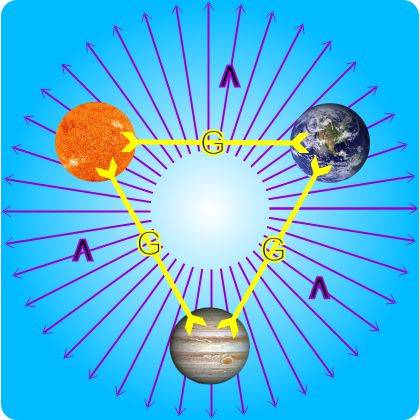
Newt chips in. “Einstein came at it from a different direction. His General Relativity field equations contained two numbers for observation to fill in — G, Newton’s gravitational constant, and lambda (Λ), which we now call the Cosmological Constant. Lambda measures the energy density of empty space. The equations say the balance between lambda and gravity controls whether the Universe expands, contracts or stays static. Lambda‘s just a little bit positive so the universe is expanding.”

“Same conclusion, different name. Neither one says where the energy comes from.”

That’s my cue. “True, but Einstein’s work goes deeper. Newtonian physics maps the Universe onto a stable grid of straight lines. In General Relativity those lines are deformed and twisted under the influence of massive objects. Vinnie and I talked about how gravity’s a fictitious force arising from that deformation. Like John Wheeler said, ‘Mass tells space-time how to curve, and space-time tells mass how to move.’ Anyway, when you throw dark energy’s lambda into the mix, the grid lines themselves go into motion. Dark energy torques the spacetime fabric that pulls galaxies together.”

“So dark energy pulls things apart by spreading out the grid they’re built on? If that’s so how come I’m still in one piece?”

“Nothing personal, but you’re too small and dense to notice. So am I, so is the Earth.”

“Why should that make a difference?”

“Time for a thought experiment. Think of the Sun. The atoms inside its surface are trying to get out, right? What’s holding them in?”

“The Sun’s gravity.”

“Just like pressure on the skin of a balloon. In either case, as long as things are stable the pressure on an enclosing real or mathematical surface rises and falls with the amount of enclosed energy density and it doesn’t matter which we talk about. Energy density’s easier to think about. With me so far?”

“I guess.”

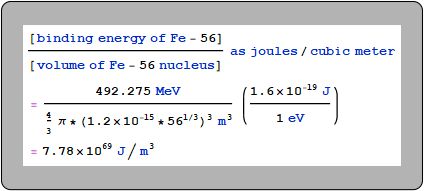
“Let’s run a few horseback numbers on Old Reliable here. Start with protons and neutrons trying to leave an atomic nucleus. Here’s the total binding energy of an iron-56 nucleus divided by its volume…”

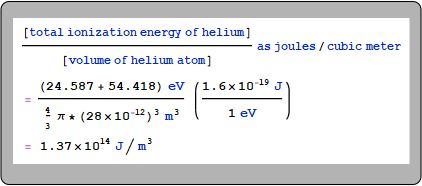
“… so the nuclear particles would fly apart except for the inward pressure exerted by the nuclear forces. Now we’ll go up a level and consider electrons trying to leave a helium atom. They’re held in by the electromagnetic force…”

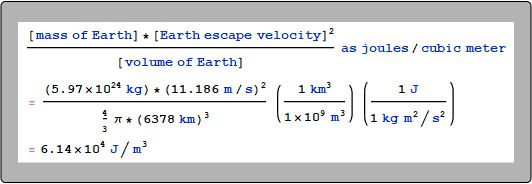
“Still a lot of inward pressure but less than nuclear by fifty-five powers of ten. Gravity next. That’s what keeps us from flying off into space. I’ll use Earth’s escape velocity to cheat-quantify it…”

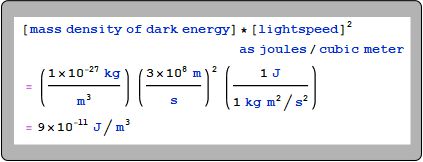
“Ten billion times weaker than the electromagnetism that holds our atoms and molecules together. Dark energy’s mass density is estimated to be about 10-27 kilograms per cubic meter. I’ll use that and Einstein’s E=mc2to calculate its pull-us-apart pressure.”

“A quintillion times weaker still.”

“So what you’re saying is, dark energy tries to pull everything apart by stretching out that spacetime grid, but it’s too weak to actually do anything to stuff that’s held together by gravity, electromagnetism or the two nuclear forces.”

“Mostly. Nuclear forces are short-range so distance doesn’t matter. Gravity and electromagnetism get weaker with the square of the distance. Dark energy only gets competitive working on objects that are separated much further than even neighboring galaxies. You’re not gonna get pulled apart.”

~~ Rich Olcott