Enter the Elephant, stage right

Anne?”

“Mm?”

“Remember when you said that other reality, the one without the letter ‘C,’  felt more probable than this one?”

“Mm-mm.”

“What tipped you off?”

Now you’re asking?”

“I’m a physicist, physicists think about stuff.  Besides, we’ve finished the pizza.”

<sigh> “This conversation has gotten pretty improbable, if you ask me.  Oh, well.  Umm, I guess it’s two things.  The more-probable realities feel denser somehow, and more jangly. What got you on this track?”

“Conservation of energy.  Einstein’s E=mc² says your mass embodies a considerable amount of energy, but when you jump out of this reality there’s no flash of light or heat, just that fizzing sound.  When you come back, no sudden chill or things falling down on us, just the same fizzing.  Your mass-energy that has to go to or come from somewhere.  I can’t think where or how.”

“I certainly don’t know, I just do it.  Do you have any physicist guesses?”

“Questions first.”

“If you must.”

“It’s what I do.  What do you perceive during a jump?  Maybe something like falling, or heat or cold?”

“There’s not much ‘during.’  It’s not like I go through a tunnel, it’s more like just turning around.  What I see goes out of focus briefly.  Mostly it’s the fizzy sound and I itch.”

“Itch.  Hmm…  The same itch every jump?”

“That’s interesting.  No, it’s not.  I itch more if I jump to a more-probable reality.”

Very interesting.  I’ll bet you don’t get that itch if you’re doing a pure time-hop.”

“You’re right!  OK, you’re onto something, give.”

“You’ve met one of my pet elephants.”

“Wha….??”White satin and elephant
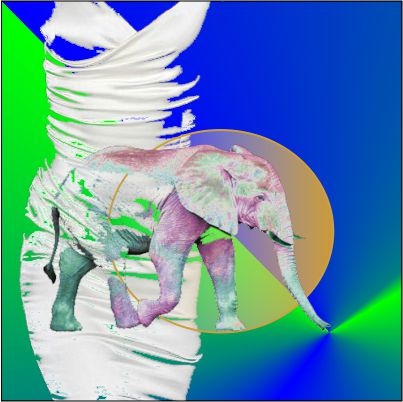
“A deep question that physics has been nibbling around for almost two centuries.  Like the seven blind men and the elephant.  Except the physicists aren’t blind and the elephant’s pretty abstract.  Ready for a story?”

“Pour me another and I will be.”

“Here you go.  OK, it goes back to steam engines.  People were interested in getting as much work as possible out of each lump of coal they burned.  It took a couple of decades to develop good quantitative concepts of energy and work so they could grade coal in terms of energy per unit weight, but they got there.  Once they could quantify energy, they discovered that each material they measured — wood, metals, water, gases — had a consistent heat capacity.  It always took the same amount of energy to raise its temperature across a given range.  For a kilogram of water at 25°C, for instance, it takes one kilocalorie to raise its temperature to 26°C.  Lead and air take less.”

“So where’s the elephant come in?”

“I’m getting there.  We started out talking about steam engines, remember?  They work by letting steam under pressure push a piston through a cylinder.  While that’s happening, the steam cools down before it’s puffed out as that classic old-time Puffing Billy ‘CHUFF.’  Early engine designers thought the energy pushing the piston just came from trading off pressure for volume.  But a guy named Carnot essentially invented thermodynamics when he pointed out that the cooling-down was also important.  The temperature drop meant that heat energy stored in the steam must be contributing to the piston’s motion because there was no place else for it to go.”

“I want to hear about the elephant.”

“Almost there.  The question was, how to calculate the heat energy.”

“Why not just multiply the temperature change by the heat capacity?”

“That’d work if the heat capacity were temperature-independent, which it isn’t.  What we do is sum up the capacity at each intervening temperature.  Call the sum ‘elephant’ though it’s better known as Entropy.  Pressure, Volume, Temperature and Entropy define the state of a gas.  Using those state functions all you need to know is the working fluid’s initial and final state and you can calculate your engine.  Engineers and chemists do process design and experimental analysis using tables of reported state function values for different substances at different temperatures.”

“Do they know why heat capacity changes?”

“That took a long time to work out, which is part of why entropy’s an elephant.  And you’ve just encountered the elephant’s trunk.”

“There’s more elephant?”

“And more of this.  Want a refill?”

~~ Rich Olcott

Three Perils for a Quest(ion), Part 3

“Things are finally slowing down.  You folks got an interesting talk going, mind if I join you?  I got biscotti.”

“Pull up a chair, Eddie.  You know everybody?”

“You and Jeremy, yeah, but the young lady’s new here.”

“I’m Jennie, visiting from England.”

“Pleased to meetcha.  So from what I overheard, we got Jeremy on some kinda Quest to a black hole’s crust.  He’s passed two Perils.  There’s a final one got something to do with a Firewall.”

“One minor correction, Eddie.  He’s not going to a crust, because a black hole doesn’t have one.  Nothing to stand on or crash into, anyway.  He’s headed to its Event Horizon, which is the next best thing.  If you’re headed inward, the Horizon marks the beginning of where it’s physically impossible to get out.”

“Hotel California, eh?”

“You could say that.  The first two Perils had to do with the black hole’s intense gravitational field.  The one ahead has to do with entangled virtual particles.”

“Entangled is the Lucy-and-Ethel thing you said where two particles coordinate instant-like no matter how far apart they are?”

“Good job of overhearing, there, Eddie.  Jeremy, tell him abut virtual particles.”

“Umm, Mr Moire and I talked about a virtual particle snapping into and out of existence in empty space so quickly that the long-time zero average energy isn’t affected.”

“What we didn’t mention then is that when a virtual pair is created, they’re entangled.  Furthermore, they’re anti-particles, which means that each is the opposite of the other — opposite charge, opposite spin, opposite several other things.  Usually they don’t last long — they just meet each other again and annihilate, which is how the average energy stays at zero.  Now think about creating a pair of virtual particles in the black hole’s intense gravitational field where the creation event sends them in opposite directions.”Astronaut and semi-biscotto
“Umm… if they’re on opposite paths then one’s probably headed into the Horizon and the other is outbound. Is the outbound one Hawking radiation?  Hey, if they’re entangled that means the inbound one still has a quantum connection with the one that escaped!”

“Wait on.  If they’re entangled and something happening to one instantaneously affects its twin, but the gravity difference gives each a different rate of time dilation, how does that work then?”

“Paradox, Jennie!  That’s part of what the Firewall is about.  But it gets worse.  You’d think that inbound particle would add mass to the black hole, right?”

“Surely.”

“But it doesn’t.  In fact, it reduces the object’s mass by exactly each particle’s mass.  That ‘long-time zero average energy‘ rule comes into play here.  If the two are separated and can’t annihilate, then one must have positive energy and the other must have negative energy.  Negative energy means negative mass, because of Einstein’s mass-energy equivalence.  The positive-mass twin escapes as Hawking radiation while the negative-mass twin joins the black hole, shrinks it, and by the way, increases its temperature.”

“Surely not, Sy.  Temperature is average kinetic energy.  Adding negative energy to something has to decrease its temperature.”

“Unless the something is a black hole, Jennie.  Hawking showed that a black hole’s temperature is inversely dependent on its mass.  Reduce the mass, raise the temperature, which is why a very small black hole radiates more intensely than a big one.  Chalk up another paradox.”

“Two paradoxes.  Negative mass makes no sense.  I can’t make a pizza with negative cheese.  People would laugh.”

“Right.  Here’s another.  Suppose you drop some highly-structured object, say a diamond, into a black hole.  Sooner or later, much later really, that diamond’s mass-energy will be radiated back out.  But there’s no relationship between the structure that went in and the randomized particles that come out.  Information loss, which is totally forbidden by thermodynamics.  Another paradox.”

“The Firewall resolves all these paradoxes then?”

“Not really, Jennie.  The notion is that there’s this thin layer of insanely intense energetic interactions, the Firewall, just outside of the Event Horizon.  That energy is supposed to break everything apart — entanglements, pre-existing structures, quantum propagators (don’t ask), everything, so what gets through the horizon is mush.  Many physicists think that’s bogus and a cop-out.”

“So no Firewall Peril?”

“Wanna take the chance?”

~~ Rich Olcott

Three Perils for a Quest(ion), Part 2

Eddie came over to our table.  “Either you folks order something else or I’ll have to charge you rent.”  Typical Eddie.

“Banana splits sound good to you two?”

[Jeremy and Jennie] “Sure.”

“OK, Eddie, two banana splits, plus a coffee, black, for me.  And an almond biscotti.”

“You want one, that’s a biscotto.”

“OK, a biscotto, Eddie.  The desserts are on my tab.”

“Thanks, Mr Moire.”

“Thanks, Sy.  I know you want to get on to the third Peril on Jeremy’s Quest for black hole evaporation, but how does he get past the Photon Sphere?”

“Yeah, how?”

“Frankly, Jeremy, the only way I can think of is to accept a little risk and go through it really fast.  At 2/3 lightspeed, for instance, you and your two-meter-tall suit would transit that zero-thickness boundary in about 10 nanoseconds.  In such a short time your atoms won’t get much out of position before the electromagnetic fields that hold your molecules together kick back in again.”

“OK, I’ve passed through.  On to the Firewall … but what is it?”

“An object of contention, for one thing.  A lot of physicists don’t believe it exists, but some claim there’s evidence for it in the 2015 LIGO observations.  It was proposed a few years ago as a way out of some paradoxes.”

“Ooo, Paradoxes — loverly.  What’re the paradoxes then?”

“Collisions between some of the fundamental principles of Physics-As-We-Know-It.  One goes back to the Greeks — the idea that the same thing can’t be in two places at once.”

“Tell me about it.  Here’s your desserts.”

“Thanks, Eddie.  The place keeping you busy, eh?”

“Oh, yeah.  Gotta be in the kitchen, gotta be runnin’ tables, all the time.”

“I could do wait-staff, Mr G.  I’m thinking of dropping track anyway, Mr Moire, 5K’s don’t have much in common with base running which is what I care about.  How about I show up for work on Monday, Mr G?”

“Kid calls me ‘Mr’ — already I like him.  You’re on, Jeremy.”

“Woo-hoo!  So what’s the link between the Firewall and the Greeks?”

Link is the right word, though the technical term is entanglement.  If you create two particles in a single event they seem to be linked together in a way that really bothered Einstein.”

“For example?”Astronaut and biscotti
“Polarizing sunglasses.  They depend on a light wave’s crosswise electric field running either up-and-down or side-to-side.  Light bouncing off water or road surface is predominately side-to-side polarized, so sunglasses are designed to block that kind.  Imagine doing an experiment that creates a pair of photons named Lucy and Ethel.  Because of how the experiment is set up, the two must have complementary polarizations.  You confront Lucy with a side-to-side filter.  That photon gets through, therefore Ethel should be blocked by a side-to-side filter but should go through an up-and-down filter.  That’s what happens, no surprise.  But suppose your test let Lucy pass an up-and-down filter.  Ethel would pass a side-to-side filter.”

“But Sy, isn’t that because each photon has a specific polarization?”

“Yeah, Jennie, but here’s the weird part — they don’t.  Suppose you confront Lucy with a filter set at some random angle.  There’s only the one photon, no half-way passing, so either it passes or it doesn’t.  Whenever Lucy chooses to pass, Ethel usually passes a filter perpendicular to that one.  It’s like Ethel hears from Lucy what the deal was — and with zero delay, no matter how far away the second test is executed.  It’s as though Lucy and Ethel are a single particle that occupies two different locations.  In fact, that’s exactly how quantum mechanics models the situation.  Quite contrary to the Greeks’ thinking.”

“You said that Einstein didn’t like entanglement, either.  How come?”

“Einstein published the original entanglement mathematics in the 30s as a counterexample against Bohr’s quantum mechanics.  The root of his relativity theories is that the speed of light is a universal speed limit.  If nothing can go faster than light, instantaneous effects like this can’t happen.  Unfortunately, recent experiments proved him wrong.  Somehow, both Relativity and Quantum Mechanics are right, even though they seem to be incompatible.”

“And this collision is why there’s a problem with black hole evaporation?”

“It’s one of the collisions.”

“There’s more?  Loverly.”

~~ Rich Olcott

Virtualosity

No knock, the door just opened suddenly.

“Hello, Jeremy.  Rule of Three?”

“Huh?  No, I was down the hall just now when I saw you go into your office so I knew you hadn’t gotten busy with something yet.  Sir.  What’s the Rule of Three?”

“Never mind.  You’re up here about virtual particles, I guess.”

“Yessir.  You said they’re ‘now you might see them, now you probably don’t.’  What’s that about and what do they have to do with abstraction and Einstein’s ‘underlying reality’?”

“What have you heard about Heisenberg’s Uncertainty Principle?”

“Ms Plenum says you can’t know where you are and how fast you’re going.”

“Ms Plenum’s got part of the usual notion but she’s missing the idea of simultaneous precision and a few other things.  Turns out you CAN know approximately where you are AND approximately how fast you’re going at a particular moment, but you can’t know both things precisely.  There’s going to be some imprecision in both measurements.  Think about Coach using a radar gun to track a thrown baseball.  How does radar work?”

“It bounces a light beam off of something and measures the light’s round-trip travel time.  I suppose it multiplies by the speed of light to convert time to distance.”

“Good.  Now how does it get the ball’s speed?”

“Uhh… probably uses two light pulses a certain time apart and calculates the speed as distance difference divided by time difference.”

“Got it in one.  Now, suppose that a second after the ball’s thrown the radar says the ball is 61 feet away from the plate and traveling at 92 mph.  Air resistance acts to slow the ball’s flight so that 92 is really an average.   Maybe it was going 92.1 mph at the first radar pulse and 91.9 mph at the second pulse.  So that reported speed has an 0.2 mph range of uncertainty.”

“Oh, and neither of the two pulses caught the ball at exactly 61 feet so that’s uncertain, too, right?”

“There you go.  We know the two averages, but each of them has a range.  The Uncertainty Principle says that the product of those two ranges has to be greater than Planck’s constant, 10-34 Joule·second.  Plugging that Joule-fraction and the mass of an electron into Einstein’s E=mc², we restate the constant as about 10-21 of an electron-second.  Those are both teeny numbers — but they’re not zero.”

“So speed and location make an uncertainty pair.  Are there others?”Zebras“A few.  The most important for this discussion is energy and time.”
“Wait a minute, those two can’t be linked that way.”

“Why not?”

“Well, because … umm … speed is change of location so those two go together, but energy isn’t change of time.  Time just … goes, and adding energy won’t make it go faster.”

“As a matter of fact, there are situations where adding energy makes time go slower, but that’s a couple of stories for another day.  What we’re talking about here is uncertainty ranges and how they combine.  Quantum theory says that if a given particle has a certain energy, give or take an energy range, and it retains that energy for a certain duration, give or take a time range, then the product of the two ranges has to be larger than that same Planck constant.   Think about a 1-meter cube of empty space out there somewhere.  Got it?

“Sure.”

“Suppose a particle appeared and then vanished somewhere in that cube sometime during a 1-second interval.  What’s the longest time that particle could have existed?”

“Easy — one second.”

“How about the shortest time?”

“Zero.  Wait, it’d be the smallest possible non-zero time, wouldn’t it?”

“Good catch.  So what’s the time uncertainty?”

“One second minus that tiniest bit of time.”

“And what’s the corresponding energy range?”

“That constant number that I forget.”

“10-21 electron-second’s worth.  Now let’s pick a shorter interval.  What’s the mass range for a particle that appears and disappears sometime during the 10-19 second it takes a photon to cross a hydrogen atom?”

“That’s 10-21 electron-second divided by 10-19 second, so it’d be, like, 0.01 electron.”

“How about 1% of that 10-19 second?”

“Wow — that’d be a whole electron.”

“A whole electron’s worth of uncertainty.  But is the electron really there?”

“Probably not, huh?”

“Like I said, ‘Now you probably don’t’.”

~~ Rich Olcott

Abstract Horses

It was a young man’s knock, eager and a bit less hesitant than his first visit.

“C’mon in, Jeremy, the door’s open.”

“Hi, Mr Moire, it’s me, Jerem…  How did ..?  Never mind.  Ready for my black hole questions?”

“I’ll do what I can, Jeremy, but mind you, even the cosmologists are still having a hard time understanding them.  What’s your first question?”

“I read where nothing can escape a black hole, not even light, but Hawking radiation does come out because of virtual particles and what’s that about?”

“That’s a very lumpy question.  Let’s unwrap it one layer at a time.  What’s a particle?”

“A little teeny bit of something that floats in the air and you don’t want to breathe it because it can give you cancer or something.”

“That, too, but we’re talking physics here.  The physics notion of a particle came from Newton.  He invented it on the way to his Law of Gravity and calculating the Moon’s orbit around the Earth.  He realized that he didn’t need to know what the Moon is made of or what color it is.  Same thing for the Earth — he didn’t need to account for the Earth’s temperature or the length of its day.  He didn’t even need to worry about whether either body was spherical.  His results showed he could make valid predictions by pretending that the Earth and the Moon were simply massive points floating in space.”

Accio abstractify!  So that’s what a physics particle is?”

“Yup, just something that has mass and location and maybe a velocity.  That’s all you need to know to do motion calculations, unless the distance between the objects is comparable to their sizes, or they’ve got an electrical charge, or they move near lightspeed, or they’re so small that quantum effects come into play.  All other properties are irrelevant.”

“So that’s why he said that the Moon was attracted to Earth like the apple that fell on his head was — in his mind they were both just particles.”

“You got it, except that apple probably didn’t exist.”

“Whatever.  But what about virtual particles?  Do they have anything to do with VR goggles and like that?”

“Very little.  The Laws of Physics are optional inside a computer-controlled ‘reality.’  Virtual people can fly, flow of virtual time is arbitrary, virtual electrical forces can be made weaker or stronger than virtual gravity, whatever the programmers decide will further the narrative.  But virtual particles are much stranger than that.”

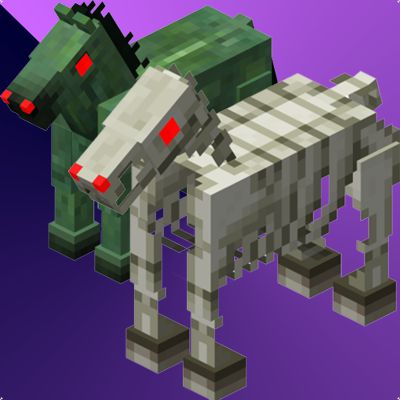
“Aw, they can’t be stranger than Minecraft.  Have you seen those zombie and skeleton horses?”Horses

“Yeah, actually, I have.  My niece plays Minecraft.  But at least those horses hang around.  Virtual particles are now you might see them, now you probably don’t.  They’re part of why quantum mechanics gave Einstein the willies.”

“Quantum mechanics comes into it?  Cool!  But what was Einstein’s problem?  Didn’t he invent quantum theory in the first place?”

“Oh, he was definitely one of the early leaders, along with Bohr, Heisenberg, Schrödinger and that lot.  But he was uncomfortable with how the community interpreted Schrödinger’s wave equation.  His row with Bohr was particularly intense, and there’s reason to believe that Bohr never properly understood the point that Einstein was trying to make.”

“Sounds like me and my Dad.  So what was Einstein’s point?”

“Basically, it’s that the quantum equations are about particles in Newton’s sense.  They lead to extremely accurate predictions of experimental results, but there’s a lot of abstraction on the way to those concrete results.  In the same way that Newton reduced Earth and Moon to mathematical objects, physicists reduced electrons and atomic nuclei to mathematical objects.”

“So they leave out stuff like what the Earth and Moon are made of.  Kinda.”

“Exactly.  Bohr’s interpretation was that quantum equations are statistical, that they give averages and relative probabilities –”

“– Like Schrödinger’s cat being alive AND dead –”

“– right, and Einstein’s question was, ‘Averages of what?‘  He felt that quantum theory’s statistical waves summarize underlying goings-on like ocean waves summarize what water molecules do.  Maybe quantum theory’s underlying layer is more particles.”

“Are those the virtual particles?”

“We’re almost there, but I’ve got an appointment.  Bye.”

“Sure.  Uhh… bye.”

~~ Rich Olcott

Questions, Meta-questions and Answers

<We rejoin Sy and Vinnie in the library stacks…> “Are you boys discussing me?”

<unison> “Oh, hi, Ramona.”

“Actually no, Ramona, we were discussing relativistic time dilation.”

“I know that, Sy, I’ve been reading your posts. Now I’ve got a question.”

“But how…?  Never mind.  Guess I’d better watch my writing.  What can I do for you?”

“You and Vinnie have been going on about kinetic time dilation and gravitational time dilation like they’re two separate things, right?”

“That’s how we’ve treated them, right, but the textbooks do the same.  The velocity-dependent time-stretch equation, tslow/tfast = √[1-(v²/c²)], comes out of Einstein’s Special Theory of Relativity. The gravity-dependent equation, tslow/tfast = √[1-(2G·M/r·c²)], came from his General Theory of Relativity.”

“But there’s no rule that says an object can’t be moving rapidly while it’s in a gravitational field, is there?  That Endurance spacecraft orbiting the black hole in the Interstellar movie certainly seemed to be in that situation.”

“No question, Ramona.  General Relativity’s just more, er, general.”

“Fine, but shouldn’t they work together?”

That got Vinnie started.  “Yeah, Sy, I started this with LIGO and gravity but you and those space shuttles got me into this speed thing.  How do you bridge ’em?”

“Not easily.  Einstein set the rules of the game when he wrote down his fundamental equations.  Physicists and mathematicians have been trying to solve them ever since.  Schwarzchild found the first solution within a year after the equations hit the streets, but he did the simplest possible system — a non-rotating spherical object with no electrical charge and alone in the Universe.  It took another half-century before Kerr and friends figured out how to handle rotating spheres with an electric charge, but even those objects are assumed to be isolated from all other masses.  Mm … how do you figure velocity, Vinnie?”

“Distance divided by time, easy.”

“Not quite that easy.  The equations say that if you’re close to a massive object, space gets compressed, time gets stretched, and the time and space dimensions get scrambled.  Literally.  Time near a Schwarzchild object points inward as you approach the sphere’s center, and don’t ask me how to visualize that.  A Kerr object has a belt around its equator where time runs backwards.  Craziness.”

“Well, how about if I’m not that close?”

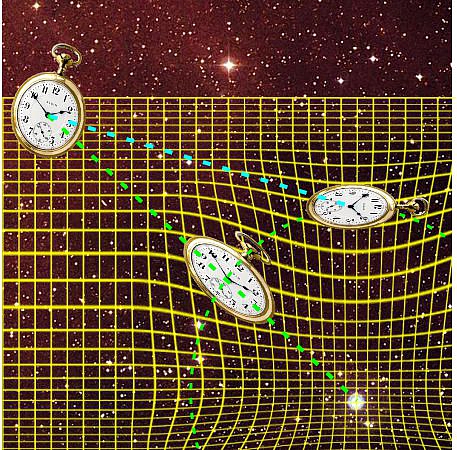
“That’s easier to answer, Ramona.  Suppose the three of us are each flying at safe distances from some heavy object with mass M.  I’m farthest away so I’m holding the fastest clock.  We’ll compare Vinnie’s and your clocks to mine.  OK?”3-clocks

“Sure, why not?”

“Fine.  Now, Vinnie, you’re closer in, resting on the direct line between me and the object.  You’re at distance r from it.  How fast does your clock run?”

“Uhhh…  We’re both on that same radial line so we’re in the same inertial frame, no kinetic effect.  I suppose you see it ticking slower because of the gravitational effect.”

“M-hm, and my clock ticks how often between ticks of yours?”

“You want the equation, huh?  All right, it’s tvinnie/tsy = √[1-(2G·M/r·c²)].”

“You’re reading my mind with those subscripts.  Now, Ramona, you’re at that same distance from the object but you’re in orbit around it.  Measured against Vinnie’s position you’ve got velocity v.  How fast is his clock ticking compared to yours?”

“Mmm…  We’re at the same level in the gravity field, so the gravitational thing makes no difference.  So … tramona/tvinnie = √[1-(v²/c²)].  Aaand, he’d see my clock running slow by the same amount. That’s weird.”

“Weird but true.  Last step — Ramona, you’re deeper in the gravitational field and you’re speeding away from me, so tramona/tsy=(tramona/tvinnie)*(tvinnie/tsy)=√[1-(2G·M/r·c²)]*√[1-(v²/c²)] covers both.”

“OK, that’s settled.  Back to Vinnie’s original question.  LIGOs are set in concrete, their velocities are zero so LIGO signals are all about gravity, right?”

“Right.”

Ramona links arms with him.  “Let’s go dancing.”  Then she gives me the eye.  “Sugarlumps, Sy?  Really?”

On the 12th floor of the Acme Building, high above the city, one man still tries to answer the Universe’s persistent questions — Sy Moire, Physics Eye.

~~ Rich Olcott

Weight And Wait, Two Aspects of Time

I was deep in the library stacks, hunting down a journal article so old it hadn’t been digitized yet.  As I rounded the corner of Aisle 5 Section 2, there he was, leaning against a post and holding a clipboard.

“Vinnie?  What are you doing here?”

“Waiting for you.  You weren’t in your office.”

“But how…?  Never mind.  What can I do for you?”

“It’s the time-dilation thing.  You said that there’s two kinds, a potential energy kind and a kinetic energy kind, but you only told me about the first one.”

“Hey, Ramona broke up that conversation, don’t blame me.  You got blank paper on that clipboard?”

“Sure.  Here.”

“Quick review — we said that potential energy only depends on where you are.  Suppose you and a clock are at some distance r away from a massive object like that Gargantua black hole, and my clock is way far away.  I see your clock ticking slower than mine.  The ratio of their ticking rates, tslow/tfast = √[1-(2G·M/r·c²)], only depends on the slow clock’s position.  Suppose you move even closer to the massive object.  That r-value gets smaller, the fraction inside the parentheses gets closer to 1, the square root gets smaller and I see your clock slow down even more.  Sound familiar?”

“Yeah, but what about the kinetic thing?”time-and-the-rovers

“I’m getting there.  You know Einstein’s famous EEinstein=m·c² equation.  See?  The formula contains neither a velocity nor a position.  That means EEinstein is the energy content of a particle that’s not moving and not under the influence of any gravitational or other force fields.  Under those conditions the object is isolated from the Universe and we call m its rest mass.  We good?”

“Yeah, yeah.”

“OK, remember the equation for gravitational potential energy?”

E=G·M·m/r.

“Let’s call that Egravity.  Now what’s the ratio between gravitational potential energy and the rest-mass energy?”

“Uh … Egravity/EEinstein = G·M·m/r·m·c² = G·M/r·c². Hey, that’s exactly half the fraction inside the square root up there. tslow/tfast = √[1-(2 Egravity/EEinstein)].  Cool.”

“Glad you like it.  Now, with that under our belts we’re ready for the kinetic thing.  What’s Newton’s equation for the kinetic energy of an object that has velocity v?”

E=½·m·v².

“I thought you’d know that.  Let’s call it Ekinetic.  Care to take a stab at the equation for kinetic time dilation?”

“As a guess, tslow/tfast = √[1-(2 Ekinetic/EEinstein)]. Hey, if I plug in the formulas for each of the energies, the halves and the mass cancel out and I get tslow/tfast = √[1-2(½m·v²/m·c²)] = √[1-(v²/c²)].  Is that it?”

“Close.  In Einstein’s math the kinetic energy expression is more complicated, but it leads to the same formula as yours.  If the velocity’s zero, the square root is 1.0 and there’s no time-slowing.  If the object’s moving at light-speed (v=c), the square root is zero and the slow clock is infinitely slow.  What’s interesting is that an object’s rest energy acts like a universal energy yardstick — both flavors of time-slowing are governed by how the current energy quantity compares to EEinstein.”

“Wait — kinetic energy depends on velocity, right, which means that it’ll look different from different inertial frames.  Does that mean that the kinetic time-slowing depends on the frames, too?”

“Sure it does.  Best case is if we’re both in the same frame, which means I see you in straight-line motion.  Each of us would get the same number if we measure the other’s velocity.  Plug that into the equation and each of us would see the same tslow for the other’s clock.  If we’re not doing uniform straight lines then we’re in different frames and our two dilation measurements won’t agree.”

“… Ramona doesn’t dance in straight lines, does she, Sy?”

“That reminds me of Einstein’s quote — ‘Put your hand on a hot stove for a minute, and it seems like an hour. Sit with a pretty girl for an hour, and it seems like a minute. That’s relativity.‘  You’re thinking curves now, eh?”

“Are you boys discussing me?”

<unison> “Oh, hi, Ramona.”

~~ Rich Olcott

Three Body Problems

The local science museum had a showing of the Christopher Nolan film Interstellar so of course I went to see it again.  Awesome visuals and (mostly) good science because Nolan had tapped the expertise of Dr Kip Thorne, one of the primary creators of LIGO.  On the way out, Vinnie collared me.

“Hey, Sy, ‘splain something to me.”

“I can try, but first let’s get out of the weather.  Al’s coffee OK with you?”

“Yeah, sure, if his scones are fresh-baked.”

Al saw me walking in.  “Hey, Sy, you’re in luck, I just pulled a tray of cinnamon scones out of the oven.”  Then he saw Vinnie.  “Aw, geez, there go my paper napkins again.”

Vinnie was ready.  “Nah, we’ll use the backs of some ad flyers I grabbed at the museum.  And gimme, uh, two of the cinnamons and a large coffee, black.”

“Here you go.”

At our table I said, “So what’s the problem with the movie?”

“Nobody shrank.  All this time we been talking about how things get smaller in a strong gravity field.  That black hole, Gargantua, was huge.  The museum lecture guy said it was like 100 million times as heavy as the Sun.  When the people landed on its planet they should have been teeny but everything was just regular-size.  And what’s up with that ‘one hour on the planet is seven years back home’ stuff?”

“OK, one thing at a time.  When the people were on the planet, where was the movie camera?”

“On the planet, I suppose.”

“Was the camera influenced by the same gravitational effects that the people were?”

“Ah, it’s the frames thing again, ain’t it?  I guess in the on-planet inertial frame everything stays the relative size they’re used to, even though when we look at the planet from our far-away frame we see things squeezed together.”

(I’ve told you that Vinnie’s smart.)  “You got it.  OK, now for the time thing.  By the way, it’s formally known as ‘time dilation.’  Remember the potential energy/kinetic energy distinction?”

“Yeah.  Potential energy depends on where you are, kinetic energy depends on how you’re moving.”

“Got it in one.  It turns out that energy and time are deeply intertwined all through physics.  Would you be surprised if I told you that there are two kinds of time dilation, one related to gravitational potential and the other to velocity?”

“Nothing would surprise me these days.  Go on.”

“The gravity one dropped out of Einstein’s Theory of Special Relativity.  The velocity one arose from his General Relativity work.”  I grabbed one of those flyers.  “Ready for a little algebra?”

“Geez.  OK, I asked for it.”gargantua-3
“You certainly did.  I’ll just give you the results, and mind you these apply only near a non-rotating sphere with no electric charge.  Things get complicated otherwise.  Suppose the sphere has mass M and you’re circling around it at a distance r from its geometric center.  You’ve got a metronome ticking away at n beats per your second and you’re perfectly happy with that.  We good?”

“So far.”

“I’m watching you from way far away.  I see your metronome running slow, at only n√[1-(2 G·M/r·c²)] beats per my second.  G is Newton’s gravity constant, c is the speed of light.  See how the square root has to be less than 1?”

“Your speed of light or my speed of light?”

“Good question, considering we’re talking about time and space getting all contorted, but Einstein guarantees that both of us measure exactly the same speed.  So anyway, in the movie both the Miller’s Planet landing team and that poor guy left on good ship  Endurance are circling Gargantua.  Earth observers would see both their clocks running slow.  But Endurance is much further out (larger r, smaller fraction) from Gargantua than Miller’s Planet is.  Endurance’s distance gave its clock more beats per Earth second than the planet gets, which is why the poor guy aged so much waiting for the team to return.”

“I wondered about that.”

Then we heard Ramona’s husky contralto.  “Hi, guys.  Al said you were back here talking physics.  Who wants to take me dancing?”

We both stood up, quickly.

“Whee, this’ll be fun.”

~~ Rich Olcott

Gravity’s Real Rainbow

Some people are born to scones, some have scones thrust upon them.  As I stepped into his coffee shop this morning, Al was loading a fresh batch onto the rack.  “Hey, Sy, try one of these.”

“Uhh … not really my taste.  You got any cinnamon ones ready?”

“Not much for cheddar-habañero, huh?  I’m doing them for the hipster trade,” waving towards all the fedoras on the room.  “Here ya go.  Oh, Vinnie’s waiting for you.”

I navigated to the table bearing a pile of crumpled yellow paper, pulled up a chair.  “Morning, Vinnie, how’s the yellow writing tablet working out for you?”

“Better’n the paper napkins, but it’s nearly used up.”

“What problem are you working on now?”

“OK, I’m still on LIGO and still on that energy question I posed way back — how do I figure the energy of a photon when a gravitational wave hits it in a LIGO?  You had me flying that space shuttle to explain frames and such, but kept putting off photons.”

“Can’t argue with that, Vinnie, but there’s a reason.  Photons are different from atoms and such because they’ve got zero mass.  Not just nearly massless like neutrinos, but exactly zero.  So — do you remember Newton’s formula for momentum?”

“Yeah, momentum is mass times the velocity.”

“Right, so what’s the momentum of a photon?”

“Uhh, zero times speed-of-light.  But that’s still zero.”

“Yup.  But there’s lots of experimental data to show that photons do carry non-zero momentum.  Among other things, light shining on an an electrode in a vacuum tube knocks electrons out of it and lets an electric current flow through the tube.  Compton got his Nobel prize for that 1923 demonstration of the photoelectric effect, and Einstein got his for explaining it.”

“So then where’s the momentum come from and how do you figure it?”

“Where it comes from is a long heavy-math story, but calculating it is simple.  Remember those Greek letters for calculating waves?”

(starts a fresh sheet of note paper) “Uhh… this (writes λ) is lambda is wavelength and this (writes ν) is nu is cycles per second.”

“Vinnie, you never cease to impress.  OK, a photon’s momentum is proportional to its frequency.  Here’s the formula: p=h·ν/c.  If we plug in the E=h·ν equation we played with last week we get another equation for momentum, this one with no Greek in it:  p=E/c.  Would you suppose that E represents total energy, kinetic energy or potential energy?”

“Momentum’s all about movement, right, so I vote for kinetic energy.”

“Bingo.  How about gravity?”

“That’s potential energy ’cause it depends on where you’re comparing it to.”

light-in-a-gravity-well“OK, back when we started this whole conversation you began by telling me how you trade off gravitational potential energy for increased kinetic energy when you dive your airplane.  Walk us through how that’d work for a photon, OK?  Start with the photon’s inertial frame.”

“That’s easy.  The photon’s feeling no forces, not even gravitational, ’cause it’s just following the curves in space, right, so there’s no change in momentum so its kinetic energy is constant.  Your equation there says that it won’t see a change in frequency.  Wavelength, either, from the λ=c/ν equation ’cause in its frame there’s no space compression so the speed of light’s always the same.”

“Bravo!  Now, for our Earth-bound inertial frame…?”

“Lessee… OK, we see the photon dropping into a gravity well so it’s got to be losing gravitational potential energy.  That means its kinetic energy has to increase ’cause it’s not giving up energy to anything else.  Only way it can do that is to increase its momentum.  Your equation there says that means its frequency will increase.  Umm, or the local speed of light gets squinched which means the wavelength gets shorter.  Or both.  Anyway, that means we see the light get bluer?”

“Vinnie, we’ll make a physicist of you yet.  You’re absolutely right — looking from the outside at that beam of photons encountering a more intense gravity field we’d see a gravitational blue-shift.  When they leave the field, it’s a red-shift.”

“Keeping track of frames does make a difference.”

Al yelled over, “Like using tablet paper instead of paper napkins.”

~~ Rich Olcott

Three ways to look at things

A familiar shadow loomed in from the hallway.

“C’mon in, Vinnie, the door’s open.”

“I brought some sandwiches, Sy.”

“Oh, thanks, Vinnie.”

“Don’t mention it.    An’ I got another LIGO issue.”

“Yeah?”

“Ohh, yeah.  Now we got that frame thing settled, how does it apply to what you wrote back when?  I got a copy here…”

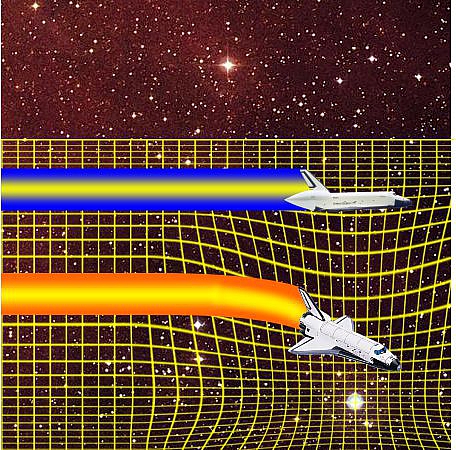
The local speed of light (miles per second) in a vacuum is constant.  Where space is compressed, the miles per second don’t change but the miles get smaller.  The light wave slows down relative to the uncompressed laboratory reference frame.

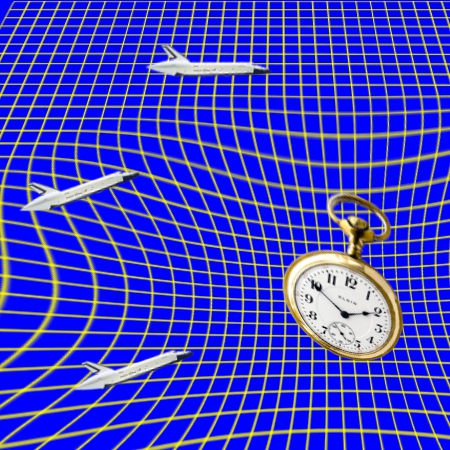
“Ah, I admit I was a bit sloppy there.  Tell you what, let’s pretend we’re piloting a pair of space shuttles following separate navigation beams that are straight because that’s what light rays do.  So long as we each fly a straight line at constant speed we’re both using the same inertial frame, right?”

“Sure.”

“And if a gravity field suddenly bent your beam to one side, you’d think you’re still flying straight but I’d think you’re headed on a new course, right?”

“Yeah, because now we’d have different inertial frames.  I’d think your heading has changed, too.”two-shuttles

“So what does the guy running the beams see?”

“Oh, ground-pounders got their own inertial frame, don’t they?  Uhh… He sees me veer off and you stay steady ’cause the gravity field bent only my beam.”

“Right — my shuttle and the earth-bound observer share the same inertial frame, for a while.”

“A while?”

“Forever if the Earth were flat because I’d be flying straight and level, no threat to the shared frame.  But the Earth’s not flat.  If I want to stay at constant altitude then I’ve got to follow the curve of the surface rather than follow the light beam straight out into space.  As soon as I vector downwards I have a different frame than the guy on the ground because he sees I’m not in straight-line motion.”

“It’s starting to get complicated.”

“No worries, this is as bad as it gets.  Now, let’s get back to square one and we’re flying along and this time the gravity field compresses your space instead of bending it.  What happens?  What do you experience?”

“Uhh… I don’t think I’d feel any difference.  I’m compressed, the air molecules I breath are compressed, everything gets smaller to scale.”

“Yup.  Now what do I see?  Do we still have the same inertial frame?”

“Wow.  Lessee… I’m still on the beam so no change in direction.  Ah!  But if my space is compressed, from your frame my miles look shorter.  If I keep going the same miles per second by my measure, then you’ll see my speed drop off.”

“Good thinking but there’s even more to it.  Einstein showed that space compression and time dilation are two sides of the same phenomenon.  When I look at you from my inertial frame, your miles appear to get shorter AND your seconds appear to get longer.”

“My miles per second slow way down from the double whammy, then?”

“Yup, but only in my frame and that other guy’s down on the ground, not in yours.”

“Wait!  If my space is compressed, what happens to the space around what got compressed?  Doesn’t the compression immediately suck in the rest of the Universe?”

“Einstein’s got that covered, too.  He showed that gravity doesn’t act instantaneously.  Whenever your space gets compressed, the nearby space stretches to compensate (as seen from an independent frame, of course).  The edge of the stretching spreads out at the speed of light.  But the stretch deformation gets less intense as it spreads out because it’s only offsetting a limited local compression.”

“OK, let’s get back to LIGO.  We got a laser beam going back and forth along each of two perpendicular arms, and that famous gravitational wave hits one arm broadside and the other arm cross-wise.  You gonna tell me that’s the same set-up as me and you in the two shuttles?”

“That’s what I’m going to tell you.”

“And the guy on the ground is…”

“The laboratory inertial reference.”

“Eat your sandwich, I gotta think about this.”

(sounds of departing footsteps and closing door)

“Don’t mention it.”

~~ Rich Olcott