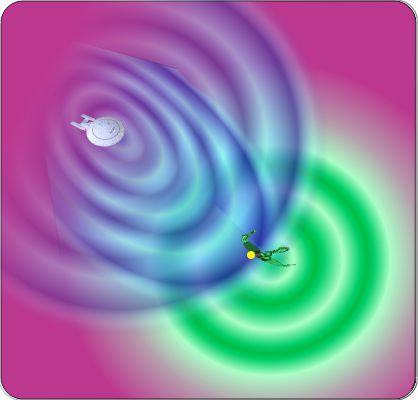
Breaking Up? Not So Hard

<transcript of smartphone dictation by Sy Moire, hard‑boiled physicist>
Day 173 of self‑isolation….
Perfect weather for a brisk solitary walk, taking the park route….
There’s the geese. No sign of Mr Feder, just as well….

Still thinking about Ms Baird and her plan for generating electric power from a black hole named Lonesome….
Can just hear Vinnie if I ever told him about this which I can’t….
“Hey, Sy, nothin’ gets out of a black hole except gravity, but she’s using Lonesome‘s magnetic field to generate electricity which is electromagnetic. How’s that happen?”
Good question….

Hhmph, that’s one angry squirrel….
Ah, a couple of crows pecking the ground under its tree. Maybe they’re too close to its acorn stash….

We know a black hole’s only measurable properties are its mass, charge and spin….
And maybe its temperature, thanks to Stephen Hawking….
Its charge is static — hah! cute pun — wouldn’t support continuous electrical generation….
The Event Horizon hides everything inside — we can’t tell if charge moves around in there or even if it’s matter or anti‑matter or something else….
The no‑hair theorem says there’s no landmarks or anything sticking out of the Event Horizon so how do we know the thing’s even spinning?

Ah, we know a black hole’s external structures — the jets, the Ergosphere belt and the accretion disk — rotate because we see red- and blue-shifted radiation from them….
The Ergosphere rotates in lockstep with Lonesome‘s contents because of gravitational frame-dragging….
Probably the disk and the jets do, too, but that’s only a strong maybe….
But why should the Ergosphere’s rotation generate a magnetic field?

How about Newt Barnes’ double‑wheel idea — a belt of charged light‑weight particles inside a belt of opposite‑charged heavy particles all embedded in the Ergosphere and orbiting at the black hole’s spin rate….
Could such a thing exist? Can simple particle collisions really split the charges apart like that?….

OK, fun problem for strolling mental arithmetic. Astronomical “dust” particles are about the size of smoke particles and those are about a micrometer across which is 10‑6 meter so the volume’s about (10‑6)3=10‑18 cubic meter and the density’s sorta close to water at 1 gram per cubic centimeter or a thousand kilograms per cubic meter so the particle mass is about 10‑18×103=10‑15 kilogram. If a that‑size particle collided with something and released just enough kinetic energy to knock off an electron, how fast was it going?

Ionization energy for a hydrogen atom is 13 electronvolts, so let’s go for a collision energy of at least 10 eV. Good old kinetic energy formula is E=½mv² but that’s got to be in joules if we want a speed in meters per second so 10 eV is, lemme think, about 2×10‑18 joules/particle. So is 2×2×10‑18/10‑15 which is 4×10‑3 or 40×10‑4, square root of 40 is about 6, so v is about 6×10‑2 or 0.06 meters per second. How’s that compare with typical speeds near Lonesome?

Ms Baird said that Lonesome‘s mass is 1.5 Solar masses and it’s isolated from external gravity and electromagnetic fields. So anything near it is in orbit and we can use the circular orbit formula v²=GM/r….
Dang, don’t remember values for G or M. Have to cheat and look up the Sun’s GM product on Old Reliable….
Ah-hah, 1.3×10²⁰ meters³/second so Lonesome‘s is also near 1020….
A solar‑mass black hole’s half‑diameter is about 3 kilometers so Lonesome‘s would be about 5×10³ meters. Say we’re orbiting at twice that so r‘s around 104 meters. Put it together we get v2=1020/104=1016 so v=108 meters/sec….
Everything’s going a billion times faster than 10 eV….
So yeah, no problem getting charged dust particles out there next to Lonesome….

Just look at the color in that tree…
Weird when you think about it. The really good color is summertime chlorophyll green when the trees are soaking up sunlight and turning CO2 into oxygen for us but people get excited about dying leaves that are red or yellow…

Well, now. Lonesome‘s Event Horizon is the no-going-back point on the way to its central singularity which we call infinity because its physics are beyond anything we know. I’ve just closed out another decade of my life, another Event Horizon on my own one‑way path to a singularity…

Hey! Mr Feder! Come ask me a question to get me out of this mood.

Author’s note — Yes, ambient radiation in Lonesome‘s immediate vicinity probably would account for far more ionization than physical impact, but this was a nice exercise in estimation and playing with exponents and applied physical principles.

~~ Rich Olcott

Engineering A Black Hole

<bomPAH-dadadadaDEEdah> That weird ringtone on Old Reliable again. Sure enough, the phone function’s caller-ID display says 710‑555‑1701.  “Ms Baird, I presume?”

A computerish voice, aggressive but feminine, with a hint of desperation. “Commander Baird will be with you shortly, Mr Moire. Please hold.”

A moment later, “Hello, Mr Moire.”

“Ms Baird. Congratulations on the promotion.”

“Thank you, Mr Moire. I owe you for that.”

“How so?”

“Your posts about phase-based weaponry got me thinking. I assembled a team, we demonstrated a proof of concept and now Federation ships are being equipped with the Baird‑Prymaat ShieldSaw. Works a treat on Klingon and Romulan shielding. So thank you.”

“My pleasure. Where are you now?”

“I’m on a research ship called the Invigilator. We’re orbiting black hole number 77203 in our catalog. We call it ‘Lonesome‘.”

“Why that name?”

“Because there’s so little other matter in the space nearby. The poor thing barely has an accretion disk.”

“Sounds boring.”

“No, it’s exciting, because it’s so close to a theoretical ideal. It’s like the perfectly flat plane and the frictionless pulley — in real life there are always irregularities that the simple equations can’t account for. For black holes, our only complete solutions assume that the collapsed star is floating in an empty Universe with no impinging gravitational or electromagnetic fields. That doesn’t happen, of course, but Lonesome comes close.”

“But if we understand the theoretical cases and it nearly matches one, why bother with it at all?”

“Engineering reasons.”

“You’re engineering a black hole?”

“In a way, yes. Or at least that’s what we’re working on. We think we have a way to extract power from a black hole. It’ll supply inexhaustible cheap energy for a new Star Fleet anti‑matter factory. “

“I thought the only thing that could escape a black hole’s Event Horizon was Hawking radiation, and it cheats.”

“Gravity escapes honestly. Its intense field generates some unexpected effects. Your physicist Roger Penrose used gravity to explain the polar jets that decorate so many compact objects including black holes. He calculated that if a comet or an atom or something else breakable shatters when it falls into a spinning compact object’s gravitational field, some pieces would be trapped there but under the right conditions other pieces would slingshot outward with more energy than they had going in. In effect, the extra energy would come from the compact object’s angular momentum.”

“And that’s what you’re planning to do? How are you going to trap the expelled pieces?”

“No, that’s not what we’re planning. Too random to be controlled with our current containment field technology. We’re going pure electromagnetic, turning Lonesome into a giant motor‑generator. We know it has a stable magnetic field and it’s spinning rapidly. We’ll start by giving Lonesome some close company. There’s enough junk in its accretion disk for several Neptune‑sized planets. The plan is to use space tugs to haul in the big stuff and Bussard technology for the dust, all to assemble a pair of Ceres-sized planetoids. W’re calling them Pine and Road. We’ll park them in a convenient equatorial orbit in a Lagrange‑stable configuration so Pine, Road and Lonesome stay in a straight line.”

“Someone’s been doing research on old cinema.”

“The Interstellar Movie Database. Anyhow, when the planetoids are out there we string conducting tractor beams between them. If we locate Pine and Road properly, Lonesome’s rotating magnetic field lines will cross the fields at right angles and induce a steady electric current. Power for the anti‑matter synthesizers.”

“Ah, so like Penrose’s process you’re going to drain off some of Lonesome‘s rotational kinetic energy. Won’t it run out?”

Lonesome‘s mass is half again heavier than your Sun’s, Mr Moire. It’ll spin for a long, long time.”

“Umm … that ‘convenient orbit.’ Lonesome‘s diameter is so small that orbits will be pretty speedy. <calculating quickly with Old Reliable> Even 200 million kilometers away you’d circle Lonesome in less than 15 minutes. Will the magnetic field that far out be strong enough for your purposes?”

“Almost certainly so, but the gravimagnetodynamic equations don’t have exact solutions. We’re not going to know until we get there.”

“That’s how research works, all right. Good luck.”

~~ Rich Olcott

Avoiding A Big Bang

<fffshwwPOP!!> … <thump!> “Ow!”

That white satin dress, that molten‑silver voice. “Anne? Is that you? Are you OK?”

“Yeah, Sy, it’s me. I’m all right … I think.”

“What happened? Where’ve you been all year? Or considering it’s you I should ask, when’ve you been?”

“You know the line between history and archaeology?”

“Whether or not there was writing?”

“Sort of. Anyway, I’ve crossed it dozens of times. You wouldn’t believe some of the things I’ve seen. The professionals sure wouldn’t.”

“Wait, does the dress go with you? White satin wasn’t a thing centuries ago.”

“Oh, it changes like camouflage when I travel. That’s one reason I like this era — white satin’s so much nicer than muddy homespun or deerskins, mmm?”

“Mm‑hmmm. I suppose that’s why the dress didn’t get messed up when you erupted here. What led to that, anyway?”

“I don’t know. It probably had something to do with me experimenting with my ‘pushing’ superpower, going for a direction I hadn’t tried before. I’ve always known that front‑and‑back ‘pushing’ moves me forward or backward in time. You helped me understand that a ‘push’ to the side shifts me between alternate Universes at different probability levels. ‘Pushing’ up or down changes my size. Well, this morning I figured out a different direction to ‘push’ and that was weird.”

“You’ve described all three normal directions of space, so a new one would have to be weird.”

“I know what that direction feels like even if I can’t describe it. What was weird is what happened when I tried ‘pushing’ there. Things came into focus a little slowly. That may be what saved me. What I saw in front of me was … me. Dress, hair, everything, reflected left‑to‑right like looking in a mirror but our movements were a little different. Things were sharpening up and suddenly this sheet of fire flared between us and it blew me … here, to your office. What was all that about, Sy?”

“A couple of questions first. That sheet of fire — did it have a color or was it pure white?”

“Not white, more of a bright blue-violet.”

“And did it start like <snap> or were there preliminary sparkles?”

“Umm .. yes, there were sparkles! In fact I was already ‘pushing’ away when the bad flare‑up started. How did you know?”

“Just following a train of thought. I’m hypothesizing here, but I think you just barely escaped blowing the Earth apart.”

“WHAAATT!!?!”

“It all goes back to the Big Bang and our belief that physical phenomena have fundamental symmetries. Back in the Universe’s first few skillionths of a second the energy density was so high that the electromagnetic and nuclear forces were symmetry‑related. Any twitch in the chaotic unified force field was equally likely to become a proton or an anti‑proton, matter or anti‑matter. So why is anti‑matter so rare in our Universe?”

“Maybe the matter atoms just wiped out all the anti‑matter.”

“Uh‑uh. By symmetry, there should have been exactly as much of each sort. If the wipe‑out had happened there wouldn’t have been enough matter left over to make a single galaxy, much less billions of them. But here we are. Explaining that is one of the biggest challenges in cosmology.”

“You say ‘symmetry‘ like that’s a sacred principle.”

“I wouldn’t say ‘sacred‘ but the most accurate physical theory we know of is based on the product of Charge, Parity and Time symmetries being constant in our Universe. If you take a normal atom and somehow reverse both its charge and spin to get an anti‑matter atom, the symmetries say that the reversed atom must travel backward in time. From an outsider’s perspective it’d be like the original atom and the anti‑atom rush together, annihilate each other and release the enormous amount of energy that accomplished the reversal. Anne, I think you almost ‘pushed’ yourself into an anti‑Universe with a reversed CPT symmetry.”

“Those blue-violet flashes…”

“…were atoms from the air you carried with you, colliding with anti‑atoms in your anti‑twin’s air. Good thing those micro‑collisions released enough energy to get you back here before…”

“…I touched anti‑Anne or even breathed! <shiver> That would have been…”

“…BLOOEY!”

“This is nicer, mmm?”

~~ Rich Olcott

The Sound of Money

<chirp, chirp> “Moire, here, there’ll be a late-night surcharge for this call.”

“Hiya, Sy, it’s me, Vinnie. Got a minute? I wanna run something past you.”

“Sure, if it’s interesting enough to keep me awake.”

“It’s that Physics-money hobby horse you’ve been riding. I think I’ve got another angle on it for you.”

“Really? Shoot.”

“OK, a while ago you and me and Richard Feder talked about waves and how light waves and sound waves are different because light waves make things go up-and-down while the waves go forward but sound waves go back-and-forth.”

“Transverse waves versus compression waves, uh-huh.”

“Yeah and when you look close at a sound wave what you see is individual molecules don’t travel. What happens is like in a pool game where one ball bumps another ball and it stops but the bumped ball moves forward and the first ball maybe even moves back a little.”

“The compression momentum carries forward even though the particles don’t, right.”

“And that means that sound waves only travel as fast as the air molecules can move back and forth which is a lot slower than light waves which move by shaking the electric field. I got that, but why doesn’t sound move a lot faster in something like iron where the atoms don’t have to move?”

“Oh, it does, something like 200 times faster than in air. There’s a couple of factors in play. It all goes back to Newton —”

“Geez, he had a hand in everything Physics, didn’t he?”

“Except for electromagnetism and nuclear stuff. The available technology was just too primitive to let him experiment in those areas. Anyway, Newton discovered a formula connecting the speed of sound in a medium to its density. Like his Law of Gravity, it worked but he didn’t know why it worked. Also like gravity, we’ve got a better idea now.”

“What’s the better idea?”

“The key notions weren’t even invented until decades after Newton’s Principia was published. The magic words are the particulate nature of matter and intermolecular stiffness.”

“Hah?”

“One at a time. Newton was a particle guy to an extent. He believed that light is made of particles, but he didn’t take the next step to thinking of all matter as being made of particles. But it is, and the particles interact with each other. Think of it as stickiness. How effective the stickiness is depends on the temperature and which molecules you’re talking about. Gas molecules have so much kinetic energy relative to their sticky that they mostly just bounce off each other. In liquids and solids the molecules stay close enough together that the stickiness acts like springs. The springs may be more or less stiff depending on which molecules or ions or atoms are involved.”

“I see where you’re going. Stuff with stiffer springs doesn’t move as much as looser stuff at the same temperature; sound goes faster through a solid than through a liquid or gas. That’s what Newton figured out, huh?”

“No, he just measured and said, basically, ‘here’s the formula.‘ Just like with gravity, he didn’t suggest why the numbers were what they were. <yawn> So, you called with an idea about sound and money physics.”

“Right. Got off the track there, but this was helpful. What got me started was some newscaster saying how the Paycheck Protection Program is dumping money into the economy during the pandemic. My first thought was, ‘Haw, that’s gotta be a splash!‘ Then I imagined this pulse of money sloshing back and forth like a wave and that led me to sound waves and then I kept going. No dollar bill moves around that much, but when people spend them that’s like the compression wave moving out.”

“Interesting idea, Vinnie. From a Physics perspective, the question is, ‘How fast does the wave move?’ It’s another temperature‑versus‑stickiness thing.”

“Yeah, I figure money velocity measures the economy like temperature measures molecule motion. Money velocity goes up with inflation. If the velocity’s high people spend their money because why not.”

“Yup. From the government’s perspective the whole purpose of economic stimulation is getting the cash flowing again. Their problem is locating the money velocity kickover point.”

~~ Rich Olcott

Better A Saber Than A Club?

There’s a glass-handled paper-knife on my desk, a reminder of a physics experiment gone very bad back in the day. “Y’know, Vinnie, this knife gives me an idea for another Star Trek weapons technology.”

“What’s that, Sy?”

“Some kinds of wave have another property in addition to frequency, amplitude and phase. What do you know about seismology?”

“Not a whole lot. Uhh … earthquakes … Richter scale … oh, and the Insight lander on Mars has seen a couple dozen marsquakes in the first six months it was looking for them.”

“Cool. Well, where I was going is that earthquakes have three kinds of waves. One’s like a sound wave — it’s called a Pwave or pressure wave and it’s a push-pull motion along the direction the wave is traveling. The second is called an Swave or shear wave. It generates motion in some direction perpendicular to the wave’s path.”

“Not only up-and-down?”

“No, could be any perpendicular direction. Deep in the Earth, rock can slide any which-way. One big difference between the two kinds is that a Pwave travels through both solid and molten rock, but an Swave can’t. Try to apply shearing stress to a fluid and you just stir it around your paddle. The side-to-side shaking isn’t transmitted any further along the wave’s original path. The geophysicists use that difference among other things to map out what’s deep below ground.”

“Parallel and perpendicular should cover all the possibilities. What’s the third kind?”

“It’s about what happens when either kind of deep wave hits the surface. A Pwave will use up most of its energy bouncing things up and down. So will an Swave that’s mostly oriented up-and-down. However, an Swave that’s oriented more-or-less parallel to the surface will shake things side-to-side. That kind’s called a surface wave. It does the most damage and also spreads out more broadly than a P- or Swave that meets the surface with the same energy.”

“This is all very interesting but what does it have to do with Starfleet’s weapons technology? You can’t tell a Romulan captain what direction to come at you from.”

“Of course not, but you can control the polarization angle in your weapon beams.”

“Polarization angle?”

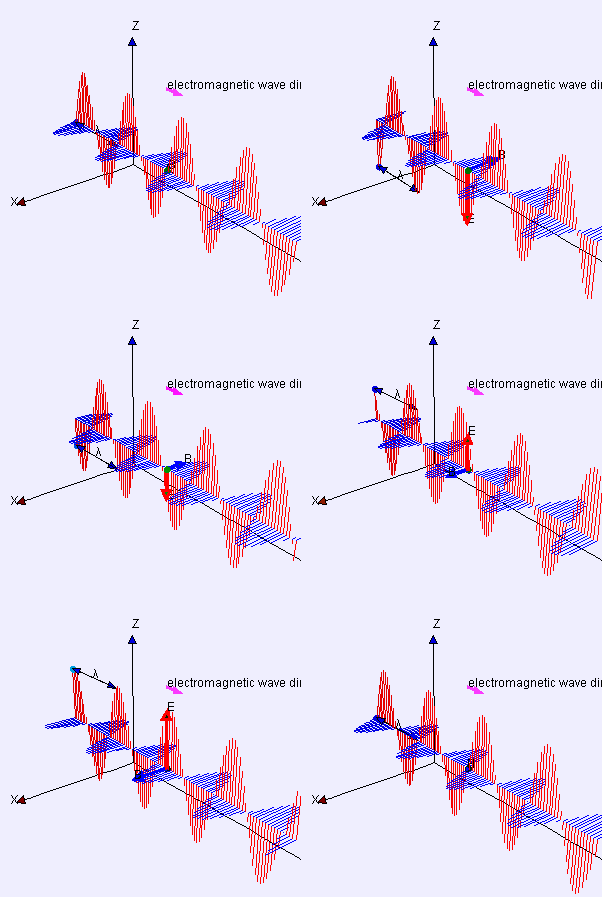
Plane-polarized electromagnetic wave
Electric (E) field is red
Magnetic (B) field is blue
(Image by Loo Kang Wee and
Fu-Kwun Hwang from Wikimedia Commons)

“Yeah. I guess we sort of slid past that point. Any given Swave vibrates in only one direction, but always perpendicular to the wave path. Does that sound familiar?”

“Huh! Yeah, it sounds like polarized light. You still got that light wave movie on Old Reliable?”

“Sure, right here. The red arrow represents the electric part of a light wave. Seismic waves don’t have a magnetic component so the blue arrow’s not a thing for them. The beam is traveling along the y‑axis, and the electric field tries to move electrons up and down in the yz plane. A physicist would say the light beam is planepolarized. Swaves are polarized the same way. See the Enterprise connection?”

“Not yet.”

“Think about the Star Trek force-projection weapons — regular torpedoes, photon torpedoes, ship-mounted phasers, tractor beams, Romulan pulse cannons and the like. They all act like a Pwave, delivering push-pull force along the line of fire. Even if Starfleet’s people develop a shield-shaker that varies a tractor beam’s phase, that’s still just a high-tech version of a club or cannon ball. Beamed Swaves with polarization should be interesting to a Starfleet weapons designer.”

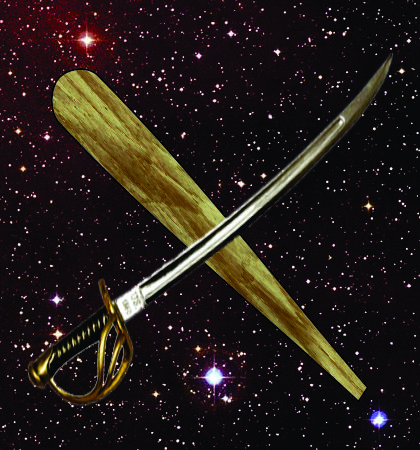
“You may have something. The Bridge crew talks about breaking through someone’s shield. Like you’re using a mace or bludgeon. A polarized wave would be more like an edged knife or saber. Why not rip the shield instead? Those shields are never perfect spheres around a ship. If your beam’s polarization angle happens to match a seam where two shield segments come together — BLOOEY!”

“That’s the idea. And you could jiggle that polarization angle like a jimmy — another way to confuse the opposition’s defense system.”

“I’m picturing a Klingon ship’s butt showing through a rip in its invisibility cloak. Haw!”

~~ Rich Olcott

How To Phase A Foe

“It’s Starfleet’s beams against Klingon shields, Vinnie. I’m saying both are based on wave phenomena.”

“What kind of wave, Sy?”

“Who knows? They’re in the 24th Century, remember. Probably not waves in the weak or strong nuclear force fields — those’d generate nuclear explosions. Could be electromagnetic waves or gravitational waves, could be some fifth or sixth force we haven’t even discovered yet. Whatever, the Enterprise‘s Bridge crew keeps saying ‘frequency’ so it’s got to have some sort of waveishness.”

“OK, you’re sayin’ whatever’s waving, if it’s got frequency, amplitude and phase then we can talk principles for building a weapon system around it. I can see how Geordi’s upping the amplitude of the Enterprise‘s beam weapons would help Worf’s battle job — hit ’em harder, no problem. Jiggling the frequencies … I sort of see that, it’s what they always talk about doing anyway. But you say messing with beam phase can be the kicker. What difference would it make if a peak hits a few milliseconds earlier or later?”

“There’s more than one wave in play. <keys clicking> Here’s a display of the simplest two-beam interaction.”

“I like pictures, but this one’s complicated. Read it out to me.”

“Sure. The bottom line is our base case, a pure sine wave of some sort. We’re looking at how it’s spread out in space. The middle line is the second wave, traveling parallel to the first one. The top line shows the sum of the bottom two at each point in space. That nets out what something at that point would feel from the combined influence of the two waves. See how the bottom two have the same frequency and amplitude?”

“Sure. They’re going in the same direction, right?”

“Either that or exactly the opposite direction, but it doesn’t matter. Time and velocity aren’t in play here, this is just a series of snapshots. When I built this video I said, ‘What will things look like if the second beam is 30° out of phase with the first one? How about 60°?‘ and so on. The wheel shape just labels how out-of-phase they are, OK?”

“Give me a sec. … OK, so when they’re exactly in sync the angle’s zero and … yup, the top line has twice the amplitude of the bottom one. But what happened to the top wave at 180°? Like it’s not there?”

“It’s there, it’s just zero in the region we’re looking at. The two out-of-phase waves cancel each other in that interval. That’s how your noise-cancelling earphones work — an incoming sound wave hits the earphone’s mic and the electronics generate a new sound wave that’s exactly out-of-phase at your ear and all you hear is quiet.”

“I’ve wondered about that. The incoming sound has energy, right, and my phones are using up energy. I know that because my battery runs down. So how come my head doesn’t fry with all that? Where does the energy go?”

“A common question, but it confuses cause and effect. Yes, it looks like the flatline somehow swallows the energy coming from both sides but that’s not what happens. Instead, one side expends energy to counter the other side’s effect. Flatlines signal success, but you generally get it only in a limited region. Suppose these are sound waves, for example, and think about the molecules. When an outside sound source pushes distant molecules toward your ear, that produces a pressure peak coming at you at the speed of sound, right?”

“Yeah, then…”

“Then just as the pressure peak arrives to push local molecules into your ear, your earphone’s speaker acts to pull those same molecules away from it. No net motion at your ear, so no energy expenditure there. The energy’s burned at either end of the transmission path, not at the middle. Don’t worry about your head being fried.”

“Well that’s a relief, but what does this have to do with the Enterprise?”

“Here’s a sketch where I imagined an unfriendly encounter between a Klingon cruiser and the Enterprise after Geordi upgraded it with some phase-sensitive stuff. Two perpendicular force disks peaked right where the Klingon shield troughed. The Klingon’s starboard shield generator just overloaded.”

“That’ll teach ’em.”

“Probably not.”

~~ Rich Olcott

Three Ploys to Face A Foe

Run done, Vinnie and I head upstairs to my office to get out of the windchill. My Starship Enterprise poster reminds me. “Geez, it’s annoying.”

“Now what, Sy?”

“I’ve been binge-watching old Star Trek:Next Generation TV programs and the technobabble’s gotten annoying.”

“What’s the problem this time?”

“Well, whenever the Enterprise gets into a fix where it’s their phaser beam or tractor beam or shields against some new Borg technology or something, Geordi or Worf get busy making adjustments and it’s always the frequency. ‘Modulate to a lower frequency!‘ or ‘Raise the frequency!‘ or even ‘Randomize the frequency!‘ At one point Dr Crusher was fiddling with someone’s ‘biophysical frequency.’ They miss two-thirds of the options, and especially they miss the best one when you’re trying to mess up your opponent’s stuff.”

“Wait, I thought we said frequency’s what waves are all about. There’s more?”

“Oh, yeah. The fact that they’re saying ‘frequency’ says their beams and shields and such are probably based on some kind of wave phenomenon. The good guys should be fiddling with amplitude and phase, too. Especially phase.”

“OK, I’ll bite. What’re those about?”

I poke a few keys on my computer and bring this up on the wall screen.

“OK, we’ve talked about frequency, the distance or time between peaks. Frequency’s the difference between a tuba and a piccolo, between infra-red and X-rays. That top trace is an example of modulating the frequency, somehow varying the carrier wave’s peak-to-peak interval. See the difference between the modulated wave and the dotted lines where it would be if the modulation were turned off?”

“Modulation means changing?”

“Mm-hm. The important thing is that only the piece within the box gets altered.”

“Got it. OK, you’ve labelled the middle line ‘Amplitude‘ and that’s gotta be about peak height because they’re taller inside the modulation box than the dotted line. I’m guessing here, but does the bigger peak mean more energy?”

“Good guess, but it depends on the kind of wave. Sound waves, yup, that’s exactly what’s going on. Light waves are different, because a photon’s energy is is determined by its frequency. You can’t pump up a photon’s amplitude, but you can pump up the number of photons in the beam.”

“Hey, Sy, I just realized. Your amplitude modulation and frequency modulation must be the AM and FM on my car radio. So in AM radio they sit on the station’s frequency, right, and make a signal by tweaking the amount of power going to the antenna?”

“That’s the basic idea, though engineers chasing efficiency have improved things a lot in the century since they started experimenting with radio. Implementing FM is more complicated so took a few more decades to make that competitive with AM.”

“So what’s the story with, um, ‘phase modulation‘? My radio’s got no PM dial.”

<poking more keys> “Here’s the way I think of a sine wave — it’s what you’d see looking at a mark on the edge of a rolling wheel. The size of the wheel sets the wave’s amplitude, the wheel’s rotation speed sets the wave’s frequency, and the phase is where it is in the rotation cycle. Modulating the phase would be like jerking the wheel back and forth while it’s rotating.”

“So that’s why there’s hiccups in your bottom red Phase line — things don’t match up across a phase shift.. Hmm… I’m still thinking about my radio. AM sound tends to have more static, especially during thunderstorms. That’d be because my radio amplifies any electromagnetic wave amplitudes at the frequency I’d set it for and that includes waves from the lightning. FM sound’s a lot clearer. Is that because frequency shifts don’t happen much?”

“Exactly.”

“PM broadcasts ought to be even safer against noise. How come I never see them?”

“You do. WiFi uses it, precisely because it works well even at extremely low power levels. OK, challenge question — why do you think I think PM would be better than FM against Borg tech?”

“It’d be like in fencing or martial arts. Frequency’s jab, jab, jab, regular-like. Shifting your wave phase would be mixing it up, they wouldn’t know when the next peak’s coming.”

“Yup. Now tell Geordi.”

~~ Rich Olcott

Wave As You Go By

A winter day, a bit nippy and windy enough to raise scattered whitecaps on the park lake. Apparently neither the geese nor Mr Richard Feder (of Fort Lee, NJ) enjoy that — the geese are standing on the shore and he’s huddled down on a bench as I pass. “Hey Moire, I gotta question.”

“Mr Feder. I’m trying to keep warm. If you want answers you’ll have to jog along.”

“Oh, alright <oof>. OK, watching those waves got me thinking. They keep going because the wind pushes on ’em, right? So what pushes on sound waves and light waves? If something pushes hard enough on a sound wave does it speed up enough to be a light wave?”

“So many questions. Are you sure you’ve got enough wind?”

“Ha, ha. I’ve been working out a little.”

“We’ll see. Well, first, nothing needs to push on a wave once it’s started. They travel on their own momentum.”

“Then why do these waves die away when the wind stops?”

“You’ve got two things going on there, on different time scales. When the wind stops blowing it stops making new waves. Actually, winds rarely stop all at once, they taper off. It looks like waves are dying away but really you just see smaller and smaller waves. Inside a single wave, though, friction takes its toll.”

“Friction? Waves rub against each other? That’s not what’s going on here — they keep their distance unless different groups run crosswise and then they all just keep going.”

Turbulence in a water wave

“Not friction between waves, friction within a wave. There’s a lot of turbulence inside a water wave — the wind piles up surface molecules on one side, gravity and surface tension move the other side’s molecules downward, and the ones inside are pulled in every direction. All that helter-skelter motion randomizes the wave’s momentum and converts the wave’s energy to heat. When that’s gone, the wave’s gone.”

“So how’s sound different from that?”

“Lots of ways. To begin with, wind and gravity move molecules up and down perpendicular to the wave’s direction of travel. Sound waves aren’t affected by gravity. They move molecules back and forth parallel to the wave’s direction.”

“But they still die out, right? Turn to heat and all that?”

“Absolutely, Mr Feder. How fast a wave dies out depends on what heat-conversion processes are in play. In a water wave gravity and surface tension work together to smooth things out. Neither’s active in sound waves. The only way a sound wave can lose energy is through random collisions between molecules that aren’t in sync with the wave. Could be the wave hits a mushy object or maybe it just gets buried in other waves.”

“Like at a football game, when everyone’s shouting but all you hear is the roar.”

“Pretty good example, Mr Feder.”

“So how’s a light wave different?”

“Light waves don’t even need molecules. The electromagnetic field near a particle is the net effect of all the attractions and repulsions it feels from all other charged particles everywhere in the Universe. When some charged particle somewhere moves, that changes the field. The change is transmitted throughout the field as a wave traveling at the speed of light.”

“What makes it die away?”

“It doesn’t. On a dark, clear night your eyes can see stars a quintillion miles away. Astronomers with their instruments can detect objects millions of times further away.”

“No smoothing out? How come?”

“That’s a very deep question, Mr Feder, one that really bothered Einstein. You’d think a photon’s wave would get fainter the further it spreads. In fact, it delivers all its energy to the first charged particle it can interact with, no matter how far it had traveled. Weird, huh?”

“Weird, all right. So we got these three very different things — they start different, they push different, they got different speeds, they die different, but we call them all waves. Why’s that?”

“They’re all waves because they’re all patterns that transmit energy and momentum across space. Physicists have found general rules that apply to the patterns, whatever the wave type. Equations that work for one kind work for many others, too.”

Gravity waves?”

“And gravitational waves.”

~~ Rich Olcott

The Jet and The Plane

“OK, Sy, I get your point about a black hole being more than a mystical event horizon hiding whatever’s inside it. I’ll give you it’s a structure with a trapped-light shell and a pumpkin-donut belt around that –“

“… if it’s rotating, Vinnie…”

“– if it’s rotating, but what does all that have to do with those huge jets coming out of the poles instead of the equator where they belong?”

Suddenly Newt Barnes, astrophysicist in training, is standing by our table. “You guys are talking my research topic, just the hottest thing in astrophysics these days. Those jets were the subject of over a thousand papers last year. Mind if I sit in?”

“Of course not.” “We’re all ears.”

“Well, there’s a couple more layers to peel before we can make a maybe connection. Vinnie, what’s the weirdest thing about those jets?”

“Like I said, they’re huge — millions of lightyears long.”

“True, but other structures are huge, too — galaxy superclusters, for instance. The real weirdness is how narrow the jets are — less than a degree wide, and they’ve maintained that tight geometry while they’ve grown for millions of years. We still don’t know what’s in a jet. If it’s a beam of charged particles you’d think they’d repel each other and spread out almost immediately. If the particles are uncharged they’d bang into each other and into the prevailing interstellar medium. Random collisions would spread the beam out maybe a little slower than a charged-particle beam but still. A photon beam would be more stable but you’d need a really good collimating mechanism at the jet’s base to get the waves all marching so precisely.”

“What’s left, dark matter?”

“Almost certainly not. Many jets emit huge quantities of electromagnetic radiation at all frequencies from radio up through X-rays and beyond. Dark matter doesn’t do electromagnetism. No, jets are somehow created from normal stuff. The question is, how is it kept under such tight control?”

“The other question is, where’s all that stuff coming from if nothing can escape outta the event horizon?”

“Ah, that has to do with yet another part of the structure — the accretion disk.”

“What they got that orange picture of, right? Big ring like Saturn’s.”

“Well, similar shape, but different origin, different composition and very different dynamics. Saturn’s rings are mostly water-ice, built up from the debris of ice-moons that collided or were pulled apart by tidal forces. A black hole’s accretion disk is made up of planets, dust particles, atoms, whatever junk was unfortunate enough to be too close when the black hole passed by. Pick any incoming object and call it Freddie. Unless Freddie and the event horizon’s core are on an exact collision course, Freddie gets swept up by the disk.”

“Then what happens?”

“Freddie collides with something already in the disk. Lots of somethings. Each collision does two things. One, Freddie and the something break into smaller pieces. Two, some of Freddie’s gravitational potential energy relative to the core is converted to heat, making the collision debris package hotter than Freddie and the something were to begin with. After a while, Freddie gets ground down to atoms or smaller and they’re all really hot, radiating intensely just like Planck and Einstein said they would.”

“So we got a ring like Saturn’s, like I said.”

“Only sort of. Saturn has half-a-dozen distinct rings. They shine by reflected sunlight, the middle ring is brightest and broadest, and the innermost ring is dark and skinny. Our only direct accretion disk image so far is a one blurry view, but the object shines with its own light and in theory the disk isn’t segmented. There should be just one ring and it’d be brightest at a sharp inner edge.”

“Why’s that?”

“The light’s produced by hot particles. Heat generation’s most intense where the gravity well is steepest. That’s nearest the core. For a non-spinning black hole the threshold is one-sixth of the horizon’s diameter. If Freddie gets knocked the slightest bit closer than that it’s doomed to fall the rest of the way in. The edge is closer-in if the hole’s rotating but then Freddie has an interesting time. Relatively.”

“Gonna be frames again, right?”

“Yeah.”

~~ Rich Olcott

The Top Choice

Al grabs me as I step into his coffee shop. “Sy, ya gotta stop Vinnie, he’s using up paper napkins again, and he’s making a mess!”

Sure enough, there’s Vinnie at his usual table by the door. He’s got a kid’s top, a big one, spinning on a little stand. He’s methodically dropping crumpled-up paper wads onto it and watching them fly off onto the floor. “Hey, Vinnie, what’s the project?”

“Hi, Sy. I’m trying to figure how come these paper balls are doing a circle but when they fly off they always go in a straight line, at least at first. They got going-around momentum, right, so how come they don’t make a spiral like stars in a galaxy?”

Astronomy professor Cathleen’s standing in the scone line. She never misses an opportunity to correct a misconception. “Galaxy stars don’t spray out of the center in a spiral, Vinnie. Like planets going around a star, stars generally follow elliptical orbits around the galactic center. A star that’s between spiral arms now could be buried in one ten million years from now. The spiral arms appear because of how the orbits work. One theory is that the innermost star orbits rotate their ellipse axes more quickly than the outer ones and the spirals form where the ellipses pile up. Other theories have to do with increased star formation or increased gravitational attraction within the pile-up regions. Probably all three contribute to the structures. Anyhow, spirals don’t form from the center outward.”

My cue for some physics. “What happens in a galaxy is controlled by gravity, Vinnie, and gravity doesn’t enter into what you’re doing. Except for all that paper falling onto Al’s floor. There’s no in-plane gravitational or electromagnetic attraction in play when your paper wads leave the toy. Newton would say there’s no force acting to make them follow anything other than straight lines once they break free.”

“What about momentum? They’ve got going-around momentum, right, shouldn’t that keep them moving spirally?”

I haul out Old Reliable for a diagram. “Thing is, your ‘going-around momentum,’ also known as ‘angular momentum,’ doesn’t exist. Calm down, Vinnie, I mean it’s a ‘fictitious force‘ that depends on how you look at it.”

“Is this gonna be frames again?”

“Yup. Frames are one of our most important analytical tools in Physics. Here’s your toy and just for grins I’ve got it going around counterclockwise. That little white circle is one of your paper wads. In the room’s frame that wad in its path is constantly converting linear momentum between the x-direction and the y-direction, right?”

“East-West to North-South and back, yeah, I get that.”

“Such a mess to calculate. Let’s make it easier. Switch to the perspective of a frame locked to the toy. In that frame the wad can move in two directions. It can fly away along the radial direction I’ve called r, or it can ride along sideways in the s-direction.”

“So why hasn’t it flown away?”

“Because you put some spit on it to make it stick — don’t deny it, I saw you. While it’s stuck, does it travel in the r direction?”

“Nope, only in the s direction. Which should make it spiral like I said.”

“I’m not done yet. One of Newton’s major innovations was the idea of infinitesimal changes, also known as little-bits. The s-direction is straight, not curved, but it shifts around little-bit by little-bit as the top rotates. Newton’s Laws say force is required to alter momentum. What force influences the wad’s s-momentum?”

“Umm … that line you’ve marked c.”

“Which is the your spit’s adhesive force between the paper and the top. The wad stays stuck until the spit dries out and no more adhesion so no more c-force. Then what happens?”

“It flies off.”

“In which direction?”

“Huh! In the r-direction.”

“And in a straight line, just like Newton said. What you called ‘going-around momentum’ becomes ‘radial momentum’ and there’s no spiraling, right?”

“I guess you’re right, but I miss spirals.”

Al comes over with a broom. “Now that’s settled, Vinnie, clean up!”

~~ Rich Olcott

  • Thanks for the question, Jen Keeler. Stay tuned.