They Went That-away. But Why?

“It’s worse than that, Vinnie.”  I pull out Old Reliable, my math-monster tablet.  “Let me scan in that three-electron drawing of yours.”3 electrons in B-field

“Good enough to keep a record of it?”

“Nope, I want to exercise a new OVR app I just bought.”

“You mean OCR.”

“Uh-uh, this is Original Vector Reconstruction, not Optical Character Recognition.    OCR lets you read a document into a word processor so you can modify it.  OVR does the same thing but with graphics.  Give me a sec … there.  OK, look at this.”3 electrons in B-field revisited
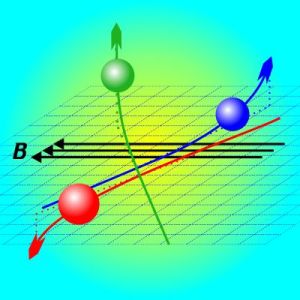
“Cool, you turned my drawing 180°, sort of.  Nice app.  Oh, and you moved the red electron’s path so it’s going opposite to the blue electron instead of parallel to the magnetic field.  Why’d you bother?”

“See the difference between blue and red?”

“Well, yeah, one’s going up, one’s going down.  That’s what I came to you about and you shot down my theory.  Those B-arrows in the magnetic field are going in completely the wrong direction to push things that way.”

“Well, actually, they’re going in exactly the right direction for that, because a magnetic field pushes along perpendiculars.  Ever hear of The Right Hand Rule?”

“You mean like ‘lefty-loosey, righty-tighty’?”

“That works, too, but it’s not the rule I’m talking about.  If you point your thumb in the direction an electron is moving, and your index finger in the direction of the magnetic field, your third finger points in the deflection direction.  Try it.”

“Hurts my wrist when I do it for the blue one, but yeah, the rule works for that.  It’s easier for the red one.  OK, you got this rule, fine, but why does it work?”

“Part of it goes back to the vector math you don’t want me to throw at you.  Let’s just say that there are versions of a Right Hand Rule all over physics.  Many of them are essentially definitions, in the same way that Newton’s Laws of Motion defined force and mass.  Suppose you’re studying the movements directed by some new kind of force.  Typically, you try to define some underlying field in such a way that you can write equations that predict the movement.  You haven’t changed Nature, you’ve just improved our view of how things fit together.”

“So you’re telling me that whoever made that drawing I copied drew the direction those B-arrows pointed just to fit the rule?”

“Almost.  The intensity of the field is whatever it is and the lines minus their pointy parts are wherever they are.  The only thing we can set a rule for is which end of the line gets the arrowhead.  Make sense?”Spiraling electron

“I suppose.  But now I got two questions instead of the one I come in here with.  I can see the deflection twisting that electron’s path into a spiral.  But I don’t see why it spirals upward instead of downward, and I still don’t see how the whole thing works in the first place.”

“I’m afraid you’ve stumbled into a rabbit hole  we don’t generally talk about.  When Newton gave us his Law of Gravity, he didn’t really explain gravity, he just told us how to calculate it.  It took Einstein and General Relativity to get a deeper explanation.  See that really thick book on my shelf over there?  It’s loaded with tables of thermodynamic numbers I can use to calculate chemical reactions, but we didn’t start to understand those numbers until quantum mechanics came along.  Maxwell’s equations let us calculate electricity, magnetism and their interaction — but they don’t tell us why they work.”

“I get the drift.  You’re gonna tell me it goes up because it goes up.”

“That’s pretty much the story.  Electrons are among the simplest particles we know of.  Maxwell and his equations gave us a good handle on how they behave, nothing on why we have a Right Hand Rule instead of a Left Hand Rule.  The parity just falls out of the math.  Left-right asymmetry seems to have something to do with the geometry of the Universe, but we really don’t know.”

“Will string theory help?”

“Physicists have spent 50 years grinding on that without a testable result.  I’m not holding my breath.”

~~ Rich Olcott
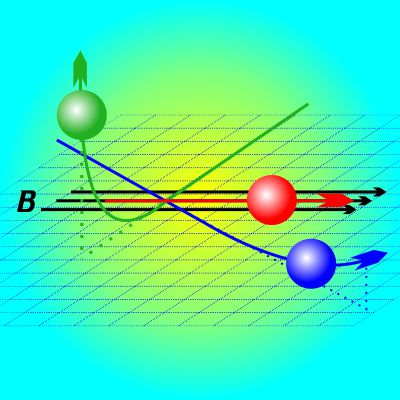
Three off The Plane

Rumpus in the hallway.  Vinnie dashes into my office, tablet in hand and trailing paper napkins.  “Sy! Sy! I figured it out!”

“Great!  What did you figure out?”

“You know they talk about light and radio being electromagnetic waves, but I got to wondering.  Radio antennas don’t got magnets so where does the magnetic part come in?”

“19th-Century physicists struggled with that question until Maxwell published his famous equations.  What’s your answer?”

“Well, you know me — I don’t do equations, I do pictures.  I saw a TV program about electricity.  Some Danish scientist named Hans Christian Anderson—”

“Ørsted.”

“Whoever.  Anyway, he found that magnetism happens when an electric current starts or stops.  That’s what gave me my idea.  We got electrons, right, but no magnetrons, right?”

“Mmm, your microwave oven has a vacuum tube called a magnetron in it.”

“C’mon, Sy, you know what I mean.  We got no whatchacallit, ‘fundamental particle’ of magnetism like we got with electrons and electricity.”

“I’ll give you that.  Physicists have searched hard for evidence of magnetic monopoles — no successes so far.  So why’s that important to you?”

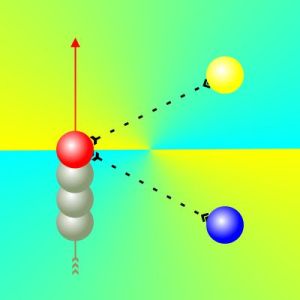
3 electrons moving north“It told me that the magnetism stuff has to come from what electrons do.  And that’s when I came up with this drawing.”  <He shoves a paper napkin at me.>  “See, the three balls are electrons and they’re all negative-negative pushing against each other only I’m just paying attention to what the red one’s doing to the other two.  Got that?”

“Sure.  The arrow means the red electron is traveling upward?”

“Yeah.  Now what’s that moving gonna do to the other two?”

“Well, the red’s getting closer to the yellow.  That increases the repulsive force yellow feels so it’ll move upward to stay away.”

“Uh-huh.  And the force on blue gets less so that one’s free to move upward, too.  Now pretend that the red one starts moving downward.”

“Everything goes the other way, of course.  Where does the magnetism come in?”

3 electrons in B-field“Well, that was the puzzle.  Here’s a drawing I copied from some book.  The magnetic field is those B arrows and there’s three electrons moving  in the same flat space in different directions.  The red one’s moving along the field and stays that way.  The blue one’s moving slanty across the field and gets pushed upwards.  The green one’s going at right angles to B and gets bent way up.  I’m looking and looking — how come the field forces them to move up?”
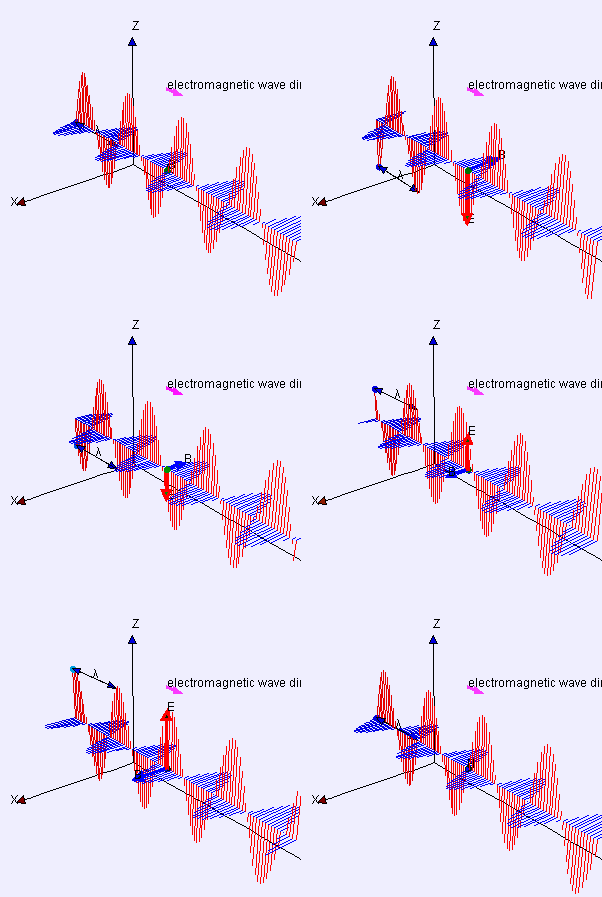
“Good question.  To answer it those 19th Century physicists developed vector analysis—”

Electromagneticwave3D
Plane-polarized electromagnetic wave
Electric (E) field is red
Magnetic (B) field is blue
(Image by Loo Kang Wee and Fu-Kwun Hwang from Wikimedia Commons)

“Don’t give me equations, Sy, I do pictures.  Anyway, I figured it out, and I did it from a movie I got on my tablet here.  It’s a light wave, see, so it’s got both an electric field and a magnetic field and they’re all sync’ed up together.”

“I see that.”

“What the book’s picture skipped was, where does the B-field come from?  That’s what I figured out.  Actually, I started with where the the light wave came from.”

“Which is…?”

“Way back there into the page, some electron is going up and down, and that creates the electric field whose job is to make other electrons go up and down like in my first picture, right?”

“OK, and …?”

“Then I thought about some other electron coming in to meet the wave.  If it comes in crosswise, its path is gonna get bent upward by the E-field.  That’s what the blue and green electrons did.  So what I think is, the magnetic effect is really from the E-field acting on moving electrons.”

“Nice try, but it doesn’t explain a couple of things.  For instance, there’s the difference between the green and blue paths.  Why does the amount of deflection depend on the angle between the B direction and the incoming path?”

“Dunno.  What’s the other thing?”

“Experiment shows that the faster the electron moves, the greater the magnetic deflection.  Does your theory account for that?”

“Uhh … my idea says less deflection.”

“Sorry, another beautiful theory stumbles on ugly facts.”

~~ Rich Olcott

Lighting and a diagram of a linac

Curiosity in The Internet Market

“I got another question, Moire.”

“Of course you do, Mr Feder.  Let’s hear it.”

“I read on the Internet that there’s every kind of radioactivity coming out of lightning bolts.  So is that true, how’s it happen and how come we’re not all glowing in the dark?”

“Well, now, like much else you read on the Internet there’s a bit of truth in there, and a bit of not-truth, all wrapped up in hype.  The ‘every kind of radioactivity’ part, for instance, that’s false.”

“Oh yeah?  What’s false about that?”

“Kinds like heavy-atom fission and alpha-particle ejection.  Neither have been reported near lightning strikes and they’re not likely to be.  Lightning travels through air.  Air is 98% nitrogen and oxygen with a sprinkling of light atoms.  Atoms like that don’t do those kinds of radioactivity.”

“So what’s left?”

“There’s only two kinds worth worrying about — beta decay, where the nucleus spits out an electron or positron, and some processes that generate gamma-rays.  Gamma’s a high-energy photon, higher even than X-rays.  Gamma photons are strong enough to ionize atoms and molecules.”

“You said ‘worth worrying about.’  I like worrying.  What’s in the not-worth-it bucket?”

“Neutrinos.  They’re so light and interact so little with matter that many physicists think of them as just an accounting device.  Trillions go through you every second and you don’t notice and neither do they.  Really, don’t worry about them.”

“Easy for you to say.  Awright, so how does lightning make the … I guess the beta and gamma radioactivity?”

“We know the general outlines, although a lot of details have yet to be filled in.  What do you know about linear accelerators?”

“Not a clue.  What is one?”

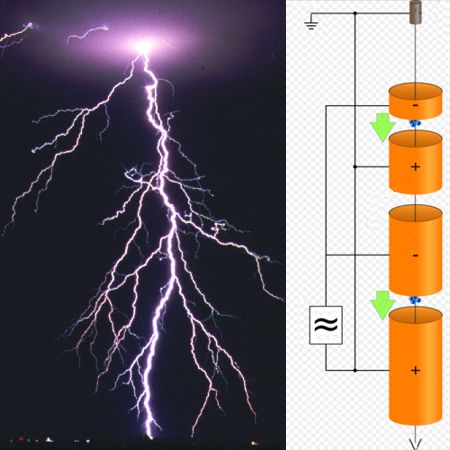
Lighting and a diagram of a linac
Linac diagram adapted from
Sgbeer – Own work, CC BY-SA 3.0

“It’s a technology for making high-energy electrons and other charged particles.  Picture a straight evacuated pipe equipped with ring electrodes at various distances from the source end.  The source could be an electron gun or maybe a rig that spits out ions of some sort.  Voltages between adjacent electrodes downstream of a particle will give it a kick when it passes en route to the target end.  By using the right voltages at the right times you can boost an electron’s kinetic energy into the hundred-million-eV range.  That’s a lot of kinetic energy.  Got that picture?”

“Suppose that I do.  Then what?”

“Lightning is the same thing but without the pipe and it’s not straight.  The electrons have an evacuated path, because plasma formation drives most of the molecules out of there.  Activity inside the clouds gives them high voltages, up to a couple hundred megavolts.  But on top of that there’s bremsstrahlung.”

“Brem…?”

Bremsstrahlung — German for braking radiation.  You know how your car’s tires squeal when you make a turn at speed?”

“One of my favorite sounds, ‘specially when … never mind.  What about it?”

“That’s your tires converting your forward momentum into sound waves.  Electrons do that, too, but with electromagnetism.  The lightning path zigs and zags.  An electron’s path has to follow suit.  At each swerve, the electron throws off some of its kinetic energy as an electromagnetic wave, otherwise known as a photon.  Those can be very high-energy photons, X-rays or even gamma-rays.”

“So that’s where the gammas come from.”

“Yup.  But there’s more.  Remember those nitrogen atoms?  Ninety-nine-plus percent of them are nitrogen-14, a nice, stable isotope with seven protons and seven neutrons.  If a sufficiently energetic gamma strikes a nitrogen-14, the atom’s nucleus can kick out a neutron and turn into unstable nitrogen-13.  That nucleus emits a positron to become stable carbon-13.  So you’ve got free neutrons and positrons to add to the radiation list.”

“With all that going on, how come I’m not glowing in the dark?”

“‘Because the radiation goes away quickly and isn’t contagious.  Most of the neutrons are soaked up by  hydrogen atoms in passing water molecules (it’s raining, remember?).  Nitrogen-13 has a 10-minute half-life and it’s gone.  The remaining neutrons, positrons and gammas can ionize stuff, but that happens on the outsides of molecules, not in the nuclei.  Turning things radioactive is a lot harder to do.  Don’t worry about it.”

“Maybe I want to.”

“Your choice, Mr Feder.”

~~ Rich Olcott

Three Perils for a Quest(ion), Part 2

Eddie came over to our table.  “Either you folks order something else or I’ll have to charge you rent.”  Typical Eddie.

“Banana splits sound good to you two?”

[Jeremy and Jennie] “Sure.”

“OK, Eddie, two banana splits, plus a coffee, black, for me.  And an almond biscotti.”

“You want one, that’s a biscotto.”

“OK, a biscotto, Eddie.  The desserts are on my tab.”

“Thanks, Mr Moire.”

“Thanks, Sy.  I know you want to get on to the third Peril on Jeremy’s Quest for black hole evaporation, but how does he get past the Photon Sphere?”

“Yeah, how?”

“Frankly, Jeremy, the only way I can think of is to accept a little risk and go through it really fast.  At 2/3 lightspeed, for instance, you and your two-meter-tall suit would transit that zero-thickness boundary in about 10 nanoseconds.  In such a short time your atoms won’t get much out of position before the electromagnetic fields that hold your molecules together kick back in again.”

“OK, I’ve passed through.  On to the Firewall … but what is it?”

“An object of contention, for one thing.  A lot of physicists don’t believe it exists, but some claim there’s evidence for it in the 2015 LIGO observations.  It was proposed a few years ago as a way out of some paradoxes.”

“Ooo, Paradoxes — loverly.  What’re the paradoxes then?”

“Collisions between some of the fundamental principles of Physics-As-We-Know-It.  One goes back to the Greeks — the idea that the same thing can’t be in two places at once.”

“Tell me about it.  Here’s your desserts.”

“Thanks, Eddie.  The place keeping you busy, eh?”

“Oh, yeah.  Gotta be in the kitchen, gotta be runnin’ tables, all the time.”

“I could do wait-staff, Mr G.  I’m thinking of dropping track anyway, Mr Moire, 5K’s don’t have much in common with base running which is what I care about.  How about I show up for work on Monday, Mr G?”

“Kid calls me ‘Mr’ — already I like him.  You’re on, Jeremy.”

“Woo-hoo!  So what’s the link between the Firewall and the Greeks?”

Link is the right word, though the technical term is entanglement.  If you create two particles in a single event they seem to be linked together in a way that really bothered Einstein.”

“For example?”Astronaut and biscotti
“Polarizing sunglasses.  They depend on a light wave’s crosswise electric field running either up-and-down or side-to-side.  Light bouncing off water or road surface is predominately side-to-side polarized, so sunglasses are designed to block that kind.  Imagine doing an experiment that creates a pair of photons named Lucy and Ethel.  Because of how the experiment is set up, the two must have complementary polarizations.  You confront Lucy with a side-to-side filter.  That photon gets through, therefore Ethel should be blocked by a side-to-side filter but should go through an up-and-down filter.  That’s what happens, no surprise.  But suppose your test let Lucy pass an up-and-down filter.  Ethel would pass a side-to-side filter.”

“But Sy, isn’t that because each photon has a specific polarization?”

“Yeah, Jennie, but here’s the weird part — they don’t.  Suppose you confront Lucy with a filter set at some random angle.  There’s only the one photon, no half-way passing, so either it passes or it doesn’t.  Whenever Lucy chooses to pass, Ethel usually passes a filter perpendicular to that one.  It’s like Ethel hears from Lucy what the deal was — and with zero delay, no matter how far away the second test is executed.  It’s as though Lucy and Ethel are a single particle that occupies two different locations.  In fact, that’s exactly how quantum mechanics models the situation.  Quite contrary to the Greeks’ thinking.”

“You said that Einstein didn’t like entanglement, either.  How come?”

“Einstein published the original entanglement mathematics in the 30s as a counterexample against Bohr’s quantum mechanics.  The root of his relativity theories is that the speed of light is a universal speed limit.  If nothing can go faster than light, instantaneous effects like this can’t happen.  Unfortunately, recent experiments proved him wrong.  Somehow, both Relativity and Quantum Mechanics are right, even though they seem to be incompatible.”

“And this collision is why there’s a problem with black hole evaporation?”

“It’s one of the collisions.”

“There’s more?  Loverly.”

~~ Rich Olcott

Three Perils for a Quest(ion), Part 1

Eddie makes great pizzas but Jeremy thinks they stay in the oven just a little too long.  As he crunched an extra-crispy wedge-edge he mused, “Gravity aside, I wonder what it’d be like to land on a black hole.  I bet it’d be real slippery if it’s as smooth as Mr Moire says.”

Jennie cut in.  “Don’t be daft, lad.  Everyone’s read about the spaceman sliding through the event horizon unaware until it’s too late.  Someone far away sees the bloke’s spacetime getting all distorted but in his local frame of reference everything’s right as rain.  Right, Sy?”

“As rain, Jennie, if all you’re concerned about is relativity.  But Spaceman Jeremy has lots of other things to be concerned about on his way to the event horizon.  Which he couldn’t stand on anyway.”

“Why not, Mr Moire?  I mean, I said ‘gravity aside’ so I ought to be able to stand up.”

“Nothing to stand on, Jeremy.  It’d be like trying to stand on Earth’s orbit.”

“Pull the other one, Sy.  How can they be alike?”

“Both of them are mathematical constructs rather than physical objects.  An orbit is an imaginary line that depicts planet or satellite locations.  An event horizon is an imaginary figure enclosing a region with such intense spacetime curvature that time points inward.  They’re abstract objects, not  concrete ones.  But let’s get back to Jeremy’s black hole evaporation quest.  He’ll have to pass three perils.”

“Ooo, a Quest with Perils —  loverly.  What are the Perils then?”

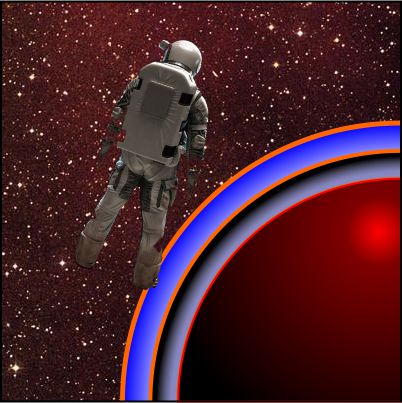
“The Roche Radius, the Photon Sphere and the Firewall.  Got your armor on, Jeremy?”Astronaut and 3xBlack hole

“Ready, Mr Moire.”

“Stand up.  The Roche effect is all about gravitational discrepancy between two points.  The two meter distance between your head and feet isn’t enough for a perceptible difference in downward pull.  However, when we deal with astronomical distances the differences can get significant.  For instance, ocean water on the day side of Earth is closer to the Sun and experiences a stronger sunward pull than water on the night side.”

“Ah, so that’s why we get tides.”

“Right.  Sit, sit, sit.  So in 1849 Édouard Roche wondered how close two objects could get until tidal forces pulled one of them apart.  He supposed the two objects were both just balls of rocks or fluid held together by gravity.  Applying Newton’s Laws and some approximations he got a formula for threshold distance in terms of the big guy’s mass and the little guy’s density.  Suppose you’re held together only by gravity and you’re nearing the Sun feet-first.  Its mass is 2×1030 kg/m³.  Even including your space armor, your average density is about 1.5 kg/m³.  According to Roche’s formula, if you got closer than 8.6×10⁶ kilometers your feet would break away and fall into the Sun before the rest of you would.  Oh, that distance is about 1/7 the radius of Mercury’s orbit so it’s pretty close in.”

“But we’re talking black holes here.  What if the Sun collapses to a black hole?”

“Surprisingly, it’s exactly the same distance.  The primary’s operative property is its mass, not its diameter.  Good thing Jeremy’s really held together by atomic and molecular electromagnetism, which is much stronger than gravity.  Which brings us to his second Peril, the dreaded Photon Sphere.”

“Should I shudder, Sy?”

“Go ahead, Jennie.  The Sphere is another mathematical object, not something physical you’d collide with, Jeremy.  It’s a zero-thickness shell representing where electromagnetic waves can orbit a massive object like a black hole or a neutron star.  Waves can penetrate the shell easily in either direction, but if one happens to fly in exactly along a tangent, it’s trapped on the Sphere.”

“That’s photons.  Why is it a peril to me?”

“Remember that electromagnetism that holds you together?  Photons carry that force.  Granted, in a molecule they’re standing waves rather than the free waves we see with.  The math is impossible, but here’s the Peril.  Suppose one of your particularly important molecules happens to lie tangent to the Sphere while you’re traversing it.  Suddenly, the forces holding that molecule together fly away from you at the speed of light.  And that disruption inexorably travels along your body as you proceed on your Quest.”

[both shudder]

~~ Rich Olcott

Calvin And Hobbes And i

Hobbes 2I so miss Calvin and Hobbes, the wondrous, joyful comic strip that cartoonist Bill Watterson gave us between 1985 and 1995.  Hobbes was a stuffed toy tiger — except that 6-year-old Calvin saw him as a walking, talking man-sized tiger with a sarcastic sense of humor.
So many things in life and physics are like Hobbes — they depend on how you look at them.  As we saw earlier, a fictitious force disappears when viewed from the right frame of reference.  There’s that particle/wave duality thing that Duc de Broglie “blessed” us with.  And polarized light.

In an earlier post I mentioned that light is polar, in the sense that a single photon’s electric field acts to vibrate an electron (pole-to-pole) within a single plane.
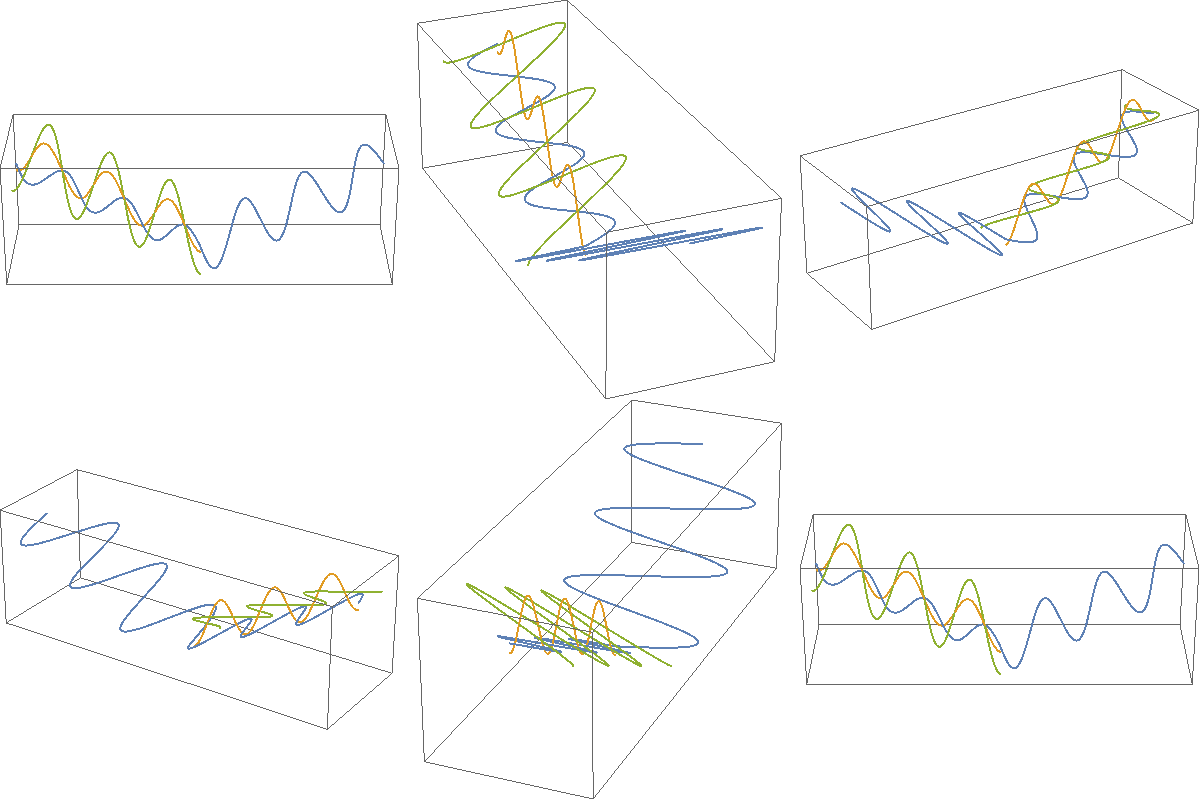
wavesIn this video, orange, green and blue electromagnetic fields shine in from one side of the box onto its floor.  Each color’s field is polar because it “lives” in only one plane.  However, the beam as a whole is unpolarized because different components of the total field direct recipient electrons into different planes giving zero net polarization.  The Sun and most other familiar light sources emit unpolarized light.
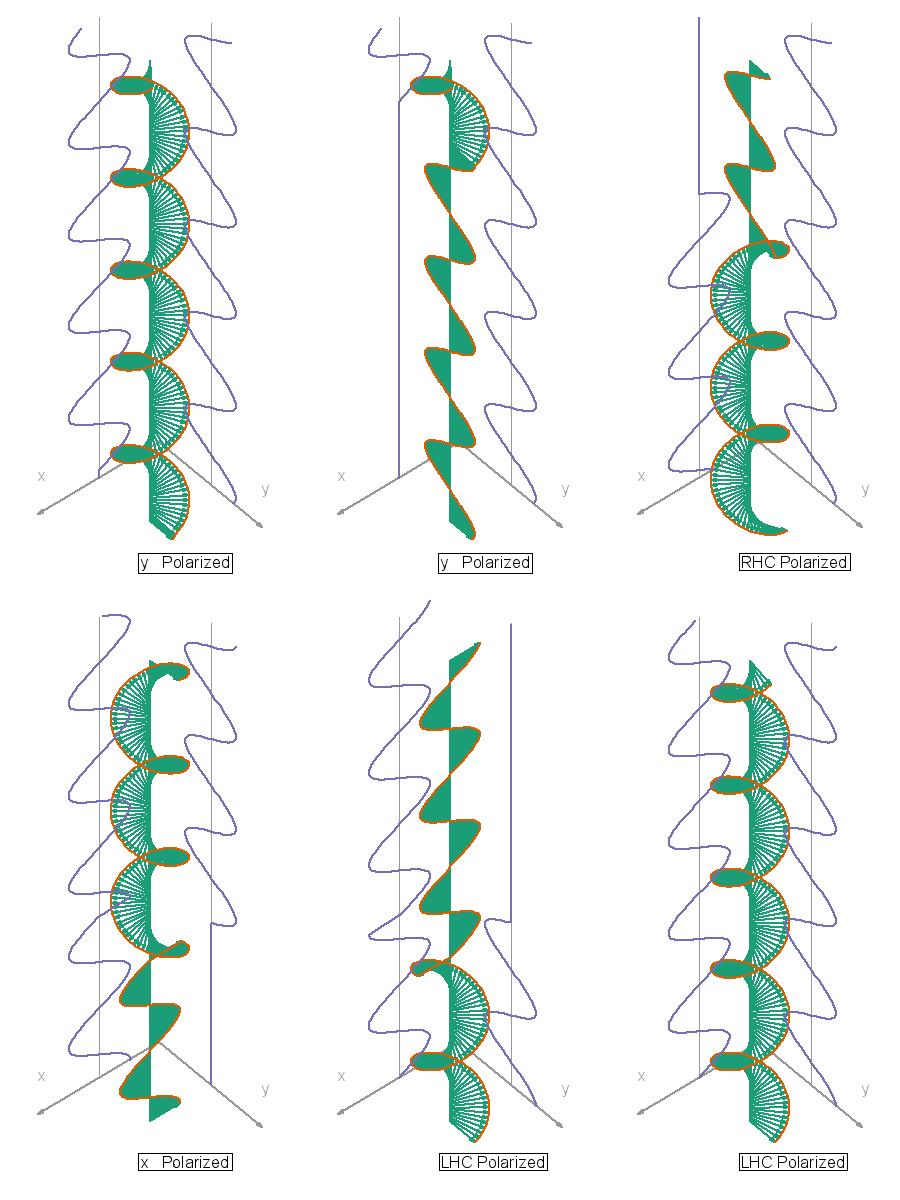
When sunlight bounces at a low angle off a surface, say paint on a car body or water at the beach, energy in a field that is directed perpendicular to the surface is absorbed and turned into heat energy.  (Yeah, I’m skipping over a semester’s-worth of Optics class, but bear with me.)  In the video, that’s the orange wave.

At the same time, fields parallel to the surface are reflected.  That’s what happens to the blue wave.

Suppose a wave is somewhere in between parallel and perpendicular, like the green wave.  No surprise, the vertical part of its energy is absorbed and the horizontal part adds to the reflection intensity.  That’s why the video shows the outgoing blue wave with a wider swing than its incoming precursor had.

The net effect of all this is that low-angle reflected light is polarized and generally more intense than the incident light that induced it.  We call that “glare.”  Polarizing sunglasses can help by selectively blocking horizontally-polarized electric fields reflected from water, streets, and that *@%*# car in front of me.

Wave_Polarisation
David Jessop’s brilliant depiction of plane and circularly polarized light

Things can get more complicated. The waves in the first video are all in synch — their peaks and valleys match up (mostly). But suppose an x-directed field and a y-directed field are headed along the same course.  Depending on how they match up, the two can combine to produce a field driving electrons along the x-direction, the y-direction, or in clockwise or counterclockwise circles.  Check the red line in this video — RHC and LHC depict the circularly polarized light that sci-fi writers sometimes invoke when they need a gimmick.

Physicists have several ways to describe such a situation mathematically.  I’ve already used the first, which goes back 380 years to René Descartes and the Cartesian x, y,… coordinate system he planted the seed for.  We’ve become so familiar with it that reading a graph is like reading words.  Sometimes easier.

In Cartesian coordinates we write x– and y-coordinates as separate functions of time t:
x = f1(t)
y = f2(t)
where each f could be something like 0.7·t2-1.3·t+π/4 or whatever.  Then for each t-value we graph a point where the vertical line at the calculated x intersects the horizontal line at the calculated y.

But we can simplify that with a couple of conventions.  Write √(-1) as i, and say that i-numbers run along the y-axis.  With those conventions we can write our two functions in a single line:
x + i y = f1(t) + i f2(t)
One line is better than two when you’re trying to keep track of a big calculation.

But people have a long-running hang-up that’s part theory and part psychology.  When Bombelli introduced these complex numbers back in the 16th century, mathematicians complained that you can’t pile up i thingies.  Descartes and others simply couldn’t accept the notion, called the numbers “imaginary,” and the term stuck.

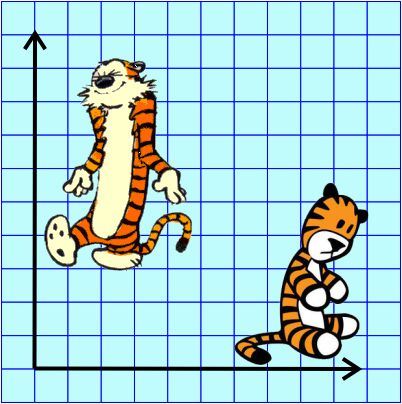
Which is why Hobbes the way Calvin sees him is on the imaginary axis.

~~ Rich Olcott

What’s that funnel about, really?

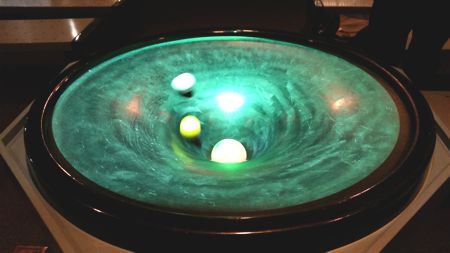
If you’ve ever watched or read a space opera (oh yes, you have), you know about the gravity well that a spacecraft has to climb out of when leaving a planet.  Every time I see the Museum’s gravity well model (photo below), I’m reminded of all the answers the guy gave to, “Johnny, what can you make of this?

The model’s a great visitor-attracter with those “planets” whizzing around the “Sun,” but this one exhibit really represents several distinct concepts.   For some of them it’s not quite the right shape.DMNS gravity well

The simplest concept is geometrical.  “Down” is the direction you move when gravity’s pulling on you.

HS cone
Gravitational potential energy change
for small height differences

A gravity well model for that concept would be just a straight line between you and the neighborhood’s most intense gravity source.

You learned the second concept in high school physics class.  Any object has gravitational potential energy that measures the amount of energy it would give up on falling.  Your teacher probably showed you the equation GPE = m·g·h, where m is the mass of the object, h is its height above ground level, and g is a constant you may have determined in a lab experiment.

If the width of the gravity well model at a given height represents GPE at that level, the model is a simple straight-sided cone.

Newton energy cone
Gravitational potential energy change
for large height differences
The h indicates
an approximately linear range
where the HS equation could apply.

But of course it’s not that simple.  Newton’s Law of Gravity says that the potential energy at any height r away from the planet’s center is proportional to 1/r.

Hmm… that looks different from the “proportional to h” equation.  Which is right?

Both equations are valid, but over different distance scales.  The HS teachers didn’t quite lie to you, but they didn’t give you the complete picture either.  Your classroom was about 4000 miles (21,120,000 feet) from Earth’s center, whereas the usual experiments involve height differences of at most a dozen feet.  Even the 20-foot drop from a second-story window is less than a millionth of the way down to Earth’s center.

Check my numbers:

Height h 1/(r+h)
× 108
Difference in 1/(r+h)
× 1014
0 4.734,848,484 0
20 4.734,844,001 4.48
40 4.734,839,517 8.97
60 4.734,835,033 13.45
80 4.734,830,549 17.93
100 4.734,826,066 22.42

rh lineSure enough, that’s a straight line (see the chart).  Reminds me of how Newton’s Law of Gravity is valid except at very short distances.  The HS Law of Gravity works fine for small spans but when the distances get big we have to use Newton’s equation.

We’re not done yet. That curvy funnel-shaped gravity well model could represent the force of gravity rather than its potential energy.  Newton told us that the force goes as 1/r2 so it decreases much more rapidly than the potential energy does as you get further away.  The gravity force well has a correspondingly sharper curve to it than the gravity energy well.

Newton force cone
The force of gravity
or an embedding diagram

The funnel model could also represent the total energy required to get a real spacecraft off the surface and up into space.  Depending on which sci-fi gimmickry is in play, the energy may come from a chemical or ion rocket, an electromagnetic railgun, or even a tractor beam from some mothership way up there.

No matter the technology, the theoretical energy requirement to get to a given height is the same.  In practice, however, each technology is optimal for some situations but forbiddingly inefficient in others.  Thus, each technology’s funnel  has its own shape and that shape will change depending on the setting.

In modern physics, the funnel model could also represent Einstein’s theory of how a mass “bends” the space around it.  (Take a look at this post, which is about how mass curves space by changing the local distance scale.)  Cosmologists describe the resulting “shapes” with embedding diagrams that are essentially 2D pictures of 3D (or 4D) contour plots.  The contours are closest together where space is most compressed, just as lines showing a steep hillside on a landscape contour map are close together.

The ED around a non-spinning object looks just like the force model picture above.  No surprise — gravitational force is how we we perceive spatial curvature.

~~ Rich Olcott

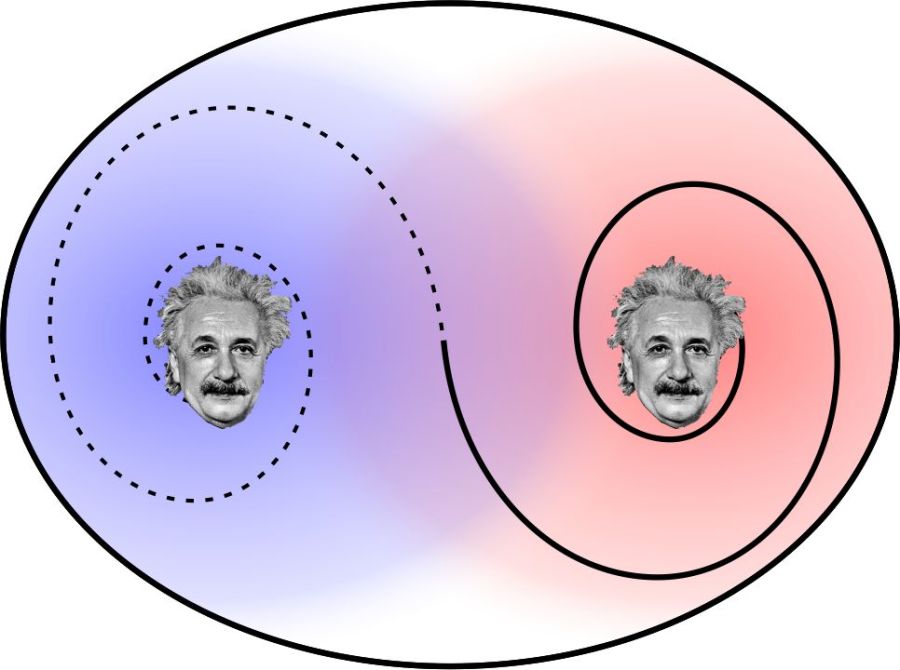
Reflections in Einstein’s bubble

There’s something peculiar in this earlier post where I embroidered on Einstein’s gambit in his epic battle with Bohr.  Here, I’ll self-plagiarize it for you…

Consider some nebula a million light-years away.  A million years ago an electron wobbled in the nebular cloud, generating a spherical electromagnetic wave that expanded at light-speed throughout the Universe.

Last night you got a glimpse of the nebula when that lightwave encountered a retinal cell in your eye.  Instantly, all of the wave’s energy, acting as a photon, energized a single electron in your retina.  That particular lightwave ceased to be active elsewhere in your eye or anywhere else on that million-light-year spherical shell.

Suppose that photon was yellow light, smack in the middle of the optical spectrum.  Its wavelength, about 580nm, says that the single far-away electron gave its spherical wave about 2.1eV (3.4×10⁻¹⁹ joules) of energy.  By the time it hit your eye that energy was spread over an area of a trillion square lightyears.  Your retinal cell’s cross-section is about 3 square micrometers so the cell can intercept only a teeny fraction of the wavefront.  Multiplying the wave’s energy by that fraction, I calculated that the cell should be able to collect only 10-75 joules.  You’d get that amount of energy from a 100W yellow light bulb that flashed for 10-73 seconds.  Like you’d notice.

But that microminiscule blink isn’t what you saw.  You saw one full photon-worth of yellow light, all 2.1eV of it, with no dilution by expansion.  Water waves sure don’t work that way, thank Heavens, or we’d be tsunami’d several times a day by earthquakes occurring near some ocean somewhere.

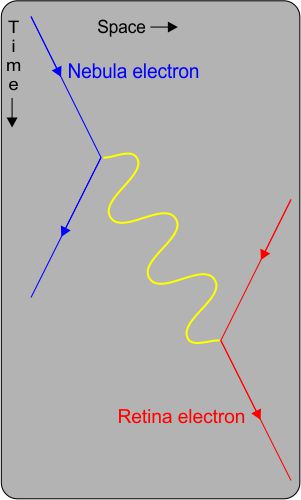
Feynman diagramHere we have a Feynman diagram, named for the Nobel-winning (1965) physicist who invented it and much else.  The diagram plots out the transaction we just discussed.  Not a conventional x-y plot, it shows Space, Time and particles.  To the left, that far-away electron emits a photon signified by the yellow wiggly line.  The photon has momentum so the electron must recoil away from it.
The photon proceeds on its million-lightyear journey across the diagram.  When it encounters that electron in your eye, the photon is immediately and completely converted to electron energy and momentum.

Here’s the thing.  This megayear Feynman diagram and the numbers behind it are identical to what you’d draw for the same kind of yellow-light electron-photon-electron interaction but across just a one-millimeter gap.

It’s an essential part of the quantum formalism — the amount of energy in a given transition is independent of the mechanical details (what the electrons were doing when the photon was emitted/absorbed, the photon’s route and trip time, which other atoms are in either neighborhood, etc.).  All that matters is the system’s starting and ending states.  (In fact, some complicated but legitimate Feynman diagrams let intermediate particles travel faster than lightspeed if they disappear before the process completes.  Hint.)

Because they don’t share a common history our nebular and retinal electrons are not entangled by the usual definition.  Nonetheless, like entanglement this transaction has Action-At-A-Distance stickers all over it.  First, and this was Einstein’s objection, the entire wave function disappears from everywhere in the Universe the instant its energy is delivered to a specific location.  Second, the Feynman calculation describes a time-independent, distance-independent connection between two permanently isolated particles.  Kinda romantic, maybe, but it’d be a boring movie plot.

As Einstein maintained, quantum mechanics is inherently non-local.  In QM change at one location is instantaneously reflected in change elsewhere as if two remote thingies are parts of one thingy whose left hand always knows what its right hand is doing.

Bohr didn’t care but Einstein did because relativity theory is based on geometry which is all about location. In relativity, change here can influence what happens there only by way of light or gravitational waves that travel at lightspeed.

In his book Spooky Action At A Distance, George Musser describes several non-quantum examples of non-locality.  In each case, there’s no signal transmission but somehow there’s a remote status change anyway.  We don’t (yet) know a good mechanism for making that happen.

It all suggests two speed limits, one for light and matter and the other for Einstein’s “deeper reality” beneath quantum mechanics.

~~ Rich Olcott

Gargh, His Heirs, and the AAAD Problem

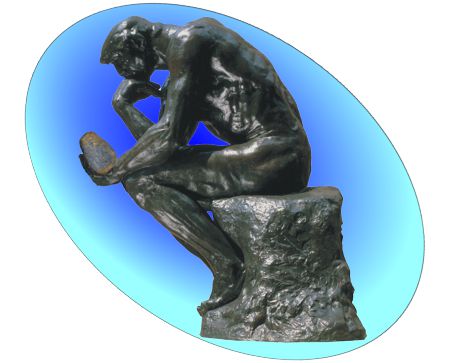
Gargh the thinkerGargh, proto-humanity’s foremost physicist 2.5 million years ago, opened a practical investigation into how motion works.  “I throw rock, hit food beast, beast fall down yes.  Beast stay down no.  Need better rock.”  For the next couple million years, we put quite a lot of effort into making better rocks and better ways to throw them.  Less effort went into understanding throwing.
There seemed to be two kinds of motion.  The easier kind to understand was direct contact — “I push rock, rock move yes.  Rock stop move when rock hit thing that move no.”  The harder kind was when there wasn’t direct contact — “I throw rock up, rock hit thing no but come back down.  Why that?

Gargh was the first but hardly the last physicist to puzzle over the Action-At-A-Distance problem (a.k.a. “AAAD”).  Intuition tells us that between pusher and pushee there must be a concrete linkage to convey the push-force.  To some extent, the history of physics can be read as a succession of solutions to the question, “What linkage induces this apparent case of AAAD?”

Most of humanity was perfectly content with AAAD in the form of magic of various sorts.  To make something happen you had to wish really hard and/or depend on the good will of some (generally capricious) elemental being.

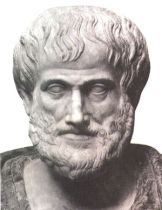
aristotle 1Aristotle wasn’t satisfied with anything so unsystematic.  He was just full of theories, many of which got in each other’s way.  One theory was that things want to go where they’re comfortable  because of what they’re made of — stones, for instance, are made of earth so naturally they try to get back home and that’s why we see them fall downwards (no concrete linkage, so it’s still AAAD).
Unfortunately, that theory didn’t account for why a thrown rock doesn’t just fall straight down but instead goes mostly in the direction it’s thrown.  Aristotle (or one of his followers) tied that back to one of his other theories, “Nature hates a vacuum.”  As the rock flies along, it pushes the air aside (direct contact) and leaves a vacuum behind it. More air rushes in to fill the vacuum and pushes the rock ahead (more direct contact).

We got a better (though still AAAD) explanation in the 17th Century when physicists invented the notions of gravity and inertia.Newton 204

Newton made a ground-breaking claim in his Principia.  He proposed that the Solar System is held together by a mysterious AAAD force he called gravity.  When critics asked how gravity worked he shrugged, “I do not form hypotheses” (though he did form hypotheses for light and other phenomena).

Inertia is also AAAD.  Those 17th Century savants showed that inertial forces push mass towards the Equator of a rotating object.  An object that’s completely independent of the rest of the Universe has no way to “know” that it’s rotating so it ought to be a perfect sphere.  In fact, the Sun and each of its planets are wider at the equator than you’d expect from their polar diameters.  That non-sphere-ness says they must have some AAAD interaction with the rest of the Universe.  A similar argument applies to linear motion; the general case is called Mach’s Principle.
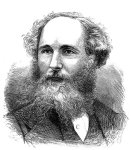
JCMaxwell

The ancients knew of the mysterious AAAD agents electricity and its fraternal twin, magnetism.  However, in the 19th Century James Clerk Maxwell devised a work-around.  Just as Newton “invented” gravity, Maxwell “invented” the electromagnetic field.  This invisible field isn’t a material object.  However, waves in the field transmit electromagnetic forces everywhere in the Universe.  Not AAAD, sort of.

It wasn’t long before someone said, “Hey, we can calculate gravity that way, too.”  That’s why we now speak of a planet’s gravitational field and gravitational waves.

But the fields still felt like AAAD because they’re not concrete.  Some modern physicists stand that objection on its head.  Concrete objects, they say, are made of atoms which themselves are nothing more than persistent fluctuations in the electromagnetic and gravitational fields.  By that logic, the fields are what’s fundamental — all motion is by direct contact.einstein-tongue edged

Einstein moved resolutely in both directions.  He negated gravity’s AAAD-ness by identifying mass-contorted space as the missing linkage.  On the other hand, he “invented” quantum entanglement, the ultimate spooky AAAD.

 ~~ Rich Olcott

Oh, what an entangled wave we weave

“Here’s the poly bag wiff our meals, Johnny.  ‘S got two boxes innit, but no labels which is which.”
“I ordered the mutton pasty, Jennie, anna fish’n’chips for you.”
“You c’n have this box, Johnny.  I’ll take the other one t’ my place to watch telly.”

<ring>
” ‘Ullo, Jennie?  This is Johnny.  The box over ‘ere ‘as the fish.  You’ve got mine!”


In a sense their supper order arrived in an entangled state.  Our friends knew what was in both boxes together, but they didn’t know what was in either box separately.  Kind of a Schrödinger’s Cat situation — they had to treat each box as 50% baked pasty and 50% fried codfish.

But as soon as Johnny opened one box, he knew what was in the other one even though it was somewhere else.  Jennie could have been in the next room or the next town or the next planet — Johnnie would have known, instantly, which box had his meal no matter how far away that other box was.

By the way, Jennie was free to open her box on the way home but that’d make no difference to Johnnie — the box at his place would have stayed a mystery to him until either he opened it or he talked to her.

Entangled 2Information transfer at infinite speed?  Of course not, because neither hungry person knows what’s in either box until they open one or until they exchange information.  Even Skype operates at light-speed (or slower).

But that’s not quite quantum entanglement, because there’s definite content (meat pie or batter-fried cod) in each box.  In the quantum world, neither box holds something definite until at least one box is opened.  At that point, ambiguity flees from both boxes in an act of global correlation.

There’s strong experimental evidence that entangled particles literally don’t know which way is up until one of them is observed.  The paired particle instantaneously gets that message no matter how far away it is.

Niels Bohr’s Principle of Complementarity is involved here.  He held that because it’s impossible to measure both wave and particle properties at the same time, a quantized entity acts as a wave globally and only becomes local when it stops somewhere.

Here’s how extreme the wave/particle global/local thing can get.  Consider some nebula a million light-years away.  A million years ago an electron wobbled in the nebular cloud, generating a spherical electromagnetic wave that expanded at light-speed throughout the Universe.

cats-eye nebula
The Cat’s Eye Nebula (NGC 6543)
courtesy of NASA’s Hubble Space Telescope

Last night you got a glimpse of the nebula when that lightwave encountered a retinal cell in your eye.  Instantly, all of the wave’s energy, acting as a photon, energized a single electron in your retina.  That particular lightwave ceased to be active elsewhere in your eye or anywhere else on that million-light-year spherical shell.

Surely there was at least one other being, on Earth or somewhere else, that was looking towards the nebula when that wave passed by.  They wouldn’t have seen your photon nor could you have seen any of theirs.  Somehow your wave’s entire spherical shell, all 1012 square lightyears of it, instantaneously “knew” that your eye’s electron had extracted the wave’s energy.

But that directly contradicts a bedrock of Einstein’s Special Theory of Relativity.  His fundamental assumption was that nothing (energy, matter or information) can go faster than the speed of light in vacuum.  STR says it’s impossible for two distant points on that spherical wave to communicate in the way that quantum theory demands they must.

Want some irony?  Back in 1906, Einstein himself “invented” the photon in one of his four “Annus mirabilis” papers.  (The word “photon” didn’t come into use for another decade, but Einstein demonstrated the need for it.)  Building on Planck’s work, Einstein showed that light must be emitted and absorbed as quantized packets of energy.

It must have taken a lot of courage to write that paper, because Maxwell’s wave theory of light had been firmly established for forty years prior and there’s a lot of evidence for it.  Bottom line, though, is that Einstein is responsible for both sides of the wave/particle global/local puzzle that has bedeviled Physics for a century.

~~ Rich Olcott