


The Crazy Theory contest is still going strong in the back room at Al’s coffee shop. I gather from the score board scribbles that Jim’s Mars idea (one mark-up says “2 possible 2 B crazy!“) is way behind Amanda’s “green blood” theory. There’s some milling about, then a guy next to me says, “I got this, hold my coffee,” and steps up to the mic. Big fellow, don’t recognize him but some of the Physics students do — “Hey, it’s Cap’n Mike at the mic. Whatcha got for us this time?”
“I got the absence of a theory, how’s that? It’s about the Four Forces.”
Someone in the crowd yells out, “Charm, Persuasiveness, Chaos and Bloody-mindedness.”
“Nah, Jennie, that’s Terry Pratchett’s Theory of Historical Narrative. We’re doing Physics here. The right answer is Weak and Strong Nuclear Forces, Electromagnetism, and Gravity, with me? Question is, how do they compare?”
Another voice from the crowd. “Depends on distance!”
“Well yeah, but let’s look at cases. Weak Nuclear Force first. It works on the quarks that form massive particles like protons. It’s a really short-range force because it depends on force-carrier particles that have very short lifetimes. If a Weak Force carrier leaves its home particle even at the speed of light which they’re way too heavy to do, it can only fly a small fraction of a proton radius before it expires without affecting anything. So, ineffective anywhere outside a massive particle.”
It’s a raucous crowd. “How about the Strong Force, Mike?”
. <chorus of “HOO-wah!”>
“Semper fi that. OK, the carriers of the Strong Force —”
. <“Naa-VY! Naaa-VY!”>
. <“Hush up, guys, let him finish.”>
“Thanks, Amanda. The Strong Force carriers have no mass so they fly at lightspeed, but the force itself is short range, falls off rapidly beyond the nuclear radius. It keeps each trio of quarks inside their own proton or neutron. And it’s powerful enough to corral positively-charged particles within the nucleus. That means it’s way stronger inside the nucleus than the Electromagnetic force that pushes positive charges away from each other.”
“How about outside the nucleus?”
“Out there it’s much weaker than Electromagnetism’s photons that go flying about —”
. <“Air Force!”>
. <“You guys!”>
“As I was saying… OK, the Electromagnetic Force is like the nuclear forces because it’s carried by particles and quantum mechanics applies. But it’s different from the nuclear forces because of its inverse-square distance dependence. Its range is infinite if you’re willing to wait a while to sense it because light has finite speed. The really different force is the fourth one, Gravity —”
. <“Yo Army! Ground-pounders rock!”>
“I was expecting that. In some ways Gravity’s like Electromagnetism. It travels at the same speed and has the same inverse-square distance law. But at any given distance, Gravity’s a factor of 1038 punier and we’ve never been able to detect a force-carrier for it. Worse, a century of math work hasn’t been able to forge an acceptable connection between the really good Relativity theory we have for Gravity and the really good Standard Model we have for the other three forces. So here’s my Crazy Theory Number One — maybe there is no connection.”
. <sudden dead silence>
“All the theory work I’ve seen — string theory, whatever — assumes that Gravity is somehow subject to quantum-based laws of some sort and our challenge is to tie Gravity’s quanta to the rules that govern the Standard Model. That’s the way we’d like the Universe to work, but is there any firm evidence that Gravity actually is quantized?”
. <more silence>
“Right. So now for my Even Crazier Theories. Maybe there’s a Fifth Force, also non-quantized, even weaker than Gravity, and not bound by the speed of light. Something like that could explain entanglement and solve Einstein’s Bubble problem.”
. <even more silence>
“OK, I’ll get crazier. Many of us have had what I’ll call spooky experiences that known Physics can’t explain. Maybe stupid-good gambling luck or ‘just knowing’ when someone died, stuff like that. Maybe we’re using the Fifth Force in action.”
. <complete pandemonium>
~ Rich Olcott
Note to my readers with connections to the US National Guard, Coast Guard, Merchant Marine and/or Public Health Service — Yeah, I know, but one can only stretch a metaphor so far.

 Those two electrons push their dust grains apart almost a quintillion times more strongly than gravity pulls them together. And the distance makes no difference — close together or far apart, push wins. You can’t use gravity to build a planet from charged particles.”
 “Good question. If protons were more positive than electrons, electrostatic repulsion would always be proportional to mass. We couldn’t separate that force from gravity. Physicists have separately measured electron and proton charge. They’re equal (except for sign) to 10 decimal places. Unfortunately, we’d need another 25 digits of accuracy before we could test your hypothesis.”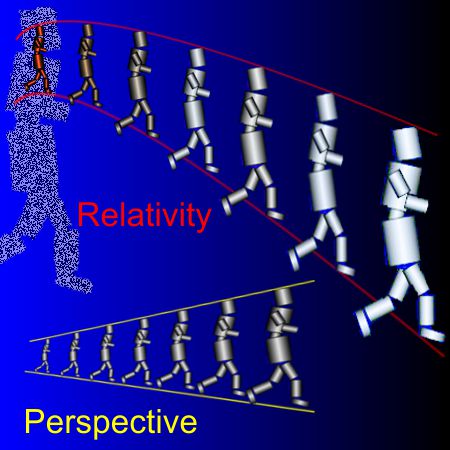
 “But GR’s not the only player. Special Relativity’s in there, too.”

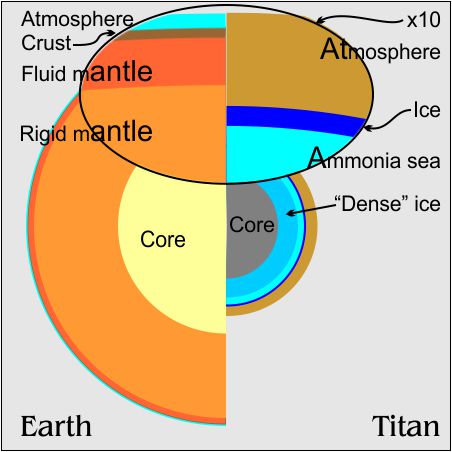 Titan’s atmosphere is heavy-duty compared with Earth’s — 6 times deeper and about 1½ times the surface pressure. When I read those numbers I thought, “Huh? But Titan’s diameter is only 40% as big as Earth’s and its surface gravity is only 10% of ours. How come it’s got such a heavy atmosphere?”


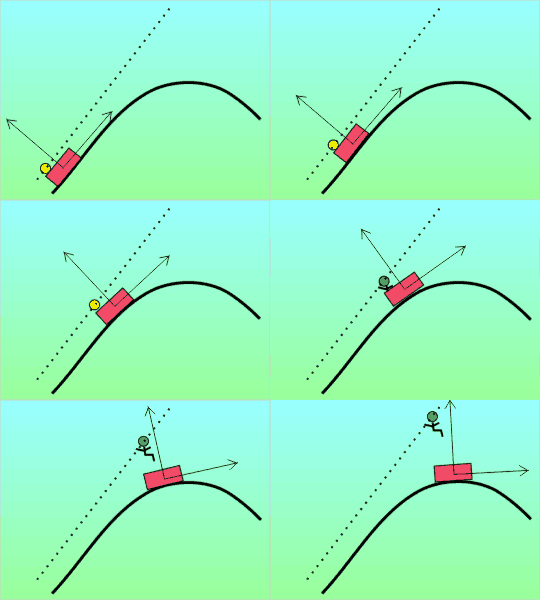 But there are other accelerations that aren’t so easily accounted for. Ever ride in a car going around a curve and find yourself almost flung out of your seat? This little guy wasn’t wearing his seat belt and look what happened. The car accelerated because changing direction is an acceleration due to a lateral force. But the guy followed Newton’s First Law and just kept going in a straight line. Did he accelerate?
 Suppose you’re investigating an object’s motion that appears to arise from a new force you’d like to dub “heterofugal.” If you can find a different frame of reference (one not attached to the object) or otherwise explain the motion without invoking the “new force,” then heterofugalism is a fictitious force.
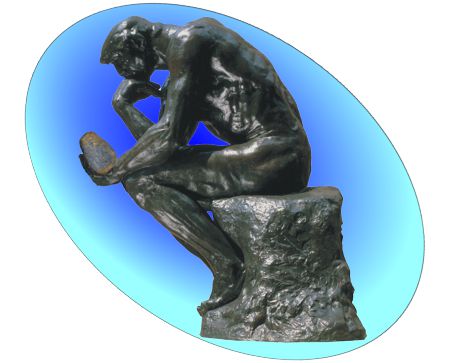 Gargh, proto-humanity’s foremost physicist 2.5 million years ago, opened a practical investigation into how motion works. “I throw rock, hit food beast, beast fall down yes. Beast stay down no. Need better rock.” For the next couple million years, we put quite a lot of effort into making better rocks and better ways to throw them. Less effort went into understanding throwing.
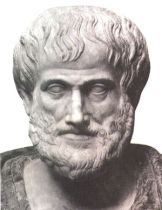 Aristotle wasn’t satisfied with anything so unsystematic. He was just full of theories, many of which got in each other’s way. One theory was that things want to go where they’re comfortable because of what they’re made of — stones, for instance, are made of earth so naturally they try to get back home and that’s why we see them fall downwards (no concrete linkage, so it’s still AAAD).

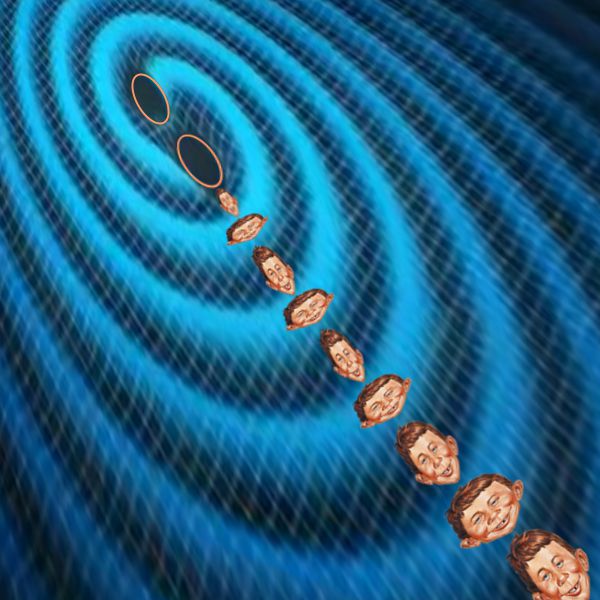
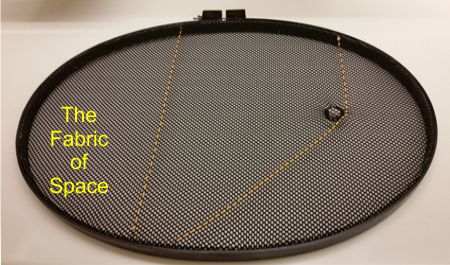
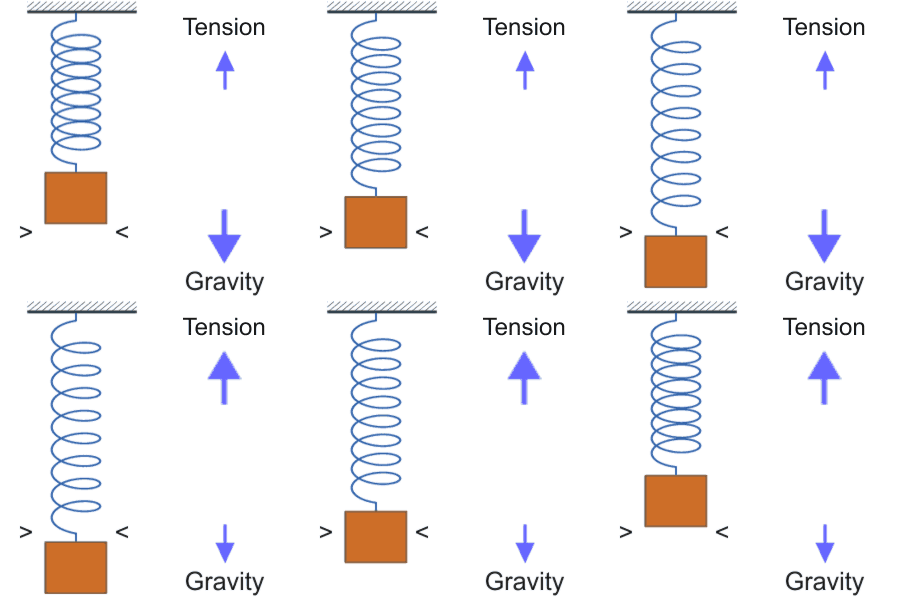 A wave happens in a system when a driving force and a restoring force take turns overshooting an equilibrium point AND the away-from-equilibrium-ness gets communicated around the system. The system could be a bunch of springs tied together in a squeaky old bedframe, or labor and capital in an economic system, or the network of water molecules forming the ocean surface, or the fibers in the fabric of space (whatever those turn out to be).
 An isolated black hole is surrounded by an intense gravitational field and a corresponding compression of spacetime. A pair of black holes orbiting each other sends out an alternating series of tensions, first high, then extremely high, then high…
 Hard Science Ain't Hard