Breaking Up? Not So Hard

<transcript of smartphone dictation by Sy Moire, hard‑boiled physicist>
Day 173 of self‑isolation….
Perfect weather for a brisk solitary walk, taking the park route….
There’s the geese. No sign of Mr Feder, just as well….

Still thinking about Ms Baird and her plan for generating electric power from a black hole named Lonesome….
Can just hear Vinnie if I ever told him about this which I can’t….
“Hey, Sy, nothin’ gets out of a black hole except gravity, but she’s using Lonesome‘s magnetic field to generate electricity which is electromagnetic. How’s that happen?”
Good question….

Hhmph, that’s one angry squirrel….
Ah, a couple of crows pecking the ground under its tree. Maybe they’re too close to its acorn stash….

We know a black hole’s only measurable properties are its mass, charge and spin….
And maybe its temperature, thanks to Stephen Hawking….
Its charge is static — hah! cute pun — wouldn’t support continuous electrical generation….
The Event Horizon hides everything inside — we can’t tell if charge moves around in there or even if it’s matter or anti‑matter or something else….
The no‑hair theorem says there’s no landmarks or anything sticking out of the Event Horizon so how do we know the thing’s even spinning?

Ah, we know a black hole’s external structures — the jets, the Ergosphere belt and the accretion disk — rotate because we see red- and blue-shifted radiation from them….
The Ergosphere rotates in lockstep with Lonesome‘s contents because of gravitational frame-dragging….
Probably the disk and the jets do, too, but that’s only a strong maybe….
But why should the Ergosphere’s rotation generate a magnetic field?

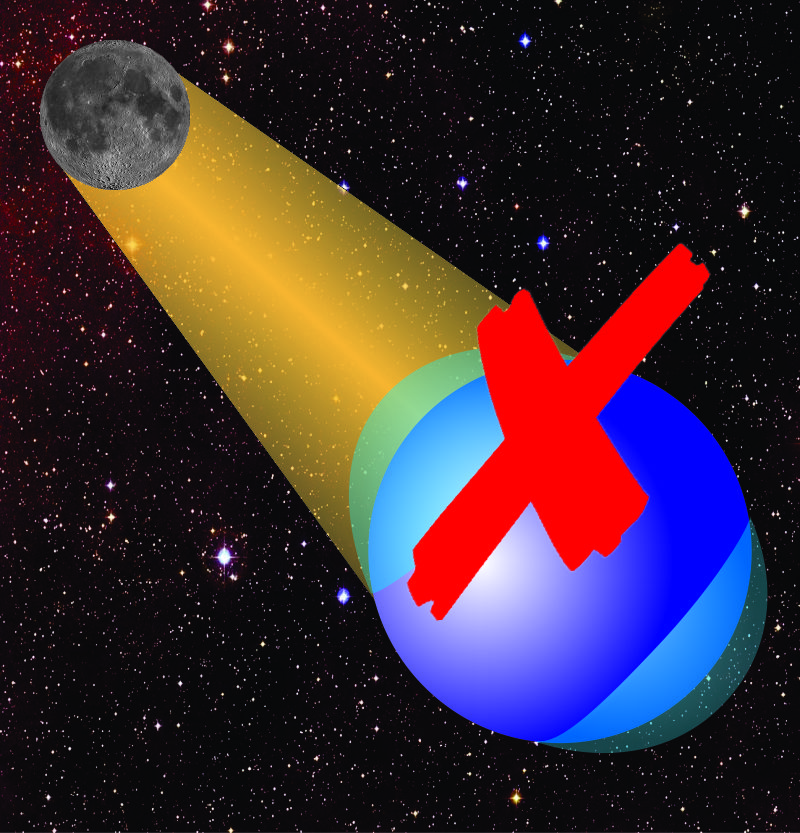
How about Newt Barnes’ double‑wheel idea — a belt of charged light‑weight particles inside a belt of opposite‑charged heavy particles all embedded in the Ergosphere and orbiting at the black hole’s spin rate….
Could such a thing exist? Can simple particle collisions really split the charges apart like that?….

OK, fun problem for strolling mental arithmetic. Astronomical “dust” particles are about the size of smoke particles and those are about a micrometer across which is 10‑6 meter so the volume’s about (10‑6)3=10‑18 cubic meter and the density’s sorta close to water at 1 gram per cubic centimeter or a thousand kilograms per cubic meter so the particle mass is about 10‑18×103=10‑15 kilogram. If a that‑size particle collided with something and released just enough kinetic energy to knock off an electron, how fast was it going?

Ionization energy for a hydrogen atom is 13 electronvolts, so let’s go for a collision energy of at least 10 eV. Good old kinetic energy formula is E=½mv² but that’s got to be in joules if we want a speed in meters per second so 10 eV is, lemme think, about 2×10‑18 joules/particle. So is 2×2×10‑18/10‑15 which is 4×10‑3 or 40×10‑4, square root of 40 is about 6, so v is about 6×10‑2 or 0.06 meters per second. How’s that compare with typical speeds near Lonesome?

Ms Baird said that Lonesome‘s mass is 1.5 Solar masses and it’s isolated from external gravity and electromagnetic fields. So anything near it is in orbit and we can use the circular orbit formula v²=GM/r….
Dang, don’t remember values for G or M. Have to cheat and look up the Sun’s GM product on Old Reliable….
Ah-hah, 1.3×10²⁰ meters³/second so Lonesome‘s is also near 1020….
A solar‑mass black hole’s half‑diameter is about 3 kilometers so Lonesome‘s would be about 5×10³ meters. Say we’re orbiting at twice that so r‘s around 104 meters. Put it together we get v2=1020/104=1016 so v=108 meters/sec….
Everything’s going a billion times faster than 10 eV….
So yeah, no problem getting charged dust particles out there next to Lonesome….

Just look at the color in that tree…
Weird when you think about it. The really good color is summertime chlorophyll green when the trees are soaking up sunlight and turning CO2 into oxygen for us but people get excited about dying leaves that are red or yellow…

Well, now. Lonesome‘s Event Horizon is the no-going-back point on the way to its central singularity which we call infinity because its physics are beyond anything we know. I’ve just closed out another decade of my life, another Event Horizon on my own one‑way path to a singularity…

Hey! Mr Feder! Come ask me a question to get me out of this mood.

Author’s note — Yes, ambient radiation in Lonesome‘s immediate vicinity probably would account for far more ionization than physical impact, but this was a nice exercise in estimation and playing with exponents and applied physical principles.

~~ Rich Olcott

The Solid Gold Bath Towel

“C’mon, Sy, I heard weaseling there — ‘velocity‑based thinking‘ ain’t the same as velocity numbers.”

“Guilty as charged, Vinnie. The centuries-old ‘velocity of money‘ notion has been superceded for a half-century, but the theory’s still useful in the right circumstances. It’s like Newton’s Law of Gravity that way, except we’ve been drifting away from Newton for a full century.”

“What, gravity doesn’t work any more?”

“Sure it does, and most places the force is exactly what Newton said it should be — proportional to the mass divided by the distance. But it goes wrong when the mass‑to‑distance ratio gets huge, say close to a star or a black hole. That’s when we move up to Einstein’s theory. It includes Newton’s Law as a special case but it covers the high-ratio cases more exactly and accounts for more phenomena.”

“Just for grins, how about when the ratio is tiny?”

“We don’t know. Some cosmologists have suggested that’s what dark energy is about. Maybe when galaxies get really far apart, they’re not attracted to each other quite as much as Newton’s Law says.”

“I suppose the money theories have problems at high and low velocities?”

“That’s one pair of problems. Money velocity is proportional to nominal traffic divided by money supply. Suppose an average currency unit changes hands thousands of times a day. That says people don’t have confidence that money will buy as much tomorrow as it could today. They’ve got hyperinflation.”

“Ah, and at the low end it’d be like me putting Eddie’s autographed $20 in a frame on my wall. No spend, no traffic, zero velocity.”

“Right, but for the economy it’d be everyone putting all their money under their mattresses. Money that’s frozen in place doesn’t do anything except maybe make someone feel good. It’s like water in a stream, it has to be flowing to be useful in generating power.”

“Wait, you used a word back there, ‘nominal.’ What’s that about?”

“Good ears. It points up another important distinction between Physics and Economics. Suppose you’re engineering a mill at that stream and you measure water flow in cubic meters per second. Kinetic energy is mass times velocity squared and power is energy per unit time. If you know water’s density in kilograms per cubic meter you can calculate the stream’s available water power. Density is key to finding mass from volume when volume’s easy to measure, or volume from easily‑measured mass.”

“OK, so what’s that got to do with ‘nominal‘?”

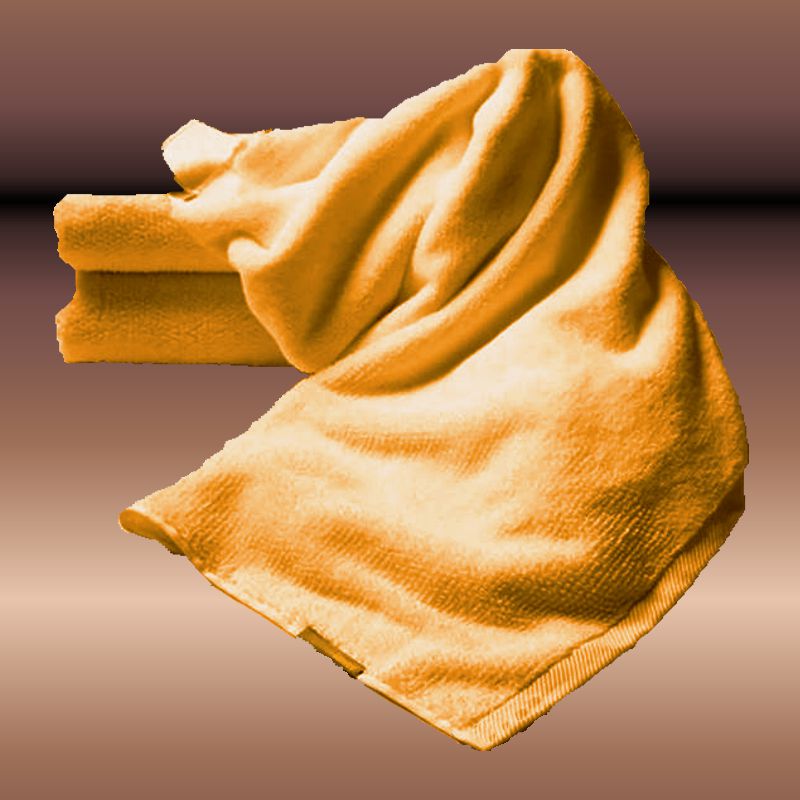
“In economic situations, money is easy to measure — it’s just the price paid — but value is a puzzle. In fact, people say that understanding the linkage between price and value is the central problem of Economics. There’s a huge number of theories out there, with good counter-examples for every one of them. For example, consider the solid gold bath towel.”

“What a stupid idea. Thing like that couldn’t dry you off in the desert.”

“True, but it’s made out of a rare material and some people think rarity makes value. In the right setting it’d be beautiful and there are certainly people who think beauty makes value. A lot of person‑time would be required to create it and some people think labor input is what makes value. The people who think utility makes value would give that towel very low marks. Of course, if you’ve already got plenty of bath towels you’re not about to buy another one so you don’t care.”

“So how do they decide what its price should be?”

“Depends on where you are. Many countries use a supply‑demand auction system that measures value by what people are willing to pay. Planned‑economy countries set prices by government edict. Other countries use a mixed system where the government sets prices for certain commodities like bread and fuel but everything else is subject to haggling. Whatever system’s in use, ‘nominal‘ traffic is the total of all transaction prices and that’s supposed to measure value.”

“Velocity’s supposed to be money supply divided into value flow but we can’t use value so we fake it with money flow?”

“You got it. Then the government tries to manage the money supply so velocity’s in a sweet spot.”

“Sounds rickety.”

“Yup.”

~~ Rich Olcott

Supply, Demand And Friction

<chirp, chirp> “Moire here. Open for business on a reduced schedule.”

“Hiya, Sy. It’s Eddie, taking orders for tonight’s pizza deliveries. My 6:15 wave is full-up, can I schedule you for 6:45? Whaddaya like tonight?”

“Yeah, a little later’s OK, Eddie. Mmmm, I think a stromboli this time. Rolled up like that, it ought to stay hot longer.”

“Good idea. Hey, I been thinking about that ‘velocity of money‘ thing and the forces that change where it goes. Isn’t that just another name for ‘supply and demand’? Bad weather messes up the wheat crop, I gotta pay more for pizza flour, that kinda thing.”

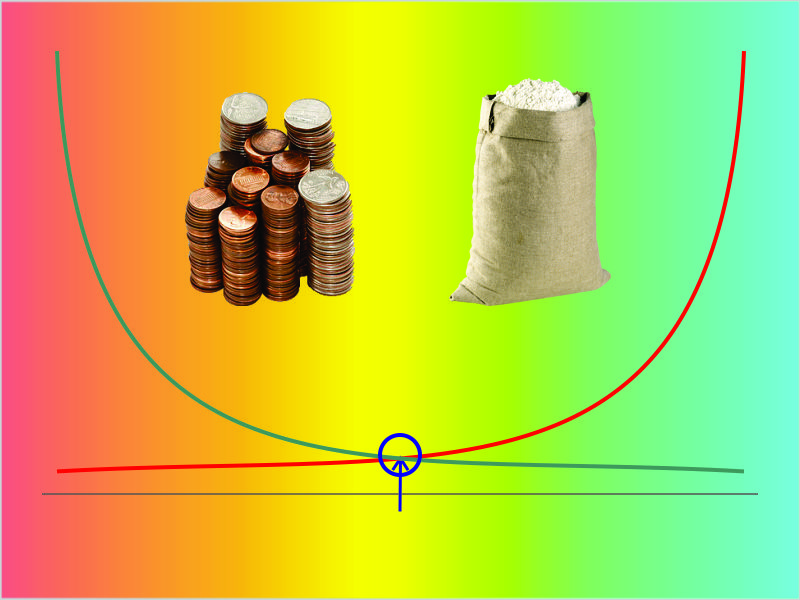
“That’s one of the oldest theories in economics, the idea that low supply increases prices and conversely. Economists often use two hyperbolas to describe the trade-off. Unfortunately, the idea’s only sorta true and only for certain markets. Oh, and it’s only sorta related to how fast money flows through the economy.”

“C’mon, Sy, you’re talking to a professional here. I watch my costs pretty close. Supply-demand tells my story — a bad tomato harvest drives my red sauce price through the roof.”

“No question it works for some products where there’s many independent buyers, many independent sellers, everyone has the same information, and a few other technical only-ifs. It’s what they call a perfect market. How many different companies do you buy flour from?”

“Three or four in town here. I switch around. Keeps ’em on their toes and holds their price down.”

“Competition’s a good thing, right? No buyer pays more than they absolutely must and no seller takes less than their competition does. Negative feedback all over the place. If one vendor figures out an advantage and can make money selling the same stuff for a lower price, everyone else copies them and the market price settles into a new lower equilibrium and there’s no advantage any more.”

“Yeah, that’s the way it works for flour.”

“And a few other commodities like grains and metals and West Texas crude. Economic theorists love the perfect-market model because it sets prices so nicely. Physicists love ideal cases, too — frictionless pulleys on infinitely sharp pivots, that kind of thing, where you can ignore the practical details. Most markets have lots of practical considerations that gum up the works.”

“Devil’s in the details, huh?”

“Sure. I seem to recall you’ve got a favorite sausage supplier.”

“Yeah, my brother-in-law Joey. OK, he’s family, but he does good work — fresh meat ground exactly the way I want it, got a good nose for spices, dependable delivery, what’s not to like?”

“Is he more expensive?””

“A little, a little, but it’s worth it.”

“So hereabouts there’s an imperfect market for sausage. The economists might tally Joey’s extra profit from that premium price to an accounting column labeled ‘Goodwill.’ A physicist would have another name for it.”

“Goodwill. Joey’d like that. So what would the physicist call it?”

“Real mechanical systems are never perfectly energy‑efficient. Energy is always lost to friction. In my money‑physics framework money’s lost to friction. It’s the reason you pay a premium above what would be perfect‑market price for sausage. Nothing wrong with that so long as you know you’re doing it and why. Most real markets are loaded with friction of various sorts. Think of market regulators as mechanics, running around with oil cans as they reduce inefficiency and friction.”

“What other frictions … lemme think. Monopoly, for sure — some big chain takes over my market, drives me the rest of the way out of business and then they can charge whatever they want. Umm … collusion, either direction. Advertising, maybe, but that’s mostly legal.”

“You got the idea. So, how is business?”

“Are you kidding? Way off. I had to lay off people, now it’s just me baking and delivering.”

“Would you buy flour these days at the usual price?”

“Nah. At the rate things are going what I got will last me for a l‑o‑o‑n‑g time. I got no place to put any more.”

“Your customers aren’t buying, you’re not buying, money’s not changing hands. The velocity of money’s so low that supply-demand isn’t capable of setting price. That’s deflation, not market friction.”

“Either way, it hurts.”

~~ Rich Olcott

Memories: The Corners of Your Mind

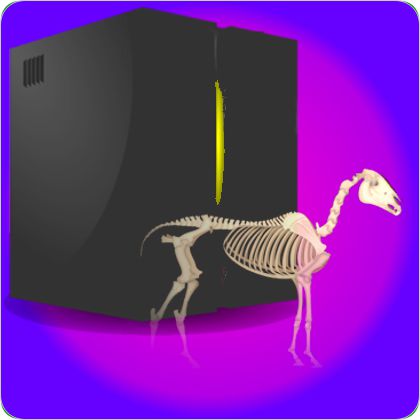
Vinnie doesn’t let go of a question. “OK, Robert, I got that a computer’s internal network is sorta like a horse’s sinews, tying muscle and bone together. An’ I got that a computer’s processors of whichever kind are like a horse’s muscles. But what does for a computer what bones do for a horse?”

“The ‘bones’ are a bit of a stretch, Vinnie. Data’s one possibility, memory or storage is the other one.”

Vinnie takes the bait. “Horse muscles move horse bones. The processors move data, so data’s got to be the bones.”

For the sake of argument, I come back. “But when the electricity turns off, the data goes away, right? Memory’s still there, so memory must be the bones. Or is it storage? What’s the difference between memory and storage?”

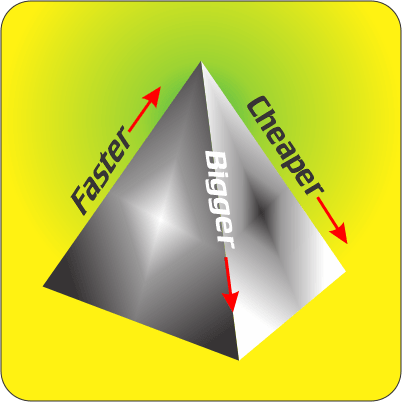
“You’ve put your finger on it, Sy — persistence. If the data’s retained when the power’s off, like on a hard drive, it’s in storage. Otherwise it’s in memory. Setting aside power glitches, of course — a bad glitch can even kill some kinds of storage and the data it’s holding, which is one reason for doing backups. As a general rule, memory is smaller, more expensive and much faster than storage so there’s a trade-off. If you want a lot of speed, load up on fast memory but it’ll cost you cash and resilience.”

“I’ll bet that’s where your special skills come in handy, right, Robert?”

“Pretty much, Vinnie. The trick is to get the right data into the right kind of memory at the right time.”

“The right kind…?”

“Ohhhyeah, there’s a whole hierarchy out there — on-chip memory essentially inside the processor, on-board memory on separate chips, off-board memory and storage…. It goes on all the way out to The Cloud if you’re set up that way. There’s even special memory for keeping track of which data is where in the other memories. The internal network plays into it, too — the data bus to a given memory could be just a byte wide or many times fatter, which makes a big difference in access speed. The hardware takes care of some data placement automatically, but a lot of it we can affect with the software. That’s mostly where I come in.”

Horse skeleton from Wikimedia Commons by CC license

“Doin’ what? The hardware’s pretty much what your boss already bought, not much you can tinker with there. The bits are zoomin’ around inside at electronic speeds, you can’t pick and choose where to put ’em.”

“Yes, we can, if we’re smart and careful. You know Michael Corleone’s line, ‘Keep your friends close but your enemies closer‘? With us it’s ‘Keep your next data byte close but your next program instruction closer.'”

The Memory Pyramid

“Whuzzat mean?”

“What you want to do is have bytes ready for the processor as soon as it’s ready to work with them. That means predicting which bytes it’ll want next and getting those to the top of the memory pyramid. Programs do a lot of short loops, enough that standard architectures have separate instruction memories just for that.”

“So how do you do that predicting? Like Vinnie said, things move fast in there.”

“You design for patterns. My favorite is sequential-and-discard. When you’re watching a movie you look at frames in series and you rarely go back. In the computer we deliver sequential bytes in an orderly manner to fast memory but we don’t have to worry about storing them back out again. Easy-peasy. Sequential-and-store is also highly predictable but then you have to down-copy, too.”

“Yeah, either way the data just flows through. What others?”

Periodic is useful if you can arrange your program and data to exploit it. If you know a just-used series of bytes are going to be relevant again soon, you try to reserve enough close-in memory to hold onto them. Data references tend to spread out but sometimes you can tilt the odds by clumping together related bytes that are likely to be used together — like all weather data for one location.”

“What if you don’t have any of those patterns?”

“Worst case scenario. You guess periodic, buy lots of memory and cross your fingers.”

~~ Rich Olcott

A Wheel in A Wheel

The conversation’s gotten a little dry so I carry our mugs over to Al’s coffee tap for refills. Vinnie’s closest so he gets the first one. “Thanks, Sy. So you say that a black hole has all these other things on the outside — the photon sphere and that weird belt if it’s rotating and the accretion disk and the jets which is what I asked about in the first place.”

Astrophysicist-in-training Newt Barnes gets the second mug. “My point, Vinnie, is they all act together. You can’t look at just one thing. Thanks, Sy. You know, you should’ve paid more attention to the ergosphere.”

“Ergosphere?”

“Yeah, Vinnie, that pumpkin-shaped layer Sy described — actually, more a pumpkin shell. The event horizon and photon sphere take up space inside of it and the accretion disk’s inner edge grazes its equator. The pumpkin is fatter for a more rapidly rotating black hole, but its boundary still dips down to meet the event horizon at the rotational poles. Diagrams usually show it just sitting there but that’s not quite true.”

“It wobbles?”

“No, the shape stays in place, locked to the event horizon just like the diagrams show. What’s inside it, though, is moving like mad. That’s what we’d see from a far-away frame, anyhow.”

Frames again, I knew it. The pumpkin’s got frames?”

“With extreme-gravity situations it’s always frames, Vinnie. The core’s gravity pulls in particles from the accumulation disk. They think they’re going straight. From an outsider’s perspective everything swerves spinwise at the ergosphere’s boundary. Even if a high-speed particle had been aimed in the other direction, it’s going spinwise once it’s inside the ergosphere.”

“Who’s making it do that?”

“Frame-dragging on steroids. We’ve known for a century that gravity from any massive body compresses the local space. ‘Kilometers are shorter near a black hole,’ as the saying goes. If the body is rotating, that counts too, at least locally — space itself joins the spin. NASA’s Gravity B probe detected micromicrodegree-level frame rotation around Earth. The ergosphere, though, has space is twisted so far that the direction of time points spinwise in the same way that it points inwards within the event horizon. Everything has to travel along time’s arrow, no argument.”

“You said ‘local‘ twice there. How far does this spread?”

“Ah, that’s an important question. The answer’s ‘Not as far as you think.’ Everything scales with the event horizon’s diameter and that scales with the mass. If the Sun were a non-rotating black hole, for instance, its event horizon would be only about 6 kilometers across, less than 4 miles. Its photon sphere would be 4.5 kilometers out from the center and the inner edge of its accretion disk would be a bit beyond that. Space compression dies out pretty quick on the astronomical scale — only a millionth of the way out to the orbit of Mercury the effect’s down to just 3% of its strength at the photosphere.”

“How about if it’s rotating?”

“The frame-dragging effect dies out even faster, with the cube of the distance. At the same one-millionth of Mercury’s orbit, the twist-in-space factor is 0.03% of what it is at the photosphere. At planet-orbit distances spin’s a non-player. However, in the theory I’m researching, spin’s influence may go much further.”

“Why’s that?”

“Seen from an outside frame, what’s inside the ergosphere rotates really fast. Remember that stuff coming in from the accretion disk’s particle grinder? It ought to be pretty thoroughly ionized, just a plasma of negative electrons and positive particles like protons and atomic nuclei. The electrons are thousands of times lighter than the positive stuff. Maybe the electrons settle into a different orbit from the positive particles.”

“Further in or further out?”

“Dunno, I’m still calculating. Either way, from the outside it’d look like two oppositely-charged disks, spinning in the same direction. We’ve known since Ørsted that magnetism comes from a rotating charge. Seems to me the ergosphere’s contents would generate two layers of magnetism with opposite polarities. I think what keeps the jets confined so tightly is a pair of concentric cylindrical magnetic fields extruded from the ergosphere. But it’s going to take a lot of math to see if the idea holds water.”

“Or jets.”

~~ Rich Olcott

The Jet and The Plane

“OK, Sy, I get your point about a black hole being more than a mystical event horizon hiding whatever’s inside it. I’ll give you it’s a structure with a trapped-light shell and a pumpkin-donut belt around that –“

“… if it’s rotating, Vinnie…”

“– if it’s rotating, but what does all that have to do with those huge jets coming out of the poles instead of the equator where they belong?”

Suddenly Newt Barnes, astrophysicist in training, is standing by our table. “You guys are talking my research topic, just the hottest thing in astrophysics these days. Those jets were the subject of over a thousand papers last year. Mind if I sit in?”

“Of course not.” “We’re all ears.”

“Well, there’s a couple more layers to peel before we can make a maybe connection. Vinnie, what’s the weirdest thing about those jets?”

“Like I said, they’re huge — millions of lightyears long.”

“True, but other structures are huge, too — galaxy superclusters, for instance. The real weirdness is how narrow the jets are — less than a degree wide, and they’ve maintained that tight geometry while they’ve grown for millions of years. We still don’t know what’s in a jet. If it’s a beam of charged particles you’d think they’d repel each other and spread out almost immediately. If the particles are uncharged they’d bang into each other and into the prevailing interstellar medium. Random collisions would spread the beam out maybe a little slower than a charged-particle beam but still. A photon beam would be more stable but you’d need a really good collimating mechanism at the jet’s base to get the waves all marching so precisely.”

“What’s left, dark matter?”

“Almost certainly not. Many jets emit huge quantities of electromagnetic radiation at all frequencies from radio up through X-rays and beyond. Dark matter doesn’t do electromagnetism. No, jets are somehow created from normal stuff. The question is, how is it kept under such tight control?”

“The other question is, where’s all that stuff coming from if nothing can escape outta the event horizon?”

“Ah, that has to do with yet another part of the structure — the accretion disk.”

“What they got that orange picture of, right? Big ring like Saturn’s.”

“Well, similar shape, but different origin, different composition and very different dynamics. Saturn’s rings are mostly water-ice, built up from the debris of ice-moons that collided or were pulled apart by tidal forces. A black hole’s accretion disk is made up of planets, dust particles, atoms, whatever junk was unfortunate enough to be too close when the black hole passed by. Pick any incoming object and call it Freddie. Unless Freddie and the event horizon’s core are on an exact collision course, Freddie gets swept up by the disk.”

“Then what happens?”

“Freddie collides with something already in the disk. Lots of somethings. Each collision does two things. One, Freddie and the something break into smaller pieces. Two, some of Freddie’s gravitational potential energy relative to the core is converted to heat, making the collision debris package hotter than Freddie and the something were to begin with. After a while, Freddie gets ground down to atoms or smaller and they’re all really hot, radiating intensely just like Planck and Einstein said they would.”

“So we got a ring like Saturn’s, like I said.”

“Only sort of. Saturn has half-a-dozen distinct rings. They shine by reflected sunlight, the middle ring is brightest and broadest, and the innermost ring is dark and skinny. Our only direct accretion disk image so far is a one blurry view, but the object shines with its own light and in theory the disk isn’t segmented. There should be just one ring and it’d be brightest at a sharp inner edge.”

“Why’s that?”

“The light’s produced by hot particles. Heat generation’s most intense where the gravity well is steepest. That’s nearest the core. For a non-spinning black hole the threshold is one-sixth of the horizon’s diameter. If Freddie gets knocked the slightest bit closer than that it’s doomed to fall the rest of the way in. The edge is closer-in if the hole’s rotating but then Freddie has an interesting time. Relatively.”

“Gonna be frames again, right?”

“Yeah.”

~~ Rich Olcott

Beyond The Shadow of A…?

“Alright, Vinnie, what’s the rest of it?”

“The rest of what, Sy?”

“You wouldn’t have hauled that kid’s toy into Al’s shop here just to play spitballs with it. You’re building up to something and what is it?”

“My black hole hobby, Sy. The things’re just a few miles wide but pack more mass than the Sun. A couple of my magazines say they give off jets top and bottom because of how they spin. That just don’t fit. The stuff ought to come straight out to the sides like the paper wads did.”

“Well, umm… Ah. You know the planet Saturn.”

“Sure.”

“Are its rings part of the planet?”

“No, of course not, they go around it. I even seen an article about how the rings probably came from a couple of collided moons and how water from the Enceladus moon may be part of the outside ring. Only thing Saturn does for the rings is supply gravity to keep ’em there.”

“But our eyes see planet and rings together as a single dot of light in the sky. As far as the rest of the Solar System cares, Saturn consists of that big cloudy ball of hydrogen and the rings and all 82 of its moons, so far. Once you get a few light-seconds away, the whole collection acts as a simple point-source of gravitational attraction.”

“I see where you’re going. You’re gonna say a black hole’s more than just its event horizon and whatever it’s hiding inside there.”

“Yup. That ‘few miles wide’ — I could make a case that you’re off by trillions. A black hole’s a complicated beast when we look at it close up.”

“How can you look at a thing like that close up?”

“Math, mostly, but the observations are getting better. Have you seen the Event Horizon Telescope’s orange ring picture?”

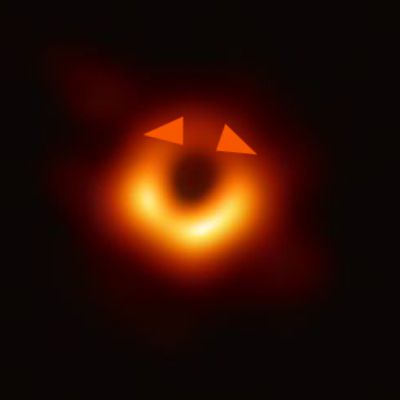
“You mean the one that Al messed with and posted for Hallowe’en? It’s over there behind his cash register. What’s it about, anyway?”

“It’s an image of M87*, the super-massive black hole at the center of the M87 galaxy. Not the event horizon itself, of course, that’s black. The orange portion actually represents millimeter-radio waves that escape from the accretion disk circling the event horizon. The innermost part of the disk is rotating around the hole at near-lightspeed. The arc at the bottom is brighter because that’s the part coming toward us. The photons get a little extra boost from Special Relativity.”

Frames again?”

“With black holes it’s always frames. You’ll love this. From the shell’s perspective, it spits out the same number of photons per second in every direction. From our perspective, time is stretched on the side rotating away from us so there’s fewer photons per one of our seconds and it’s dimmer. In the same amount of our time the side coming toward us emits more photons so it’s brighter. Neat demonstration, eh?”

“Cute. So the inner black part’s the hole ’cause it can’t give off light, right?”

“Not quite. That’s a shadow. Not a shadow of the event horizon itself, mind you, but of the photon sphere. That’s a shell about 1½ times the width of the event horizon. Any photon that passes exactly tangent to the sphere is doomed to orbit there forever. If the photon’s path is the slightest bit inward from that, the poor particle heads inward towards whatever’s in the center. The remaining photons travel paths that look bent to a distant observer, but the point is that they keep going and eventually someone like us could see them.”

“The shadow and the accretion disk, that’s what the EHT saw?”

“Not exactly.”

“There’s more?”

“Yeah. M87* is a spinning black hole, which is more complicated than one that’s sitting still. Wrapped around the photon sphere there’s an ergosphere, as much as three times wider than the event horizon except it’s pumpkin-shaped. The ergosphere’s widest at the rotational equator, but it closes in to meet the event horizon at the two poles. Anything bigger than a photon that crosses its boundary is condemned to join the spin parade, forever rotating in sync with the object’s spin.”

“When are you gonna get to the jets, Sy?”

~~ Rich Olcott

The Top Choice

Al grabs me as I step into his coffee shop. “Sy, ya gotta stop Vinnie, he’s using up paper napkins again, and he’s making a mess!”

Sure enough, there’s Vinnie at his usual table by the door. He’s got a kid’s top, a big one, spinning on a little stand. He’s methodically dropping crumpled-up paper wads onto it and watching them fly off onto the floor. “Hey, Vinnie, what’s the project?”

“Hi, Sy. I’m trying to figure how come these paper balls are doing a circle but when they fly off they always go in a straight line, at least at first. They got going-around momentum, right, so how come they don’t make a spiral like stars in a galaxy?”

Astronomy professor Cathleen’s standing in the scone line. She never misses an opportunity to correct a misconception. “Galaxy stars don’t spray out of the center in a spiral, Vinnie. Like planets going around a star, stars generally follow elliptical orbits around the galactic center. A star that’s between spiral arms now could be buried in one ten million years from now. The spiral arms appear because of how the orbits work. One theory is that the innermost star orbits rotate their ellipse axes more quickly than the outer ones and the spirals form where the ellipses pile up. Other theories have to do with increased star formation or increased gravitational attraction within the pile-up regions. Probably all three contribute to the structures. Anyhow, spirals don’t form from the center outward.”

My cue for some physics. “What happens in a galaxy is controlled by gravity, Vinnie, and gravity doesn’t enter into what you’re doing. Except for all that paper falling onto Al’s floor. There’s no in-plane gravitational or electromagnetic attraction in play when your paper wads leave the toy. Newton would say there’s no force acting to make them follow anything other than straight lines once they break free.”

“What about momentum? They’ve got going-around momentum, right, shouldn’t that keep them moving spirally?”

I haul out Old Reliable for a diagram. “Thing is, your ‘going-around momentum,’ also known as ‘angular momentum,’ doesn’t exist. Calm down, Vinnie, I mean it’s a ‘fictitious force‘ that depends on how you look at it.”

“Is this gonna be frames again?”

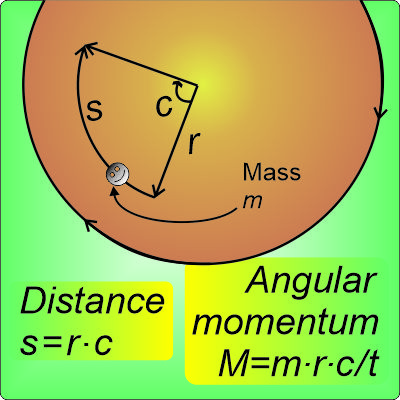
“Yup. Frames are one of our most important analytical tools in Physics. Here’s your toy and just for grins I’ve got it going around counterclockwise. That little white circle is one of your paper wads. In the room’s frame that wad in its path is constantly converting linear momentum between the x-direction and the y-direction, right?”

“East-West to North-South and back, yeah, I get that.”

“Such a mess to calculate. Let’s make it easier. Switch to the perspective of a frame locked to the toy. In that frame the wad can move in two directions. It can fly away along the radial direction I’ve called r, or it can ride along sideways in the s-direction.”

“So why hasn’t it flown away?”

“Because you put some spit on it to make it stick — don’t deny it, I saw you. While it’s stuck, does it travel in the r direction?”

“Nope, only in the s direction. Which should make it spiral like I said.”

“I’m not done yet. One of Newton’s major innovations was the idea of infinitesimal changes, also known as little-bits. The s-direction is straight, not curved, but it shifts around little-bit by little-bit as the top rotates. Newton’s Laws say force is required to alter momentum. What force influences the wad’s s-momentum?”

“Umm … that line you’ve marked c.”

“Which is the your spit’s adhesive force between the paper and the top. The wad stays stuck until the spit dries out and no more adhesion so no more c-force. Then what happens?”

“It flies off.”

“In which direction?”

“Huh! In the r-direction.”

“And in a straight line, just like Newton said. What you called ‘going-around momentum’ becomes ‘radial momentum’ and there’s no spiraling, right?”

“I guess you’re right, but I miss spirals.”

Al comes over with a broom. “Now that’s settled, Vinnie, clean up!”

~~ Rich Olcott

  • Thanks for the question, Jen Keeler. Stay tuned.

Fly High, Silver Bird

“TANSTAAFL!” Vinnie’s still unhappy with spacecraft that aren’t rocket-powered. “There Ain’t No Such Thing As A Free Lunch!”

“Ah, good, you’ve read Heinlein. So what’s your problem with Lightsail 2?”

“It can’t work, Sy. Mostly it can’t work. Sails operate fine where there’s air and wind, but there’s none of that in space, just solar wind which if I remember right is just barely not a vacuum.”

Astronomer-in-training Jim speaks up. “You’re right about that, Vinnie. The solar wind’s fast, on the order of a million miles per hour, but it’s only about 10-14 atmospheres. That thin, it’s probably not a significant power source for your sailcraft, Al.”

“I keep telling you folks, it’s not wind-powered, it’s light-powered. There’s oodles of sunlight photons out there!”

“Sure, Al, but photons got zero mass. No mass, no momentum, right?”

Plane-polarized electromagnetic wave in motion
Plane-polarized electromagnetic wave
Electric (E) field is red
Magnetic (B) field is blue
(Image by Loo Kang Wee and Fu-Kwun Hwang from Wikimedia Commons)

My cue to enter. “Not right, Vinnie. Experimental demonstrations going back more than a century show light exerting pressure. That implies non-zero momentum. On the theory side … you remember when we talked about light waves and the right-hand rule?”

“That was a long time ago, Sy. Remind me.”

“… Ah, I still have the diagram on Old Reliable. See here? The light wave is coming out of the screen and its electric field moves electrons vertically. Meanwhile, the magnetic field perpendicular to the electric field twists moving charges to scoot them along a helical path. So there’s your momentum, in the interaction between the two fields. The wave’s combined action delivers force to whatever it hits, giving it momentum in the wave’s direction of travel. No photons in this picture.”

Astrophysicist-in-training Newt Barnes dives in. “When you think photons and electrons, Vinnie, think Einstein. His Nobel prize was for his explanation of the photoelectric effect. Think about some really high-speed particle flying through space. I’m watching it from Earth and you’re watching it from a spaceship moving along with it so we’ve each got our own frame of reference.”

“Frames, awright! Sy and me, we’ve talked about them a lot. When you say ‘high-speed’ you’re talking near light-speed, right?”

“Of course, because that’s when relativity gets significant. If we each measure the particle’s speed, do we get the same answer?”

“Nope, because you on Earth would see me and the particle moving through compressed space and dilated time so the speed I’d measure would be more than the speed you’d measure.”

“Mm-hm. And using ENewton=mv² you’d assign it a larger energy than I would. We need a relativistic version of Newton’s formula. Einstein said that rest mass is what it is, independent of the observer’s frame, and we should calculate energy from EEinstein²=(pc)²+(mc²)², where p is the momentum. If the momentum is zero because the velocity is zero, we get the familiar EEinstein=mc² equation.”

“I see where you’re going, Newt. If you got no mass OR energy then you got nothing at all. But if something’s got zero mass but non-zero energy like a photon does, then it’s got to have momentum from p=EEinstein/c.”

“You got it, Vinnie. So either way you look at it, wave or particle, light carries momentum and can power Lightsail 2.”

Lightsail 2 flying over Earth, against a yellow background
Adapted from image by Josh Spradling / The Planetary Society

“Question is, can sunlight give it enough momentum to get anywhere?”

“Now you’re getting quantitative. Sy, start up Old Reliable again.”

“OK, Newt, now what?”

“How much power can Lightsail 2 harvest from the Sun? That’ll be the solar constant in joules per second per square meter, times the sail’s area, 32 square meters, times a 90% efficiency factor.”

“Got it — 39.2 kilojoules per second.”

“That’s the supply, now for the demand. Lightsail 2 masses 5 kilograms and starts at 720 kilometers up. Ask Old Reliable to use the standard circular orbit equations to see how long it would take to harvest enough energy to raise the craft to another orbit 200 kilometers higher.”

“Combining potential and kinetic energies, I get 3.85 megajoules between orbits. That’s only 98 seconds-worth. I’m ignoring atmospheric drag and such, but net-net, Lightsail 2‘s got joules to burn.”

“Case closed, Vinnie.”

~~ Rich Olcott

Dark Shadows

Change-me Charlie’s still badgering Astronomer-in-training Jim and Physicist-in-training Newt about “Dark Stuff,” though he’s switched his target from dark matter to dark energy. “OK, the expansion of the Universe is speeding up. How does dark energy do that?”

Jim steps up to bat. “At this point dark energy’s just a name. We frankly have no idea what the name represents, although it seems appropriate.”

“Why’s that?”

“Gravity pulls things together, right, and we have evidence that galaxies are flying away from each other. When you pick something up your muscles give it gravitational potential energy that becomes kinetic energy when you let go and it drops. In space, a galaxy moving away from its neighbors gains gravitational potential energy relative to them. If the Energy Conservation Law holds, that energy has to come from somewhere. ‘Dark energy’ is what we call the somewhere, but naming something and understanding it are two different things.”

Newt chips in. “Einstein came at it from a different direction. His General Relativity field equations contained two numbers for observation to fill in — G, Newton’s gravitational constant, and lambda (Λ), which we now call the Cosmological Constant. Lambda measures the energy density of empty space. The equations say the balance between lambda and gravity controls whether the Universe expands, contracts or stays static. Lambda‘s just a little bit positive so the universe is expanding.”

“Same conclusion, different name. Neither one says where the energy comes from.”

That’s my cue. “True, but Einstein’s work goes deeper. Newtonian physics maps the Universe onto a stable grid of straight lines. In General Relativity those lines are deformed and twisted under the influence of massive objects. Vinnie and I talked about how gravity’s a fictitious force arising from that deformation. Like John Wheeler said, ‘Mass tells space-time how to curve, and space-time tells mass how to move.’ Anyway, when you throw dark energy’s lambda into the mix, the grid lines themselves go into motion. Dark energy torques the spacetime fabric that pulls galaxies together.”

“So dark energy pulls things apart by spreading out the grid they’re built on? If that’s so how come I’m still in one piece?”

“Nothing personal, but you’re too small and dense to notice. So am I, so is the Earth.”

“Why should that make a difference?”

“Time for a thought experiment. Think of the Sun. The atoms inside its surface are trying to get out, right? What’s holding them in?”

“The Sun’s gravity.”

“Just like pressure on the skin of a balloon. In either case, as long as things are stable the pressure on an enclosing real or mathematical surface rises and falls with the amount of enclosed energy density and it doesn’t matter which we talk about. Energy density’s easier to think about. With me so far?”

“I guess.”

“Let’s run a few horseback numbers on Old Reliable here. Start with protons and neutrons trying to leave an atomic nucleus. Here’s the total binding energy of an iron-56 nucleus divided by its volume…”

“… so the nuclear particles would fly apart except for the inward pressure exerted by the nuclear forces. Now we’ll go up a level and consider electrons trying to leave a helium atom. They’re held in by the electromagnetic force…”

“Still a lot of inward pressure but less than nuclear by fifty-five powers of ten. Gravity next. That’s what keeps us from flying off into space. I’ll use Earth’s escape velocity to cheat-quantify it…”

“Ten billion times weaker than the electromagnetism that holds our atoms and molecules together. Dark energy’s mass density is estimated to be about 10-27 kilograms per cubic meter. I’ll use that and Einstein’s E=mc2to calculate its pull-us-apart pressure.”

“A quintillion times weaker still.”

“So what you’re saying is, dark energy tries to pull everything apart by stretching out that spacetime grid, but it’s too weak to actually do anything to stuff that’s held together by gravity, electromagnetism or the two nuclear forces.”

“Mostly. Nuclear forces are short-range so distance doesn’t matter. Gravity and electromagnetism get weaker with the square of the distance. Dark energy only gets competitive working on objects that are separated much further than even neighboring galaxies. You’re not gonna get pulled apart.”

~~ Rich Olcott