Deep Symmetry

“Sy, I can understand mathematicians getting seriously into symmetry. They love patterns and I suppose they’ve even found patterns in the patterns.”

“They have, Anne. There’s a whole field called ‘Group Theory‘ devoted to classifying symmetries and then classifying the classifications. The split between discrete and continuous varieties is just the first step.”

“You say ‘symmetry‘ like it’s a thing rather than a quality.”

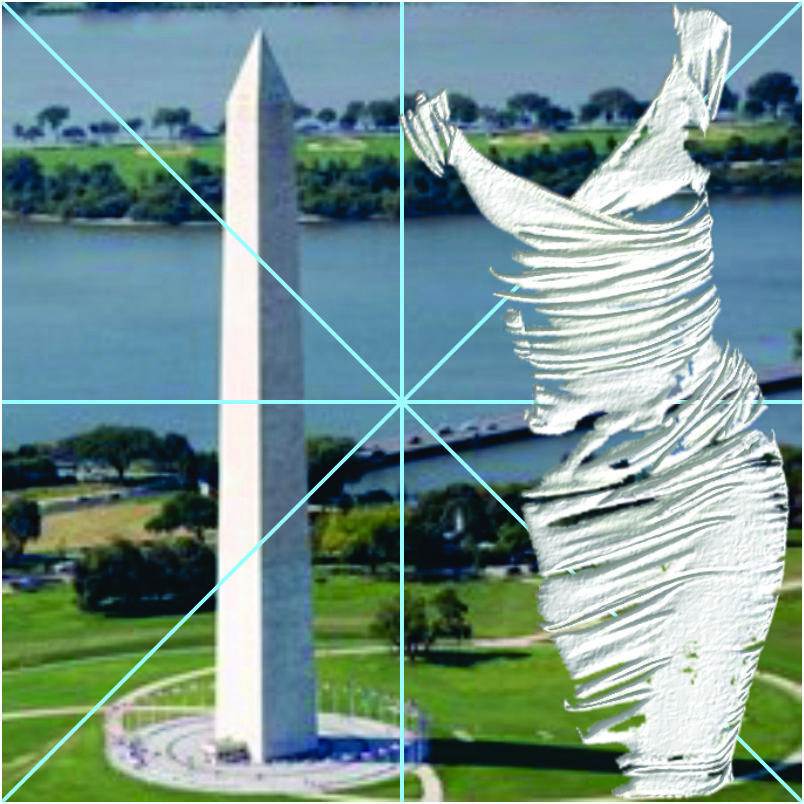
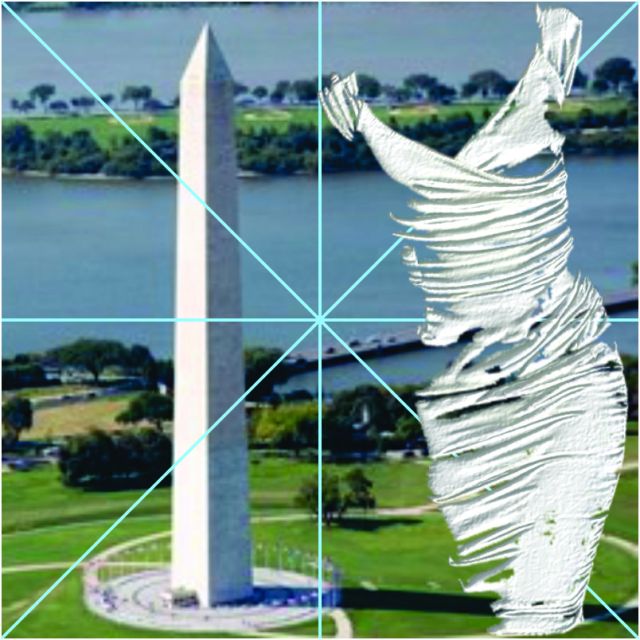
“Nice observation. In this context, it is. Something may be symmetrical, that’s a quality. Or it may be subject to a symmetry operation, say a reflection across its midline. Or it may be subject to a whole collection of operations that match the operations of some other object, say a square. In that case we say our object has the symmetry of a square. It turns out that there’s a limited number of discrete symmetries, few enough that they’ve been given names. Squares, for instance, have D4 symmetry. So do four-leaf clovers and the Washington Monument.”

“OK, the ‘4’ must be in there because you can turn it four times and each time it looks the same. What’s the ‘D‘ about?”

Dihedral, two‑sided, like two appearances on either side of a reflection. That’s opposed to ‘C‘ which comes from ‘Cyclic’ like 1‑2‑3‑4‑1‑2‑3‑4. My lawn sprinkler has C4 symmetry, no mirrors, but add one mirror and bang! you’ve got eight mirrors and D4 symmetry.”

“Eight, not just four?”

“Eight. Two mirrors at 90° generate another one 45° between them. That’s the thing with symmetry operations, they combine and multiply. That’s also why there’s a limited number of symmetries. You think you’ve got a new one but when you work out all the relationships it turns out to be an old one looked at from a different angle. Cubes, for instance — who knew they have a three‑fold rotation axis along each body diagonal, but they do.”

“I guess symmetry can make physics calculations simpler because you only have to do one symmetric piece and then spread the results around. But other than that, why do the physicists care?”

“Actually they don’t care much about most of the discrete symmetries but they care a whole lot about the continuous kind. A century ago, a young German mathematician named Emmy Noether proved that within certain restrictions, every continuous symmetry comes along with a conserved quantity. That proof suddenly tied together a bunch of Physics specialties that had grown up separately — cosmology, relativity, thermodynamics, electromagnetism, optics, classical Newtonian mechanics, fluid mechanics, nuclear physics, even string theory—”

“Very large to very small, I get that, but how can one theory have that range? And what’s a conserved quantity?”

“It’s theorem, not theory, and it capped two centuries of theoretical development. Conserved quantities are properties that don’t change while a system evolves from one state to another. Newton’s First Law of Motion was about linear momentum as a conserved quantity. His Second Law, F=ma, connected force with momentum change, letting us understand how a straight‑line system evolves with time. F=ma was our first Equation of Motion. It was a short step from there to rotational motion where we found a second conserved quantity, angular momentum, and an Equation of Motion that had exactly the same form as Newton’s first one, once you converted from linear to angular coordinates.”
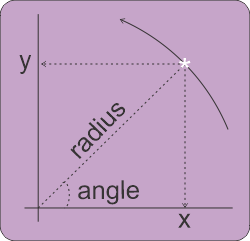
“Converting from x-y to radius-angle, I take it.”

“Exactly, Anne, with torque serving as F. That generalization was the first of many as physicists learned how to choose the right generalized coordinates for a given system and an appropriate property to serve as the momentum. The amazing thing was that so many phenomena follow very similar Equations of Motion — at a fundamental level, photons and galaxies obey the same mathematics. Different details but the same form, like a snowflake rotated by 60 degrees.”

“Ooo, lovely, a really deep symmetry!”

“Mm-hm, and that’s where Noether came in. She showed that for a large class of important systems, smooth continuous symmetry along some coordinate necessarily entails a conserved quantity. Space‑shift symmetry implies conservation of momentum, time‑shift symmetry implies conservation of energy, other symmetries lock in a collection of subatomic quantities.”

“Symmetry explains a lot, mm-hm.”
~~ Rich Olcott
The Relativity Factor

“Sy, it’s nice that Einstein agreed with Rayleigh’s wave theory stuff but why’d you even drag him in? I thought the faster‑than‑light thing was settled.”

“Vinnie, faster‑than‑light wasn’t even an issue until Einstein came along. Science had known lightspeed was fast but not infinite since Rømer measured it in Newton’s day. ‘Pretty fast,’ they said, but Newtonian mechanics is perfectly happy with any speed you like. Then along came Einstein.”

“Speed cop, was he?”

“Funny, Vinnie. No, Einstein showed that the Universe enforces the lightspeed limit. It’s central to how the Universe works. Come to think of it, the crucial equation had been around for two decades, but it took Einstein to recognize its significance.”

“Ah, geez, equations again.”

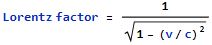
“Just this one and it’s simple. It’s all about comparing v for velocity which is how fast something’s going, to c the speed of light. Nothing mystical about the arithmetic — if you’re going half the speed of light, the factor works out to 1.16. Ninety‑nine percent of c gives you 7.09. Tack on another 9 and you’re up to 22.37 and so on.”

“You got those numbers memorized?”

“Mm-hm, they come in handy sometimes.”

“Handy how? What earthly use is it? Nothing around here goes near that fast.”

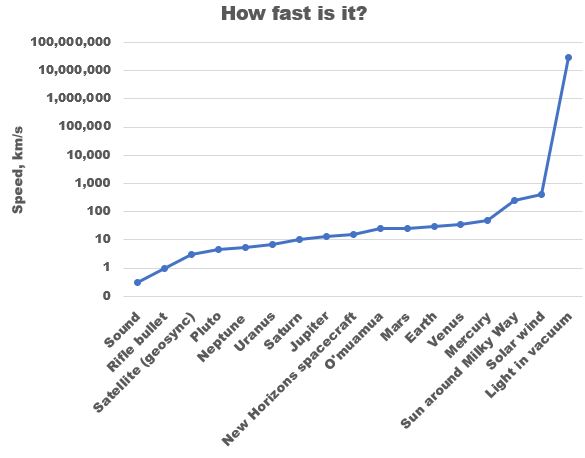
“Do you like your GPS? It’d be useless if the Lorentz factor weren’t included in the calculations. The satellites that send us their sync signals have an orbit about 84 000 kilometers wide. They run that circle once a sidereal day, just shy of 86 400 seconds. That works out to 3 kilometers per second and a Lorentz factor of 1.000 005.”

“Yeah, so? That’s pretty close to 1.0.”

“It’s off by 5 parts per million. Five parts per million of Earth’s 25 000-mile circumference is an eighth of a mile. Would you be happy if your GPS directed you to somewhere a block away from your address?”

“Depends on why I’m going there, but I get your point. So where else does this factor come into play?”

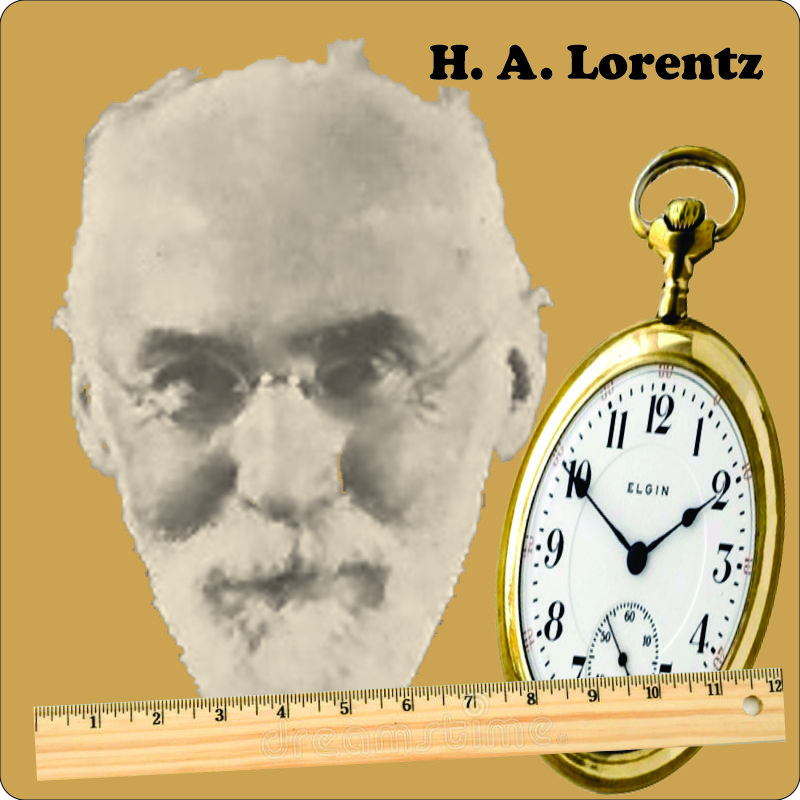
“Practically anywhere that involves a precision measurement of length or duration. It’s at the core of Einstein’s Special Relativity work. He thought about observing a distant moving object. It’s carrying a clock and a ruler pointed along the direction of motion. The observer would see ticks of the clock get further apart by the Lorentz factor, that’s time dilation. Meanwhile, they’d see the ruler shrink by the factor’s inverse, that’s space compression.”

“What’s this ‘distant observer‘ business?”

“It’s less to do with distance than with inertial frames. If you’re riding one inertial frame with a GPS satellite, you and your clock stay nicely synchronized with the satellite’s signals. You’d measure its 1×1‑meter solar array as a perfect square. Suppose I’m riding a spaceship that’s coasting to Mars. I measure everything relative to my own inertial frame which is different from yours. With my telescope I’d measure your satellite’s solar array as a rectangle, not a square. The side perpendicular to the satellite’s orbit would register the expected 1 meter high, but the side pointing along the orbit would be shorter, 1 meter divided by the Lorentz factor for our velocity difference. Also, our clocks would drift apart by that Lorentz factor.”

“Wait, Sy, there’s something funny about that equation.”

“Oh? What’s funny?”

“What if somebody’s speed gets to c? That’d make the bottom part zero. They didn’t let us do that in school.”

“And they shouldn’t — the answer is infinity. Einstein spotted the same issue but to him it was a feature, not a bug. Take mass, for instance. When they meet Einstein’s famous E=mc² equation most people think of the nuclear energy coming from a stationary lump of uranium. Newton’s F=ma defined mass in terms of a body’s inertia — the greater the mass, the more force needed to achieve a certain amount of acceleration. Einstein recognized that his equation’s ‘E‘ should include energy of motion, the ½mv² kind. He had to adjust ‘m‘ to keep F=ma working properly. The adjustment was to replace inertial mass with ‘relativistic mass,’ calculated as inertial mass times the Lorentz factor. It’d take infinite force to accelerate any relativistic mass up to c. That’s why lightspeed’s the speed limit.”

~~ Rich Olcott
Chasing Rainbows

“C’mon, Sy, Newton gets three cheers for tying numbers to the rainbow’s colors and all that, but what’s it got to do with that three speeds of light thing which is where we started this discussion?”

“Vinnie, they weren’t just numbers, they were angles. The puzzle was why each color was bent to a different degree when entering or leaving the prism. That was an inconvenient truth for Newton.”

“Inconvenient? There’s a loaded word.”

“Indeed. A little context — Newton was in a big brouhaha about whether light was particles or waves. Newton was a particle guy all the way, battling wave theory proponents like Euler and Descartes and their followers on the Continent. Even Hooke in London had a wave theory. Newton’s problem was that his beam deflections happened right at the prism’s air‑glass interfaces.”

“What difference does that … wait, you mean that there’s no bending inside the prism? Light inside still goes straight but in a different direction?”

“That’s it, exactly. The deflection angles are the same, whether the beam hits the prism near the short‑path tip or the long‑path base. No evidence of further deviation inside the prism unless it has bubbles — Newton had to discard or mask off some bad prisms. Explaining the no‑curvature behavior is difficult in a particle framework, easy in a wave framework.”

“Really? I don’t see why.”

Left: faster medium, right: slower medium
Credit: Ulflund, under Creative Commons 1.0

“Suppose light is particles, which by definition are local things affected only by local forces. The medium’s effects on a particle would happen in the bulk material rather than at the interface. The effect would accumulate as the particles travel further through the medium. The bend should be a curve. Unfortunately for Newton, that’s not what his observations showed.”

“OK, scratch particles. Why not scratch waves, too?”

“Waves have no problem with abrupt variation at an interface, They flip immediately to a new stable mode. For example. here’s an animation showing an abrupt speed change at the interface between a fast‑travel medium like air and a slow‑travel medium like glass or water. See how one end of each bar gets slowed down while the other end is still moving at speed? By the time the whole bar is inside, its path has slewed to the refraction angle.”

“Like a car sliding on ice when a rear wheel sticks for an moment, eh Sy?”

“That was not a fun ride, Vinnie.”

“I enjoyed it. Whatever, I get how going air‑to‑glass or vice‑versa can change a beam’s direction. But if everything’s going through the same angle, how do rainbows happen?”

“Everything doesn’t go through the same angle. Frequencies make a difference. Go back to the video and keep your eye on one bar as it sweeps up the interface. See how the sweep’s speed controls the deflection angle?”

“Yeah, if the sweep went slower the beam would get a chance to bend further. Faster sweeps would bend it less. But what could change the sweep speed?

“Two things. One, change the medium to one with a different transmission speed. Two, change the wave itself so it has a different speed. According to Snell’s Law, the important parameter for a pair of media is their ratio of fast‑speed divided by slow‑speed. If the fast medium is a vacuum that ratio is the slow medium’s index of refraction. The greater the index, the greater the bend.”

“Changing the medium doesn’t apply. I got one prism, it’s got one index, but I still get a whole rainbow.”

“Right, rainbows are about how one prism treats a bunch of waves with different time and space frequencies.”

“Space frequency?”

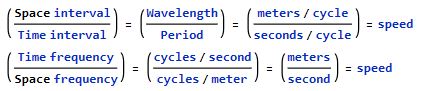
“If you measure a wave in meters it’s cycles per meter.”

“Wavelength upside down. Got it.”

“Whether you figure in frequencies or intervals, the wave speed works out the same.”

“Speed of light, finally.”

“Point is, when a wave goes through any medium, its time frequency doesn’t change but its space frequency does. Interaction with local charge shortens the wavelength. Short‑wavelength blue waves are held back more than long‑wavelength red ones. The different angles make your rainbow. The hold‑back is why refraction indices are usually greater than one.”

“Usually?”

~~ Rich Olcott
Through A Prism Brightly

Familiar footsteps outside my office. “C’mon in, Vinnie, the door’s open.”

“Hi, Sy, gotta minute?”

“Sure, Vinnie, business is slow. What’s up?”

“Business is slow for me, too. I was looking over some of your old posts—”

“That slow, eh?”

“You know it. Anyway, I’m hung up on that video where light’s got two different speeds.”

“Three, really.”

“That’s even worse. What’s the story?”

“Well, first thing, it depends on where the light is. If you’re out in the vacuum, far away from atoms, they’re all the same, c. Simple.”

“Matter messes things up, then.”

“Of course. Our familiar kind of matter, anyway, made of charges like quarks and electrons. Light’s whole job is to interact with charges. When it does, things happen.”

“Sure — photon bangs into a rock, it stops.”

“It’s not that simple. Remember the wave-particle craziness? Light’s a particle at either end of its trip but in between it’s a wave. The wave could reflect off the rock or diffract around it. Interstellar infra-red astronomy depends upon IR scooting around dust particles so we can see the stars behind the dust clouds. What gets interesting is when the light encounters a mostly transparent medium.”

“I get suspicious when you emphasize ‘mostly.’ Mostly how?”

“Transparent means no absorption. The only thing that’s completely transparent is empty space. Anything made of normal matter can’t be completely transparent, because every kind of atom absorbs certain frequencies.”

“Glass is transparent.”

“To visible light, but even that depends on the glass. Ever notice how cheap drinking glasses have a greenish tint when you look down at the rim? Some light absorption, just not very much. Even pure silica glass is opaque beyond the near ultraviolet. … Okay, bear with me on this. Why do you suppose Newton made such a fuss about prisms?”

“Because he saw it made a rainbow in sunlight and thought that was pretty?”

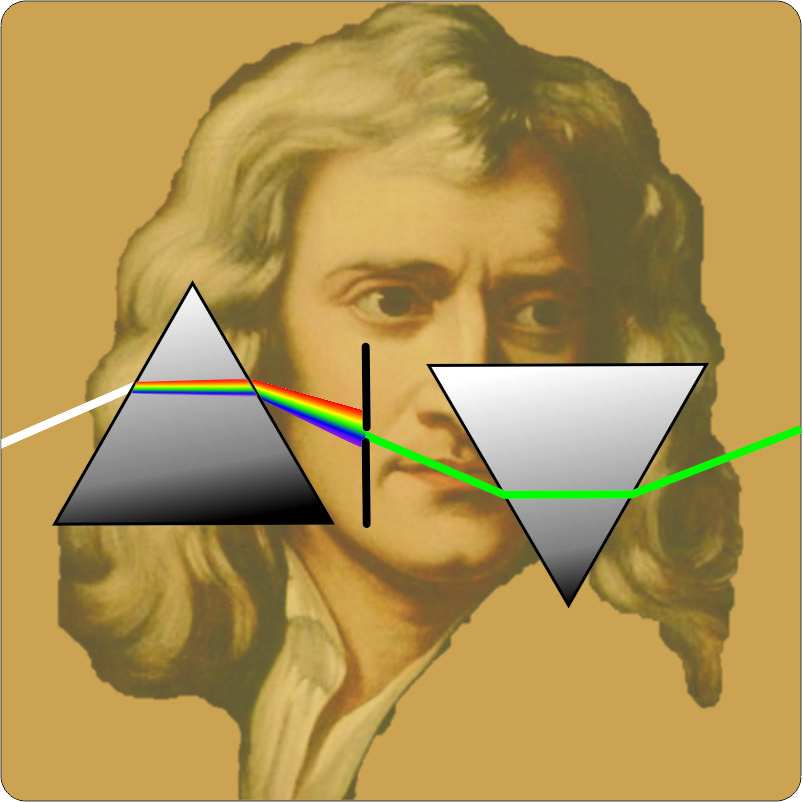
“Nothing so mild. We’re talking Newton here. No, it had to do with one of his famous ‘I’m right and everyone else is wrong‘ battles. Aristotle said that sunlight is pure white‑color, and that objects emit various kinds of darkness to overcome the white and produce colors for us. That was academic gospel for 2000 years until Newton decided it was wrong. He went to war with Aristotle using prisms as his primary weapons.”

“So that’s why he invented them?”

“No, no, they’d been around for millennia, ever since humans discovered that prismatic quartz crystals in a beam of sunlight throw rainbows. Newton’s innovation was to use multiple prisms arrayed with lenses and mirrors. His most direct attack on Aristotle used two prisms. He aimed the beam coming out of the first prism onto a reversed second prism. Except for some red and violet fringes at the edges, the light coming out of the second prism matched the original sunlight beam. That proved colors are in the light, not in Aristotle’s darknesses.”

“Newton won. End of story.”

“Not by a long shot. Aristotle had the strength of tradition behind him. A lot of Continental academics and churchmen had built their careers around his works. Newton’s earlier battles had won him many enemies and some grudging respect but few effective allies. Worse, Newton published his experiments and observations in a treatise which he wrote in English instead of the conventional scholarly Latin. Typical Newtonian belligerence, probably. The French academicians reacted by simply rejecting his claims out of hand. It took a generational turnover before his thinking was widely accepted.”

“Where do speeds come into this?”

“Through another experiment in Newton’s Optics treatise. If he used a card with a hole in it to isolate, say, green light in the space between the two prisms, the light beam coming from the second prism was the matching green. No evidence of any other colors. That was an important observation on its own, but Newton’s real genius move was to measure the diffraction angles. Every color had its own angle. No matter the conditions, any particular light color was always bent by the same number of degrees. Newton had put numbers to colors. That laid the groundwork for all of spectroscopic science.”

“And that ties to speed how?”

~~ Rich Olcott

Space Potatoes

“Uncle Sy, what’s the name of the Moon face that’s just a sliver?”

“It’s called a crescent, Teena, and it’s ‘phase,’ not ‘face’. Hear the z-sound?”

“Ah-hah, one of those spelling things, huh?”

“I’m afraid so. What brought that question up?”

“I was telling Bratty Brian about the Moon shadows and he said he saw a cartoon about something that punched a hole in the Moon and left just the sliver.”

“Not going to happen, Sweetie. Anything as big as the Moon, Mr Newton’s Law of Gravity says that it’ll be round, mostly, except for mountains and things.”

“Cause there’s something really heavy in the center?”

“No, and that’s probably what shocked people the most back in those days. They had Kings and Emperors, remember, and a Pope who led all the Christians in Europe. People expected everything to have some central figure in charge. That’s why they argued about whether the center of the Universe was the Earth or the Sun. Mr Newton showed that you don’t need anything at all at the center of things.”

“But then what pulls the things together?”

“The things themselves and the rules they follow. Remember the bird murmuration rules?”

“That was a long time ago, Uncle Sy. Umm… wasn’t one rule that each bird in the flock tries to stay about the same distance from all its neighbors?”

“Good memory. That was one of the rules. The others were to fly in the same general direction as everybody else and to try stay near the middle of the flock. Those three rules pretty much kept the whole flock together and protected most of the birds from predators. Mr Newton had simpler rules for rocks and things floating in space. His first rule was. ‘Keep going in the direction you’ve been going unless something pulls you in another direction.’ We call that inertia. The second rule explained why rocks fly differently than birds do.”

“Rocks don’t fly, Uncle Sy, they fall down.”

“Better to think of it as flying towards other things. Instead of the safe‑distance rule, Mr Newton said, ‘The closer two things are, the harder they pull together.’ Simple, huh?”

“Oh, like my magnet doggies.”

“Yes, exactly like that, except gravity always attracts. There’s no pushing away like magnets do when you turn one around. Suppose that back when the Solar System was being formed, two big rocks got close. What would happen?”

“They’d bang together.”

“And then?”

“They’d attract other rocks and more and more. Bangbangbangbang!”

“Right. What do you suppose happens to the energy from those bangs? Remember, we’re out in space so there’s no air to carry the sound waves away.”

“It’d break the rocks into smaller rocks. But the energy’s still there, just in smaller pieces, right?”

“The most broken-up energy is heat. What does that tell you?”

“The rock jumble must get … does it get hot enough to melt?”

“It can So now suppose there’s a blob of melted rock floating in space, and every atom in the melted rock is attracted to every other atom. Pretend you’re an atom out at one end of the blob.”

“I see as many atoms to one side as to the other so I’m gonna pull in towards the middle.”

“And so will all the other atoms. What shape is that going to make the blob?”

“Ooooh. Round like a planet. Or the Sun. Or the Moon!”

“So now tell me what would happen if someone punched a hole in the Moon?”

“All the crumbles at the crescent points would get pulled in towards the middle. It wouldn’t be a crescent any more!”

“Exactly. Mind you, if it doesn’t melt it may not be spherical. Melted stuff can only get round because molten atoms are free to move.”

“Are there not-round things in space?”

“Lots and lots. Small blobs couldn’t pull themselves spherical before freezing solid. They could be potato‑shaped, like the Martian moons Phobos and Deimos. Some rocks came together so gently that they didn’t melt. They just stuck together, like Asteroid Bennu where our OSIRIS-REx spacecraft sampled.”

“Space has surprising shapes, huh?”

“Space always surprises.”

~~ Rich Olcott

  • Thanks to Xander and Alex who asked the question.

Shadow Play

“Uncle Sy! Uncle Sy! You’re back! Didja see the red moon?”

“Hi, Teena. Good to be home. No, I didn’t get to see the red moon. Where I was it didn’t even get red.”

“I saw it! I saw it! Mommie put me to bed early so I could wake up to see it earrrly in the morning. I saw the red part but the Moon looked smaller than it does coming up from behind the houses and they said it was going to be sooo big but it wasn’t. Anyway, I didn’t stay awake. Why was it red?”

“Was it really red red like your favorite crayon?”

“Mm-no, more like orange-y red.”

“Sunset color, right?”

“Uh-huh. Was it sunset on the Moon?”

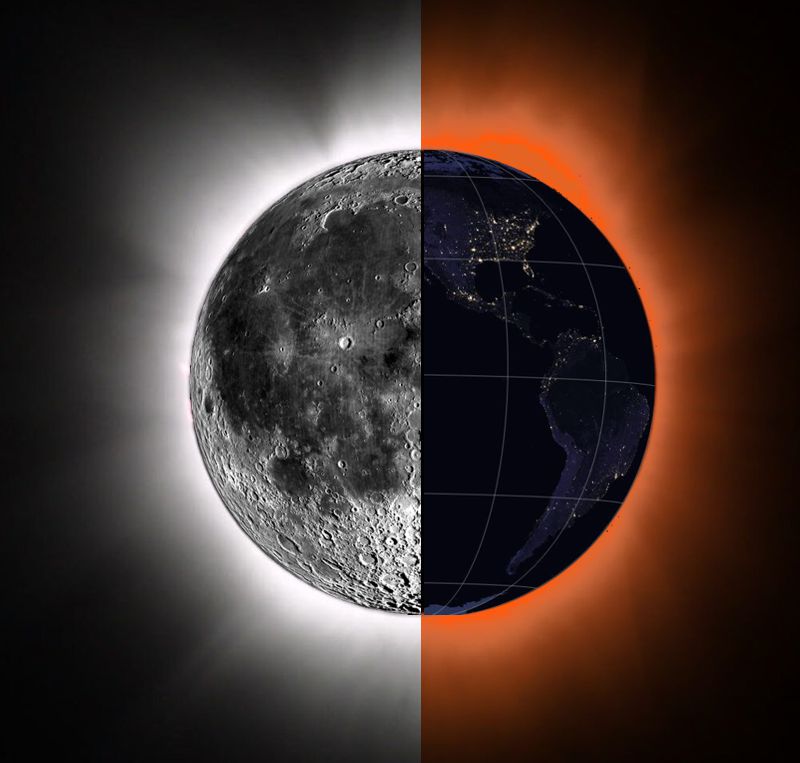
“Sort of. The sunsets we see on Earth are red mostly because our air absorbs the Sun’s blue light when we’re looking across the atmosphere. Only the red light gets through to our eyes. Remember the solar eclipse we saw, when the Moon came exactly between us and the Sun? Moon eclipses are inside out from that. We come between the Moon and the Sun. The only light getting past us has gone across our atmosphere just like sunset light does so it’s orange‑y red like a sunset.”

“Oooh … does the Sun ever get between us and the Moon?”

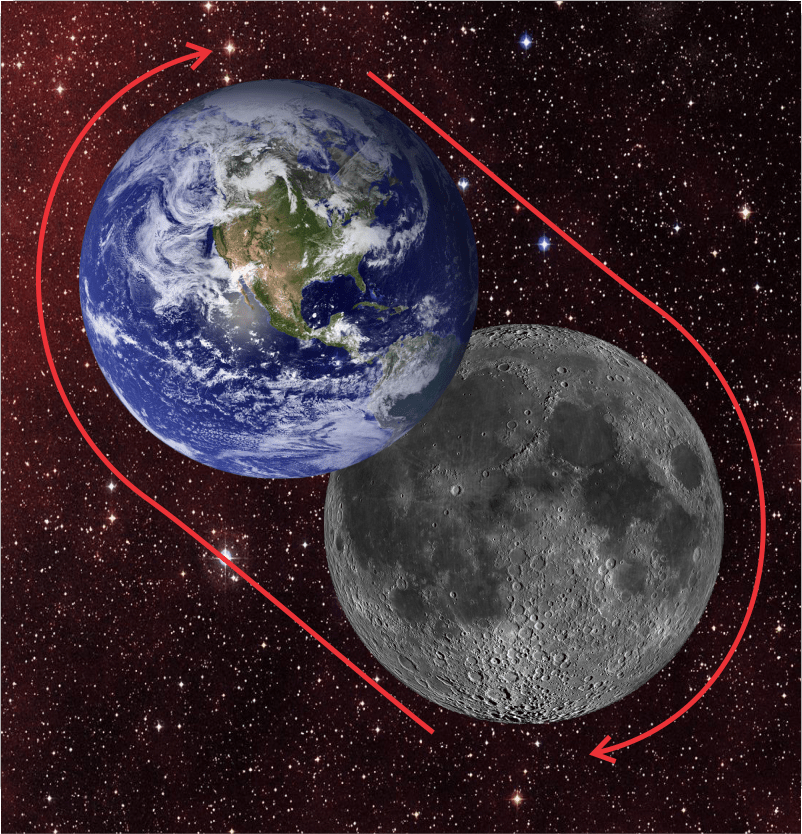
“Don’t worry, Sweetie. We’re far, far from the Sun. Mr Newton’s Laws of Motion say that we and the Moon will be waltzing out here for a long, long time.”

“Whee, we’re dancing around the Sun! MOMmie, Uncle Sy’s here!”

“Hi, Sis. You saw the eclipse, then.”

“Mm-hm. I realized while I was watching it that lunar phase shadows work differently from eclipses.”

“Oh? How so?”

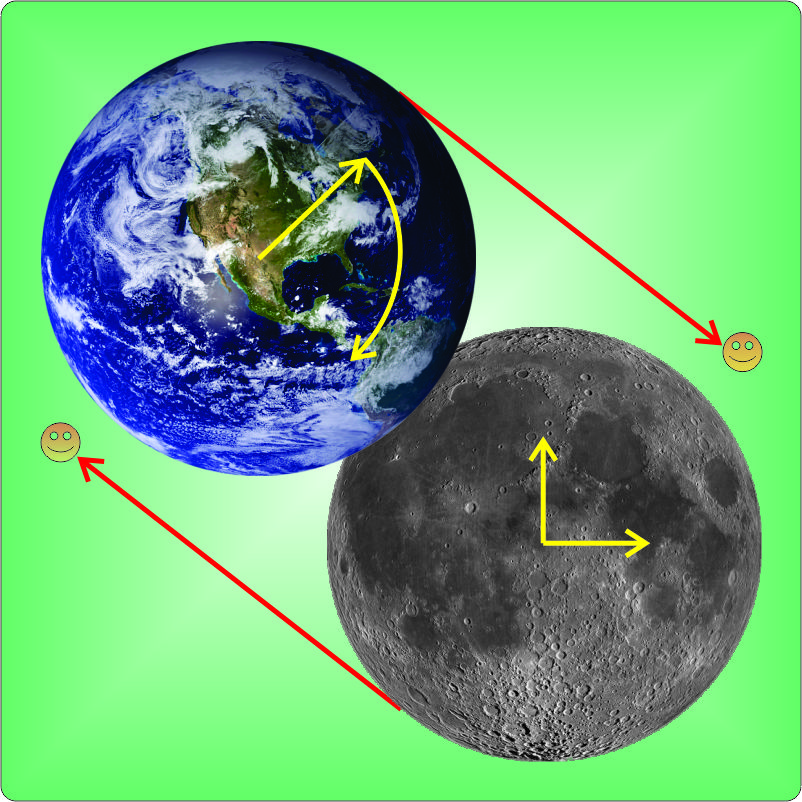
“The shadow shapes are different, for one. The edge of the lunar phase shadow always passes through both poles. In a solar eclipse the shadow only reaches the poles at totality, and in a lunar eclipse there’s this almost straight shadow arc that marches across the whole face.”

“Interesting. You said ‘for one,’ so what else?”

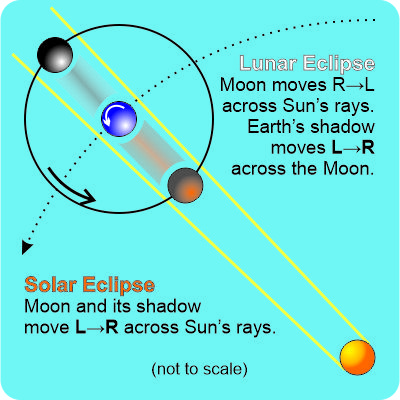
“Eclipse shadows move in the wrong direction. Starting from a full moon, the shadow comes in from the right until you get to new moon, then it falls away to the left until you get back to full moon. Agreed?”

“I always get confused. I’ll take your word for it.”

“I looked it up. In two places. Anyhow, in both kinds of eclipse the shadow creeps from left to right. Just backwards from the lunar phases. I wonder if that has anything to do with ancient societies thinking that an eclipse is somehow evil.”

“Mommie, you know you’re not supposed to use words I don’t know unless you’re keeping secrets. What’s lunar faces?”

“Sorry, Teena, not secret. Lunar means Moon. Sy, can you show her phases on Old Reliable?”

“Sure. Here’s a quick sketch, Teena. Pretend that the little ball is the Moon going around the Earth. The Sun is off to the right. You know the Moon goes around the Earth and it always keeps the same side towards us, right?”

“That’s the Man In The Moon except it’s really mountains and stuff pointing at us.”

“That’s what the little triangle shows, like it’s his nose. See how sometimes it’s in the light and sometimes it’s in shadow? The big ball is what we see when the Moon is in each position. When the Man is facing straight towards the Sun we call that the Full Moon phase. When he’s completely in shadow that’s the New Moon phase. There’s names for other special positions, and all of the special positions are phases, OK?”

“I suppose you have a logical explanation for the shadows?”

“Sure, Sis. It’s all about where the shadow’s being cast and how the shadow caster is moving at the time. This diagram tells the story. Nearly everything in the Solar System runs counterclockwise—”

“Widdershins.”

“… Right. Every orbit runs left‑to‑right half the time, right‑to‑left the other half. The two kinds of eclipse happen in opposite halves. The geometry works out that we see both eclipse shadows move left‑to‑right. See?”

“Cool.”

~~ Rich Olcott
  • Thanks to Alex for the question, and to Lori for the shadow observation, which I hadn’t seen discussed before.

Rotation, Revolution and The Answer

“Sy, I’m startin’ to think you got nothin’. Al and me, we ask what’s pushing the Moon away from us and you give us angular momentum and energy transfers. C’mon, stop dancin’ around and tell us the answer.”

“Yeah, Sy, gravity pulls things together, right, so how come the Moon doesn’t fall right onto us?”

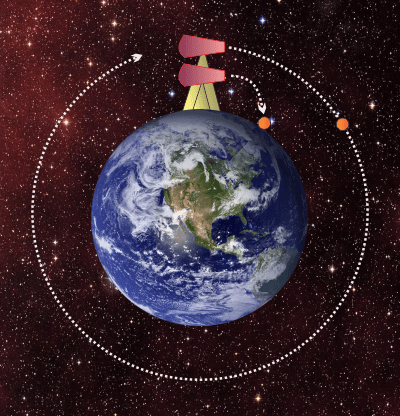
“Not dancing, Vinnie, just laying some groundwork for you. Newton answered Al’s question — the Moon is falling towards us, but it’s going so fast it overshoots. That’s where momentum comes in, Vinnie. Newton showed that a ball shot from a cannon files further depending on how much momentum it gets from the initial kick. If you give it enough momentum, and set your cannon high enough that the ball doesn’t hit trees or mountains, the ball falls beyond the planet and keeps on falling forever in an elliptical orbit.”

“Forever until it hits the cannon.”

“hahaha, Al. Anyway, the ball achieves orbit by converting its linear momentum to angular momentum with the help of gravity. The angular momentum pretty much defines the orbit. In Newton’s gravity‑determined universe, momentum and position together let you predict everything.”

“Linear and angular momentum work the same way?”

“Mostly. There’s only one kind of linear momentum — straight ahead — but there are two kinds of angular momentum — rotation and revolution.”

“Aw geez, there’s another pair of words I can never keep straight.”

“You and lots of people, Vinnie. They’re synonyms unless you’re talking technicalese. In Physics and Astronomy, rotation with the O gyrates around an object’s own center, like a top or a planet rotating on its axis. Revolution with the E gyrates around some external location, like the planet revolving around its sun. Does that help?”

“Cool, that may come in handy. So Newton’s cannon ball got its umm, revolution angular momentum from linear momentum so where does rotation angular momentum come from?”

“Subtle question, Vinnie, but they’re actually all just momentum. Fair warning, I’m going to avoid a few issues that’d get us too far into the relativity weeds. Let’s just say that momentum is one of those conserved quantities. You can transfer momentum from one object to another and convert between forms of momentum, but you can’t create momentum in an isolated system.”

“That sounds a lot like energy, Sy.”

“You’re right, Al, the two are closely related. Newton thought that momentum was THE conserved quantity and all motion depended on it. His arch‑enemy Leibniz said THE conserved quantity was kinetic energy, which he called vis viva. That disagreement was just one battle in the Newton‑Leibniz war. It took science 200 years to understand the momentum/kinetic energy/potential energy triad.”

“Wait, Sy, I’ve seen NASA steer a rocketship and give it a whole different momentum. I don’t see no conservation.”

“You missed an important word, Vinnie — isolated. Momentum calculations apply to mechanical systems — no inputs of mass or non‑mechanical energy. Chemical or nuclear fuels break that rule and get you into a different game.”

“Ah-hahh, so if the Earth and Moon are isolated…”

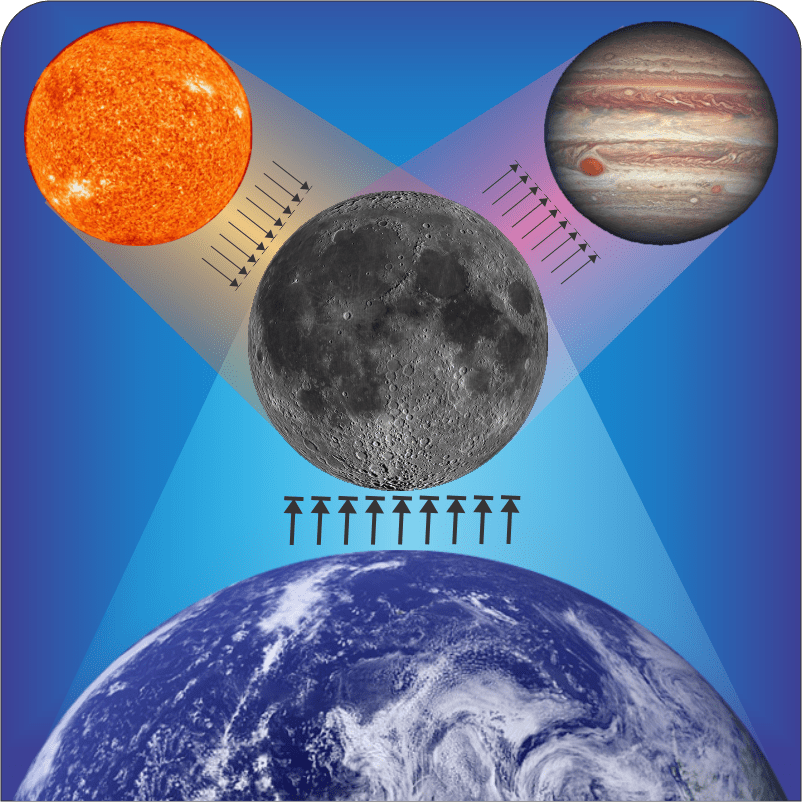
“Exactly, and you’re way ahead of me. Like we said, no significant net forces coming from the Sun or Jupiter, so no change to our angular momentum.”

“Hey, wait, guys. Solar power. I know we’ve got a ton of sunlight coming in every day.”

“Not relevant, Al. Even though sunlight heats the Earth, mass and momentum aren’t affected by temperature. Anyhow, we’re finally at the point where I can answer your question.”

“About time.”

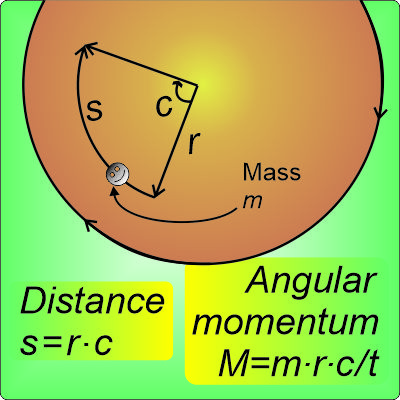
“Hush. OK, here’s the chain. Earth rotates beneath the Moon and gets its insides stirred up by the Moon’s gravity. The stirring is kinetic energy extracted from the energy of the Earth‑Moon system. The Moon’s revolution or the Earth’s rotation or both must slow down. Remember the M=m·r·c/t equation for angular momentum? The Earth‑Moon system is isolated so the angular momentum M can’t change but the angular velocity c/t goes down. Something’s got to compensate. The system’s mass m doesn’t change. The only thing that can increase is distance r. There’s your answer, guys — conservation of angular momentum forces the Moon to drift outward.”

“Long way to the answer.”

“To the Moon and back.”

~~ Rich Olcott

Here’s a Different Angle

“OK, Sy, so there’s a bulge on the Moon’s side of the Earth and the Earth rotates but the bulge doesn’t and that makes the Moon’s orbit just a little bigger and you’ve figured out that the energy it took to lift the Moon raised Earth’s temperature by a gazillionth of a degree, I got all that, but you still haven’t told Al and me how the lifting works.”

“You wouldn’t accept it if I just said, ‘The Moon lifts itself by its bootstraps,’ would you?”

“Not for a minute.”

“And you don’t like equations. <sigh> OK, Al, pass over some of those paper napkins.”

“Aw geez, Sy.”

“You guys asked the question and this’ll take diagrams, Al. Ante up. … Thanks. OK, remember the time Cathleen and I caught Vinnie here at Al’s shop playing with a top?”

“Yeah, and he was spraying paper wads all over the place.”

“I wasn’t either, Al, it was the top sending them out with centri–…, some force I can never remember whether it’s centrifugal or centripetal.”

“Centrifugal, Vinnie, –fugal– like fugitive, outward‑escaping force. It’s one of those ‘depends on how you look at itfictitious forces. From where you were sitting, the wads looked like they were flying outward perpendicular to the top’s circle. From a wad’s point of view, it flew in a straight line tangent to the circle. It’s like we have two languages, Room and Rotor. They describe the same phenomena but from different perspectives.”

“Hey, it’s frames again, ain’t it?”

“Newton’s inertial frames? Sort‑of but not quite. Newton’s First Law only holds in the Room frame — no acceleration, motion is measured by distance, objects at rest stay put. Any other object moves in a straight line unless its momentum is changed by a force. You can tackle a problem by considering momentum and force components along separate X and Y axes. Both X and Y components work the same way — push twice as hard in either direction, get twice the acceleration in that direction. Nice rules that the Rotor frame doesn’t play by.”

“I guess not. The middle’s the only place an object can stay put, right?”

“Exactly, Al. Everything else looks like it’s affected by weird, constantly‑varying forces that’re hard to describe in X‑Y terms.”

“So that breaks Newton’s physics?”

“Of course not. We just have to adapt his F=m·a equation (sorry, Vinnie!) to Rotor conditions. For small movements we wind up with two equations. In the strict radial direction it’s still F=m·a where m is mass like we know it, a is acceleration outward or inward, and F is centrifugal or centripetal, depending. Easy. Perpendicular to ‘radial‘ we’ve got ‘angular.’ Things look different there because in that direction motion’s measured by angle but Newton’s Laws are all about distances — speed is distance per time, acceleration is speed change per time and so forth.”

“So what do you do?”

“Use arc length. Distance along an arc is proportional to the angle, and it’s also proportional to the radius of the arc, so just multiply them together.”

“What, like a 45° bend around a 2-foot radius takes 90 feet? That’s just wrong!”

“No question, Al. You have to measure the angle in the right units. Remember the formula for a circle’s circumference?”

“Sure, it’s 2πr.”

“Which tells you that a full turn’s length is times the radius. We can bridge from angle to arc length using rotational units so that a full turn, 360°, is units. We’ll call that unit a radian. Half a circle is π radians. Your 45° angle in radians is π/4 or about ¾ of a radian. You’d need about (¾)×(2) or 1½ feet of whatever to get 45° along that 2-foot arc. Make sense?”

“Gimme a sec … OK, I’m with you.”

“Great. So if angular distance is radius times angle, then angular momentum which is mass times distance per time becomes mass times radius times angle per time.”

“”Hold on, Sy … so if I double the mass I double the momentum just like always, but if something’s spinning I could also double the angular momentum by doubling the radius or spinning it twice as fast?”

“Couldn’t have put it better myself, Vinnie.”

~~ Rich Olcott

Two Against One, And It’s Not Even Close


On a brisk walk across campus when I hear Vinnie yell from Al’s coffee shop. “Hey! Sy! Me and Al got this argument going you gotta settle.”

“Happy to be a peacemaker, but it’ll cost you a mug of Al’s coffee and a strawberry scone.”

“Coffee’s no charge, Sy, but the scone goes on Vinnie’s tab. What’s your pleasure?”

“It’s morning, Al, time for black mud. What’s the argument, Vinnie?”

“Al read in one of his astronomy magazines that the Moon’s drifting away from us. Is that true, and if it is, how’s it happen? Al thinks Jupiter’s gravity’s lifting it but I think it’s because of Solar winds pushing it. So which is it?”

“Here you go, Sy, straight from the bottom of the pot.”

“Perfect, Al, thanks. Yes, it’s true. The drift rate is about 1¼ nanometers per second, 1½ inches per year. As to your argument, you’re both wrong.”

“Huh?”
 ”Aw, c’mon!”

“Al, let’s put some numbers to your hypothesis. <pulling out Old Reliable and screen‑tapping> I’m going to compare Jupiter’s pull on the Moon to Earth’s when the two planets are closest together. OK?”

“I suppose.”

“Alright. Newton’s Law tells us the pull is proportional to the mass. Jupiter’s mass is about 320 times Earth, which is pretty impressive, right? But the attraction drops with the square of the distance. The Moon is 1¼ lightseconds from Earth. At closest approach, Jupiter is almost 2100 lightseconds away, 1680 times further than the Moon. We need to divide the 320 mass factor by a 1680‑squared distance factor and that makes <key taps> Jupiter’s pull on the Moon is only 0.011 percent of Earth’s. It’ll be <taps> half that when Jupiter’s on the other side of the Sun. Not much competition, eh?”

“Yeah, but a little bit at a time, it adds up.”

“We’re not done yet. The Moon feels the big guy’s pull on both sides of its orbit around Earth. On the side where the Moon’s moving away from Jupiter, you’re right, Jupiter’s gravity slows the Moon down, a little. But on the moving-toward-Jupiter side, the motion’s sped up. Put it all together, Jupiter’s teeny pull cancels itself out over every month’s orbiting.”

“Gotcha, Al. So what about my theory, Sy?”

“Basically the same logic, Vinnie. The Solar wind varies, thanks to the Sun’s variable activity, but satellite measurements put its pressure somewhere around a nanopascal, a nanonewton per square meter. Multiply that by the Moon’s cross‑sectional area and we get <tap, tap> a bit less than ten thousand newtons of force on the Moon. Meanwhile, Newton’s Law says the Earth’s pull on the Moon comes to <tapping>
  G×(Earth’s mass)×(Moon’s mass)/(Earth-Moon distance)²
and that comes to 2×10¹¹ newtons. Earth wins by a 107‑fold landslide. Anyway, the pressure slows the Moon for only half of each month and speeds it up the other half so we’ve got another cancellation going on.”

“So what is it then?”
 ”So what is it then?”

“Tides. Not just ocean tides, rock tides in Earth’s fluid outer mantle. Earth bulges, just a bit, toward the Moon. But Earth also rotates, so the bulge circles the planet every day.”

“Reminds me of the wave in the Interstellar movie, but why don’t we see it?”

“The movie’s wave was hundreds of times higher than ours, Al. It was water, not rock, and the wave‑raiser was a huge black hole close by the planet. The Moon’s tidal pull on Earth produces only a one‑meter variation on a 6,400,000‑meter radius. Not a big deal to us. Of course, it makes a lot of difference to the material that’s being kneaded up and down. There’s a lot of friction in those layers.”

“Friction makes heat, Sy. Rock tides oughta heat up the planet, right?”

“Sure, Vinnie, the process does generate heat. Force times distance equals energy. Raising the Moon by 1¼ nanometers per second against a force of 2×10²¹ newtons gives us <taping furiously> an energy transfer rate of 4×10‑23 joules per second per kilogram of Earth’s 6×1024‑kilogram mass. It takes about a thousand joules to heat a kilogram of rock by one kelvin so we’re looking at a temperature rise near 10‑27 kelvins per second. Not significant.”

“No blaming climate change on the Moon, huh?”

~~ Rich Olcott

Moon Shot

<chirp, chirp> “Moire here.”

“Hi, Mr Moire, it’s Jeremy. Hey, I’ve been reading through some old science fiction stories and I ran across some numbers that just don’t look right.”

“Science fiction can be pretty clunky. Some Editors let their authors play fast and loose on purpose, just to generate Letters to The Editor. Which author and what story?”

“This is Heinlein, Mr Moire. I know his ideas about conditions on Mars and Venus were way off but that was before we had robot missions that could go there and look. When he writes about space navigation, though, he’s always so specific it looks like he’d actually done the calculations.”

“OK, which story and what numbers?”

“This one’s called, let me check, Gentlemen, Be Seated. It’s about these guys who get trapped in a tunnel on the Moon and there’s a leak letting air out of the tunnel so they seal the leak when one of the guys —”

“I know the story, Jeremy. I’ve always wondered if it was Heinlein or his Editor who got cute with the title. Anyway, which numbers bothered you?”

“I kinda thought the title came first. Anyway, everybody knows that the Earth’s gravity is six times the Moon’s, but he says that the Earth’s mass is eighty times the Moon’s and that’s why the Earth raises tides on the Moon except they’re rock tides, not water tides, and the movement makes moonquakes and one of them might have caused the leak. So why isn’t the Earth’s gravity eighty times the Moon’s, not six?”

“Read me the sentence about eighty.”

“Umm … here it is, ‘Remember, the Earth is eighty times the mass of the Moon, so the tidal stresses here are eighty times as great as the Moon’s effect on Earth tides.‘ I checked the masses in Wikipedia and eighty is about right.”

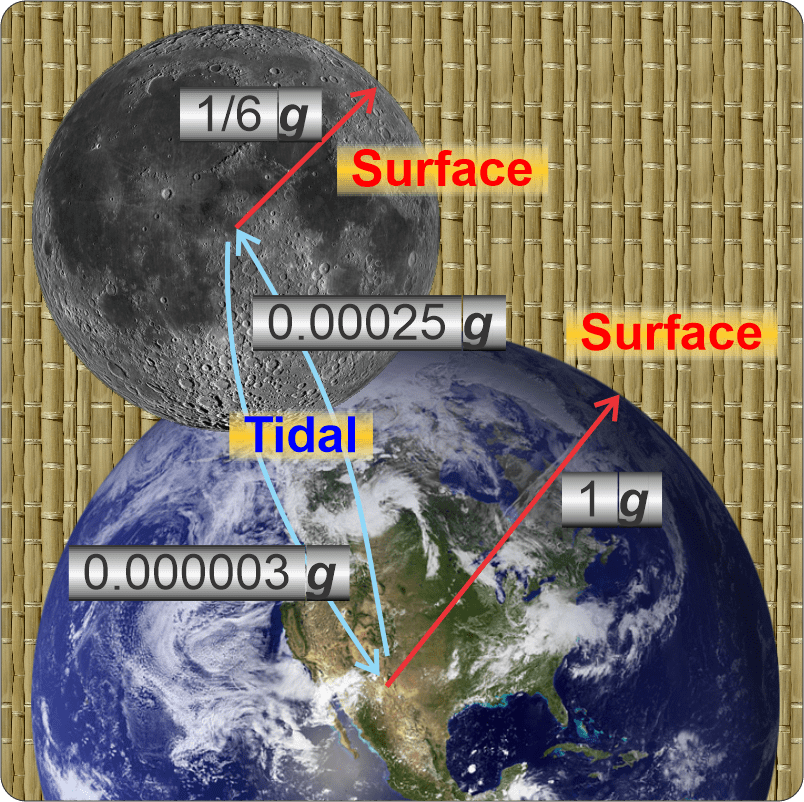
“I hadn’t realized the ratio was that large, I mean that the Moon is that small. One point for Heinlein. Anyway, you’re comparing north and east. The eighty and the six both have to do with gravity but they’re pointing in different directions.”

“Huh? I thought gravity’s pull was always toward the center.”

“It is, but it makes a difference where you are and which center you’re thinking about. You’re standing on the Earth so the closest center to you is Earth’s and most of the gravity you feel is the one-gravity pull from there. Suppose you’re standing on the Moon —”

“One-sixth, I know, Mr Moire, but why isn’t it one‑eightieth?”

“Because on the Moon you’re a lot closer to the center of the Moon than you were to the center of the Earth back on Earth. Let’s put some numbers to it. Got a calculator handy?”

“Got my cellphone.”

“Duh. OK, Newton showed us that an object’s gravitational force is proportional to the object’s mass divided by the square of the distance to the center. Earth’s radius is about 4000 miles and the Moon’s is about a quarter of that, so take the mass as 1/80 and divide by 1/4 squared. What do you get?”

“Uhh … 0.2 gravities.”

“One-fifth g. Close enough to one-sixth. If we used accurate numbers we’d be even closer. See how distance makes a difference?”

“Mm-hm. What about Heinlein’s tidal stuff?”

“Ah, now that’s looking in the other direction, where the distance is a lot bigger. Earth-to-Moon is about 250,000 miles. Standing on the Moon, you’d feel Earth’s one‑g gravity diminished by a factor of 4000/250000 squared. What’s that come to?”

“Umm… the distance factor is (4000/250000)² … I get 250 microgravities. Not much. Heinlein made a good bet with his characters deciding that the leak was caused by a nearby rocket crash instead of a moonquake.”

“How about Heinlein’s remark about the Moon’s effect on Earth?”

“Same distance but one eightieth the mass so I divide by 80 — three microgravities. Wow! That can’t possibly be strong enough to raise tides here.”

“It isn’t, though that’s the popular idea. What really happens is that the Moon’s field pulls water sideways from all directions towards the sub‑Lunar point. Sideways motion doesn’t fight Earth’s gravity, it just makes the water pile up in the center.”

“Hah, piled-up water. Weird. Well, I feel better about Heinlein now.”

~~ Rich Olcott