Flasks Of Money

<chirp, chirp> “Moire here.”

“Hiya, Sy, it’s me again.”

“Hi, Eddie. I thought you were done with your deliveries tonight. That was a good stromboli, by the way, just the right amount of zing and sauce.”

“Thanks. Yeah, I’m done for the day, but I was thinking while I drove home. We said that the Feds and the banks together can tinker with the money supply so there’s no Conservation of Money like we got Conservation of Energy. But then we said that it matters to keep money in local businesses instead of letting it drain away somewhere else. That says there’s only so much to go around like the amount doesn’t change. So which is it?”

“Good point. You’ve touched on another contrasting parallel between Physics and Economics. In Physics we mostly understand how atoms work and we’ve got a pretty good handle on the forces that control objects big enough to see. J Willard Gibbs, probably the foremost physicist of the late 1800s, devised Statistical Mechanics to bridge the gap between the two levels. The idea is to start with the atoms or molecules. They’re quantum objects, of course, so we can’t have much precise information at that level. What we can get, though, is averages and spreads on one object’s properties — speed, internal energy levels, things like that. Imagine we have an ensemble of those guys, mostly identical but each with their own personal set of properties. Gibbs showed us how to apply low-level averages and spreads across the whole ensemble to calculate upper-level properties like magnetic strength and heat capacity.”

“Ensemble. Fancy word.”

“Not my word, blame Gibbs. He invented the field so we go with his terminology. Atoms weren’t quite a respectable topic of conversation at the time so he kept things general and talked about ‘macroscopic properties‘ which we can measure directly and ‘microscopic properties‘ which were mysterious at the time. Think of three flasks holding samples of some kind of gas, OK?”

“No problem.”

“The first flask is stoppered, no gas can get in or out but energy can pass through the flask’s wall. Gibbs would call the confined collection of molecules a ‘canonical ensemble‘. Because the wall transmits energy we can use an external thermometer to measure the ensemble’s temperature. Other than that, all we know about the contents is the number of particles and the volume the particles can access.”

“Canonical?”

“In Gibbs’ usage it means that he’s pared things down to an abstract essence. It doesn’t matter whether what’s inside is atoms or fruitflies, his logic still holds. Now for flask number two. It’s heavily insulated so whatever energy it had inside originally, that’s what it’s got now. We can’t measure the temperature in this one. Gibbs would consider the particles in there to be a ‘microcanonical ensemble,’ with the ‘micro’ indicating the energy restriction.”

“Where there’s a microcanonical there’s gotta be a macrocanonical.”

“You’d think, but Gibbs used the term ‘grand canonical ensemble‘ instead. That’s flask number three, which has neither insulation nor stopper. Both energy and matter are free to enter or leave the ensemble. Gibbs’ notion of canonical ensembles and the math that grows out of them have been used in every kind of analysis from solid state physics to cybersecurity.”

“OK, I think I see where you’re going here. Money acts sorta like energy so you’re gonna lay out three kinds of economy restriction.”

“You’re way ahead of me and the economists, Eddie. They’ve only got two levels, though they do use reasonable names for them — microeconomics and macroeconomics. For them the micro level is about individuals, businesses, the markets they play in and how they spend their incomes. Supply-demand thinking gets used a lot.”

“That figures. What about macro?”

“Macro level is about regions and countries and the world. Supply‑demand plays here, too, except the macroeconomists worry about how demand for money itself affects its value compared to everything else.”

“They got bridges like Gibbs built?”

“Nope. Atoms are simple, people are complicated. The economists are still arguing about the basics. Anyway, the economists’ micro level assumes local money stays local and has a stable value.”

“Keeping my business stable is good.”

~~ Rich Olcott

Above The Air, Below The Red

Vinnie and I walk into Al’s coffee shop just as he sets out a tray of scones. “Odd-looking topping on those, Al. What is it?”

“Dark cherry and dark chocolate, Sy. Something about looking infra-red. Cathleen special-ordered them for some Astronomy event she’s hosting in the back room. Carry this tray in there for me?”

Vinne grabs the tray and a scone. “Sure, Al. … Mmm, tasty. … Hi, Cathleen. Here’s your scones. What’s the event?”

“It’s a memorial symposium for the Spitzer Space Telescope, Vinnie. Spitzer‘s been an infra-red workhorse for almost 17 years and NASA formally retired it at the end of January.”

“What’s so special about infra-red? It’s just light, right? We got the Hubble for that.”

“A perfect cue for Jim’s talk. <to crowd> Grab a scone and settle down, everyone. Welcome to our symposium, ‘IR , Spitzer And The Universe.’ Our first presentation today is entitled ‘What’s So Special About Infra-red?‘ Jim, you’re on.”

“Thanks, Cathleen. This is an introductory talk, so I’ll keep it mostly non-technical. So, question for everybody — when you see ‘IR‘, what do you think of first?”

<shouts from the crowd> “Pizza warmer!” “Invisible light!” “Night-vision goggles!”

“Pretty much what I expected. All relevant, but IR’s much more than that. To begin with, many more colors than visible light. We can distinguish colors in the rainbow because each color’s lightwave has a different frequency. Everybody OK with that?”

<general mutter of assent>

“OK. Well, the frequency at the violet end of the visible spectrum is a bit less than double the frequency at the red end. In music when you double the frequency you go up an octave. The range of colors we see from red to violet is less than an octave, about like going from A-natural to F-sharp on the piano. The infra-red spectrum covers almost nine octaves. An 88-key piano doesn’t even do eight.”

<voice from the crowd, maybe an Art major> “Wow, if we could see infra-red think of all the colors there’d be!”

“But you’d need a whole collection of specialized eyes to see them. With light, every time you go down an octave you reduce the photon’s energy capacity by half. Visible light is visible because its photons have just enough energy to cause an electronic change in our retinas’ photoreceptor molecules. Five octaves higher than that, the photons have enough energy to knock electrons right out of a molecule like DNA. An octave lower than visible, almost nothing electronic.”

<Vinnie’s always-skeptical voice> “If there’s no connecting with electrons, how does electronic infra-red detection work?”

“Two ways. A few semiconductor configurations are sensitive to near- and mid-infra-red photons. The Spitzer‘s sensors are grids of those configurations. To handle really low-frequency IR you have to sense heat directly with bolometer techniques that track expansion and contraction.”

<another skeptical voice> “OK then, how does infra-red heating work?”

“Looks like a paradox, doesn’t it? Infra-red photons are too low-energy to make a quantum change in a molecule’s electronic arrangement, but we know that the only way photons can have an effect is by making quantum changes. So how come we feel infra-red’s heat? The key is, photons can interact with any kind of charged structure, not just electrons. If a molecule’s charges aren’t perfectly balanced a photon can vibrate or rotate part of a molecule or even the whole thing. That changes its kinetic energy because molecular motion is heat, right? Fortunately for the astronomers, gas vibrations and rotations are quantized, too. An isolated water molecule can only do stepwise changes in vibration and rotation.”

“Why’s that fortunate?”

“Because that’s how I do my research. Every kind of molecule has its own set of steps, its own set of frequencies where it can absorb light. The infra-red range lets us do for molecules what the visual range lets us do for atoms. By charting specific absorption bands we’ve located and identified interstellar clouds of water, formaldehyde and a host of other chemicals. I just recently saw a report of ‘helonium‘, a molecular ion containing helium and hydrogen, left over from when the Universe began. Infra-red is so cool.”

“No, it’s warm.”

Image suggested by Alex

~~ Rich Olcott

Computer Power, Or Not

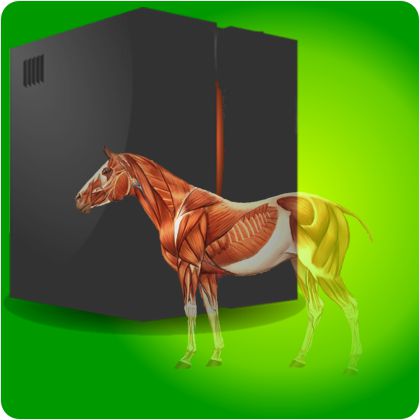
A voice from the scone line behind me. “That’s like poetical, sayin’ a horse’s sinews tie muscle to bone and a computer’s internal network is like sinew ’cause it ties things together the same way. But what does for the computer what muscle and bone do for a horse? Hi, Robert, I’m Vinnie, me and Sy here go way back. I’ll have a strawberry scone, Al, and these guys are on me.”

“Sure thing, Vinnie, here ya go.”

“Thanks, Al.” “Thanks, Vinnie.” “Thanks — Vinnie, is it?”

“Yeah. Glad to meetcha. So what are they?”

“The computer equivalent of horse muscle and bone? Well, the horse’s muscle activity generates its power so the computer’s ‘muscles’ are clearly its processors.”

Horse musculature from artwork by Jenny Stout, with permission

“Processors, plural? My heavy-duty desk machine only has one CPU thingy in there, I looked.”

“Only one chip package, Sy, but there’s a lot inside that black block. Your ‘Central Processing Unit’ is probably multi-core, which means it has somewhere between four and dozens of more-or-less independent sub-processors, each with its own set of registers and maybe even local cache memories. If your operating system is multi-core-aware, at any given moment your system could be running a different program on each core.”

“Hey, you’re right, I often download emails and browse the internet at the same time I’ve got a big calculation going. Doesn’t seem to slow it down.”

“Mm-hm. I like to call those cores eccentric processing units because they’re not really central.” <Vinnie pretends to grab Robert’s scone.> “You’ve got a video card in there, too, right?”

“Of course.”

“This may come as a shock, but you probably have more raw compute power on that card than you do in your CPU module. The card’s primary chip has hundreds of millions of transistors allocated to hundreds or thousands of simple-minded micro-micro-processors ganged together to do identical calculations on separate inputs. Rotating a 3-D object, for example, requires four multiplications and an addition for each x-, y- and z-coordinate of every point on the object. No if-then logic, just a very small arithmetic program repeated a gazillion times.”

“So the main CPU doesn’t have to do that.”

“Right. Same principle, you may have ASICs in there devoted to certain tasks like network interfacing.”

“A-six?”

Application Specific Integrated Circuits. They’re everywhere from your smartphone to your hobby drone.”

“Don’t have a hobby drone, use mine for business.”

“OK, your business drone, Vinnie. Your drone and its controller both use ASICs.”

“How will the quantum computer play into this, Robert? I’ve been reading how it automagically tries all possible solutions and instantly comes up with the one that solves the problem.”

“That’s hype, mostly. Quantum computing could indeed give quick solutions, but to a very limited set of problems. For instance, everyone talks about factoring special large numbers. When QC succeeds in that it’ll disrupt internet security, cryptography, blockchain applications and a couple more not-here-yet technologies that depend on factorization being hard to do. But QC can only tackle problems that involve a small amount of data. It’s no good for Big Data kinds of problems like weather modeling or fingerprint matching or rummaging through a medical database to find the optimal treatment for a given collection of clinical findings.”

“Why’s that?”

“A quantum CPU works with a set of constraints and inputs. It does its tryeverything thing to generate an output that’s consistent with the constraints and input. The factorization constraint, for example, is just one algorithm. The input is a single number. The output is one set of factors. Compare that with the weather problem where the goal is to calculate the future weather for every kilometer-by-kilometer-by-kilometer cell of atmosphere on the globe. The constraint is a whole series of equations governing atmospheric gases (especially water) together with the topography of the underlying surface. Each cell’s input is all the measurable weather variables (temperature, humidity, wind velocity, clouds, whatever) plus history for that cell and its neighbors. The output per time-step is predicted weather variables for a billion cells. Quantum’s no help with that data flood — you need good networks.”

~~ Rich Olcott

Maybe even smaller?

There’s a sofa in my office. Sometimes it’s used to seat some clients for a consultation, sometimes I use it for a nap. This evening Anne and I are sitting on it, close together, after a meal of Eddie’s Pizza d’amore.

“I’ve been thinking, Sy. I don’t want to use my grow-shrink superpower very much.”

“Fine with me, I like the size you are. Why’d you decide that?”

“I remember Alice saying, ‘Three inches is such a wretched height to be.’ She was thinking about what her cat would do to her at that height. I’m thinking about what an amoeba might do to me if I were down to bacteria-size and I wouldn’t be able to see it coming because I’d be too small to see light. It would be even messier further down.”

“Well, mess is the point of quantum mechanics — all we get is the averages because it’s all chaos at the quantum level. Bohr would say we can’t even talk about what’s down there, but you’d be in the thick of it.”

She shudders delicately, leans in tighter. <long, very friendly pause> “Where’d that weird number come from, Sy?”

“What weird number?”

“Ten-to-the-minus-thirty-fifth. You mentioned it as a possible bottom to the size range.”

Now you’re asking?”

“I’ve got this new superpower, I need to think about stuff.  Besides, we’ve finished the pizza.”

<sigh> “This conversation reminds me of our elephant adventure.  Oh well.  Umm. It may have started on a cold, wet afternoon. You know, when your head’s just not up to real work so you grab a scratchpad and start doodling? I’ll bet Max Planck was in that state when he started fiddling with universal constants, like the speed of light and his own personal contribution ħ, the quantum of action.”

“He could change their values?”

“No, of course not. But he could combine them in different ways to see what came out. Being a proper physicist he’d make sure the units always came out right. I’m not sure which unit-system he worked in so I’ll just stick with SI units, OK?”

“Why should I argue?”

“No good reason to. So… c is a velocity so its units are meters per second. Planck’s constant ħ is energy times time, which you can write either as joule-seconds or kilogram-meter² per second. He couldn’t just add the numbers together because the units are different. However, he could divide the one by the other so the per-seconds canceled out. That gave him kilogram-meters, which wasn’t particularly interesting. The important step was the next one.”

“Don’t keep me in suspense.”

“He threw Newton’s gravitational constant G into the mix. Its units are meter³ per kilogram per second². ‘Ach, vut a mess,’ he thought, ‘but maybe now ve getting somevere. If I multiply ħ by G the kilograms cancel out und I get meter5 per second³. Now … Ah! Divide by c³ vich is equal to multiplying by second³/meter³ to cancel out all the seconds and ve are left mit chust meter² vich I can take the square root uff. Wunderbar, it is simply a length! How ’bout that?‘”

“Surely he didn’t think ‘how ’bout that?‘”

“Maybe the German equivalent. Anyway, doodling like that is one of the ways researchers get inspirations. This one was so good that (Għ/c³)=1.6×10-35 meter is now known as the Planck length. That’s where your ten-to-the-minus-thirty-fifth comes from.”

“That’s pretty small. But is it really the bottom?”

“Almost certainly not, for a couple of different reasons. First, although the Planck formula looks like a fundamental limit, it’s not. In the same report Planck re-juggled his constants to define the Planck mass (ħc/G)=2.2×10-8 kilograms or 22 micrograms. Grains of sand weight less than that. If Planck’s mass isn’t a limit, Planck’s length probably isn’t either. Before you ask, the other reason has to do with relativity and this is not the time for that.”

“Mmm … so if space is quantized, which is where we started, the little bits probably aren’t Planck-sized?”

“Who knows? But my guess is, no, probably much smaller.”

“So I wouldn’t accidentally go out altogether like a candle then. That’s comforting to know.”

My turn to shudder. <another long, friendly pause>.

~~Rich Olcott

Conversation of Energy

Teena’s next dash is for the slide, the high one, of course. “Ha-ha, Uncle Sy, beat you here. Look at me climbing up and getting potential energy!”

“You certainly did and you certainly are.”

“Now I’m sliding down all kinetic energy, wheee!” <thump, followed by thoughtful pause> “Uncle Sy, I’m all mixed up. You said momentum and energy are like cousins and we can’t create or destroy either one but I just started momentum coming down and then it stopped and where did my kinetic energy go? Did I break Mr Newton’s rule?”

“My goodness, those are good questions. They had physicists stumped for hundreds of years. You didn’t break Mr Newton’s Conservation of Momentum rule, you just did something his rule doesn’t cover. I did say there are important exceptions, remember.”

“Yeah, but you didn’t say what they are.”

“And you want to know, eh? Mmm, one exception is that the objects have to be big enough to see. Really tiny things follow quantum rules that have something like momentum but it’s different. Uhh, another exception is the objects can’t be moving too fast, like near the speed of light. But for us the most important exception is that the rule only applies when all the energy to make things move comes from objects that are already moving.”

“Like my marbles banging into each other on the floor?”

“An excellent example. Mr Newton was starting a new way of doing science. He had to work with very simple systems and and so his rules were very simple. One Sun and one planet, or one or two marbles rolling on a flat floor. His rules were all about forces and momentum, which is a combination of mass and speed. He said the only way to change something’s momentum was to push it with a force. Suppose when you push on a marble it goes a foot in one second and has a certain momentum. If you push it twice as hard it goes two feet in one second and has twice the momentum.”

“What if I’ve got a bigger marble?”

“If you have a marble that’s twice as heavy and you give it the one-foot-per-second speed, it has twice the momentum. Once there’s a certain amount of momentum in one of Mr Newton’s simple systems, that’s that.”

“Oh, that’s why I’ve got to snap my steelie harder than the glass marbles ’cause it’s heavier. Oh!Oh!And when it hits a glass one, that goes faster than the steelie did ’cause it’s lighter but it gets the momentum that the steelie had.”

“Perfect. You Mommie will be so proud of you for that thinking.”

“Yay! So how are momentum and energy cousins?”

“Cous… Oh. What I said was they’re related. Both momentum and kinetic energy depend on both mass and speed, but in different ways. If you double something’s speed you give it twice the momentum but four times the amount of kinetic energy. The thing is, there’s only a few kinds of momentum but there are lots of kinds of energy. Mr Newton’s Conservation of Momentum rule is limited to only certain situations but the Conservation of Energy rule works everywhere.”

“Energy is bigger than momentum?”

“That’s one way of putting it. Let’s say the idea of energy is bigger. You can get electrical energy from generators or batteries, chemical energy from your muscles, gravitational energy from, um, gravity –“

“Atomic energy from atoms, wind energy from the wind, solar energy from the Sun –“

“Cloud energy from clouds –“

“Wait, what?”

“Just kidding. The point is that energy comes in many varieties and they can be converted into one another and the total amount of energy never changes.”

“Then what happened to my kinetic energy coming down the slide? I didn’t give energy to anything else to make it start moving.”

“Didn’t you notice the seat of your pants getting hotter while you were slowing down? Heat is energy, too — atoms and molecules just bouncing around in place. In fact, one of the really good rules is that sooner or later, every kind of energy turns into heat.”

“Big me moving little atoms around?”

“Lots and lots of them.”

~~ Rich Olcott

Swinging into Physics

A gorgeous Spring day, perfect for taking my 7-year-old niece to the park. We politely say “Hello” to the geese and then head to the playground. Of course she runs straight to the swing set. “Help me onto the high one, Uncle Sy!”

“Why that one, Teena? Your feet won’t reach the ground and you won’t be able to kick the ground to get going.”

“The high one goes faster,”

“How do you know that?”

“I saw some kids have races and the kid on the high swing always did more back-and-forths. Sometimes it was a big kid, sometimes a little kid but they always went faster.”

“Good observing, Sweetie. OK, upsy-daisy — there you are.”

“Now give me pushes.”

“I’m not doing all the work. Tell you what, I’ll give you a start-up shove and then you pump to keep swinging.”

“But I don’t know how!”

“When you’re going forward, lean way back and put your feet up as high as you can. Then when you’re going backward, do the opposite — lean forward and bend your knees way back. Now <hnnnhh!> try it.

<creak … creak> “Hey, I’m doing it! Wheee!”

<creak> “Good job, you’re an expert now.”

“How’s it work, Uncle Sy?”

“It’s a dance between kinetic energy, potential energy and momentum.”

“I’m just a little kid, Uncle Sy, I don’t know what any of those things are.”

“Mmm… Energy is what makes things move or change. You know your toy robot? What happens when its batteries run down?”

“It stops working, silly, until Mommie puts its battery in the charger overnight and then it works again.”

“Right. Your robot needs energy to move. The charger stores energy in the battery. Stored energy is called potential which is like ‘maybe,’ because it’s not actually making something happen. When the robot gets its full-up battery back and you press its GO button, the robot can move around and that’s kinetic energy. ‘Kinetic’ is another word for ‘moving.'”

“So when I’m running around that’s kinetic energy and when I get tired and fall asleep I’m recharging my potential energy?”

“Exactly. You’re almost as smart as your Mommie.”

“An’ when I’m on the swing and it’s moving, that’s kinetic.”

“You’ve got part of it. Watch what’s happening while you swing. Are you always moving?”

<creak … creak> “Ye-e—no! Between when I swing up and when I come down, I stop for just a teeny moment at the top. And I stop again between backing up and going forward. Is that when I’m potential?”

“Sort of, except it’s not you, it’s your swinging-energy that’s all potential at the top. Away from the top you turn potential energy into kinetic energy, going faster and faster until you’re at the bottom. That’s when you go fastest because all your potential energy has become kinetic energy. As you move up from the bottom you slow down because you’re turning your kinetic energy back into potential energy.”

<creak> “Back and forth, potential to kinetic to potential, <creak> over and over. Wheee! Mommie would say I’m recycling!”

“Yes, she would.”

<creak> “Hey, Uncle Sy, how come I don’t stop at the bottom when I’m all out of potential?”

“Ah. What’s your favorite kind of word?”

M-words! I love M-words! Like ‘murmuration‘ and ‘marbles.'”

“Well, I’ve got another one for you — momentum.”

“Oh, that’s yummy — mmmo-MMMENN-tummmm. What’s it mean?”

“It’s about how things that are moving in a straight line keep moving along that line unless something else interferes. Or something that’s standing still will just stay there until something gives it momentum. When we first sat you in the swing you didn’t go anywhere, did you?”

“No, ’cause my toes don’t reach down to the ground and I can’t kick to get myself started.”

“That would have been one way to get some momentum going. When I gave you that push, that’s another way.”

“Or I could wear a jet-pack like Tony Stark. Boy, that’d give me a LOT of momentum!”

“Way too much. You’d wrap the swing ropes round the bar and you’d be stuck up there. Anyway, when you swing past the bottom, momentum is what keeps you going upward.”

“Yay, momentum!” <creak>

~~ Rich Olcott

Three Shades of Dark

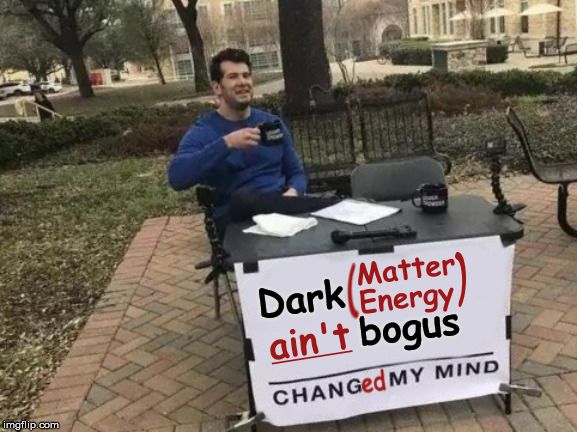
The guy’s got class, I’ll give him that. Astronomer-in-training Jim and Physicist-in-training Newt met his challenges so Change-me Charlie amiably updates his sign.

But he’s not done. “If dark matter’s a thing, how’s it different from dark energy? Mass and energy are the same thing, right, so dark energy’s gotta be just another kind of dark matter. Maybe dark energy’s what happens when real matter that fell into a black hole gets squeezed so hard its energy turns inside out.”

Jim and Newt just look at each other. Even Cap’n Mike’s boggled. Someone has to start somewhere so I speak up. “You’re comparing apples, cabbages and fruitcake. Yeah, all three are food except maybe for fruitcake, but they’re grossly different. Same thing for black holes, dark matter and dark energy — we can’t see any of them directly but they’re grossly different.”

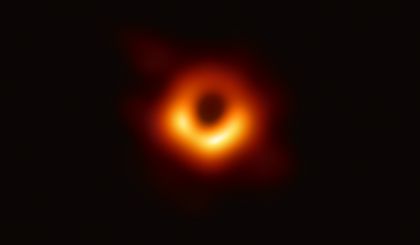
EHT's image of the black hole at the center of the Messier 87 galaxy
Black hole and accretion disk, image by the Event Horizon Telescope Collaboration

Vinnie’s been listening off to one side but black holes are one of his hobbies. “A black hole’s dark ’cause its singularity’s buried inside its event horizon. Whatever’s outside and somehow gets past the horizon is doomed to fall towards the singularity inside. The singularity itself might be burn-your-eyes bright but who knows, ’cause the photons’re trapped. The accretion disk is really the only lit-up thing showing in that new EHT picture. The black in the middle is the shadow of the horizon, not the hole.”

Jim picks up the tale. “Dark matter’s dark because it doesn’t care about electromagnetism and vice-versa. Light’s an electromagnetic wave — it starts when a charged particle wobbles and it finishes by wobbling another charged particle. Normal matter’s all charged particles — negative electrons and positive nuclei — so normal matter and light have a lot to say to each other. Dark matter, whatever it is, doesn’t have electrical charges so it doesn’t do light at all.”

“Couldn’t a black hole have dark matter in it?”

“From what little we know about dark matter or the inside of a black hole, I see no reason it couldn’t.”

“How about normal matter falls in and the squeezing cooks it, mashes the pluses and minuses together and that’s what makes dark matter?”

“Great idea with a few things wrong with it. The dark matter we’ve found mostly exists in enormous spherical shells surrounding normal-matter galaxies. Your compressed dark matter is in the wrong place. It can’t escape from the black hole’s gravity field, much less get all the way out to those shells. Even if it did escape, decompression would let it revert to normal matter. Besides, we know from element abundance data that there can’t ever have been enough normal matter in the Universe to account for all the dark matter.”

Newt’s been waiting for a chance to cut in. “Dark energy’s dark, too, but it works in the opposite direction from the other two. Gravity from normal matter, black holes or otherwise, pulls things together. So does gravity from dark matter which is how we even learned that it exists. Dark energy’s negative pressure pulls things apart.”

“Could dark energy pull apart a black hole or dark matter?”

Big Cap’n Mike barges in. “Depends on if dark matter’s particles. Particles are localized and if they’re small enough they do quantum stuff. If that’s what dark matter is, dark energy can move the particles apart. My theory is dark matter’s just ripples across large volumes of space so dark energy can change how dark matter’s spread around but it can’t break it into pieces.”

Vinnie stands up for his hobby. “Dark energy can move black holes around, heck it moves galaxies, but like Sy showed us with Old Reliable it’s way too weak to break up black holes. They’re here for the duration.”

Newt pops him one. “The duration of what?”

“Like, forever.”

“Sorry, Hawking showed that black holes evaporate. Really slowly and the big ones slower than the little ones and the temperature of the Universe has to cool down a bit more before that starts to get significant, but not even the black holes are forever.”

“How long we got?”

“Something like 10106 years.”

“That won’t be dark energy’s fault, though.”

~~ Rich Olcott

The Magnificent Seven

“Hey, Sy, you said there’s seven fundamental standards. We’ve talked about the second and the meter and the kilogram and the ampere. What’s left?”

“The mole, the kelvin and the candela, Al. They’re all kinda special-purpose but each has its charms. The mole, for instance, is cute and fuzzy and has its very own calendar date.”

“You’re pulling our legs, Sy. A cute unit of measure? No way.”

“Hear me out, Vinnie. How many shoes in a dozen pairs?”

“Huh? Two dozen, that’s twenty-four.”

“Sure, but it’s easier to work in dozens. How many hydrogen atoms in a dozen H2O molecules?”

“Two dozen, of course. Are we going somewhere here?”

“Next step. A mole is like a dozen on steroids, about 6×10²³ whatevers. How many hydrogen atoms in a mole of H2O molecules?”

“Two moles, I suppose, or 12×1023.”

“You got the idea.”

“Cute.”

“A-hah! Gotcha for one.”

“Fair hit. How about the fuzzy part and the date?”

“The fuzzy has to do with isotopes. Every element has an atomic number and an atomic weight. The atomic number counts protons in the nucleus –all atoms of an element have the same atomic number. But different isotopes of an element have different numbers of neutrons. The ‘weight’ is protons plus neutrons, averaged across the isotopes. If you’re holding a mole of an element, you’re holding its atomic weight in grams. The fuzzy happens because samples of an element from different sources can have different mixtures of isotopes. You may have some special diamonds that contain nothing but carbon-12. A mole of those atoms masses exactly 12 grams. My sample is enriched with 10% of carbon-13. Mole-for-mole, my carbon is a tad heavier than yours. In fact, 6×10²³ of my atoms mass 12.10 grams. That’s an extreme example but you get the idea.”

“Fuzzy, a little, OK. And the date thing?”

“June 23 is Mole Day, celebrated by Chemistry teachers everywhere.”

“What’s the kelvin about then?”

“Temperature. And most solid-state electronics. Zero kelvin is absolute zero, the coldest temperature something can get, when the maximum heat has been sucked out and all its atoms have minimum vibrational energy. From there you heat it up degree by degree until you get to where water can co-exist as liquid, solid and water vapor. It used to be the standard to call that temperature 273.16 K.”

“Used to be? Water doesn’t do that any more?”

“Oh, it still does, but the old standard had problems. It used five different ‘official’ techniques and 16 different calibration checks to cover the range from 3 K up to the melting point of copper. Some of those standards, like the melting pressure of helium-3, are not only inconvenient but expensive. Others led to measured intermediate temperatures that disagree depending on which direction you’re going. The defined standards did nothing for the plasma people who work above 1500 K. It was a mess.”

“So how does the new standard fix that?”

“It exploits new tech, especially in solid-state science. The Boltzmann constant, kB, is sort of the quantum of heat capacity at the microscopic level. The product kBT is a threshold energy. Practically everything that happens at the quantum level depends on the ratio of some process energy divided by kBT. If the ratio’s high the process runs; if it’s low, nothing. In-between, the response is predictably temperature-dependent. Thanks to a plethora of new solid-state thermal sensors that depend on that logic, we now have a handle on the range from microkelvins to kilokelvins and above.”

“Pretty good. What’s the last one?”

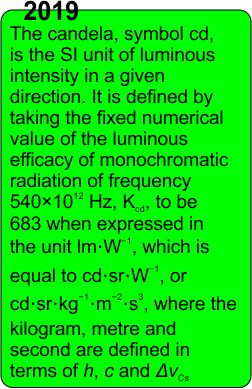
“It’s the one I’m least happy about, the candela. It’s a unit for how bright a light source is, sort-of. Take the source’s power output at all optical frequencies and ‘correct’ that by how much each frequency would stimulate a mathematically modeled ‘standard human eye.’ Isolate the ‘corrected’ watts at 555 nanometers, multiply by Kcd=683. It’s a time-hallowed metric that lighting designers depend upon, but it skips over little things like we actually see with rod cells and three kinds of cone cells, none of which match the standard curve. Kcd is just too human-centered to be a universal constant.”

“Humans ain’t universal. We’re not even on Mars.”

“Yet.”

~~ Rich Olcott

Beautiful Realization

“Whaddaya mean, Sy, ‘charge and resistance and voltage all playing beautiful together‘? How’s that beautiful?”

“It is when they play together in a Kibble Balance, Vinnie. That beautifully-designed device solved the realization problem for two of the revised fundamental standards of measurement. Here’s the one for electricity.”

“That’s odd. It says ‘electric current’ but the number’s about charge. And I don’t see anything in there about voltage or resistance.”

“True. The electronic charge e is one of our universal constants. It and the speed of light and Planck’s constant h are the same on Mars as they are here on Earth. Take a cesium-based laser from Earth to Mars and its frequency doesn’t change. That’s why the revisions are measure-anywhere standards, no need to carry something to Paris to compare it to a physical object.”

“This is another one of those definition tricks, isn’t it? Like the cesium frequency — we defined the second by saying it’s the time required for so-and-so many waves of that light beam. Here, it’s not like someone measured the charge in coulombs, it’s we’re gonna make the coulomb exactly big enough so when we do measure an electron it’ll match up.”

“You’re not wrong, Vinnie, but it’s not quite that arbitrary. Lots of people did measure the electron against the old standard. This number represents the most accurate estimate across all the measurements. The standards board just froze it there. It’s the same strategy they took with the other six fundamental standards — each of them sits on top of a well-known constant.”

“Like Newton’s gravitational constant?”

“Sorry, Al, not that one. It’s universal, alright, but it’s only known to four significant figures, nowhere near the 8-or-better level the metrologists demand.”

“So tell us about the beauty part, Sy.”

I grab some paper napkins from the dispenser at our table. Al gives me a look. In his opinion Vinnie uses way too many of those and he doesn’t want it to spread. “Just using what I need to make a point, Al. Vinnie, I know you like pictures better than algebra but bear with me.”

“Yeah, you went through the kilogram thing pretty quick what with the garlic and all.”

“Oooh, yeah.” <scribbling on the first napkin> “Well anyway, here’s a sketch of the Kibble Balance rigged for weighing but let’s just pay attention to the parts in the dark blue oval. That zig-zag line labeled RK is a resistor that exploits the quantum Hall effect. Quantum math says its resistance is given by RK=h/e2. That’s exactly 25812.80756 ohms.”

“That a lot more digits than gravity.”

“Nice catch, Al. Now the second component in the oval is a quantum voltmeter. If you put a voltage V across it, the Josephson junction inside passes an alternating current whose frequency is f=V/CJ, where CJ=h/2e.” <scribbling on the second napkin> “Put another way. the frequency tells you the voltage from V=f×CJ and that’s the same as V=f×h/2e.” <scribbling on the third napkin> “The current iW going through RK is V/RK and that’s going to be iW=(f×CJ)/(RK)=f×(CJ/RK)=f×(h/2e)/(h/e2)=(f/2)×e. You with me?”

“Gimme a minute… You’re saying that the current is going to be half some frequency, which we can measure, times the charge on an electron. Yeah, that makes sense, ’cause the current is electrons and you got us counting electrons. Hey, wait, what happened to the h?”

“Canceled out in the fraction, just the way that e canceled out in the fraction for the kilogram.”

“Cute.”

“Better than cute, it’s beautiful. The same equipment, the Kibble Balance plus a gravimeter, gives you the realization of a kilogram depending only on h, AND the realization of the ampere depending only on e. Once you know the standards for time, which depends only on that cesium frequency, and for length, which depends only on time and the speed of light, you can get standards for mass and electric current in the NIST lab here on Earth or up on Mars or anywhere.”

“Almost anywhere.”

“What’s your exception?”

“In space, where there’s no gravity.”

“Einstein covered that with his Equivalence Principle.”

~~ Rich Olcott

The Currant Affair

Al has a new sign up at his coffee shop, “Scone of the day — Current.” He chuckles when I quietly point out the spelling error. “I know how to spell currant, Sy. I’m just gonna enjoy telling people that whatever I’m taking from the oven is the current flavor.” I’m high-fiving him for that, just as Vinnie slams in and yells out, “Hey, Al, you got your sign spelled wrong. Got any cranberry ones in there?”

Al gives me a look. I shrug. Vinnie starts in on me. “Hey, Sy, that was pretty slick what that Kibble guy did. All the measurements and calculations had the mass standard depending on three universal constants but then suddenly there was only two.”

Al pricks up his ears. “Universal constants, Sy?”

“We think so. Einstein said that the speed of light c is the same everywhere. That claim has withstood a century of testing so the International Bureau of Weights and Measures took that as their basis when they redefined the meter as the standard of length. Planck’s constant h is sometimes called the quantum of action. It shows up everywhere in quantum-related phenomena and appears to be fundamental to the way the Universe works. Bryan Kibble’s team created a practical way to have a measure-anywhere standard of mass and it just happens to depend only on having good values for c and h.”

“What’s the one that Vinnie said dropped out?”

“I knew you’d ask that, Al. It’s e, the charge on an electron. The proton and every other sub-atomic particle we’ve measured has a charge that’s some integer multiple of e. Sometimes the multiplier is one, sometimes it’s zero, sometimes it’s a negative, but e appears to be a universal quantum of charge. Millikan’s oil drop experiment is the classic example. He measured the charge on hundreds of ionized droplets floating in an electric field between charged plates. Every droplet held some integer multiple between 1 and 150 of 1.6×10⁻¹⁹ Coulomb.”

“That’s a teeny bit of electricity. I remember from Ms Kendall’s class that one coulomb is one ampere flowing for one second. Then a microampere flowing for a microsecond is, uhh, 6 million electrons. How did they make that countable?”

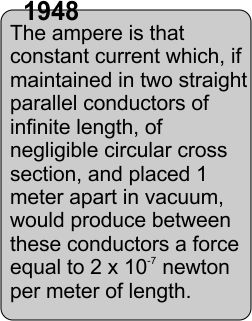
“Ah, you’ve just touched on the ‘realization problem,’ which is not about getting an idea but about making something real, turning a definition into a practical measurement. Electrical current is a good example. Here’s the official definition from 60 years ago. See any problems with it, Vinnie?”

“Infinitely long wires that are infinitely thin? Can’t do it. That’s almost as goofy as that 1960 definition of a second. And how does the force happen anyway?”

“The force comes from electrons moving in each wire electromagnetically pushing on the electrons in the other wire, and that’s a whole other story. The question here is, how could you turn those infinities into a real measurement?”

“Lemme guess. In the 1960 time standard they did a math trick to model a fake Sun and based the second on how the fake Sun moves. Is this like that, with fake wires?”

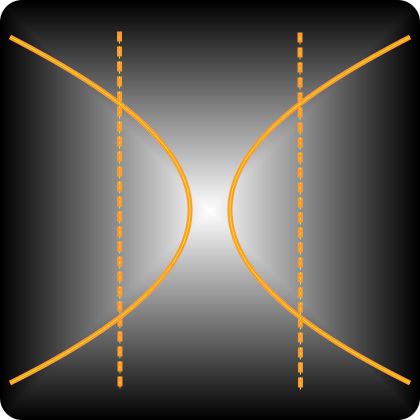
“Nice shot, Vinnie. One of the methods worked like that — take a pair of wires with a known resistance, bend them along a pair of parabolas or some other known curve set close together, apply a voltage and measure the force. Then you use Maxwell’s equations to ‘correct’ the force to what it would have been with the infinite wires the right distance apart. Nobody was comfortable with that.”

“Not surprised — too many ways to do it wrong, and besides, that’s an awfully small force to measure.”

“Absolutely. Which is why there were so many competing standards, some dating back to the 1860s when we were still trying to figure out what electricity is. Some people used a standard resistor R and the voltage V from a standard chemical cell. Then they defined their standard current I from I=V/R. Some measured power P and calculated I2=P/R. Other people standardized charge from the electrostatic force F=q1q2/r2 between two charged objects; they defined current as charge passed per second. It was a huge debate.”

“Who won?”

“Charge and R and V, all playing together and it’s beautiful.”

~~ Rich Olcott