Red Harvest

<continued> Al’s coffee shop was filling up as word got around about Anne in her white satin.  I saw a few selfie-takers in the physics crowd surreptitiously edge over to get her into their background.  She was busy thinking so she didn’t notice.  “The entropy-elephant picture is starting to come together, Sy.  We started out with entropy measuring accumulated heat capacity in a steam engine.”

“That’s where Carnot started, yes.”

“But when Jeremy threw that hot rock into the black hole” <several in the astronomy crew threw startled looks at Jeremy>, “its heat energy added to the black hole’s mass, but it should have added to the black hole’s entropy, too.  ‘Cause of Vinnie’s Second Law.”white satin and black hole 3

Vinnie looked up.  “Ain’t my Second Law, it’s thermodynamics’ Second Law.  Besides, my version was ‘energy’s always wasted.’  Sy’s the one who turned that into ‘entropy always increases.'”

“So anyway, black holes can’t have zero entropy like people used to think.  But if entropy also has to do with counting possibilities, than how does that apply to black holes?  They have only one state.”

“That’s where Hawking got subtle.  Jeremy, we’ve talked about how the black hole’s event horizon is a mathematical abstraction, infinitely thin and perfectly smooth and all that.”

“Yessir.”

“Hawking moved one step away from that abstraction.  In essence he said the  event horizon is surrounded by a thin shell of virtual particles.  Remember them, Jeremy?”

“Uh-huh, that was on my quest to the event horizon.  Pairs of equal and opposite virtual particles randomly appear and disappear everywhere in space and because they appear together they’re entangled and if one of them dips into the event horizon then it doesn’t annihilate its twin which — Oh!  Random!  So what’s inside the event horizon may have only one state, so far as we know, but right outside the horizon any point may or may not be hosting, can I call it an orphan particle?  I’ll bet that uncertainty give rise to the entropy, right?”

<finger-snaps of approval from the physics side of the room>

“Well done, Jeremy!  ‘Orphan’ isn’t the conventional term but it gets the idea across.”

“Wait, Sy.  You mentioned that surface area and entropy go together and now I see why.  The larger the area, the more room there is for those poor orphans.  When Jeremy’s rock hit the event horizon and increased the black hole’s mass, did the surface area increase enough to allow for the additional entropy?” <more finger-snapping>

“Sure did, Anne.  According to Hawking’s calculation, it grew by exactly the right amount.  Mass and area both grow as the square of the diameter.”

“How come not the radius?”

“Well , Vinnie, the word ‘radius‘ is tricky when you’re discussing black holes.  The event horizon is spherical and has a definite diameter — you could measure it from the outside.  But the sphere’s radius extends down to the singularity and is kind of infinite and isn’t even strictly speaking a distance.  Space-time is twisted in there, remember, and that radial vector is mostly time near its far end.  On the other hand, you could use ‘radius‘ to mean ‘half the diameter‘ and you’d be good for calculating effects outside the event horizon.”

“OK, that’s the entropy-area connection, but how does temperature tie in with surface gravity?”

“They’re both inversely dependent on the black hole’s mass.  Let’s take surface gravity first, and here when I say ‘r‘ I’m talking ‘half-diameter,‘ OK?”

“Sure.”

“Good.  Newton taught us that an object with mass M has a gravitational attraction proportional to M/r².  That still holds if you’re not inside the event horizon.  Now, the event horizon’s r is also proportional to the object’s mass so you’ve got M/M² which comes to 1/M.  With me?”

“Yeah.”

“Hawking used quantum physics to figure the temperature thing, but here’s a sloppy short-cut.  Anne, remember how we said that entropy is approximately heat capacity divided by temperature?”

“Mm-hmm.”

“The shell’s energy is mostly heat and proportional to M.  We’ve seen the shell’s entropy is proportional to .  The temperature is heat divided by entropy.  That’s proportional to M/M² which is the same 1/M as surface gravity.” <boos from all sides>. “Hey, I said it was sloppy.”

~~ Rich Olcott

Schrödinger’s Elephant

Al’s coffee shop sits right between the Astronomy and Physics buildings, which is good because he’s a big Science fan.  He and Jeremy are in an excited discussion when Anne and I walk in.  “Two croissants, Al, and two coffees, black.”

“Comin’ up, Sy.  Hey, you see the news?  Big days for gravitational astronomy.”

Jeremy breaks in.  “There’s a Nobel Prize been announced —”

“Kip Thorne the theorist and Barry Barish the management guy —”

“and Rainer Weiss the instrumentation wizard —”

“shared the Physics prize for getting LIGO to work —”

“and it saw the first signal of a black hole collision in 2015 —”

“and two more since —”

“and confirmed more predictions from relativity theory —”

“and Italy’s got their Virgo gravitational wave detector up and running —”

“And Virgo and our two LIGOs, —”

“Well, they’re both aLIGOs now, being upgraded and all —”

“all three saw the same new wave —”

“and it’s another collision between black holes with weird masses that we can’t account for.  Who’s the lady?”

“Al, this is Anne.  Jeremy, close your mouth, you’ll catch a fly.”  (Jeremy blushes, Anne twinkles.)  “Anne and I are chasing an elephant.”

“Pleased to meetcha, Anne.  But no livestock in here, Sy, the Health Department would throw a fit!”

I grin.  “That’s exactly what Eddie said.  It’s an abstract elephant, Al.  We’ve been discussing entropy. Which is an elephant because it’s got so many aspects no-one can agree on what it is.  It’s got something to do with heat capacity, something to do with possibilities you can’t rule out, something to do with signals and information.  And Hawking showed that entropy also has something to do with black holes.”

“Which I don’t know much about, fellows, so someone will have to explain.”

Jeremy leaps in.  “I can help with that, Miss Anne, I just wrote a paper on them.”

“Just give us the short version, son, she can ask questions if she wants a detail.”

“Yessir.  OK, suppose you took all the Sun’s mass and squeezed it into a ball just a few miles across.  Its density would be so high that escape velocity is faster than the speed of light so an outbound photon just falls back inward and that’s why it’s black.  Is that a good summary, Mr Moire?”

“Well, it might be good enough for an Internet blog but it wouldn’t pass inspection for a respectable science journal.  Photons don’t have mass so the whole notion of escape velocity doesn’t apply.  You do have some essential elements right, though.  Black holes are regions of extreme mass density, we think more dense than anywhere else in the Universe.  A black hole’s mass bends space so tightly around itself that nearby light waves are forced to orbit its region or even spiral inward.  The orbiting happens right at the black hole’s event horizon, its thin shell that encloses the space where things get really weird.  And Anne, the elephant stands on that shell.”white satin and black hole“Wait, Mr Moire, we said that the event horizon’s just a mathematical construct, not something I could stand on.”

“And that’s true, Jeremy.  But the elephant’s an abstract construct, too.  So abstract we’re still trying to figure out what’s under the abstraction.”

“I’m trying to figure out why you said the elephant’s standing there.”

“Anne, it goes back to the event horizon’s being a mathematical object, not a real one.  Its spherical surface marks the boundary of the ultimate terra incognita.  Lightwaves can’t pass outward from it, nor can anything material, not even any kind of a signal.  For at least some kinds of black hole, physicists have proven that the only things we can know about one are its mass, spin and charge.  From those we can calculate some other things like its temperature, but black holes are actually pretty simple.”

“So?”

“So there’s a collision with Quantum Theory.  One of QT’s fundamental assumptions is that in principle we can use a particle’s current wave function to predict probabilities for its future.  But the wave function information disappears if the particle encounters an event horizon.  Things are even worse if the particle’s entangled with another one.”

“Information, entropy, elephant … it’s starting to come together.”

“That’s what he said.”

~~ Rich Olcott

Three Perils for a Quest(ion), Part 3

“Things are finally slowing down.  You folks got an interesting talk going, mind if I join you?  I got biscotti.”

“Pull up a chair, Eddie.  You know everybody?”

“You and Jeremy, yeah, but the young lady’s new here.”

“I’m Jennie, visiting from England.”

“Pleased to meetcha.  So from what I overheard, we got Jeremy on some kinda Quest to a black hole’s crust.  He’s passed two Perils.  There’s a final one got something to do with a Firewall.”

“One minor correction, Eddie.  He’s not going to a crust, because a black hole doesn’t have one.  Nothing to stand on or crash into, anyway.  He’s headed to its Event Horizon, which is the next best thing.  If you’re headed inward, the Horizon marks the beginning of where it’s physically impossible to get out.”

“Hotel California, eh?”

“You could say that.  The first two Perils had to do with the black hole’s intense gravitational field.  The one ahead has to do with entangled virtual particles.”

“Entangled is the Lucy-and-Ethel thing you said where two particles coordinate instant-like no matter how far apart they are?”

“Good job of overhearing, there, Eddie.  Jeremy, tell him abut virtual particles.”

“Umm, Mr Moire and I talked about a virtual particle snapping into and out of existence in empty space so quickly that the long-time zero average energy isn’t affected.”

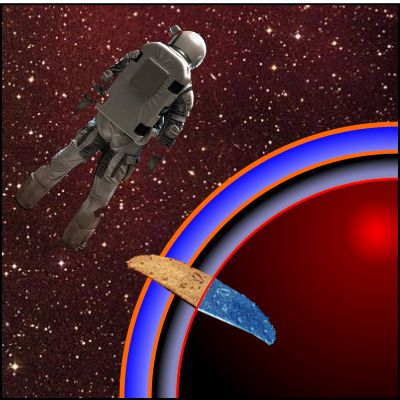
“What we didn’t mention then is that when a virtual pair is created, they’re entangled.  Furthermore, they’re anti-particles, which means that each is the opposite of the other — opposite charge, opposite spin, opposite several other things.  Usually they don’t last long — they just meet each other again and annihilate, which is how the average energy stays at zero.  Now think about creating a pair of virtual particles in the black hole’s intense gravitational field where the creation event sends them in opposite directions.”Astronaut and semi-biscotto
“Umm… if they’re on opposite paths then one’s probably headed into the Horizon and the other is outbound. Is the outbound one Hawking radiation?  Hey, if they’re entangled that means the inbound one still has a quantum connection with the one that escaped!”

“Wait on.  If they’re entangled and something happening to one instantaneously affects its twin, but the gravity difference gives each a different rate of time dilation, how does that work then?”

“Paradox, Jennie!  That’s part of what the Firewall is about.  But it gets worse.  You’d think that inbound particle would add mass to the black hole, right?”

“Surely.”

“But it doesn’t.  In fact, it reduces the object’s mass by exactly each particle’s mass.  That ‘long-time zero average energy‘ rule comes into play here.  If the two are separated and can’t annihilate, then one must have positive energy and the other must have negative energy.  Negative energy means negative mass, because of Einstein’s mass-energy equivalence.  The positive-mass twin escapes as Hawking radiation while the negative-mass twin joins the black hole, shrinks it, and by the way, increases its temperature.”

“Surely not, Sy.  Temperature is average kinetic energy.  Adding negative energy to something has to decrease its temperature.”

“Unless the something is a black hole, Jennie.  Hawking showed that a black hole’s temperature is inversely dependent on its mass.  Reduce the mass, raise the temperature, which is why a very small black hole radiates more intensely than a big one.  Chalk up another paradox.”

“Two paradoxes.  Negative mass makes no sense.  I can’t make a pizza with negative cheese.  People would laugh.”

“Right.  Here’s another.  Suppose you drop some highly-structured object, say a diamond, into a black hole.  Sooner or later, much later really, that diamond’s mass-energy will be radiated back out.  But there’s no relationship between the structure that went in and the randomized particles that come out.  Information loss, which is totally forbidden by thermodynamics.  Another paradox.”

“The Firewall resolves all these paradoxes then?”

“Not really, Jennie.  The notion is that there’s this thin layer of insanely intense energetic interactions, the Firewall, just outside of the Event Horizon.  That energy is supposed to break everything apart — entanglements, pre-existing structures, quantum propagators (don’t ask), everything, so what gets through the horizon is mush.  Many physicists think that’s bogus and a cop-out.”

“So no Firewall Peril?”

“Wanna take the chance?”

~~ Rich Olcott

Three Perils for a Quest(ion), Part 2

Eddie came over to our table.  “Either you folks order something else or I’ll have to charge you rent.”  Typical Eddie.

“Banana splits sound good to you two?”

[Jeremy and Jennie] “Sure.”

“OK, Eddie, two banana splits, plus a coffee, black, for me.  And an almond biscotti.”

“You want one, that’s a biscotto.”

“OK, a biscotto, Eddie.  The desserts are on my tab.”

“Thanks, Mr Moire.”

“Thanks, Sy.  I know you want to get on to the third Peril on Jeremy’s Quest for black hole evaporation, but how does he get past the Photon Sphere?”

“Yeah, how?”

“Frankly, Jeremy, the only way I can think of is to accept a little risk and go through it really fast.  At 2/3 lightspeed, for instance, you and your two-meter-tall suit would transit that zero-thickness boundary in about 10 nanoseconds.  In such a short time your atoms won’t get much out of position before the electromagnetic fields that hold your molecules together kick back in again.”

“OK, I’ve passed through.  On to the Firewall … but what is it?”

“An object of contention, for one thing.  A lot of physicists don’t believe it exists, but some claim there’s evidence for it in the 2015 LIGO observations.  It was proposed a few years ago as a way out of some paradoxes.”

“Ooo, Paradoxes — loverly.  What’re the paradoxes then?”

“Collisions between some of the fundamental principles of Physics-As-We-Know-It.  One goes back to the Greeks — the idea that the same thing can’t be in two places at once.”

“Tell me about it.  Here’s your desserts.”

“Thanks, Eddie.  The place keeping you busy, eh?”

“Oh, yeah.  Gotta be in the kitchen, gotta be runnin’ tables, all the time.”

“I could do wait-staff, Mr G.  I’m thinking of dropping track anyway, Mr Moire, 5K’s don’t have much in common with base running which is what I care about.  How about I show up for work on Monday, Mr G?”

“Kid calls me ‘Mr’ — already I like him.  You’re on, Jeremy.”

“Woo-hoo!  So what’s the link between the Firewall and the Greeks?”

Link is the right word, though the technical term is entanglement.  If you create two particles in a single event they seem to be linked together in a way that really bothered Einstein.”

“For example?”Astronaut and biscotti
“Polarizing sunglasses.  They depend on a light wave’s crosswise electric field running either up-and-down or side-to-side.  Light bouncing off water or road surface is predominately side-to-side polarized, so sunglasses are designed to block that kind.  Imagine doing an experiment that creates a pair of photons named Lucy and Ethel.  Because of how the experiment is set up, the two must have complementary polarizations.  You confront Lucy with a side-to-side filter.  That photon gets through, therefore Ethel should be blocked by a side-to-side filter but should go through an up-and-down filter.  That’s what happens, no surprise.  But suppose your test let Lucy pass an up-and-down filter.  Ethel would pass a side-to-side filter.”

“But Sy, isn’t that because each photon has a specific polarization?”

“Yeah, Jennie, but here’s the weird part — they don’t.  Suppose you confront Lucy with a filter set at some random angle.  There’s only the one photon, no half-way passing, so either it passes or it doesn’t.  Whenever Lucy chooses to pass, Ethel usually passes a filter perpendicular to that one.  It’s like Ethel hears from Lucy what the deal was — and with zero delay, no matter how far away the second test is executed.  It’s as though Lucy and Ethel are a single particle that occupies two different locations.  In fact, that’s exactly how quantum mechanics models the situation.  Quite contrary to the Greeks’ thinking.”

“You said that Einstein didn’t like entanglement, either.  How come?”

“Einstein published the original entanglement mathematics in the 30s as a counterexample against Bohr’s quantum mechanics.  The root of his relativity theories is that the speed of light is a universal speed limit.  If nothing can go faster than light, instantaneous effects like this can’t happen.  Unfortunately, recent experiments proved him wrong.  Somehow, both Relativity and Quantum Mechanics are right, even though they seem to be incompatible.”

“And this collision is why there’s a problem with black hole evaporation?”

“It’s one of the collisions.”

“There’s more?  Loverly.”

~~ Rich Olcott

The Thin Edge of Infinity

Late in the day, project’s half done but it’s hungry time.  I could head home for a meal and drive back, but instead I board the elevator down to Eddie’s Pizza on the second floor.  The door opens on 8 and Jeremy gets on, with a girl.

“Oh, hi, Mr. Moire.  Didja see I hit a triple in the last game?  What if the Sun became a black hole?  This is that English girl I told you about.”

“Hello, Jennie.”

“Wotcha, Sy.”

“You know each other?”

“Ra-ther.  He wrote me into his blog a year ago.  You were going on about particles then, right, Sy?”

“Right, Jennie, but that was particles confined in atoms.  Jeremy’s interested in larger prey.”

“So I hear.”

The elevator lets us out at Eddie’s place.  We luck into a table, order and resume talking.  I open with, “What’s a particle?”

“Well, Sy, your post with Jeremy says it’s an abstract point with a minimal set of properties, like mass and charge, in a mathematical model of a real object with just that set of properties.”

“Ah, you’ve been reading my stuff.  That simplifies things.  So when can we treat a black hole like a particle?  Did you see anything about that in my archives, Jennie?”

“The nearest I can recall was Professor ‘t Hooft’s statement.  Ermm… if the Sun’s so far away that we can calculate planetary orbits accurately by treating it as a point, then we’re justified in doing so.”

“And if the Sun were to suddenly collapse to a black hole?”

“It’d be a lot smaller, even more like a point.  No change in gravity then.  But wouldn’t Earth be caught up in relativity effects like space compression?’

“Not unless you’re really close.  Space compression around a non-rotating (Schwarzchild) black hole scales by a factor that looks like Schwarzchild factor, where D is the object’s diameter and d is your distance from it.  Suppose the Sun suddenly collapsed without losing any mass to become a Schwarzchild object.  The object’s diameter would be a bit less than 4 miles.  Earth is 93 million miles from the Sun so the compression factor here would be [poking numbers into my smartphone] 1.000_000_04.  Nothing you’d notice.  It’d be 1.000_000_10 at Mercury.  You wouldn’t see even 1% compression until you got as close as 378 miles, 10% only inside of 43 miles.  Fifty percent of the effect shows up in the last 13 miles.  The edge of a black hole is sharper than this pizza knife.”Knife-edges
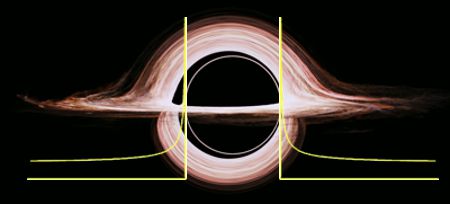
“How about if it’s spinning?  Ms Plenum referred me to a reading about frame-dragging.”

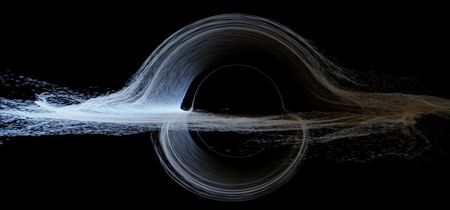
“Ah, Jeremy, you’re thinking of Gargantua, the Interstellar movie’s strangely lopsided black hole.  I just ran across this report by Robbie Gonzalez.  He goes into detail on why the image is that way, and why it should have looked more like this picture.  Check out the blueshift on the left and the shift into the infra-red on the right.”

better Gargantua
A more accurate depiction of Gargantua.  Image from
James, et al., Class. Quantum Grav. 32 (2015) 065001 (41pp),
licensed under CC BY-NC-ND 3.0

[both] “Awesome!”

“So it’s the spin making the weirdness then, Sy?”

“Yes, ma’am.  If Gargantua weren’t rotating, then the space around it would be perfectly spherical.  As Gonzalez explains, the movie’s plotline needed an even more extreme spacetime distortion than they could get from that.  Dr Kip Thorne, their physics guru, added more by spinning his mathematical model nearly up to the physical limit.”

“I’ll bite, Mr Moire.  What’s the limit?”

“Rotating so fast that points on the equator would be going at lightspeed.  Can’t do that.  Anyhow, extreme spin alters spacetime distortion, which goes from spherical to pumpkin-shaped with a twist.  The radial scaling changes form, too, from Schwarzchild factor to Kerr factorA is proportional to spin.  When A is small (not much spin) or the distance is large those A/d² terms essentially vanish relative to the others and the scaling looks just like the simple almost-a-point Schwarzchild case.  When A is large or the distance is small the A/d² terms dominate top and bottom, the factor equals 1 and there’s dragging but no compression.  In the middle, things get interesting and that’s where Dr Thorne played.”
“So no relativity jolt to Earth.”

“Yep.”

“Here’s your pizzas.”

“Thanks, Eddie.”

[sounds of disappearing pizza]

~~ Rich Olcott

Baseball And The Virtual Particle

Al was pouring my mugful of his morning blend (“If it doesn’t wake you up we’ll call the doctor“) when Jeremy stepped into the counter.  “Hi, Mr Moire.  I’m still trying to get my head around that virtual particle thing.  Hi, Al, a large decaf, please, double sugar, three creamers.  It looks like the shorter amount of time you give a particle to happen, the bigger it can get, but that doesn’t make sense because I’d think the longer you wait the more likely it’s gonna happen.  Thanks, Al.”

“Take a breath to blow on that coffee, Jeremy, or you’ll burn your tongue.  Hmm…  Word is your batting average is running about 250 these days.  That right?”

“Yessir.  I didn’t know you’re keeping track.”

“Keeping my ears open is part of my job.  So you’re hitting about once every four at-bats.  That gives Coach an estimate of when you’ll get your next hit.  What’s your slugging average?”

“What’s a slugging average?”

“Your total number of batted-on bases, divided by your at-bats, times a thousand ’cause sports writers don’t do decimal points.  You get one count in the numerator for a single, two for a double and so on.”

“Lemme think.  If I’m doing 250 overall and about half are singles and the other half are doubles that’d give me an SA of … about 375.”

“Pretty good.  So does that number tell Coach anything about when to expect another double?”

“Mmm, no, but what does that have to do with my virtual particle question?”

“In each case you’ve got a pair of statistics that tell you some things and hide other things.  Batting averages and your wait-time notion are about when to expect an event of some sort to occur.  You could hit another single or you could tag a homer — all Coach knows is that you should be able to get on base about once every four at-bats.”

“What about the other statistics?”

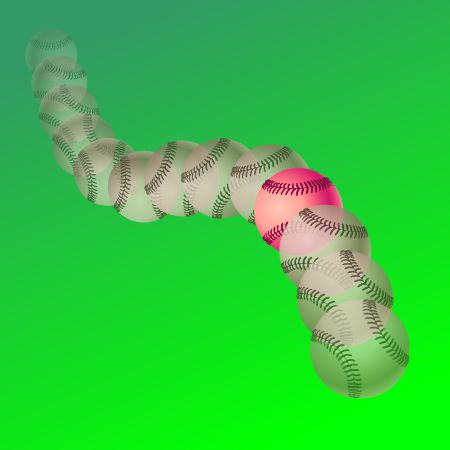
“They’re the flip side, sort of.  You could think of the SA as batting potential.  If you hit homers all the time your SA would be 4000.  If you whiff every pitch your SA would be zero.  Anything between those extremes tells Coach something about your productivity but nothing about when you’re going to produce.  Energy uncertainty works the same way for virtual particles.  If you’re doing long-duration energy evaluations you can be pretty sure that any single measurement will be close to the long-term average.  You might possibly see a significant deviation from that average but only if you check just the right brief interval.”Virtual baseball

“And for the particles in that empty space?”

“If you’re looking long-term, no particles.  That’s what ’empty’ means.  When there’s definitely nothing in a volume of space it makes sense to say its energy is zero because particles have mass and therefore embody energy.  But a particle might show up and go away after a very brief interval without significantly affecting that long-term average.  Quantum theory doesn’t say it will show up, just that it might.”

“So does it?”

“Oh yes, in space, in the lab and in commerce.  One explanation for your cell phone’s NFC function hinges on virtual radio-frequency photons being exchanged between devices.”

“Wait.  If a virtual particle shows up in that empty space, then it’s not empty any more and its energy isn’t zero any more, is it?”

“You’ve just discovered one aspect of zero-point energy, the quantum prediction that every system, even empty space, contains a non-zero minimum amount of energy.  People have thought about tapping that energy to power perpetual motion machines.”

“That’d be cool — the ultimate renewable.”

“Wouldn’t it, though?  But no can do, for a couple of reasons.  Virtual particles, by their nature, are random phenomena.  You can’t depend upon what kind of particle might show up, or when, nor how long it might hang around.  It’s not like NFC where antennas generate the particles.  The other issue is that ‘minimum’ means minimum.  If you could pull energy out of that space you’d lower its energy content and drop it below the minimum…. What’s the grin about?”

“Just wondering how they’d score hitting a virtual ball that disappears before the fielder catches it.”

~~ Rich Olcott

Virtualosity

No knock, the door just opened suddenly.

“Hello, Jeremy.  Rule of Three?”

“Huh?  No, I was down the hall just now when I saw you go into your office so I knew you hadn’t gotten busy with something yet.  Sir.  What’s the Rule of Three?”

“Never mind.  You’re up here about virtual particles, I guess.”

“Yessir.  You said they’re ‘now you might see them, now you probably don’t.’  What’s that about and what do they have to do with abstraction and Einstein’s ‘underlying reality’?”

“What have you heard about Heisenberg’s Uncertainty Principle?”

“Ms Plenum says you can’t know where you are and how fast you’re going.”

“Ms Plenum’s got part of the usual notion but she’s missing the idea of simultaneous precision and a few other things.  Turns out you CAN know approximately where you are AND approximately how fast you’re going at a particular moment, but you can’t know both things precisely.  There’s going to be some imprecision in both measurements.  Think about Coach using a radar gun to track a thrown baseball.  How does radar work?”

“It bounces a light beam off of something and measures the light’s round-trip travel time.  I suppose it multiplies by the speed of light to convert time to distance.”

“Good.  Now how does it get the ball’s speed?”

“Uhh… probably uses two light pulses a certain time apart and calculates the speed as distance difference divided by time difference.”

“Got it in one.  Now, suppose that a second after the ball’s thrown the radar says the ball is 61 feet away from the plate and traveling at 92 mph.  Air resistance acts to slow the ball’s flight so that 92 is really an average.   Maybe it was going 92.1 mph at the first radar pulse and 91.9 mph at the second pulse.  So that reported speed has an 0.2 mph range of uncertainty.”

“Oh, and neither of the two pulses caught the ball at exactly 61 feet so that’s uncertain, too, right?”

“There you go.  We know the two averages, but each of them has a range.  The Uncertainty Principle says that the product of those two ranges has to be greater than Planck’s constant, 10-34 Joule·second.  Plugging that Joule-fraction and the mass of an electron into Einstein’s E=mc², we restate the constant as about 10-21 of an electron-second.  Those are both teeny numbers — but they’re not zero.”

“So speed and location make an uncertainty pair.  Are there others?”Zebras“A few.  The most important for this discussion is energy and time.”

“Wait a minute, those two can’t be linked that way.”

“Why not?”

“Well, because … umm … speed is change of location so those two go together, but energy isn’t change of time.  Time just … goes, and adding energy won’t make it go faster.”

“As a matter of fact, there are situations where adding energy makes time go slower, but that’s a couple of stories for another day.  What we’re talking about here is uncertainty ranges and how they combine.  Quantum theory says that if a given particle has a certain energy, give or take an energy range, and it retains that energy for a certain duration, give or take a time range, then the product of the two ranges has to be larger than that same Planck constant.   Think about a 1-meter cube of empty space out there somewhere.  Got it?

“Sure.”

“Suppose a particle appeared and then vanished somewhere in that cube sometime during a 1-second interval.  What’s the longest time that particle could have existed?”

“Easy — one second.”

“How about the shortest time?”

“Zero.  Wait, it’d be the smallest possible non-zero time, wouldn’t it?”

“Good catch.  So what’s the time uncertainty?”

“One second minus that tiniest bit of time.”

“And what’s the corresponding energy range?”

“That constant number that I forget.”

“10-21 electron-second’s worth.  Now let’s pick a shorter interval.  What’s the mass range for a particle that appears and disappears sometime during the 10-19 second it takes a photon to cross a hydrogen atom?”

“That’s 10-21 electron-second divided by 10-19 second, so it’d be, like, 0.01 electron.”

“How about 1% of that 10-19 second?”

“Wow — that’d be a whole electron.”

“A whole electron’s worth of uncertainty.  But is the electron really there?”

“Probably not, huh?”

“Like I said, ‘Now you probably don’t’.”

~~ Rich Olcott

Abstract Horses

It was a young man’s knock, eager and a bit less hesitant than his first visit.

“C’mon in, Jeremy, the door’s open.”

“Hi, Mr Moire, it’s me, Jerem…  How did ..?  Never mind.  Ready for my black hole questions?”

“I’ll do what I can, Jeremy, but mind you, even the cosmologists are still having a hard time understanding them.  What’s your first question?”

“I read where nothing can escape a black hole, not even light, but Hawking radiation does come out because of virtual particles and what’s that about?”

“That’s a very lumpy question.  Let’s unwrap it one layer at a time.  What’s a particle?”

“A little teeny bit of something that floats in the air and you don’t want to breathe it because it can give you cancer or something.”

“That, too, but we’re talking physics here.  The physics notion of a particle came from Newton.  He invented it on the way to his Law of Gravity and calculating the Moon’s orbit around the Earth.  He realized that he didn’t need to know what the Moon is made of or what color it is.  Same thing for the Earth — he didn’t need to account for the Earth’s temperature or the length of its day.  He didn’t even need to worry about whether either body was spherical.  His results showed he could make valid predictions by pretending that the Earth and the Moon were simply massive points floating in space.”

Accio abstractify!  So that’s what a physics particle is?”

“Yup, just something that has mass and location and maybe a velocity.  That’s all you need to know to do motion calculations, unless the distance between the objects is comparable to their sizes, or they’ve got an electrical charge, or they move near lightspeed, or they’re so small that quantum effects come into play.  All other properties are irrelevant.”

“So that’s why he said that the Moon was attracted to Earth like the apple that fell on his head was — in his mind they were both just particles.”

“You got it, except that apple probably didn’t exist.”

“Whatever.  But what about virtual particles?  Do they have anything to do with VR goggles and like that?”

“Very little.  The Laws of Physics are optional inside a computer-controlled ‘reality.’  Virtual people can fly, flow of virtual time is arbitrary, virtual electrical forces can be made weaker or stronger than virtual gravity, whatever the programmers decide will further the narrative.  But virtual particles are much stranger than that.”

“Aw, they can’t be stranger than Minecraft.  Have you seen those zombie and skeleton horses?”Horses

“Yeah, actually, I have.  My niece plays Minecraft.  But at least those horses hang around.  Virtual particles are now you might see them, now you probably don’t.  They’re part of why quantum mechanics gave Einstein the willies.”

“Quantum mechanics comes into it?  Cool!  But what was Einstein’s problem?  Didn’t he invent quantum theory in the first place?”

“Oh, he was definitely one of the early leaders, along with Bohr, Heisenberg, Schrödinger and that lot.  But he was uncomfortable with how the community interpreted Schrödinger’s wave equation.  His row with Bohr was particularly intense, and there’s reason to believe that Bohr never properly understood the point that Einstein was trying to make.”

“Sounds like me and my Dad.  So what was Einstein’s point?”

“Basically, it’s that the quantum equations are about particles in Newton’s sense.  They lead to extremely accurate predictions of experimental results, but there’s a lot of abstraction on the way to those concrete results.  In the same way that Newton reduced Earth and Moon to mathematical objects, physicists reduced electrons and atomic nuclei to mathematical objects.”

“So they leave out stuff like what the Earth and Moon are made of.  Kinda.”

“Exactly.  Bohr’s interpretation was that quantum equations are statistical, that they give averages and relative probabilities –”

“– Like Schrödinger’s cat being alive AND dead –”

“– right, and Einstein’s question was, ‘Averages of what?‘  He felt that quantum theory’s statistical waves summarize underlying goings-on like ocean waves summarize what water molecules do.  Maybe quantum theory’s underlying layer is more particles.”

“Are those the virtual particles?”

“We’re almost there, but I’ve got an appointment.  Bye.”

“Sure.  Uhh… bye.”

~~ Rich Olcott

The Solar System is in gear

Pythagoras was onto far more than he knew.  He discovered that a stretched string made a musical tone, but only when it was plucked at certain points.  The special points are those where the string lengths above and below the point are in the ratio of small whole numbers — 1:1, 1:2, 2:3, ….  Away from those points you just get a brief buzz.  All of Western musical theory grew out of that discovery.

sinesThe underlying physics is straightforward.  The string produces a stable tone only if its motion has nodes at both ends, which means the vibration has to have a whole number of nodes, which means you have to pluck halfway between two of the nodes you want.  If you pluck it someplace like 39¼:264.77 then you excite a whole lot of frequencies that fight each other and die out quickly.

That notion underlies auditorium acoustics and aircraft design and quantum mechanics.  In a way, it also determines where objects reside in the Solar System.

If you’ve got a Sun with only one planet, that planet can pick any orbit it wants — circular or grossly elliptical, close approach or far, constrained only by the planet’s kinetic energy.

If you toss in a second planet it probably won’t last long — the two will smash together or one will fall into the Sun or leave the system.  There are half-a-dozen Lagrange points, special configurations like “all in a straight line” where things are stable.  Other than those, a three-body system lives in chaos — not even a really good computer program can predict where things will be after a few orbits.

geared-saturnAdd a few more planets in a random configuration and stability goes out the window — but then something interesting happens.  It’s the Chladni effect all over again.  Planets and dust and everything go rampaging around the system.  After a while (OK, a billion years or so) sweet-spot orbits start to appear, special niches where a planet can collect small stuff but where nothing big comes close enough to break it apart.  It’s not like each planet seeks shelter, but if it finds one it survives.
It’s a matter of simple arithmetic and synchrony.  Suppose you’re in a 600-day orbit.  Neighbor Fred looking for a good spot to occupy could choose your same 600-day orbit but on the other side of the Sun from you.  But that’s a hard synchrony to maintain — be off by a few percent and in just a few years, SMASH!

The next safest place would be in a different orbit but still somehow in synchrony with yours.  Inside your orbit Fred has to go faster and therefore has a shorter orbital period than yours.  Suppose Fred’s year is exactly 300 days (a 2:1 period ratio, like a 2:1 gear ratio).  Every six months he’s sort-of close to you but the rest of the time he’s far away.

Our Solar System does seem to have developed using gear-year logic.  Adjacent orbital years are very close to being in whole-number ratios.  Mercury, for instance, circles the Sun in about 88 days.  That’s just 2% away from 2/5 of Venus’s 225¾ days.

This table shows year-lengths for the Sun’s most prominent hangers-on, along with ratios for adjacent objects.  For the “ideal” ratios I arbitrarily picked nearby whole-number multiples of 2.  I calculated how long each object’s year “should” be compared to its lower neighbor — the average inaccuracy across all ten objects is only 0.18%.

Object
Period, years
2 × shorter / longer period
“Ideal” ratio
“Ideal” period, years
Real/”Ideal”
Mercury
0.24
0.24
Venus
0.62
5.11
5 : 2
0.60
102%
Earth
1.00
3.25
3 : 2
0.92
108%
Mars
1.88
3.76
4 : 2
2.00
94%
Ceres
4.60
4.89
5 : 2
4.70
98%
Jupiter
11.86
5.16
5 : 2
11.50
103%
Saturn
29.46
4.97
5 : 2
29.65
99%
Uranus
84.02
5.70
6 : 2
88.37
95%
Neptune
164.80
3.92
4 : 2
168.04
98%
Pluto
248.00
3.01
3 : 2
247.20
100%

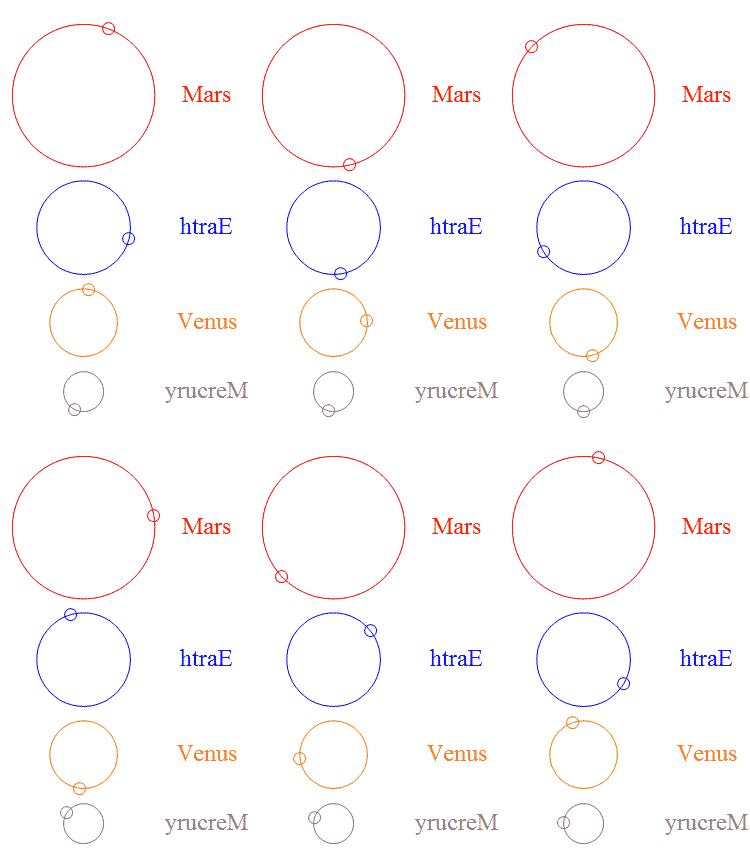
gears-2The usual rings-around-the-Sun diagram doesn’t show the specialness of the orbits we’ve got.  This chart shows the four innermost planets in their “ideal” orbits, properly scaled and with approximately the right phases.  I used artistic license to emphasize the gear-like action by reversing Earth’s and Mercury’s direction.   Earth and Mars are never near each other, nor are Earth and Venus.
It doesn’t show up in this video’s time resolution, but Venus and Mercury demonstrate another way the gears can work.  Mercury nears Venus twice in each full 5-year cycle, once leading and once trailing.  The leading pass slows Mercury down (raising it towards Venus), but the trailing pass speeds it up again.  Net result — safe!

~~ Rich Olcott

Hoppin’ water molecules

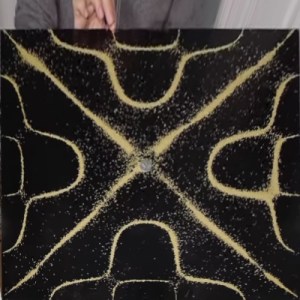
chladny-2Before you get any further in this post, follow this link to Steve Mould’s demonstration of  Chladni figures.  (I’ll wait here.)  It’s a neat demo and the effect plays into some recent discoveries in planetary science.

Steve’s couscous grains dance to the vibrations of the iron plate they’re sitting on.  The patterns happen because he controls where those vibrations happen.  Or more importantly, don’t happen (see his fingers pinching the plate?).

The study of vibration goes back to Pythagoras, the ancient Greek geek who determined that a plucked stretched string invariably exhibits a whole number of peaks and nodes.  (A node is a point on the string that doesn’t move, like those dots on the chart).  I’m so tempted to yammer about the relationship between nodes and quantum mechanics, but I’ve already posted on that topic.sines

The important point for this post is that Steve’s demonstration shows individual particles, each moving under the influence of random impacts, nonetheless winding up at a common destination.  They’re repeatedly kicked away from points where the iron plate is fluctuating strongly.  If a particle suddenly finds itself on a non-fluctuating nodal point (or nodal line, which is just a collection of nodal points), it stays there because why not?

The basic principle applies to numerous phenomena in Physics, Chemistry and other Sciences.  The particles in Chladni’s experiment were grains of sand.  Steve used coucous grains, which work better in video.  But they could also be molecules.  On the Moon.

Back in the 2000s there was intense debate in the lunar astronomy community.  One argument went, “The Solar Wind teems with hydrogen ions (H+).  The Moon’s surface rocks are mostly silicon oxides.  Those H+ ions will yank oxygen O2- ions off exposed rocks to make H2O molecules.  There has to be water on the Moon!”

The other side of the argument (in real Science there’s always at least one other side) went, “Maybe so, but Solar radiation also contains high-energy electrons and photons that’ll rip those molecules apart.  Water can’t survive up there!”

If/when we plant a Moon colony, the colonists will need water.  Either it gets shipped up from Earth — EXPENSIVE — or we find and mine water up there.  NASA did the only thing that could be done — they sent up a spacecraft for a close look.   When the Lunar Reconnaissance Orbiter (the LRO) launched in 2009 it carried half-a-dozen instruments.  One of them was the Lyman Alpha Mapping Project (LAMP) camera.

LAMP was the embodiment of a sly trick.  Buried in starlight’s ultraviolet spectrum are photons (a.k.a. Lyman-α  light) with a wavelength of 121.6 nanometers.  They’re generated by excited hydrogen atoms and they’re (mostly) absorbed by hydrogen atoms but reflected by rock that doesn’t contain hydrogen.

LAMP’s camera was designed to be sensitive to just those Lyman-α photons.  As LRO circled the Moon, the LAMP camera recorded what fraction of those special photons was bouncing off the Moon.  By subtraction, it told us  what fraction was being absorbed by surface hydrogen.

LAMP did find water.  The fun facts are its form and location — it was frost, buried in “fluffy soils” in the walls of craters.
water-moonThis photo, part of the LAMP exhibit at the Denver Museum of Nature and Science, shows why.  It’s a model of a cratered Moon lit by sunlight.

An H2O molecule may develop anywhere on the Moon’s surface.  Then it experiences life’s usual slings and arrows (well, electrons and photons) that might blast it apart or might merely give it a kinetic kick to somewhere else.  That process continues until the molecule or a descendant drops into a nice shady crater.

The best craters would be the ones in the polar regions, where sunlight arrives at a low angle and the crater walls are permanently shadowed like the one at the top in the model.  That’s exactly were LAMP found the most dark spots.  HAH —  Chladni in space!

But there’s more.  In 2012, NASA’s MESSENGER spacecraft produced evidence for water on Mercury, the hottest planet in the Solar System.  Once again, those molecules were hiding in polar craters along with a few other surprising molecular species.  That knocked my socks off when I read the scientific report.

~~ Rich Olcott