The Music of The Spherical Harmonics

Eddie’s diner serves tasty pizza, but his music playlist’s tasty, too — heavy with small-group vocals.  We’re talking atomic structure but suddenly Vinnie surprises me.  “Whoa, she’s got a hot voice!”

“Who?”

“That girl who’s singing.”

“Which one?  That’s a quartet.”

“The alto.”

“How can you pick one voice out of that close-harmony performance?”

“By listening!  She’s the only one singing those notes.”

“You’re hearing a chaotic sound wave yet you can pick out just one sound.”

“Yeah, just her special notes.”

“Interesting thing is, atoms do that, too.  Think about, say, a uranium atom, 92 electrons attracted by the nucleus, repelled by every other electron, all dashing about in the nuclear field and getting in each other’s way.  Think that’d be a nice, orderly picture?”

“Sure not.  It’d be, like you say, chaotic.”

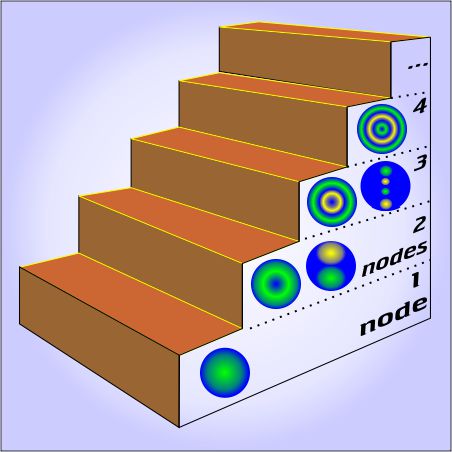
“But just like we can describe a messy sound wave as a combination of frequencies, we can describe that atom’s electron structure as a combination of basic patterns.”  I pull Old Reliable from its holster and bring up an image.  “Here’s something I built for a presentation.  It’s a little busy so I’ll walk you through it.”Shell levels
“Busy, uh-huh.”

“Start with those blue circles.  They look familiar?”

“Right, they’re Laplace’s spherical patterns.  You got them sorted by how many blue spaces they got.”

“Yup.  Blue represents a node, a 2-D region where the value touches or crosses zero.  There are patterns with three or more nodes, but I ran out of space and patience to draw them.  Laplace showed there’s an infinite number of candidate patterns as you add more and more nodes.  You can describe any physically reasonable distribution around the central point as some combination of his patterns.”

“Why’d you draw them on stair-steps?”

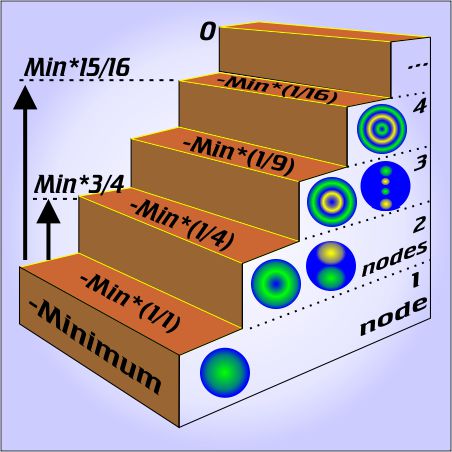
“Because each step (we call it a shell) is at a different potential energy level.  Suppose, for instance, that there’s charge in that one-node pattern.  Moving it away from the nucleus puts a node there.  That’ll cost some energy and shift charge to the two-node shell.  To exclude it from there and also from another node, say a larger spherical surface, would take even more energy, and so on.”

“How is that potential energy?”

“We’re comparing shell energy to the energy of an electron that’s far away.  It’s like gravitational potential energy, maybe the energy a space rock converts to kinetic energy as it falls to Earth.  Call the far-away energy zero.  The numbers get more and more negative as the rock or the charge get closer to the center of attraction.”

“Ah, so that’s why you’ve got minus signs in the picture.”

“Exactly.  See zero at the top of the stairs?  With a hydrogen atom, for instance, an electron would give up 13.6 electron-volts of energy to get close to the nucleus in that 1-node pattern.  Conversely, it’d take 13.6 eV to rip that charge completely away.”

“If the 13.6 is what you’re calling ‘Minimum’, why not just write ‘–13.6’ in there?”

“It’s a different number for different atoms and even ions.  Astronomers see all kinds of ions with every amount of charge so they have to keep things general in their calculations.”

“What are those fractions about?  Wait, don’t tell me, I can figure this.  Each divisor is the square of its node count.  Are those the 1/n² numbers from whosit’s formula?”

Rydberg’s.  You’re on the right track, keep going.”

“If the minimum is 13.6 eV, the diagram says that the two-node shell is … 3.4 eV down from the top and … 10.2 eV up from the bottom.  And from what we said about the hydrogen spectrum, I’ll bet that 10.2 eV jump is the first line in that, was it the Ly series, the one in the ultra-violet?”

“Bravo, Vinnie!  The Lyman series it is.  Excellent memory for detail there.”

“I noticed something else.  You carefully didn’t say we moved an electron between shells.”

“That’s an important point.  At the atomic size scale we can’t treat the electron as a particle moving around.  Lightwaves act to turn off one shell and excite another one, like your singer exciting a different note.”

“Yes, she does.”

~~ Rich Olcott

  • Thanks to the Molnars for a delightful meal, and to their dinner party guests the Jumps for instigating this post.

Shells A-poppin’

We step into Eddie’s.  Vinnie spots Jeremy behind the gelato stand.  “Hey, kid, you studying something Science-y?”

“Yessir, my geology text.”

“Lemme see it a sec, OK?”

“Sure.  Want a gelato?”

“Yeah, gimme a pistachio, double-dip.  I’ll hold your book while you’re doing that.  Ah-hah, Sy, lookie here, page 37 — new textbook but this atom diagram coulda come right out of that 1912 Bohr paper you don’t like.  See, eight dots in a ring around the nucleus.  Can’t be wrong or it wouldn’t have survived this long, right?”

<sigh>  “What it is isn’t what it was.  Bohr proposed his model as a way to explain atomic spectra.  We’ve got a much better model now — but the two agree on three points.  Atoms organize their electronic charge in concentric shells, innermost shells deepest in the nuclear energy well.  Second, each shell has a limited capacity.  Third, when charge moves from one shell to another, light energy is absorbed or emitted to match the energy difference between shells.  Beyond those, not much.  Here, this diagram hints at the differences.”Better Bohr

“The scrambled-looking half is the new picture?”

“Pure chaos, where the only thing you can be sure of is the averages.  These days the Bohr model survives as just an accounting device to keep track of how much charge is in each shell.  That diagram — what kind of atom is it describing?”

“I dunno, two electrons inside, eight outside, ten total.”

“Could be neon, or a fluoride, oxide, sodium or magnesium ion.  From a quantum perspective they all look the same.”

“Here’s your gelato, sir.”

“Thanks, kid, here’s your book back.  But those are different elements, Sy.”

“The important thing, Vinnie, is they all have an outer shell with eight units of charge.  That’s the most stable configuration.”

“What’s so special about eight, Mr Moire?  If it’s pure chaos shouldn’t any number be OK?”

“Like I said, Jeremy, it’s the averages that count.  Actually, this is one of my favorite examples of what Wigner called ‘The Unreasonable Effectiveness of Mathematics in the Natural Sciences.’  Back in 1782, a century and a quarter before anyone took atoms seriously, Laplace did some interesting math.  Have you ever waited for a pot of water to boil and spent the time tapping the pot to see the ripples?”

“Who hasn’t?  Doesn’t boil any faster, though.”

“True.  Looking at those waves, you saw patterns you don’t see with flat reflectors, right?”

“Oh, yeah — some like dumbbells, a lot of circles.”

“Mm-hm.  In a completely random situation all possible patterns could appear, but the pot’s circular boundary suppresses everything except wave patterns that match its symmetry.  You don’t see hexagons, for instance.”

“That’s right, I didn’t.”

“So there’s Laplace in the 1790s, thinking about Newton’s Law of Gravity, and he realizes that even in the boundaryless Solar System there’s still a boundary condition — any well-behaved standing wave has to have the same value at the central point no matter what direction you come from.  He worked out all the possible stable patterns that could exist in a central field like that.  Some of them look like what you saw in the water.  We now classify them by symmetry and node count.”

“Node?”Disk orbitals

“A region where the pattern hits zero, Vinnie.  Density waves range from zero to some positive value; other kinds range from positive to negative values.  A spherical wave could peak at the center and then go to zero infinitely far away.  One node.  Or it could be zero at the center, peak in a spherical shell some distance out and then fade away.  That’d be two nodes.  Or it could be zero at the center, zero far away, and have two peaks at different distances with a spherical third node in between.  Here’s another two-node pattern — that dumbbell shape with nodes at the center and infinity.  You can add radial nodes partway out.”

“I’m getting the picture.”

“Sure.  You might think Laplace’s patterns are just pretty pictures, but electron charge in atoms and ions just happens to collect in exactly those patterns.  Combine Laplace’s one-node and two-node patterns, you get the two lowest-energy stable shells.  They hold exactly ten charge units.  The energies are right, too.  Effective?”

“Unreasonably.”

~~ Rich Olcott

Rockfall

<continued>  The coffee shop crowd had gotten rowdy in response to my sloppy physics, but everyone hushed when I reached for my holster and drew out Old Reliable.  All had heard of it, some had seen it in action — a maxed-out tablet with customized math apps on speed-dial.

“Let’s take this nice and slow.  Suppose we’ve got an non-charged, non-spinning solar-mass black hole.  Inside its event horizon the radius gets weird but let’s pretend we can treat the object like a simple sphere.  The horizon’s half-diameter, we’ll call it the radius, is rs=2G·M/c²G is Newton’s gravitational constant, M is the object’s mass and c is the speed of light.  Old Reliable says … about 3 kilometers.  Question is, what happens when we throw a rock in there?  To keep things simple, I’m going to model dropping the rock gentle-like, dead-center and with negligible velocity relative to the hole, OK?”

<crickets>

“Say the rock has the mass of the Earth, almost exactly 3×10⁻⁶ the Sun’s mass.  The gravitational potential energy released when the rock hits the event horizon from far, far away would be E=G·M·m/rs, which works out to be … 2.6874×1041 joules.  What happens to that energy?”falling rock and black hole

rs depends on mass, Mr Moire, so the object will expand.  Won’t that push on what’s around it?”

“You’re thinking it’d act like a spherical piston, Jeremy, pushing out in all directions?”

“Yeah, sorta.”

“After we throw in a rock with mass m, the radius expands from rs to rp=2G·(M+m)/c².  I set m to Earth’s mass and Old Reliable says the new radius is … 3.000009 kilometers.  Granted the event horizon is only an abstract math construct, but suppose it’s a solid membrane like a balloon’s skin.  When it expands by that 9 millimeters, what’s there to push against?  The accretion disk?  Those rings might look solid but they’re probably like Saturn’s rings — a collection of independent chunks of stuff with an occasional gas molecule in-between.  Their chaotic orbits don’t have a hard-edged boundary and wouldn’t notice the 9-millimeter difference.  Inward of the disk you’ve got vacuum.  A piston pushing on vacuum expends zero energy.  With no pressure-volume work getting done that can’t be where the infall energy goes.”

“How about lift-a-weight work against the hole’s own gravity?”

“That’s a possibility, Vinnie.  Some physicists maintain that a black hole’s mass is concentrated in a shell right at the event horizon.  Old Reliable here can figure how much energy it would take to expand the shell that extra 9 millimeters.  Imagine that simple Newtonian physics applies — no relativistic weirdness.  Newton proved that a uniform spherical shell’s gravitational attraction is the same as what you’d get from having the same mass sitting at the shell’s geometric center.  The gravitational pull the shell exerts on itself originally was E=G·M²/rs.  Lifting the new mass from rs to rp will cost ΔE=G·(M+m)²/r– G·M²/rs.  When I plug in the numbers…  That’s interesting.”

Vinnie’s known me long enough to realize “That’s interesting” meant “Whoa, I certainly didn’t expect THAT!

“So what didja expect and whatcha got?”

“What I expected was that lift-it-up work would also be just a small fraction of the infall energy and the rest would go to heat.  What I got for ΔE here was 2.6874×1041 joules, exactly 100% of the input.  I wonder what happens if I use a bigger planet.  Gimme a second … OK, let’s plot a range …  How ’bout that, it’s linear!”ep-es

“Alright, show us!”

All the infall energy goes to move the shell’s combined mass outward to match the expanded size of the event horizon.  I’m amazed that such a simple classical model produces a reasonable result.”

“Like Miss Plenum says, Mr Moire, sometimes the best science comes from surprises.”

“I wouldn’t show it around, Jeremy, except that it’s consistent with Hawking’s quantum-physics result.”

“How’s that?”

“Remember, he showed that a black hole’s temperature varies as 1/M.  We know that temperature is ΔE/ΔS, where the entropy change ΔS varies as .  We’ve just found that ΔE varies as M.  The ΔE/ΔS ratio varies as M/M²=1/M, just like Hawking said.”

Then Jennie got into the conversation.

~~ Rich Olcott

Red Harvest

<continued> Al’s coffee shop was filling up as word got around about Anne in her white satin.  I saw a few selfie-takers in the physics crowd surreptitiously edge over to get her into their background.  She was busy thinking so she didn’t notice.  “The entropy-elephant picture is starting to come together, Sy.  We started out with entropy measuring accumulated heat capacity in a steam engine.”

“That’s where Carnot started, yes.”

“But when Jeremy threw that hot rock into the black hole” <several in the astronomy crew threw startled looks at Jeremy>, “its heat energy added to the black hole’s mass, but it should have added to the black hole’s entropy, too.  ‘Cause of Vinnie’s Second Law.”white satin and black hole 3

Vinnie looked up.  “Ain’t my Second Law, it’s thermodynamics’ Second Law.  Besides, my version was ‘energy’s always wasted.’  Sy’s the one who turned that into ‘entropy always increases.'”

“So anyway, black holes can’t have zero entropy like people used to think.  But if entropy also has to do with counting possibilities, than how does that apply to black holes?  They have only one state.”

“That’s where Hawking got subtle.  Jeremy, we’ve talked about how the black hole’s event horizon is a mathematical abstraction, infinitely thin and perfectly smooth and all that.”

“Yessir.”

“Hawking moved one step away from that abstraction.  In essence he said the  event horizon is surrounded by a thin shell of virtual particles.  Remember them, Jeremy?”

“Uh-huh, that was on my quest to the event horizon.  Pairs of equal and opposite virtual particles randomly appear and disappear everywhere in space and because they appear together they’re entangled and if one of them dips into the event horizon then it doesn’t annihilate its twin which — Oh!  Random!  So what’s inside the event horizon may have only one state, so far as we know, but right outside the horizon any point may or may not be hosting, can I call it an orphan particle?  I’ll bet that uncertainty give rise to the entropy, right?”

<finger-snaps of approval from the physics side of the room>

“Well done, Jeremy!  ‘Orphan’ isn’t the conventional term but it gets the idea across.”

“Wait, Sy.  You mentioned that surface area and entropy go together and now I see why.  The larger the area, the more room there is for those poor orphans.  When Jeremy’s rock hit the event horizon and increased the black hole’s mass, did the surface area increase enough to allow for the additional entropy?” <more finger-snapping>

“Sure did, Anne.  According to Hawking’s calculation, it grew by exactly the right amount.  Mass and area both grow as the square of the diameter.”

“How come not the radius?”

“Well , Vinnie, the word ‘radius‘ is tricky when you’re discussing black holes.  The event horizon is spherical and has a definite diameter — you could measure it from the outside.  But the sphere’s radius extends down to the singularity and is kind of infinite and isn’t even strictly speaking a distance.  Space-time is twisted in there, remember, and that radial vector is mostly time near its far end.  On the other hand, you could use ‘radius‘ to mean ‘half the diameter‘ and you’d be good for calculating effects outside the event horizon.”

“OK, that’s the entropy-area connection, but how does temperature tie in with surface gravity?”

“They’re both inversely dependent on the black hole’s mass.  Let’s take surface gravity first, and here when I say ‘r‘ I’m talking ‘half-diameter,‘ OK?”

“Sure.”

“Good.  Newton taught us that an object with mass M has a gravitational attraction proportional to M/r².  That still holds if you’re not inside the event horizon.  Now, the event horizon’s r is also proportional to the object’s mass so you’ve got M/M² which comes to 1/M.  With me?”

“Yeah.”

“Hawking used quantum physics to figure the temperature thing, but here’s a sloppy short-cut.  Anne, remember how we said that entropy is approximately heat capacity divided by temperature?”

“Mm-hmm.”

“The shell’s energy is mostly heat and proportional to M.  We’ve seen the shell’s entropy is proportional to .  The temperature is heat divided by entropy.  That’s proportional to M/M² which is the same 1/M as surface gravity.” <boos from all sides>. “Hey, I said it was sloppy.”

~~ Rich Olcott

Schrödinger’s Elephant

Al’s coffee shop sits right between the Astronomy and Physics buildings, which is good because he’s a big Science fan.  He and Jeremy are in an excited discussion when Anne and I walk in.  “Two croissants, Al, and two coffees, black.”

“Comin’ up, Sy.  Hey, you see the news?  Big days for gravitational astronomy.”

Jeremy breaks in.  “There’s a Nobel Prize been announced —”

“Kip Thorne the theorist and Barry Barish the management guy —”

“and Rainer Weiss the instrumentation wizard —”

“shared the Physics prize for getting LIGO to work —”

“and it saw the first signal of a black hole collision in 2015 —”

“and two more since —”

“and confirmed more predictions from relativity theory —”

“and Italy’s got their Virgo gravitational wave detector up and running —”

“And Virgo and our two LIGOs, —”

“Well, they’re both aLIGOs now, being upgraded and all —”

“all three saw the same new wave —”

“and it’s another collision between black holes with weird masses that we can’t account for.  Who’s the lady?”

“Al, this is Anne.  Jeremy, close your mouth, you’ll catch a fly.”  (Jeremy blushes, Anne twinkles.)  “Anne and I are chasing an elephant.”

“Pleased to meetcha, Anne.  But no livestock in here, Sy, the Health Department would throw a fit!”

I grin.  “That’s exactly what Eddie said.  It’s an abstract elephant, Al.  We’ve been discussing entropy. Which is an elephant because it’s got so many aspects no-one can agree on what it is.  It’s got something to do with heat capacity, something to do with possibilities you can’t rule out, something to do with signals and information.  And Hawking showed that entropy also has something to do with black holes.”

“Which I don’t know much about, fellows, so someone will have to explain.”

Jeremy leaps in.  “I can help with that, Miss Anne, I just wrote a paper on them.”

“Just give us the short version, son, she can ask questions if she wants a detail.”

“Yessir.  OK, suppose you took all the Sun’s mass and squeezed it into a ball just a few miles across.  Its density would be so high that escape velocity is faster than the speed of light so an outbound photon just falls back inward and that’s why it’s black.  Is that a good summary, Mr Moire?”

“Well, it might be good enough for an Internet blog but it wouldn’t pass inspection for a respectable science journal.  Photons don’t have mass so the whole notion of escape velocity doesn’t apply.  You do have some essential elements right, though.  Black holes are regions of extreme mass density, we think more dense than anywhere else in the Universe.  A black hole’s mass bends space so tightly around itself that nearby light waves are forced to orbit its region or even spiral inward.  The orbiting happens right at the black hole’s event horizon, its thin shell that encloses the space where things get really weird.  And Anne, the elephant stands on that shell.”white satin and black hole“Wait, Mr Moire, we said that the event horizon’s just a mathematical construct, not something I could stand on.”

“And that’s true, Jeremy.  But the elephant’s an abstract construct, too.  So abstract we’re still trying to figure out what’s under the abstraction.”

“I’m trying to figure out why you said the elephant’s standing there.”

“Anne, it goes back to the event horizon’s being a mathematical object, not a real one.  Its spherical surface marks the boundary of the ultimate terra incognita.  Lightwaves can’t pass outward from it, nor can anything material, not even any kind of a signal.  For at least some kinds of black hole, physicists have proven that the only things we can know about one are its mass, spin and charge.  From those we can calculate some other things like its temperature, but black holes are actually pretty simple.”

“So?”

“So there’s a collision with Quantum Theory.  One of QT’s fundamental assumptions is that in principle we can use a particle’s current wave function to predict probabilities for its future.  But the wave function information disappears if the particle encounters an event horizon.  Things are even worse if the particle’s entangled with another one.”

“Information, entropy, elephant … it’s starting to come together.”

“That’s what he said.”

~~ Rich Olcott

The Thin Edge of Infinity

Late in the day, project’s half done but it’s hungry time.  I could head home for a meal and drive back, but instead I board the elevator down to Eddie’s Pizza on the second floor.  The door opens on 8 and Jeremy gets on, with a girl.

“Oh, hi, Mr. Moire.  Didja see I hit a triple in the last game?  What if the Sun became a black hole?  This is that English girl I told you about.”

“Hello, Jennie.”

“Wotcha, Sy.”

“You know each other?”

“Ra-ther.  He wrote me into his blog a year ago.  You were going on about particles then, right, Sy?”

“Right, Jennie, but that was particles confined in atoms.  Jeremy’s interested in larger prey.”

“So I hear.”

The elevator lets us out at Eddie’s place.  We luck into a table, order and resume talking.  I open with, “What’s a particle?”

“Well, Sy, your post with Jeremy says it’s an abstract point with a minimal set of properties, like mass and charge, in a mathematical model of a real object with just that set of properties.”

“Ah, you’ve been reading my stuff.  That simplifies things.  So when can we treat a black hole like a particle?  Did you see anything about that in my archives, Jennie?”

“The nearest I can recall was Professor ‘t Hooft’s statement.  Ermm… if the Sun’s so far away that we can calculate planetary orbits accurately by treating it as a point, then we’re justified in doing so.”

“And if the Sun were to suddenly collapse to a black hole?”

“It’d be a lot smaller, even more like a point.  No change in gravity then.  But wouldn’t Earth be caught up in relativity effects like space compression?’

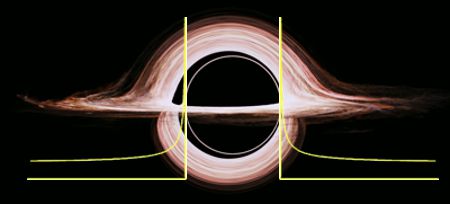
“Not unless you’re really close.  Space compression around a non-rotating (Schwarzchild) black hole scales by a factor that looks like Schwarzchild factor, where D is the object’s diameter and d is your distance from it.  Suppose the Sun suddenly collapsed without losing any mass to become a Schwarzchild object.  The object’s diameter would be a bit less than 4 miles.  Earth is 93 million miles from the Sun so the compression factor here would be [poking numbers into my smartphone] 1.000_000_04.  Nothing you’d notice.  It’d be 1.000_000_10 at Mercury.  You wouldn’t see even 1% compression until you got as close as 378 miles, 10% only inside of 43 miles.  Fifty percent of the effect shows up in the last 13 miles.  The edge of a black hole is sharper than this pizza knife.”Knife-edges
“How about if it’s spinning?  Ms Plenum referred me to a reading about frame-dragging.”

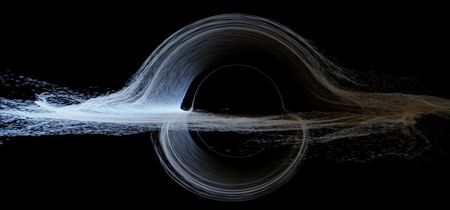
“Ah, Jeremy, you’re thinking of Gargantua, the Interstellar movie’s strangely lopsided black hole.  I just ran across this report by Robbie Gonzalez.  He goes into detail on why the image is that way, and why it should have looked more like this picture.  Check out the blueshift on the left and the shift into the infra-red on the right.”

better Gargantua
A more accurate depiction of Gargantua.  Image from
James, et al., Class. Quantum Grav. 32 (2015) 065001 (41pp),
licensed under CC BY-NC-ND 3.0

[both] “Awesome!”

“So it’s the spin making the weirdness then, Sy?”

“Yes, ma’am.  If Gargantua weren’t rotating, then the space around it would be perfectly spherical.  As Gonzalez explains, the movie’s plotline needed an even more extreme spacetime distortion than they could get from that.  Dr Kip Thorne, their physics guru, added more by spinning his mathematical model nearly up to the physical limit.”

“I’ll bite, Mr Moire.  What’s the limit?”

“Rotating so fast that points on the equator would be going at lightspeed.  Can’t do that.  Anyhow, extreme spin alters spacetime distortion, which goes from spherical to pumpkin-shaped with a twist.  The radial scaling changes form, too, from Schwarzchild factor to Kerr factorA is proportional to spin.  When A is small (not much spin) or the distance is large those A/d² terms essentially vanish relative to the others and the scaling looks just like the simple almost-a-point Schwarzchild case.  When A is large or the distance is small the A/d² terms dominate top and bottom, the factor equals 1 and there’s dragging but no compression.  In the middle, things get interesting and that’s where Dr Thorne played.”

“So no relativity jolt to Earth.”

“Yep.”

“Here’s your pizzas.”

“Thanks, Eddie.”

[sounds of disappearing pizza]

~~ Rich Olcott

No-hair today, grown tomorrow

It was a classic May day, perfect for some time by the lake in the park.  I was watching the geese when a squadron of runners stampeded by.   One of them broke stride, dashed my way and plopped down on the bench beside me.  “Hi, Mr Moire. <pant, pant>”

“Afternoon, Jeremy.  How are things?”

“Moving along, sir.  I’ve signed up for track, I think it’ll help my base-running,  I’ve met a new girl, she’s British, and that virtual particle stuff is cool but I’m having trouble fitting it into my black hole paper.”

“Here’s one angle.  Nobelist Gerard ‘t Hooft said, ‘A particle is fundamental when it’s useful to think of it as fundamental.‘  In that sense, a black hole is a fundamental particle.  Even more elementary than atoms, come to think of it.”

“Huh?”

“It has to do with the how few numbers you need to completely specify the particle.  You’d need a gazillion terabytes for just the temperatures in the interior and oceans and atmosphere of Earth.  But if you’re making a complete description of an isolated atom you just need about two dozen numbers — three for position, three for linear momentum, one for atomic number (to identify which element it represents), one for its atomic weight (which isotope), one for its net charge if it’s been ionized, four more for nuclear and electronic spin states, maybe three or four each for the energy levels of its nuclear and electronic configuration.  So an atom is simpler than the Earth”

“And for a black hole?”

“Even simpler.  A black hole’s event horizon is smooth, so smooth that you can’t distinguish one point from another.  Therefore, no geography numbers.  Furthermore, the physics we know about says whatever’s inside that horizon is completely sealed off from the rest of the universe.  We can’t have knowledge of the contents, so we can’t use any numbers to describe it.  It’s been proven (well, almost proven) that a black hole can be completely specified with only eleven numbers — one for its total mass-energy, one for its electric charge, and three each for position, linear momentum and angular momentum.  Leave out the location and orientation information and you’ve got three numbers — mass, charge, and spin.  That’s it.”

“How about its size or it temperature?”

“Depends how you measure size.  Event horizons are spherical or nearly so, but the equations say the distance from an event horizon to where you’d think its center should be is literally infinite.  You can’t quantify a horizon’s radius, but its diameter and surface area are both well-defined.  You can calculate both of them from the mass.  That goes for the temperature, too.”

“How about if it came from antimatter instead of matter?”

“Makes no difference because the gravitational stresses just tear atoms apart.”

“Wait, you said, ‘almost proven.’  What’s that about?”no hair 1

“Believe it or not, the proof is called The No-hair Theorem.  The ‘almost’ has to do with the proof’s starting assumptions.  In the simplest case, zero change and zero spin and nothing else in the Universe, you’ve got a Schwarzchild object.  The theorem’s been rigorously proven for that case — the event horizon must be perfectly spherical with no irregularities — ‘no hair’ as one balding physicist put it.”

“How about if the object spins and gets charged up, or how about if a planet or star or something falls into it?”

“Adding non-zero spin and charge makes it a Kerr-Newman object.  The theorem’s been rigorously proven for those, too.  Even an individual infalling mass has only a temporary effect.  The black hole might experience transient wrinkling but we’re guaranteed that the energy will either be radiated away as a gravitational pulse or else simply absorbed to make the object a little bigger.  Either way the event horizon goes smooth and hairless.”

“So where’s the ‘almost’ come in?”

“Reality.  The region near a real black hole is cluttered with other stuff.  You’ve seen artwork showing an accretion disk looking like Saturn’s rings around a black hole.  The material in the disk distorts what would otherwise be a spherical gravitational field.  That gnarly field’s too hairy for rigorous proofs, so far.  And then Hawking pointed out the particle fuzz…”

~~ Rich Olcott

Abstract Horses

It was a young man’s knock, eager and a bit less hesitant than his first visit.

“C’mon in, Jeremy, the door’s open.”

“Hi, Mr Moire, it’s me, Jerem…  How did ..?  Never mind.  Ready for my black hole questions?”

“I’ll do what I can, Jeremy, but mind you, even the cosmologists are still having a hard time understanding them.  What’s your first question?”

“I read where nothing can escape a black hole, not even light, but Hawking radiation does come out because of virtual particles and what’s that about?”

“That’s a very lumpy question.  Let’s unwrap it one layer at a time.  What’s a particle?”

“A little teeny bit of something that floats in the air and you don’t want to breathe it because it can give you cancer or something.”

“That, too, but we’re talking physics here.  The physics notion of a particle came from Newton.  He invented it on the way to his Law of Gravity and calculating the Moon’s orbit around the Earth.  He realized that he didn’t need to know what the Moon is made of or what color it is.  Same thing for the Earth — he didn’t need to account for the Earth’s temperature or the length of its day.  He didn’t even need to worry about whether either body was spherical.  His results showed he could make valid predictions by pretending that the Earth and the Moon were simply massive points floating in space.”

Accio abstractify!  So that’s what a physics particle is?”

“Yup, just something that has mass and location and maybe a velocity.  That’s all you need to know to do motion calculations, unless the distance between the objects is comparable to their sizes, or they’ve got an electrical charge, or they move near lightspeed, or they’re so small that quantum effects come into play.  All other properties are irrelevant.”

“So that’s why he said that the Moon was attracted to Earth like the apple that fell on his head was — in his mind they were both just particles.”

“You got it, except that apple probably didn’t exist.”

“Whatever.  But what about virtual particles?  Do they have anything to do with VR goggles and like that?”

“Very little.  The Laws of Physics are optional inside a computer-controlled ‘reality.’  Virtual people can fly, flow of virtual time is arbitrary, virtual electrical forces can be made weaker or stronger than virtual gravity, whatever the programmers decide will further the narrative.  But virtual particles are much stranger than that.”

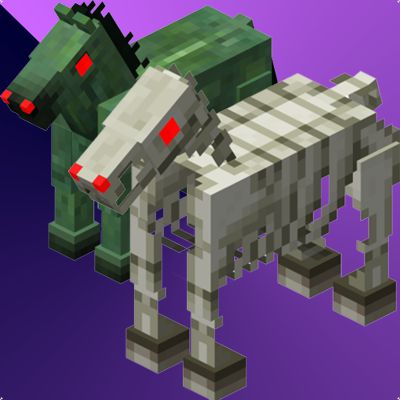
“Aw, they can’t be stranger than Minecraft.  Have you seen those zombie and skeleton horses?”Horses

“Yeah, actually, I have.  My niece plays Minecraft.  But at least those horses hang around.  Virtual particles are now you might see them, now you probably don’t.  They’re part of why quantum mechanics gave Einstein the willies.”

“Quantum mechanics comes into it?  Cool!  But what was Einstein’s problem?  Didn’t he invent quantum theory in the first place?”

“Oh, he was definitely one of the early leaders, along with Bohr, Heisenberg, Schrödinger and that lot.  But he was uncomfortable with how the community interpreted Schrödinger’s wave equation.  His row with Bohr was particularly intense, and there’s reason to believe that Bohr never properly understood the point that Einstein was trying to make.”

“Sounds like me and my Dad.  So what was Einstein’s point?”

“Basically, it’s that the quantum equations are about particles in Newton’s sense.  They lead to extremely accurate predictions of experimental results, but there’s a lot of abstraction on the way to those concrete results.  In the same way that Newton reduced Earth and Moon to mathematical objects, physicists reduced electrons and atomic nuclei to mathematical objects.”

“So they leave out stuff like what the Earth and Moon are made of.  Kinda.”

“Exactly.  Bohr’s interpretation was that quantum equations are statistical, that they give averages and relative probabilities –”

“– Like Schrödinger’s cat being alive AND dead –”

“– right, and Einstein’s question was, ‘Averages of what?‘  He felt that quantum theory’s statistical waves summarize underlying goings-on like ocean waves summarize what water molecules do.  Maybe quantum theory’s underlying layer is more particles.”

“Are those the virtual particles?”

“We’re almost there, but I’ve got an appointment.  Bye.”

“Sure.  Uhh… bye.”

~~ Rich Olcott

Questions, Meta-questions and Answers

<We rejoin Sy and Vinnie in the library stacks…> “Are you boys discussing me?”

<unison> “Oh, hi, Ramona.”

“Actually no, Ramona, we were discussing relativistic time dilation.”

“I know that, Sy, I’ve been reading your posts. Now I’ve got a question.”

“But how…?  Never mind.  Guess I’d better watch my writing.  What can I do for you?”

“You and Vinnie have been going on about kinetic time dilation and gravitational time dilation like they’re two separate things, right?”

“That’s how we’ve treated them, right, but the textbooks do the same.  The velocity-dependent time-stretch equation, tslow/tfast = √[1-(v²/c²)], comes out of Einstein’s Special Theory of Relativity. The gravity-dependent equation, tslow/tfast = √[1-(2G·M/r·c²)], came from his General Theory of Relativity.”

“But there’s no rule that says an object can’t be moving rapidly while it’s in a gravitational field, is there?  That Endurance spacecraft orbiting the black hole in the Interstellar movie certainly seemed to be in that situation.”

“No question, Ramona.  General Relativity’s just more, er, general.”

“Fine, but shouldn’t they work together?”

That got Vinnie started.  “Yeah, Sy, I started this with LIGO and gravity but you and those space shuttles got me into this speed thing.  How do you bridge ’em?”

“Not easily.  Einstein set the rules of the game when he wrote down his fundamental equations.  Physicists and mathematicians have been trying to solve them ever since.  Schwarzchild found the first solution within a year after the equations hit the streets, but he did the simplest possible system — a non-rotating spherical object with no electrical charge and alone in the Universe.  It took another half-century before Kerr and friends figured out how to handle rotating spheres with an electric charge, but even those objects are assumed to be isolated from all other masses.  Mm … how do you figure velocity, Vinnie?”

“Distance divided by time, easy.”

“Not quite that easy.  The equations say that if you’re close to a massive object, space gets compressed, time gets stretched, and the time and space dimensions get scrambled.  Literally.  Time near a Schwarzchild object points inward as you approach the sphere’s center, and don’t ask me how to visualize that.  A Kerr object has a belt around its equator where time runs backwards.  Craziness.”

“Well, how about if I’m not that close?”

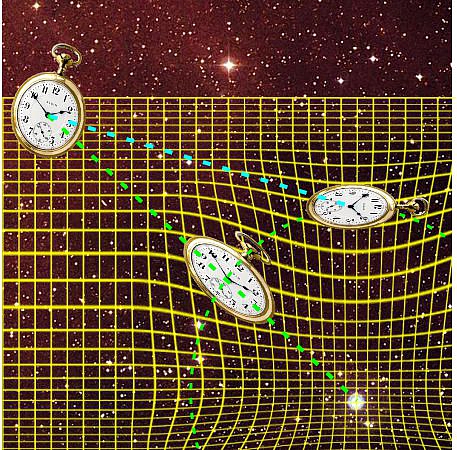
“That’s easier to answer, Ramona.  Suppose the three of us are each flying at safe distances from some heavy object with mass M.  I’m farthest away so I’m holding the fastest clock.  We’ll compare Vinnie’s and your clocks to mine.  OK?”3-clocks

“Sure, why not?”

“Fine.  Now, Vinnie, you’re closer in, resting on the direct line between me and the object.  You’re at distance r from it.  How fast does your clock run?”

“Uhhh…  We’re both on that same radial line so we’re in the same inertial frame, no kinetic effect.  I suppose you see it ticking slower because of the gravitational effect.”

“M-hm, and my clock ticks how often between ticks of yours?”

“You want the equation, huh?  All right, it’s tvinnie/tsy = √[1-(2G·M/r·c²)].”

“You’re reading my mind with those subscripts.  Now, Ramona, you’re at that same distance from the object but you’re in orbit around it.  Measured against Vinnie’s position you’ve got velocity v.  How fast is his clock ticking compared to yours?”

“Mmm…  We’re at the same level in the gravity field, so the gravitational thing makes no difference.  So … tramona/tvinnie = √[1-(v²/c²)].  Aaand, he’d see my clock running slow by the same amount. That’s weird.”

“Weird but true.  Last step — Ramona, you’re deeper in the gravitational field and you’re speeding away from me, so tramona/tsy=(tramona/tvinnie)*(tvinnie/tsy)=√[1-(2G·M/r·c²)]*√[1-(v²/c²)] covers both.”

“OK, that’s settled.  Back to Vinnie’s original question.  LIGOs are set in concrete, their velocities are zero so LIGO signals are all about gravity, right?”

“Right.”

Ramona links arms with him.  “Let’s go dancing.”  Then she gives me the eye.  “Sugarlumps, Sy?  Really?”

On the 12th floor of the Acme Building, high above the city, one man still tries to answer the Universe’s persistent questions — Sy Moire, Physics Eye.

~~ Rich Olcott

Is there a lurker in the Solar System?

The Solar System is much bigger than we learned in school, with a more complicated history.

pillars-with-vortex
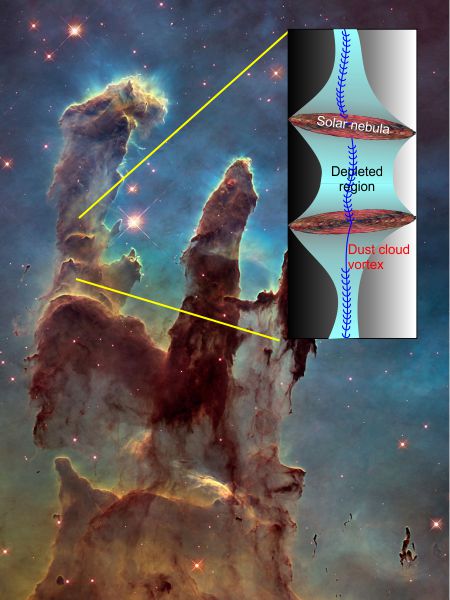
NASA’s 2014 edition of “The Pillars of Creation,”
plus a speculative addition

This famous photograph shows a portion of the Eagle Nebula, about 7,000 lightyears away from us but still within the Milky Way Galaxy.  The nebula is a diffuse mass of dust, gas  (mostly hydrogen atoms, of course) and hundreds of stars aborning.  Spectroscopic red- and blue-shift data could prove me wrong, but to my eye those “pillars” are exactly what you’d expect to see if each had formed around a vortex such as I described in my previous post.  Those two bright rings look very much like solar nebulae, don’t they?

If that’s what the rings are, then the region between them should be even emptier than normal interstellar space (estimated at one hydrogen atom per cm³ or about 30 atoms per fluid ounce if you swing that way).  If you’re floating in vacuum and a whole solar system’s gravity is pulling you towards it, then that’s where you’ll go.  Interstellar space will be emptier without you.

By the way, space between galaxies is a million times emptier than space between stars.

The solar nebula hypothesis does a decent job of explaining the familiar structure — an inward succession of gas giants, then an asteroid belt, then rocky planets, all orbiting within a degree or so of their common Plane of The Ecliptic.  When the Sun lit up 4.6 billion years ago, its fierce light stripped hydrogen and other light elements from the region where the inner planets were coalescing.  Those atoms fled outward to the asteroids, the gas giants and beyond.  An eon later, the rocky planets collected water and other volatiles from impacting comets and such.

But some incoming objects, especially the long-period comets, seem to have no respect for the Ecliptic.  They come at us from all angles, an oddity that led Ernst Öpik and Jan Oort to suggest that the familiar planar Solar System is in fact enclosed by a spherical shell of loosely-held objects, ready to pelt us at any time from wherever they happened to be.

No-one’s yet seen that shell, but statistical models suggest it’s huge.  Earth is one Astronomical Unit (AU) from the Sun.  Neptune, our farthest-out known planet, orbits at about 30 AU.  Researchers think the Oort Cloud starts somewhere near 2,000 AU and runs out to 20,000 or more.  Some suggest it may contain material from other solar systems.

Astronomers also think the Cloud contains something like a trillion objects, pebble-size up to planetoids or bigger.  In a volume that large, the average distance between objects is about 30 AU.  When NASA’s New Horizon spacecraft finally flies through the Oort Cloud 900 years from now, accidentally colliding with something shouldn’t be a problem.

outer-orbits
I drew the Oort Cloud much too small
compared to the purple Kuiper Belt Object orbits
(adapted from the Batygin-Brown paper)

In between the familiar Solar System and the Oort Cloud there’s a whole zoo of objects we’ve only started to glimpse in the past 25 years.  The Kuiper Belt is a doughnut of about 100,000 bodies that stay close to the Ecliptic Plane but orbit from just beyond Neptune’s orbit out to about twice as far.  (By my calculation the average distance between the rocks is, you guessed it, about 30 AU.)  These guys are heavily influenced by Neptune’s gravity and thought to be leftovers from our solar nebula.  Most short-period comets seem to come from the Kuiper Belt.

Recently, CalTech astrophysicists Konstantin Batygin and Michael Brown, drew attention to a half-dozen objects with orbits that were strangely similar.  Unlike the other thousand-or-so Kuiper Belt Objects characterized so far, these all

  • go further than 250 AU from the Sun despite getting as close as 50 AU
  • have a perihelion (the point of closest approach to the Sun) at about the same equatorial latitude (see the diagram)
  • (the kicker) the perihelion drops below the ecliptic by about the same amount.

The authors account for these observations, and more, by hypothesizing a Planet 9 that roams out beyond the Kuiper Belt.  They call it “a mildly inclined, highly eccentric distant perturber.”  I know what you’re thinking, but in the paper those are technical terms.

~~ Rich Olcott