Time Is Where You Find It

A familiar footstep in the hall outside my office, “C’mon in, Vinnie, the door’s open.”

“Got a few minutes, Sy?”

More than just “a minute.” This sounds serious so I push my keyboard aside. “Sure, what’s up?”

“I’ve been thinking about different things, putting ’em together different ways. I came up with something, sorta, that I wanted to run past you before I brought it to one of Cathleen’s ‘Crazy Theories‘ parties.”

“Why, Vinnie, you’re being downright diffident. Spill it.”

“Well, it’s all fuzzy. First part goes way back to years ago when you wrote that there’s zero time between when a photon gets created and when it gets used up. But that means that create and use-up are simultaneous and that goes against Einstein’s ‘No simultaneity‘ thing which I wonder if you couldn’t get around it using time tick signals to sync up two space clocks.”

“That’s quite a mix and I see why you say it’s fuzzy. Would you be surprised if I used the word ‘frame‘ while clarifying it?”

“I’ve known you long enough it wouldn’t surprise me. Go ahead.”

“Let’s start with the synchronization idea. You’re not the first to come up with that suggestion. It can work, but only if the two clocks are flying in formation, exactly parallel course and speed.”

“Hah, that goes back to our first talk with the frame thing. You’re saying the clocks have to share the same frame like me and that other pilot.”

“Exactly. If the ships are zooming along in different inertial frames, each will measure time dilation in the other. How much depends on their relative velocities.”

“Wait, that was another conversation. We were pretending we’re in two spaceships like we’re talking about here and your clock ran slower than mine and my clock ran slower than yours which is weird. You explained it with equations but I’ve never been good with equations. You got a diagram?”

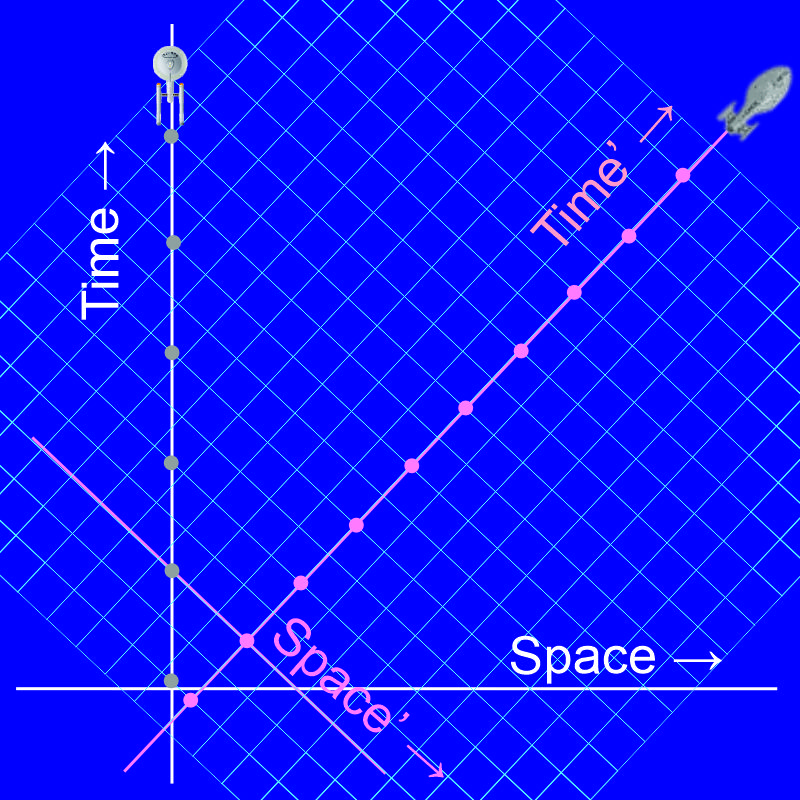
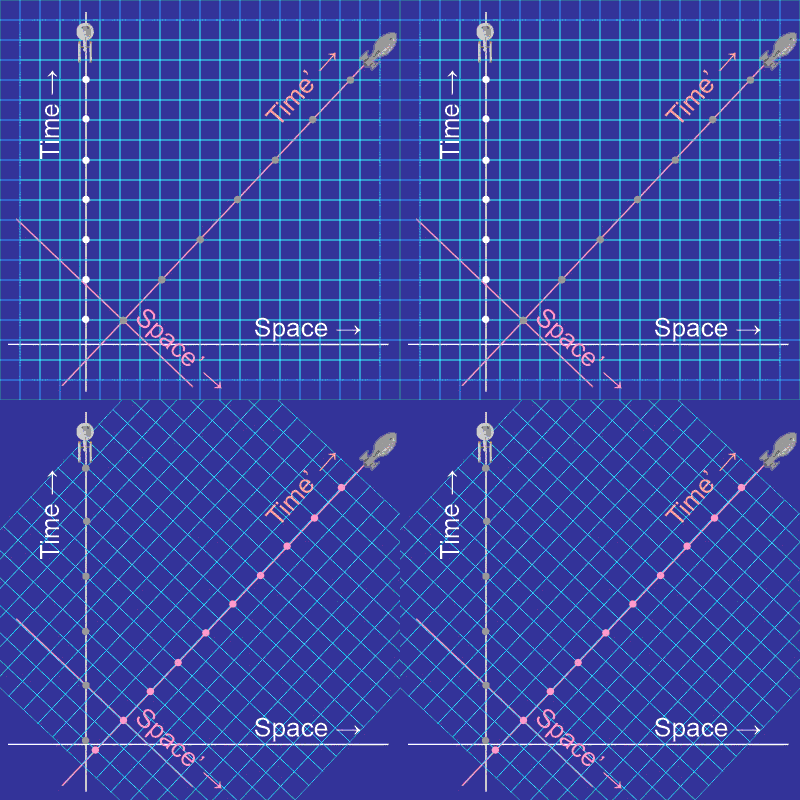
“Better than that, I’ve got a video. It flips back and forth between inertial frames for Enterprise and Voyager. We’ll pretend that they sync their clocks at the point where their tracks cross. I drew the Enterprise timeline vertical because Enterprise doesn’t move in space relative to Enterprise. The white dots are the pings it sends out every second. Meanwhile, Voyager is on a different course with its own timeline so its inertial frame is rotated relative to Enterprise‘s. The gray dots on Voyager‘s track show when that ship receives the Enterprise pings. On the Voyager timeline the pings arrive farther apart than they are on the Enterprise timeline so Voyager perceives that Enterprise is falling farther and farther behind.”

“Gimme a sec … so Voyager says Enterprise‘s timer is going slow, huh?”

“That’s it exactly. Now look at the rotated frame. The pink dots show when Voyager sends out its pings. The gray dots on Enterprise‘s track show when the pings arrive.”

“And Enterprise thinks that Voyager‘s clock is slow, just backwards of the other crew. OK, I see you can’t use sync pulses to match up clocks, but it’s still weird.”

“Which is where Lorentz and Minkowski and Einstein come into the picture. Their basic position was that physical events are real and there should be a way to measure them that doesn’t depend on an observer’s frame of reference. Minkowski’s ‘interval‘ metric qualifies. After converting time and location measurements to intervals, both crews would measure identical spacetime separations. Unfortunately, that wouldn’t help with clock synchronization because spacetime mixes time with space.”

“How about the photons?”

“Ah, that’s a misquotation. I didn’t say the time is zero, I said ‘proper time‘ and that’s different. An object’s proper time is measured by its clock in its inertial frame while traveling time t and distance d between two events. Anyone could measure t and d in their inertial frame. Minkowski’s interval is defined as s=[(ct)²‑d²]. Proper time is s/c. Intuitively I think of s/c as light’s travel time after it’s done traversing distance d. In space, photons always travel at lightspeed so their interval and proper time are always zero.”

“Photon create and use-up aren’t simultaneous then.”

“Only to photons.”

~~ Rich Olcott

The Threshold of Stuffiness

<chirp chirp> “Moire here.”

“Hi, Sy, it’s Susan Kim. I read your humidifier piece and I’ve got your answer for you.”

“Answer? I didn’t know I’d asked a question.”

“Sure you did. You worked out that your humidifier mostly keeps your office at 45% relative humidity by moisturizing incoming air that’s a lot drier than that. As a chemist I like how you brought in moles to check your numbers. Anyway, you wondered how to figure the incoming airflow. I’ve got your answer. It’s a scaling problem.”

“Mineral scaling? No, I don’t think so. The unit’s mostly white plastic so I wouldn’t see any scaling, but it seems to be working fine. I’ve been using de-ionized water and following the instructions to rinse the tank with vinegar every week or so.”

“Nope, not that kind of scale, Sy. You’ve got a good estimate from a small sample and you wondered how to scale it up, is all.”

“Sample? How’d I take a sample?”

“You gave us the numbers. Your office is 1200 cubic feet, right, and it took 88 milliliters of water to raise the relative humidity to where you wanted it, right, and the humidifier used a 1000 milliliters of water to keep it there for a day, right? Well, then. If one roomful of air requires 88 milliliters, then a thousand milliliters would humidify (1000/88)=11.4 room changes per day.”

“Is that a good number?”

“I knew you’d ask. According to the ventilation guidelines I looked up, ‘Buildings occupied by people typically need between 5 and 10 cubic feet per minute per person of fresh air ventilation.‘ You’re getting 11.4 roomfuls per day, times your office volume of 1200 cubic feet, divided by 1440 minutes per day. That comes to 9.5 cubic feet per minute. On the button if you’re alone, a little bit shy if you’ve got a client or somebody in there. I’d say your building’s architect did a pretty good job.”

“I like the place, except for when the elevators act up. All that figuring must have you thirsty. Meet me at Al’s and I’ll buy you a mocha latte.”

“Sounds like a plan.”


“Hi, folks. Saw you coming so I drew your usuals, mocha latte for Susan, black mud for Sy. Did I guess right?”

“Al, you make mocha lattes better than anybody.”

“Thanks, Susan, I do my best. Go on, take a table.”

“Susan, I was thinking while I walked over here. My cousin Crystal doesn’t like to wear those N95 virus masks because she says they make her short of breath. Her theory is that they trap her exhaled CO2 and those molecules get in the way of the O2 molecules she wants to breathe in. What does chemistry say to that theory?”

“Hmm. Well, we can make some estimates. N95 filtration is designed to block 95% of all particles larger than 300 nanometers. A couple thousand CO2 molecules could march abreast through a mesh opening that size no problem. An O2 molecule is about the same size. Both kinds are so small they never contact the mesh material so there’s essentially zero likelihood of differential effect.”

“So exhaled CO2 isn’t preferentially concentrated. Good. How about the crowd‑out idea?”

“Give me a second. <tapping on phone> Not supported by the numbers, Sy. There’s one CO2 for every 525 O2‘s in fresh air. Exhaled air is poorer in O2, richer in CO2, but even there oxygen has a 4‑to‑1 dominance.”

“But if the mask traps exhaled air…”

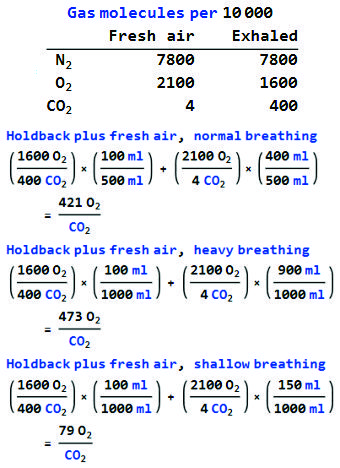
“Right. The key number is the retention ratio, what fraction of an exhaled breath the mask holds back. A typical exhale runs about 500 milliliters, could be half that if you’ve got lung trouble, twice or more if you’re working hard. This mask looks about 300 milliliters just sitting on the table, but there’s probably only 100 milliliters of space when I’m wearing it. It’s just arithmetic to get the O2/CO2 ratio for each breathing mode, see?”

“Looks good.”

“Even a shallow breather still gets 79 times more O2 than CO2. Blocking just doesn’t happen.”

“I’ll tell Crys.”

~ Rich Olcott

Why I Never Know What Time It Is

It’s always fun watching Richard Feder (of Fort Lee, NJ) as he puts two and two together. He gets a gleam in his eye and one corner of his mouth twitches. On a good day with the wind behind him I’ve seen his total get as high as 6½. “I wanna get back to that ‘everybody has their own time‘ monkey‑business where if you’re moving fast your clock slows down. What about the stardates on Star Trek? Those guys go zooming through space at all different angles and speeds. How do they keep their calendars in synch?”

Trekkie and Astronomy fan Al takes the bait. “Artistic license, Mr Feder. The writers can make anything happen, subject to budgets and producer approval. The first Star Trek series, they just used random four‑digit numbers for stardates. That was OK because the network aired the episodes in random order anyway so no‑one cared about story arc continuity. Things were more formal on Captain Picard’s Enterprise, as you’d expect — five‑digit stardates, first digit always ‘4‘ for 24th Century, thousands digit was ‘1‘ for season one, ‘2‘ for season two and so on. Working up the other way, the digit right of the decimal point was tenths of a standard day, the units place counted days within an episode and the tens and hundreds they just picked random numbers.”

“I suppose that’s what they did, but how could they make it work? You guys yammer on about time dilation. Say a ship’s running at Warp Whoop‑de‑doo, relativity should slow its calendar to a crawl. You couldn’t get a whole fleet into battle position when some of the ships had to get started years ahead of time. And that’s just the dilation slow-down, travel time’s on top of that.”

“Travel time measured how, Mr Feder, and from where?”

“Well, there you go, Cathleen, that’s what I’m talking about!”

“You know that Arthur C Clarke quote, ‘Any sufficiently advanced technology is indistinguishable from magic‘? The Enterprise crew’s always communicating with ‘sub‑space radio’, which sure looks like magic to me. They could send sync pulses through there along with chatter. When you drop out of warp space, your clocks catch the pulses and sync up, I suppose.”

“There’s a deeper issue than that, guys.”

“What’s that, Sy?”

“You’re talking like universal time is a thing, which it isn’t. Hasn’t been since Einstein’s Special Relativity used Minkowski’s math to stir space and time together. General Relativity scrambles things even worse, especially close to a strong gravity center. You remember about gravity forcing spacetime to curve, right? The curvature inside a black hole’s event horizon gets so tight that time rotates toward the geometric center. No, I can’t imagine what that looks like, either. The net of it, though, is that a black hole is a funnel into its personal future. Nothing that happens inside one horizon can affect anything inside another one so different holes could even have different time rates. We’ve got something like 25000 or more stellar black holes scattered through the Milky Way, plus that big one in the center, and that’s just one galaxy out of billions. Lots of independent futures out there.”

“What about the past, Sy? I’d think the Big Bang would provide a firm zero for time going forward and it’s been one second per second since then.”

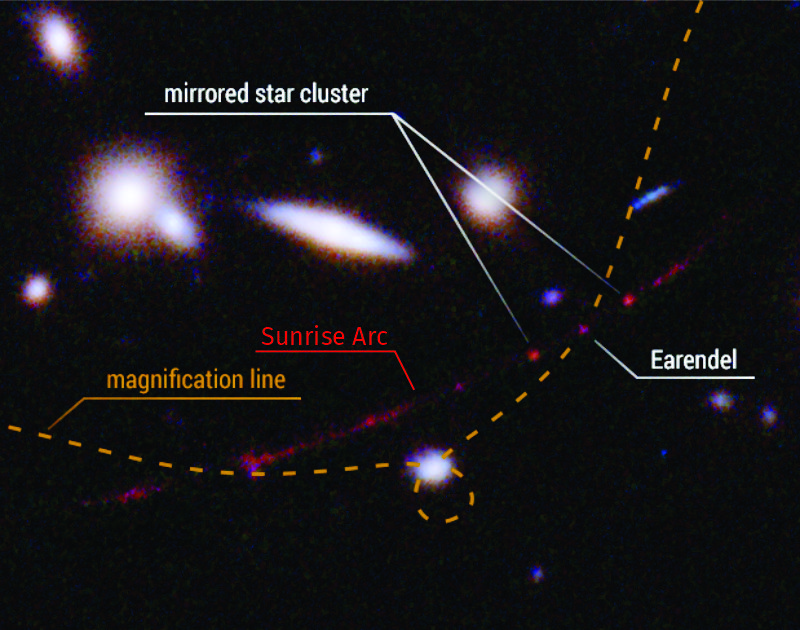
“Nup. Black holes are an extreme case. Any mass slows down time in its vicinity, the closer the slower. That multi‑galaxy gravitational lens that lets us see Earendel? It works because the parts of Earth‑bound light waves closest to the center of mass see more time dilation than the parts farther away and that bends the beam toward our line of sight.”

“Hey, that reminds me of prisms bending light waves.”

“Similar effect, Vinnie, but the geometry’s different. Prisms and conventional lenses change light paths abruptly at their surfaces. Gravitational lenses bend light incrementally along the entire path. Anyhow, time briefly hits light’s brakes wherever it’s near a galaxy cluster, galaxy or anything.”

“So a ship’s clock can fidget depending on what gravity it’s seen recently?”

“Mm-hm. Time does ripples on its ripples. ‘Universal Time‘ is an egregious example of terminology overreach.”

~~ Rich Olcott

A Thumbtack in A Needlestack

“What’re the odds?”

“Odds on what, Vinnie?”

“A gazillion galaxies out there, only 41 lensing galaxy clusters, but one of them shows us a singleton star. I mean, what’s special about that star? What are the odds?”

I can’t help it. “Astronomical, Vinnie.”

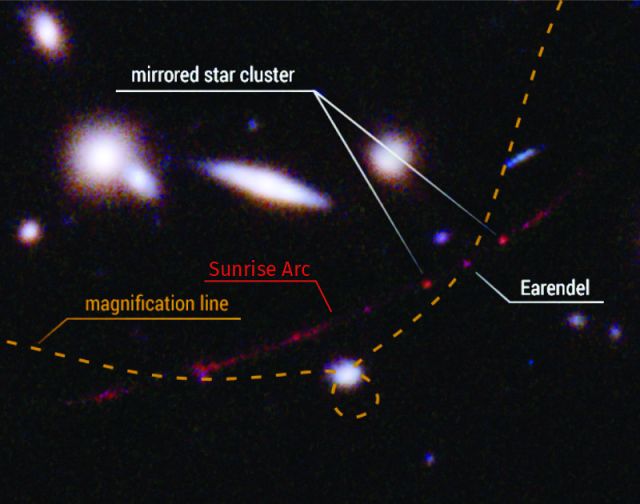
Cathleen punches my shoulder, hard. “Sy Moire, you be ashamed of yourself. That pun was ancient a century ago. Vinnie, the odds are better than they seem. We didn’t just stumble on Earendel and the Sunrise Arc, we found them in a highly targeted Big Data search for things just like that — objects whose light was extremely stretched and also gravitationally bent in our direction. The Arc’s lensing galaxy cluster has a spherical effect, more or less, so it also acts on light from other far-away objects and sends it in other directions. It even bends an image of our Milky Way towards Earendel’s galaxy.”

“I call weaseling — you used ‘more or less‘.”

“Guilty as charged, Vinnie. A nice, spherical black hole is the simplest case of gravitational lensing — just one mass at the center of its simple light‑bending gravity field. Same thing for a single star like our Sun. Clusters are messy. Tens or hundreds of billion‑star galaxies, scattered at random angles and random positions about their common center of mass. The combined gravity field is lumpy, to say the least. Half of that research paper is devoted to techniques for estimating the field and its effects on light in the region around the Arc.”

“I guess they had to get 3D positions for all the galaxies in the cluster. That’d be a lot of work.”

“It would, Al, but that’s beyond what current technology can do. Instead, they used computer models to do — get this, Sy — curve fitting.”

<chuckle> “Good one, Cathleen.”

“What’s so funny?”

“There’s a well-established scientific technique called ‘curve fitting.’ You graph some data and try to find an equation that does a respectable job of running through or at least near your data points. Newton started it, of course. Putting it in modern terms, he’d plot out some artillery data and say, ‘Hmm, that looks like a parabola H=h+v·t+a·t2. I wonder what values of h, v and a make the H-t curve fit those measurements. Hey, a is always 32 feet per second per second. Cool.’ Or something like that. Anyhow, Cathleen’s joke was that the researchers used curve fitting to fit the Sunrise Arc’s curve, right?”

“They did that, Sy. The underlying physical model, something called ‘caustic optics,’ says that—”

“Caustic like caustic soda? I got burnt by that stuff once.”

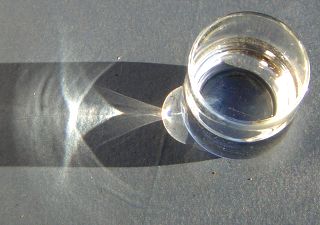
Image by Heiner Otterstedt,
under the Creative Commons Attribution-Share Alike 3.0 Unported license

“That’s the old name for sodium hydroxide, Vinnie. It’s a powerful chemical and yeah, it can give you trouble if you’re not careful. That name and caustic optics both come from the Greek word for burning. The optics term goes back to using a lens as a burning glass. See those focused patterns of light next to your water glass? Each pattern is a caustic. The Arc’s lensing cluster’s like any light‑bender, it’s enclosed in a caustic perimeter. Light passing near the perimeter gets split, the two parts going to either side of the perimeter. The Earendel team’s curve‑fitting project asked, ‘Where must the caustic perimeter be to produce these duplicate galaxy images neighboring the Arc?‘ The model even has that bulge from the gravity of a nearby foreground galaxy.”

“And the star?”

“Earendel seems to be smack on top of the perimeter. Any image touching that special line is intensified way beyond what it ought to be given the source’s distance from us. It’s a pretty bright star to begin with, though. Or maybe two stars.”

“Wait, you don’t know?”

“Not yet. This study pushed the boundaries of what Hubble can do for us. We’re going to need JWST‘s infrared instruments to nail things down.”

Al’s in awe. “Wow — that caustic’s sharp enough to pick one star out of a galaxy.”

“Beat the astronomical odds, huh?”

Adapted from a public-domain image.
Credit: Science: NASA / ESA / Brian Welch (JHU) / Dan Coe (STScI); Image processing: NASA / ESA / Alyssa Pagan (STScI)

~~ Rich Olcott

When The Stars Are Aligned Right

Cathleen and I are chatting when Vinnie bursts into the coffee shop waving a newspaper. “New news, guys, they’ve just announced Hubble spotted the farthest‑away star. How about that? Think what JWST will be able to do!”

Cathleen raises an eyebrow. “Sounds like press release science. What else do they say?”

“Not a whole lot. Lessee… These guys went through old Hubble data and found a piece of an Einstein ring which I don’t know what that is and partway along the ring is a star and somehow they figured out it’s 50 times heavier than the Sun and 12 billion years old and it’s the farthest star they’ve ever seen and that’s why NASA’s all excited.”

“Do you believe all that?”

“Maybe the NASA PR people do?”

“Maybe. I just read the technical paper behind that announcement. The authors themselves aren’t absolutely sure. The paper’s loaded with supporting evidence and ‘how we did it‘ details but it’s also loaded with caveats. The text includes a string of alternative explanations for their observations, winding up with a typical ‘we await further evidence from JWST‘ statement. Reads a lot more like real science. Besides, we’ve already seen more distant stars but they’re all jumbled together inside their very distant galaxies.”

“Unpack it for me. Start with what’s an Einstein ring?”

“It’s a gravitational lensing effect. Sy, does Old Reliable still have a copy of that graphic you did about gravitational lensing?”

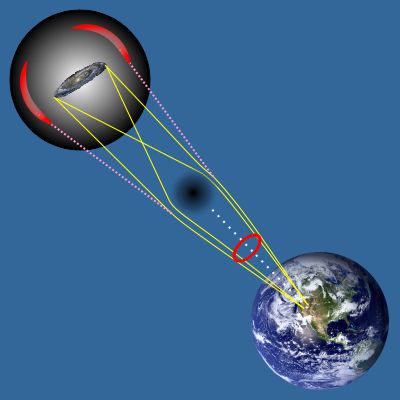
“That was years ago. Let me check… Uh‑huh, here it is.”

“Thanks. Vinnie, you know how a prism changes light’s direction.”

“Sy and me, we talked about how a prism bends light when light crosses from air to glass or the other way ’cause of the different speed it goes in each material. Uhh, if I remember right the light bends toward the slower speed, and you get more bend with shorter wavelengths.”

“Bingo, Vinnie. Gravitational lensing also bends light, but the resemblance ends there. The light’s just going through empty space, not different media. What varies is the shape of spacetime itself. Say an object approaches a heavy mass. Because of relativity the space it moves through appears compressed and its time is dilated. Compressed distance divided by dilated time means reduced velocity. Parts of a spread‑out lightwave closest to the mass slow down more than parts further way so the whole wave bends toward the heavy mass. Okay?”

“Hold on. Umm, so in your picture light coming towards us from that galaxy doesn’t get blocked by that black thingy, the light bends around it on both sides and focuses in on us?”

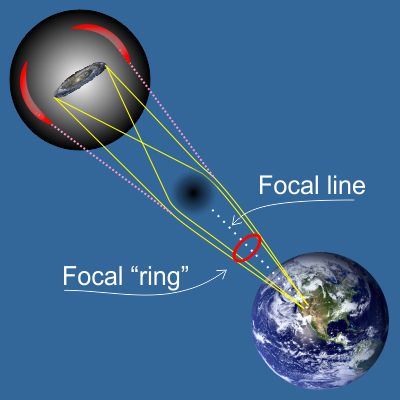
“Exactly. Now carry it further. The diagram cuts a flat 2D slice along round 3D spatial reality. Those yellow lines really are cones. Three‑sixty degrees around the black blob, the galaxy’s light bends by the same amount towards the line between us and the blob. Your Einstein ring is a cut across the cone, assuming that the galaxy, the blob and Earth are all exactly on the same straight line. If the galaxy’s off‑center the picture isn’t as pretty — you only get part of a ring, like those red arcs in Sy’s diagram.”

“A galactic rainbow. That ought to be awesome!”

“Well it would be, but there’s another difference between prisms and blobs. Rainbows happen because prisms and raindrops bend short‑wavelength colors more than longer ones, like you said. Gravitational lensing doesn’t care about wavelength. Wavelengths do shift as light traverses a gravitational well but the outbound red shift cancels the inbound blue shift.. Where gravity generates an Einstein ring, all wavelengths bend through the same angle. Which is a good thing for bleeding‑edge astronomy researchers.”

“Why’s that, Cathleen?”

“If the effect were wavelength‑dependent we’d have aberration, the astronomer’s nemesis. Images would be smeared out. As it is, all the photons from a point hit the same spot on the sensor and we’ve got something to see.”

“Tell him about amplification, Cathleen.”

“Good point, Sy. Each galactic star emits light in every direction. In effect, the blob collects light over its entire surface area and concentrates that light along the focal line. We get the brightest image when the stars are aligned right.”

~~ Rich Olcott

Now And Then And There

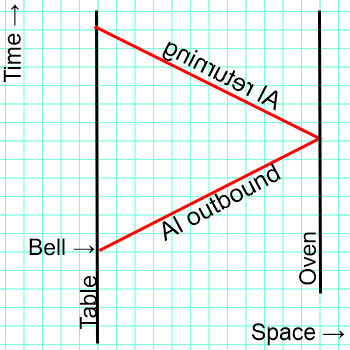
Still at our table in Al’s otherwise empty coffee shop. We’re leading up to how Physics scrambled Now when a bell dings behind the counter. Al dashes over there. Meanwhile, Cathleen scribbles on a paper napkin with her colored pencils. She adds two red lines just as Al comes back with a plate of scones. “Here, Sy, if you’re going to talk Minkowski space this might be useful.”

“Hah, you’re right, Cathleen, this is perfect. Thanks, Al, I’ll have a strawberry one. Mmm, I love ’em fresh like this. OK, guys, take a look at Cathleen’s graphy artwork.”

“So? It’s the tile floor here.”

“Not even close, Mr Feder. Check the labels. The up‑and‑down label is ‘Time’ with later as higher. The diagram covers the period we’ve been sitting here. ‘Now‘ moves up, ‘Here’ goes side‑to‑side. ‘Table‘ and ‘Oven‘, different points in space, are two parallel lines. They’re lines because they both exist during this time period. They’re vertical because neither one moves from its relative spatial position. Okay?”

“Go on, Moire.”
  ”Makes sense to me, Sy.”

“Good. ‘Bell‘ marks an event, a specific point in spacetime. In this case it’s the moment when we here at the table heard the bell. I said ‘spacetime‘ because we’re treating space and time as a combined thing. Okay?”

“Go on, Moire.”
  ”Makes sense to me, Sy.”

“So then Al went to the oven and came back to the table. He traveled a distance, took some time to do that. Distance divided by time equals velocity. ‘Table‘ has zero velocity and its line is vertical. Al’s line would tilt down more if he went faster, okay?”

“Mmmm, got it, Sy.”
  ”Cute how you draw the come-back label backwards, lady. Go on, Moire.”

“I do my best, Mr Feder.”

“Fine, you’ve got the basic ideas. Now imagine all around us there’s graph paper like this — except there’s no paper and it’s a 4‑dimensional grid to account for motion in three spatial dimensions while time proceeds. Al left and returned to the same space point so his spacetime interval is just the time difference. If two events differ in time AND place there’s special arithmetic for calculating the interval.”

“So where’s that get us, Moire?”

“It got 18th and 19th Century Physics very far, indeed. Newton and everyone after him made great progress using math based on a nice stable rectangular space grid crossed with an orderly time line. Then Lorentz and Poincaré and Einstein came along.”

“Who’s Poincaré?”

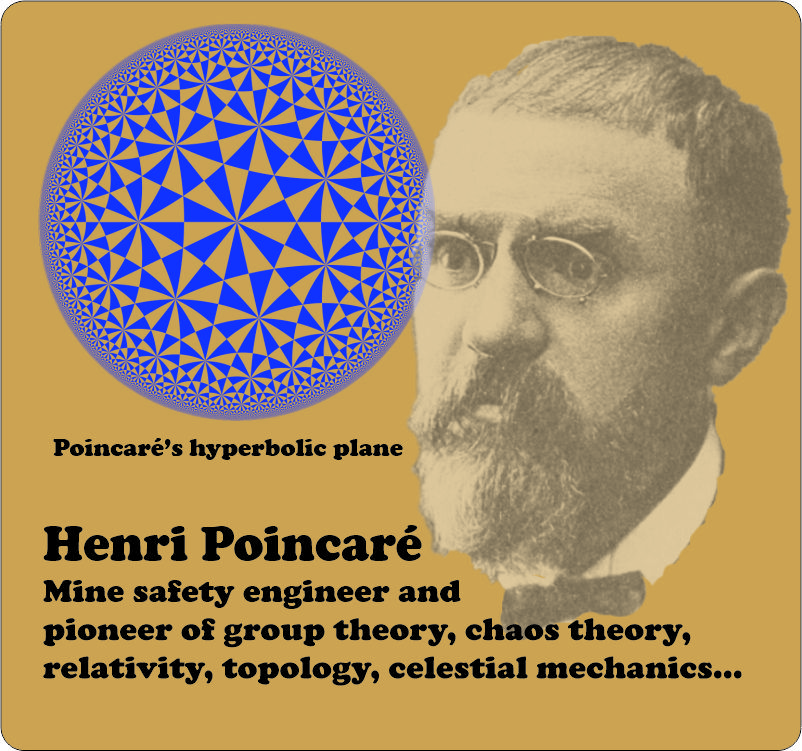
“The foremost mathematician of nineteenth Century France. A mine safety engineer most days and a wide‑ranging thinker the rest of the time — did bleeding‑edge work in many branches of physics and math, even invented a few branches of his own. He put Lorentz’s relativity work on a firm mathematical footing, set the spacetime and gravity stage for Minkowsky and Einstein. All that and a long list of academic and governmental appointments but somehow he found the time to have four kids.”

“A ball of fire, huh? So what’d he do to Newton’s jungle gym?”

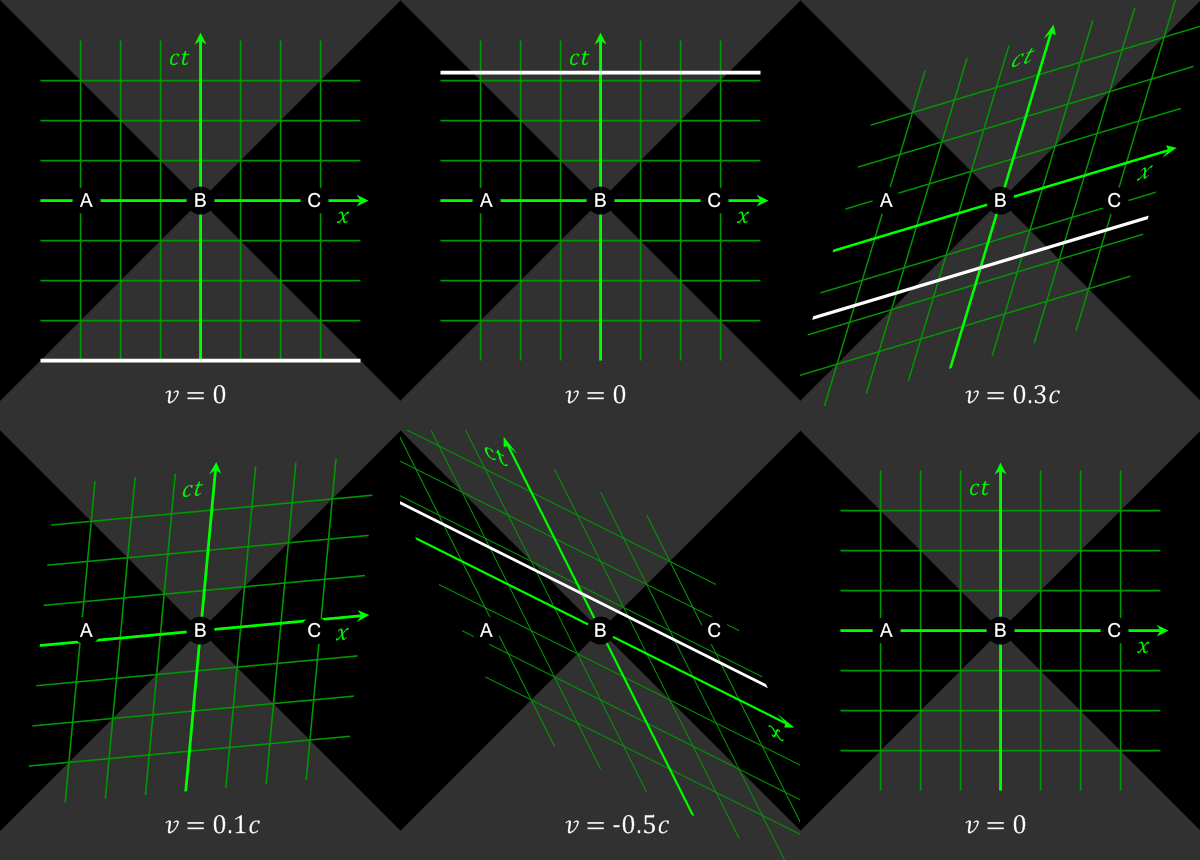
“Turned its steel rod framework into jello. Remember how Cathleen’s Minkowski diagram connected slope with velocity? Einstein showed how Lorentz’s relativity factor sets a speed limit for our Universe. On the diagram, that’d be a minimum slope. Going vertical is okay, that’s standing still in space. Going horizontal isn’t, because that’d be instantaneous travel. This animation tells the ‘Now‘ story better than words can.”

“Whah?”
  ”Whah?”

“We’re looking down on three space travelers and three events. Speeds below lightspeed are within the gray hourglass shape. The white line perpendicular to each traveler’s time line is their personal ‘Now‘. The travelers go at different velocities relative to us so their slopes and ‘Now‘ lines are different. From our point of view, time goes straight up. One traveler is sitting still relative to us so its timeline is marked ‘v=0‘ and parallels ours. We and the v=0 traveler see events A, B and C happening simultaneously. The other travelers don’t agree. ‘Simultaneous‘ is an illusion.”

~~ Rich Olcott

Now And Then

“Alright, I suppose there’s no going down below the Universe’s Year Zero, but what about the other direction? Do you physics guys have a handle on Time’s Top?”

“That’d be Cosmology, Mr Feder. We physicists avoid theorizing about stuff we can’t check against data. Well, except for string theory. The far past leaves clues that astronomers like Cathleen can gather. Sad to say, though, we barely have a handle on Now.”

Cathleen grins. Al and Mr Feder go, “Whaaat?”

“No, really. One of Einstein’s insights was that two observers randomly and independently flying through space won’t be able to agree on whether two external events occurred simultaneously. They can’t even agree on what time it is now.”

“Oh, yeah, I know about that. I’ve read about how the GPS system needs to make corrections to account for what relativity does to the satellite timings.”

“You’re right, Al, but that’s a different issue. Some of that relativistic correction has to do with space compression because of Earth’s mass. The simultaneity problem is strictly about rapid motion and geometry.”

“Wait — geometry?”

“Relativistic geometry, which is a bit different from the kind that Descartes built.”

“Whoa, Sy, slow down there. Descartes was the ‘I think therefore I am‘ guy, right? What’s that got to do with geometry?”

“I guess I got a little ahead of myself there, didn’t I? OK. Yeah, Al, same Descartes. Grew up Catholic in France, was a professional mercenary soldier in the Thirty Years War, wound up fighting first on the Catholic French side and later on fought on the Protestant Dutch side but cross‑over was common, both directions. He realized he was in an ostensibly religious war that was really about who ruled over whom. That may have had something to do with him becoming a professional philosopher who rejected all religious dogmas in favor of what he could learn solely from logic and his own senses. That’s where his famous mantra came from — he started by proving to himself that he existed.”

“Logic led to geometry, I suppose.”

“Indeed, but a new kind, one that required a few innovations that Descartes developed. On the one hand, mathematicians traditionally expressed algebraic problems in words and some of them were doozies, like saying ‘the zenzizenzizenzic‘ where we’d just say x8. We got that simple but <ahem> powerful notation from Descartes. On the geometry side, he’d ditch all the confusing line-ending markers in a diagram like this one. Instead, he’d label the whole line representing a known quantity with a front-of-the-alphabet letter like a or b or c. A line representing an unknown quantity would get its label from the alphabet-trailers like x, y and z. Then he used the same character conventions and his new power notation to write and manipulate algebraic expressions. Those notational inventions were foundational for his bridge between algebraic and geometrical problems. Draw your problem with lines and curves, transform it to algebraic equations, solve that problem exactly, transform it back to geometry and you’re done. Or vice-versa.”

The mesolabe instrument (in red).

“That goes back to Descartes, huh?”

“Mm-hm. His big innovation, though, arose from a borrow from an early Greek gadget called a mesolabe. He proposed an idealized version that would let someone break a line into exact fractions or compare a length against a unit length. That broke the rules of classical Geometry but setting his mesolabe’s Y‑angle to 90° prompted him to name points by their distance along the x– and y‑axes. That’s the nub of the Cartesian coordinate system — a rectangular grid of numbered straight lines that go on forever. Graph paper, right? Wrap the grid around the Earth and you’ve got latitudes and longitudes. Add more numbered grid lines perpendicular to either grid and you’ve got z‑axis coordinates. Three coordinates let you name any point in space. Newton and all the physicists who came after him until the dawn of the 20th Century assumed Descartes’ nice, stable coordinate system.”

“20th Century — that’s when Einstein came on the scene. He broke that system?”

“Sure did. You’ve heard about bent space?”

“Who hasn’t?”

“Well, fasten your seat belts, it’s going to be a fun ride.”

~~ Rich Olcott

The Red Advantage

“OK, Cathleen, I get that JWST and Hubble rate about the same for sorting out things that are close together in the sky, and I get that they look at different kinds of light so it’s hard to compare sensitivity. Let’s get down to brass tacks. Which one can see farther?”

“An excellent question, Mr Feder. I’ve spent an entire class period on different aspects of it.”

“Narrow it down a little, I ain’t got all day.”

“You asked for it — a quick course on cosmological redshift. Fasten your seat belt. You know what redshift is, right?”

“Yeah, Moire yammers on about it a lot. Waves stretch out from something moving away from you.”

I bristle. “It’s important! And some redshifts don’t have anything to do with motion.”

“Right, Sy. Redshift in general has been a crucial tool for studying everything from planetary motion to the large‑scale structure of the Universe. Your no‑motion redshift — you’re thinking of gravitational redshift, right?”

“Mm-hm. From a distance, space appears to be compressed near a massive object, less compressed further away. Suppose we send a robot to take up a position just outside a black hole’s event horizon. The robot uses a green laser to send us its observations. Space dilates along the beam’s path out of the gravity well. The expanding geometry stretches the signal’s wavelength into the red range even though the robot’s distance from us is constant.”

“So, that’s gravitational redshift and there’s the Doppler redshift that Mr Feder referred to—”

“Is that what its name is? With p‘s? I always heard it as ‘doubler’ effect and wondered where that came from.”

“It came from Christian Doppler’s name, Al. Back in the 1840s he was investigating a star. He noticed that its spectrum was the overlap of two spectra slightly shifted with respect to each other. Using wave theory he proposed that the star was a binary and that the shifted spectra arose from one star coming towards us and the other moving away. Later work confirmed his ideas and the rest is history. So it’s Doppler, not doubler, even though the initial observation was of a stellar doublet.”

“So what’s this cosmo thing?”

“Cosmological redshift. It shows up at large distances. On the average, all galaxies are moving away from us, but they’re moving away from each other, too. That was Hubble’s big discovery. Well, one of them..”

“Wait, how can that be? If I move away from Al, here, I’m moving toward Sy or somebody.”

“We call it the expansion of the universe. Have you ever made raisin bread?”

“Nah, I just eat it.”

“Ok, then, just visualize how it’s made. You start with a flat lump of dough, raisins close together, right? The loaf rises as the yeast generates gas inside the lump. The dough expands and the raisins get further apart, all of them. There’s no pushing away from a center, it’s just that there’s an increasing amount of bubbly dough between each pair of neighboring raisins. That’s a pretty good analogy to galactic motion — the space between galaxies is expanding. The general motion is called Hubble flow.”

“So we see their light as redshifted because of their speed away from us.”

“That’s part of it, Al, but there’s also wave‑stretching because space itself is expanding. Suppose some far‑away galaxy, flying away at 30% of lightspeed, sent out a green photon with a 500‑nanometer wavelength. If the Doppler effect were the only one in play, our relative speeds would shift our measurement of that photon out to about 550 nanometers, into the yellow. Space expansion at intermediate stations along its path can cumulatively dilate the wave by further factors out into the infrared or beyond. Comparing two galaxies, photons from the farther one will traverse a longer path through expanding space and therefor experience greater elongation. Hubble spotted one object near its long‑wavelength limit with a recognizable spectrum feature beyond redshift factor 11.”

“Hey, that’s the answer to Mr Feder’s question!”

“So what’s the answer, smart guy?”

JWST will be able to see farther, because its infrared sensors can pick up distant light that’s been stretched beyond what Hubble can handle.”

~~ Rich Olcott

Which Way Is Up?

“OK, Moire, the Attitude Control System’s reaction wheels swing James Webb Space Telescope through whatever angle changes it wants, but how does ACS know what direction JWST‘s at to begin with? Does it go searching through that million‑star catalog to find something that matches?”

“Hardly, Mr Feder, that’d be way too much work for a shipboard computer. No, ACS consults the orientations maintained by a set of gyroscopes that are mounted on JWST‘s framework. Each one points along an unvarying bearing relative to the Universe, no matter how the satellite’s situated.”

“Gyroscopes? Like the one I had as a kid? Winding the string around the axle was a pain and then however hard I pulled the string I couldn’t keep one going for more than half a minute. It always wobbled anyway. Bad choice.”

“Not the JWST choice, NASA mostly doesn’t do toys. Actually, the gyroscope you remember has a long and honorable history. Gimbals have been known and used in one form or another for centuries. A few researchers mounted a rotor inside a gimbal set for various purposes in the mid‑1800s, but it was Léon Foucault who named his gadget a gyroscope when he used one for a public demonstration of the Earth’s rotation. People used to go to lectures like we go to a show. Science was popular in those days.”

“Wait — Foucault? The pendulum guy?”
 ”Wait — Foucault? The knife‑edge test guy?”

“Our science museum used to have a big pendulum. I loved to watch it knock down those domino thingies one by one as it turned around its circle. Then they took it out to make room for another dinosaur or something.”

“Yup. A museum’s most precious resource is floorspace. That weight swinging on a long wire takes up a lot of square feet. Foucault’s pendulum was another of his Earth‑rotation demonstrations, just a year after the gyroscope show. Yeah, Al, same guy — Foucault invented that technique you use to check your telescope mirrors. He pioneered a lot of Physics. He showed that the absorption spectrum of a gas when a light shines through it matches the spectrum it emits when you heat it up. His lightspeed measurement came within one percent of our currently accepted value. ”

Astronomer Cathleen shakes her head. “Imagine, 200 years after Kepler and Newton, yet people in Foucault’s day still needed convincing that the Earth is a globe floating in space. A century and a half later some still do. <sigh> Funny, isn’t it, how Foucault was working at the same time on two such different phenomena.”

“Not so different, Cathleen. Both demonstrate the same underlying principle — inertia relates to the Universe and doesn’t care about local conditions. Foucault was really working on inertia. He made use of two different inertial effects for his demonstrations. By the way, Mr Feder, the pendulum doesn’t turn. The Earth turns beneath the pendulum to bring those domino thingies into target position.”

“That’s hard to believe.”

“Could be why his demonstrations used two different phenomena. Given 19th Century technology, those were probably his best options.”

“If only he’d had lasers, huh?”

“One kind of modern gyroscope is laser‑based. Uses photons going around a ring. Actually, photons or pulses of them going around the same ring in opposite directions. When the ring itself rotates, the photons or pulses going against the rotation encounter the Start point sooner than their opposites do. Time the difference and you can figure the rotation rate. Unfortunately, Foucault didn’t have lasers or the exquisite timing devices we have today. But that’s not the kind of gyroscope JWST carries, anyway.”

“OK, I’ll bite. What does it use?”

“The slickest one yet, Al. If you carefully tap the rim of a good wine glass it’ll vibrate like the red line here. The dotted blue circle’s the glass at rest. Under the right conditions inertia holds the planes of vibration steady even if the glass itself rotates. People have figured out how to use that principle to build extremely accurate. reliable and low‑maintenance gyroscopes for measuring and stabilizing rotations. JWST carries a set.”

“Nothing to lubricate, eh?”

Portrait of Léon Foucault from Wikimedia under Creative Commons Attribution 3.0 Unported license.

~~ Rich Olcott

Turn This Way to Turn That Way

“I don’t understand, Sy. I get that James Webb Space Telescope uses its reaction wheels like a ship uses a rudder to change direction by pushing against something outside. Except the rudder pushes against water but the reaction wheels push against … what, the Universe?”

“Maybe probably, Al. We simply don’t know how inertia works. Newton just took inertia as a given. His Laws of Motion say that things remain at rest or persist in linear motion unless acted upon by some force. He didn’t say why. Einstein’s General Relativity starts from his Equivalence Principle — gravitational inertia is identical to mechanical inertia. That’s held up to painstaking experimental tests, but why it works is still an open question. Einstein liked Mach’s explanation, that we experience these inertias because matter interacts somehow with the rest of the Universe. He didn’t speculate how that interaction works because he didn’t like Action At A Distance. The quantum field theory people say that everything’s part of the universal field structure, which sounds cool but doesn’t help much. String theory … ’nuff said.”

“Hey, Moire, what’s all that got to do with the reaction wheel thing? JWST can push against one all it wants but it won’t go anywhere ’cause the wheel’s inside it. What’s magic about the wheels?”

JWST doesn’t want to go anywhere else, Mr Feder. We’re happy with it being in its proper orbit, but it needs to be able to point to different angles. Reaction wheels and gyroscopes are all about angular momentum, not about the linear kind that’s involved with moving from place to place.”

“HAH! JWST is moving place to place, in that orbit! Ain’t it got linear momentum then?”

Newton’s Principia, Proposition II, Theorem II

“In a limited way, pun intended. Angular momentum is linear momentum plus a radial constraint. This goes back to Newton and his Principia book. I’ve got a copy of his basic arc‑splitting diagram here in Old Reliable. The ABCDEF line is a section of some curve around point S. He treated it as a succession of short line segments ABc, BCd, CDe and so on. If JWST is at point B, for instance, Newton would say that it’s traveling with a certain linear momentum along the BCd line. However, it’s constrained to move along the arc so it winds up at D instead d. To account for the constraint Newton invented centripetal force to pull along the Sd line. He then mentally made the steps smaller and smaller until the sequence of short lines matched the curve. At the limit, a sequence of little bits of linear momentum becomes angular momentum. By the way, this step‑reduction process is at the heart of calculus. Anyway, JWST uses its reaction wheels to swing itself around, not to propel itself.”

“And we’re back to my original question, Sy. What makes that swinging happen?”

“Oh, you mean the mechanical reality. Easy, Al. Like I said, three pairs of motorized wheels are mounted on JWST‘s frame near the center of mass. Their axles are at mutual right angles. Change a wheel’s angular momentum, you get an equal opposing change to the satellite’s. Suppose the Attitude Control System wants the satellite to swing to starboard. That’d be clockwise viewed from the cold side. ACS must tell a port/starboard motor to spin its wheel faster counterclockwise. If it’s already spinning clockwise, the command would be to put on the brakes, right? Either way, JWST swings clockwise. With the forward/aft motors and the hot‑side/cold‑side motors, the ACS is equipped to get to any orientation. See how that works?”

“Hang on.” <handwaving ensues> “Yeah, I guess so.”

“Hey, Moire. What if the wheel’s already spinning at top speed in the direction the ACS wants more of?”

“Ah, that calls for a momentum dump. JWST‘s equipped with eight small rocket engines called thrusters. They convert angular momentum back to linear momentum in rocket exhaust. Suppose we need a further turn to starboard but a port/starboard wheel is nearing threshold spin rate. ACS puts the brakes on that wheel, which by itself would turn the satellite to port. However, ACS simultaneously activates selected thrusters to oppose the portward slew. Cute, huh?”

~~ Rich Olcott