A Force-to-Force Meeting

The Crazy Theory contest is still going strong in the back room at Al’s coffee shop. I gather from the score board scribbles that Jim’s Mars idea (one mark-up says “2 possible 2 B crazy!“) is way behind Amanda’s “green blood” theory.  There’s some milling about, then a guy next to me says, “I got this, hold my coffee,” and steps up to the mic.  Big fellow, don’t recognize him but some of the Physics students do — “Hey, it’s Cap’n Mike at the mic.  Whatcha got for us this time?”

“I got the absence of a theory, how’s that?  It’s about the Four Forces.”

Someone in the crowd yells out, “Charm, Persuasiveness, Chaos and Bloody-mindedness.”

“Nah, Jennie, that’s Terry Pratchett’s Theory of Historical Narrative.  We’re doing Physics here.  The right answer is Weak and Strong Nuclear Forces, Electromagnetism, and Gravity, with me?  Question is, how do they compare?”

Another voice from the crowd. “Depends on distance!”

“Well yeah, but let’s look at cases.  Weak Nuclear Force first.  It works on the quarks that form massive particles like protons.  It’s a really short-range force because it depends on force-carrier particles that have very short lifetimes.  If a Weak Force carrier leaves its home particle even at the speed of light which they’re way too heavy to do, it can only fly a small fraction of a proton radius before it expires without affecting anything.  So, ineffective anywhere outside a massive particle.”

It’s a raucous crowd.  “How about the Strong Force, Mike?”

.  <chorus of “HOO-wah!”>

“Semper fi that.  OK, the carriers of the Strong Force —”

.  <“Naa-VY!  Naaa-VY!”>

.  <“Hush up, guys, let him finish.”>

“Thanks, Amanda.  The Strong Force carriers have no mass so they fly at lightspeed, but the force itself is short range, falls off rapidly beyond the nuclear radius.  It keeps each trio of quarks inside their own proton or neutron.  And it’s powerful enough to corral positively-charged particles within the nucleus.  That means it’s way stronger inside the nucleus than the Electromagnetic force that pushes positive charges away from each other.”

“How about outside the nucleus?”

“Out there it’s much weaker than Electromagnetism’s photons that go flying about —”

.  <“Air Force!”>

.  <“You guys!”>

“As I was saying…  OK, the Electromagnetic Force is like the nuclear forces because it’s carried by particles and quantum mechanics applies.  But it’s different from the nuclear forces because of its inverse-square distance dependence.  Its range is infinite if you’re willing to wait a while to sense it because light has finite speed.  The really different force is the fourth one, Gravity —”

.  <“Yo Army!  Ground-pounders rock!”>

“I was expecting that.  In some ways Gravity’s like Electromagnetism.  It travels at the same speed and has the same inverse-square distance law.  But at any given distance, Gravity’s a factor of 1038 punier and we’ve never been able to detect a force-carrier for it.  Worse, a century of math work hasn’t been able to forge an acceptable connection between the really good Relativity theory we have for Gravity and the really good Standard Model we have for the other three forces.  So here’s my Crazy Theory Number One — maybe there is no connection.”

.  <sudden dead silence>

“All the theory work I’ve seen — string theory, whatever — assumes that Gravity is somehow subject to quantum-based laws of some sort and our challenge is to tie Gravity’s quanta to the rules that govern the Standard Model.  That’s the way we’d like the Universe to work, but is there any firm evidence that Gravity actually is quantized?”

.  <more silence>

“Right.  So now for my Even Crazier Theories.  Maybe there’s a Fifth Force, also non-quantized, even weaker than Gravity, and not bound by the speed of light.  Something like that could explain entanglement and solve Einstein’s Bubble problem.”

.  <even more silence>

“OK, I’ll get crazier.  Many of us have had what I’ll call spooky experiences that known Physics can’t explain.  Maybe stupid-good gambling luck or ‘just knowing’ when someone died, stuff like that.  Maybe we’re using the Fifth Force in action.”

.  <complete pandemonium>
four forces plus 1

~ Rich Olcott


Note to my readers with connections to the US National Guard, Coast Guard, Merchant Marine and/or Public Health Service — Yeah, I know, but one can only stretch a metaphor so far.
Moby Divergence

Stepping into Pizza Eddie’s I see Jeremy at his post behind the gelato stand, an impressively thick book in front of him.  “Hi, Jeremy, one chocolate-hazelnut combo, please.  What’re you reading there?”

“Hi, Mr Moire.  It’s Moby Dick, for English class.”

“Ah, one of my favorites.  Melville was a 19th-century techie, did for whaling what Tom Clancy did for submarines.”

“You’re here at just the right time, Mr Moire.  I’m reading the part where something called ‘the corpusants’ are making lights glow around the Pequod.  Sometimes he calls them lightning, but they don’t seem to come down from the sky like real lightning.  Umm, here it is, he says. ‘All the yard-arms were tipped with pallid fire, and touched at each tri-pointed lightning-rod-end with three tapering white flames, each of the three tall masts was silently burning in that sulphurous air, like three gigantic wax tapers before an altar.’  What’s that about?”St Elmos fire

“That glow is also called ‘St Elmo’s Fire‘ among other things.  It’s often associated with a lightning storm but it’s a completely different phenomenon.  Strictly speaking it’s a concentrated coronal discharge.”

“That doesn’t explain much, sir.”

“Take it one word at a time.  If you pump a lot of electrons into a confined space, they repel each other and sooner or later they’ll find ways to leak away.  That’s literally dis-charging.”

“How do you ‘pump electrons’?”

“Oh, lots of ways.  The ancient Greeks did it by rubbing amber with fur, Volta did it chemically with metals and acid,  Van de Graaff did it with a conveyor belt, Earth does it with winds that transport air between atmospheric layers.  You do it every time you shuffle across a carpet and get shocked when you put your finger near a water pipe or a light switch.”

“That only happens in the wintertime.”

“Actually, carpet-shuffle electron-pumping happens all the time.  In the summer you discharge as quickly as you gain charge because the air’s humidity gives the electrons an easy pathway away from you.  In the winter you’re better insulated and retain the charge until it’s too late.”

“Hm.  Next word.”

Corona, like ‘halo.’  A coronal discharge is the glow you see around an object that gets charged-up past a certain threshold.  In air the glow can be blue or purple, but you can get different colors from other gases.  Basically, the electric field is so intense that it overwhelms the electronic structure of the surrounding atoms and molecules.  The glow is electrons radiating as they return to their normal confined chaos after having been pulled into some stretched-out configuration.”

“But this picture of the corpusants has them just at the mast-heads and yard-arms, not all over the boat.”

“That’s where the ‘concentrated’ word come in.  I puzzled over that, too, when I first looked into the phenomenon.  Made no sense.”

“Yeah.  If the electrons are repelling each other they ought to spread out as much as possible.  So why do they seem pour out of the pointy parts?”

“That was a mystery until the 1880s when Heaviside cleaned up Maxwell’s original set of equations.  The clarified math showed that the key is the electric field’s spread-out-ness, technically known as divergence.”

DivergenceWith my finger I draw in the frost on his gelato cabinet.  “Imagine this is a brass ball, except I’ve pulled one side of it out to a cone.  Someone’s loaded it up with extra electrons so it’s carrying a high negative charge.”
“The electrons have spread themselves evenly over the metal surface, right, including at the pointy part?”

“Yup, that’s why I’m doing my best to make all these electric field arrows the same distance apart at their base.  They’re also supposed to be perpendicular to the surface.  What part of that field will put the most rip-apart stress on the local air molecules?”

“Oh, at the tip, where the field spreads out most abruptly.”

“Bingo.  What makes the glow isn’t the average field strength, it’s how drastically the field varies from one side of a molecule to the other.  That’s what rips them apart.  And you get the greatest divergence at the pointy parts like at the Pequod’s mast-head.”

“And Ahab’s harpoon.”

~~ Rich Olcott

A Recourse to Pastry

There’s something wrong about the displays laid out on Al’s pastry counter — no symmetry.  One covered platter holds eight pinwheels in a ring about a central one, but the other platter’s central pinwheel has only a five-pinwheel ring around it.  I yell over to him.  “What’s with the pastries, Al?  You usually balance things up.”

“Ya noticed, hey, Sy?  It’s a tribute to the Juno spacecraft.  She went into orbit around Jupiter on the 5th of July 2016 so I’m celebrating her anniversary.”

“Well, that’s nice, but what do pinwheels have to do with the spacecraft?”

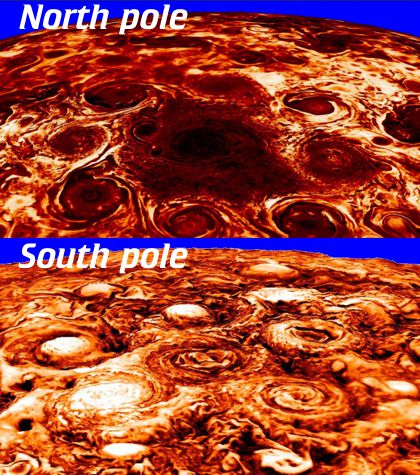
“Haven’t you seen the polar pictures she sent back?  Got a new poster behind the cash register.  Ain’t they gorgeous?”Jupiter both poles“They’re certainly eye-catching, but I thought Jupiter’s all baby-blue and salmon-colored.”

Astronomer Cathleen’s behind me in line.  “It is, Sy, but only in photographs using visible sunlight.  These are infrared images, right, Al?”

“Yeah, from … lemme look at the caption … Juno‘s JIRAM instrument.”

“Right, the infrared mapper.  It sees heat-generated light that comes from inside Jupiter.  It’s the same principle as using blackbody radiation to take a star’s temperature, but here we’re looking at a planet.  Jupiter’s way colder than a star so the wavelengths are longer, but on the other hand it’s close-up so we don’t have to reckon with relativistic wavelength stretching.  At any rate, infrared wavelengths are too long for our eyes to see but they penetrate clouds of particulate matter like interstellar dust or the frigid clouds of Jupiter.”

Jupiter south pole 1
NASA mosaic view of Jupiter’s south pole by visible light

“So this red hell isn’t what the poles actually look like?”

“No, Al,  the visible light colors are in the tops of clouds and they’re all blues and white.  These infrared images show us temperature variation within the clouds.  Come to think of it, that Hell’s frozen over — if I recall correctly, the temperature range in those clouds runs from about –10°C to –80°C.  In Fahrenheit that’d be from near zero to crazy cold.”

“Those aren’t just photographs in Al’s poster?”

“Oh, no, Sy, there’s a lot of computer processing in between Juno‘s wavelength numbers and what the public sees.  The first step is to recode all the infrared wavelengths to visible colors.  In that north pole image I’d say that they coded red-to-black as warm down to white as cool.  The south pole image looks like warmest is yellow-to-white, coolest is red.”

“How’d you figure that?”

“The programs fake the apparent heights.  The warmest areas are where we can see most deeply into the atmosphere, which would be at the center or edge of a vortex.  The cooler areas would be upper-level material.  The techs use that logic to generate the perspective projection that we interpret as a 3-D view.”

Vinnie’s behind us in line and getting impatient.  “I suppose there’s Science in those pretty pictures?”

“Tons of it, and a few mysteries.  JIRAM by itself is telling the researchers a lot about where and how much water and other small molecules reside in Jupiter’s atmosphere.  But Juno has eight other sensors.  Scientists expect to harvest important information from each of them.  Correlations between the data streams will give us exponentially more.”

He’s still antsy.  “Such as?”

“Like how Jupiter’s off-axis magnetic field is related to its lumpy gravitational field.  When we figure that out we’ll know a lot more about how Jupiter works, and that’ll help us understand Saturn and gas-giant exoplanets.”GRS core

Al breaks in.  “What about the mysteries, Cathleen?”

“Those storms, for instance.  They look like Earth-style hurricanes, driven by upwelling warm air.  They even go in the right direction.  But why are they crammed together so and how can they stay stable like that?  Adjacent gears have to rotate in opposite directions, but these guys all go in the same direction.  I can’t imagine what the winds between them must be like.”

“And how come there’s eight in the north pole ring but only five at the other pole?”

“Who knows, Vinnie?  The only guess I have is that Jupiter’s so big that one end doesn’t know what the other end’s doing.”

“Someone’s gonna have to do better than that.”

“Give ’em time.”

~~ Rich Olcott

Terzetto for Rubber Ruler

ruler and sodium lines“So you’re telling me, Cathleen, that you can tell how hot a star is by looking at its color?”

“That’s right, Vinnie.  For most stars their continuous spectrum is pretty close to the blackbody equation tying peak wavelength to temperature.”

“But you can’t do that with far-away stars, right, because the further they are, the more stretched-out their lightwaves get.  Won’t that mess up the peak wavelength?”

“The key is Kirchhoff’s other kinds of spectrum.”

“You’re talking the bright-line and dark-line kinds.”

“Exactly.  Each kind of spectrum comes from a different process — each is affected differently by the object in question and the environment it’s embedded in.  A continuous spectrum is all about charged particles moving randomly in response to the heat energy they’re surrounded by.  It doesn’t matter what kind of particles they are or even whether they’re positive or negative.  Whenever a particle changes direction, it twitches the electromagnetic field and gives off a wave.”

“Right — the higher the temperature the less time between twitches; the wave can’t move as far before things change so the wavelength’s shorter; any speed’s possible so you can turn that dial wherever; I got all that.  So what’s different with the bright-line and dark-line spectrums?”

Cathleen and I both blurt out, “Spectra!” at the same time and give each other a look.  We’re grown-ups now.  We don’t say, “Jinx!” to each other any more.

“Alright, spectra.  But how’re they different?”

I pick up the story.  “Like Cathleen said, continuous spectra from same–temperature stuff look identical no matter what kind of stuff’s involved because heat is motion and each particle moves as a unit  The other kinds of spectrum are about transitions within particles so they’re all about which kind of stuff.  A given kind of atom can only absorb certain wavelengths of light and it can only relax by giving off exactly the same wavelengths.  There’s no in-betweens.”

She cuts in.  “Sodium, for instance.  It has two strong lines in the yellow, at 588.995 and 589.592 nanometers.  Whether in a star or a meteor or fireworks, sodium gives off exactly those colors.  Conversely, in an interstellar cloud or in a star’s outermost layers sodium absorbs exactly those colors from any continuous-spectrum light passing through.”

I’m back in.  “And there’s the key to your unmixing question, Vinnie.  We’ve talked about frames, remember?  Your far-away star’s light-generating layers emit a continuous spectrum that describes its temperature.  If we were right next to it, that’s the spectrum we’d see.  But as you say, we’re a long way away and in our frame the light’s been stretched.  It still looks like the black-body curve but it’s red-shifted because of our relative motion.”

Cathleen’s turn.  “But if there are sodium atoms in the star’s upper layers, their absorptions will cut a pair of notches in that emitted spectrum.  It won’t be a smooth curve, there’ll be two sharp dips in it, close together, with the blue-side one twice as strong as the other one.  Easy to recognize and measure the redshift.  The blackbody peak is redshifted by exactly the same amount so with some arithmetic you’ve got the peak’s original wavelength and the star’s temperature.”

Mine.  “See, because we know what the sodium wavelengths were in the star’s frame, we can divide the dip wavelengths we measure by the rest-frame numbers we know about.  The ratios give us the star’s redshift.”

Spectrum with only blackbody and sodium Cathleen turns to her laptop and starts tapping keys.  “Let’s do an example.  Suppose we’re looking at a star’s broadband spectrogram.  The blackbody curve peaks at 720 picometers.  There’s an absorption doublet with just the right relative intensity profile in the near infra-red at 1,060,190 and 1,061,265 picometers.  They’re 1,075 picometers apart.  In the lab, the sodium doublet’s split by 597 picometers.  If the star’s absorption peaks are indeed the sodium doublet then the spectrum has been stretched by a factor of 1075/597=1.80.  Working backward, in the star’s frame its blackbody peak must be at 720/1.80=400 picometers, which corresponds to a temperature of about 6,500 K.”

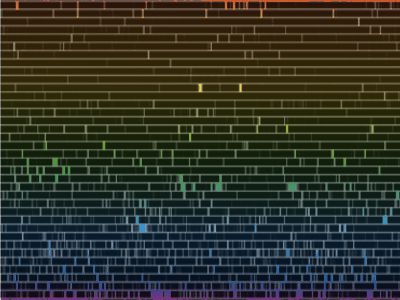
“Old Reliable calculates from that stretch factor and the Hubble Constant the star’s about ten billion lightyears away and fleeing at 240,000 km/s.”

“All that from three peaks.  Spectroscopy’s pretty powerful, huh?”

Cathleen and me: “For sure!    Jinx!”

~~ Rich Olcott

Trio for Rubber Ruler

“It’s all about how lightwaves get generated and then what happens.”

Sy and me talked about that, Cathleen.  Lightwaves come from jiggling electrons, right?”

“Any kind of charged particles, Vinnie, but there’s different ways that can happen.  Each leads to its own kind of spectrum.”

“Different kinds of spectrum?  Do you mean like visible versus infrared and ultraviolet, Cathleen?”

“No, I don’t, Sy.  I’m referring to the thing’s overall appearance in every band.  A hundred and fifty years ago Kirchoff pointed out that light from a source can have lines of color, lines without color, or a smooth display without lines.”

“Like that poster that Al put up between the physicist and astronomer corners?”  (We’re still chatting at a table in Al’s coffee shop.  I’m on my fourth scone.)

Astroruler with solar spectrum
Based on N.A.Sharp, NOAO/NSO/Kitt Peak FTS/AURA/NSF

“Kind of.  That’s based on a famous image created at Kitt Peak Observatory.  In the background there you see a representation of what Kirchoff called a continuous or black-body spectrum, where all the colors fade smoothly into each other in classic rainbow order.  You’re supposed to ignore the horizontal dark lines.”

“And the vertical lines?”

“They form what Kirchoff called an absorption spectrum.  Each dark vertical represents an isolated color that we don’t get from the Sun.”

“You’re saying we get all the other colors but them, right?”

“Exactly, Vinnie.  The Sun’s chromosphere layer filters those specific wavelengths before they get from the deeper photosphere out into space.”

“Complicated filter.”

“Of course.  The Sun contains most of the elements lighter than nickel.  Each kind of atom absorbs its own collection of frequencies.”

“Ah, that’s the quantum thing that Sy and me talked about, right, Sy?”

“Mm-hm.  We only did the hydrogen atom, but the same principles apply.  An electromagnetic wave tickles an atom.  If the wave delivers exactly the right amount of energy, the atom’s chaotic storm of electrons resonates with the energy and goes a different-shaped storm.  But each kind of atom has a limited set of shapes.  If the energy doesn’t match the energy difference between a pair of levels, there’s no absorption and the wave just passes by.”

“But I’ll bet the atom can’t hold that extra energy forever.”

“Good bet, Vinnie.  The flip side of absorption is emission.  I expect that Cathleen has an emission spectrum somewhere on her laptop there.”Emission spectrum“You’re right, Sy.  It’s not a particularly pretty picture, but it shows that nice strong sodium doublet in the yellow and the broad iron and hydrogen lines down in the green and blue.  I’ll admit it, Vinnie, this is a faked image I made to show my students what the solar atmosphere would look like if you could turn off the photosphere’s continuous blast of light.  The point is that the atoms emit exactly the same sets of colors that they absorb.”
“You do what you gotta do, Cathleen.  But tell me, if each kind of atom does only certain colors, where’s that continuous rainbow come from?  Why aren’t we only getting hydrogen colors?”

“Kirchoff didn’t have a clue on that, Vinnie.  It took 50 years and Einstein to solve it.  Not just where the light comes from but also its energy-wavelength profile.”

“So where does the light come from?”

“Pure heat.  You can get a continuous spectrum from a hot wire, molten lava, a hole through the wall of a hot oven, even the primordial chaos of the Big Bang.  It doesn’t matter what kind of matter you’re looking at, the profile just depends on the temperature.  You know that temperature measures the kinetic energy stored in particle random motion, Vinnie?”

“Well, I wouldn’t have put it that way, but yeah.”

“Well, think about the Sun, just a big ball of really hot atoms and electrons and nuclei, all bouncing off each other in frantic motion.  Every time one of those changes direction it affects the electromagnetic field, jiggles it as you say.  The result of all that jiggling is the continuous spectrum.  Absorption and emission lines come from electrons that are confined to an atom, but heat motion is unconfined.”

“How about hot metal?”

“The atoms are locked in their lattice, but heat jiggles the whole lattice.”

~~ Rich Olcott

Toccata for A Rubber Ruler

“How the heck do they know that?”

“Know what, Vinnie?”

“That the galaxy they saw with that gravitational lens is 13 billion years old?  I mean, does it come with a birth certificate, Cathleen?”

“Mm, it does, sort of — hydrogen atoms.  Really old hydrogen atoms.”

“Waitaminit.  Hydrogen’s hydrogen — one proton, one electron per atom.  They’re all the same, right?  How do you know one’s older than another one?”

“Because they look different.”

“How could they look different when they’re all the same?”

“Let me guess, Cathleen.  These old hydrogens, are they far far away?”

“On the button, Sy.”

“What where they’re at got to do with it?”

“It’s all about spectroscopy and the Hubble constant, Vinnie.  What do you know about Edwin Hubble?”

“Like in Hubble Space Telescope?  Not much.”

“Those old atoms were Hubble’s second big discovery.”

“Your gonna start with the other one, right?”

“Sorry, classroom habit.  His first big discovery was that there’s more to the Universe than just the Milky Way Galaxy.  That directly contradicted Astronomy’s Big Names.  They all believed that the cloudy bits they saw in the sky were nebulae within our galaxy.  Hubble’s edge was that he had access to Wilson Observatory’s 100-inch telescope that dwarfed the smaller instruments that everyone else was using.  Bigger scope, more light-gathering power, better resolution.”

“Hubble won.”

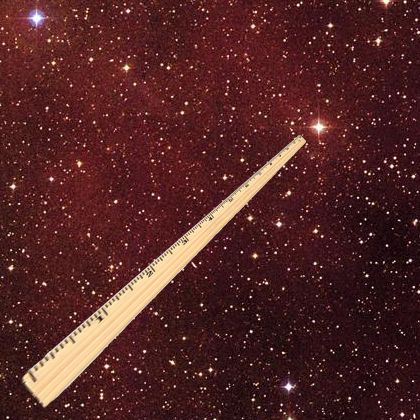
“Yeah, but how he won was the key to his other big discovery.  The crucial question was, how far away are those ‘nebulae’?  He needed a link between distance and something he could measure directly.  Stellar brightness was the obvious choice.  Not the brightness we see on Earth but the brightness we’d see if we were some standard distance away from it.  Fortunately, a dozen years earlier Henrietta Swan Leavitt found that link.  Some stars periodically swing bright, then dim, then bright again.  She showed that for one subgroup of those stars, there’s a simple relationship between the star’s intrinsic brightness and its peak-to-peak time.”Astroruler

“So Hubble found stars like that in those nebulas or galaxies or whatever?”

“Exactly.  With his best-of-breed telescope he could pick out individual variable stars in close-by galaxies.  Their fluctuation gave him intrinsic brightness.  The brightness he measured from Earth was a lot less.  The brightness ratios gave him distances.  They were a lot bigger than everyone thought.”

“Ah, so now he’s got a handle on distance.  Scientists love to plot everything against everything, just to see, so I’ll bet he plotted something against distance and hit jackpot.”

“Well, he was a bit less random than that, Sy.  There were some theoretical reasons to think that the Universe might be expanding.  The question was, how fast?  For that he tapped another astronomer’s results.  Vesto Slipher at Lowell Observatory was looking at the colors of light emitted by different galaxies.  None had light exactly like our Milky Way’s.  A few were a bit bluer, but most were distinctly red-shifted.”

“Like the Doppler effect in radar?  Things coming toward you blue-shift the radar beam, things going away red-shift it?”

“Similar to that, Vinnie, but it’s emitted light, not a reflected beam. To a good approximation, though, you can say that the red shift is proportional to the emitting object’s speed towards or away from us.  Hubble plotted his distance number for each galaxy he’d worked on, against Slipher’s red-shift speed number for the same galaxy.  It wasn’t the prettiest graph you’ve ever seen, but there was a pretty good correlation.  Hubble drew the best straight line he could through the points.  What’s important is that the line sloped upward.”

“Lemme think … If everything just sits there, there’d be no red-shift and no graph, right?  If everything is moving away from us at a steady speed, then the line would be flat — zero slope.  But he saw an upward slope, so the farther something is the faster it’s going further from us?”

“Bravo, Vinnie.  That’s the expansion of the Universe you’ve heard about.  Locally there are a few things coming toward us — that’s those blue-shifted galaxies, for instance — but the general trend is away.”

“So that’s why you say those far-away hydrogens look different.  By the time we see their light it’s been red-shifted.”

“93% redder.”

~~ Rich Olcott

The Speeds of Light

“I don’t give up easy, Sy.”

“I know that, Vinnie.  Still musing about lightwaves and how they’re all an electron’s fault?”

“Yeah.  Hey, can your OVR app on Old Reliable grab a shot from this movie running on my smartphone?”

“We can try … got it.  Now what?”

“I wanna try mixing that with your magnetic field picture.”

“I’ll bring that up … Here, have at it.”

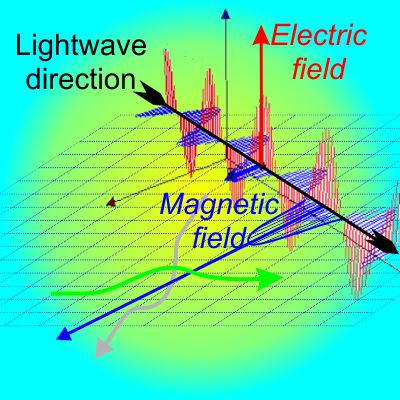
“Umm … Nice app, works very intuitive-like …  OK, see this?”Electrons and lightwave

“Ah.  It’s a bit busy, walk me through what’s in there.”

“OK. First we got the movie’s lightwave.  The ray’s running along that black arrow, see?  Some electron back behind the picture is going up and down to energize the ray and that makes the electric field that’s in red that makes other electrons go up and down, right?”

“That’s the red arrow, hmm?”

“Yeah, that electron got goosed ’cause it was standing in the way.  It follows the electric field’s direction.  Now help me out with the magnetic stuff.”

“Alright.  The blue lines represent the lightwave’s magnetic component.  A lightwave’s magnetic field lines are always perpendicular to its electric field.  Magnetism has no effect on uncharged particles or motionless charged particles.  If you’re a moving charged particle, say an electron, then the field deflects your trajectory.”

“This is what I’m still trying to wrap my head around.  You say that the field’s gonna push the particle perpendicular to the field and to the particle’s own vector.”

“That’s exactly what happens.  The green line, for instance, could represent an electron that crossed the magnetic field.  The field deflected the electron’s path upwards, crossways to the field and the electron’s path.  Then I suppose the electron encountered the reversed field from the lightwave’s following cycle and corrected course again.”

“And the grey line?”

“That’d be an electron crossing more-or-less along the field.  According to the Right Hand Rule it was deflected downward.”

“Wait.  We’ve got two electrons on the same side of the field and they’re deflected in opposite directions then correct back.  Doesn’t that average out to no change?”

“Not quite.  The key word is mostly.  Like gravity fields, electromagnetic fields get weaker with distance.  Each up or down deflection to an electron on an outbound path will be smaller than the previous one so the ‘course corrections’ get less correct.  Inbound electrons get deflected ever more strongly on the way in, of course, but eventually they become outbound electrons and get messed up even more.  All those deflections produce an expanding cone of disturbed electrons along the path of the ray.”

“Hey, but when any electron moves that changes the fields, right?  Wouldn’t there be a cone of disturbed field, too?”

“Absolutely.  The whole process leads to several kinds of dispersion.”

“Like what?”

“The obvious one is simple geometry.  What had been a simple straight-line ray is now an expanding cone of secondary emission.  Suppose you’re an astronomer looking at a planet that’s along that ray, for instance.  Light’s getting to you from throughout the cone, not just from the straight line.  You’re going to get a blurred picture.”

“What’s another kind?”

“Moving those electrons around extracts energy from the wave.  Some fraction of the ray’s original photons get converted to lower-energy ones with lower frequencies.  The net result is that the ray’s spectrum is spread and dispersed towards the red.”

“You said several kinds.”

“The last one’s a doozy — it affects the speeds of light.”

“‘Speeds,’ plural?”ripples in a wave

“There’s the speed of field’s ripples, and there’s the speed of the whole signal, say when a star goes nova.  Here’s a picture I built on Old Reliable.  The gold line is the electric field — see how the ripples make the red electron wobble?  The green dots on the axis give you comparison points that don’t move.  Watch how the ripples move left to right just like the signal does, but at their own speed.”

“Which one’s Einstein’s?”

“The signal.  Its speed is called the group velocity and in space always runs 186,000 mph.  The ripple speed, technically it’s the phase velocity, is slower because of that extracted-and-redistributed-energy process.  Different frequencies get different slowdowns, which gives astronomers clues about the interstellar medium.”

“Clues are good.”

~~ Rich Olcott

They Went That-away. But Why?

“It’s worse than that, Vinnie.”  I pull out Old Reliable, my math-monster tablet.  “Let me scan in that three-electron drawing of yours.”3 electrons in B-field

“Good enough to keep a record of it?”

“Nope, I want to exercise a new OVR app I just bought.”

“You mean OCR.”

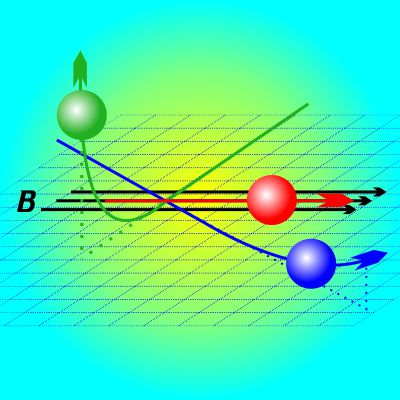
“Uh-uh, this is Original Vector Reconstruction, not Optical Character Recognition.    OCR lets you read a document into a word processor so you can modify it.  OVR does the same thing but with graphics.  Give me a sec … there.  OK, look at this.”3 electrons in B-field revisited

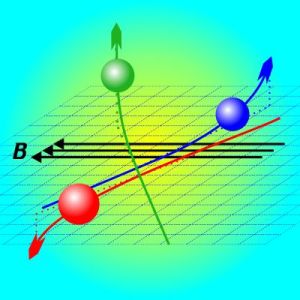
“Cool, you turned my drawing 180°, sort of.  Nice app.  Oh, and you moved the red electron’s path so it’s going opposite to the blue electron instead of parallel to the magnetic field.  Why’d you bother?”

“See the difference between blue and red?”

“Well, yeah, one’s going up, one’s going down.  That’s what I came to you about and you shot down my theory.  Those B-arrows in the magnetic field are going in completely the wrong direction to push things that way.”

“Well, actually, they’re going in exactly the right direction for that, because a magnetic field pushes along perpendiculars.  Ever hear of The Right Hand Rule?”

“You mean like ‘lefty-loosey, righty-tighty’?”

“That works, too, but it’s not the rule I’m talking about.  If you point your thumb in the direction an electron is moving, and your index finger in the direction of the magnetic field, your third finger points in the deflection direction.  Try it.”

“Hurts my wrist when I do it for the blue one, but yeah, the rule works for that.  It’s easier for the red one.  OK, you got this rule, fine, but why does it work?”

“Part of it goes back to the vector math you don’t want me to throw at you.  Let’s just say that there are versions of a Right Hand Rule all over physics.  Many of them are essentially definitions, in the same way that Newton’s Laws of Motion defined force and mass.  Suppose you’re studying the movements directed by some new kind of force.  Typically, you try to define some underlying field in such a way that you can write equations that predict the movement.  You haven’t changed Nature, you’ve just improved our view of how things fit together.”

“So you’re telling me that whoever made that drawing I copied drew the direction those B-arrows pointed just to fit the rule?”

“Almost.  The intensity of the field is whatever it is and the lines minus their pointy parts are wherever they are.  The only thing we can set a rule for is which end of the line gets the arrowhead.  Make sense?”Spiraling electron

“I suppose.  But now I got two questions instead of the one I come in here with.  I can see the deflection twisting that electron’s path into a spiral.  But I don’t see why it spirals upward instead of downward, and I still don’t see how the whole thing works in the first place.”

“I’m afraid you’ve stumbled into a rabbit hole  we don’t generally talk about.  When Newton gave us his Law of Gravity, he didn’t really explain gravity, he just told us how to calculate it.  It took Einstein and General Relativity to get a deeper explanation.  See that really thick book on my shelf over there?  It’s loaded with tables of thermodynamic numbers I can use to calculate chemical reactions, but we didn’t start to understand those numbers until quantum mechanics came along.  Maxwell’s equations let us calculate electricity, magnetism and their interaction — but they don’t tell us why they work.”

“I get the drift.  You’re gonna tell me it goes up because it goes up.”

“That’s pretty much the story.  Electrons are among the simplest particles we know of.  Maxwell and his equations gave us a good handle on how they behave, nothing on why we have a Right Hand Rule instead of a Left Hand Rule.  The parity just falls out of the math.  Left-right asymmetry seems to have something to do with the geometry of the Universe, but we really don’t know.”

“Will string theory help?”

“Physicists have spent 50 years grinding on that without a testable result.  I’m not holding my breath.”

~~ Rich Olcott

Three off The Plane

Rumpus in the hallway.  Vinnie dashes into my office, tablet in hand and trailing paper napkins.  “Sy! Sy! I figured it out!”

“Great!  What did you figure out?”

“You know they talk about light and radio being electromagnetic waves, but I got to wondering.  Radio antennas don’t got magnets so where does the magnetic part come in?”

“19th-Century physicists struggled with that question until Maxwell published his famous equations.  What’s your answer?”

“Well, you know me — I don’t do equations, I do pictures.  I saw a TV program about electricity.  Some Danish scientist named Hans Christian Anderson—”

“Ørsted.”

“Whoever.  Anyway, he found that magnetism happens when an electric current starts or stops.  That’s what gave me my idea.  We got electrons, right, but no magnetrons, right?”

“Mmm, your microwave oven has a vacuum tube called a magnetron in it.”

“C’mon, Sy, you know what I mean.  We got no whatchacallit, ‘fundamental particle’ of magnetism like we got with electrons and electricity.”

“I’ll give you that.  Physicists have searched hard for evidence of magnetic monopoles — no successes so far.  So why’s that important to you?”

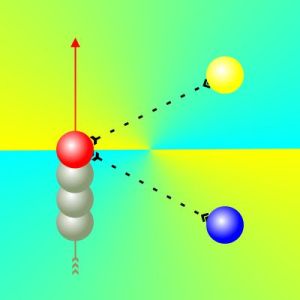
3 electrons moving north“It told me that the magnetism stuff has to come from what electrons do.  And that’s when I came up with this drawing.”  <He shoves a paper napkin at me.>  “See, the three balls are electrons and they’re all negative-negative pushing against each other only I’m just paying attention to what the red one’s doing to the other two.  Got that?”

“Sure.  The arrow means the red electron is traveling upward?”

“Yeah.  Now what’s that moving gonna do to the other two?”

“Well, the red’s getting closer to the yellow.  That increases the repulsive force yellow feels so it’ll move upward to stay away.”

“Uh-huh.  And the force on blue gets less so that one’s free to move upward, too.  Now pretend that the red one starts moving downward.”

“Everything goes the other way, of course.  Where does the magnetism come in?”

3 electrons in B-field“Well, that was the puzzle.  Here’s a drawing I copied from some book.  The magnetic field is those B arrows and there’s three electrons moving  in the same flat space in different directions.  The red one’s moving along the field and stays that way.  The blue one’s moving slanty across the field and gets pushed upwards.  The green one’s going at right angles to B and gets bent way up.  I’m looking and looking — how come the field forces them to move up?”
“Good question.  To answer it those 19th Century physicists developed vector analysis—”

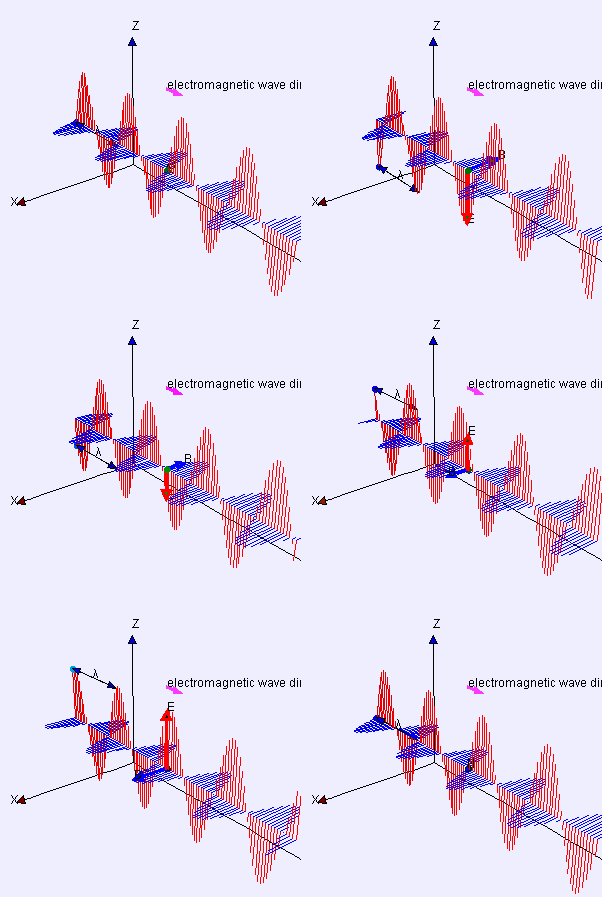
Electromagneticwave3D
Plane-polarized electromagnetic wave
Electric (E) field is red
Magnetic (B) field is blue
(Image by Loo Kang Wee and Fu-Kwun Hwang from Wikimedia Commons)

“Don’t give me equations, Sy, I do pictures.  Anyway, I figured it out, and I did it from a movie I got on my tablet here.  It’s a light wave, see, so it’s got both an electric field and a magnetic field and they’re all sync’ed up together.”

“I see that.”

“What the book’s picture skipped was, where does the B-field come from?  That’s what I figured out.  Actually, I started with where the the light wave came from.”

“Which is…?”

“Way back there into the page, some electron is going up and down, and that creates the electric field whose job is to make other electrons go up and down like in my first picture, right?”

“OK, and …?”

“Then I thought about some other electron coming in to meet the wave.  If it comes in crosswise, its path is gonna get bent upward by the E-field.  That’s what the blue and green electrons did.  So what I think is, the magnetic effect is really from the E-field acting on moving electrons.”

“Nice try, but it doesn’t explain a couple of things.  For instance, there’s the difference between the green and blue paths.  Why does the amount of deflection depend on the angle between the B direction and the incoming path?”

“Dunno.  What’s the other thing?”

“Experiment shows that the faster the electron moves, the greater the magnetic deflection.  Does your theory account for that?”

“Uhh … my idea says less deflection.”

“Sorry, another beautiful theory stumbles on ugly facts.”

~~ Rich Olcott

Three atop A Crosshatch

“Hey, Sy, what you said back there, ‘three and a fraction‘ ways to link atoms together…”

“Yeah, Vinnie?”

“What’s that about?  How do fractions come in when you’re counting?”

“Well, I was thinking about how atoms in separate molecules can interact short of reacting and forming new molecular orbitals.  I figure that as a fraction.”

Charge sharing ain’t the whole story?”

“It would be except that sharing usually isn’t equal.  It depends on where the atoms are in the Periodic Table.”

“What’s it got to do with the Periodic Table?”

“The Table’s structure reflects atom structures — how many shells are active in a base-state atom of each element and how many units of charge are in its outermost shell.  Hydrogen and Helium are in Row 1 because the 1-node shell is the only active one in those atoms.  The atoms from Lithium to Neon in Row 2 have charge activating both the 1-node shell and the 2-node shell, and so on.”

“What’s that get us?”

“It gets us a feel for how the atoms behave.  You know I’m all about dimensions, right?”

“Ohhh, yeah.”

“OK, we’ve got a two-dimensional table here.  Going across, each atom’s nucleus has one more proton than its buddy to the left.  What’s that going to do to the electronic charge?”

“Gonna pull it in closer.”

“Wait, Vinnie, there’s an extra electron in there, too.  Won’t that cancel out the proton, Sy?”

“Good thinking, Eddie.  Yes, it does, but only partially.  The atoms do get smaller as you go across, but it’s irregular because negative-negative repulsion within a shell works to expand it almost as much as negative-positive attraction contracts it.”

“Bet things get bigger as you go down the Table, though.”

“Mostly, Vinnie, because each row down adds a shell that’s bigger than the shrinking inner shells.”

“Mostly?”

“The bigger shells with more nodes have more complex charge patterns than just balls and dumbbells.  Those two rows below the main table actually squinch into the lowest two boxes in the third column.  In those elements, some of the activated patterns barely shield the nucleus.  The atoms to their right in the main table are almost identical in size to the elements above them.”

“So I can guess an atom’s size.  So what?”

“So that and the charge give you a handle on the element’s properties and chemistry.  Up there in the top right corner you’ve got the atoms with the highest ratio of nuclear charge to size.  If given the opportunity to pull charge from atoms to their left and below them, what do you suppose happens?”

“You get lop-sided bonds, I guess.”

“Exactly.  In water, for instance, the Oxygen pulls charge towards itself and away from the Hydrogen atoms.  That makes each O-H bond a little dipole, positive-ish at the hydrogen end and negative-ish at the oxygen end.”

“Won’t the positive-ish ends pull on the negative-ish parts of next-door molecules?”

“You’ve just invented hydrogen bonding, Eddie.  That’s exactly what happens in liquid water.  Each molecule can link up like that with many adjacent ones and build a huge but floppy structure.  It’s floppy because hydrogen bonds are nowhere near as strong as orbital-sharing bonds.  Even so, the energy required to move through liquid H2O or to vaporize it is much greater than for liquid methane (CH4), ammonia (NH3) or any similar molecule.”

“Can that pull-away action go all the way?”

“You’ve just invented ionic bonding, Vinnie.  The elements in the Oxygen and Fluorine columns can extract charge completely away from many of those far to the left and below them.  Fluorine steals charge from Lithium, for instance.  Fluoride ions are net negative, lithium ions are net positive.  Opposites attract, same as always, but now it’s  entire ions that attract each other and you get crystals.”

“That’s your and-a-fraction?”

“Not quite, Vinnie.  There’s one more, Van der Waals forces.  They come from momentary polarizations as electron chaos sloshes back and forth in neighboring molecules.  They’re why solids are solid even without ionic or hydrogen bonding.”

“Geez, look at the time.  Rosalie’s got my dinner waiting.  Bye, guys, everybody out!”

~~ Rich Olcott