Fly High, Silver Bird

“TANSTAAFL!” Vinnie’s still unhappy with spacecraft that aren’t rocket-powered. “There Ain’t No Such Thing As A Free Lunch!”

“Ah, good, you’ve read Heinlein. So what’s your problem with Lightsail 2?”

“It can’t work, Sy. Mostly it can’t work. Sails operate fine where there’s air and wind, but there’s none of that in space, just solar wind which if I remember right is just barely not a vacuum.”

Astronomer-in-training Jim speaks up. “You’re right about that, Vinnie. The solar wind’s fast, on the order of a million miles per hour, but it’s only about 10-14 atmospheres. That thin, it’s probably not a significant power source for your sailcraft, Al.”

“I keep telling you folks, it’s not wind-powered, it’s light-powered. There’s oodles of sunlight photons out there!”

“Sure, Al, but photons got zero mass. No mass, no momentum, right?”
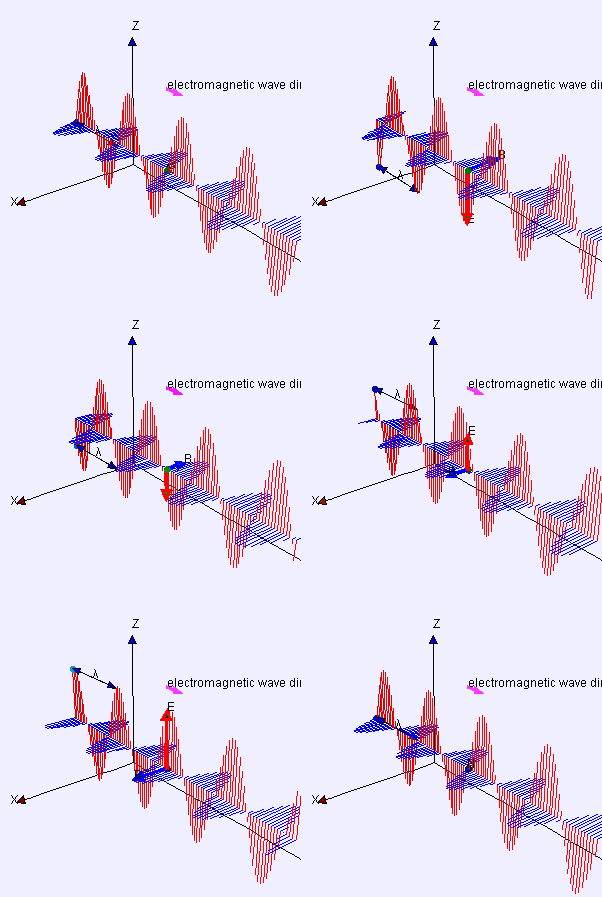
Plane-polarized electromagnetic wave in motion
Plane-polarized electromagnetic wave
Electric (E) field is red
Magnetic (B) field is blue
(Image by Loo Kang Wee and Fu-Kwun Hwang from Wikimedia Commons)

My cue to enter. “Not right, Vinnie. Experimental demonstrations going back more than a century show light exerting pressure. That implies non-zero momentum. On the theory side … you remember when we talked about light waves and the right-hand rule?”

“That was a long time ago, Sy. Remind me.”

“… Ah, I still have the diagram on Old Reliable. See here? The light wave is coming out of the screen and its electric field moves electrons vertically. Meanwhile, the magnetic field perpendicular to the electric field twists moving charges to scoot them along a helical path. So there’s your momentum, in the interaction between the two fields. The wave’s combined action delivers force to whatever it hits, giving it momentum in the wave’s direction of travel. No photons in this picture.”

Astrophysicist-in-training Newt Barnes dives in. “When you think photons and electrons, Vinnie, think Einstein. His Nobel prize was for his explanation of the photoelectric effect. Think about some really high-speed particle flying through space. I’m watching it from Earth and you’re watching it from a spaceship moving along with it so we’ve each got our own frame of reference.”

“Frames, awright! Sy and me, we’ve talked about them a lot. When you say ‘high-speed’ you’re talking near light-speed, right?”

“Of course, because that’s when relativity gets significant. If we each measure the particle’s speed, do we get the same answer?”

“Nope, because you on Earth would see me and the particle moving through compressed space and dilated time so the speed I’d measure would be more than the speed you’d measure.”

“Mm-hm. And using ENewton=mv² you’d assign it a larger energy than I would. We need a relativistic version of Newton’s formula. Einstein said that rest mass is what it is, independent of the observer’s frame, and we should calculate energy from EEinstein²=(pc)²+(mc²)², where p is the momentum. If the momentum is zero because the velocity is zero, we get the familiar EEinstein=mc² equation.”

“I see where you’re going, Newt. If you got no mass OR energy then you got nothing at all. But if something’s got zero mass but non-zero energy like a photon does, then it’s got to have momentum from p=EEinstein/c.”

“You got it, Vinnie. So either way you look at it, wave or particle, light carries momentum and can power Lightsail 2.”

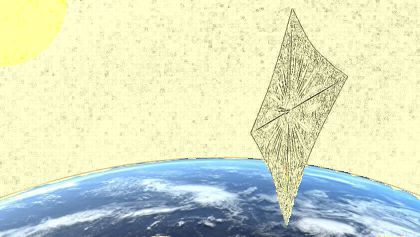
Lightsail 2 flying over Earth, against a yellow background
Adapted from image by Josh Spradling / The Planetary Society

“Question is, can sunlight give it enough momentum to get anywhere?”

“Now you’re getting quantitative. Sy, start up Old Reliable again.”

“OK, Newt, now what?”

“How much power can Lightsail 2 harvest from the Sun? That’ll be the solar constant in joules per second per square meter, times the sail’s area, 32 square meters, times a 90% efficiency factor.”

“Got it — 39.2 kilojoules per second.”

“That’s the supply, now for the demand. Lightsail 2 masses 5 kilograms and starts at 720 kilometers up. Ask Old Reliable to use the standard circular orbit equations to see how long it would take to harvest enough energy to raise the craft to another orbit 200 kilometers higher.”

“Combining potential and kinetic energies, I get 3.85 megajoules between orbits. That’s only 98 seconds-worth. I’m ignoring atmospheric drag and such, but net-net, Lightsail 2‘s got joules to burn.”

“Case closed, Vinnie.”

~~ Rich Olcott
Sail On, Silver Bird

Big excitement in Al’s coffee shop. “What’s the fuss, Al?”

Lightsail 2, Sy. The Planetary Society’s Sun-powered spacecraft. Ten years of work and some luck and it’s up there, way above Hubble and the ISS, boosting itself higher every day and using no fuel to do it. Is that cool or what?”

“Sun-powered? Like with a huge set of solar panels and an electric engine?”

“No, that’s the thing. It’s got a couple of little panels to power its electronics and all, but propulsion is all direct from the Sun and that doesn’t stop. Steady as she goes, Skipper, Earth to Mars in weeks, not months. Woo-hoo!”

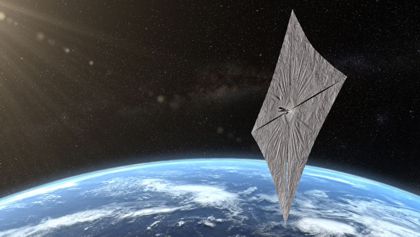
Image by Josh Spradling / The Planetary Society

Never the rah-rah type, Big Vinnie throws shade from his usual table by the door. “It didn’t get there by itself, Al. SpaceX’s Falcon Heavy rocket did the hard work, getting Lightsail 2 and about 20 other thingies up to orbit. Takes a lot of thrust to get out of Earth’s gravity well. Chemical rockets can do that, puny little ion drives and lightsails can’t.”

“Yeah, Vinnie, but those ‘puny’ guys could lead us to a totally different travel strategy.” A voice from the crowd, astrophysicist-in-training Newt Barnes. “Your big brawny rocket has to burn a lot of delta-v just to boost its own fuel. That’s a problem.”

Al looks puzzled. “Delta-v?”

“It’s how you figure rocket propellant, Al. With a car you think about miles per gallon because if you take your foot off the gas you eventually stop. In space you just keep going with whatever momentum you’ve got. What’s important is how much you can change momentum — speed up, slow down, change direction — and that depends on the propellant you’re using and the engine you’re putting it through. All you’ve got is what’s in the tanks.”

Al still looks puzzled. I fill in the connection. “Delta means difference, Al, and v is velocity which covers both speed and direction so delta-v means — “

“Got it, Sy. So Vinnie likes big hardware but bigger makes for harder to get off the ground and Newt’s suggesting there’s a limit somewhere.”

“Yup, it’s gotten to the point that the SpaceX people chase an extra few percent performance by chilling their propellants so they can cram more into the size tanks they use. I don’t know what the limit is but we may be getting close.”

Newt’s back in. “Which is where strategy comes in, Vinnie. Up to now we’re mostly using a ballistic strategy to get to off-Earth destinations, treating the vehicle like a projectile that gets all its momentum at the beginning of the trip. But there’s really three phases to the trip, right? You climb out of a gravity well, you travel to your target, and maybe you make a controlled landing you hope. With the ballistic strategy you burn your fuel in phase one while you’re getting yourself into a transfer orbit. Then you coast on momentum through phase two.”

“You got a better strategy?”

“In some ways, yeah. How about applying continuous acceleration throughout phase two instead of just coasting? The Dawn spacecraft, for example, was rocket-launched out of Earth’s gravity well but used a xenon-ion engine in continuous-burn mode to get to Mars and then on to Vesta and Ceres. Worked just fine.”

“But they’re such low-thrust –“

“Hey, Vinnie, taking a long time to build up speed’s no problem when you’re on a long trip anyway. Dawn‘s motor averaged 1.8 kilometer per second of delta-v — that works out to … about 4,000 miles per hour of increased speed for every hour you keep the motor running. Adds up.”

“OK, I’ll give you the ion motor’s more efficient than a chemical system, but still, you need that xenon reaction mass to get your delta-v. You still gotta boost it up out of the well. All you’re doing with that strategy is extend the limit.”

Al dives back in. “That’s the beauty of Lightsail, guys. No delta-v at all. Just put it up there and light-pressure from the Sun provides the energy. Look, I got this slick video that shows how it works.”

Video courtesy of The Planetary Society.

~~ Rich Olcott

Fierce Roaring Beast

A darkish day calls for a fresh scone so I head for Al’s coffee shop. Cathleen’s there with some of her Astronomy students. Al’s at their table instead of his usual place behind the cash register. “So what’s going on with these FRBs?”

She plays it cool. “Which FRBs, Al? Fixed Rate Bonds? Failure Review Boards? Flexible Reed Baskets?”

Jim, next to her, joins in. “Feedback Reverb Buffers? Forged Razor Blades?
Fennel Root Beer?”

I give it a shot. “Freely Rolling Boulders? Flashing Rapiers and Broadswords? Fragile Reality Boundary?”

“C’mon, guys. Fast Radio Bursts. Somebody said they’re the hottest thing in Astronomy.”

Cathleen, ever the teacher, gives in. “Well, they’re right, Al. We’ve only known about them since 2007 and they’re among the most mystifying objects we’ve found out there. Apparently they’re scattered randomly in galaxies all over the sky. They release immense amounts of energy in incredibly short periods of time.”

“I’ll say.” Vinnie’s joins the conversation from the next table. “Sy and me, we been talking about using the speed of light to measure stuff. When I read that those radio blasts from somewhere last just a millisecond or so, I thought, ‘Whatever makes that blast happen, the signal to keep it going can’t travel above lightspeed. From one side to the other must be closer than light can travel in a millisecond. That’s only 186 miles. We got asteroids bigger than that!'”

“300 kilometers in metric.” Jim’s back in. “I’ve played with that idea, too. The 70 FRBs reported so far all lasted about a millisecond within a factor of 3 either way — maybe that’s telling us something. The fastest way to get lots of energy is a matter-antimatter annihilation that completely converts mass to energy by E=mc².  Antimatter’s awfully rare 13 billion years after the Big Bang, but suppose there’s still a half-kilogram pebble out there a couple galaxies away and it hits a hunk of normal matter. The annihilation destroys a full kilogram; the energy release is 1017 joules. If the event takes one millisecond that’s 1020 watts of power.”

“How’s that stand up against the power we receive in an FRB signal, Jim?”

“That’s the thing, Sy, we don’t have a good handle on distances. We know how much power our antennas picked up, but power reception drops as the square of the source distance and we don’t know how far away these things are. If your distance estimate is off by a factor of 10 your estimate of emitted power is wrong by a factor of 100.”

“Ballpark us.”

<sigh> “For a conservative estimate, say that next-nearest-neighbor galaxy is something like 1021 kilometers away. When the signal finally hits us those watts have been spread over a 1021-kilometer sphere. Its area is something like 1049 square meters so the signal’s power density would be around 10-29 watts per square meter. I know what you’re going to ask, Cathleen. Assuming the radio-telescope observations used a one-gigahertz bandwidth, the 0.3-to-30-Jansky signals they’ve recorded are about a million million times stronger than my pebble can account for. Further-away collisions would give even smaller signals.”

Looking around at her students, “Good self-checking, Jim, but for the sake of argument, guys, what other evidence do we have to rule out Jim’s hypothesis? Greg?”

“Mmm… spectra? A collision like Jim described ought to shine all across the spectrum, from radio on up through gamma rays. But we don’t seem to get any of that.”

“Terry, if the object’s very far away wouldn’t its shorter wavelengths be red-shifted by the Hubble Flow?”

“Sure, but the furthest-away one we’ve tagged so far is nearer than z=0.2. Wavelengths have been stretched by 20% or less. Blue light would shift down to green or yellow at most.”

“Fran?”

“We ought to get even bigger flashes from antimatter rocks and asteroids. But all the signals have about the same strength within a factor of 100.”

“I got an evidence.”

“Yes, Vinnie?”

“That collision wouldn’t’a had a chance to get started. First contact, blooie! the gases and radiation and stuff push the rest of the pieces apart and kill the yield. That’s one of the problems the A-bomb guys had to solve.”

Al’s been eaves-dropping, of course. “Hey, guys. Fresh Raisin Bread, on the house.”

~~ Rich Olcott

Friendly Resting Behemoths

What Time Is It on Mars?

I’m puffing a little after hiking up a dozen flights of stairs. That whole bank of Acme Building elevators is closed off while the repair crew tries to free up the one that trapped us. The crowd waiting for the other bank is forgetaboutit. I unlock my office door and there’s Vinnie, tinkering with the thermostat. “Geez, Sy, it’s almost as cold in here as it is out in the hall. Hey, ya think there’s anything to the rumor that building management is gonna rent out that elevator as office space? And how does time work on Mars?”

“Morning, Vinnie. You’re right, I don’t think so, and where’d that last question come from?”

“I been thinking about those ultra-accurate clocks and how they’d play into that relativity stuff we talked about with Ramona.” <short lull in the conversation as we both consider Ramona> “Suppose there’s one of those clocks in a satellite going around Earth. If I remember right, it’s going ZIP around the planet so its clock ought to run faster than my wristwatch, but it’s further out of Earth’s gravity well so its clock ought to run slower. Which would win?”

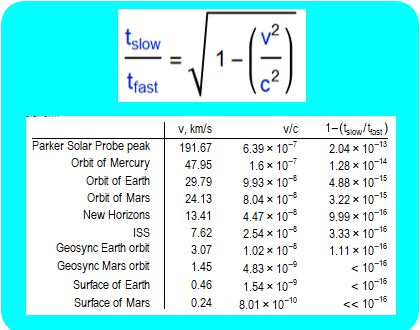
“You remembered right — you’ve got Special Relativity and General Relativity in a couple of nutshells, and yes, they sometimes work in opposite directions. You have to look at the numbers. Give me a sec to work up a few examples on Old Reliable… OK, let’s start with the speed part. That’s Special Relativity because they both start with ‘SP’.”

“Cute.”

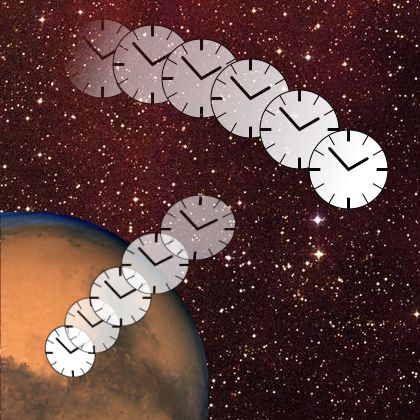
“I thought so.  OK, here’s a handful of locations and their associated straight-line speeds relative to some star far away. That last column shows a difference factor for a clock at each location compared to a far-away motionless clock in a zero gravitational field. Multiply the factor by 86,400 seconds per day to get the time difference per day. The fastest thing on the list is that spacecraft we’re sending to the Sun by way of some slingshot maneuvers around Venus to speed it up. The Special Relativity difference comes to less than two nanoseconds per day. That’s barely in the range we can detect. It’s way less for everyplace else. ”

“Hey, Mars is down at the bottom. Lemme think why… OK, slower rotation than Earth’s, AND smaller radius so you don’t move as far for the same degrees of spin, so the formula barely subtracts anything from 1.0, right?”

“Yup, the slower you go compared to lightspeed the smaller the time adjustment. The difference between unity and the ratio for a point on Mars’ surface is so small that Old Reliable suffered a floating-point underflow trying to calculate it. That’s hard to make it do. Bottom line, the SR effect doesn’t really kick in unless you’re going faster than practically everything larger than an atom.”

“So how about the gravity wells? I’ll bet the deeper the well, the more time gets stretched.”

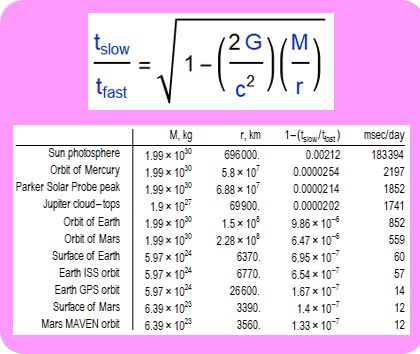
“Good bet. The well gets deeper as the attracting mass increases. But your clock feels less of a squeeze if it’s further away. The net effect is controlled by the mass-to-distance ratio inside that square root. Worst case in this table is at the top. A clock embedded in the Sun’s photosphere loses 0.00212*(86400 sec/day)=183 seconds compared to a far-away motionless clock in free-fall. We here on Earth lose 912 milliseconds a day total, but the astronauts on the ISS lose about 3 milliseconds less than we do because they’re further away from Earth’s center.”

“Yeah, I read about those twin astronauts. The one flying on the ISS didn’t get older as fast as the one that stayed on Earth.”

“About a second’s-worth over a year. So, do you have your relativity and Mars-time answer?”

“Sorta. But what time is it up there right now?”

“Hey, Mars is a whole world and has different times at different places just like Earth does. Wherever you are on Mars, ‘noon’ is when the Sun is overhead. Mars spins about 3% slower than Earth does — noon-to-noon there is Earth’s 24 hours plus 37 minutes and change. Add in the net 340-millisecond relativistic daily drift away from Earth time. No way can you sync up Earth and Mars times.”

“Nothin’s simple, huh?”

~~ Rich Olcott

A Force-to-Force Meeting

The Crazy Theory contest is still going strong in the back room at Al’s coffee shop. I gather from the score board scribbles that Jim’s Mars idea (one mark-up says “2 possible 2 B crazy!“) is way behind Amanda’s “green blood” theory.  There’s some milling about, then a guy next to me says, “I got this, hold my coffee,” and steps up to the mic.  Big fellow, don’t recognize him but some of the Physics students do — “Hey, it’s Cap’n Mike at the mic.  Whatcha got for us this time?”

“I got the absence of a theory, how’s that?  It’s about the Four Forces.”

Someone in the crowd yells out, “Charm, Persuasiveness, Chaos and Bloody-mindedness.”

“Nah, Jennie, that’s Terry Pratchett’s Theory of Historical Narrative.  We’re doing Physics here.  The right answer is Weak and Strong Nuclear Forces, Electromagnetism, and Gravity, with me?  Question is, how do they compare?”

Another voice from the crowd. “Depends on distance!”

“Well yeah, but let’s look at cases.  Weak Nuclear Force first.  It works on the quarks that form massive particles like protons.  It’s a really short-range force because it depends on force-carrier particles that have very short lifetimes.  If a Weak Force carrier leaves its home particle even at the speed of light which they’re way too heavy to do, it can only fly a small fraction of a proton radius before it expires without affecting anything.  So, ineffective anywhere outside a massive particle.”

It’s a raucous crowd.  “How about the Strong Force, Mike?”

.  <chorus of “HOO-wah!”>

“Semper fi that.  OK, the carriers of the Strong Force —”

.  <“Naa-VY!  Naaa-VY!”>

.  <“Hush up, guys, let him finish.”>

“Thanks, Amanda.  The Strong Force carriers have no mass so they fly at lightspeed, but the force itself is short range, falls off rapidly beyond the nuclear radius.  It keeps each trio of quarks inside their own proton or neutron.  And it’s powerful enough to corral positively-charged particles within the nucleus.  That means it’s way stronger inside the nucleus than the Electromagnetic force that pushes positive charges away from each other.”

“How about outside the nucleus?”

“Out there it’s much weaker than Electromagnetism’s photons that go flying about —”

.  <“Air Force!”>

.  <“You guys!”>

“As I was saying…  OK, the Electromagnetic Force is like the nuclear forces because it’s carried by particles and quantum mechanics applies.  But it’s different from the nuclear forces because of its inverse-square distance dependence.  Its range is infinite if you’re willing to wait a while to sense it because light has finite speed.  The really different force is the fourth one, Gravity —”

.  <“Yo Army!  Ground-pounders rock!”>

“I was expecting that.  In some ways Gravity’s like Electromagnetism.  It travels at the same speed and has the same inverse-square distance law.  But at any given distance, Gravity’s a factor of 1038 punier and we’ve never been able to detect a force-carrier for it.  Worse, a century of math work hasn’t been able to forge an acceptable connection between the really good Relativity theory we have for Gravity and the really good Standard Model we have for the other three forces.  So here’s my Crazy Theory Number One — maybe there is no connection.”

.  <sudden dead silence>

“All the theory work I’ve seen — string theory, whatever — assumes that Gravity is somehow subject to quantum-based laws of some sort and our challenge is to tie Gravity’s quanta to the rules that govern the Standard Model.  That’s the way we’d like the Universe to work, but is there any firm evidence that Gravity actually is quantized?”

.  <more silence>

“Right.  So now for my Even Crazier Theories.  Maybe there’s a Fifth Force, also non-quantized, even weaker than Gravity, and not bound by the speed of light.  Something like that could explain entanglement and solve Einstein’s Bubble problem.”

.  <even more silence>

“OK, I’ll get crazier.  Many of us have had what I’ll call spooky experiences that known Physics can’t explain.  Maybe stupid-good gambling luck or ‘just knowing’ when someone died, stuff like that.  Maybe we’re using the Fifth Force in action.”

.  <complete pandemonium>
four forces plus 1

~ Rich Olcott


Note to my readers with connections to the US National Guard, Coast Guard, Merchant Marine and/or Public Health Service — Yeah, I know, but one can only stretch a metaphor so far.

A Three-dog Night Would Be So Cool

“So we’ve got three fundamentally different messengers from the stars, Mr Feder.  The past couple of years have given us several encouraging instances of receiving two messengers from the same event.  If we ever receive all three messengers from the same event, that might give us what we need to solve the biggest problem in modern physics.”

“That’s a pretty deep statement, Moire.  Care to unpack it?  The geese here would love to hear about it.”

“Lakeside is a good place for thoughts like this.  The first messenger was photons.  We’ve been observing starlight photons for tens of thousand of years.  Tycho Brahe and Galileo took it to a new level a few centuries ago with their careful observation, precision measurements and Galileo’s telescope.”

“That’s done us pretty good, huh?”

“Oh sure, we’ve charted the heavens and how things move, what we can see of them.  But our charts imply there’s much we can’t see.  Photons only interact with electric charge.  Except for flat-out getting absorbed if the wavelength is right, photons don’t care about electrically neutral material and especially they don’t care about dark matter.”

“So that’s why we’re interested in the other messengers.”

“Exactly.  Even electrically neutral things have mass and interact with the gravitational field.  You remember the big news a few years ago, when our brand-new LIGO instruments caught a gravitational wave signal from a couple of black holes in collision.  Black holes don’t give off photons, so the gravitational wave messenger was our only way of learning about that event.”

“No lightwave signal at all?”

“Well, there was a report of a possible gamma-ray flare in that patch of sky, but it was borderline-detectable.  No observatory using lower-energy light saw anything there.  So, no.”

“You’re gonna tell me and the geese about some two-messenger event now, right?”

“That’s where I’m going, Mr Feder.  Photons first.  Astronomers have been wondering for decades about where short, high-energy gamma-ray bursts come from.  They seem to happen randomly in time and space.  About a year ago the Fermi satellite’s gamma-ray telescope detected one of those bursts and sent out an automated ‘Look HERE’ alert to other observatories.  Unfortunately, Fermi‘s resolution isn’t wonderful so its email pointed to a pretty large patch of sky.  Meanwhile back on Earth and within a couple of seconds of Fermi‘s moment, the LIGO instruments caught an unusual gravitational wave signal that ran about a hundred times slower than the black-hole signals they’d seen.  Another automated ‘Look HERE’ alert went out.  This one pointed to a small portion of that same patch of sky.  Two messengers.”

“Did anyone find anything?”

“Seventy other observatories scrutinized the overlap region at every wavelength known to Man.  They found a kilonova, an explosion of light and matter a thousand times brighter than typical novae.  The gravitational wave evidence indicated a collision between two neutron stars, something that had never before been recorded.  Photon evidence from the spewed-out cloud identified a dozen heavy elements theoreticians hadn’t been able to track to an origin.  Timing details in the signals gave cosmologists an independent path to resolving a problem with the Hubble Constant.  And now we know where those short gamma-ray bursts come from.”

“Pretty good for a two-messenger event.  Got another story like that?”

“A good one.  This one’s neutrinos and photons, and the neutrinos came in first.  One neutrino.”

One neutrino?”

“Yup, but it was a special one, a super-high-powered neutrino whose incoming path our IceCube observatory could get a good fix on.  IceCube sent out its own automated ‘Look HERE’ alert.  The Fermi team picked up the alert and got real excited because the alert’s coordinates matched the location of a known and studied gamma-ray source.  Not a short-burster, but a flaring blazar.  That neutrino’s extreme energy is evidence for blazars being one of the long-sought sources of cosmic rays.”

“Puzzle solved, maybe.  Now what you said about a three-messenger signal?”grebe messenger pairs“Gravitational waves are relativity effects and neutrinos are quantum mechanical.  Physicists have been struggling for a century to bridge those two domains.  Evidence from a three-messenger event could provide the final clues.”
“I’ll bet the geese enjoyed hearing all that.”

“They’re grebes, Mr Feder.”

~~ Rich Olcott

“Hot Jets, Captain Neutrino!”

“Hey, Cathleen, while we’re talking IceCube, could you ‘splain one other thing from that TV program?”

“Depends on the program, Al.”

“Oh, yeah, you weren’t here when we started on this.  So I was watching this program and they were talking about neutrinos and how there’s trillions of them going through like my thumbnail every second and then IceCube saw this one neutrino that they’re real excited about so what I’m wondering is, what’s so special about just that neutrino? How do they even tell it apart from all the others?”

“How about the direction it came from, Cathleen?  We get lotsa neutrinos from the Sun and this one shot in from somewhere else?”

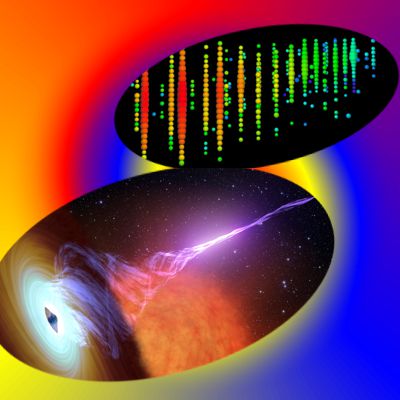
SMBH jet and IceCube
Images from NASA and JPL-Caltech

“An interesting question, Vinnie.  The publicity did concern its direction, but the neutrino was already special.  It registered 290 tera-electron-volts.”

“Ter-what?”

“Sorry, scientific shorthand — tera is ten-to-the-twelfth.  A million electrons poised on a million-volt gap would constitute a Tera-eV of potential energy.  Our Big Guy had 290 times that much kinetic energy all by himself.”

“How’s that stack up against other neutrinos?”

“Depends on where they came from.  Neutrinos from a nuclear reactor’s uranium or plutonium fission carry only about 10 Mega-eV, wimpier by a factor of 30 million.  The Sun’s primary fusion process generates neutrinos peaking out at 0.4 MeV, 25 times weaker still.”

“How about from super-accelerators like the LHC?”

“Mmm, the LHC makes TeV-range protons but it’s not designed for neutrino production.  We’ve got others that have been pressed into service as neutrino-beamers. It’s a complicated process — you send protons crashing into a target.  It spews a splatter of pions and K-ons.  Those guys decay to produce neutrinos that mostly go in the direction you want.  You lose a lot of energy.  Last I looked the zippiest neutrinos we’ve gotten from accelerators are still a thousand times weaker than the Big Guy.”

I can see the question in Vinnie’s eyes so I fire up Old Reliable again.  Here it comes… “What’s the most eV’s it can possibly be?”  Good ol’ Vinnie, always goes for the extremes.

“You remember the equation for kinetic energy?”

“Sure, it’s E=½ m·v², learned that in high school.”

“And it stayed with you.  OK, and what’s the highest possible speed?”

“Speed o’ light, 186,000 miles per second.”

“Or 300 million meters per second, ’cause that’s Old Reliable’s default setting.  Suppose we’ve got a neutrino that’s going a gnat’s whisker slower than light.  Let’s apply that formula to the neutrino’s rest mass which is something less than 1.67×10-36 kilograms…”Speedy neutrino simple calculation“Half an eV?  That’s all?  So how come the Big Guy’s got gazillions of eV’s?”

“But the Big Guy’s not resting.  It’s going near lightspeed so we need to apply that relativistic correction to its mass…Speedy neutrino relativistic calculation“That infinity sign at the bottom means ‘as big as you want.’  So to answer your first question, there isn’t a maximum neutrino energy.  To make a more energetic neutrino, just goose it to go even closer to the speed of light.”
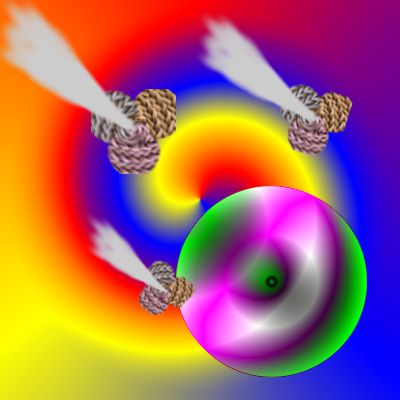
“Musta been one huge accelerator that spewed the Big Guy.”

“One of the biggest, Al.”  Cathleen again.  “That’s the exciting thing about what direction the particle came from.”

“Like the North Pole or something?”

“Much further away, much bigger and way more interesting.  As soon as IceCube caught that neutrino signal, it automatically sent out a “Look in THIS direction!” alert to conventional observatories all over the world.  And there it was — a blazar, 5.7 billion lightyears away!”

“Wait, Cathleen, what’s a blazar?”

“An incredibly brilliant but highly variable photon source, from radio frequencies all the way up to gamma rays and maybe cosmic rays.  We think the thousands we’ve catalogued are just a fraction of the ones within range.  We’re pretty sure that each of them depends on a super-massive black hole in the center of a galaxy.  The current theory is that those photons come from an astronomy-sized accelerator, a massive swirling jet that shoots out from the central source.  When the jet happens to point straight at us, flash-o!”

Duck!

“I wouldn’t worry about a neutrino flood.  The good news is IceCube’s signal alerted astronomers to check TXS 0506+056, a known blazar, early in a new flare cycle.”

“An astrophysical fire alarm!”

~~ Rich Olcott

Bigger than you’d think

Al’s coffee shop, the usual mid-afternoon crowd of chatterers and laptop-tappers.  Al’s walking his refill rounds, but I notice he’s carrying a pitcher rather than his usual coffee pot.  “Hey, Al, what’s with the hardware?”

“Got iced coffee here, Sy.  It’s hot out, people want to cool down.  Besides, this is in honor of IceCube.”

“Didn’t realize you’re gangsta fan.”

“Nah, not the rapper, the cool experiment down in the Antarctic.  It was just in the news.”

“Oh?  What did they say about it?”

“It’s the biggest observatory in the world, set up to look for the tiniest particles we know of, and it uses a cubic mile of ice which I can’t think how you’d steer it.”

A new voice, or rather, a familiar one. “One doesn’t, Al.”
Neutrino swirl 1“Hello, Jennie.  Haven’t seen you for a while.”
“I flew home to England to see my folks.  Now I’m back here for the start of the Fall term.  I’ve already picked a research topic — neutrinos.  They’re weird.”

“Hey, Jennie, why are they so tiny?”

“It’s the other way to, Al.  They’re neutrinos because they’re so tiny.  Sy would say that for a long time they were simply an accounting gimmick to preserve the conservation laws.”

“I would?”

“Indeed.  People had noticed that when uranium atoms give off alpha particles to become thorium, the alpha particles always have about the same amount of energy.  The researchers accounted for that by supposing that each kind of nucleus has some certain quantized amount of internal energy.  When one kind downsizes to another, the alpha particle carries off the difference.”

“That worked well, did it?”

“Oh, yes, there are whole tables of nuclear binding energy for alpha radiation.  But when a carbon-14 atom emits a beta particle to become nitrogen-14, the particle can have pretty much any amount of energy up to a maximum.  It’s as though the nuclear quantum levels don’t exist for beta decay.  Physicists called it the continuous beta-spectrum problem and people brought out all sorts of bizarre theories to try to explain it.  Finally Pauli suggested maybe something we can’t see carries off energy and leaves less for the beta.  Something with no charge and undetectable mass and the opposite spin from what the beta has.”

“Yeah, that’d be an accounting gimmick, alright.  The mass disappears into the rounding error.”

“It might have done, but twenty years later they found a real particle.  Oh, I should mention that after Pauli made the suggestion Fermi came up with a serious theory to support it.  Being Italian, he gave the particle its neutrino name because it was neutral and small.”

“But how small?”

“We don’t really know, Al.  We know the neutrino’s mass has to be greater than zero because it doesn’t travel quite as fast as light does.  On the topside, though, it has to be lighter than than a hydrogen atom by at least a factor of a milliard.”

“Milliard?”

“Oh, sorry, I’m stateside, aren’t I?  I should have said a billion.  Ten-to-the-ninth, anyway.”

“That’s small.  I guess that’s why they can sneak past all the matter in Earth like the TV program said and never even notice.”

This gives me an idea.  I unholster Old Reliable and start to work.

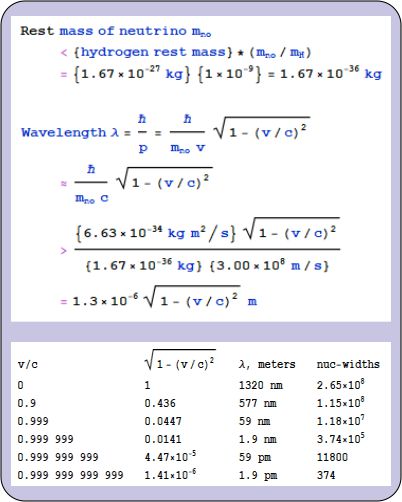
“Be right with you… <pause> … Jennie, I noticed that you were being careful to say that neutrinos are light, rather than small.  Good careful, ’cause ‘size’ can get tricky at this scale.  In the early 1920s de Broglie wrote that every particle is associated with a wave whose wavelength depends on the particle’s momentum.  I used his formula, together with Jennie’s upper bound for the neutrino’s mass, to calculate a few wavelength lower bounds.Neutrino wavelength calcMomentum is velocity times mass.  These guys fly so close to lightspeed that for a long time scientists thought that neutrinos are massless like photons.  They’re not, so I used several different v/c ratios to see what the relativistic correction does.  Slow neutrinos are huge, by atom standards.  Even the fastest ones are hundreds of times wider than a nucleus.”

“With its neutrino-ness spread so thin, no wonder it’s so sneaky.”

“That may be part of it, Al.”

“But how do you steer IceCube?”

~~ Rich Olcott

Rhythm Method

A warm Summer day.  I’m under a shady tree by the lake, watching the geese and doing some math on Old Reliable.  Suddenly a text-message window opens up on its screen.  The header bar says 710-555-1701.  Old Reliable has never held a messaging app, that’s not what I use it for.  The whole thing doesn’t add up.  I type in, Hello?

Hello, Mr Moire.  Remember me?

Suddenly I do.  That sultry knowing stare, those pointed ears.  It’s been a yearHello, Ms Baird.  What can I do for you?

Another tip for you, Mr Moire.  One of my favorite star systems — the view as you approach it at near-lightspeed is so ... meaningful.  Your astronomers call it PSR J0337+1715.

So of course I head over to Al’s coffee shop after erasing everything but that astronomical designation.  As I hoped, Cathleen and a few of her astronomy students are on their mid-morning break.  Cathleen winces a little when she sees me coming.  “Now what, Sy?  You’re going to ask about blazars and neutrinos?”

I show her Old Reliable’s screen.  “Afraid not, Cathleen, I’ll have to save that for later.  I just got a message about this star system.  Recognize it?”

“Why, Sy, is that a clue or something?  And why is the lettering in orange?”

“Long story.  But what can you tell me about this star system?”

“Well, it’s probably one of the most compact multi-component systems we’re ever going to run across.  You know what compact objects are?”

“Sure.  When a star the size of our Sun exhausts most of its hydrogen fuel, gravity wins its battle against heat.  The star collapses down to a white dwarf, a Sun-full of mass packed into a planet-size body.  If the star’s a bit bigger it collapses even further, down to a neutron star just a few miles across.  The next step would be a black hole, but that’s not really a star, is it?”

“No, it’s not.  Jim, why not?”

“Because by definition a black hole doesn’t emit light.  A black hole’s accretion disk or polar jets might, but not the object itself.”

“Mm-hm.  Sy, your ‘object’ is actually three compact objects orbiting  around each other.  There’s a neutron star with a white dwarf going around it, and another white dwarf swinging around the pair of them.  Vivian, does that sound familiar?”

“That’s a three-body system, like the Moon going around the Earth and both going around the Sun.  Mmm, except really both white dwarfs would go around the neutron star because it’s heaviest and we can calculate the motion like we do the Solar System.”

“Not quite.  We can treat the Sun as motionless because it has 99% of the mass.  J0337+1715’s neutron star doesn’t dominate its system as much as the Sun does ours.  That outermost dwarf has 20% of its system’s mass.  Phil, what does that suggest to you?”

“It’d be like Pluto and Charon.  Charon’s got 10% of their combined mass and so Pluto and Charon both orbit a point 10% of the way out from Pluto.  From Earth we see Pluto wobbling side to side around that point.  So the neutron star must wobble around the point 20% outward towards the heavy dwarf.  Hey, star-wobble is how we find exoplanets.  Is that what this is about, Mr Moire?  Did someone measure its red-shift behavior?”PSR J0337+1715Cathleen saves me from answering.  “Not quite.  The study Sy’s chasing is actually a cute variation on red-shift measurements.  That ‘PSR‘ designation means the neutron star is a pulsar.  Those things emit electromagnetic radiation pulses with astounding precision, generally regular within a few dozen nanoseconds.  If we receive slowed-down pulses then the object’s going away; sped-up and it’s approaching, just like with red-shifting.  The researchers  derived orbital parameters for all three bodies from the between-pulse durations.  The heavy dwarf is 200 times further out than the light one, for instance.  Not an easy experiment, but it yielded an important result.”

My ears perk up.  “Which was…?”

“The gravitational force between the pulsar and each dwarf was within six parts per million of what Newton’s Laws prescribe.  That observation rules out whole classes of theories that tried to explain galaxies and galaxy clusters without invoking dark matter.”

Cool, huh?

Uh-huh.

~~ Rich Olcott

Terzetto for Rubber Ruler

ruler and sodium lines“So you’re telling me, Cathleen, that you can tell how hot a star is by looking at its color?”
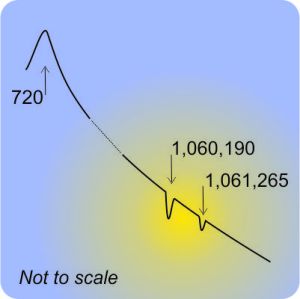
“That’s right, Vinnie.  For most stars their continuous spectrum is pretty close to the blackbody equation tying peak wavelength to temperature.”

“But you can’t do that with far-away stars, right, because the further they are, the more stretched-out their lightwaves get.  Won’t that mess up the peak wavelength?”

“The key is Kirchhoff’s other kinds of spectrum.”

“You’re talking the bright-line and dark-line kinds.”

“Exactly.  Each kind of spectrum comes from a different process — each is affected differently by the object in question and the environment it’s embedded in.  A continuous spectrum is all about charged particles moving randomly in response to the heat energy they’re surrounded by.  It doesn’t matter what kind of particles they are or even whether they’re positive or negative.  Whenever a particle changes direction, it twitches the electromagnetic field and gives off a wave.”

“Right — the higher the temperature the less time between twitches; the wave can’t move as far before things change so the wavelength’s shorter; any speed’s possible so you can turn that dial wherever; I got all that.  So what’s different with the bright-line and dark-line spectrums?”

Cathleen and I both blurt out, “Spectra!” at the same time and give each other a look.  We’re grown-ups now.  We don’t say, “Jinx!” to each other any more.

“Alright, spectra.  But how’re they different?”

I pick up the story.  “Like Cathleen said, continuous spectra from same–temperature stuff look identical no matter what kind of stuff’s involved because heat is motion and each particle moves as a unit  The other kinds of spectrum are about transitions within particles so they’re all about which kind of stuff.  A given kind of atom can only absorb certain wavelengths of light and it can only relax by giving off exactly the same wavelengths.  There’s no in-betweens.”

She cuts in.  “Sodium, for instance.  It has two strong lines in the yellow, at 588.995 and 589.592 nanometers.  Whether in a star or a meteor or fireworks, sodium gives off exactly those colors.  Conversely, in an interstellar cloud or in a star’s outermost layers sodium absorbs exactly those colors from any continuous-spectrum light passing through.”

I’m back in.  “And there’s the key to your unmixing question, Vinnie.  We’ve talked about frames, remember?  Your far-away star’s light-generating layers emit a continuous spectrum that describes its temperature.  If we were right next to it, that’s the spectrum we’d see.  But as you say, we’re a long way away and in our frame the light’s been stretched.  It still looks like the black-body curve but it’s red-shifted because of our relative motion.”

Cathleen’s turn.  “But if there are sodium atoms in the star’s upper layers, their absorptions will cut a pair of notches in that emitted spectrum.  It won’t be a smooth curve, there’ll be two sharp dips in it, close together, with the blue-side one twice as strong as the other one.  Easy to recognize and measure the redshift.  The blackbody peak is redshifted by exactly the same amount so with some arithmetic you’ve got the peak’s original wavelength and the star’s temperature.”

Mine.  “See, because we know what the sodium wavelengths were in the star’s frame, we can divide the dip wavelengths we measure by the rest-frame numbers we know about.  The ratios give us the star’s redshift.”

Spectrum with only blackbody and sodium Cathleen turns to her laptop and starts tapping keys.  “Let’s do an example.  Suppose we’re looking at a star’s broadband spectrogram.  The blackbody curve peaks at 720 picometers.  There’s an absorption doublet with just the right relative intensity profile in the near infra-red at 1,060,190 and 1,061,265 picometers.  They’re 1,075 picometers apart.  In the lab, the sodium doublet’s split by 597 picometers.  If the star’s absorption peaks are indeed the sodium doublet then the spectrum has been stretched by a factor of 1075/597=1.80.  Working backward, in the star’s frame its blackbody peak must be at 720/1.80=400 picometers, which corresponds to a temperature of about 6,500 K.”

“Old Reliable calculates from that stretch factor and the Hubble Constant the star’s about ten billion lightyears away and fleeing at 240,000 km/s.”

“All that from three peaks.  Spectroscopy’s pretty powerful, huh?”

Cathleen and me: “For sure!    Jinx!”

~~ Rich Olcott