Zarzuela for Rubber Ruler

“Hey, Cathleen, if the expansion of the Universe stretches light’s wavelengths, how do you know when you see a color in a star what you’re looking at?”

“Excuse me, Professor, but your office-mate said you’d be here at the coffee shop and I have a homework question.”

“Good heavens, look at the time!  It’s my office hours, I should be over there.  Oh well, you’re here, Maria, what’s the question?”

“You showed us this chart and asked us to write an essay on it.  I don’t know where to begin.”Temp and BB peak
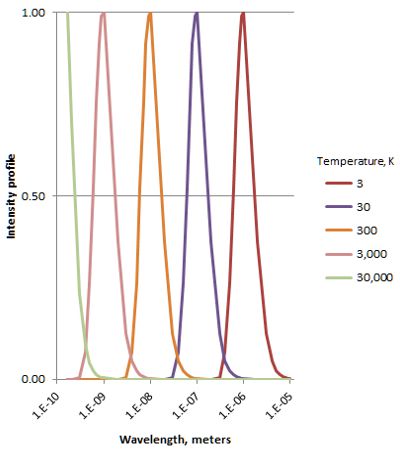
“Ah.  Hang on, Vinnie, this bears on your question, too.  OK, Maria, what can you tell me about the chart?”

“Well, there are five peaked curves, labeled with different temperatures.  Can I assume the green curve peaks, too, not continuing straight up?”

“Yes.  What else?”

“The horizontal axis, sorry I don’t know the word —”

“abscissa”

“Oh, we have almost the same word in Spanish!  Anyhow, the abscisa says it shows wavelengths.  It goes from a tenth of a nanometer to maybe 10 micrometers.  The chart must have to do with light, because sound waves can’t get that short.  The … ordinada…?”

“Ordinate”

“Thank you.  The ordinate says ‘Intensity’ so the chart must show light spectra at different temperatures.  But there’s only one peak at each temperature.”

“Is that Kirchhoff’s ‘continuous spectrum,’ Cathleen?”

“Right, Vinnie, a smoothly-varying cascade of every wavelength, photons arising from heat-generated motion of charged particles.”

Ah, ya lo veo — this is blackbody spectra given off by hot objects.  You showed us one in class and here we have several.”

“Good, Maria.  Now —”

“But all the peaks look exactly the same, Cathleen.  The hot objects ought to be brighter.  A really hot flame, you can’t even look at it.  Something’s phony.”

“Good eye, Vinnie.  I divided each curve in the graph by its peak height to put them all on an even footing.  That’s why the axis is labeled ‘Intensity profile‘ instead of ‘Intensity.'”

“I’ve got a different issue, Cathleen.  Hot objects have more energy to play with.  Shouldn’t the hotter peaks spread over a wider wavelength range?  These are all the same width.”

“I think I know the answer to that one, Mr Moire.  In class la profesora showed us how the blackbody curve’s equation has two factors, like B=W*X.  The W factor depends only on wavelength and grows bigger as the wavelength gets smaller.  That’s the ‘ultraviolet catastrophe,’ right, ma’am?”

“Mm-hm.  Go on, Maria.”

“But the X factor gets small real fast as the wavelength gets small.  In fact, it gets small so fast that it overpowers W‘s growth — the W*X product gets small, too.  Do you have that movie you showed us on your laptop there, ma’am?”

“Sure.  Here it is…”Blackbody peaks 1

“OK, the blue line is that W factor.  Oh, by the way, the ordinate scale here is logarithmic, so the value at the left end of the blue line is 1027/106 or about 1021 times bigger than it is at the right end even though it looks like a straight line.  The green line is that temperature-dependent factor.  See how it pulls down the orange lines’ values for cold objects, but practically goes away for very hot objects?”

“Yeah, that shows it real good, right, Sy?  That orange peak moves to the left just like Cathleen’s picture shows.  It answers your question, too.”

“It does, Vinnie?  How so?”

“‘Cause the peaks get broader as they get higher.  It’s like the intensity at the, umm, microwave end hardly changes at all and the whole rest of the curve swings up and out from there.”

“Keep in mind, guys, that we’re talking really large numbers here.  Vinnie’s ‘hardly changes at all’ is actually a factor of 40,000 or so.  Those pretty peaks in my homework chart are only pretty because the spread-out tails are so small relative to the peaks.”

“Alright, Cathleen, but how does Maria’s question tie in with mine?”

“They both hinge on wavelength.  The blackbody equation lets us measure a star’s temperature by looking at its color.  Do you have enough to start on that essay, Maria?”

“Yes, ma’am.  Gracias.”

De nada.  Now run along and get to work on it.”

~~ Rich Olcott
Étude for A Rubber Ruler

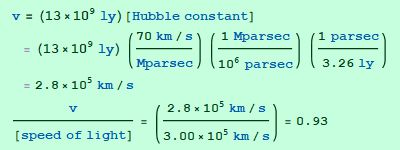
93% redder?  How do you figure that, Sy, and what’s it even mean?”

“Simple arithmetic, Vinnie.  Cathleen said that most-distant galaxy is 13 billion lightyears away.  I primed Old Reliable with Hubble’s Constant to turn that distance into expansion velocity and compare it with lightspeed.  Here’s what came up on its screen.”Old Reliable z calculation“Whoa, Sy.  Do you read the final chapter of a mystery story before you begin the book?”

“Of course not, Cathleen.  That way you don’t know the players and you miss what the clues mean.”

“Which is the second of Vinnie’s questions.  Let’s take it a step at a time.  I’m sure that’ll make Vinnie happier.”

“It sure will.  First step — what’s a parsec?”

“Just another distance unit, like a mile or kilometer but much bigger.  You know that a lightyear is the distance light travels in an Earth year, right?”

“Right, it’s some huge number of miles.”

“About six trillion miles, 9½ trillion kilometers.  Multiply the kilometers by 3.26 to get parsecs.  And no, I’m not going to explain the term, you can look it up.  Astronomers like the unit, other people put it in the historical-interest category with roods and firkins.”

“Is that weird ‘km/sec/Mparsec’ mix another historical thing?”

“Uh-huh.  That’s the way Hubble wrote it in 1929.  It makes more sense if you look at it piecewise.  It says for every million parsecs away from us, the outward speed of things in general increases by 70 kilometers per second.”

“That helps, but it mixes old and new units like saying miles per hour per kilometer.  Ugly.  It’d be prettier if you kept all one system, like (pokes at smartphone screen) … about 2.27 km/sec per 1018 kilometers or … about 8 miles an hour per quadrillion miles.  Which ain’t much now that I look at it.”

“Not much, except it adds up over astronomical distances.  The Andromeda galaxy, for instance, is 15×1018 miles away from us, so by your numbers it’d be moving away from us at 120,000 miles per hour.”

“Wait, Cathleen, I thought Andromeda is going to collide with the Milky Way four billion years from now.”

Opposing motion in a starfield“It is, Sy, and that’s one of the reasons why Hubble’s original number was so far off.  He only looked at about 50 close-by galaxies, some of which are moving toward us and some away.  You only get a view of the general movement when you look at large numbers of galaxies at long distances.  It’s like looking through a window at a snowfall.  If you concentrate on individual flakes you often see one flying upward, even though the fall as a whole is downward.  Andromeda’s 250,000 mph march towards us is against the general expansion.”
“Like if I’m flying a plane and the airspeed indicator says I’m doing 200 but my ground-speed is about 140 then I must be fighting a 60-knot headwind.”

“Exactly, Vinnie.  For Andromeda the ‘headwind’ is the Hubble Flow, that general outward trend.  If Sy’s calculation were valid, which it’s not, then that galaxy 13 billion lightyears from here would indeed be moving further away at  93% of lightspeed.  Someone living in that galaxy could shine a 520-nanometer green laser at us.  At this end we see the beam stretched by 193% to 1000nm.  That’s outside the visible range, well into the near-infrared.  All four visible lines in the hydrogen spectrum would be out there, too.”

“So that’s why ‘old hydrogens’ look different — if they’re far enough away in the Hubble Flow they’re flying away from us so fast all their colors get stretched by the red-shift.”

“Right, Vinnie.”

“Wait, Cathleen, what’s wrong with my calculation?”

“Two things, Sy.  Because the velocities are close to lightspeed, you need to apply a relativistic correction factor.  That velocity ratio Old Reliable reported — call it b.  The proper stretch factor is z=√ [(1+b)/(1–b)].  Relativity takes your 93% stretch down to (taps on laptop keyboard) … about 86%.  The bluest wavelength on hydrogen’s second-down series would be just barely visible in the red at 680nm.”

“What’s the other thing?”Ruler in perspective

“The Hubble Constant can’t be constant.  Suppose you run the movie backwards.  The Universe shrinks steadily at 70 km/sec/Mparsec.  You hit zero hundreds of millions of years before the Big Bang.”

“The expansion must have started slow and then accelerated.”

“Vaster and faster, eh?”

“Funny, Sy.”

~~ Rich Olcott

The Biggest Telescope in The Universe

Vinnie rocks back in his chair.  “These gravitational lenses, Cathleen.  How do you figure their apertures and f-numbers, space being infinite and all?”

She takes a breath to answer, but I cut in.  “Whoa, I never got past a snapshot camera.  How about you explain Vinnie’s question before you answer it?”Bird and lenses

“You’re right, Sy, most people these days just use their cellphone camera and have no clue about what it does inside.  Apertures and f-numbers are all just simple geometry.  Everything scales with the lens’ focal length.”

“That’s how far away something is that you’re taking a picture of?”

“No, it’s a characteristic of the lens itself.  It’s the distance between the midpoint of the lens and its focal plane, which is where you’d want to put the sensor chip or film in a camera.  The aperture is the diameter of the light beam entering the lens.  The optimal aperture, the image size, even the weight of the lens, all scale to the lens focal length.”

“I can see image size thing — the further back the focal plane, the bigger the image by the the time it gets there.  It’s like a lever.”

“Sort of, Vinnie, but you’ve got the idea.”

“The aperture scales to focal length?  I’d think you could make a lens with any diameter you like.”

“Sure you could, Sy, but remember you’d be using a recording medium of some sort and it’s got an optimum input level.  Too much light and you over-expose, too little and you under-expose.  To get the right amount of light when you take the shot the aperture has to be right compared to the focal length.”

“Hey, so that’s the reason for the old ‘Sunny 16‘ rule.  Didn’t matter if I had a 35mm Olympus or a big ol’ Rollei, if it was a sunny day I got good pictures with an f/16 aperture.  ‘Course I had to balance the exposure time with the film’s speed rating but that was easy.”

“Exactly, Vinnie.  If I remember right, the Rollei’s images were about triple the size of the little guy’s.  Tripled focal length meant tripled lens size.  You could use the same speed-rated film in both cameras and use the same range of f-stops.  The rule still works with digital cameras but you need to know your sensor’s ISO rating.”

“Ya got this, Sy?  Can we move on to Cathleen’s gravity lenses?”

“Sure, go ahead.”

“Well, they’re completely different from … I’ll call them classical lenses. That kind has a focal plane and a focal length and an aperture and only operates along one axis.  Gravitational lenses have none of that, but they have an infinite number of focal lines and rings.”

Gravitational lens and galaxy“Infinite?”

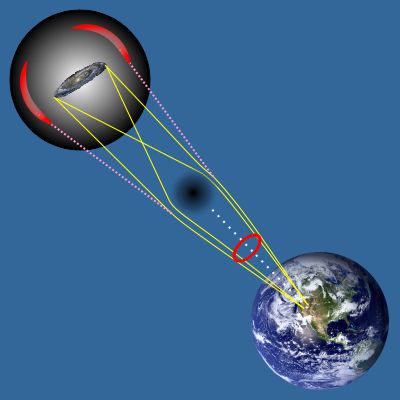
“At least in principle.  Any observation point in the Universe has a focal line running to a massive object’s center of gravity.  At any point along the line, you could look toward an object and potentially see all or part of a ring composed of light from some bright object behind it.  Einstein showed that a completed ring’s  visual angle depends on the deflector’s mass and the three distances between the observer, the deflector and the bright object.”

“The way you said that, there could be a bunch of rings.”

“Sure, one for each bright object shining onto the lens.  For that matter, the deflector itself could be complex — the gravity of a whole cluster of galaxies rather than the single black hole we’ve been assuming as an example.”

“That diagram reminds me of Galileo’s telescope, just a three-foot tube with an objective lens at the far end and an eyepiece lens to look through.  But it was enough to show him the rings of Saturn and the moons of Jupiter.”

“Right, Sy.  His objective lens was maybe a couple of inches across.  If its focal point was halfway down the tube, his scope’s light-gathering power would match an f/9 camera lens.  Gravitational lenses don’t have apertures so not an issue.”

“So here we are like Galileo, with a brand new kind of telescope.”

“Poetic, Vinnie, and so right.  It’s already shown us maybe the youngest galaxy, born 13 billion years ago.  We’re just getting started.”

~~ Rich Olcott

The Speeds of Light

“I don’t give up easy, Sy.”

“I know that, Vinnie.  Still musing about lightwaves and how they’re all an electron’s fault?”

“Yeah.  Hey, can your OVR app on Old Reliable grab a shot from this movie running on my smartphone?”

“We can try … got it.  Now what?”

“I wanna try mixing that with your magnetic field picture.”

“I’ll bring that up … Here, have at it.”

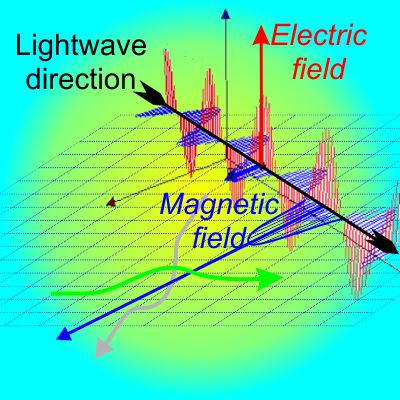
“Umm … Nice app, works very intuitive-like …  OK, see this?”Electrons and lightwave

“Ah.  It’s a bit busy, walk me through what’s in there.”

“OK. First we got the movie’s lightwave.  The ray’s running along that black arrow, see?  Some electron back behind the picture is going up and down to energize the ray and that makes the electric field that’s in red that makes other electrons go up and down, right?”

“That’s the red arrow, hmm?”

“Yeah, that electron got goosed ’cause it was standing in the way.  It follows the electric field’s direction.  Now help me out with the magnetic stuff.”

“Alright.  The blue lines represent the lightwave’s magnetic component.  A lightwave’s magnetic field lines are always perpendicular to its electric field.  Magnetism has no effect on uncharged particles or motionless charged particles.  If you’re a moving charged particle, say an electron, then the field deflects your trajectory.”

“This is what I’m still trying to wrap my head around.  You say that the field’s gonna push the particle perpendicular to the field and to the particle’s own vector.”

“That’s exactly what happens.  The green line, for instance, could represent an electron that crossed the magnetic field.  The field deflected the electron’s path upwards, crossways to the field and the electron’s path.  Then I suppose the electron encountered the reversed field from the lightwave’s following cycle and corrected course again.”

“And the grey line?”

“That’d be an electron crossing more-or-less along the field.  According to the Right Hand Rule it was deflected downward.”

“Wait.  We’ve got two electrons on the same side of the field and they’re deflected in opposite directions then correct back.  Doesn’t that average out to no change?”

“Not quite.  The key word is mostly.  Like gravity fields, electromagnetic fields get weaker with distance.  Each up or down deflection to an electron on an outbound path will be smaller than the previous one so the ‘course corrections’ get less correct.  Inbound electrons get deflected ever more strongly on the way in, of course, but eventually they become outbound electrons and get messed up even more.  All those deflections produce an expanding cone of disturbed electrons along the path of the ray.”

“Hey, but when any electron moves that changes the fields, right?  Wouldn’t there be a cone of disturbed field, too?”

“Absolutely.  The whole process leads to several kinds of dispersion.”

“Like what?”

“The obvious one is simple geometry.  What had been a simple straight-line ray is now an expanding cone of secondary emission.  Suppose you’re an astronomer looking at a planet that’s along that ray, for instance.  Light’s getting to you from throughout the cone, not just from the straight line.  You’re going to get a blurred picture.”

“What’s another kind?”

“Moving those electrons around extracts energy from the wave.  Some fraction of the ray’s original photons get converted to lower-energy ones with lower frequencies.  The net result is that the ray’s spectrum is spread and dispersed towards the red.”

“You said several kinds.”

“The last one’s a doozy — it affects the speeds of light.”

“‘Speeds,’ plural?”ripples in a wave

“There’s the speed of field’s ripples, and there’s the speed of the whole signal, say when a star goes nova.  Here’s a picture I built on Old Reliable.  The gold line is the electric field — see how the ripples make the red electron wobble?  The green dots on the axis give you comparison points that don’t move.  Watch how the ripples move left to right just like the signal does, but at their own speed.”

“Which one’s Einstein’s?”

“The signal.  Its speed is called the group velocity and in space always runs 186,000 mph.  The ripple speed, technically it’s the phase velocity, is slower because of that extracted-and-redistributed-energy process.  Different frequencies get different slowdowns, which gives astronomers clues about the interstellar medium.”

“Clues are good.”

~~ Rich Olcott

Three off The Plane

Rumpus in the hallway.  Vinnie dashes into my office, tablet in hand and trailing paper napkins.  “Sy! Sy! I figured it out!”

“Great!  What did you figure out?”

“You know they talk about light and radio being electromagnetic waves, but I got to wondering.  Radio antennas don’t got magnets so where does the magnetic part come in?”

“19th-Century physicists struggled with that question until Maxwell published his famous equations.  What’s your answer?”

“Well, you know me — I don’t do equations, I do pictures.  I saw a TV program about electricity.  Some Danish scientist named Hans Christian Anderson—”

“Ørsted.”

“Whoever.  Anyway, he found that magnetism happens when an electric current starts or stops.  That’s what gave me my idea.  We got electrons, right, but no magnetrons, right?”

“Mmm, your microwave oven has a vacuum tube called a magnetron in it.”

“C’mon, Sy, you know what I mean.  We got no whatchacallit, ‘fundamental particle’ of magnetism like we got with electrons and electricity.”

“I’ll give you that.  Physicists have searched hard for evidence of magnetic monopoles — no successes so far.  So why’s that important to you?”

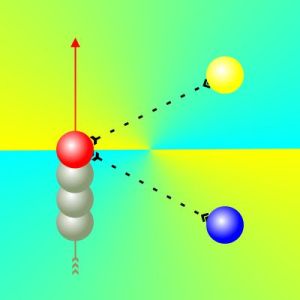
3 electrons moving north“It told me that the magnetism stuff has to come from what electrons do.  And that’s when I came up with this drawing.”  <He shoves a paper napkin at me.>  “See, the three balls are electrons and they’re all negative-negative pushing against each other only I’m just paying attention to what the red one’s doing to the other two.  Got that?”

“Sure.  The arrow means the red electron is traveling upward?”

“Yeah.  Now what’s that moving gonna do to the other two?”

“Well, the red’s getting closer to the yellow.  That increases the repulsive force yellow feels so it’ll move upward to stay away.”

“Uh-huh.  And the force on blue gets less so that one’s free to move upward, too.  Now pretend that the red one starts moving downward.”

“Everything goes the other way, of course.  Where does the magnetism come in?”

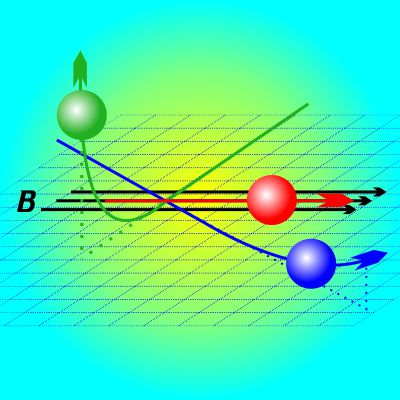
3 electrons in B-field“Well, that was the puzzle.  Here’s a drawing I copied from some book.  The magnetic field is those B arrows and there’s three electrons moving  in the same flat space in different directions.  The red one’s moving along the field and stays that way.  The blue one’s moving slanty across the field and gets pushed upwards.  The green one’s going at right angles to B and gets bent way up.  I’m looking and looking — how come the field forces them to move up?”
“Good question.  To answer it those 19th Century physicists developed vector analysis—”

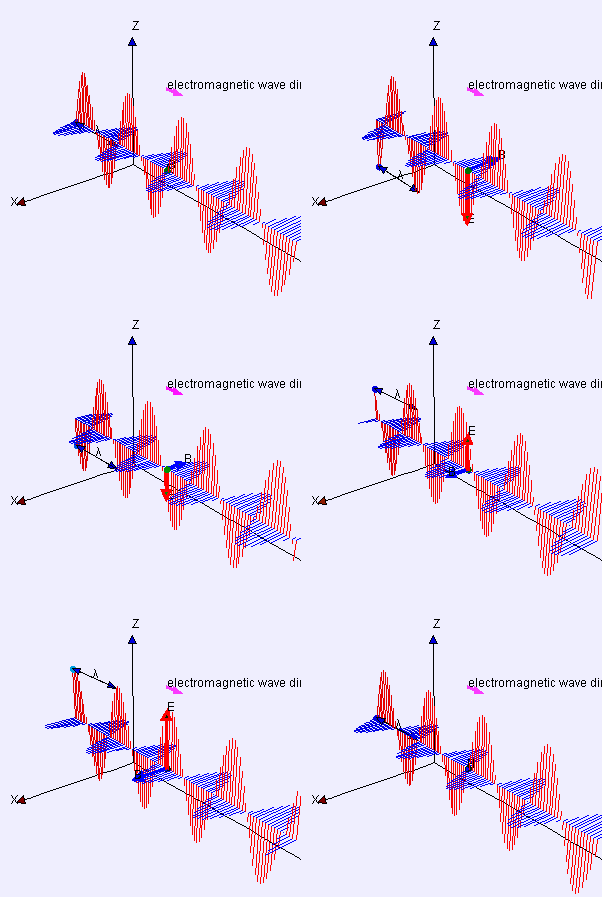
Electromagneticwave3D
Plane-polarized electromagnetic wave
Electric (E) field is red
Magnetic (B) field is blue
(Image by Loo Kang Wee and Fu-Kwun Hwang from Wikimedia Commons)

“Don’t give me equations, Sy, I do pictures.  Anyway, I figured it out, and I did it from a movie I got on my tablet here.  It’s a light wave, see, so it’s got both an electric field and a magnetic field and they’re all sync’ed up together.”

“I see that.”

“What the book’s picture skipped was, where does the B-field come from?  That’s what I figured out.  Actually, I started with where the the light wave came from.”

“Which is…?”

“Way back there into the page, some electron is going up and down, and that creates the electric field whose job is to make other electrons go up and down like in my first picture, right?”

“OK, and …?”

“Then I thought about some other electron coming in to meet the wave.  If it comes in crosswise, its path is gonna get bent upward by the E-field.  That’s what the blue and green electrons did.  So what I think is, the magnetic effect is really from the E-field acting on moving electrons.”

“Nice try, but it doesn’t explain a couple of things.  For instance, there’s the difference between the green and blue paths.  Why does the amount of deflection depend on the angle between the B direction and the incoming path?”

“Dunno.  What’s the other thing?”

“Experiment shows that the faster the electron moves, the greater the magnetic deflection.  Does your theory account for that?”

“Uhh … my idea says less deflection.”

“Sorry, another beautiful theory stumbles on ugly facts.”

~~ Rich Olcott

Shopping The Old Curiosity

“Still got questions, Moire.”

“This’ll be your last shot this year, Mr Feder.  What’s the question?”

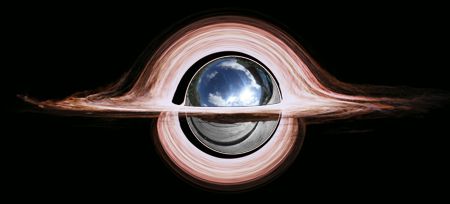
“They say a black hole absorbs all the light that falls on it. But the theory of blackbody radiation says a perfect absorber is also a perfect radiator. Emission should be an exact opposite flow to the incoming flow in every direction. Wouldn’t a black hole be shiny like a ball bearing?”Black hole as ball bearing 1
“A perfectly good question, but with crucial imperfections. Let’s start with the definition of a perfect absorber — it’s an object that doesn’t transmit or reflect any light. Super-black, in other words. So by definition it can’t be a mirror.”

“OK, maybe not a mirror, but the black hole has to send out some kind of exact opposite light to balance the arriving light.”

“Yes, but not in the way you think. Blackbody theory does include the assumption that the object is in equilibrium, your ‘exact opposite flow.’ The object must indeed send out as much energy as it receives, otherwise it’d heat up or cool down. But the outbound light doesn’t necessarily have to be at the same frequencies as the inbound light had. In fact, it almost never will.”

“How come not?”

“Because absorption and emission are two different processes and they play by different rules. If we’re including black holes in the discussion there are four different processes. No, five.  Maybe six.”

“I’m listening.”

“Good. Blackbody first. When a photon is absorbed by regular matter, it affects the behavior of some electron in there. Maybe it starts spending more time in a different part of the molecule, maybe it moves faster — one way or another, the electron configuration changes and that pulls the atomic nuclei away from where they were and the object’s atoms wobble differently. So the photon raises the object’s internal kinetic energy, which means raising its temperature, and we’ve got energy absorption, OK?”

“Yeah, and…?”

“At some later time, to keep things in equilibrium that additional energy has to be gotten rid of. But you can’t just paint one bit of energy red, say it’s special and follow it until it’s emitted. The whole molecule or crystal or whatever has excess energy as the result of all the incoming photons. When the total gets high enough, something has to give.  The object emits some photons to get rid of some of the excess. The only thing you can say about the outbound photons is that they generally have a lower energy than the incoming ones.”

“Why’s that?”

“Think of a bucket that’s brim-full and you’re dumping in cupfuls of water. Unless you’re pouring slowly and carefully, the dribbles escaping over the bucket’s rim will generally be many small amounts sloshing out more often than those cupfuls come in.  For light that’s fluorescence.”

“I suppose. What about the black hole?”

“The problem with a black hole is the mystery of what’s inside its event horizon. It probably doesn’t contain matter in the form of electrons and nuclei but we don’t know. There are fundamental reasons why information about what’s inside can’t leak out to us. All we can say is that when a light wave encounters a black hole, it’s trapped by the intense gravity field and its energy increments the black hole’s mass.  The mechanism … who knows?”

“Like I said, it gets absorbed. And gets emitted as Hawking radiation.”

“Sorry, that’s exactly what doesn’t happen. Hawking radiation arises from a different pair of processes. Process 1 generates pairs of virtual particles, which could be photons, electrons or something heavier. That happens at a chaotic but steady rate throughout the Universe.  Usually the particle pairs get back together and annihilate.  However, right next to the black hole’s event horizon there’s Process 2, in which one member of a virtual pair flies inward and the other member flies outward as a piece of Hawking radiation. Neither process even notices incoming photons. That’s not mirroring or even fluorescence.”

“Phooey, it was a neat idea.”

“That it was, but facts.”

~~ Rich Olcott

  • Thanks to lifeisthermal for inspiring this post.
  • Thus endeth a full year of Sy Moire stories.  I hope you enjoyed them.  Here’s to a new year and new ideas for all.

Weight And Wait, Two Aspects of Time

I was deep in the library stacks, hunting down a journal article so old it hadn’t been digitized yet.  As I rounded the corner of Aisle 5 Section 2, there he was, leaning against a post and holding a clipboard.

“Vinnie?  What are you doing here?”

“Waiting for you.  You weren’t in your office.”

“But how…?  Never mind.  What can I do for you?”

“It’s the time-dilation thing.  You said that there’s two kinds, a potential energy kind and a kinetic energy kind, but you only told me about the first one.”

“Hey, Ramona broke up that conversation, don’t blame me.  You got blank paper on that clipboard?”

“Sure.  Here.”

“Quick review — we said that potential energy only depends on where you are.  Suppose you and a clock are at some distance r away from a massive object like that Gargantua black hole, and my clock is way far away.  I see your clock ticking slower than mine.  The ratio of their ticking rates, tslow/tfast = √[1-(2G·M/r·c²)], only depends on the slow clock’s position.  Suppose you move even closer to the massive object.  That r-value gets smaller, the fraction inside the parentheses gets closer to 1, the square root gets smaller and I see your clock slow down even more.  Sound familiar?”

“Yeah, but what about the kinetic thing?”time-and-the-rovers

“I’m getting there.  You know Einstein’s famous EEinstein=m·c² equation.  See?  The formula contains neither a velocity nor a position.  That means EEinstein is the energy content of a particle that’s not moving and not under the influence of any gravitational or other force fields.  Under those conditions the object is isolated from the Universe and we call m its rest mass.  We good?”

“Yeah, yeah.”

“OK, remember the equation for gravitational potential energy?”

E=G·M·m/r.

“Let’s call that Egravity.  Now what’s the ratio between gravitational potential energy and the rest-mass energy?”

“Uh … Egravity/EEinstein = G·M·m/r·m·c² = G·M/r·c². Hey, that’s exactly half the fraction inside the square root up there. tslow/tfast = √[1-(2 Egravity/EEinstein)].  Cool.”

“Glad you like it.  Now, with that under our belts we’re ready for the kinetic thing.  What’s Newton’s equation for the kinetic energy of an object that has velocity v?”

E=½·m·v².

“I thought you’d know that.  Let’s call it Ekinetic.  Care to take a stab at the equation for kinetic time dilation?”

“As a guess, tslow/tfast = √[1-(2 Ekinetic/EEinstein)]. Hey, if I plug in the formulas for each of the energies, the halves and the mass cancel out and I get tslow/tfast = √[1-2(½m·v²/m·c²)] = √[1-(v²/c²)].  Is that it?”

“Close.  In Einstein’s math the kinetic energy expression is more complicated, but it leads to the same formula as yours.  If the velocity’s zero, the square root is 1.0 and there’s no time-slowing.  If the object’s moving at light-speed (v=c), the square root is zero and the slow clock is infinitely slow.  What’s interesting is that an object’s rest energy acts like a universal energy yardstick — both flavors of time-slowing are governed by how the current energy quantity compares to EEinstein.”

“Wait — kinetic energy depends on velocity, right, which means that it’ll look different from different inertial frames.  Does that mean that the kinetic time-slowing depends on the frames, too?”

“Sure it does.  Best case is if we’re both in the same frame, which means I see you in straight-line motion.  Each of us would get the same number if we measure the other’s velocity.  Plug that into the equation and each of us would see the same tslow for the other’s clock.  If we’re not doing uniform straight lines then we’re in different frames and our two dilation measurements won’t agree.”

“… Ramona doesn’t dance in straight lines, does she, Sy?”

“That reminds me of Einstein’s quote — ‘Put your hand on a hot stove for a minute, and it seems like an hour. Sit with a pretty girl for an hour, and it seems like a minute. That’s relativity.‘  You’re thinking curves now, eh?”

“Are you boys discussing me?”

<unison> “Oh, hi, Ramona.”

~~ Rich Olcott

LIGO and lambda and photons, oh my!

I was walking my daily constitutional when Al waved me into his coffee shop.  “Sy, he’s at it again with the paper napkins.  Do something!”

I looked over.  There was Vinnie at his table, barricaded behind a pile of crumpled-up paper.  I grabbed a chair.

“Morning, Vinnie.  Having fun?”

“Greek letters.  Why’d they have to use Greek letters?”

The question was both rhetorical and derivative so I ignored it.  There were opened books under the barricade — upper-level physics texts.  “How come you’re chasing through those books?”

“I wanted to follow up on how LIGO operates with photons after we talked about all that space shuttle stuff.  But geez, Sy!”

“You’re a brave man, Vinnie.  So,  which letters are giving you trouble?”

“These two, that look kinda like each other upside down.” He pointed to one equation, λ=c.

“Ah, wavelength equals the speed of light divided by the frequency.”

“How do you do that?”

“Some of those symbols go way back.  You just get used to them.  Most of them make sense when you learn the names for the letters — lambda (λ) is the peak-to-peak length of a lightwave, and nu (ν) is the number of peaks per second.  If it makes you feel any better, I’ve yet to meet a physicist who can write a zeta (ζ) — they generally just draw a squiggle and move on.”

“And there’s this other equation,” pointing to E=h·ν.  “What’s that about?”

“Good eye.  You just picked two equations that are fundamental to LIGO’s operation.  If a lightwave has frequency ν, the equations tell us two things about it — its energy is h·ν (h is Planck’s constant, 6.6×10⁻³⁴ Joule-seconds), and its wavelength is c (c is the speed of light).  For instance, yellow light has a frequency near 520×1012/sec.  One photon carries 3.8×10-40 Joules of energy.  Not much, but it adds up when a light beam contains lots of photons.  The same photon has a wavelength near 580×10-9 meters traveling through free space.”

“So what happens when one of those photons is in a LIGO beam?  Won’t a gravitational wave’s stretch-and-squeeze action mess up its wave?”

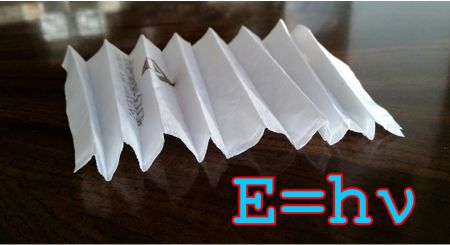
paper-napkin-waveI smoothed out one of Vinnie’s crumpled napkins. As I folded it into pleats and scooted it along the table I said, “Doesn’t mess up the wave so much as change the way we think about it.  We’re used to graphing out a spatial wave as an up-and-down pattern like this that moves through time, right?”
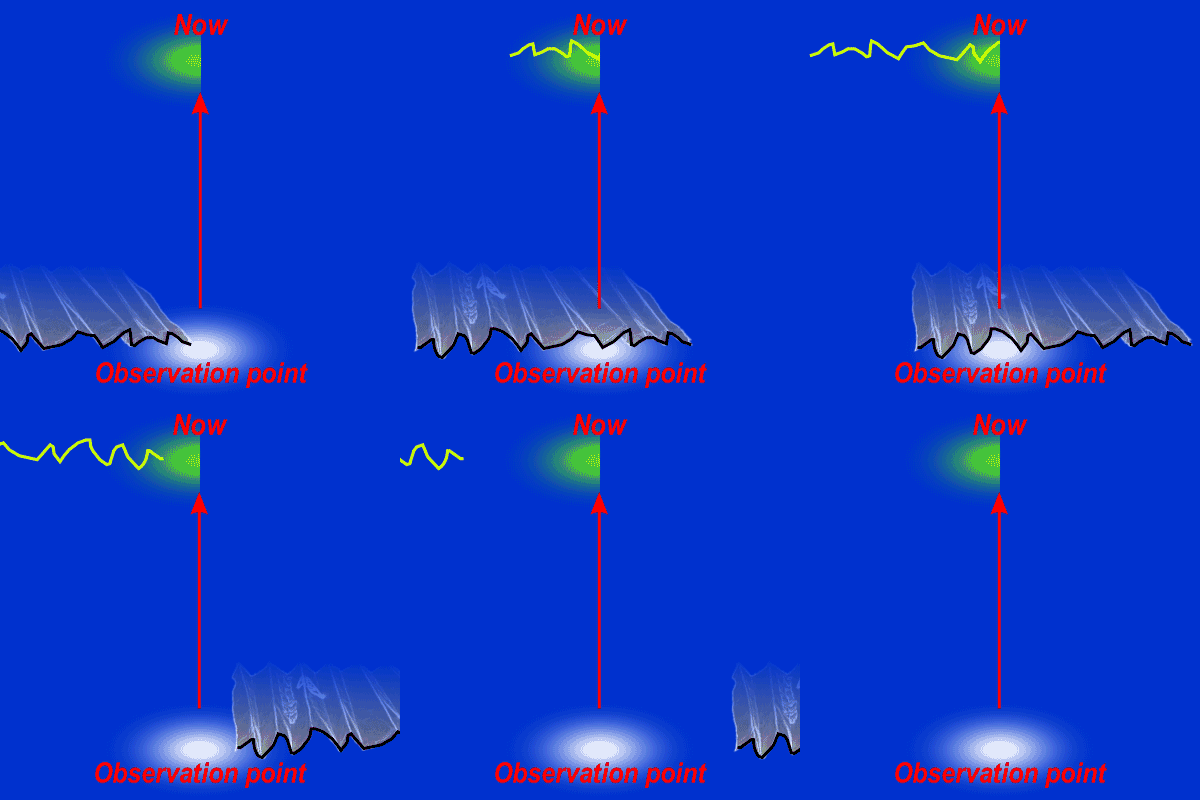
“That’s a lousy-looking wave.”

time-and-space-and-napkin
As the napkin moves through space,
the upper graph shows the height of its edge
above the observation point.

“It’s a paper napkin, f’pitysake, and I’m making a point here. Watch close.  If you monitor a particular point along the wave’s path in space and track how that point moves in time, you get the same profile except we draw it along the t-axis instead of along a space-axis.  See?”

“Hey, the time profile is the space profile going backwards.  Oh, right, it’s goin’ into the past ’cause it’s a memory.”

“That’s one of those things that people miss.  If you only draw sine waves, they’re the same in either direction.  The important point is that although timewaves and spacewaves have the same shape, they’ve got different meanings.  The timewave is directly connected to the wave’s energy by that E equation.  The spacewave is indirectly connected, because your other equation there scales it by the local speed of light.”

“Come again?  Local speed of light?  I thought it was 186,000 miles per second everywhere.”

“It is, but some of those miles are shorter than others.  Near a heavy mass, for instance, or in the compression phase of a gravitational wave, or inside a transparent material.  If you’re traveling in the lightwave’s inertial frame, you see no variation.  But if you’re watching from an independent inertial frame, you see the lightwave hit a slow patch.  Distance per cycle gets shorter.  Like that lambda-nu equation says, when c gets smaller the wavelength decreases.”

Al walked over.  “Gotcha a present, Vinnie.  Here’s a pad of yellow writing paper.  No more napkins, OK?”

“Uhh, thanks.”

“Don’t mention it.”

~~ Rich Olcott

Three ways to look at things

A familiar shadow loomed in from the hallway.

“C’mon in, Vinnie, the door’s open.”

“I brought some sandwiches, Sy.”

“Oh, thanks, Vinnie.”

“Don’t mention it.    An’ I got another LIGO issue.”

“Yeah?”

“Ohh, yeah.  Now we got that frame thing settled, how does it apply to what you wrote back when?  I got a copy here…”

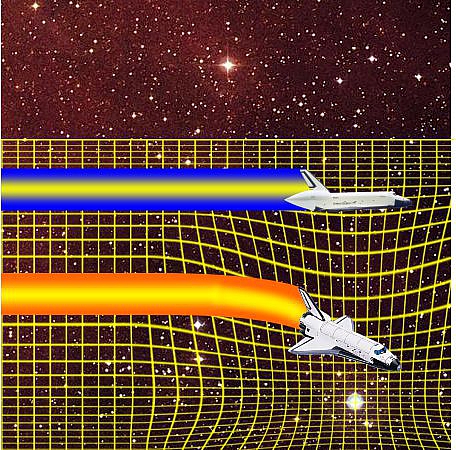
The local speed of light (miles per second) in a vacuum is constant.  Where space is compressed, the miles per second don’t change but the miles get smaller.  The light wave slows down relative to the uncompressed laboratory reference frame.

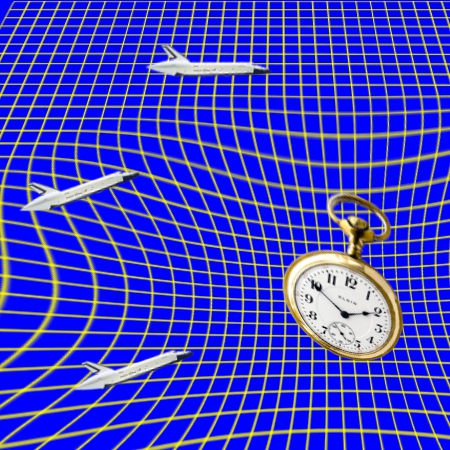
“Ah, I admit I was a bit sloppy there.  Tell you what, let’s pretend we’re piloting a pair of space shuttles following separate navigation beams that are straight because that’s what light rays do.  So long as we each fly a straight line at constant speed we’re both using the same inertial frame, right?”

“Sure.”

“And if a gravity field suddenly bent your beam to one side, you’d think you’re still flying straight but I’d think you’re headed on a new course, right?”

“Yeah, because now we’d have different inertial frames.  I’d think your heading has changed, too.”two-shuttles

“So what does the guy running the beams see?”

“Oh, ground-pounders got their own inertial frame, don’t they?  Uhh… He sees me veer off and you stay steady ’cause the gravity field bent only my beam.”

“Right — my shuttle and the earth-bound observer share the same inertial frame, for a while.”

“A while?”

“Forever if the Earth were flat because I’d be flying straight and level, no threat to the shared frame.  But the Earth’s not flat.  If I want to stay at constant altitude then I’ve got to follow the curve of the surface rather than follow the light beam straight out into space.  As soon as I vector downwards I have a different frame than the guy on the ground because he sees I’m not in straight-line motion.”

“It’s starting to get complicated.”

“No worries, this is as bad as it gets.  Now, let’s get back to square one and we’re flying along and this time the gravity field compresses your space instead of bending it.  What happens?  What do you experience?”

“Uhh… I don’t think I’d feel any difference.  I’m compressed, the air molecules I breath are compressed, everything gets smaller to scale.”

“Yup.  Now what do I see?  Do we still have the same inertial frame?”

“Wow.  Lessee… I’m still on the beam so no change in direction.  Ah!  But if my space is compressed, from your frame my miles look shorter.  If I keep going the same miles per second by my measure, then you’ll see my speed drop off.”

“Good thinking but there’s even more to it.  Einstein showed that space compression and time dilation are two sides of the same phenomenon.  When I look at you from my inertial frame, your miles appear to get shorter AND your seconds appear to get longer.”

“My miles per second slow way down from the double whammy, then?”

“Yup, but only in my frame and that other guy’s down on the ground, not in yours.”

“Wait!  If my space is compressed, what happens to the space around what got compressed?  Doesn’t the compression immediately suck in the rest of the Universe?”

“Einstein’s got that covered, too.  He showed that gravity doesn’t act instantaneously.  Whenever your space gets compressed, the nearby space stretches to compensate (as seen from an independent frame, of course).  The edge of the stretching spreads out at the speed of light.  But the stretch deformation gets less intense as it spreads out because it’s only offsetting a limited local compression.”

“OK, let’s get back to LIGO.  We got a laser beam going back and forth along each of two perpendicular arms, and that famous gravitational wave hits one arm broadside and the other arm cross-wise.  You gonna tell me that’s the same set-up as me and you in the two shuttles?”

“That’s what I’m going to tell you.”

“And the guy on the ground is…”

“The laboratory inertial reference.”

“Eat your sandwich, I gotta think about this.”

(sounds of departing footsteps and closing door)

“Don’t mention it.”

~~ Rich Olcott

Superluminal Superman

Comic book and movie plotlines often make Superman accelerate up to lightspeed and travel backward in time.  Unfortunately, well-known fundamental Physics principles forbid that.  But suppose Green Lantern or Dr Strange could somehow magic him past the Lightspeed Barrier.  Would that let him do his downtimey thing?

Light_s hourglass
Light’s Hourglass

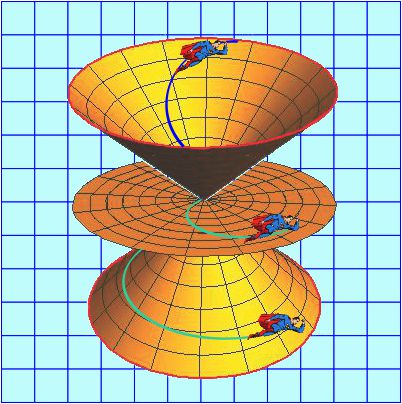
A quick review of Light’s Hourglass.  According to Einstein we live in 4D spacetime.  At any moment you’re at a specific time t relative to some origin time t=0 and a specific 3D location (x,y,z) relative to a spatial origin (0,0,0).  Your spacetime address is (ct,x,y,z) where c is the speed of light.  This diagram shows time running vertically into the future, plus two spatial coordinates x and y.  Sorry, I can’t get z into the diagram so pretend it’s zero.

The two cones depict all the addresses which can communicate with the origin using a flash of light.  Any point on either cone is at just the right distance d=√(++) to match the distance that light can travel in time t.  The bottom cone is in the past, which is why we can see the light from old stars.  The top cone is in the future, which is why we can’t see light from stars that aren’t born yet.

If he obeys the Laws of Physics as we know them, Superman can travel anywhere he wants to inside the top cone.  He goes upward into the future at the rate of one second per second, just like anybody.  On the way, he can travel in space as far from (ct,0,0,0) as he likes so long as it’s not farther than the distance that light can travel the same route at his current t.

From our perspective, the Hourglass is a stack of circles (spheres in 3D space) centered on (ct,0,0,0).  From Supey’s perspective at time t he’s surrounded by a figure with radius ct that Physics won’t let him break through.  That’s his Lightspeed Barrier, like the Sonic Barrier but 900,000 times faster.

Suppose Green Lantern has magicked Supey up to twice lightspeed along the x-axis.  At moment t, he’s at (ct,2ct,0,0), twice as far as light can get.  In the diagram he’s outside the top cone but above the central disk.

Now GL pours on the power to accelerate Superman.  Each increment gets the Man of Steel closer to that disk.  He’s always “above” it, though, because he’s still moving into the future.  Only if he were to get to infinite speed could he reach the disk.

However, at infinite speed he’d go anywhere/everywhere instantaneously which would be confusing to even his Kryptonian intellect.  On the way he might run into things (stars, black holes,…) with literally zero time to react.

But the plotlines have Tall-Dark-and-Muscular flying into the past, breaching that disk and traveling downwards into the bottom cone.  Can GL make that happen?

Enter the Lorentz correction.  If you have rest mass m0 and you’re traveling at speed v, your effective mass is m=m0/√[1-(v/c)²]. That raises a couple of issues when you exceed lightspeed.

Suppose GL decelerates Superluminal Supey down towards lightspeed.  The closer he approaches c from higher speeds, the smaller that square root gets and the greater the effective mass.  It’s the same problem Superman faced when accelerating up to lightspeed.  That last mile per second down to c requires an infinite amount of braking energy — the Lightspeed Barrier is impermeable in both directions.

The other problem is that if v>c there’s a negative number inside that square root.    Above lightspeed, your effective mass becomes Bombelli-imaginary.  Remember Newton’s famous F=m·a?  Re-arrange it to a=F/m.  A real force applied to an object with imaginary mass produces an imaginary acceleration.  “Imaginary” in Physics generally means “perpendicular in some sense” and remember we’re in 4D here with time perpendicular to space.

GL might be able to shove Superman downtime, but he’d have to

  1. squeeze inward at hiper-lightspeed with exactly the same force along all three spatial dimensions, to make sure that “perpendicular” is only along the time axis
  2. start Operation Squish at some time in his own future to push towards the past.

Nice trick.  Would Superman buy in?

~~ Rich Olcott