What Goes Around

<shout from outside my office door> “Stromboli Express. Get ’em while they’re hot!”

“The door’s open, Eddie, and you’re right on schedule.”

“I aim to please, Sy. Which ain’t easy while I’m wearing this virus mask.”

“On you it looks good, Eddie. Just leave the order on the credenza. How’s my account?”

“Still good from that last twenty. I gotta say, I appreciate you keeping your tab on the plus side. You, Vinnie, all you singles, your orders are keeping me in business despite that corporate PizzaDoodle shop that opened up.”

“Doing my part to keep the money local, Eddie. Besides, you do good pizza.”

“What difference does keeping the money local make? Anything to do with money being energy?”

“Whoa, where did that come from?”

You told me, Sy. When prices get higher than a perfect supply‑demand market would set them, it’s from inefficiency like what happens to machine energy that gets turned into heat by friction.”

“Ah, you stretched my metaphor a little too far. Money behaves like energy in some ways but not in others. For one thing, Conservation of Energy applies universally, we think, but Conservation of Money not so much.”

“The dollars in my wallet don’t multiply, that’s for sure.”

“Individuals aren’t allowed to fiddle the money supply — that’s called counterfeiting. But the 1930s Great Depression taught us that purposefully creating and destroying money is part of the government’s job. Banks can vary the money supply, too, sort of.”

“Yeah, I’ve seen videos of the Mint’s printing presses and them grinding up ratty old used bills.”

“That’s the least of what they do these days. Depending on which way you define ‘money’, only about a fifth of the money supply is cash currency.”

“There’s definitions of money?”

“Mm-hm. That’s one of the keys to the part the banks play. One definition is just the currency, like you’d think. The economists pay attention to a broader definition. When you deposit tonight’s receipts in the bank, the cash doesn’t just sit in a vault. For that matter, your credit card and debit card take can’t sit in a vault. What does the bank do? It keeps a certain percentage of its deposited dollars as a reserve in case you want to pull dollars out to pay Joey for his sausage or something. The rest of those dollars can be loaned out. The loaned dollars generally get deposited for a while before they’re spent and a fraction of those deposits can be loaned out … you see where this is going.”

“Whoa, so I put on a hundred and that turns into maybe four, five hundred or more by when the dust settles. I see what you mean about banks creating money even if it’s not real money.”

“Oh, it’s real money — officially blessed marks in a ledger or more likely, bits in computers instead of paper and coins, but it counts. Anyhow, the second definition of ‘money’ combines currency and deposits from all those loans.”

“So what’s to prevent the bank from loaning out all their money and riding this pony over and over again? That’s what I’d want to do, pull in interest on like, infinite loans.”

“That’s where the government steps in. Depositors need to be sure they can make withdrawals. The Feds don’t tell banks, ‘You can only loan out a certain number of dollars.‘ What they do say is, “Your reserves have to total up to at least x fraction of your deposits.’ The Feds are free to change the value of x up or down depending on whether they want to shrink or expand the money supply.”

“Closing down or opening up the spigot and Conservation of Money ain’t a thing, gotcha. But what does that have to do with you guys keeping money local?”

“Think back to that $20 bill that went from you to Vinnie to Al to me to you. What would have happened if Al had decided to invest in some weird coffee beans instead of buying those magazines from me?”

“The dollars would fly away from our local bank and they wouldn’t be there for an x fraction loan for my business. Gotcha.”
~~ Rich Olcott
Supply, Demand And Friction

<chirp, chirp> “Moire here. Open for business on a reduced schedule.”

“Hiya, Sy. It’s Eddie, taking orders for tonight’s pizza deliveries. My 6:15 wave is full-up, can I schedule you for 6:45? Whaddaya like tonight?”

“Yeah, a little later’s OK, Eddie. Mmmm, I think a stromboli this time. Rolled up like that, it ought to stay hot longer.”

“Good idea. Hey, I been thinking about that ‘velocity of money‘ thing and the forces that change where it goes. Isn’t that just another name for ‘supply and demand’? Bad weather messes up the wheat crop, I gotta pay more for pizza flour, that kinda thing.”

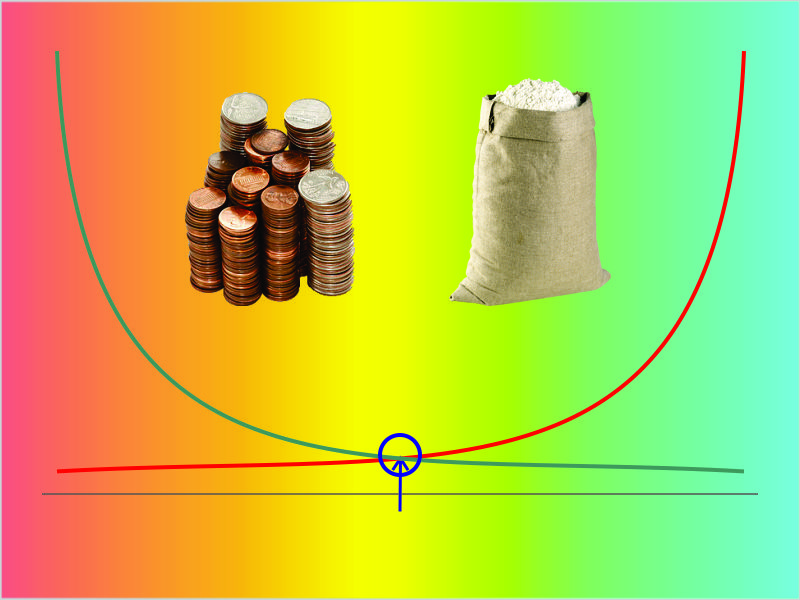
“That’s one of the oldest theories in economics, the idea that low supply increases prices and conversely. Economists often use two hyperbolas to describe the trade-off. Unfortunately, the idea’s only sorta true and only for certain markets. Oh, and it’s only sorta related to how fast money flows through the economy.”

“C’mon, Sy, you’re talking to a professional here. I watch my costs pretty close. Supply-demand tells my story — a bad tomato harvest drives my red sauce price through the roof.”

“No question it works for some products where there’s many independent buyers, many independent sellers, everyone has the same information, and a few other technical only-ifs. It’s what they call a perfect market. How many different companies do you buy flour from?”

“Three or four in town here. I switch around. Keeps ’em on their toes and holds their price down.”

“Competition’s a good thing, right? No buyer pays more than they absolutely must and no seller takes less than their competition does. Negative feedback all over the place. If one vendor figures out an advantage and can make money selling the same stuff for a lower price, everyone else copies them and the market price settles into a new lower equilibrium and there’s no advantage any more.”

“Yeah, that’s the way it works for flour.”

“And a few other commodities like grains and metals and West Texas crude. Economic theorists love the perfect-market model because it sets prices so nicely. Physicists love ideal cases, too — frictionless pulleys on infinitely sharp pivots, that kind of thing, where you can ignore the practical details. Most markets have lots of practical considerations that gum up the works.”

“Devil’s in the details, huh?”

“Sure. I seem to recall you’ve got a favorite sausage supplier.”

“Yeah, my brother-in-law Joey. OK, he’s family, but he does good work — fresh meat ground exactly the way I want it, got a good nose for spices, dependable delivery, what’s not to like?”

“Is he more expensive?””

“A little, a little, but it’s worth it.”

“So hereabouts there’s an imperfect market for sausage. The economists might tally Joey’s extra profit from that premium price to an accounting column labeled ‘Goodwill.’ A physicist would have another name for it.”

“Goodwill. Joey’d like that. So what would the physicist call it?”

“Real mechanical systems are never perfectly energy‑efficient. Energy is always lost to friction. In my money‑physics framework money’s lost to friction. It’s the reason you pay a premium above what would be perfect‑market price for sausage. Nothing wrong with that so long as you know you’re doing it and why. Most real markets are loaded with friction of various sorts. Think of market regulators as mechanics, running around with oil cans as they reduce inefficiency and friction.”

“What other frictions … lemme think. Monopoly, for sure — some big chain takes over my market, drives me the rest of the way out of business and then they can charge whatever they want. Umm … collusion, either direction. Advertising, maybe, but that’s mostly legal.”

“You got the idea. So, how is business?”

“Are you kidding? Way off. I had to lay off people, now it’s just me baking and delivering.”

“Would you buy flour these days at the usual price?”

“Nah. At the rate things are going what I got will last me for a l‑o‑o‑n‑g time. I got no place to put any more.”

“Your customers aren’t buying, you’re not buying, money’s not changing hands. The velocity of money’s so low that supply-demand isn’t capable of setting price. That’s deflation, not market friction.”

“Either way, it hurts.”

~~ Rich Olcott

The Buck Rolls On, We Hope

<knock, knock> “Door’s open. Come in but maintain social distance.”

“Hiya, Sy. Here’s your pizza, still hot and everything but no pineapple.”

“Thanks, Eddie. Just put it on the credenza. There’s a twenty there waiting for you. Put the balance on my tab.”

“Whoa, I recognize this bill. It’s the one that Vinnie won off me at the after‑hours dice game last month before all this started. See, I initialed it down here on the corner ’cause Vinnie usually don’t do that well. How’d you get it from him?”

“I didn’t get it from Vinnie, I got it from Al when I sold him a batch of old astronomy magazines. Vinnie must have finally paid off his tab at Al’s coffee shop.”

“Funny how that one bill just went in a circle. Financed some risky business, paid off a loan, bought stuff, and here I get it again so I can buy stuff to make more pizza. That’s a lotta work for one piece of paper.”

“Mm-hm. Everyone’s $20 better off now, all because the bill kept moving. Chalk it off to ‘the velocity of money.‘ If Vinnie didn’t spend that money the velocity’d be zero and none of the rest would have happened.”

“That sounds suspiciously like Physics, Sy.”

“Guilty as charged, Eddie. Just following along with what Isaac Newton started back when he was staying at his mother’s place, hiding out from the bubonic plague.”

Newton, after a day at the beach
while wearing an anti-viral mask

“What’s that got to do with money? Was Newton a banker?”

“Not quite, although the last 30 years of his life he headed up England’s Royal Mint. The core of his work during his Science years was all about change and rate of change. His Laws of Motion quantified what it takes to cause change. He developed his version of calculus to bridge between how fast change happens and how much change has happened.”

“Hey, that’s those graphs you showed me, with the wave on the top line and the slope underneath.”

“Bingo. Pandemics are a long way from the simple systems that Newton studied, but the important point is that to study his planets and pendulums he developed general strategies for tackling complex situations. He started with just a few basic concepts, like position and speed, and expanded on them.”

“Speed’s speed, what’s to expand?”

“Newton expanded the notion of speed to velocity, which also includes direction. From Newton’s point of view, the velocity of a planet in orbit is continuously changing even if its miles per hour is as steady as … a planet.”

“Who cares?”

“Newton did, because he wanted to know what makes the change happen. His starting point was if there’s any motion, it’s got to be at constant speed and in a straight line unless some force causes a velocity change. That’s where his notion of gravity came from — he invented the idea of ‘the force of gravity‘ to account for us not flying off the rotating Earth and the Earth not zooming away from the Sun. His methods set the model that physicists have followed ever since — if we see motion, we measure how fast it’s happening and then we look for the force or forces that can explain that.”

“Now I see where you’re going. That ‘velocity of money‘ thing is about how fast the paper changes hands, isn’t it? Wait, if Vinnie had put that twenty up on his wall as a trophy, then the chain would’ve been broken.”

“Right, or if Al had diverted it to buy, say, coffee beans. That’s why we say velocity of money and not speed, because the direction of flow counts.”

“Smelling more and more like Physics, Sy. Like, there’s astrophysics and biophysics and you’re coming up with econophysics.”

“Well, yeah, but I didn’t invent the term. It’s already out there, with textbooks and academic study groups and everything. It’s just interesting to use economics as a metaphor for physics and vice-versa. The fun is in seeing where the metaphors break down.”

“I see one already, Sy. Those forces — we all had different reasons to kick the bill along.”

“Good point. Now we figure out those forces.”

~~ Rich Olcott

Shortfall

<chirp, chirp> The non-business line again. “Moire here.”

“Hiya, Sy, it’s Eddie. I’m taking orders for tonight’s deliveries. I got some nice-looking artichokes here, how about a garlic and artichoke pizza?”

“No thanks, Eddie, I’ll stick with my usual pepperoni. Wait, you got any ham?”

“Sure.”

“Let’s go with a Hawai’ian.”

“Sy, we’ve had this conversation. You want pineapple on pizza you open a can and dump some on there after I leave the premises and don’t tell me. I got standards!”

“Calm down, Eddie, just yanking your chain. Yeah, do me one of those garlic and artichoke ones. Sounds more classical.”

“That’s better. I got you in the 6:15 wave, OK? Hey, that reminds me. I read your post series about waves and that got me thinking.”

“Nice to know someone reads them.”

“Well, things are real quiet, just me in the kitchen these days so I’m scraping the barrel, you know?”

“Ouch.”

“Gotcha back. Anyhow, that series was all about wiggly waves that repeat regular-like, right? I get that scientists like ’em ’cause they’re easy to calculate with. But that Logic Curve you wrote about goes up and doesn’t come back down again. Does anybody do math with that kind?”

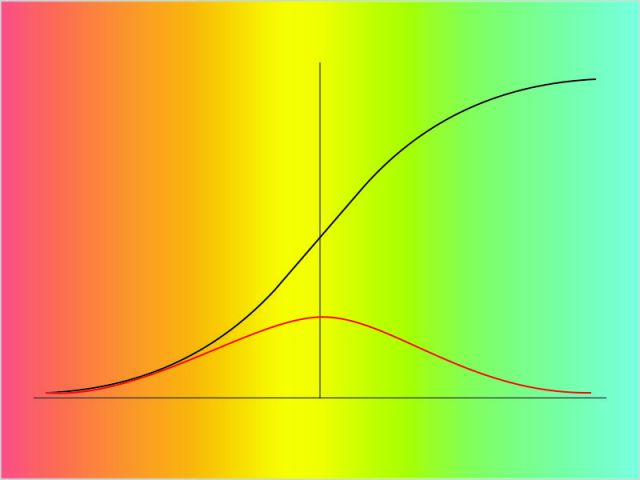
Logistic Curve — blue line,
Associated slope — red line

“Logistic Curve. ‘Logic Curve‘ isn’t a thing. The mathematicians have come up with a plethora of curves and curve families. The physicists have found uses for many of them. The Logistic Curve, for instance, is one of the first tools they take off the shelf for systems that have both lower and upper limits. You’ve seen a lot about how it’s applied to epidemiology. People also use it for ecology, economics, linguistics, chemistry, even agriculture.”

“What do the top and bottom lines have to do with each other?”

“Ah. Sorry I hadn’t made that clear. OK, find a blank page in your order pad. At the top draw a horizontal zig-zag line like a series of 45‑degree triangles touching corners.”

“45 degrees is easy — that’s an 8-slice pizza. Done.”

“You’ve just drawn what’s called a triangle wave, no surprise. OK, now right under that, you’re going to draw another wave that shows the slope of each triangle segment. Where the triangle line goes up you’ve got a positive slope that goes up one unit for every unit across so draw a line at plus‑one, OK?”

“A-ha. Got it.”

“Where the triangle line goes down you’ve got a negative slope, minus‑one.”

“What about where the triangles got points?”

“Just draw a vertical line to connect the slope segments. What’s the completed second line look like?”

“A zig-zag bunch of square boxes. Hey, wait, we made the second line be the slopes for all the pieces, right? Lemme go check the picture in the ‘Curve‘ post. So what you’re saying is … the red line is all the slopes along the blue line … OK, can I say that the red line is how fast stuff is coming at me and the blue line is the backlog?”

“Half-right. For what we’re talking about, ‘slope‘ is whatevers per time‑unit. The blue line shows how much total has come at you so far. Backlog is a little more complicated.”

“I gotta go back and read those posts again. Now I see why they’re saying ‘flattening the curve‘ — they want the blue line to not climb so fast.”

“That’s part of it.. Flattening that red-line curve as much as we can is important. That’s what the masks and social distancing are about. Maybe as many people get sick, total, but if they trickle in instead of flooding in then they don’t overload the system. Here, I’ll send a sketch to your phone.”

“Got it, but there’s lots of lines there.”

“The red line is your completion rate — pizza orders per hour, patients per day, whatever. The red line goes flat because having only one oven limits your throughput. The gray part above it is pizzas per hour you couldn’t bake or patients your hospital couldn’t take that day. The green line is doable business; the black line shows how more capacity would have improved things.”

“Reduce the incoming, raise the capacity or lose the people. Whoa.”

~~ Rich Olcott
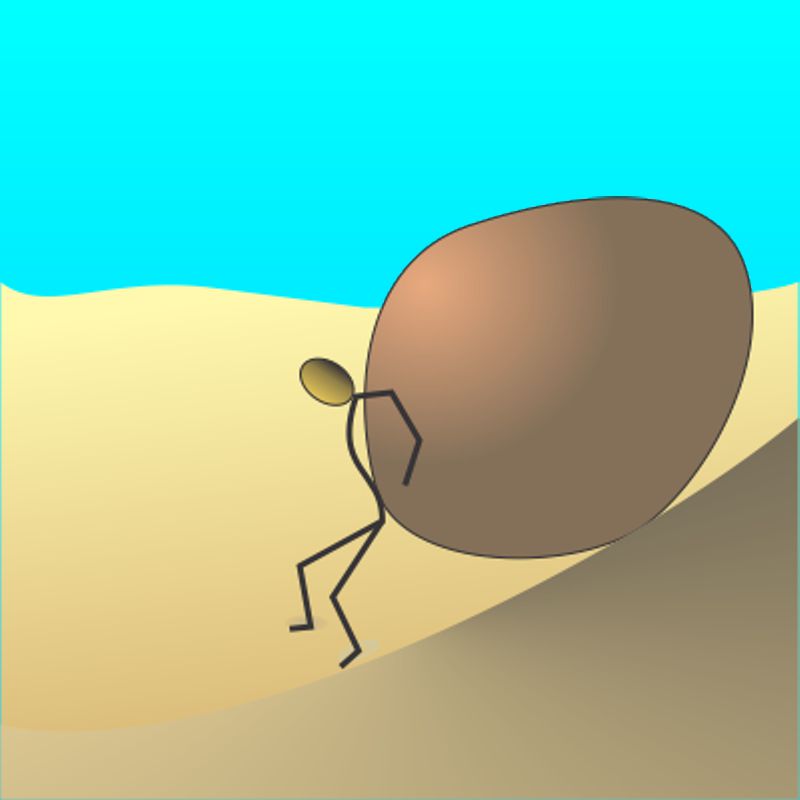
Sisyphus on A Sand Dune

I’m walking the park’s paths on a lovely early Spring day when, “There you are, Moire. I got a question!”

“As you always do, Mr Feder. What’s your question this time?”

“OK, this guy’s saying that life is all about fighting entropy but entropy always increases anyway. I seen nothing in the news about us fighting entropy so where’s he get that? Why even bother if we’re gonna lose anyway? Where’s it coming from? Can we plug the holes?”

“That’s 4½ questions with a lot of other stuff hiding behind them. You’re going to owe me pizza at Eddie’s AND a double-dip gelato.”

“You drive a hard bargain, Moire, but you’re on.”

“Deal. Let’s start by clearing away some underbrush. You seem to have the idea that entropy’s a thing, like water, that it flows around and somehow seeps into our Universe. None of that’s true.”

“That makes no sense. How can what we’ve got here increase if it doesn’t come from somewhere?”

“Ah, I see the problem — conservation. Physicists say there are two kinds of quantities in the Universe — conserved and non‑conserved. The number of cards in a deck is is a conserved quantity because it’s always 52, right?”

“Unless you’re in a game with Eddie.”

“You’ve learned that lesson, too, eh? With Eddie the system’s not closed because he occasionally adds or removes a card. Unless we catch him at it and that’s when the shouting starts. So — cards are non-conserved if Eddie’s in the game. Anyway, energy’s a conserved quantity. We can change energy from one form to another but we can’t create or extinguish energy, OK?”

“I heard about that. Sure would be nice if we could, though — electricity outta nothing would save the planet.”

“It would certainly help, and so would making discarded plastic just disappear. Unfortunately, mass is another conserved quantity unless you’re doing subatomic stuff. Physicists have searched for other conserved quantities because they make calculations simpler. Momentum‘s one, if you’re careful how you define it. There’s about a dozen more. The mass of water coming out of a pipe exactly matches the mass that went in.”

“What if the pipe leaks?”

“Doesn’t matter where the water comes out. If you measure the leaked mass and the mass at the pipe’s designed exit point the total outflow equals the inflow. But that gets me to the next bit of underbrush. Energy’s conserved, that’s one of our bedrock rules, but energy always leaks and that’s another bedrock rule. The same rule also says that matter always breaks into smaller pieces if you give it a chance though that’s harder to calculate. We measure both leakages as entropy. Wherever you look, any process that converts energy or matter from one form to another diverts some fraction into bits of matter in random motion and that’s an increase of entropy. One kind of entropy, anyway.”

“Fine, but what’s all this got to do with life?”

“It’s all to get us to where we can talk about entropy in context. You’re alive, right?”

“Last I looked.”

“Ever break a bone?”

<taps his arm> “Sure, hasn’t everybody one time or another?”

“Healed up pretty well, I see. Congratulations. Right after the break that arm could have gone in lots of directions it’s not supposed to — a high entropy situation. So you wore a cast while your bone cells worked hard to knit you together again and lower that entropy. Meanwhile, the rest of your body kept those cells supplied with energy and swept away waste products. You see my point?”

“So what you’re saying is that mending a broken part uses up energy and creates entropy somewhere even though the broken part is less random. I got that.”

“Oh, it goes deeper than that. If you could tag one molecule inside a living cell you’d see it bouncing all over the place until it happens to move where something grabs it to do something useful. Entropy pushes towards chaos, but the cell’s pattern of organized activity keeps chaos in check. Like picnicking on a windy day — only constant vigilance maintains order. That’s the battle.”

“Hey, lookit, Eddie’s ain’t open. I’ll owe you.”

“Pizza AND double-dip gelato.”

~~ Rich Olcott

How To Wave A Camel

“You’re sayin’, Sy, no matter what kind of wave we got, we can break it down by amplitude, frequency and phase?”

“Right, Vinnie. Your ears do that automatically. They grab your attention for the high-amplitude loud sounds and the high-frequency screechy ones. Goes back to when we had to worry about predators, I suppose.”

“I know about music instruments and that, but does it work for other kinds of waves?”

“It works for waves in general. You can match nearly any shape with the right combination of sine waves. There’s a few limitations. The shape has to be single-valued — no zig-zags — and it has to be continuous — no stopping over here and starting over there..”

“Ha! Challenge for you then. Use waves to draw a camel. Better yet– make it a two-humped camel.”

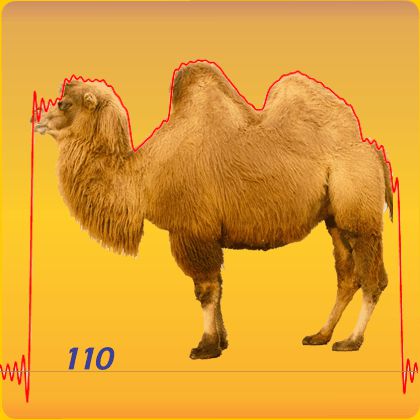
“A Bactrian camel, eh? OK, there’s pizza riding on this, you understand. <keys clicking> All right, image search for Bactrian camel … there’s a good one … scan for its upper profile … got that … tack on some zeroes fore and aft … dump that into my Fourier analysis engine … pull the coefficients … plot out the transform — wait, just for grins, plot it out in stages on top of the original … here you are, Vinnie, you owe me pizza.”

“OK, what is it?”

“Your Bactrian camel.”

“Yeah, I can see that, but what’s with the red line and the numbers?”

“OK, the red line is the sum of a certain number of sine waves with different frequencies but they all start and end at the same places. The number says how many waves were used in the sum. See how the ‘1‘ line is just a single peak, ‘3‘ is more complicated and so on? But I can’t just add sine waves together — that’d give the same curve no matter what data I use. Like in a church choir. The director doesn’t want everyone to sing at top volume all the time. Some passages he wants to bring out the alto voices so he hushes the men and sopranos, darker passages he may want the bases and baritones to dominate. Each section has to come in with its own amplitude.”

“So you give each sine wave an amplitude before you add ’em together. Makes sense, but how do you know what amplitudes to give out?”

“That gets into equations, which I know you don’t like. In practice these days you get all the amplitudes in one run of the Fast Fourier Transform algorithm, but it’s easier to think of it as the stepwise process that they used before the late 1960s. You start with the lowest-frequency sine wave that fits between the start- and end-points of your data.”

“Longest wavelength to match the data length, gotcha.”

“Mm-hm. So you put in that wave with an amplitude near the average value of your data in the middle art of the range. That’s picture number 1.”

“Step 2 is to throw in the next shorter wavelength that fits, right? Half the wavelength, with an amplitude to match the differences between your data and wave 1. And then you keep going.”

“You got the idea. Early physicists and their grad students used up an awful lot of pencils, paper and calculator time following exactly that strategy. Painful. The FFT programs freed them up to do real thinking.”

“So you get a better and better approximation from adding more and more waves. What stopped you from getting it perfect?”

“Two things — first, you can’t use more waves than about half the number of data points. Second, you see the funny business at his nose? Those come from edges and sudden sharp changes, which Fourier doesn’t handle well. That’s why edges look flakey in JPEG images that were saved in high-compression mode.”

“Wait, what does JPEG have to do with this?”

“JPEG and most other kinds of compressed digital image, you can bet that Fourier-type transforms were in play. Transforms are crucial in spectroscopy, astronomy, weather prediction, MP3 music recordings –“

Suddenly Vinnie’s wearing a big grin. “I got a great idea! While that Klingon ship’s clamped in our tractor beam, we can add frequencies that’d make them vibrate to Brahms’ Lullaby.”

“Bad idea. They’d send back Klingon Opera.”

~~ Rich Olcott

Maybe even smaller?

There’s a sofa in my office. Sometimes it’s used to seat some clients for a consultation, sometimes I use it for a nap. This evening Anne and I are sitting on it, close together, after a meal of Eddie’s Pizza d’amore.

“I’ve been thinking, Sy. I don’t want to use my grow-shrink superpower very much.”

“Fine with me, I like the size you are. Why’d you decide that?”

“I remember Alice saying, ‘Three inches is such a wretched height to be.’ She was thinking about what her cat would do to her at that height. I’m thinking about what an amoeba might do to me if I were down to bacteria-size and I wouldn’t be able to see it coming because I’d be too small to see light. It would be even messier further down.”

“Well, mess is the point of quantum mechanics — all we get is the averages because it’s all chaos at the quantum level. Bohr would say we can’t even talk about what’s down there, but you’d be in the thick of it.”

She shudders delicately, leans in tighter. <long, very friendly pause> “Where’d that weird number come from, Sy?”

“What weird number?”

“Ten-to-the-minus-thirty-fifth. You mentioned it as a possible bottom to the size range.”

Now you’re asking?”

“I’ve got this new superpower, I need to think about stuff.  Besides, we’ve finished the pizza.”

<sigh> “This conversation reminds me of our elephant adventure.  Oh well.  Umm. It may have started on a cold, wet afternoon. You know, when your head’s just not up to real work so you grab a scratchpad and start doodling? I’ll bet Max Planck was in that state when he started fiddling with universal constants, like the speed of light and his own personal contribution ħ, the quantum of action.”

“He could change their values?”

“No, of course not. But he could combine them in different ways to see what came out. Being a proper physicist he’d make sure the units always came out right. I’m not sure which unit-system he worked in so I’ll just stick with SI units, OK?”

“Why should I argue?”

“No good reason to. So… c is a velocity so its units are meters per second. Planck’s constant ħ is energy times time, which you can write either as joule-seconds or kilogram-meter² per second. He couldn’t just add the numbers together because the units are different. However, he could divide the one by the other so the per-seconds canceled out. That gave him kilogram-meters, which wasn’t particularly interesting. The important step was the next one.”

“Don’t keep me in suspense.”

“He threw Newton’s gravitational constant G into the mix. Its units are meter³ per kilogram per second². ‘Ach, vut a mess,’ he thought, ‘but maybe now ve getting somevere. If I multiply ħ by G the kilograms cancel out und I get meter5 per second³. Now … Ah! Divide by c³ vich is equal to multiplying by second³/meter³ to cancel out all the seconds and ve are left mit chust meter² vich I can take the square root uff. Wunderbar, it is simply a length! How ’bout that?‘”

“Surely he didn’t think ‘how ’bout that?‘”

“Maybe the German equivalent. Anyway, doodling like that is one of the ways researchers get inspirations. This one was so good that (Għ/c³)=1.6×10-35 meter is now known as the Planck length. That’s where your ten-to-the-minus-thirty-fifth comes from.”

“That’s pretty small. But is it really the bottom?”

“Almost certainly not, for a couple of different reasons. First, although the Planck formula looks like a fundamental limit, it’s not. In the same report Planck re-juggled his constants to define the Planck mass (ħc/G)=2.2×10-8 kilograms or 22 micrograms. Grains of sand weight less than that. If Planck’s mass isn’t a limit, Planck’s length probably isn’t either. Before you ask, the other reason has to do with relativity and this is not the time for that.”

“Mmm … so if space is quantized, which is where we started, the little bits probably aren’t Planck-sized?”

“Who knows? But my guess is, no, probably much smaller.”

“So I wouldn’t accidentally go out altogether like a candle then. That’s comforting to know.”

My turn to shudder. <another long, friendly pause>.

~~Rich Olcott

The Case of The Garlic Calzone

I’m on an after-lunch hike through the park, trying to digest one of Pizza Eddie’s roasted garlic calzones. Vinnie’s walking a path that joins mine. “Hey, Sy. Whoa, lemme get upwind of you. You did the garlic calzone again, huh?”

“Yeah, and this time Eddie went two cloves over the line and didn’t roast them enough. Talk to me, take my mind off it, OK?”

“Sure. Uhhh… Let’s get back to kilograms which I got started on from a magazine article saying they’re chucking the old kilogram for something better. We were talking about that but got sidelined with measuring time and distance. So what’s the better thing?”

“They weren’t really sidelines, Vinnie, they were setting-up exercises. The technical world needs a set of measurement standards that are stable and precisely reproducible anywhere, any time. The old kilogram, the IPK, isn’t any of that. It’s a polished cylinder of platinum-iridium alloy in a Paris vault. You can’t reproduce it exactly, just very close. All you can do is bring a candidate object to Paris, measure the mass difference between it and the IPK, and then carry your newly-certified junior standard home to calibrate other masses on down the line. And hope you don’t scratch yours or get fingermarks on it en route.”

“But if we’re talking mass, why did time and distance standards even come into the conversation?”

“Several becauses. High-accuracy time measurement is fundamental to all the modern standards; much of the laser technology that supports the new time standard also plays into the other revised standards; and the time standard is the simplest one to describe and implement. No matter where you are, you can build a cesium-atom maser and fire it up. Start counting peaks in the maser beam and when you reach the defined number you’ve been counting for exactly one second. <burp> Excuse me.”

“You’re ‘scused. Yeah, the distance thing is pretty simple, too, now they’ve defined the speed of light as a standard. Is the mass standard that simple?”

“Nowhere near. In fact, it’s easier to describe the technique than to explain why it meets the requirements. It depends upon an apparatus called the Kibble Balance, named in honor of the late Bryan Kibble who devoted two decades of his life to perfecting the machine. Like with the spring balance we talked about, you estimate an object’s mass by comparing the force of gravity on it to some opposing force that you can quantify. The object in question goes on the Balance’s test pan. The opposing ‘pan’ is essentially a motor-generator, just a permanent magnet and a moving coil of wire.”

“Alright, I know enough about motors to see that’s complicated. To figure the balance of forces you gotta know the magnet’s strength and geometry, the coil’s resistance and geometry and speed, the voltage across it, the current through it… They’re none of them exact numbers. And you gotta account for how gravity can be different somewhere else like on Mars. Hard to see how that’s much of an improvement.”

“That’s the beauty of it. Kibble’s machine and measurement protocol are designed so that many of the finicky quantities drop out of the calculation. What’s left is high-accuracy counting-type numbers.”

“Measurement protocol? It’s not just ‘load the test pan and read a dial’?”

“Nope, it’s a three-step process. First step is to measure g, the acceleration of gravity in the Kibble room. Galileo showed all masses accelerate the same so any mass will do. National standards labs can’t just take a value from a book. At their level of rigor g has measurably different values on different floors of the building. You need a high-accuracy gravimeter — a vertical evacuated pipe with a laser interferometer pointing up from the bottom. Drop a mirrored test mass down the pipe while an atomic clock records exactly when the falling mass passes each of hundreds of checkpoints. Two adjacent distance-time pairs gives you one velocity, two adjacent velocity-time pairs gives you one acceleration, average them all together. <BURP!> You got any antacid tablets?”

“Do I look like somebody with a first aid kit in my purse? Don’t answer that. Here.”

“Thanks. No more garlic calzones, ever.”

~~ Rich Olcott

Trombones And Echoes

Vinnie’s fiddling with his Pizza Eddie’s pizza crumbs. “Hey, Sy, so we got the time standard switched over from that faked 1900 Sun to counting lightwave peaks in a laser beam. I understand why that’s more precise ’cause it’s a counting measure, and it’s repeatable and portable ’cause they can set up a time laser on Mars or wherever that uses the same identical kinds of atoms to do the frequency stuff. All this talk I hear about spacetime, I’m thinkin’ space is linked to time, right? So are they doing smart stuff like that for measuring space?”

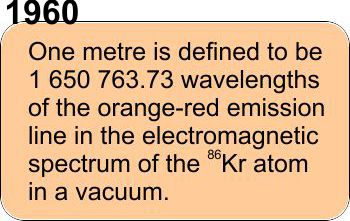
“They did in 1960, Vinnie. Before that the meter was defined to be the distance between two carefully positioned scratches on a platinum-iridium bar that was lovingly preserved in a Paris basement vault. In 1960 they went to a new standard. Here, I’ll bring it up on Old Reliable. By the way, it’s spelled m-e-t-e-r stateside, but it’s the same thing.”

“Mmm… Something goofy there. Look at the number. You’ve been going on about how a counted standard is more precise than one that depends on ratios. How can you count 0.73 of a cycle?”

“You can’t, of course, but suppose you look at 100 meters. Then you’d be looking at an even 165,076,373 of them, OK?”

“Sorta, but now you’re counting 165 million peaks. That’s a lot to ask even a grad student to do, if you can trust him.”

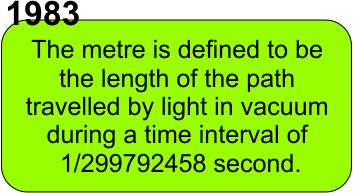
“He won’t have to. Twenty-three years later they went to this better definition.”

“Wait, that depends on how accurate we can measure the speed of light. We get more accurate, the number changes. Doesn’t that get us into the ‘different king, different foot-size’ hassle?”

“Quite the contrary. It locks down the size of the unit. Suppose we develop technology that’s good to another half-dozen digits of precision. Then we just tack half-a-dozen zeroes onto that fraction’s denominator after its decimal point. Einstein said that the speed of light is the same everywhere in the Universe. Defining the meter in terms of lightspeed gives us the same kind of good-everywhere metric for space that the atomic clocks give us for time.”

“I suppose, but that doesn’t really get us past that crazy-high count problem.”

“Actually, we’ve got three different strategies for different length scales. For long distances we just use time-of-flight. Pick someplace far away and bounce a laser pulse off of it. Use an atomic clock to measure the round-trip time. Take half that, divide by the defined speed of light and you’ve got the distance in meters. Accuracy is limited only by the clock’s resolution and the pulse’s duration. The Moon’s about a quarter-million miles away which would be about 2½ seconds round-trip. We’ve put reflectors up there that astronomers can track to within a few millimeters.”

“Fine, but when distances get smaller you don’t have as many clock-ticks to work with. Then what do you do?”

“You go to something that doesn’t depend on clock-ticks but is still connected to that constant speed of light. Here, this video on Old Reliable ought to give you a clue.”

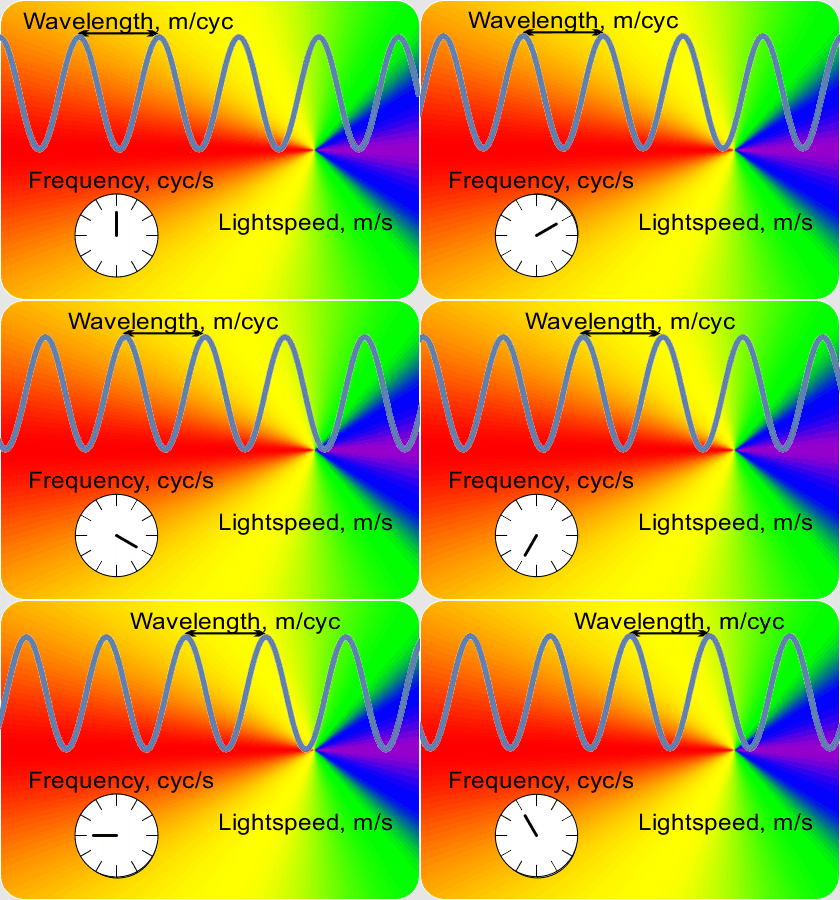
“OK, the speed which is a constant is the number of peaks that’s the frequency times the distance between them that’s the wavelength. If I know a wavelength then arithmetic gets me the frequency and vice-versa. Fine, but how do I get either one of them?”

“How do you tune a trombone?”

“Huh? I suppose you just move the slide until you get the note you want.”

“Yup, if a musician has good ear training and good muscle memory they can set the trombone’s resonant tube length to play the right frequency. Table-top laser distance measurements use the same principle. A laser has a resonant cavity between two mirrors. Setting the mirror-to-mirror distance determines the laser’s output. When you match the cavity length to something you want to measure, the laser beam frequency tells you the distance. At smaller scales you use interference techniques to compare wavelengths.”

Vinnie gets a gleam in his eye. “Time-of-flight measurement, eh?” He flicks a pizza crumb across the room.

In a flash Eddie’s standing over our table. “Hey, hotshot, do that again and you’re outta here!”

“Speed of light, Sy?”

“Pretty close, Vinnie.”

~~ Rich Olcott

For the VLA, Timing Is Everything

Eddie’s pizza is especially tasty after a long walk down a stairwell. Vinnie and I are polishing off the last of our crumbs when he says, “OK, so we got these incredibly accurate clocks. Two questions. What do we use them for besides sending out those BBC pips, and what do they have to do with the new kilogram standard?”

“Pips? Oh, the top-of-the-hour radio station beeps we used to depend upon to set our watches. Kept us all up-to-the-minute, us and the trains and planes — but we don’t need 10-digit accuracy for that. What we do get from high-quality time signals is the ability to create distributed instruments.”

“Distributed instruments?”

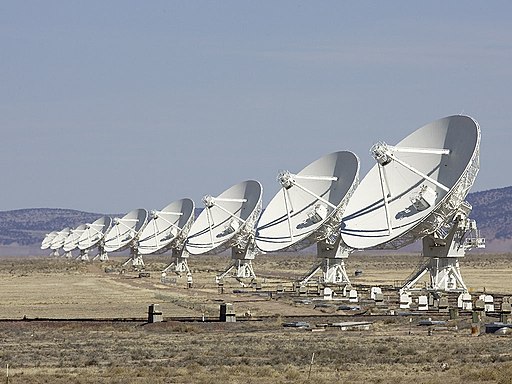
“Ones with pieces in different places. You know about the Jansky Very Large Array, that huge multi-dish radio telescope in New Mexico?”

Karl G. Jansky Very Large Array, photo by Mihaiscanu
via Wikimedia Commons licensed under Creative Commons

“Been there. Nice folks in Pie Town up the road.”

“Did you look around?”

“Of course. What I didn’t understand is why they got 27 dishes and they’re all pointed the same direction. You’d think one would be enough for looking at something.”

“Ah, that’s the thing. All of them together make one telescope.”

<sets smartphone to calculator mode> “Lessee … dish is 25 meters across, πD2/4, 27 dishes, convert square meters to… Geez, 3¼ acres! A single dish that size would be a bear to keep steady in the wind down there. No wonder they split it up.”

“That was one concern, but the total area’s not as important as the distance between the pairs.”

“Why’s that even relevant?”

“Because radio telescopes don’t work the way that optical ones do. No lens or mirror, just a big dish that accepts whatever comes in along a narrow beam of radio waves.”

“How narrow?”

“About the size of the full Moon.”

“That can cover a lot of stars and galaxies.”

“It sure can, which is why early radio astronomy was pretty low-resolution. Astronomers needed a way to pick out the signals from individual objects within that field of view. Turns out two eyes are better than one.”

“3D vision?”

“Kinda related, but not really. Our two eyes give us 3D vision because each eye provides a slightly different picture of close-by objects, say, less than about 5 yards away. For everything further, one eye’s view is no different from the other’s. You’d get the same effect if distant things were painted on a flat background, which is how come a movie set backdrop still looks real.”

“You’re saying that the stars are so far away that each dish gets the same picture.”

“Yeah.”

“So why have more than one?”

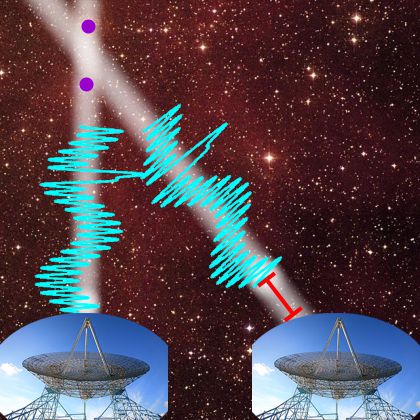
“They don’t get the picture at the same time. With an atomic clock you can take account of when each signal arrives at each dish. Here’s a diagram I did up on Old Reliable. It’s way out of scale but it makes the point, I think. We’ve got two dishes at the bottom here, and those purple dots are two galaxies. Each dish sees them on top of each other and can’t distinguish which one sent that peaky signal. What’s important is, the dish on the right receives the signal later. See that red bar? That’s the additional path length the signal has to travel to reach the second dish.”

“Can’t be much later, light travels pretty fast.”

“About 30 centimeters per nanosecond, which adds up. When the VLA dishes are fully spread out, the longest dish-to-dish distance is about 36 kilometers which is about 120 microseconds as the photon flies. That’s over a million ticks on the cesium clock – no problem tracking the differences.”

“Same picture a little bit later. Doesn’t seem worth the trouble.”

“What makes it worth the trouble is what you can learn from the total space-time pattern after you combine the signals mathematically. Under good conditions the VLA can resolve signals from separate objects only 40 milliarcseconds apart, about 1/45000 the diameter of the Moon. That’s less than the width of a dime seen from 50 miles away.”

“The time pattern is how the dishes act like a single spread-around telescope, huh? Without the high-precision time data, they’re just duplicates?”

“Atomic clocks let us see the Universe.”

~~ Rich Olcott