Dark Passage

Change-me Charlie’s not giving up easily. “You said that NASA picture did three things, but you only told us two of them — that dark matter’s a thing and that it’s separate from normal matter. What’s the third thing? What exactly is in that picture? Does it tell us what dark matter is?”

The Bullet Cluster ( 1E 0657-56 )

Physicist-in-training Newt’s ready for him. “Not much of a clue about what dark matter is, but a good clue about how it behaves. As to what’s in the picture, we need some background information first.”

“Go ahead, it’s not dinner-time yet.”

“First, this isn’t two stars colliding. It’s not even two galaxies. It’s two clusters of galaxies, about 40 all together. The big one on the left probably has the mass of a couple quintillion Suns, the small one about 10% of that.”

“That’s a lot of stars.”

“Oh, most of it’s definitely not stars. Maybe only 1-2%. Those stars and the galaxies they form are embedded in ginormous clouds of proton-electron plasma that make up 5-20% of the mass. The rest is that dark matter you don’t like.”

“Quadrillions of stars are gonna make a super-super-nova when they collide!”

“Well, no. That doesn’t even happen when two galaxies collide. The average distance between neighboring stars in a galaxy is 200-300 times the diameter of a star so it’s unlikely that any two of them will come even close. Next level up, the average distance between galaxies in a cluster is about 60 galaxy diameters or more, depending. The galaxies will mostly just slide past each other. The real colliders are the spread-out stuff — the plasma clouds and of course the dark matter, whatever that is.”

Astronomer-in-training Jim cuts in. “Anyway, the collision has already happened. The light from this configuration took 3.7 billion years to reach us. The collision itself was longer ago than that because the bullet’s already passed through the big guy. From that scale-bar in the bottom corner I’d say the centers are about 2 parsecs apart. If I recall right, their relative velocity is about 3000 kilometers per second so…” <poking at his smartphone> “…the peak intersection was about 700 million years earlier than that. Call it 4.3 billion years ago.”

“So what’s with the cotton candy?”

Newt looks puzzled. “Cotton… oh, the pink pixels. They’re markers for where NASA’s Chandra telescope saw X-rays coming from.”

“What can make X-rays so far from star radiation that could set them going?”

“The electrons do it themselves. An electron emits radiation every time it collides with another charged particle and changes direction. When two plasma clouds interpenetrate you get twice as many particles per unit volume and four times the collision rate so the radiation intensity quadruples. There’s always some X-radiation in the plasma because the temperature in there is about 8400 K and particle collisions are really violent. The Chandra signal pink shows the excess over background.”

“The blue in the Jim’s picture is supposed to be what, extra gravity?”

“Basically, yeah. It’s not easy to see from the figure, but there are systematic distortions in the images of the background galaxies in the blue areas. Disks and ellipsoids appear to be bent, depending on where they sit relative to the clusters’ centers of mass. The researchers used Einstein’s equations and lots of computer time to work back from the distortions to the lensing mass distributions.”

“So what we’ve got is a mostly-not-from-stars gravity lump to the left, another one to the right, and a big cloud in the middle with high-density hot bits on its two sides. Something in the middle blew up and spread gas around mostly in the direction of those two clusters. What’s that tell us?”

“Sorry, that’s not what happened. If there’d been a central explosion the excess to the right would be arc-shaped, not a cone like you see. No, this really is the record of one galaxy cluster bursting through another one. Particle-particle friction within the plasma clouds held them back while the embedded galaxies and dark matter moved on.”

“OK, the galaxies aren’t close-set enough for them to slow each other down, but wouldn’t friction in the dark matter hold things back, too?”

“Now that’s an interesting question…”

~~ Rich Olcott

Beautiful Realization

“Whaddaya mean, Sy, ‘charge and resistance and voltage all playing beautiful together‘? How’s that beautiful?”

“It is when they play together in a Kibble Balance, Vinnie. That beautifully-designed device solved the realization problem for two of the revised fundamental standards of measurement. Here’s the one for electricity.”

“That’s odd. It says ‘electric current’ but the number’s about charge. And I don’t see anything in there about voltage or resistance.”

“True. The electronic charge e is one of our universal constants. It and the speed of light and Planck’s constant h are the same on Mars as they are here on Earth. Take a cesium-based laser from Earth to Mars and its frequency doesn’t change. That’s why the revisions are measure-anywhere standards, no need to carry something to Paris to compare it to a physical object.”

“This is another one of those definition tricks, isn’t it? Like the cesium frequency — we defined the second by saying it’s the time required for so-and-so many waves of that light beam. Here, it’s not like someone measured the charge in coulombs, it’s we’re gonna make the coulomb exactly big enough so when we do measure an electron it’ll match up.”

“You’re not wrong, Vinnie, but it’s not quite that arbitrary. Lots of people did measure the electron against the old standard. This number represents the most accurate estimate across all the measurements. The standards board just froze it there. It’s the same strategy they took with the other six fundamental standards — each of them sits on top of a well-known constant.”

“Like Newton’s gravitational constant?”

“Sorry, Al, not that one. It’s universal, alright, but it’s only known to four significant figures, nowhere near the 8-or-better level the metrologists demand.”

“So tell us about the beauty part, Sy.”

I grab some paper napkins from the dispenser at our table. Al gives me a look. In his opinion Vinnie uses way too many of those and he doesn’t want it to spread. “Just using what I need to make a point, Al. Vinnie, I know you like pictures better than algebra but bear with me.”

“Yeah, you went through the kilogram thing pretty quick what with the garlic and all.”

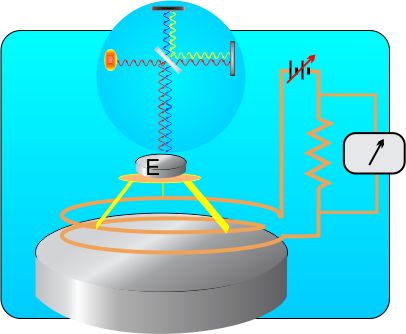
“Oooh, yeah.” <scribbling on the first napkin> “Well anyway, here’s a sketch of the Kibble Balance rigged for weighing but let’s just pay attention to the parts in the dark blue oval. That zig-zag line labeled RK is a resistor that exploits the quantum Hall effect. Quantum math says its resistance is given by RK=h/e2. That’s exactly 25812.80756 ohms.”

“That a lot more digits than gravity.”

“Nice catch, Al. Now the second component in the oval is a quantum voltmeter. If you put a voltage V across it, the Josephson junction inside passes an alternating current whose frequency is f=V/CJ, where CJ=h/2e.” <scribbling on the second napkin> “Put another way. the frequency tells you the voltage from V=f×CJ and that’s the same as V=f×h/2e.” <scribbling on the third napkin> “The current iW going through RK is V/RK and that’s going to be iW=(f×CJ)/(RK)=f×(CJ/RK)=f×(h/2e)/(h/e2)=(f/2)×e. You with me?”

“Gimme a minute… You’re saying that the current is going to be half some frequency, which we can measure, times the charge on an electron. Yeah, that makes sense, ’cause the current is electrons and you got us counting electrons. Hey, wait, what happened to the h?”

“Canceled out in the fraction, just the way that e canceled out in the fraction for the kilogram.”

“Cute.”

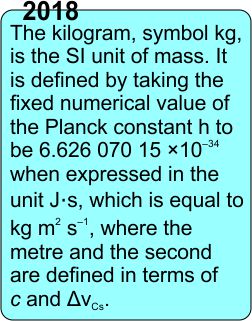
“Better than cute, it’s beautiful. The same equipment, the Kibble Balance plus a gravimeter, gives you the realization of a kilogram depending only on h, AND the realization of the ampere depending only on e. Once you know the standards for time, which depends only on that cesium frequency, and for length, which depends only on time and the speed of light, you can get standards for mass and electric current in the NIST lab here on Earth or up on Mars or anywhere.”

“Almost anywhere.”

“What’s your exception?”

“In space, where there’s no gravity.”

“Einstein covered that with his Equivalence Principle.”

~~ Rich Olcott

The Currant Affair

Al has a new sign up at his coffee shop, “Scone of the day — Current.” He chuckles when I quietly point out the spelling error. “I know how to spell currant, Sy. I’m just gonna enjoy telling people that whatever I’m taking from the oven is the current flavor.” I’m high-fiving him for that, just as Vinnie slams in and yells out, “Hey, Al, you got your sign spelled wrong. Got any cranberry ones in there?”

Al gives me a look. I shrug. Vinnie starts in on me. “Hey, Sy, that was pretty slick what that Kibble guy did. All the measurements and calculations had the mass standard depending on three universal constants but then suddenly there was only two.”

Al pricks up his ears. “Universal constants, Sy?”

“We think so. Einstein said that the speed of light c is the same everywhere. That claim has withstood a century of testing so the International Bureau of Weights and Measures took that as their basis when they redefined the meter as the standard of length. Planck’s constant h is sometimes called the quantum of action. It shows up everywhere in quantum-related phenomena and appears to be fundamental to the way the Universe works. Bryan Kibble’s team created a practical way to have a measure-anywhere standard of mass and it just happens to depend only on having good values for c and h.”

“What’s the one that Vinnie said dropped out?”

“I knew you’d ask that, Al. It’s e, the charge on an electron. The proton and every other sub-atomic particle we’ve measured has a charge that’s some integer multiple of e. Sometimes the multiplier is one, sometimes it’s zero, sometimes it’s a negative, but e appears to be a universal quantum of charge. Millikan’s oil drop experiment is the classic example. He measured the charge on hundreds of ionized droplets floating in an electric field between charged plates. Every droplet held some integer multiple between 1 and 150 of 1.6×10⁻¹⁹ Coulomb.”

“That’s a teeny bit of electricity. I remember from Ms Kendall’s class that one coulomb is one ampere flowing for one second. Then a microampere flowing for a microsecond is, uhh, 6 million electrons. How did they make that countable?”

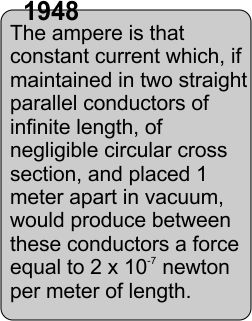
“Ah, you’ve just touched on the ‘realization problem,’ which is not about getting an idea but about making something real, turning a definition into a practical measurement. Electrical current is a good example. Here’s the official definition from 60 years ago. See any problems with it, Vinnie?”

“Infinitely long wires that are infinitely thin? Can’t do it. That’s almost as goofy as that 1960 definition of a second. And how does the force happen anyway?”

“The force comes from electrons moving in each wire electromagnetically pushing on the electrons in the other wire, and that’s a whole other story. The question here is, how could you turn those infinities into a real measurement?”

“Lemme guess. In the 1960 time standard they did a math trick to model a fake Sun and based the second on how the fake Sun moves. Is this like that, with fake wires?”

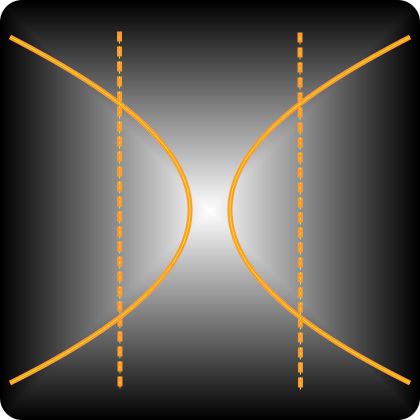
“Nice shot, Vinnie. One of the methods worked like that — take a pair of wires with a known resistance, bend them along a pair of parabolas or some other known curve set close together, apply a voltage and measure the force. Then you use Maxwell’s equations to ‘correct’ the force to what it would have been with the infinite wires the right distance apart. Nobody was comfortable with that.”

“Not surprised — too many ways to do it wrong, and besides, that’s an awfully small force to measure.”

“Absolutely. Which is why there were so many competing standards, some dating back to the 1860s when we were still trying to figure out what electricity is. Some people used a standard resistor R and the voltage V from a standard chemical cell. Then they defined their standard current I from I=V/R. Some measured power P and calculated I2=P/R. Other people standardized charge from the electrostatic force F=q1q2/r2 between two charged objects; they defined current as charge passed per second. It was a huge debate.”

“Who won?”

“Charge and R and V, all playing together and it’s beautiful.”

~~ Rich Olcott

Revenge of The Garlic Calzone

“So what’s the next two steps?” Vinnie asks.

“I’m thinking a dose of the pink stuff and a glass of milk. That garlic calzone’s just not giving up.”

“Nah, we were talking about the new mass standard and how it uses a Kibble Balance protocol you said had three steps but you only got to the gravity-measuring step. You wanna talk to take your mind off your gut, do some more of that.”

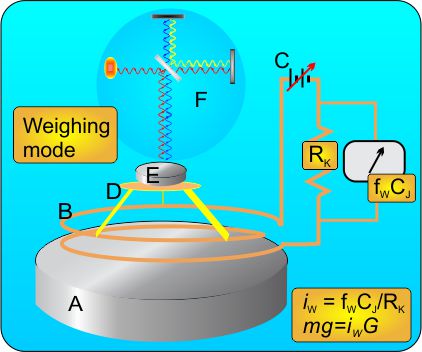
“<burp-sigh> OK, assume we did an accurate measurement of gravity’s acceleration g right next to the Balance.” <pulling Old Reliable from its holster...> “Here’s the device in the protocol’s second step, ‘weighing mode’. Bottom to top we’ve got a permanent magnet A and a coil of wire B that’s hooked up to some electronics. The coil floats in the magnetic field because it’s carrying an electric current from that adjustable power source C. The balance’s test pan D rides on the coil and supports our target mass E. Up top, laser interferometer F keeps track of the test pan’s position. Got all that?”

“Mass goes in the pan, got it.”

“Good. You adjust the current through the coil until the interferometer tells you the test pan is floating motionless. Here’s where the electronics come into play. The same current goes through resistor RK, a quantum Hall effect device chilling in a magnetic field and a bath of liquid helium. Quantum math says its resistance is h/e², where e is the charge on an electron and h is Planck’s constant. Those’re both universals like Einstein’s lightspeed c. RK comes to 25812.807557 ohms. You remember the V-I-R diagram?”

“Once Ms Kendall drills it into your brain it’s there forever. Volts equals current in amps times resistance in ohms.”

“Yep. In the Kibble Balance we evaluate the coil’s balancing current by measuring the voltage drop across RK. The voltmeter uses a Josephson junction, another quantum thingie. At a voltage V the junction passes a small alternating current whose frequency is f=V/CJ, where CJ=h/2e. Count the frequency and you can calculate the voltage. DivideV by RK to get the current iW going through the resistor. Everything here meets the count-based, stable, reproducible-anywhere standard.”

“I suppose the w suffixes mean ‘weigh mode’ and m in the bottom equation is the mass. Makes sense that heavier masses need more current to float them. What’s G?”

“Hold on, I got another burp coming … <bo-o-o-O-O-ORP!>”

“Impressive.”

“Thanks, I suppose. G rolls up all those geometry factors — size, shape and power of the magnet and so forth — that you complained about when I said ‘motor-generator.’ We take care of that in the third step. Here’s the diagram for that.”

“Looks pretty much the same.”

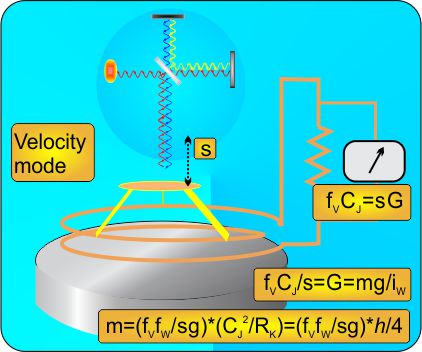
“We took out the target mass and the power source, and see, there’s v-subscripts for ‘velocity mode.’ We move the coil vertically while
the atomic clock ticks and the interferometer tracks the pan’s position. That lets us calculate speed s. The coil moving through the magnetic field generates a voltage V=fvCj=sG. Because the geometry factor G is identical between modes, the linkage between coil speed and output power is exactly the same as the linkage between current and input power. That’s the middle equation — velocity-mode voltage divided by speed equals weighing-mode force divided by current.”

“That’s weird.”

“But true, and so elegant. Every variable in that equation save the mass comes from a high-accuracy, high-precision reproducible standard. That makes mass a measure-anywhere dimension, too. But wait, there’s more.”

“Too much math already.”

“Just a little more. Plug all these equations together and you get the bottom one. That’s exciting.”

“Doesn’t look exciting to me.”

“It goes back to the universal constants thing. The first factor in th middle is a ratio of count-derived quantities. Plug the quantum definitions into the second factor and you get CJ²/RK=(h²/4e²)(e²/h)=h/4. What that says is mass is expressible in units of Planck’s constant. That’s deep stuff! What’s exciting is that the standards people used that result in defining the kilogram.”

“Well, blow me down. And one more of your garlic burps or any more math just might.”

~~ Rich Olcott

Trombones And Echoes

Vinnie’s fiddling with his Pizza Eddie’s pizza crumbs. “Hey, Sy, so we got the time standard switched over from that faked 1900 Sun to counting lightwave peaks in a laser beam. I understand why that’s more precise ’cause it’s a counting measure, and it’s repeatable and portable ’cause they can set up a time laser on Mars or wherever that uses the same identical kinds of atoms to do the frequency stuff. All this talk I hear about spacetime, I’m thinkin’ space is linked to time, right? So are they doing smart stuff like that for measuring space?”

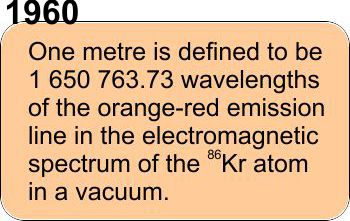
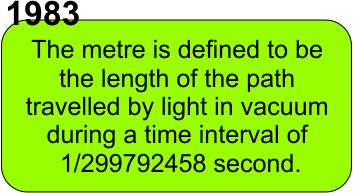
“They did in 1960, Vinnie. Before that the meter was defined to be the distance between two carefully positioned scratches on a platinum-iridium bar that was lovingly preserved in a Paris basement vault. In 1960 they went to a new standard. Here, I’ll bring it up on Old Reliable. By the way, it’s spelled m-e-t-e-r stateside, but it’s the same thing.”

“Mmm… Something goofy there. Look at the number. You’ve been going on about how a counted standard is more precise than one that depends on ratios. How can you count 0.73 of a cycle?”

“You can’t, of course, but suppose you look at 100 meters. Then you’d be looking at an even 165,076,373 of them, OK?”

“Sorta, but now you’re counting 165 million peaks. That’s a lot to ask even a grad student to do, if you can trust him.”

“He won’t have to. Twenty-three years later they went to this better definition.”

“Wait, that depends on how accurate we can measure the speed of light. We get more accurate, the number changes. Doesn’t that get us into the ‘different king, different foot-size’ hassle?”

“Quite the contrary. It locks down the size of the unit. Suppose we develop technology that’s good to another half-dozen digits of precision. Then we just tack half-a-dozen zeroes onto that fraction’s denominator after its decimal point. Einstein said that the speed of light is the same everywhere in the Universe. Defining the meter in terms of lightspeed gives us the same kind of good-everywhere metric for space that the atomic clocks give us for time.”

“I suppose, but that doesn’t really get us past that crazy-high count problem.”

“Actually, we’ve got three different strategies for different length scales. For long distances we just use time-of-flight. Pick someplace far away and bounce a laser pulse off of it. Use an atomic clock to measure the round-trip time. Take half that, divide by the defined speed of light and you’ve got the distance in meters. Accuracy is limited only by the clock’s resolution and the pulse’s duration. The Moon’s about a quarter-million miles away which would be about 2½ seconds round-trip. We’ve put reflectors up there that astronomers can track to within a few millimeters.”

“Fine, but when distances get smaller you don’t have as many clock-ticks to work with. Then what do you do?”

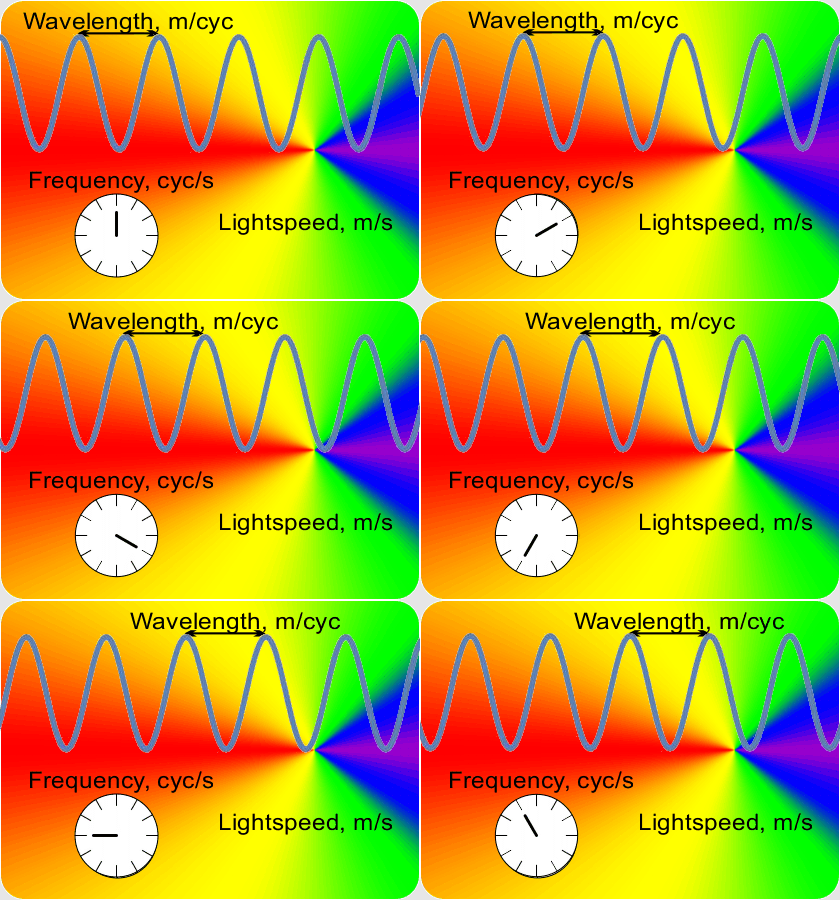
“You go to something that doesn’t depend on clock-ticks but is still connected to that constant speed of light. Here, this video on Old Reliable ought to give you a clue.”

“OK, the speed which is a constant is the number of peaks that’s the frequency times the distance between them that’s the wavelength. If I know a wavelength then arithmetic gets me the frequency and vice-versa. Fine, but how do I get either one of them?”

“How do you tune a trombone?”

“Huh? I suppose you just move the slide until you get the note you want.”

“Yup, if a musician has good ear training and good muscle memory they can set the trombone’s resonant tube length to play the right frequency. Table-top laser distance measurements use the same principle. A laser has a resonant cavity between two mirrors. Setting the mirror-to-mirror distance determines the laser’s output. When you match the cavity length to something you want to measure, the laser beam frequency tells you the distance. At smaller scales you use interference techniques to compare wavelengths.”

Vinnie gets a gleam in his eye. “Time-of-flight measurement, eh?” He flicks a pizza crumb across the room.

In a flash Eddie’s standing over our table. “Hey, hotshot, do that again and you’re outta here!”

“Speed of light, Sy?”

“Pretty close, Vinnie.”

~~ Rich Olcott

A Force-to-Force Meeting

The Crazy Theory contest is still going strong in the back room at Al’s coffee shop. I gather from the score board scribbles that Jim’s Mars idea (one mark-up says “2 possible 2 B crazy!“) is way behind Amanda’s “green blood” theory.  There’s some milling about, then a guy next to me says, “I got this, hold my coffee,” and steps up to the mic.  Big fellow, don’t recognize him but some of the Physics students do — “Hey, it’s Cap’n Mike at the mic.  Whatcha got for us this time?”

“I got the absence of a theory, how’s that?  It’s about the Four Forces.”

Someone in the crowd yells out, “Charm, Persuasiveness, Chaos and Bloody-mindedness.”

“Nah, Jennie, that’s Terry Pratchett’s Theory of Historical Narrative.  We’re doing Physics here.  The right answer is Weak and Strong Nuclear Forces, Electromagnetism, and Gravity, with me?  Question is, how do they compare?”

Another voice from the crowd. “Depends on distance!”

“Well yeah, but let’s look at cases.  Weak Nuclear Force first.  It works on the quarks that form massive particles like protons.  It’s a really short-range force because it depends on force-carrier particles that have very short lifetimes.  If a Weak Force carrier leaves its home particle even at the speed of light which they’re way too heavy to do, it can only fly a small fraction of a proton radius before it expires without affecting anything.  So, ineffective anywhere outside a massive particle.”

It’s a raucous crowd.  “How about the Strong Force, Mike?”

.  <chorus of “HOO-wah!”>

“Semper fi that.  OK, the carriers of the Strong Force —”

.  <“Naa-VY!  Naaa-VY!”>

.  <“Hush up, guys, let him finish.”>

“Thanks, Amanda.  The Strong Force carriers have no mass so they fly at lightspeed, but the force itself is short range, falls off rapidly beyond the nuclear radius.  It keeps each trio of quarks inside their own proton or neutron.  And it’s powerful enough to corral positively-charged particles within the nucleus.  That means it’s way stronger inside the nucleus than the Electromagnetic force that pushes positive charges away from each other.”

“How about outside the nucleus?”

“Out there it’s much weaker than Electromagnetism’s photons that go flying about —”

.  <“Air Force!”>

.  <“You guys!”>

“As I was saying…  OK, the Electromagnetic Force is like the nuclear forces because it’s carried by particles and quantum mechanics applies.  But it’s different from the nuclear forces because of its inverse-square distance dependence.  Its range is infinite if you’re willing to wait a while to sense it because light has finite speed.  The really different force is the fourth one, Gravity —”

.  <“Yo Army!  Ground-pounders rock!”>

“I was expecting that.  In some ways Gravity’s like Electromagnetism.  It travels at the same speed and has the same inverse-square distance law.  But at any given distance, Gravity’s a factor of 1038 punier and we’ve never been able to detect a force-carrier for it.  Worse, a century of math work hasn’t been able to forge an acceptable connection between the really good Relativity theory we have for Gravity and the really good Standard Model we have for the other three forces.  So here’s my Crazy Theory Number One — maybe there is no connection.”

.  <sudden dead silence>

“All the theory work I’ve seen — string theory, whatever — assumes that Gravity is somehow subject to quantum-based laws of some sort and our challenge is to tie Gravity’s quanta to the rules that govern the Standard Model.  That’s the way we’d like the Universe to work, but is there any firm evidence that Gravity actually is quantized?”

.  <more silence>

“Right.  So now for my Even Crazier Theories.  Maybe there’s a Fifth Force, also non-quantized, even weaker than Gravity, and not bound by the speed of light.  Something like that could explain entanglement and solve Einstein’s Bubble problem.”

.  <even more silence>

“OK, I’ll get crazier.  Many of us have had what I’ll call spooky experiences that known Physics can’t explain.  Maybe stupid-good gambling luck or ‘just knowing’ when someone died, stuff like that.  Maybe we’re using the Fifth Force in action.”

.  <complete pandemonium>
four forces plus 1

~ Rich Olcott


Note to my readers with connections to the US National Guard, Coast Guard, Merchant Marine and/or Public Health Service — Yeah, I know, but one can only stretch a metaphor so far.

Schroeder’s Magic Kittycat

“Bedtime, Teena.”

“Aw, Mommie, I had another question for Uncle Sy.  And I’m not sleepy yet anyhow.”

“Well, if we’re just sitting here relaxing, I suppose.  Sy, make your answer as boring as possible.”

“You know me better than that, Sis, but I’ll try.  What’s your question, Teena?”

“You said something once about quantum and Schroeder’s famous kittycat.  Why is it famous?  If it’s quantum it must be a very, very small cat.  Is it magic?”

“???… Oh, Schrödinger’s Cat.  It’s a pretend cat, not a real one, but it’s famous because it’s both asleep and awake.”

“I see what you did there, Sy.”

“Yeah, Sis, but it’s for a good cause, right?”

“But Uncle Sy, how can you tell?  Sometimes Tommie our kittycat looks sound asleep but he’s not really because he can hear when Mommie opens the cat-food can.”

“Schrödinger’s Cat is special.  Whenever he’s awake his eyes are wide open and whenever he’s asleep his eyes are shut.  And he’s in a box.”

“Tommie loves to sit in boxes.”

“Schrödinger’s Cat’s box is sealed tight.  You can’t see into it.”

“So how do you know whether he’s asleep?”

“That was Mr Schrödinger’s point.  We can’t know, so we have to suppose it’s both.  Many people have made jokes about that.  Mr. Schrödinger said the usual interpretation of quantum mechanics is ridiculous and his cat story was his way of proving that.  The cat doesn’t even have to be quantum-small and the story still works.”

“How could it be halfway?  Either his eyes are open or they’re … wait, sometimes Tommie squints, is that it?”

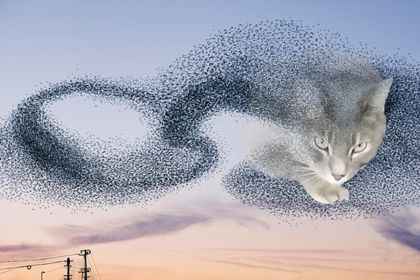
“Nice try, but no.  Do you remember when we were looking at the bird murmuration and I asked you to point to its middle?”

“Oh, yes, and it was making a beautiful spiral.  Mommie, you should have seen it!”

“Were there any birds right at its middle?”

“Um, no-o.  All around the middle but not right there.”

“Birds to the left, birds to the right, but no birds in the middle.  But if I’d I asked you to point to the place where the birds were, you’d’ve pointed to the middle.”

“Uh-huh.”

“You see how that’s like Mr Schrödinger’s cat’s situation?  It’s really asleep or maybe it’s really awake, but if we’re asked for just one answer we’d have to say ‘halfway between.’  Which is silly just like Mr Schrödinger said — by the usual quantum calculation we’d have to consider his cat to be half awake.  That was part of the long argument between Mr Einstein and the other scientist.”

“Wait, Sy, I didn’t hear that part of you two’s conversation on the porch.  What argument was that?”

“This was Einstein’s big debate with Niels Bohr.  Bohr maintained that all we could ever know about the quantum world are the probabilities the calculations yielded.  Einstein held that the probabilities had to result from processes taking place in some underlying reality.  Cat reality here, which we can resolve by opening the box, but the same issue applies across the board at the quantum level.  The problem’s more general than it appears, because much the same issue appears any time you can have a mixture of two or more states.  Are you asleep yet, Sweetie?”

“Nnn, kp tkng.”

“OK.  Entanglement, for instance.  Pretty much the same logic that Schrödinger disparaged can also apply to quantum particles on different paths through space.  Fire off any process that emits a pair of particles, photons for instance.  The wave function that describes both of them together persists through time so if you measure a property for one of them, say polarization direction, you know what that property is for the other one without traveling to measure it.  So far, so good.  What drove Einstein to deplore the whole theory is that the first particle instantaneously notifies the other one that it’s been measured.  That goes directly counter to Einstein’s Theory of Relativity which says that communication can’t go any faster than the speed of light.  Aaand I think she’s asleep.”

“Nice job, Sy, I’ll put her to bed.  We may discuss entanglement sometime.  G’night, Sy.”

“G’night, Sis.  Let me know the next time you do that meatloaf recipe.”

Cat emerging from murmuration~~ Rich Olcott

What Are Quantum Birds Made Of?

“Do quantum thingies follow the same rules that birds do, Uncle Sy?”

“Mostly not, Teena.  Some quantum rules are simple, others are complicated and many are weird.”

“Tell me a simple one and a weird one.”

“Hm… the Principle of Correspondence is simple.  It says if you’ve got a lot of quantum things acting together, the whole mishmash acts by the same rules that a regular-sized thing that size would follow.  If all those birds flew in every direction there’s no flock to talk about, but if they fly by flock rules we can talk about how wind affects the flock’s motion.”

“It’s a murmuration, Uncle Sy.”

“Correction noted, Sweetie.”

“Now tell me a weird one.”

“There’s the rule that a quantum thing acts like it’s in a specific place when you look at it but it’s spread out when you’re not looking.”

“Kittie does that!  She’s never where you look for her.”

“Mm, that’s kind of in the other direction.  We see quantum particles in specific somewheres, not specific nowheres.  The rule is called wave-particle duality and people have been trying to figure out how it works for a hundred years.  Let’s try this.  Put your thumb and forefinger up to your eye and look between them at the blue sky.  Hold your fingers very close together but don’t let them touch.  What do you see?”

“Ooo, there’s stripes in between!  It looks like my finger’s going right into my thumb, but I can feel they’re not touching.  Hey, it works with my other fingers, too, but it hurts if I try it with my pinkie.”

“Then don’t do it with your pinkie, silly.  The stripes are called ‘interference’ and only waves do that.  You’ve watched how water waves go up and down, right?”

“Sure!”

“When the high part of one wave meets the low part of another wave, what happens?”

“I guess high and low make middle.”

“Good guess, that’s exactly right.  That little teeny space between your fingers lets through only certain waves.  You see light where the highs and lows are, dark where the waves middle out.”

“So light’s made out of waves, huh?”

“Well, except that scientists have done lots of experiments where light behaves like it’s made out of little particles called photons.  The funny thing is, light always acts like a wave when it’s traveling from one place to another, but at both ends of the trip it always acts like photons.  That’s the big mystery — how does it do that?”

“You know how it works, don’tcha, Uncle Sy?”

“Only kinda sorta, Teena.  I think it has to do with the idea of big things made out of little things made out of littler things.  Einstein — wait, you know who Einstein was, right?”

“He was the famous scientist with the big hair.”

“That’s right.  He and another scientist had a big debate over 80 years ago.  The other scientist said that when quantum things make patterns, like those stripes you’re looking at, the patterns are all we can know about them.  Einstein said that there has to be something deeper down that drives the patterns.”

“Who won the debate?”

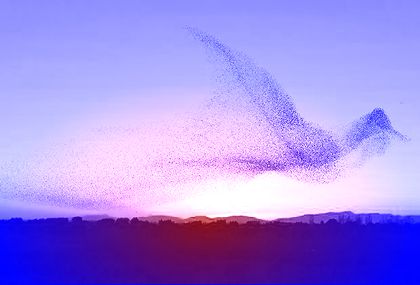
“At the time most people thought that the other man had, but philosophies change.  Since that time lots of people have followed Einstein’s thinking.  Some of the theories are pretty silly, I think, but I’m betting on birds made out of birds.”

“That’s silly, too, Uncle Sy.”

“Maybe, maybe not, we’ll see some day.  It starts with what you might call ‘the smallness quantum,’ though it’s also called ‘the Planck length‘ after Mr Planck who helped invent quantum mechanics.  The Planck length is awesomely small.  It’s as much smaller than us as we are smaller than the whole universe.”

“But there’s lots of things bigger than we are.”

“Exactly.  We’re smaller than whales, they’re smaller than planets, planets are smaller than suns, and galaxies, and on up.  But we don’t know near as many size scales in the other direction – us and bacteria and atoms and protons and that’s about it.  I think there’s plenty of room down there for structures and chaos we’ve not thought of yet.”

“Like birds in murmurations.”

“Mm-hmm.”Bird made out of birds 1

~~ Rich Olcott

Heavenly Messengers

A gorgeous Fall day, a little bit cool-ish, perfect for a brisk walk in the park.  I’m striding along the lake-bound path when there’s a breathless shout behind me.  “Hey, Moire, wait up!  I got questions!”

“Hello, Mr Feder.  What’s the topic this time?  And keep up, please, I’ve got geese to watch.”

“I been reading in the business pages <puff, puff> about all the money different countries are putting into ‘multi-messenger astronomy.’  <puff>  What’s that about, anyway?  Who’s sending messages and ain’t the Internet good enough?”

“It’s not who, Mr Feder, it’s what — stars, galaxies, black holes, the Universe.  And the messages are generally either ‘Here I am‘ or ‘Something interesting just happened‘.  The Internet just doesn’t reach that far and besides, no kitten pictures.”

“Pretty simple-sounding messages, so why the big bucks for extra message-catchers?”

“Fair question.  It has to do with what kind of information each messenger carries.  Photons, for instance.”

“Yeah, light-waves, the rainbow.”

“Way more than the rainbow.  Equating light-waves to just the colors we see is like equating sound-waves to just the range from A4 through F4# on a piano.”

“Hey, that’s less than an octave.”

“Yup, and electromagnetism’s scale is hugely broader than that.  Most of the notes, or colors, are way out of our range.  A big tuba makes a deep, low-frequency note but a tiny piccolo makes a high note.  Photon characteristics also scale with the size of where they came from.  Roughly speaking, the shorter the light’s wave-length, the smaller the process it came out of and the smaller its target will be.  Visible light, for instance, is sent and received by loosely-held charge sloshing inside an atom or molecule.  Charge held tight to a nucleus gives rise to higher-energy photons, in the ultra-violet range or beyond.”

“Like how beyond?”

“X-rays can rip electrons right out of a molecule.  Gamma rays are even nastier and involve charge activity inside a nucleus, like during a nuclear reaction.”

“How about in the other direction?  Nothing?”

“Hardly.  Going that way is going to bigger scales.  Infra-red is about parts of molecules vibrating against each other, microwave is about whole molecules rotating.  When your size range gets out to feet-to-miles you’re looking at radio waves that probably originated from free electrons or ions slammed back and forth by electric or magnetic fields.”

“So these light ranges are like messengers that clue us in on what’s going on out there?  Different messengers, different kindsa clues?”

“You got the idea.  Add in that what happens to the light on the way here is also important.  Radio and microwave photons with their long wavelengths swerve around dust particles that block out shorter-wavelength ones.  Light that traversed Einstein-bent space lets us measure the masses of galaxies.  Absorption and polarization at specific wavelengths tell us what species are out there and what they’re doing.  Blue-shifts and red-shifts tell us how fast things are moving towards and away from us.  And of course, atmospheric distortions tell us we’ve got to put satellite observatories above the atmosphere to see better.”

“One messenger, lots of effects.”

“Indeed, but in the past few years we’ve added two more, really important messengers.  Photons are good, but they’re limited to just one of the four fundamental forces.”

“Hey, there’s gotta be more than that.  This is a complicated world.”

“True, but physicists can account for pretty much everything at the physical and chemical level with only four — electromagnetism, gravity, the strong force that holds nuclei together and the weak force that’s active in nuclear transformation processes.  Photons do electromagnetism and that’s all.”

“So you’re saying we’ve got a line on two of the others?”

“Exactly.  IceCube and its kin record the arrival of high-energy neutrinos.  In a sense they are to the weak force what photons are to electromagnetism.  We don’t know whether gravitation works through particles, but LIGO and company are sensitive to changes in the gravitational field that’s always with us.  Each gives us a new perspective on what’s happening out there.”

“So if you get a signal from one of the new messengers at the same time you get a photon signal…”

“Oh, look, the geese are coming in.”

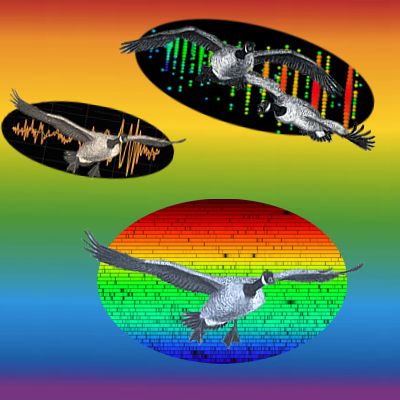
Heavenly messengers

~~ Rich Olcott

Einstein’s Revenge

Vinnie’s always been a sucker for weird-mutant sci-fi films so what Jennie says gets him going.  “So you got these teeny-tiny neutrinos and they mutate?  What do they do, get huge and eat things?”

“Nothing that interesting, Vinnie — or uninteresting, depending on what you’re keen on.  No, what happens is that each flavor neutrino periodically switches to another flavor.”

“Like an electron becomes a muon or whatever?”

“Hardly.  The electron and muon and tau particles themselves don’t swap.  Their properties differ too much —  the muon’s 200 times heaver than the electron and the tau’s sixteen times more massive than that.  It’s their associated neutrinos that mutate, or rather, oscillate.  What’s really weird, though, is how they do that.”

“How’s that?”

“As I said, they cycle through the three flavors.  And they cycle through three different masses.”

“OK, that’s odd but how is it weird?”

“Their flavor doesn’t change at the same time and place as their mass does.”Neutrino braid with sines

“Wait, what?”

“Each kind of neutrino, flavor-wise, is distinct — it reacts with a unique set of particles and yields different reaction products to what the other kinds do.  But experiments show that the mass of each kind of neutrino can vary from moment to moment.  At some point, the mass changes enough that suddenly the neutrino’s flavor oscillates.”

“That makes me think each mass could be a mix of three different flavors, too.”

“Capital, Vinnie!  That’s what the math shows.  It’s two different ways of looking at the same coin.”

“The masses oscillate, too?”

“Oh, indeed.  But no-one knows exactly what the mass values are nor even how the mass variation controls the flavors.  Or the other way to.  We know two of the masses are closer together than to the third but that’s about it.  On the experimental side there’s loads of physicists and research money devoted to different ways of measuring how neutrino oscillation rates depend on neutrino energy content.”

“And on the theory side?”

“Tons of theories, of course.  Whenever we don’t know much about something there’s always room for more theories.  The whole object of experiments like IceCube is to constrain the theories.  I’ve even got one I may present at Al’s Crazy Theory Night some time.”

“Oh, yeah?  Let’s hear it.”

“It’s early days, Al, so no flogging it about, mm?  Do you know about beat frequencies?”

“Yeah, the piano tuner ‘splained it to me.  You got two strings that make almost the same pitch, you get this wah-wah-wah effect called a beat.  You get rid of it when the strings match up exact.”  He grabs a few glasses from the counter and taps them with a spoon until he finds a pair that’s close.  “Like this.”

“Mm-hmm, and when the wah-wahs are close enough together they merge to become a note on their own.  You can just imagine how much more complicated it gets when there are three tones close together.”

I see where she’s going and bring up a display on Old Reliable —an overlay of three sine waves.   “Here you go, Jennie.  The red line is the average of the three regular waves.”Three sines on Old Reliable“Thanks, Sy.  Look, we’ve got three intervals where everything syncs up.  See the new satellite peaks half-way in between?  There’s more hidden pattern where things look chaotic in the rest of the space.”

“Yeah, so?”

“So, Vinnie, my crazy theory is that like a photon’s energy depends on its wave frequency in the electromagnetic field, a neutrino is a combination of three weak-field waves of slightly different frequency, one for each mass.  When they sync up one way you’ve got an electron neutrino, when they sync up a different way you’ve got a muon neutrino, and a third way for a tau neutrino.”

I’ve got to chuckle.  “Nothing against your theory, Jennie, though you’ve got some work ahead of you to flesh it out and test it.  I just can’t help thinking of Einstein and his debates with Bohr.  Bohr maintained that all we can know about the quantum realm are the averages we calculate.  Einstein held that there must be understandable mechanisms underlying the statistics.  Field-based theories like yours are just what Einstein ordered.”

“I could do worse.”Neutrino swirl around Einstein

~~ Rich Olcott