Why Physics Is Complex

“I guess I’m not surprised, Sy.”

“At what, Vinnie?”

“That quantum uses these imaginary numbers — sorry, you’d prefer we call them i‑numbers.”

“Makes no difference to me, Vinnie. Descartes’ pejorative term has been around for three centuries so that’s what the literature uses. It’s just that most people pick up the basic idea more quickly without the woo baggage that the real/imaginary nomenclature carries along. So, yes, it’s true that both i‑numbers and quantum mechanics appear mystical, but really quantum mechanics is the weird one. And relativity.”

“Wait, relativity too? That’s hard to imagine, HAW!”

“Were you in the room for Jim’s Open Mic session where he talked about Minkowski’s geometry?”

“Nope, missed that.”

“Ah, okay. Do you remember the formula for the diagonal of a rectangle?”

“That’d be the hypotenuse formula, c²=a²+b². Told you I was good at Geometry.”

“Let’s use ‘d‘ for distance, because we’re going to need ‘c‘ for the speed of light. While we’re at it, let’s replace your ‘a and ‘b‘ with ‘x‘ and ‘y,’ okay?”

“Sure, why not?”
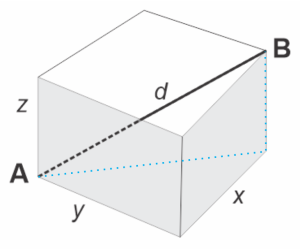
<casting image onto office monitor> “So the formula for the body diagonal of this box is…”

“Umm … That blue line across the bottom’s still √(x²+y²) and it’s part of another right triangle. d‘s gotta be the square root of x²+y²+z².”

“Great. Now for a fourth dimension, time, so call it ‘t.’ Say we’re going for light’s path between A at one moment and B some time t later.”

“Easy. Square root of x²+y²+z²+t².”

“That’s almost a good answer.”

“Almost?”

“The x, y and z are distance but t is a duration. The units are different so you can’t just add the numbers together. It’d be like adding apples to bicycles.”

“Distance is time times speed, so we multiply time by lightspeed to make distance traveled. The formula’s x²+y²+z²+(ct)². Better?”

“In Euclid’s or Newton’s world that’d be just fine. Not so much in our Universe where Einstein’s General Relativity sets the rules. Einstein or Minkowski, no‑one knows which one, realized that time is fundamentally perpendicular to space so it works by i‑numbers. You need to multiply t by ic.”

“But i²=–1 so that makes the formula x²+y²+z²–(ct)².”

“Which is Minkowski’s ‘interval between an event at A and another event at B. Can’t do relativity work without using intervals and complex numbers.”

“Well that’s nice but we started talking about quantum. Where do your i‑numbers come into play there?”

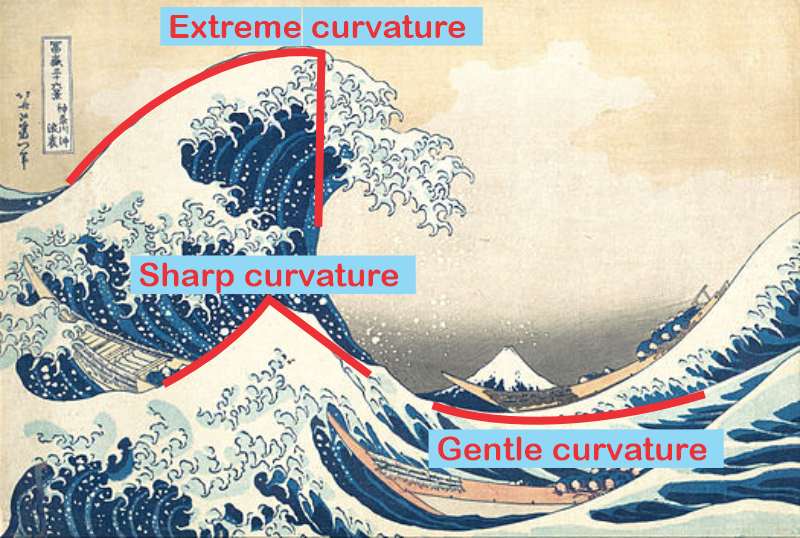
“It goes back to the wave equation— no, I know you hate equations. Visualize an ocean wave and think about describing its surface curvature.”
“Curvature?”

“How abruptly the slope changes. If the surface is flat the slope is zero everywhere and the curvature is zero. Up near the peak the slope changes drastically within a short distance and we say the surface is highly curved. With me?”

“So far.”

“Good. Now, visualize the wave moving past you at some convenient speed. Does it make sense that the slope change per unit time is proportional to the curvature?”

“The pointier the wave segment, the faster its slope has to change. Yeah, makes sense.”

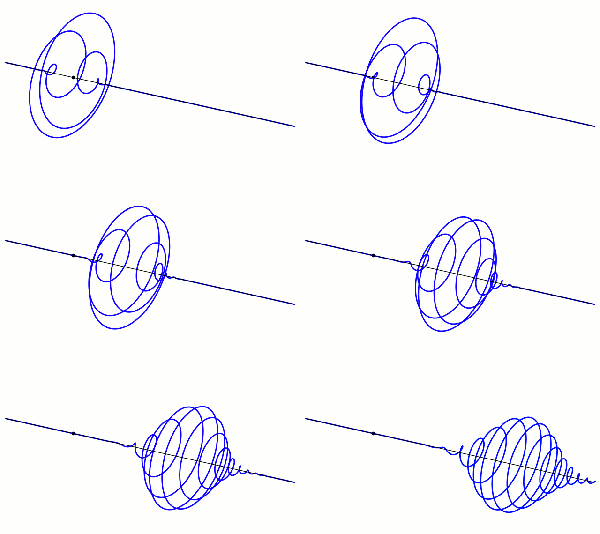
“Which is what the classical wave equation says — ‘time‑change is proportional to space‑change’. The quantum wave equation is fundamental to QM and has exactly the same form, except there’s an i in the proportionality constant and that changes how the waves work.” <casting a video> “The equation’s general solution has a complex exponential factor eix. At any point its value is a single complex number with two components. From the x‑direction, the circle looks like a sine wave. From the i‑direction it also looks like a sine wave, but out of phase with the x‑wave, okay?”
“Out of phase?”

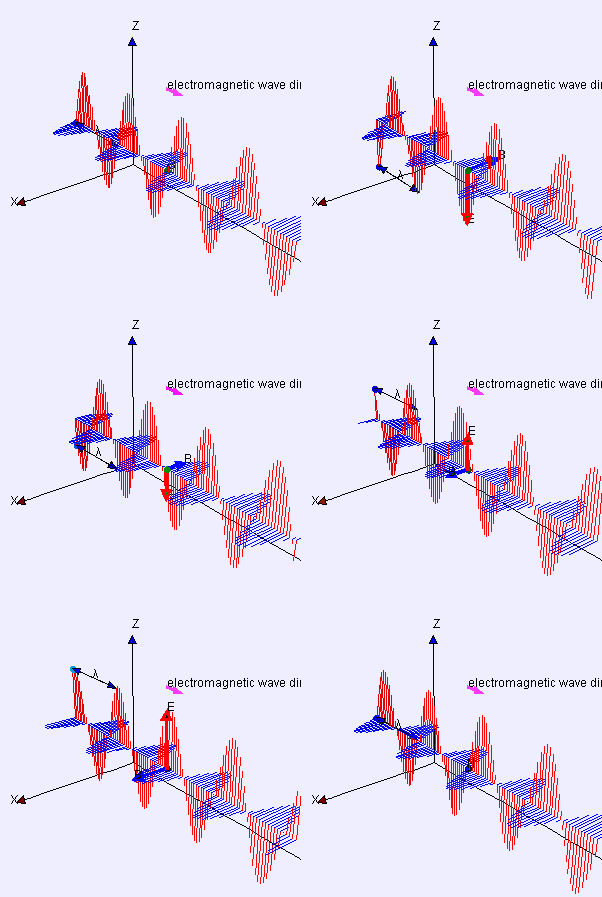
“When one wave peaks, the other’s at zero and vice‑versa. The point is, rotation’s built into the quantum waves because of that i‑component.” <another video> “Here’s a lovely example — that black dot emits a photon that twists and releases the electromagnetic field as it moves along.”

~ Rich Olcott

A Non-political Polarizing Topic

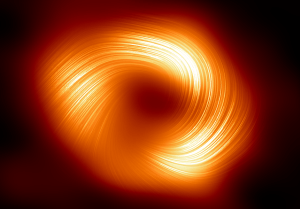
Vinnie gets the deck next, but first thing he does is plop a sheet of paper onto the table. “Topic is black holes, of course. Everybody’s seen this, right?”

“Sure, it’s the new view of the Milky Way’s super-massive black hole with the extra lines. So deal already.”

“Hold your horses, Cal.” <Vinnie starts dealing.> “I’m looking for explanations. Where’d those lines come from? They swirl across the accretion disk like so much rope, right? Why aren’t they just going straight in orderly‑like? The whole thing just don’t make sense to me.”

Susan bets a few chips. “I saw a similar pop‑sci article, Vinnie. It said the lines trace out polarization in the light waves the Event Horizon Telescope captured. Okay, radio waves — same thing just longer wavelength. Polarized radio waves. I’ve measured concentrations of sugar and amino acid solutions by how much the liquid rotates polarized light, but the light first went through a polarizing filter. How does a black hole make polarized waves?”

Kareem matches Susan’s bet. “Mm‑hm. We use polarized light passing through thin sections of the rocks we sample to characterize the minerals in them. But like Susan says, we don’t make polarized light, we use a filter to subtract out the polarization we don’t want. You’re the physicist, Sy, how does the black hole do the filtering?”

Plane‑polarized electromagnetic wave
 Electric (E) field is red
 Magnetic (B) field is blue
(Image by Loo Kang Wee and Fu-Kwun Hwang from Wikimedia Commons)

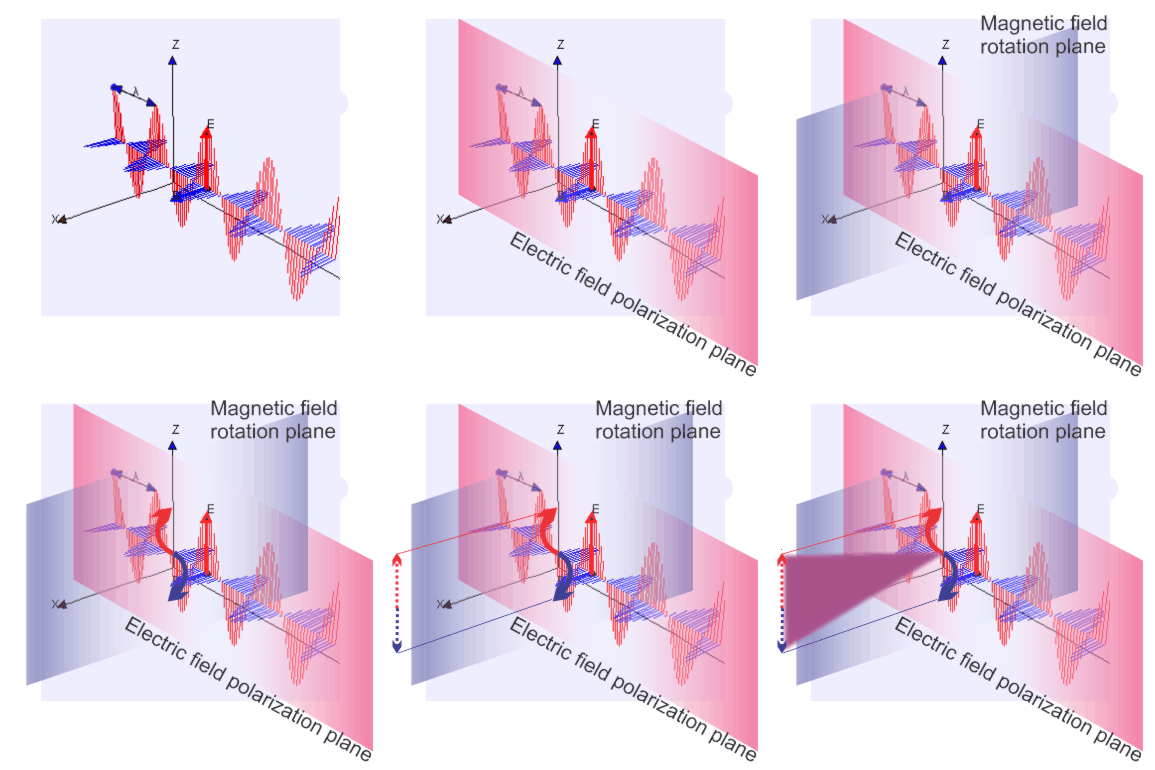
My hand’s good so I match the current ante. “It doesn’t. There’s no filtering, the light just comes out that way. I’d better start with the fundamentals.” <displaying Old Reliable> “Does this look familiar, Vinnie?”

“Yeah, Sy, you’ve used it a lot. That blue dot in the back’s an electron, call it Alice, bobbing straight up and down. That’s the polarization it’s puttin’ on the waves. The red lines are the force that another electron, call it Bob, feels at whatever distance away. Negative‑negative is repelling that so Bob goes down where the red line goes up but you get the basic idea.”

“The blue lines are important here.”

“I’m still hazy on those. They twist things, right?”

“That’s one way to put it. Hendrik Lorentz put it better when he wrote that Bob in this situation experiences one force with two components. There’s the red‑line charge‑dependent component, plus the blue‑line component that depends on the charge and Bob’s motion relative to Alice. If the two are moving in parallel—”

“The same frame, then. I knew frames would get into this somehow.”

“It’s hard to avoid frames when motion’s the subject. Anyway, if the two electrons are moving in parallel, the blue‑line component has zero effect. If the two are moving in different directions, the blue‑line component rotates Bob’s motion perpendicular to Alice’s red‑line polarization plane. How much rotation depends on the angle between the two headings — it’s a maximum when Bob’s moving perpendicular to Alice’s motion.”

“Wait, if this is about relative motion, then Bob thinks Alice is twisting, too. If she thinks he’s being rotated down, then he thinks she’s being rotated up, right? Action‑reaction?”

“Absolutely, Vinnie. Now let’s add Carl to the cast.”

“Carl?”

Alice and Bob’s electromagnetic interaction
begets motion that generates new polarized light.

“Distant observer at right angles to Alice’s polarization plane. From Carl’s point of view both electrons are just tracking vertically. Charges in motion generate lightwaves so Carl sees light polarized in that plane.”

Cathleen’s getting impatient, makes her bet with a rattle of chips. “What’s all this got to do with the lines in the EHT image?”

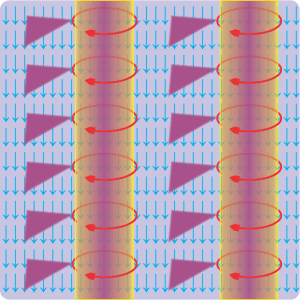
“The hole’s magnetic field herds charged particles into rotating circular columns. Faraday would say each column centers on a line of force. Alice and a lot of other charged particles race around some column. Bob and a lot of other particles vibrate along the column and emit polarized light which shows up as bright lines in the EHT image.”

“But why are the columns twisted?”

“Orbit speed in the accretion disk increases toward its center. I’d bet that’s what distorts the columns. Also, I’ve got four kings.”

“That takes this pot, Sy.”

~~ Rich Olcott

Marconi Would Be Proud

A warmish Spring day.  I’m under a shady tree by the lake, waiting for the eclipse and doing some math on Old Reliable.  Suddenly there’s a text‑message window on its screen.  The header bar says 710‑555‑1701 . Old Reliable has never held a messaging app, that’s not what I use it for, but the set-up is familiar. I type in, Hello?

Hello, Mr Moire. Remember me?

Of course I do.  That sultry knowing stare, those pointed earsHello, Lieutenant Baird.  It’s been a year.  What can I do for you?

Not Lieutenant any more, I’m back up to Commander, Provisional.

Congratulations. Did you invent something again?

Yes, but I can’t discuss it on this channel. I owe you for the promotion. I got the idea from one of your Crazy Theories posts. You and your friends have no clue but you come up with interesting stuff anyway.

You’re welcome, I suppose. Mind you, your science is four centuries ahead of ours but we do the best we can.

I know that, Mr Moire. Which is why I’m sending you this private chuckle.

Private like with Ralphie’s anti‑gravity gadget? I suggested he add another monitoring device in between two of his components. That changed the configuration you warned me about. He’s still with us, no anti‑gravity, but now he blames me.

Good ploy. Sorry about the blaming. Now it’s your guy Vinnie who’s getting close to something.

Vinnie? He’s not the inventor type, except for those maps he’s done with his buddy Larry. What’s he hit on?

His speculation from your Quantum Field Theory discussion that entanglement is somehow involved with ripples in a QFT field, ripples that are too weak to register as a particle peak. He’s completely backwards on entanglement, but those ripples—

Wait, what’s that about entanglement?

Entanglement is the normal state for quantized particles. Our 24th‑Century science says every real and virtual particle in the Universe is entangled with every other particle that shares the same fields. It’s an all‑embracing quantum state. Forget your reductionist 20th‑Century‑style quantum states, this is something … different. Your Hugh Everett and his mentor John Archibald Wheeler had an inking of that fact a century before your time, though of course they didn’t properly understand the implications and drew a ridiculous conclusion. Anyway, when your experimenting physicists say they’ve created an entangled particle pair, they’ve simply extracted two particles from the common state. When they claim to transmit one of the particles somewhere they’re really damping out the local field peak linked to their particle’s anti‑particle’s anti‑peak at the distant location and that puts an anti‑anti‑particle‑particle peak there. Naturally, that happens nearly instantaneously.

I don’t follow the anti‑particle‑anti‑peak part. Or why it’s naturally instantaneous.

I didn’t expect you to or else I wouldn’t have told you about it. The Prime Directive, you know. Which is why the chuckle has to be private, understand?

I won’t tell. I live in “the city that knows how to keep its secrets,” remember?

Wouldn’t do you any good if you did tell and besides, Vinnie wouldn’t think it’s funny. Here’s the thing. As Vinnie guessed, there are indeed sub‑threshold ripples in all of the fundamental fields that support subatomic particles and the forces that work between them. And no, I won’t tell you how many fields, your Standard Model has quite enough complexity to <heh> perturb your physicists. A couple hundred years in your future, humanity’s going to learn how to manipulate the quarks that inhabit the protons and neutrons that make up a certain kind of atom. You’ll jiggle their fields and that’ll jiggle other fields. Pick the right fields and you get ripples that travel far away in space but very little in time, almost horizontal in Minkowski space. It won’t take long for you to start exploiting some of your purposely jiggled fields for communication purposes. Guess what a lovely anachronism you’ll use to name that capability.

‘Jiggled fields’ sounds like communications tech we use today based on the electromagnetic field — light waves traveling through glass fibers, microwave relays for voice and data—

You’re getting there. Go for the next longer wavelength range.

Radio? You’ll call it radio?

Subspace radio. Isn’t that wonderful?

~~ Rich Olcott

Fields of Dreams

Vinnie takes a slug of his coffee. “So the gravitational field carries the gravitational wave. I suppose Einstein would blame sound waves on some kind of field?”

I take a slug of mine. “Mm-hm. We techies call it a pressure field. Can’t do solar physics without it. The weather maps you use when plotting up a flight plan — they lay three fields on top of the geography.”

“Lessee — temp, wind … and barometer reading. In the old days I’d use that one to calibrate my altimeter. You say those are fields?”

“In general, if a variable has a value at every point in the region of interest, the complete set of values is a field. Temperature and pressure are the simplest type. Their values are just numbers. Each point in a wind field has both speed and direction, two numbers treated as a single value, so you’ve got a field of vector values.”

“Oh, I know vectors, Sy. I’m a pilot, remember? So you’re saying instead of looking at molecules back‑and‑forthing to make sound waves we step back and look at just the pressure no matter the molecules. Makes things simpler, I can see that. Okay, how about the idea those other guys had?”

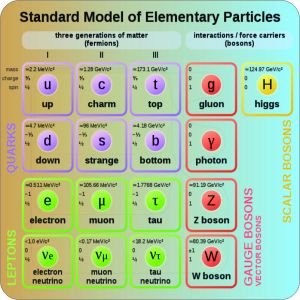
“Hm? Oh, the other wave carrier idea. Einstein’s gravitational waves are just fine, but the Quantum Field Theorists added a collection of other fields, one for each of the 17 boxes in the Standard Model.”

“Boxes?”

<displaying Old Reliable’s screen> “Here’s the usual graphic. It’s like the chemist’s Periodic Table but goes way below the atomic level. There’s a box each for six kinds of quarks; another half‑dozen for electrons, neutrinos and their kin; four more boxes for mediating electromagnetism and the weak and strong nuclear forces. Finally and at last there’s a box for the famous Higgs boson which isn’t about gravity despite what the pop‑sci press says.”

“What’s in the boxes?”

“Each box holds a list of properties — rest mass, spin, different kinds of charge, and a batch of rules for how to interact with the other thingies.”

“Thingies, Sy? I wouldn’t expect that word from you.”

“I would have said ‘particle‘ but that would violate QFT’s tenets despite the graphic’s headline.”

“Tenets? That word sounds more like you. What’s the problem?”

“That the word ‘particle‘ as we normally use it doesn’t really apply at the quantum field level. Each box names a distinct field that spreads its values and waves all across the Universe. There’s an electron field, a photon field, an up‑quark field, a down‑quark field, and so on. According to QFT, what we’d call a particle is nothing more than a localized peak in its underlying field. Where you find a peak you’ll find all the properties listed in its box. Wherever the field’s value is below its threshold, you find none of them.”

“All or none, huh? I guess that’s where quantum comes in. Wait, that means there could be gazillions of one of them popping up wherever, like maybe a big lump of one kind all right next to each other.”

“No, the rules prevent that. Quarks, for instance, only travel in twos or threes of assorted kinds. The whole job of the gluons is to enforce QFT rules so that, for instance, two up‑quarks and a down‑quark make a proton but only if they have different color charges.”

“Wait, color charge?”

“Not real colors, just quantum values that could as easily have been labeled 1, 2, 3 or A, B, C. There’s also an anti- for each value so the physicists could have used ±1, ±2, ±3, but they didn’t, they used ‘red’ and ‘anti‑red’ and so forth. And ‘color charge‘ is a different property from electric charge. Gluons only interact with color charge, photons only interact with electric charge. The rules are complicated.”

“You said ‘waves.’ Each of these fields can have waves like gravity waves?”

“Absolutely. We can’t draw good pictures of them because they’re 3‑dimensional. And they’re constantly in motion, of course.”

“How fast can those waves travel?”

“The particles are limited to lightspeed or slower; the waves, who knows?”

“Ripples zipping around underneath the quantum threshold could account for entanglement, ya’ know?”

“Maybe.”

~~ Rich Olcott

Screams And Thunders

Coffee time. I step into Cal’s shop and he’s all over me. ”Sy, have you heard about the the NASA sonification project?”

Susan puts down her mocha latte. “I didn’t like some of what they’ve released. Sounds too much like people screaming.”

Jeremy looks up from the textbook he’s reading. ”In space, no-one can hear you scream.”

Vinnie rumbles from his usual table by the door. “Any of these got anything to do with the Cosmic Hum?”

“They have nothing to do with each other, except they do. Spiral galaxies, too.”

“Huh?”
 ”Huh?”
  ”Huh?”
   ”Huh?”

“A mug of my usual, Cal, please, and a strawberry scone.”

“Sure, Sy, here ya go, but you can’t say something like that around here without you tellin’ us how come.”

“Does the name Bishop Berkeley ring a bell with anyone?”

Vinnie’s on it. ”That the ‘If a tree falls in the forest…‘ guy, right? Claimed there’s no sound unless somebody’s there to hear it?”

“And by extension, no sound outside human hearing range.”

“But bats and them use sound we can’t hear.”
 ”So do elephants and whales.”

“Well there you go. So are we agreed that he was wrong?”

“Not quite, Mr Moire. His definition of ‘sound‘ was different from one you’d like. He was a philosopher theorizing about perception, but you’re a physicist. You two don’t even define reality the same way.”

Vinnie’s rumble. ”Good shot, Jeremy. Sound is waves. Sy and me, we talked about them a lot. One molecule bangs into the next one and so on. The molecules don’t move forward, mostly, but the banging does. Sy showed me a video once. So yeah, people listening or not, that tree made a sound. There’s molecules up in space, so there’s sound up there, too, right, Sy?”

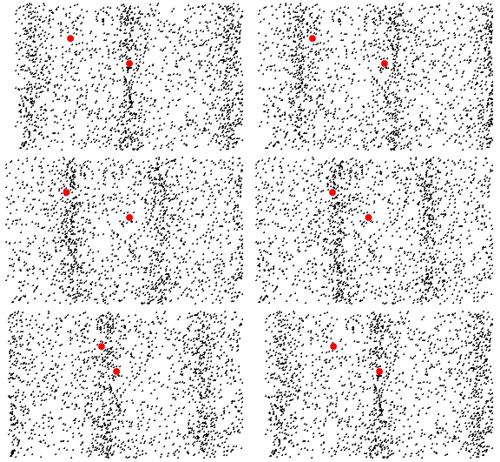
“Mmm, depends on where you are. And what sounds you’re equipped to listen for. The mechanism still works, things advancing a wave by bouncing off each other, but the wave’s length has to be longer than the average distance between the things.” <drawing Old Reliable, pulling up display> “Here’s that video Vinnie saw. I’ve marked two of the particles. You see them moving back and forth over about a wavelength. Suppose a much shorter wave comes along.”

“Umm… Each one would get a forward kick before they got back into position. They wouldn’t oscillate, they’d just keep moving in that direction. No sound wave, just a whoosh.”

“Right, Jeremy. Each out‑of‑sync interaction converts some of the wave’s oscillating energy into one‑way motion. The wave doesn’t get energy back. A dozen wavelengths along, no more wave. So the average distance between particles, we call it the mean free path, sets limits to the length and frequency of a viable wave. Our ears would say it filters out the treble.”

“Space ain’t quite empty so it still has a few atoms to bump together. What kinds of limits do we get out there?”

“Well, there’s degrees of empty. Interplanetary space has more atoms per cubic meter than interstellar which is more crowded than intergalactic. Nebulae and molecular clouds can be even less empty. Huge range, but in general we’re talking wavelengths longer than a million kilometers. Frequencies measured in months or years — low even for your voice, Vinnie.”

Jeremy gets a look on his face. ”One of my girlfriends is a soprano. We tested her in the audio lab and she could hit a note just under two kilohertz, that’s two thousand cycles per second. My top screech was below half that. I could scream in space, but I guess not low enough to be heard.”

“Yeah, keep that spacesuit helmet closed and be sure your radio intercom’s working.”

“Wait, what about screaming over the radio?”

“Radio operates with electromagnetic waves, not bumping atoms. Mean free path limits don’t apply. Radio’s frequency range is around a hundred megahertz, screeching’s no problem. Your broadcast equipment’s response range would set your limits.”

“Sy, those screamy sounds I objected to — you say they can’t have traveled across space as sound waves. Was that a radio transmission?”

“Maybe, Susan. From what I’ve read, we’ve picked up beaucoodles of radio sources, all different types and all over the sky. Each broadcasts a spectrum of different radio frequencies. Some of them are constant radiators, some vary at different rates. You may have heard a recording of a kilohertz variable source.”

<shudder> “All nasty treble, no bass or harmony.”

~~ Rich Olcott

  • Thanks to Alex, who raised several questions.

Not Silly-Season Stuff, Maybe

“Keep up the pace, Mr Feder, air conditioning is just up ahead.”

“Gotta stop to breathe, Moire, but I got just one more question.”

“A brief pause, then. What’s your question?”

“What’s all this about LK99 being a superconductor? Except it ain’t? Except maybe it is? What is LK99, anyway, and how do superconductors work? <puffing>”

“So many question marks for just one question. Are you done?”

“And why do news editors care?”

“There’s lots of ways we’d put superconductivity to work if it didn’t need liquid‑helium temperatures. Efficient electric power transmission, portable MRI machines, maglev trains, all kinds of advances, maybe even Star Trek tricorders.”

“Okay, I get how zero‑resistance superconductive wires would be great for power transmission, but how do all those other things have anything to do with it?”

“They depend on superconductivity’s conjoined twin, diamagnetism.”

Dia—?”

“Means ‘against.’ It’s sort of an application of Newton’s Third Law.”

“That’s the one says, ‘If you push on the Universe it pushes back,’ right?”

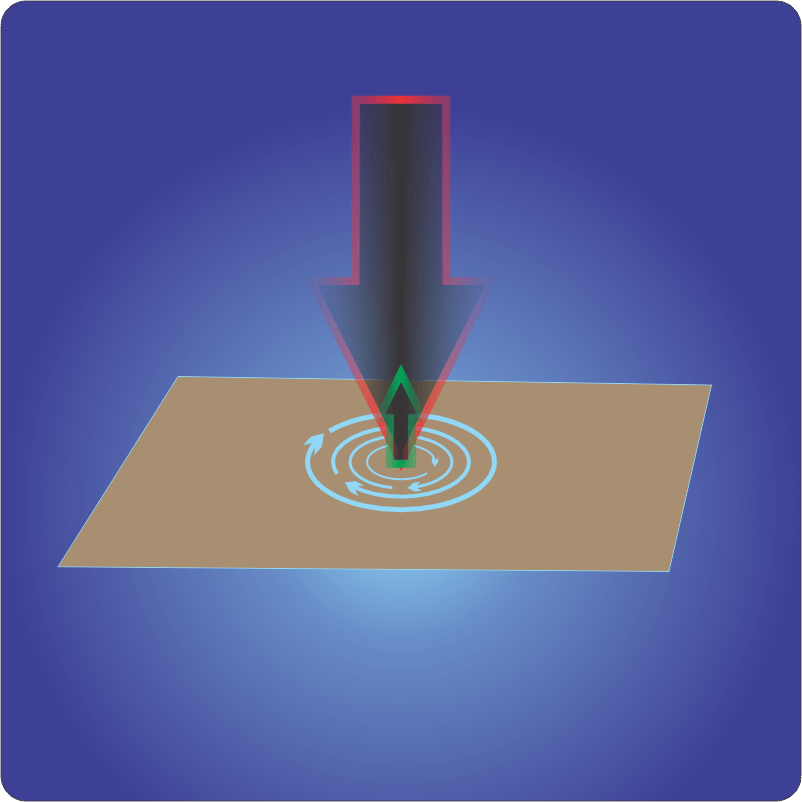
“Very good, Mr Feder. In electromagnetism that’s called Lenz’ Law. Suppose you bring a magnet towards some active conductor, say a moving sheet of copper. Or maybe it’s already carrying an electric current. Either way, the magnet’s field makes charge carriers in the sheet move perpendicular to the field and to the prevailing motion. That’s an eddy current.”

“How come?”

“Because quantum and I’m not about to get into that in this heat. Emil Lenz didn’t propose a mechanism when he discovered his Law in 1834 but it works. What’s interesting is what happens next. The eddy current generates its own magnetic field that opposes your magnet’s field. There’s your push‑back and it’s called diamagnetism.”

“I see where you’re going, Moire. With a superconductor there’s zero resistance and those eddy currents get big, right?”

“In theory they could be infinite. In practice they’re exactly strong enough to cancel out any external magnetic field, up to a limit that depends on the material. A maglev train’s superconducting pads would float above its superconducting track until someone loads it too heavily.”

“What about portable MRI you said? It’s not like someone’s gonna stand on one.”

“A portable MRI would require a really strong magnet that doesn’t need plugging in. Take that superconducting sheet and bend it into a doughnut. Run your magnet through the hole a few times to start a current. That current will run forever and so will the magnetic field it generates, no additional power required. You can make the field as strong as you like, again within a limit that depends on the material.”

“Speaking of materials, what’s the limit for that LK99 stuff?”

“Ah, just in time! Ahoy, Susan! Out for a walk yourself, I see. We’re on our way to Al’s for coffee and air conditioning. Mr Feder’s got a question that’s more up your Chemistry alley than my Physics.”

“LK99, right? It’s so newsy.”

“Yeah. What is it? Does it superconduct or not?”

“Those answers have been changing by the week. Chemically, it’s basically lead phosphate but with copper ions replacing some of the lead ions.”

“They can do that?”

“Oh yes, but not as neatly as we’d like. Structurally, LK99’s an oxide framework in the apatite class — a lattice of oxygens with phosphorus ions sitting in most of the holes in the lattice, lead ions in some of the others. Natural apatite minerals also have a sprinkling of hydroxides, fluorides or chlorides, but the reported synthesis doesn’t include a source for any of those.”

“Synthesis — so the stuff is hand‑made?”

“Mm‑hm, from a series of sold‑state reactions. Those can be tricky — you grind each of your reactants to a fine powder, mix the powders, seal them in a tube and bake at high temperature for hours. The heat scrambles the lattices. The atoms can settle wherever they want, mostly. I think that’s part of the problem.”

“Like maybe they don’t?”

“Maybe. There are uncontrollable variables — grinding precision, grain size distribution, mixing details, reaction tube material, undetected but critical impurities — so many. That’s probably why other labs haven’t been able to duplicate the results. Superconductivity might be so structure‑sensitive that you have to prepare your sample j‑u‑s‑t right.”

~~ Rich Olcott

LIGO And NANOGrav

Afternoon coffee time, but Al’s place is a little noisier than usual. “Hey, Sy, come here and settle this.”

“Settle what, Al? Hi, Vinnie.”

<waves magazine> “This NANOGrav thing, they claim it’s a brand‑new kind of gravity wave. What’s that about?”

“Does it really say, ‘gravity wave‘? Let me see that. … <sigh> Press release journalism at its finest. ‘Gravity waves’ and ‘gravitational waves’ are two entirely different things.”

“I kinda remember you wrote about that, but it was so long ago I forget how they’re different.”

“Gravity waves happen in a fluid, like air or the ocean. Some disturbance, like a heat spike or an underwater landslide, pushes part of the fluid upward relative to a center of gravity. Gravity acts to pull that part down again but in the meantime the fluid’s own internal forces spread the initial up‑shift outwards. Adjacent fluid segments pull each other up and down and that’s a gravity wave. The whole process keeps going until friction dissipates the energy.”

“Gravitational waves don’t do that?”

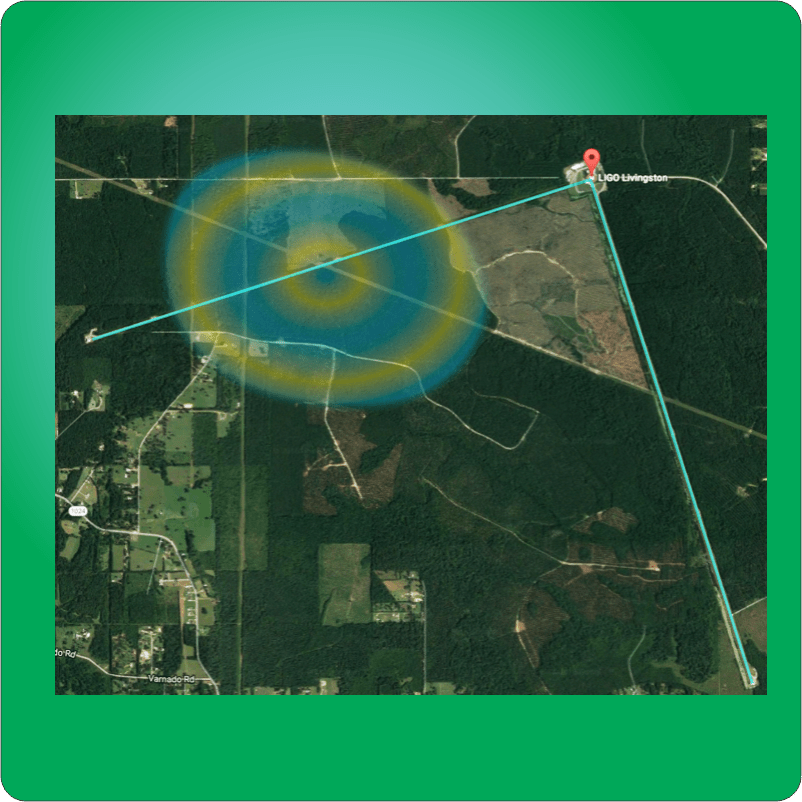
“No, because gravitational waves temporarily modify the shape of space itself. The center doesn’t go up and down, it…” <showing a file on Old Reliable> “Here, see for yourself what happens. It’s called quadrupolar distortion. Mind you, the effects are tiny percentagewise which is why the LIGO apparatus had to be built kilometer‑scale in order to measure sub‑femtometer variations. The LIGO engineers took serious precautions to prevent gravity waves from masquerading as gravitational waves.”

“Alright, so now we’ve almost got used to LIGO machines catching these waves from colliding black holes and such. How are NANOGrav waves different?”

“Is infrared light different from visible light?”

“The Hubble sees visible but the Webb sees infrared.”

“Figures you’d have that cold, Al. What I think Sy’s getting at is they’re both electromagnetic even though we only see one of them. You’re gonna say the same for these new gravitational waves, right, Sy?”

“Got it in one, Vinnie. There’s only one electromagnetic field in the Universe but lots of waves running through it. Visible light is about moving charge between energy levels in atoms or molecules which is how the visual proteins in our eyes pick it up. Infrared can’t excite electrons. It can only waggle molecule parts which is why we feel it as heat. Same way, there’s only one gravitational field but lots of waves running through it. The LIGO devices are tuned to pick up drastic changes like the <ahem> massive energy release from a black hole collision.”

“You said ‘tuned‘. Gravitational waves got frequencies?”

“Sure. And just like light, high frequencies reflect high‑energy processes. LIGO detects waves in the kilohertz range, thousands of peaks per second. NANOGrav’s detection range is sub‑nanohertz, where one cycle can take years to complete. Amazingly low energy.”

“How can they detect anything that slow?”

“With really good clocks and a great deal of patience. The new reports are based on fifteen years of data, half a billion seconds counted out in nanoseconds.”

“Hey, wait a minute. LIGO’s only half‑a‑dozen years old. Where’d they get the extra data from, the future?”

“Of course not. Do you remember us working out how LIGO works? The center sends out a laser pulse along two perpendicular arms, then compares the two travel times when the pulse is reflected back. Light’s distance‑per‑time is constant, right? When a passing gravitational wave squeezes space along one arm, the pulse in that arm completes its round trip faster. The two times don’t match any more and everyone gets excited.”

“Sounds familiar.”

“Good. NANOGrav also uses a timing‑based strategy, but it depends on pulsars instead of lasers. Before you ask, a pulsar is a rotating neutron star that blasts a beam of electromagnetic radiation. What makes it a pulsar is that the beam points away from the rotation axis. We only catch a pulse when the beam points straight at us like a lighthouse or airport beacon. Radio and X‑ray observatories have been watching these beasts for half a century but it’s only in the past 15 years that our clocks have gotten good enough to register timing hiccups when a gravitational wave passes between us and a pulsar.”

~ Rich Olcott

Symmetry And The Loopholes

“So, we’ve got geometry symmetry and relativity symmetry. Is that it, Sy?”

“Hardly, Al. There’s scores of them. Mathematics has a whole branch devoted to sorting and classifying the operations and how they group together. Shall I list a few dozen?”

“Ah, no, don’t bother, thanks. You got one I’d recognize?”

“How about charge symmetry? Flip an electron’s negative charge and you’ve got a positron that has exactly the same mass and the same interaction with light waves. OK, positrons move opposite to electrons in a magnetic field which is how their existence was confirmed, but charge is s a fundamental symmetry for normal matter.”

“Oh, right, charge is a piece of that CPT symmetry you hung your anti‑Universe story on. Which reminds me, you never said what the ‘P’ stands for.”

“Parity, as in Charge‑Parity‑Time. Before you ask, ‘parity‘ is left-right symmetry. Parity symmetry says you can replace ‘clockwise‘ with ‘counterclockwise‘ in a system and the equations describing the system will give perfectly good predictions. Time symmetry is about time running forward or backward. The equations are happy either way. The CPT theorem says the three symmetries are solidly tied together — you can’t flip one without the other two tagging along. If some process emits particle X with clockwise spin, there’s some equivalent process that soaks up an anti-X if it’s spinning counterclockwise. Very firm theorem, lots of laboratory evidence for it from electromagnetism and the nuclear strong force. But.”

“But?”

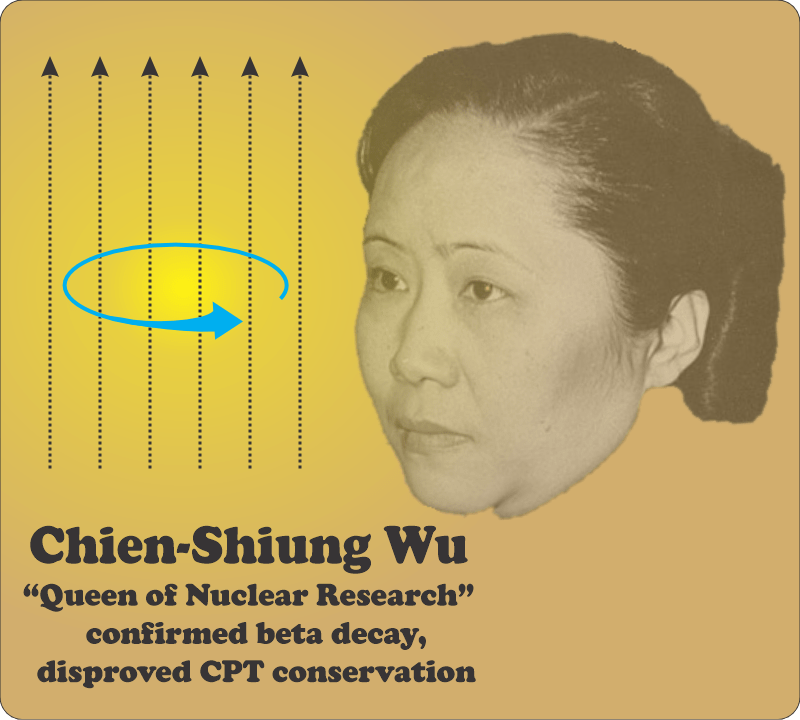
“But Chien‑Shiung Wu did an experiment that showed the nuclear weak force doesn’t always obey CPT rules. Her worked proved we live in a handed Universe. She should have gotten a Nobel for that, but it was last century and the Nobel Committee was men‑only. Two theory guys copped the prize that should have gone to the three of them. The theory guys protested but the Committee ignored Wu anyway. Sometimes things aren’t fair.”

“Tell me about it. So the theory’s got a loophole?”

“Apparently, but to my knowledge no‐one’s found it. Some string theories claim to hint at an explanation but that’s not much help, considering.”

“Huh. Could the loophole maybe be an example of symmetry breaking?”

“Very good question. I think it’s a qualified probably but that’s a guess.”

“Sy, I think that’s the wishy-washiest you’ve ever been.”

“One of my rules is, when you’re going out on a limb be sure you’re properly roped to the tree. In this case I’m generalizing from a single sample.”

“You’re gonna tell me, right?”

   Professor Higgs presents
       the Higgs Bozo.

“Just the bare outline because I don’t want to get into the deep weeds. Back in the 1960s Physics was in trouble because the nuclear strong force particles that bind the nucleus together were found to have mass and move slowly. Strong‑force theory at the time said they should be massless and move at lightspeed. The theory depended on part of the potential energy varying with the symmetry of a circle. Then Higgs—”

“The Higgs Boson guy?”

“That’s him. Anyway, he published a three‑page paper showing that those binding particles aren’t controlled solely by the nuclear strong force. Because they have a charge they also engage with the electromagnetic field. Electromagnetism is a lot weaker than the strong force, but it’s strong enough to deform the theory’s circle into an ellipse. Breaking the circular symmetry in effect gives the particles mass and slows them down.”

“So where’s the boson come in? I thought it’s what makes mass for everything.”

“Absolutely not, probably. The protons and neutrons have plenty of mass on their own, thank you very much. It’s only those strong-force particles that gain mass, less than 1% of the nucleus total. But the whole story is a great example of how making a system less symmetrical, even a little bit, can completely change how it operates. We think that’s what drove the Big Bang’s story. The early Universe was so dense and hot it was a perfectly symmetrical quark soup — chaos all the way down. Space expansion opened successive symmetry loopholes that permitted layers of structure formation.”

<looking at hands> “I don’t feel unsymmetrical.”

“Trust me, deep down you are.”

~~ Rich Olcott

Reflection, Rotation And Spacetime

“Afternoon, Al.”

“Hiya, Sy. Hey, which of these two scones d’ya like better?”

“”Mm … this oniony one, sorta. The other is too vegetable for me ‑ grass, I think, and maybe asparagus? What’s going on?”

“Experimenting, Sy, experimenting. I’m going for ‘Taste of Spring.’ The first one was spring onion, the second was fiddlehead ferns. I picked ’em myself.”

“Very seasonal, but I’m afraid neither goes well with coffee. I’ll take a caramel scone, please, plus a mug of my usual mud.”

“Aw, Sy, caramel’s a winter flavor. Here you go. Say, while you’re here, maybe you could clear up something for me?”

“I can try. What’s the something?”

“After your multiverse series I got out my astronomy magazines to read up on the Big Bang. Several of the articles said that we’ve gone through several … um, I think they said ‘epochs‘ … separated by episodes of symmetry breaking. What’s that all about?”

“It’s about a central notion in modern Physics. Name me some kinds of symmetry.”

“Mmm, there’s left‑right, of course, and the turning kind like a snowflake has. Come to think — I like listening to Bach and Vivaldi when I’m planet‑watching. I don’t know why but their stuff reminds me of geometry and feels like symmetry.”

“Would it help to know that the word comes from the Greek for ‘same measure‘? Symmetry is about transformations, like your mirror and rotation operations, that affect a system but don’t significantly change to its measurable properties. Rotate that snowflake 60° and it looks exactly the same. Both the geometric symmetries you named are two‑dimensional but the principle applies all over the place. Bach and the whole Baroque era were just saturated with symmetry. His music was so regular it even looked good on the page. Even buildings and artworks back then were planned to look balanced, as much mass and structure on the left as on the right.”

“I don’t read music, just listen to it. Why does Bach sound symmetric?”

“There’s another kind of symmetry, called a ‘translation‘ don’t ask why, where the transformation moves something along a line within some larger structure. That paper napkin dispenser, for instance. It’s got a stack of napkins that all look alike. I pull one off, napkins move up one unit but the stack doesn’t look any different.”

“Except I gotta refill it when it runs low, but I get your drift. You’re saying Bach takes a phrase and repeats it over and over and that sounds like translational symmetry along the music’s timeline.”

“Yup, maybe up or down a few tones, maybe a different register or instrument. The repeats are the thing. Play his Third Brandenberg Concerto next time you’re at your telescope, you’ll see what I mean.”

“Symmetry’s not just math then.”

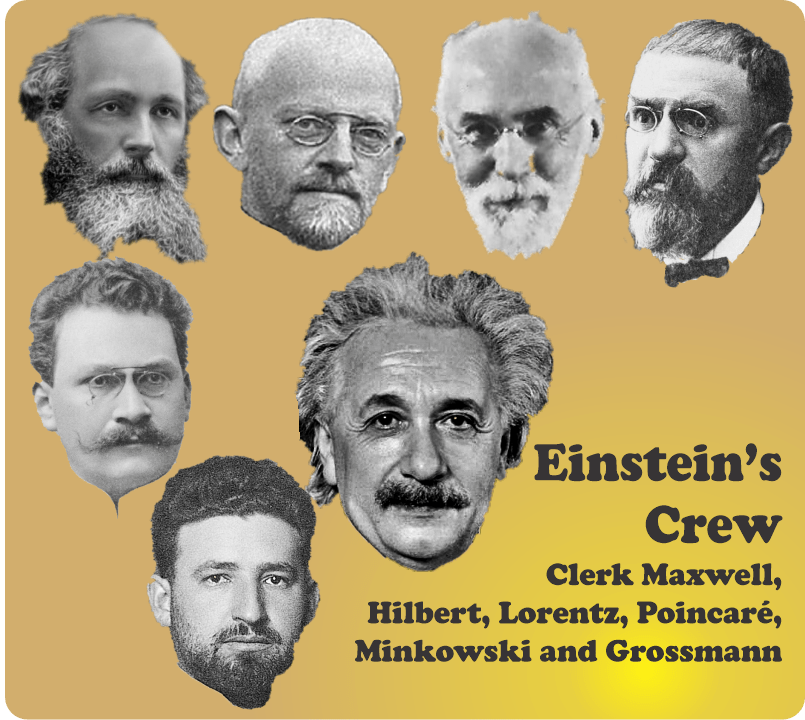
“Like I said, it’s everywhere. You’ve seen diagrams of DNA’s spiral staircase. It combines translation with rotation symmetry, does about 10 translation steps per turn, over and over. The Universe has a symmetry you don’t see at all. No‑one did until Lorentz and Poincaré revised Heaviside’s version of Maxwell’s electromagnetism equations for Minkowski space. Einstein, Hilbert and Grossman used that work to give us and the Universe a new symmetry.”

“Einstein didn’t do the math?”

“The crew I just named were world‑class in math, he wasn’t. Einstein’s strengths were his physical intuition and his ability to pick problems his math buddies would find interesting. Look, Newton’s Universe depends on absolute space and time. The distance between two objects at a given time is always the same, no matter who’s measuring it or how fast anyone is moving. All observers measure the same duration between two incidents regardless. Follow me?”

“Makes sense. That’s how things work hereabouts, anyway.”

“That’s how they work everywhere until you get to high speeds or high gravity. Lorentz proved that the distances and durations you measure depend on your velocity relative to what you’re measuring. Extreme cases lead to inconsistent numbers. Newton’s absolute space and time are pliable. To Einstein such instability was an abomination. Physics needs a firm foundation, a symmetry between all observers to support consistent measurements throughout the Universe. Einstein’s Relativity Theory rescued Physics with symmetrical mathematical transformations that enforce consistency.”

~~ Rich Olcott

Everything Everywhere All at Once

It’s either late Winter or early Spring, the weather can’t make up its mind. The geese don’t seem to approve of my walk around the park’s lake but then I realize it’s not me they object to. “Hey, Moire, wait up, I got a question for you!”

“Good morning, Mr Feder. What can I do for you?”

“This Big Bang thing I been hearing about. How can it make everything from nothing like they say?”

“You’re in good form, Mr Feder, lots of questions buried within a question.”

“Oh yeah? Seems pretty simple to me. How do we even know it happened?”

“Well, there you go, one buried question up already. We have several lines of evidence to support the idea. One of them is the CMB.”

“Complete Monkey Business?”

“Very funny. No, it’s the Cosmic Microwave Background, long‑wavelength light that completely surrounds us. It has the same wavelength profile and the same intensity within a dozen parts per million no matter what direction we look. The best explanation we have for it is that the light is finally arriving here from the Big Bang roughly 14 billion years ago. Well, a couple hundred thousand years after the Bang itself. It took that long for things to cool down enough for electrons and protons to pair up as atoms. The photons had been bouncing around between charged particles but when the charges neutralized each other the photons could roam free.”

“Same in all directions so we’re in the center, huh? The Bang musta been real close‑by.”

“Not really. Astronomers have measured the radiation’s effects on a distant intergalactic dust cloud. The effect is just what we’d expect if the cloud were right here. We’re not in a special location. From everything we can measure, the Bang happened everywhere and all at once.”

“Weird. Hard to see how that can happen.”

“We answered that nearly a century ago when Edwin Hubble discovered that there are other galaxies outside the Milky Way and that they’re in motion.”

“Yeah, I heard about that, too, with everything running away from us.”

“Sorry, no. We’re not that special, remember? On the average, everything’s running away from everything else.”

“Whaddaya mean, ‘on the average‘? Why the wishy-washy?”

“Because things cluster together and swirl around. The Andromeda galaxy is coming straight toward us, for instance, but it won’t get here for 5 billion years. The general trend only shows up when you look at large volumes, say a hundred million lightyears across or bigger. The evidence says yeah, everything’s spreading out.”

“But how can everything be moving away from everything? You run away from something, you gotta be running toward something else.”

“That’d be true if your somethings are all confined in a room whose walls don’t move. The Universe doesn’t work that way. The space between somethings continually grows new space. The volume of the whole assemblage increases.”

“Is that why I just hadda buy new pants?”

“No, that’s just you gaining weight from all that beer and bar food. The electromagnetism that holds your atoms and molecules together is much stronger than what’s driving the expansion. So is the gravitation that holds solar systems and galaxies together. Expansion only gets significant when distances get so large that the inverse square laws diminish both those forces to near zero.”

“What’s this got to do with the CMB?”

“The CMB tells us that the Bang happened everywhere, but expansion says that at early times when stars and galaxies first formed, ‘everywhere‘ was on a much smaller scale than it is now. Imagine having a video of the expansion and playing it backwards. Earendel‘s the farthest star we’ve seen, but if we and it existed 12 billion years ago we’d measure it as being close‑by but still all the way across the observable Universe. Carry that idea the rest of the way. The Big Bang is expansion from a super‑compressed everywhere.”

“Okay, what’s driving the expansion?”

“We don’t know. We call it ‘dark energy‘ but the name’s about all we have for it.”

“Aaaa-HAH! At last something you don’t know!”

“Science is all about finding things we don’t know and working to figure them out.”

~~ Rich Olcott