En Route to Spreading Out

“Gee, Mr Moire, if Einstein and Friedmann are right, some day the Universe will expand exponentially and everything dies. Even Dr Mack says that’s a downer.”

“First, it’s not ‘some day,’ it’s already. We’ve got evidence that exponential expansion became the dominant process five billion years ago. The interesting questions are about what happens during the expansion and what the timeline will be. That’s all controlled by a single weird parameter so naturally the parameter’s conventional symbol is w. Each major component of the Universe has its own value of w and they combine to predict the future course of the Universe.”

“Weird sounds like fun. What is it, another difference like the Cosmological Constant minus that mass‑pressure stuff?”

“Good guess, but it’s not a difference, It’s a ratio, between different flavors of energy.”

“Kinetic and potential, I’ll bet.”

“That split seems to be a common theme in Physics, doesn’t it? In this case, you’re almost right if we stretch things. One of the energy flavors is mass, including both normal and dark matter. If you take the long view, every atom of normal matter will sooner or later break down so you can think of it as a packet of potential energy, pent up and waiting for release. Dark matter, who knows? Anyway, w‘s denominator is mass per unit volume. The numerator’s a little trickier. As you guessed, we need something related to kinetic energy and we slide into that sideways.”

“How so?”

“Well, most of the normal matter is very dilute hydrogen which we can treat like a perfect gas. That’s something we’ve got a good theory for. Per unit volume, gas particle kinetic energy is proportional to pressure and that’s what we use for w‘s numerator. Averaged over the volume of space the pressure‑to‑mass ratio w for matter moving at ordinary speeds is effectively zero.”

“Does dark matter follow the same formula?”

“We pretend it does.”

“How about photons? They don’t have mass so that ratio would be infinity.”

“True, but they do carry momentum and it turns out w is simply ⅓ for photons and neutrinos and anything else traveling at relativistic speeds. Then there’s the Cosmological Constant’s w, which is minus‑one. Since the Big Bang we’ve gone from radiation‑dominated to matter‑dominated to Constant‑dominated; the effective w has shifted from somewhat positive to zero and into negative territory. Thanks to the surviving photons and matter, though, we’re still at least slightly above –1.0.”

“What difference does that make?”

“Minus‑one is the boundary between fates for the Universe. More positive than that, gravity and electromagnetism are guaranteed to be stronger than dark energy. Expansion will move gravity‑bound objects farther away from each other, but the galaxies and each galaxy cluster will stay together. The supply of hydrogen that fuels new stars will peter out. Eventually all the stars will gutter out and disappear into the cold dark as they wait for their constituent atoms to decay. The whole process will take something like 1010¹⁰ years.”

“That’s dark, alright, but at least it’ll take a long time. What happens of w is more negative than minus‑one?”

“The Big Rip. If w is more negative than the threshold, dark energy will grow stronger with time. We don’t know of anything that would limit the growth. First dark energy overpowers gravity and allows the galaxies and stars to disperse. Then it overrides the electromagnetism that holds molecules and rocks together. Eventually even the weak and strong nuclear forces will be defeated — no more atoms. Depending on how extreme w is, figure something like 200 billion years, give or take an eon.”

“Wow. But wait, we’ve covered radiation and mass and the Constant and none of them have a w below the threshold. What can have a more negative w?”

“A hypothesis. If there is anything, pretty much all we have is a name, ‘phantom energy,’ which is even more tentative than ‘dark energy.’ People are working to evaluate w with data. Results so far are so close to –1.0 that we can’t tell if it’s above or below the threshold or just teetering on the brink.”

“Two hundred billion years or way more. No worries, hey?”

~~ Rich Olcott

Turn This Way to Turn That Way

“I don’t understand, Sy. I get that James Webb Space Telescope uses its reaction wheels like a ship uses a rudder to change direction by pushing against something outside. Except the rudder pushes against water but the reaction wheels push against … what, the Universe?”

“Maybe probably, Al. We simply don’t know how inertia works. Newton just took inertia as a given. His Laws of Motion say that things remain at rest or persist in linear motion unless acted upon by some force. He didn’t say why. Einstein’s General Relativity starts from his Equivalence Principle — gravitational inertia is identical to mechanical inertia. That’s held up to painstaking experimental tests, but why it works is still an open question. Einstein liked Mach’s explanation, that we experience these inertias because matter interacts somehow with the rest of the Universe. He didn’t speculate how that interaction works because he didn’t like Action At A Distance. The quantum field theory people say that everything’s part of the universal field structure, which sounds cool but doesn’t help much. String theory … ’nuff said.”

“Hey, Moire, what’s all that got to do with the reaction wheel thing? JWST can push against one all it wants but it won’t go anywhere ’cause the wheel’s inside it. What’s magic about the wheels?”

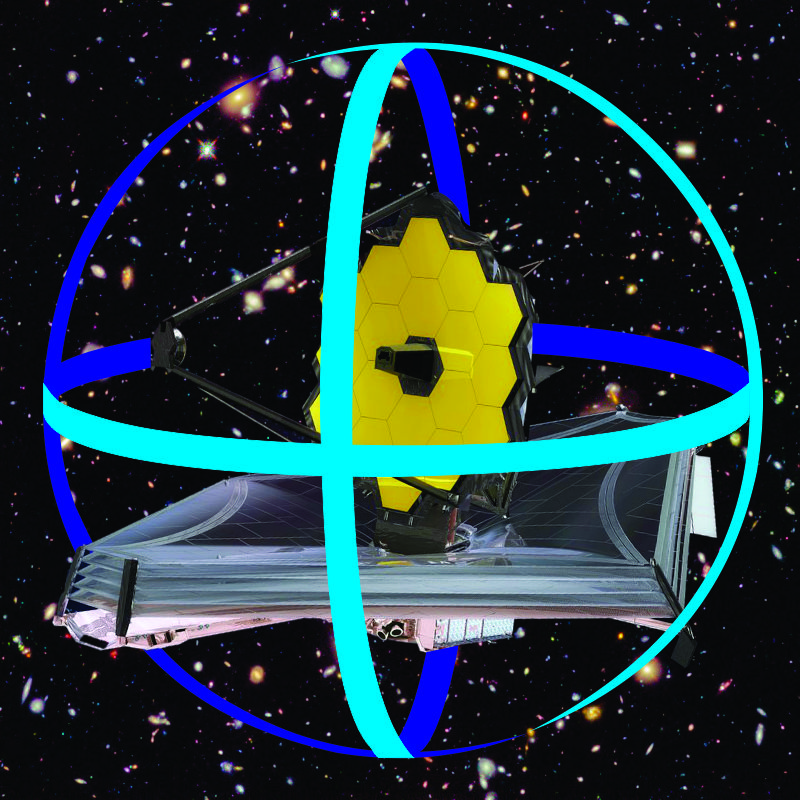
JWST doesn’t want to go anywhere else, Mr Feder. We’re happy with it being in its proper orbit, but it needs to be able to point to different angles. Reaction wheels and gyroscopes are all about angular momentum, not about the linear kind that’s involved with moving from place to place.”

“HAH! JWST is moving place to place, in that orbit! Ain’t it got linear momentum then?”

Newton’s Principia, Proposition II, Theorem II

“In a limited way, pun intended. Angular momentum is linear momentum plus a radial constraint. This goes back to Newton and his Principia book. I’ve got a copy of his basic arc‑splitting diagram here in Old Reliable. The ABCDEF line is a section of some curve around point S. He treated it as a succession of short line segments ABc, BCd, CDe and so on. If JWST is at point B, for instance, Newton would say that it’s traveling with a certain linear momentum along the BCd line. However, it’s constrained to move along the arc so it winds up at D instead d. To account for the constraint Newton invented centripetal force to pull along the Sd line. He then mentally made the steps smaller and smaller until the sequence of short lines matched the curve. At the limit, a sequence of little bits of linear momentum becomes angular momentum. By the way, this step‑reduction process is at the heart of calculus. Anyway, JWST uses its reaction wheels to swing itself around, not to propel itself.”

“And we’re back to my original question, Sy. What makes that swinging happen?”

“Oh, you mean the mechanical reality. Easy, Al. Like I said, three pairs of motorized wheels are mounted on JWST‘s frame near the center of mass. Their axles are at mutual right angles. Change a wheel’s angular momentum, you get an equal opposing change to the satellite’s. Suppose the Attitude Control System wants the satellite to swing to starboard. That’d be clockwise viewed from the cold side. ACS must tell a port/starboard motor to spin its wheel faster counterclockwise. If it’s already spinning clockwise, the command would be to put on the brakes, right? Either way, JWST swings clockwise. With the forward/aft motors and the hot‑side/cold‑side motors, the ACS is equipped to get to any orientation. See how that works?”

“Hang on.” <handwaving ensues> “Yeah, I guess so.”

“Hey, Moire. What if the wheel’s already spinning at top speed in the direction the ACS wants more of?”

“Ah, that calls for a momentum dump. JWST‘s equipped with eight small rocket engines called thrusters. They convert angular momentum back to linear momentum in rocket exhaust. Suppose we need a further turn to starboard but a port/starboard wheel is nearing threshold spin rate. ACS puts the brakes on that wheel, which by itself would turn the satellite to port. However, ACS simultaneously activates selected thrusters to oppose the portward slew. Cute, huh?”

~~ Rich Olcott

Attitude Adjustment

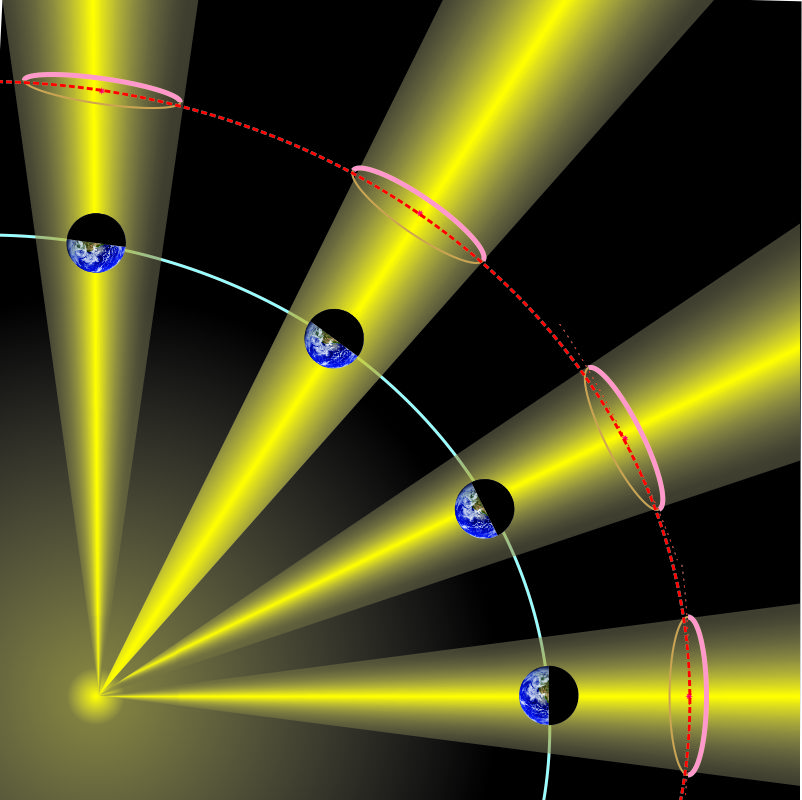
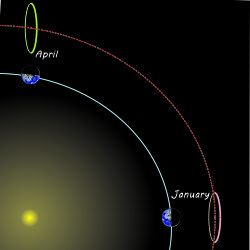
Mr Feder has a snarky grin on his face and a far‑away look in his eye. “Got another one. James Webb Space Telescope flies in this big circle crosswise to the Sun‑Earth line, right? But the Earth doesn’t stand still, it goes around the Sun, right? The circle keeps JWST the same distance from the Sun in maybe January, but it’ll fly towards the Sun three months later and get flung out of position.” <grabs a paper napkin> “Lemme show you. Like this and … like this.”

“Sorry, Mr Feder, that’s not how either JWST or L2 works. The satellite’s on a 6-month orbit around L2 — spiraling, not flinging. Your thinking would be correct for a solid gyroscope but it doesn’t apply to how JWST keeps station around L2. Show him, Sy.”

“Gimme a sec with Old Reliable, Cathleen.” <tapping> “OK, here’s an animation over a few months. What happens to JWST goes back to why L2 is a special point. The five Lagrange points are all about balance. Near L2 JWST will feel gravitational pulls towards the Sun and the Earth, but their combined attraction is opposed by the centrifugal force acting to move the satellite further out. L2 is where the three balance out radially. But JWST and anything else near the extended Sun‑Earth line are affected by an additional blended force pointing toward the line itself. If you’re close to it, sideways gravitational forces from the Sun and the Earth combine to attract you back towards the line where the sideways forces balance out. Doesn’t matter whether you’re north or south, spinward or widdershins, you’ll be drawn back to the line.”

Al’s on refill patrol, eavesdropping a little of course. He gets to our table, puts down the coffee pot and pulls up a chair. “You’re talking about the JWST. Can someone answer a question for me?”

“We can try.”
 ”What’s the question?”
  Mr Feder, not being the guy asking the question, pooches out his lower lip.

“OK, how do they get it to point in the right direction and stay there? My little backyard telescope gives me fits just centering on some star. That’s while the tripod’s standing on good, solid Earth. JWST‘s out there standing on nothing.”

JWST‘s Attitude Control System has a whole set of functions to do that. It monitors JWST‘s current orientation. It accepts targeting orders for where to point the scope. It computes scope and satellite rotations to get from here to there. Then it revises as necessary in case the first‑draft rotations would swing JWST‘s cold side into the sunlight. It picks a convenient guide star from its million‑star catalog. Finally, ACS commands its attitude control motors to swing everything into the new position. Every few milliseconds it checks the guide star’s image in a separate sensor and issues tweak commands to keep the scope in proper orientation.”

“I get the sequence, Sy, but it doesn’t answer the how. They can’t use rockets for all that maneuvering or they’d run out of fuel real fast.”

“Not to mention cluttering up the view field with exhaust gases.”

“Good point, Cathleen. You’re right, Al, they don’t use rockets, they use reaction wheels, mostly.”

“Uh-oh, didn’t broken reaction wheels kill Kepler and a few other missions?”

“That sounds familiar, Mr Feder. What’s a reaction wheel, Sy, and don’t they put JWST in jeopardy?”

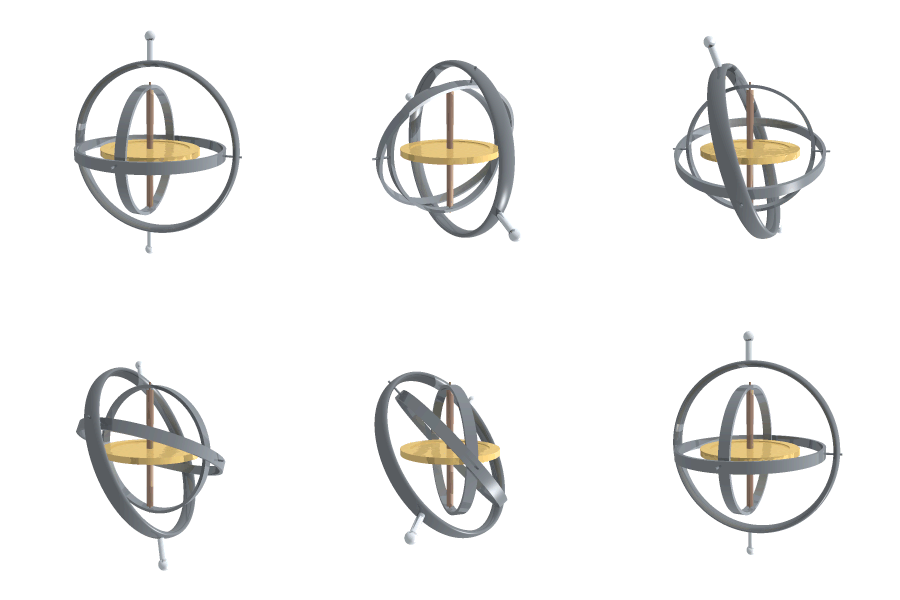
 Gyroscope, image by Lucas Vieira

“A reaction wheel is a massive doughnut that can spin at high speed, like a classical gyroscope but not on gimbals.”

“Hey, Moire, what’s a gimbal?”

“It’s a rotating frame with two pivots for something else that rotates. Two or three gimbals at mutual right angles let what’s inside orient independent of what’s outside. The difference between a classical gyroscope and a reaction wheel is that the gyroscope’s pivots rotate freely but the reaction wheel’s axis is fixed to a structure. Operationally, the difference is that you use a gyroscope’s angular inertia to detect change of orientation but you push against a reaction wheel’s angular inertia to create a change of orientation.”

“What about the jeopardy?”

Kepler‘s failing wheels used metal bearings. JWST‘s are hardened ceramic.”

<whew>

~~ Rich Olcott

The Gelato Model

“Eddie, this ginger gelato’s delicious — not too sweet and just the right amount of ginger bite.”

“Glad you like it, Anne.”

On the way down here, Sy was telling me about how so many things in the Universe run on the same mathematics if you look at them with the right coordinate system. Sy, how do you pick ‘the right coordinate system?”

“The same way you pick the right property to serve as a momentum in Newton’s Equation of Motion — physical intuition. You look for things that fit the system. Sometimes that puts you on the road to understanding, sometimes not. Eddie, you keep track of your gelato sales by flavor. How are they doing?”

“Pistachio’s always a good seller, Sy, but ginger has been coming on strong this year.”

“In motion terns, pistachio’s momentum is constant but ginger is gaining momentum, right?”

“S’what I said.”

“Measured in dollars or trayfuls?”

“In batches. I make it all in-house. I’m proud of that. Dollars, too, of course, but that’s just total for all flavors.”

“Batches all the same size?”

“Some are, some not, depending. If I had a bigger machine I could make more but I do what I can.”

“There you go, Anne, each gelato flavor is like a separate degree of freedom. Eddie’s tracked sales since he started so we can take that date as the origin. Measuring change along any degree in either batches or dollars we have perfectly respectable coordinates although the money view of the system is fuzzier. Velocity is batches per unit time, there’s even a speed limit, and ginger has accelerated. Sound familiar?”

“Sounds like you’re setting up a Physics model.”

“Call it gelato trend physics, but I don’t think I can push the analogy much further. The next step would be to define a useful momentum like Newton did with his Law of Motion.”

F=ma? That’s about acceleration, isn’t it?”

“Probably not in Newton’s mind. Back in his day they were arguing about which was conserved, energy or momentum. It was a sloppy argument because no‑one agreed on crisp definitions. People could use words like ‘quantity of motion‘ to refer to energy or momentum or even something else. Finally Newton defined momentum as ‘mass times velocity‘, but first he had to define ‘mass‘ as ‘quantity of matter‘ to distinguish it from weight which he showed is a force that’s indirectly related to mass.”

“So is it energy or momentum that’s conserved?”

“Both, once you’ve got good definitions of them. But my point is, our car culture has trained us to emphasize acceleration. Newton’s thinking centered on momentum and its changes. In modern terms he defined force as momentum change per unit time. I’m trying to think of a force‑momentum pair for Eddie’s gelato. That’s a problem because I can’t identify an analog for inertia.”

“Inertia? What’s that got to do with my gelato?”

“Not much, and that’s the problem. Inertia is resistance to force. Who can resist gelato? If it weren’t for inertia, the smallest touch would be enough to send an object at high speed off to forever. The Universe would be filled with dust because stars and planets would never get the chance to form. But here we are, which I consider a good thing. Where does inertia come from? Newton changed his mind a couple of times. To this day we only have maybe‑answers to that question.”

“You know we want to know, Sy.”

“Einstein’s favorite guess was Mach’s Principle. There’s about a dozen different versions of the basic idea but they boil down to matter interacting with the combined gravitational and electromagnetic fields generated by the entire rest of the Universe.”

“Wow. Wait, the stars are far away and the galaxies are much, much further away. Their fields would be so faint, how can they have any effect at all?”

“You’re right, Anne, field intensity per star does drop with distance squared. But the number of stars goes up with distance cubed. The two trends multiply together so the force trends grow linearly. It’s a big Universe and size matters.”

“So what about my gelato?”

“We’ll need more research, Eddie. Another scoop of ginger, Anne?”

~~ Rich Olcott

Symmetrical Eavesdropping

“Wait, Sy, you’ve made this explanation way more complicated than it has to be. All I asked about was the horrible whirling I’d gotten myself into. The three angular coordinates part would have done for that, but you dragged in degrees of freedom and deep symmetry and even dropped in that bit about ‘if measurable motion is defined.’ Why bother with all that and how can you have unmeasurable motion?”

“Curiosity caught the cat, didn’t it? Let’s head down to Eddie’s and I’ll treat you to a gelato. Your usual scoop of mint, of course, but I recommend combining it with a scoop of ginger to ease your queasy.”

“You’re a hard man to turn down, Sy. Lead on.”

<walking the hall to the elevators> “Have you ever baked a cake, Anne?”

“Hasn’t everyone? My specialty is Crazy Cake — flour, sugar, oil, vinegar, baking soda and a few other things but no eggs.”

“Sounds interesting. Well, consider the path from fixings to cake. You’ve collected the ingredients. Is it a cake yet?”

“Of course not.”

“Ok, you’ve stirred everything together and poured the batter into the pan. Is it a cake yet?”

“Actually, you sift the dry ingredients into the pan, then add the others separately, but I get your point. No, it’s not cake and it won’t be until it’s baked and I’ve topped it with my secret frosting. Some day, Sy, I’ll bake you one.”

<riding the elevator down to 2> “You’re a hard woman to turn down, Anne. I look forward to it. Anyhow, you see the essential difference between flour’s journey to cakehood and our elevator ride down to Eddie’s.”

“Mmm… OK, it’s the discrete versus continuous thing, isn’t it?”

“You’ve got it. Measuring progress along a discrete degree of freedom can be an iffy proposition.”

“How about just going with the recipe’s step number?”

“I’ll bet you use a spoon instead of a cup to get the right amount of baking soda. Is that a separate step from cup‑measuring the other dry ingredients? Sifting one batch or two? Those’d change the step‑number metric and the step-by-step equivalent of momentum. It’s not a trivial question, because Emmy Noether’s symmetry theorem applies only to continuous coordinates.”

“We’re back to her again? I thought—”

The elevator doors open at the second floor. We walk across to Eddie’s, where the tail‑end of the lunch crowd is dawdling over their pizzas. “Hiya folks. You’re a little late, I already shut my oven down.”

“Hi, Eddie, we’re just here for gelato. What’s your pleasure, Anne?”

“On Sy’s recommendation, Eddie, I’ll try a scoop of ginger along with my scoop of mint. Sy, about that symmetry theorem—”

“The same for me, Eddie.”

“Comin’ up. Just find a table, I’ll bring ’em over.”

We do that and he does that. “Here you go, folks, two gelati both the same, all symmetrical.”

“Eddie, you’ve been eavesdropping again!”

“Who, me? Never! Unless it’s somethin’ interesting. So symmetry ain’t just pretty like snowflakes? It’s got theorems?”

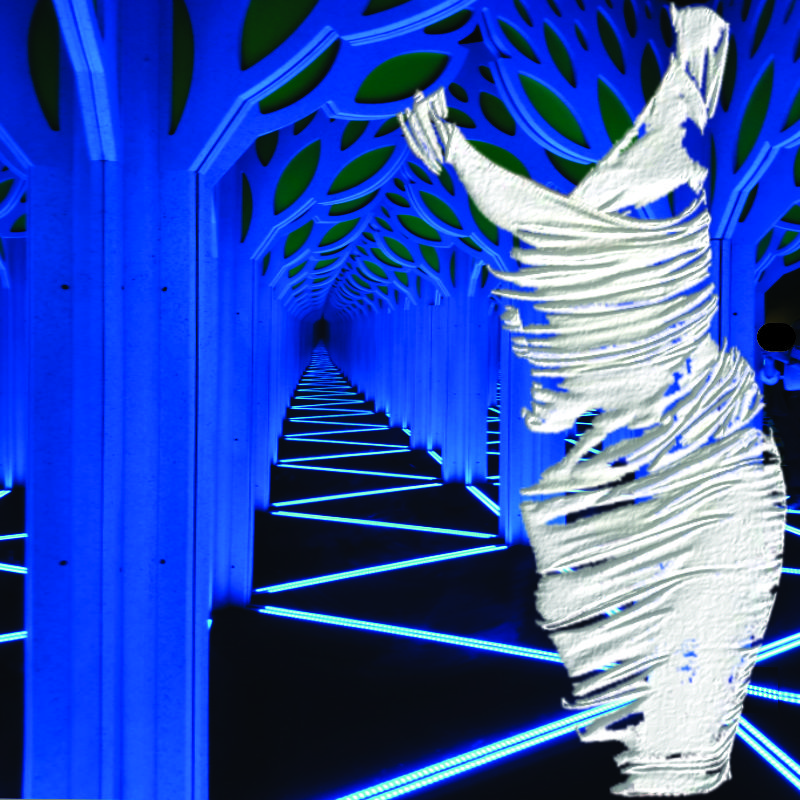
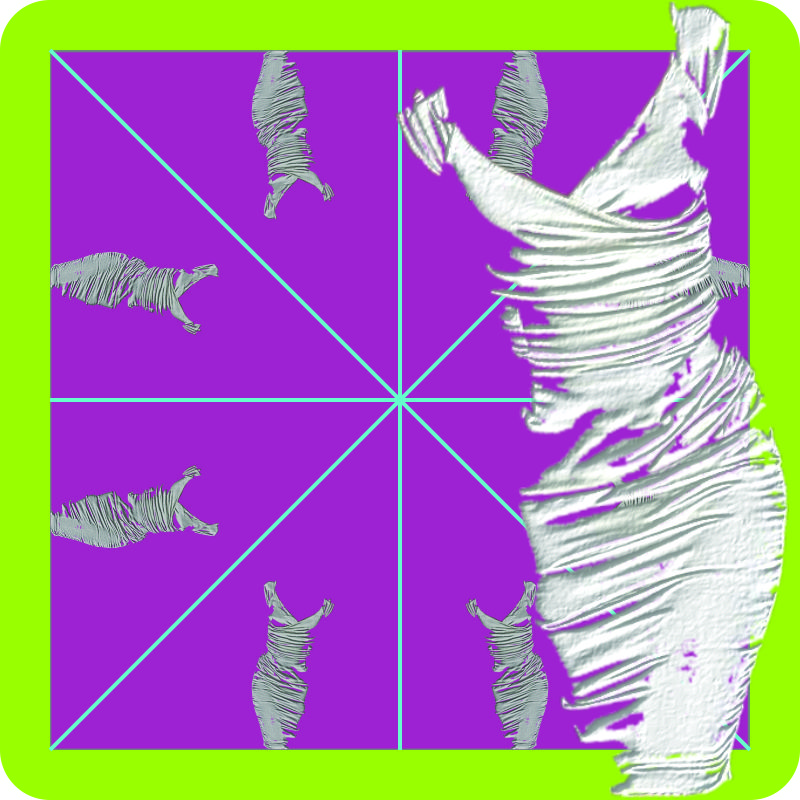
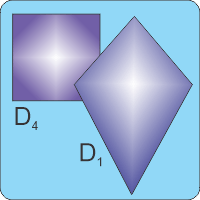
“Absolutely, Eddie. In many ways symmetry appears to be fundamental to how the Universe works. Or we think so, anyway. Here, Anne, have an extra bite of my ginger gelato. For one thing, Eddie, symmetry makes calculations a lot easier. If you know a particular system has the symmetry of a square, for instance, then you can get away with calculating only an eighth of it.”

“You mean a quarter, right, you turn a square four ways.”

“No, eight. It’s done with mirrors. Sy showed me.”

“I’m sure he did, Anne. But Sy, what if it’s not a perfect square? How about if one corner’s pulled out to a kite shape?”

“That’s called a broken symmetry, no surprise. Physicists and engineers handle systems like that with a toolkit of approximations that the mathematicians don’t like. Basically, the idea is to start with some nice neat symmetrical solution then add adjustments, called perturbations, to tweak the solution to something closer to reality. If the kite shape’s not too far away from squareness the adjusted solution can give you some insight onto how the actual thing works.”

“How about if it’s too far?”

“You go looking for a kite‑shaped solution.”

~~ Rich Olcott

Rotation, Revolution and The Answer

“Sy, I’m startin’ to think you got nothin’. Al and me, we ask what’s pushing the Moon away from us and you give us angular momentum and energy transfers. C’mon, stop dancin’ around and tell us the answer.”

“Yeah, Sy, gravity pulls things together, right, so how come the Moon doesn’t fall right onto us?”

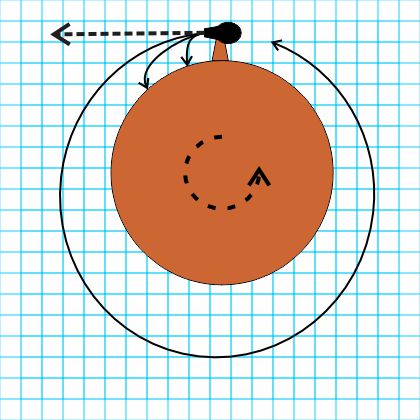
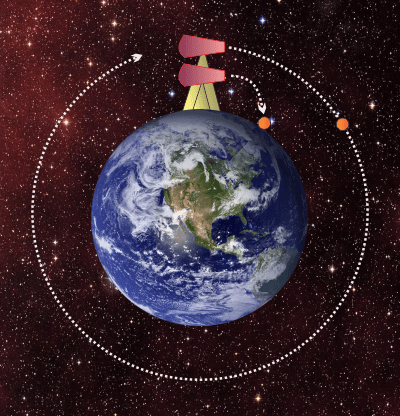
“Not dancing, Vinnie, just laying some groundwork for you. Newton answered Al’s question — the Moon is falling towards us, but it’s going so fast it overshoots. That’s where momentum comes in, Vinnie. Newton showed that a ball shot from a cannon files further depending on how much momentum it gets from the initial kick. If you give it enough momentum, and set your cannon high enough that the ball doesn’t hit trees or mountains, the ball falls beyond the planet and keeps on falling forever in an elliptical orbit.”

“Forever until it hits the cannon.”

“hahaha, Al. Anyway, the ball achieves orbit by converting its linear momentum to angular momentum with the help of gravity. The angular momentum pretty much defines the orbit. In Newton’s gravity‑determined universe, momentum and position together let you predict everything.”

“Linear and angular momentum work the same way?”

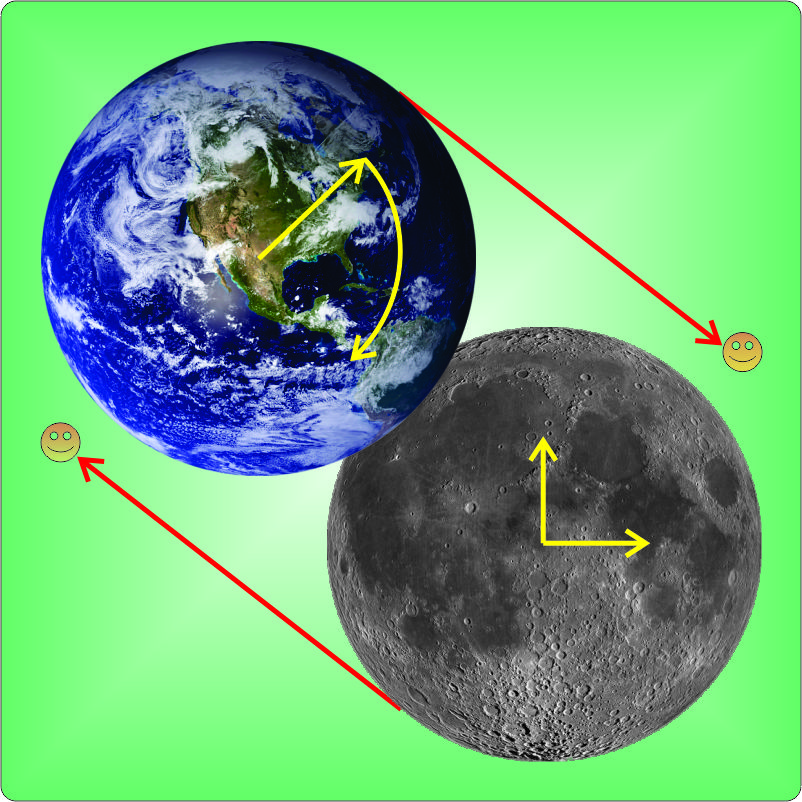
“Mostly. There’s only one kind of linear momentum — straight ahead — but there are two kinds of angular momentum — rotation and revolution.”

“Aw geez, there’s another pair of words I can never keep straight.”

“You and lots of people, Vinnie. They’re synonyms unless you’re talking technicalese. In Physics and Astronomy, rotation with the O gyrates around an object’s own center, like a top or a planet rotating on its axis. Revolution with the E gyrates around some external location, like the planet revolving around its sun. Does that help?”

“Cool, that may come in handy. So Newton’s cannon ball got its umm, revolution angular momentum from linear momentum so where does rotation angular momentum come from?”

“Subtle question, Vinnie, but they’re actually all just momentum. Fair warning, I’m going to avoid a few issues that’d get us too far into the relativity weeds. Let’s just say that momentum is one of those conserved quantities. You can transfer momentum from one object to another and convert between forms of momentum, but you can’t create momentum in an isolated system.”

“That sounds a lot like energy, Sy.”

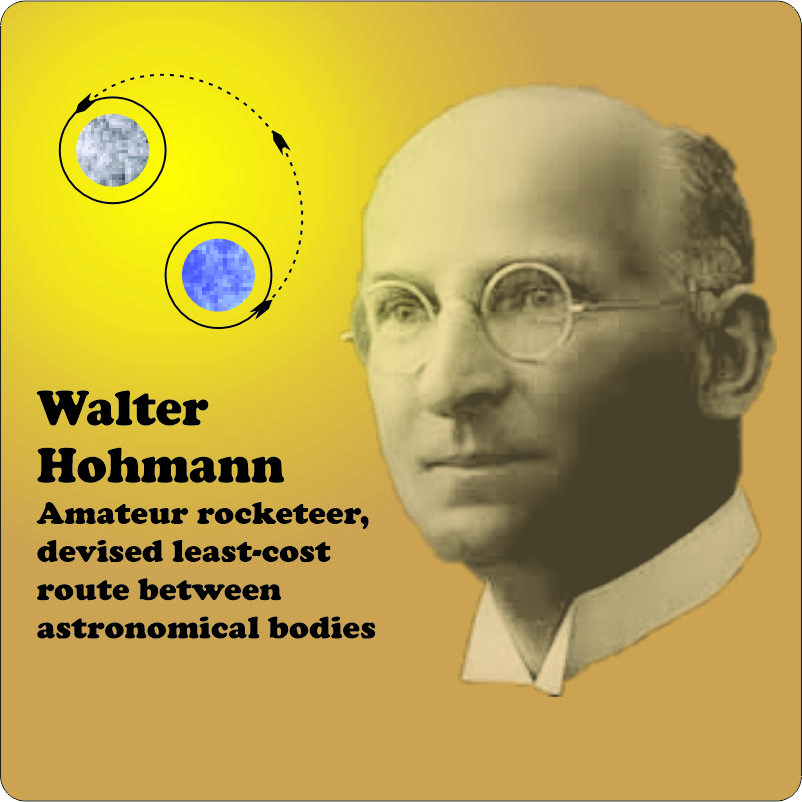
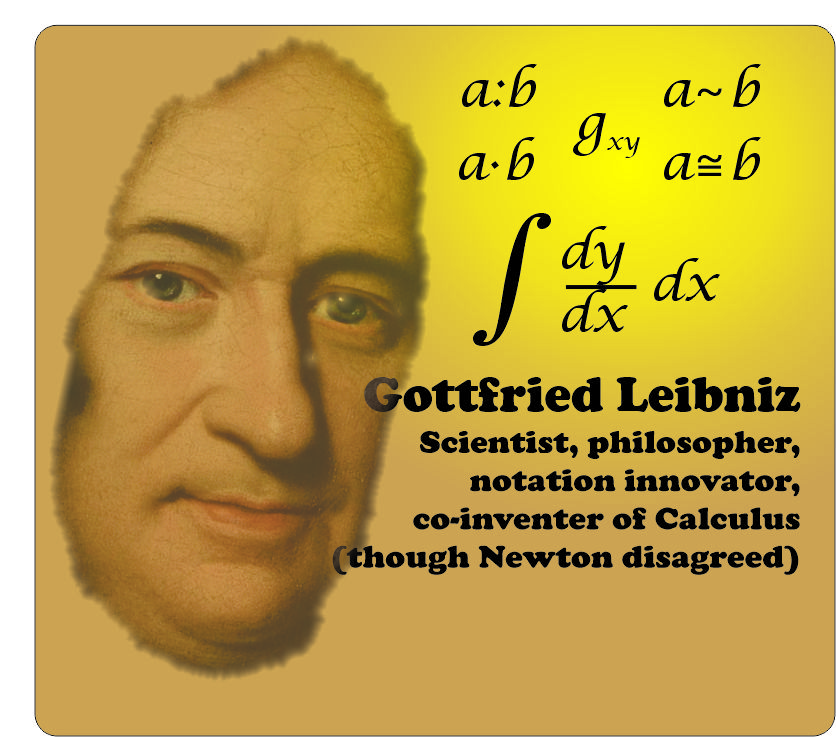
“You’re right, Al, the two are closely related. Newton thought that momentum was THE conserved quantity and all motion depended on it. His arch‑enemy Leibniz said THE conserved quantity was kinetic energy, which he called vis viva. That disagreement was just one battle in the Newton‑Leibniz war. It took science 200 years to understand the momentum/kinetic energy/potential energy triad.”

“Wait, Sy, I’ve seen NASA steer a rocketship and give it a whole different momentum. I don’t see no conservation.”

“You missed an important word, Vinnie — isolated. Momentum calculations apply to mechanical systems — no inputs of mass or non‑mechanical energy. Chemical or nuclear fuels break that rule and get you into a different game.”

“Ah-hahh, so if the Earth and Moon are isolated…”

“Exactly, and you’re way ahead of me. Like we said, no significant net forces coming from the Sun or Jupiter, so no change to our angular momentum.”

“Hey, wait, guys. Solar power. I know we’ve got a ton of sunlight coming in every day.”

“Not relevant, Al. Even though sunlight heats the Earth, mass and momentum aren’t affected by temperature. Anyhow, we’re finally at the point where I can answer your question.”

“About time.”

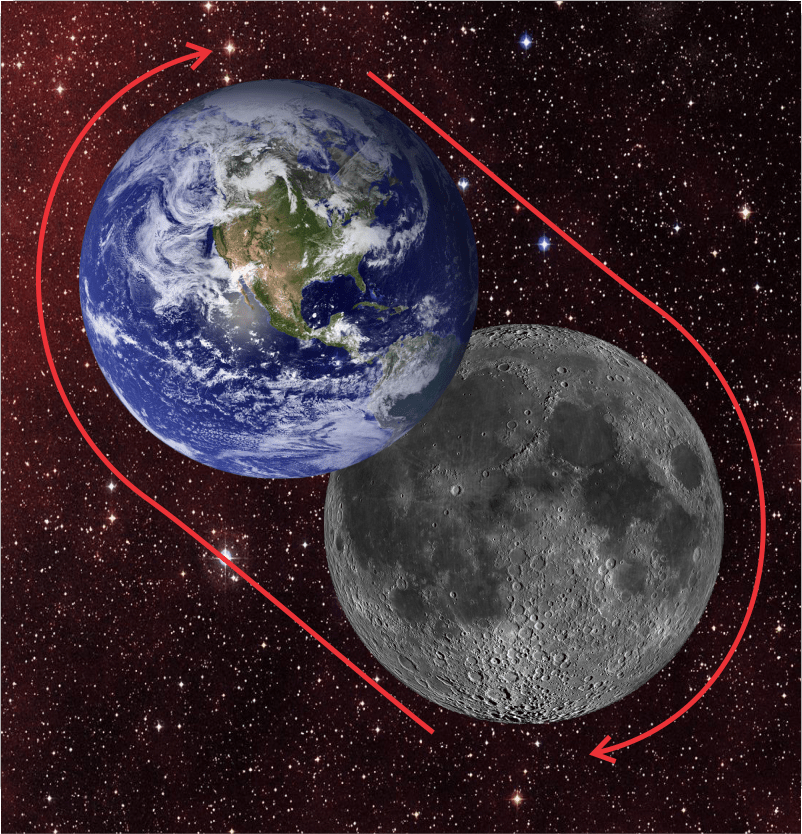
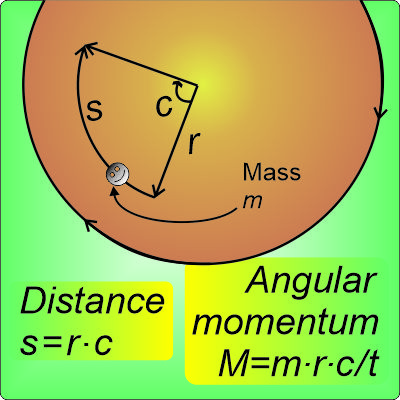
“Hush. OK, here’s the chain. Earth rotates beneath the Moon and gets its insides stirred up by the Moon’s gravity. The stirring is kinetic energy extracted from the energy of the Earth‑Moon system. The Moon’s revolution or the Earth’s rotation or both must slow down. Remember the M=m·r·c/t equation for angular momentum? The Earth‑Moon system is isolated so the angular momentum M can’t change but the angular velocity c/t goes down. Something’s got to compensate. The system’s mass m doesn’t change. The only thing that can increase is distance r. There’s your answer, guys — conservation of angular momentum forces the Moon to drift outward.”

“Long way to the answer.”

“To the Moon and back.”

~~ Rich Olcott

Here’s a Different Angle

“OK, Sy, so there’s a bulge on the Moon’s side of the Earth and the Earth rotates but the bulge doesn’t and that makes the Moon’s orbit just a little bigger and you’ve figured out that the energy it took to lift the Moon raised Earth’s temperature by a gazillionth of a degree, I got all that, but you still haven’t told Al and me how the lifting works.”

“You wouldn’t accept it if I just said, ‘The Moon lifts itself by its bootstraps,’ would you?”

“Not for a minute.”

“And you don’t like equations. <sigh> OK, Al, pass over some of those paper napkins.”

“Aw geez, Sy.”

“You guys asked the question and this’ll take diagrams, Al. Ante up. … Thanks. OK, remember the time Cathleen and I caught Vinnie here at Al’s shop playing with a top?”

“Yeah, and he was spraying paper wads all over the place.”

“I wasn’t either, Al, it was the top sending them out with centri–…, some force I can never remember whether it’s centrifugal or centripetal.”

“Centrifugal, Vinnie, –fugal– like fugitive, outward‑escaping force. It’s one of those ‘depends on how you look at itfictitious forces. From where you were sitting, the wads looked like they were flying outward perpendicular to the top’s circle. From a wad’s point of view, it flew in a straight line tangent to the circle. It’s like we have two languages, Room and Rotor. They describe the same phenomena but from different perspectives.”

“Hey, it’s frames again, ain’t it?”

“Newton’s inertial frames? Sort‑of but not quite. Newton’s First Law only holds in the Room frame — no acceleration, motion is measured by distance, objects at rest stay put. Any other object moves in a straight line unless its momentum is changed by a force. You can tackle a problem by considering momentum and force components along separate X and Y axes. Both X and Y components work the same way — push twice as hard in either direction, get twice the acceleration in that direction. Nice rules that the Rotor frame doesn’t play by.”

“I guess not. The middle’s the only place an object can stay put, right?”

“Exactly, Al. Everything else looks like it’s affected by weird, constantly‑varying forces that’re hard to describe in X‑Y terms.”

“So that breaks Newton’s physics?”

“Of course not. We just have to adapt his F=m·a equation (sorry, Vinnie!) to Rotor conditions. For small movements we wind up with two equations. In the strict radial direction it’s still F=m·a where m is mass like we know it, a is acceleration outward or inward, and F is centrifugal or centripetal, depending. Easy. Perpendicular to ‘radial‘ we’ve got ‘angular.’ Things look different there because in that direction motion’s measured by angle but Newton’s Laws are all about distances — speed is distance per time, acceleration is speed change per time and so forth.”

“So what do you do?”

“Use arc length. Distance along an arc is proportional to the angle, and it’s also proportional to the radius of the arc, so just multiply them together.”

“What, like a 45° bend around a 2-foot radius takes 90 feet? That’s just wrong!”

“No question, Al. You have to measure the angle in the right units. Remember the formula for a circle’s circumference?”

“Sure, it’s 2πr.”

“Which tells you that a full turn’s length is times the radius. We can bridge from angle to arc length using rotational units so that a full turn, 360°, is units. We’ll call that unit a radian. Half a circle is π radians. Your 45° angle in radians is π/4 or about ¾ of a radian. You’d need about (¾)×(2) or 1½ feet of whatever to get 45° along that 2-foot arc. Make sense?”

“Gimme a sec … OK, I’m with you.”

“Great. So if angular distance is radius times angle, then angular momentum which is mass times distance per time becomes mass times radius times angle per time.”

“”Hold on, Sy … so if I double the mass I double the momentum just like always, but if something’s spinning I could also double the angular momentum by doubling the radius or spinning it twice as fast?”

“Couldn’t have put it better myself, Vinnie.”

~~ Rich Olcott

Two Against One, And It’s Not Even Close


On a brisk walk across campus when I hear Vinnie yell from Al’s coffee shop. “Hey! Sy! Me and Al got this argument going you gotta settle.”

“Happy to be a peacemaker, but it’ll cost you a mug of Al’s coffee and a strawberry scone.”

“Coffee’s no charge, Sy, but the scone goes on Vinnie’s tab. What’s your pleasure?”

“It’s morning, Al, time for black mud. What’s the argument, Vinnie?”

“Al read in one of his astronomy magazines that the Moon’s drifting away from us. Is that true, and if it is, how’s it happen? Al thinks Jupiter’s gravity’s lifting it but I think it’s because of Solar winds pushing it. So which is it?”

“Here you go, Sy, straight from the bottom of the pot.”

“Perfect, Al, thanks. Yes, it’s true. The drift rate is about 1¼ nanometers per second, 1½ inches per year. As to your argument, you’re both wrong.”

“Huh?”
 ”Aw, c’mon!”

“Al, let’s put some numbers to your hypothesis. <pulling out Old Reliable and screen‑tapping> I’m going to compare Jupiter’s pull on the Moon to Earth’s when the two planets are closest together. OK?”

“I suppose.”

“Alright. Newton’s Law tells us the pull is proportional to the mass. Jupiter’s mass is about 320 times Earth, which is pretty impressive, right? But the attraction drops with the square of the distance. The Moon is 1¼ lightseconds from Earth. At closest approach, Jupiter is almost 2100 lightseconds away, 1680 times further than the Moon. We need to divide the 320 mass factor by a 1680‑squared distance factor and that makes <key taps> Jupiter’s pull on the Moon is only 0.011 percent of Earth’s. It’ll be <taps> half that when Jupiter’s on the other side of the Sun. Not much competition, eh?”

“Yeah, but a little bit at a time, it adds up.”

“We’re not done yet. The Moon feels the big guy’s pull on both sides of its orbit around Earth. On the side where the Moon’s moving away from Jupiter, you’re right, Jupiter’s gravity slows the Moon down, a little. But on the moving-toward-Jupiter side, the motion’s sped up. Put it all together, Jupiter’s teeny pull cancels itself out over every month’s orbiting.”

“Gotcha, Al. So what about my theory, Sy?”

“Basically the same logic, Vinnie. The Solar wind varies, thanks to the Sun’s variable activity, but satellite measurements put its pressure somewhere around a nanopascal, a nanonewton per square meter. Multiply that by the Moon’s cross‑sectional area and we get <tap, tap> a bit less than ten thousand newtons of force on the Moon. Meanwhile, Newton’s Law says the Earth’s pull on the Moon comes to <tapping>
  G×(Earth’s mass)×(Moon’s mass)/(Earth-Moon distance)²
and that comes to 2×10¹¹ newtons. Earth wins by a 107‑fold landslide. Anyway, the pressure slows the Moon for only half of each month and speeds it up the other half so we’ve got another cancellation going on.”

“So what is it then?”
 ”So what is it then?”

“Tides. Not just ocean tides, rock tides in Earth’s fluid outer mantle. Earth bulges, just a bit, toward the Moon. But Earth also rotates, so the bulge circles the planet every day.”

“Reminds me of the wave in the Interstellar movie, but why don’t we see it?”

“The movie’s wave was hundreds of times higher than ours, Al. It was water, not rock, and the wave‑raiser was a huge black hole close by the planet. The Moon’s tidal pull on Earth produces only a one‑meter variation on a 6,400,000‑meter radius. Not a big deal to us. Of course, it makes a lot of difference to the material that’s being kneaded up and down. There’s a lot of friction in those layers.”

“Friction makes heat, Sy. Rock tides oughta heat up the planet, right?”

“Sure, Vinnie, the process does generate heat. Force times distance equals energy. Raising the Moon by 1¼ nanometers per second against a force of 2×10²¹ newtons gives us <taping furiously> an energy transfer rate of 4×10‑23 joules per second per kilogram of Earth’s 6×1024‑kilogram mass. It takes about a thousand joules to heat a kilogram of rock by one kelvin so we’re looking at a temperature rise near 10‑27 kelvins per second. Not significant.”

“No blaming climate change on the Moon, huh?”

~~ Rich Olcott

Engineering A Black Hole

<bomPAH-dadadadaDEEdah> That weird ringtone on Old Reliable again. Sure enough, the phone function’s caller-ID display says 710‑555‑1701.  “Ms Baird, I presume?”

A computerish voice, aggressive but feminine, with a hint of desperation. “Commander Baird will be with you shortly, Mr Moire. Please hold.”

A moment later, “Hello, Mr Moire.”

“Ms Baird. Congratulations on the promotion.”

“Thank you, Mr Moire. I owe you for that.”

“How so?”

“Your posts about phase-based weaponry got me thinking. I assembled a team, we demonstrated a proof of concept and now Federation ships are being equipped with the Baird‑Prymaat ShieldSaw. Works a treat on Klingon and Romulan shielding. So thank you.”

“My pleasure. Where are you now?”

“I’m on a research ship called the Invigilator. We’re orbiting black hole number 77203 in our catalog. We call it ‘Lonesome‘.”

“Why that name?”

“Because there’s so little other matter in the space nearby. The poor thing barely has an accretion disk.”

“Sounds boring.”

“No, it’s exciting, because it’s so close to a theoretical ideal. It’s like the perfectly flat plane and the frictionless pulley — in real life there are always irregularities that the simple equations can’t account for. For black holes, our only complete solutions assume that the collapsed star is floating in an empty Universe with no impinging gravitational or electromagnetic fields. That doesn’t happen, of course, but Lonesome comes close.”

“But if we understand the theoretical cases and it nearly matches one, why bother with it at all?”

“Engineering reasons.”

“You’re engineering a black hole?”

“In a way, yes. Or at least that’s what we’re working on. We think we have a way to extract power from a black hole. It’ll supply inexhaustible cheap energy for a new Star Fleet anti‑matter factory. “

“I thought the only thing that could escape a black hole’s Event Horizon was Hawking radiation, and it cheats.”

“Gravity escapes honestly. Its intense field generates some unexpected effects. Your physicist Roger Penrose used gravity to explain the polar jets that decorate so many compact objects including black holes. He calculated that if a comet or an atom or something else breakable shatters when it falls into a spinning compact object’s gravitational field, some pieces would be trapped there but under the right conditions other pieces would slingshot outward with more energy than they had going in. In effect, the extra energy would come from the compact object’s angular momentum.”

“And that’s what you’re planning to do? How are you going to trap the expelled pieces?”

“No, that’s not what we’re planning. Too random to be controlled with our current containment field technology. We’re going pure electromagnetic, turning Lonesome into a giant motor‑generator. We know it has a stable magnetic field and it’s spinning rapidly. We’ll start by giving Lonesome some close company. There’s enough junk in its accretion disk for several Neptune‑sized planets. The plan is to use space tugs to haul in the big stuff and Bussard technology for the dust, all to assemble a pair of Ceres-sized planetoids. W’re calling them Pine and Road. We’ll park them in a convenient equatorial orbit in a Lagrange‑stable configuration so Pine, Road and Lonesome stay in a straight line.”

“Someone’s been doing research on old cinema.”

“The Interstellar Movie Database. Anyhow, when the planetoids are out there we string conducting tractor beams between them. If we locate Pine and Road properly, Lonesome’s rotating magnetic field lines will cross the fields at right angles and induce a steady electric current. Power for the anti‑matter synthesizers.”

“Ah, so like Penrose’s process you’re going to drain off some of Lonesome‘s rotational kinetic energy. Won’t it run out?”

Lonesome‘s mass is half again heavier than your Sun’s, Mr Moire. It’ll spin for a long, long time.”

“Umm … that ‘convenient orbit.’ Lonesome‘s diameter is so small that orbits will be pretty speedy. <calculating quickly with Old Reliable> Even 200 million kilometers away you’d circle Lonesome in less than 15 minutes. Will the magnetic field that far out be strong enough for your purposes?”

“Almost certainly so, but the gravimagnetodynamic equations don’t have exact solutions. We’re not going to know until we get there.”

“That’s how research works, all right. Good luck.”

~~ Rich Olcott

Traffic Control

Jeremy Yazzie @jeremyaz
hi @symoire, this is jeremy. ive been reading about the osiris‑rex mission to astrroid bennu and how they’re bringing back a sample – so complicated – fancy robot arm, n2 squirter, air‑cleaner thingy – y not just vacuum the dust or pick up a rock?


Sy Moire @symoire
@jeremyaz – quick answer is that Bennu and OSIRIS-REx are already surrounded by the vacuum of space. Sample collectors can’t suck any harder that that. I’ll email you a more complete answer later


Hi, Sy, can you believe this weather? Temps last week were twice today’s high.

Not to a physicist, Sis.
Those 90s and today’s 45 are just Fahrenheit
scale numbers.
Can’t do ratios between them, “twice” does not compute.
I don’t suppose it would help if we went centigrade and said last week’s highs were around 35 and today it’s 5?

No, that’s worse, today’s down by 85% from last week.

Centigrade’s another scale you can’t do ratio arithmetic in. Kelvins is the way to go.
Temp in K tracks the average molecular kinetic energy.
Starts at zero where nothing’s moving and rises in proportion.
Last week’s highs ran around 308 K, today is 278 K.
Today we’re only 10% cooler than last week.

Physicists! Grrrr. However you measure the weather, it still feels cold. No picnic this weekend ;^(


From: Sy Moire <sy@moirestudies.com>
To: Jeremy Yazzie <jeremyaz@college.edu>
Subj: OSIRIS-REx

Jeremy –

OK, now I’m back at the office I’ve got better tech for writing long answers.

First, the “grab a rock” idea has several issues

  • If you pick up a rock, you only have that rock, says nothing about any of its neighbors or the subsurface material it might have smacked into. Dust should be a much better representation of the whole asteroid.
  • The rock might not be willing to be picked up. When the scientists and engineers were planning the OSIRIS‑REx mission, they didn’t know Bennu’s texture — could be one solid rock or a bunch of middle‑size rocks firmly cemented together or a loose “rubble pile” of all‑size rocks and dust held together by gravity alone, or anything in between.
  • Have you ever played one of those arcade games where you try to pick up a toy with a suspended claw gadget and all you’ve got is a couple of control knobs and a button? Picking up a specific rock, even a willing one, is hard when you’re a robot operating 15 light‑minutes away from the home office.

So dust it is, but how to plan dust collection in low gravity when you know nothing about the texture? Something like a whisk broom and dust pan would work unless the surface is too uneven. Something like a drill or disk sander would be good, except to use either one you need a solid footing to work from or else you go spinning one way when the tool spins the other. (That was a problem on the International Space Station.) The Hayabusa2 mission to asteroid Ryugu used a high‑velocity impactor to create dust, but a bad ricochet or shrapnel could kill the OSIRIS‑REx mission. The planners decided that best alternative was puff‑and‑grab.

So why not an astronautical Roomba that just sucks in the dust? The thing about vacuum is that it’s a place where gas molecules aren’t. Suppose you’re a gas molecule. You’re surrounded by your buddies, all in motion and bouncing off of each other like on a crowded 3‑D dance floor. You stay more‑or‑less in place because you’re being hit more‑or‑less equally from every direction. Suddenly there’s a vacuum to one side. You’re not hit as much over there so that’s the direction you and a bunch of your buddies move. If you encounter a dust particle, it picks up your momentum and moves toward the emptiness where it could be trapped in somebody’s filter.

The planners decided to capture dust particles by entraining them in a flow of gas molecules through a filter. To make gas flow you need more gas on one side then the other. Gas molecules being few and far between in space, the obvious place to put your pusher gas is inside the filter. Hence the nitrogen squirt technique and the “air‑cleaner thingy.”

— Sy

Diagram of TAGSAM in operation
Adapted from asteroidmission.org/?attachment_id=1699
Credit: University of Arizona

~~ Rich Olcott