Rhythm Method

A warm Summer day.  I’m under a shady tree by the lake, watching the geese and doing some math on Old Reliable.  Suddenly a text-message window opens up on its screen.  The header bar says 710-555-1701.  Old Reliable has never held a messaging app, that’s not what I use it for.  The whole thing doesn’t add up.  I type in, Hello?

Hello, Mr Moire.  Remember me?

Suddenly I do.  That sultry knowing stare, those pointed ears.  It’s been a yearHello, Ms Baird.  What can I do for you?

Another tip for you, Mr Moire.  One of my favorite star systems — the view as you approach it at near-lightspeed is so ... meaningful.  Your astronomers call it PSR J0337+1715.

So of course I head over to Al’s coffee shop after erasing everything but that astronomical designation.  As I hoped, Cathleen and a few of her astronomy students are on their mid-morning break.  Cathleen winces a little when she sees me coming.  “Now what, Sy?  You’re going to ask about blazars and neutrinos?”

I show her Old Reliable’s screen.  “Afraid not, Cathleen, I’ll have to save that for later.  I just got a message about this star system.  Recognize it?”

“Why, Sy, is that a clue or something?  And why is the lettering in orange?”

“Long story.  But what can you tell me about this star system?”

“Well, it’s probably one of the most compact multi-component systems we’re ever going to run across.  You know what compact objects are?”

“Sure.  When a star the size of our Sun exhausts most of its hydrogen fuel, gravity wins its battle against heat.  The star collapses down to a white dwarf, a Sun-full of mass packed into a planet-size body.  If the star’s a bit bigger it collapses even further, down to a neutron star just a few miles across.  The next step would be a black hole, but that’s not really a star, is it?”

“No, it’s not.  Jim, why not?”

“Because by definition a black hole doesn’t emit light.  A black hole’s accretion disk or polar jets might, but not the object itself.”

“Mm-hm.  Sy, your ‘object’ is actually three compact objects orbiting  around each other.  There’s a neutron star with a white dwarf going around it, and another white dwarf swinging around the pair of them.  Vivian, does that sound familiar?”

“That’s a three-body system, like the Moon going around the Earth and both going around the Sun.  Mmm, except really both white dwarfs would go around the neutron star because it’s heaviest and we can calculate the motion like we do the Solar System.”

“Not quite.  We can treat the Sun as motionless because it has 99% of the mass.  J0337+1715’s neutron star doesn’t dominate its system as much as the Sun does ours.  That outermost dwarf has 20% of its system’s mass.  Phil, what does that suggest to you?”

“It’d be like Pluto and Charon.  Charon’s got 10% of their combined mass and so Pluto and Charon both orbit a point 10% of the way out from Pluto.  From Earth we see Pluto wobbling side to side around that point.  So the neutron star must wobble around the point 20% outward towards the heavy dwarf.  Hey, star-wobble is how we find exoplanets.  Is that what this is about, Mr Moire?  Did someone measure its red-shift behavior?”PSR J0337+1715Cathleen saves me from answering.  “Not quite.  The study Sy’s chasing is actually a cute variation on red-shift measurements.  That ‘PSR‘ designation means the neutron star is a pulsar.  Those things emit electromagnetic radiation pulses with astounding precision, generally regular within a few dozen nanoseconds.  If we receive slowed-down pulses then the object’s going away; sped-up and it’s approaching, just like with red-shifting.  The researchers  derived orbital parameters for all three bodies from the between-pulse durations.  The heavy dwarf is 200 times further out than the light one, for instance.  Not an easy experiment, but it yielded an important result.”

My ears perk up.  “Which was…?”

“The gravitational force between the pulsar and each dwarf was within six parts per million of what Newton’s Laws prescribe.  That observation rules out whole classes of theories that tried to explain galaxies and galaxy clusters without invoking dark matter.”

Cool, huh?

Uh-huh.

~~ Rich Olcott

They Went That-away. But Why?

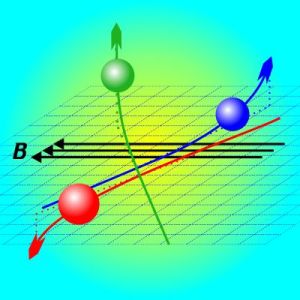
“It’s worse than that, Vinnie.”  I pull out Old Reliable, my math-monster tablet.  “Let me scan in that three-electron drawing of yours.”3 electrons in B-field

“Good enough to keep a record of it?”

“Nope, I want to exercise a new OVR app I just bought.”

“You mean OCR.”

“Uh-uh, this is Original Vector Reconstruction, not Optical Character Recognition.    OCR lets you read a document into a word processor so you can modify it.  OVR does the same thing but with graphics.  Give me a sec … there.  OK, look at this.”3 electrons in B-field revisited

“Cool, you turned my drawing 180°, sort of.  Nice app.  Oh, and you moved the red electron’s path so it’s going opposite to the blue electron instead of parallel to the magnetic field.  Why’d you bother?”

“See the difference between blue and red?”

“Well, yeah, one’s going up, one’s going down.  That’s what I came to you about and you shot down my theory.  Those B-arrows in the magnetic field are going in completely the wrong direction to push things that way.”

“Well, actually, they’re going in exactly the right direction for that, because a magnetic field pushes along perpendiculars.  Ever hear of The Right Hand Rule?”

“You mean like ‘lefty-loosey, righty-tighty’?”

“That works, too, but it’s not the rule I’m talking about.  If you point your thumb in the direction an electron is moving, and your index finger in the direction of the magnetic field, your third finger points in the deflection direction.  Try it.”

“Hurts my wrist when I do it for the blue one, but yeah, the rule works for that.  It’s easier for the red one.  OK, you got this rule, fine, but why does it work?”

“Part of it goes back to the vector math you don’t want me to throw at you.  Let’s just say that there are versions of a Right Hand Rule all over physics.  Many of them are essentially definitions, in the same way that Newton’s Laws of Motion defined force and mass.  Suppose you’re studying the movements directed by some new kind of force.  Typically, you try to define some underlying field in such a way that you can write equations that predict the movement.  You haven’t changed Nature, you’ve just improved our view of how things fit together.”

“So you’re telling me that whoever made that drawing I copied drew the direction those B-arrows pointed just to fit the rule?”

“Almost.  The intensity of the field is whatever it is and the lines minus their pointy parts are wherever they are.  The only thing we can set a rule for is which end of the line gets the arrowhead.  Make sense?”Spiraling electron

“I suppose.  But now I got two questions instead of the one I come in here with.  I can see the deflection twisting that electron’s path into a spiral.  But I don’t see why it spirals upward instead of downward, and I still don’t see how the whole thing works in the first place.”

“I’m afraid you’ve stumbled into a rabbit hole  we don’t generally talk about.  When Newton gave us his Law of Gravity, he didn’t really explain gravity, he just told us how to calculate it.  It took Einstein and General Relativity to get a deeper explanation.  See that really thick book on my shelf over there?  It’s loaded with tables of thermodynamic numbers I can use to calculate chemical reactions, but we didn’t start to understand those numbers until quantum mechanics came along.  Maxwell’s equations let us calculate electricity, magnetism and their interaction — but they don’t tell us why they work.”

“I get the drift.  You’re gonna tell me it goes up because it goes up.”

“That’s pretty much the story.  Electrons are among the simplest particles we know of.  Maxwell and his equations gave us a good handle on how they behave, nothing on why we have a Right Hand Rule instead of a Left Hand Rule.  The parity just falls out of the math.  Left-right asymmetry seems to have something to do with the geometry of the Universe, but we really don’t know.”

“Will string theory help?”

“Physicists have spent 50 years grinding on that without a testable result.  I’m not holding my breath.”

~~ Rich Olcott

RIP, Dr Hawking

Today I depart from my normal schedule and the current story line and science line.  A giant has left us and I want to pay proper tribute.

Dr Stephen Hawking enjoyed telling people of his fortunate birth date, exactly 300 years after Galileo Galilei passed away.  He liked a good joke, and I think he’d be tickled with this additional connection to the man whose work made Hawking’s work possible:
RIP Hawking

The equation in the center of this cut is Hawking’s favorite result, which he wanted to be carved on his gravestone.  It links a black hole’s entropy (S) to its surface area (A).  The other letters denote a collection of constants that have been central to the development of theoretical Physics over the past century and a half:

  • k is Boltzmann’s constant, which links temperature with kinetic energy
  • c is the speed of light, the invariance of which led Einstein to Relativity
  • G is Newton’s universal gravitational constant
  • h is Planck’s constant, the “quantum of action”

Hawking spent much of his career thinking deeply about the implications of Einstein’s concepts.  Newton’s equations support excellent descriptions of everyday physical motions, from the fall of raindrops to the orbits of solar systems.  Einstein’s equations led to insights about conditions at the most extreme — velocities near lightspeed, masses millions of times the Sun’s but packed into a volume only a few dozen miles wide.

But Hawking also pondered extremes of the ultimately large and the ultimately small — the edge of the Universe and distances far smaller than atomic nuclei.  Because his physical condition prohibited speech or quick jottings, he was forced to develop extraordinary powers of concentration and visualization that enabled him to encapsulate in a few phrases insights that would take others books to develop and communicate.

Hawking wrote books, too, of course, of a quality and clarity that turned his name and Science into watchwords for the general public as well as the physics community.  By his life and how he lived it he was an inspiration to many, abled and otherwise.  Science needs its popularizers, though some in the field deprecate them as hangers-on.  Hawking managed to bridge that gap with ease and grace, a giant with standing on either side.

Requiescat in pace, Dr Hawking.  Thank you.

~~ Rich Olcott

Shells A-poppin’

We step into Eddie’s.  Vinnie spots Jeremy behind the gelato stand.  “Hey, kid, you studying something Science-y?”

“Yessir, my geology text.”

“Lemme see it a sec, OK?”

“Sure.  Want a gelato?”

“Yeah, gimme a pistachio, double-dip.  I’ll hold your book while you’re doing that.  Ah-hah, Sy, lookie here, page 37 — new textbook but this atom diagram coulda come right out of that 1912 Bohr paper you don’t like.  See, eight dots in a ring around the nucleus.  Can’t be wrong or it wouldn’t have survived this long, right?”

<sigh>  “What it is isn’t what it was.  Bohr proposed his model as a way to explain atomic spectra.  We’ve got a much better model now — but the two agree on three points.  Atoms organize their electronic charge in concentric shells, innermost shells deepest in the nuclear energy well.  Second, each shell has a limited capacity.  Third, when charge moves from one shell to another, light energy is absorbed or emitted to match the energy difference between shells.  Beyond those, not much.  Here, this diagram hints at the differences.”Better Bohr

“The scrambled-looking half is the new picture?”

“Pure chaos, where the only thing you can be sure of is the averages.  These days the Bohr model survives as just an accounting device to keep track of how much charge is in each shell.  That diagram — what kind of atom is it describing?”

“I dunno, two electrons inside, eight outside, ten total.”

“Could be neon, or a fluoride, oxide, sodium or magnesium ion.  From a quantum perspective they all look the same.”

“Here’s your gelato, sir.”

“Thanks, kid, here’s your book back.  But those are different elements, Sy.”

“The important thing, Vinnie, is they all have an outer shell with eight units of charge.  That’s the most stable configuration.”

“What’s so special about eight, Mr Moire?  If it’s pure chaos shouldn’t any number be OK?”

“Like I said, Jeremy, it’s the averages that count.  Actually, this is one of my favorite examples of what Wigner called ‘The Unreasonable Effectiveness of Mathematics in the Natural Sciences.’  Back in 1782, a century and a quarter before anyone took atoms seriously, Laplace did some interesting math.  Have you ever waited for a pot of water to boil and spent the time tapping the pot to see the ripples?”

“Who hasn’t?  Doesn’t boil any faster, though.”

“True.  Looking at those waves, you saw patterns you don’t see with flat reflectors, right?”

“Oh, yeah — some like dumbbells, a lot of circles.”

“Mm-hm.  In a completely random situation all possible patterns could appear, but the pot’s circular boundary suppresses everything except wave patterns that match its symmetry.  You don’t see hexagons, for instance.”

“That’s right, I didn’t.”

“So there’s Laplace in the 1790s, thinking about Newton’s Law of Gravity, and he realizes that even in the boundaryless Solar System there’s still a boundary condition — any well-behaved standing wave has to have the same value at the central point no matter what direction you come from.  He worked out all the possible stable patterns that could exist in a central field like that.  Some of them look like what you saw in the water.  We now classify them by symmetry and node count.”

“Node?”Disk orbitals

“A region where the pattern hits zero, Vinnie.  Density waves range from zero to some positive value; other kinds range from positive to negative values.  A spherical wave could peak at the center and then go to zero infinitely far away.  One node.  Or it could be zero at the center, peak in a spherical shell some distance out and then fade away.  That’d be two nodes.  Or it could be zero at the center, zero far away, and have two peaks at different distances with a spherical third node in between.  Here’s another two-node pattern — that dumbbell shape with nodes at the center and infinity.  You can add radial nodes partway out.”

“I’m getting the picture.”

“Sure.  You might think Laplace’s patterns are just pretty pictures, but electron charge in atoms and ions just happens to collect in exactly those patterns.  Combine Laplace’s one-node and two-node patterns, you get the two lowest-energy stable shells.  They hold exactly ten charge units.  The energies are right, too.  Effective?”

“Unreasonably.”

~~ Rich Olcott

Rockfall

<continued>  The coffee shop crowd had gotten rowdy in response to my sloppy physics, but everyone hushed when I reached for my holster and drew out Old Reliable.  All had heard of it, some had seen it in action — a maxed-out tablet with customized math apps on speed-dial.

“Let’s take this nice and slow.  Suppose we’ve got an non-charged, non-spinning solar-mass black hole.  Inside its event horizon the radius gets weird but let’s pretend we can treat the object like a simple sphere.  The horizon’s half-diameter, we’ll call it the radius, is rs=2G·M/c²G is Newton’s gravitational constant, M is the object’s mass and c is the speed of light.  Old Reliable says … about 3 kilometers.  Question is, what happens when we throw a rock in there?  To keep things simple, I’m going to model dropping the rock gentle-like, dead-center and with negligible velocity relative to the hole, OK?”

<crickets>

“Say the rock has the mass of the Earth, almost exactly 3×10⁻⁶ the Sun’s mass.  The gravitational potential energy released when the rock hits the event horizon from far, far away would be E=G·M·m/rs, which works out to be … 2.6874×1041 joules.  What happens to that energy?”falling rock and black hole

rs depends on mass, Mr Moire, so the object will expand.  Won’t that push on what’s around it?”

“You’re thinking it’d act like a spherical piston, Jeremy, pushing out in all directions?”

“Yeah, sorta.”

“After we throw in a rock with mass m, the radius expands from rs to rp=2G·(M+m)/c².  I set m to Earth’s mass and Old Reliable says the new radius is … 3.000009 kilometers.  Granted the event horizon is only an abstract math construct, but suppose it’s a solid membrane like a balloon’s skin.  When it expands by that 9 millimeters, what’s there to push against?  The accretion disk?  Those rings might look solid but they’re probably like Saturn’s rings — a collection of independent chunks of stuff with an occasional gas molecule in-between.  Their chaotic orbits don’t have a hard-edged boundary and wouldn’t notice the 9-millimeter difference.  Inward of the disk you’ve got vacuum.  A piston pushing on vacuum expends zero energy.  With no pressure-volume work getting done that can’t be where the infall energy goes.”

“How about lift-a-weight work against the hole’s own gravity?”

“That’s a possibility, Vinnie.  Some physicists maintain that a black hole’s mass is concentrated in a shell right at the event horizon.  Old Reliable here can figure how much energy it would take to expand the shell that extra 9 millimeters.  Imagine that simple Newtonian physics applies — no relativistic weirdness.  Newton proved that a uniform spherical shell’s gravitational attraction is the same as what you’d get from having the same mass sitting at the shell’s geometric center.  The gravitational pull the shell exerts on itself originally was E=G·M²/rs.  Lifting the new mass from rs to rp will cost ΔE=G·(M+m)²/r– G·M²/rs.  When I plug in the numbers…  That’s interesting.”

Vinnie’s known me long enough to realize “That’s interesting” meant “Whoa, I certainly didn’t expect THAT!

“So what didja expect and whatcha got?”

“What I expected was that lift-it-up work would also be just a small fraction of the infall energy and the rest would go to heat.  What I got for ΔE here was 2.6874×1041 joules, exactly 100% of the input.  I wonder what happens if I use a bigger planet.  Gimme a second … OK, let’s plot a range …  How ’bout that, it’s linear!”ep-es

“Alright, show us!”

All the infall energy goes to move the shell’s combined mass outward to match the expanded size of the event horizon.  I’m amazed that such a simple classical model produces a reasonable result.”

“Like Miss Plenum says, Mr Moire, sometimes the best science comes from surprises.”

“I wouldn’t show it around, Jeremy, except that it’s consistent with Hawking’s quantum-physics result.”

“How’s that?”

“Remember, he showed that a black hole’s temperature varies as 1/M.  We know that temperature is ΔE/ΔS, where the entropy change ΔS varies as .  We’ve just found that ΔE varies as M.  The ΔE/ΔS ratio varies as M/M²=1/M, just like Hawking said.”

Then Jennie got into the conversation.

~~ Rich Olcott

Red Harvest

<continued> Al’s coffee shop was filling up as word got around about Anne in her white satin.  I saw a few selfie-takers in the physics crowd surreptitiously edge over to get her into their background.  She was busy thinking so she didn’t notice.  “The entropy-elephant picture is starting to come together, Sy.  We started out with entropy measuring accumulated heat capacity in a steam engine.”

“That’s where Carnot started, yes.”

“But when Jeremy threw that hot rock into the black hole” <several in the astronomy crew threw startled looks at Jeremy>, “its heat energy added to the black hole’s mass, but it should have added to the black hole’s entropy, too.  ‘Cause of Vinnie’s Second Law.”white satin and black hole 3

Vinnie looked up.  “Ain’t my Second Law, it’s thermodynamics’ Second Law.  Besides, my version was ‘energy’s always wasted.’  Sy’s the one who turned that into ‘entropy always increases.'”

“So anyway, black holes can’t have zero entropy like people used to think.  But if entropy also has to do with counting possibilities, than how does that apply to black holes?  They have only one state.”

“That’s where Hawking got subtle.  Jeremy, we’ve talked about how the black hole’s event horizon is a mathematical abstraction, infinitely thin and perfectly smooth and all that.”

“Yessir.”

“Hawking moved one step away from that abstraction.  In essence he said the  event horizon is surrounded by a thin shell of virtual particles.  Remember them, Jeremy?”

“Uh-huh, that was on my quest to the event horizon.  Pairs of equal and opposite virtual particles randomly appear and disappear everywhere in space and because they appear together they’re entangled and if one of them dips into the event horizon then it doesn’t annihilate its twin which — Oh!  Random!  So what’s inside the event horizon may have only one state, so far as we know, but right outside the horizon any point may or may not be hosting, can I call it an orphan particle?  I’ll bet that uncertainty give rise to the entropy, right?”

<finger-snaps of approval from the physics side of the room>

“Well done, Jeremy!  ‘Orphan’ isn’t the conventional term but it gets the idea across.”

“Wait, Sy.  You mentioned that surface area and entropy go together and now I see why.  The larger the area, the more room there is for those poor orphans.  When Jeremy’s rock hit the event horizon and increased the black hole’s mass, did the surface area increase enough to allow for the additional entropy?” <more finger-snapping>

“Sure did, Anne.  According to Hawking’s calculation, it grew by exactly the right amount.  Mass and area both grow as the square of the diameter.”

“How come not the radius?”

“Well , Vinnie, the word ‘radius‘ is tricky when you’re discussing black holes.  The event horizon is spherical and has a definite diameter — you could measure it from the outside.  But the sphere’s radius extends down to the singularity and is kind of infinite and isn’t even strictly speaking a distance.  Space-time is twisted in there, remember, and that radial vector is mostly time near its far end.  On the other hand, you could use ‘radius‘ to mean ‘half the diameter‘ and you’d be good for calculating effects outside the event horizon.”

“OK, that’s the entropy-area connection, but how does temperature tie in with surface gravity?”

“They’re both inversely dependent on the black hole’s mass.  Let’s take surface gravity first, and here when I say ‘r‘ I’m talking ‘half-diameter,‘ OK?”

“Sure.”

“Good.  Newton taught us that an object with mass M has a gravitational attraction proportional to M/r².  That still holds if you’re not inside the event horizon.  Now, the event horizon’s r is also proportional to the object’s mass so you’ve got M/M² which comes to 1/M.  With me?”

“Yeah.”

“Hawking used quantum physics to figure the temperature thing, but here’s a sloppy short-cut.  Anne, remember how we said that entropy is approximately heat capacity divided by temperature?”

“Mm-hmm.”

“The shell’s energy is mostly heat and proportional to M.  We’ve seen the shell’s entropy is proportional to .  The temperature is heat divided by entropy.  That’s proportional to M/M² which is the same 1/M as surface gravity.” <boos from all sides>. “Hey, I said it was sloppy.”

~~ Rich Olcott

Three Perils for a Quest(ion), Part 1

Eddie makes great pizzas but Jeremy thinks they stay in the oven just a little too long.  As he crunched an extra-crispy wedge-edge he mused, “Gravity aside, I wonder what it’d be like to land on a black hole.  I bet it’d be real slippery if it’s as smooth as Mr Moire says.”

Jennie cut in.  “Don’t be daft, lad.  Everyone’s read about the spaceman sliding through the event horizon unaware until it’s too late.  Someone far away sees the bloke’s spacetime getting all distorted but in his local frame of reference everything’s right as rain.  Right, Sy?”

“As rain, Jennie, if all you’re concerned about is relativity.  But Spaceman Jeremy has lots of other things to be concerned about on his way to the event horizon.  Which he couldn’t stand on anyway.”

“Why not, Mr Moire?  I mean, I said ‘gravity aside’ so I ought to be able to stand up.”

“Nothing to stand on, Jeremy.  It’d be like trying to stand on Earth’s orbit.”

“Pull the other one, Sy.  How can they be alike?”

“Both of them are mathematical constructs rather than physical objects.  An orbit is an imaginary line that depicts planet or satellite locations.  An event horizon is an imaginary figure enclosing a region with such intense spacetime curvature that time points inward.  They’re abstract objects, not  concrete ones.  But let’s get back to Jeremy’s black hole evaporation quest.  He’ll have to pass three perils.”

“Ooo, a Quest with Perils —  loverly.  What are the Perils then?”

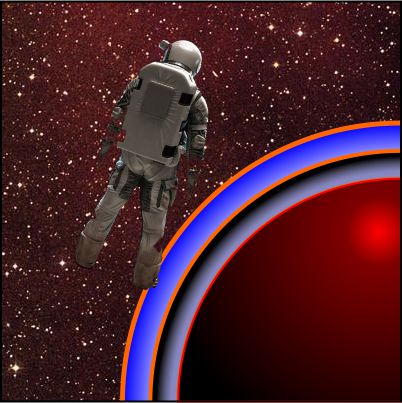
“The Roche Radius, the Photon Sphere and the Firewall.  Got your armor on, Jeremy?”Astronaut and 3xBlack hole

“Ready, Mr Moire.”

“Stand up.  The Roche effect is all about gravitational discrepancy between two points.  The two meter distance between your head and feet isn’t enough for a perceptible difference in downward pull.  However, when we deal with astronomical distances the differences can get significant.  For instance, ocean water on the day side of Earth is closer to the Sun and experiences a stronger sunward pull than water on the night side.”

“Ah, so that’s why we get tides.”

“Right.  Sit, sit, sit.  So in 1849 Édouard Roche wondered how close two objects could get until tidal forces pulled one of them apart.  He supposed the two objects were both just balls of rocks or fluid held together by gravity.  Applying Newton’s Laws and some approximations he got a formula for threshold distance in terms of the big guy’s mass and the little guy’s density.  Suppose you’re held together only by gravity and you’re nearing the Sun feet-first.  Its mass is 2×1030 kg/m³.  Even including your space armor, your average density is about 1.5 kg/m³.  According to Roche’s formula, if you got closer than 8.6×10⁶ kilometers your feet would break away and fall into the Sun before the rest of you would.  Oh, that distance is about 1/7 the radius of Mercury’s orbit so it’s pretty close in.”

“But we’re talking black holes here.  What if the Sun collapses to a black hole?”

“Surprisingly, it’s exactly the same distance.  The primary’s operative property is its mass, not its diameter.  Good thing Jeremy’s really held together by atomic and molecular electromagnetism, which is much stronger than gravity.  Which brings us to his second Peril, the dreaded Photon Sphere.”

“Should I shudder, Sy?”

“Go ahead, Jennie.  The Sphere is another mathematical object, not something physical you’d collide with, Jeremy.  It’s a zero-thickness shell representing where electromagnetic waves can orbit a massive object like a black hole or a neutron star.  Waves can penetrate the shell easily in either direction, but if one happens to fly in exactly along a tangent, it’s trapped on the Sphere.”

“That’s photons.  Why is it a peril to me?”

“Remember that electromagnetism that holds you together?  Photons carry that force.  Granted, in a molecule they’re standing waves rather than the free waves we see with.  The math is impossible, but here’s the Peril.  Suppose one of your particularly important molecules happens to lie tangent to the Sphere while you’re traversing it.  Suddenly, the forces holding that molecule together fly away from you at the speed of light.  And that disruption inexorably travels along your body as you proceed on your Quest.”

[both shudder]

~~ Rich Olcott

Abstract Horses

It was a young man’s knock, eager and a bit less hesitant than his first visit.

“C’mon in, Jeremy, the door’s open.”

“Hi, Mr Moire, it’s me, Jerem…  How did ..?  Never mind.  Ready for my black hole questions?”

“I’ll do what I can, Jeremy, but mind you, even the cosmologists are still having a hard time understanding them.  What’s your first question?”

“I read where nothing can escape a black hole, not even light, but Hawking radiation does come out because of virtual particles and what’s that about?”

“That’s a very lumpy question.  Let’s unwrap it one layer at a time.  What’s a particle?”

“A little teeny bit of something that floats in the air and you don’t want to breathe it because it can give you cancer or something.”

“That, too, but we’re talking physics here.  The physics notion of a particle came from Newton.  He invented it on the way to his Law of Gravity and calculating the Moon’s orbit around the Earth.  He realized that he didn’t need to know what the Moon is made of or what color it is.  Same thing for the Earth — he didn’t need to account for the Earth’s temperature or the length of its day.  He didn’t even need to worry about whether either body was spherical.  His results showed he could make valid predictions by pretending that the Earth and the Moon were simply massive points floating in space.”

Accio abstractify!  So that’s what a physics particle is?”

“Yup, just something that has mass and location and maybe a velocity.  That’s all you need to know to do motion calculations, unless the distance between the objects is comparable to their sizes, or they’ve got an electrical charge, or they move near lightspeed, or they’re so small that quantum effects come into play.  All other properties are irrelevant.”

“So that’s why he said that the Moon was attracted to Earth like the apple that fell on his head was — in his mind they were both just particles.”

“You got it, except that apple probably didn’t exist.”

“Whatever.  But what about virtual particles?  Do they have anything to do with VR goggles and like that?”

“Very little.  The Laws of Physics are optional inside a computer-controlled ‘reality.’  Virtual people can fly, flow of virtual time is arbitrary, virtual electrical forces can be made weaker or stronger than virtual gravity, whatever the programmers decide will further the narrative.  But virtual particles are much stranger than that.”

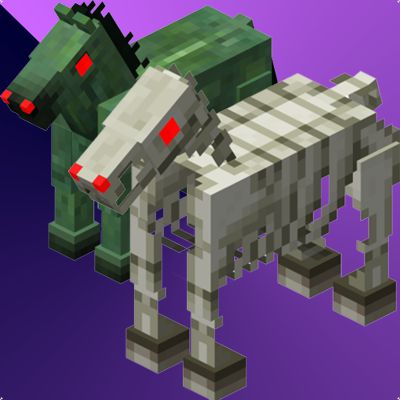
“Aw, they can’t be stranger than Minecraft.  Have you seen those zombie and skeleton horses?”Horses

“Yeah, actually, I have.  My niece plays Minecraft.  But at least those horses hang around.  Virtual particles are now you might see them, now you probably don’t.  They’re part of why quantum mechanics gave Einstein the willies.”

“Quantum mechanics comes into it?  Cool!  But what was Einstein’s problem?  Didn’t he invent quantum theory in the first place?”

“Oh, he was definitely one of the early leaders, along with Bohr, Heisenberg, Schrödinger and that lot.  But he was uncomfortable with how the community interpreted Schrödinger’s wave equation.  His row with Bohr was particularly intense, and there’s reason to believe that Bohr never properly understood the point that Einstein was trying to make.”

“Sounds like me and my Dad.  So what was Einstein’s point?”

“Basically, it’s that the quantum equations are about particles in Newton’s sense.  They lead to extremely accurate predictions of experimental results, but there’s a lot of abstraction on the way to those concrete results.  In the same way that Newton reduced Earth and Moon to mathematical objects, physicists reduced electrons and atomic nuclei to mathematical objects.”

“So they leave out stuff like what the Earth and Moon are made of.  Kinda.”

“Exactly.  Bohr’s interpretation was that quantum equations are statistical, that they give averages and relative probabilities –”

“– Like Schrödinger’s cat being alive AND dead –”

“– right, and Einstein’s question was, ‘Averages of what?‘  He felt that quantum theory’s statistical waves summarize underlying goings-on like ocean waves summarize what water molecules do.  Maybe quantum theory’s underlying layer is more particles.”

“Are those the virtual particles?”

“We’re almost there, but I’ve got an appointment.  Bye.”

“Sure.  Uhh… bye.”

~~ Rich Olcott

Weight And Wait, Two Aspects of Time

I was deep in the library stacks, hunting down a journal article so old it hadn’t been digitized yet.  As I rounded the corner of Aisle 5 Section 2, there he was, leaning against a post and holding a clipboard.

“Vinnie?  What are you doing here?”

“Waiting for you.  You weren’t in your office.”

“But how…?  Never mind.  What can I do for you?”

“It’s the time-dilation thing.  You said that there’s two kinds, a potential energy kind and a kinetic energy kind, but you only told me about the first one.”

“Hey, Ramona broke up that conversation, don’t blame me.  You got blank paper on that clipboard?”

“Sure.  Here.”

“Quick review — we said that potential energy only depends on where you are.  Suppose you and a clock are at some distance r away from a massive object like that Gargantua black hole, and my clock is way far away.  I see your clock ticking slower than mine.  The ratio of their ticking rates, tslow/tfast = √[1-(2G·M/r·c²)], only depends on the slow clock’s position.  Suppose you move even closer to the massive object.  That r-value gets smaller, the fraction inside the parentheses gets closer to 1, the square root gets smaller and I see your clock slow down even more.  Sound familiar?”

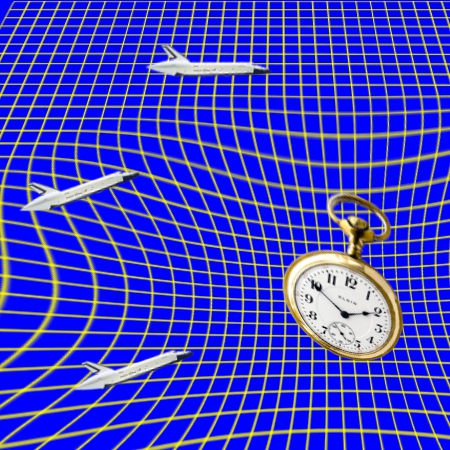
“Yeah, but what about the kinetic thing?”time-and-the-rovers

“I’m getting there.  You know Einstein’s famous EEinstein=m·c² equation.  See?  The formula contains neither a velocity nor a position.  That means EEinstein is the energy content of a particle that’s not moving and not under the influence of any gravitational or other force fields.  Under those conditions the object is isolated from the Universe and we call m its rest mass.  We good?”

“Yeah, yeah.”

“OK, remember the equation for gravitational potential energy?”

E=G·M·m/r.

“Let’s call that Egravity.  Now what’s the ratio between gravitational potential energy and the rest-mass energy?”

“Uh … Egravity/EEinstein = G·M·m/r·m·c² = G·M/r·c². Hey, that’s exactly half the fraction inside the square root up there. tslow/tfast = √[1-(2 Egravity/EEinstein)].  Cool.”

“Glad you like it.  Now, with that under our belts we’re ready for the kinetic thing.  What’s Newton’s equation for the kinetic energy of an object that has velocity v?”

E=½·m·v².

“I thought you’d know that.  Let’s call it Ekinetic.  Care to take a stab at the equation for kinetic time dilation?”

“As a guess, tslow/tfast = √[1-(2 Ekinetic/EEinstein)]. Hey, if I plug in the formulas for each of the energies, the halves and the mass cancel out and I get tslow/tfast = √[1-2(½m·v²/m·c²)] = √[1-(v²/c²)].  Is that it?”

“Close.  In Einstein’s math the kinetic energy expression is more complicated, but it leads to the same formula as yours.  If the velocity’s zero, the square root is 1.0 and there’s no time-slowing.  If the object’s moving at light-speed (v=c), the square root is zero and the slow clock is infinitely slow.  What’s interesting is that an object’s rest energy acts like a universal energy yardstick — both flavors of time-slowing are governed by how the current energy quantity compares to EEinstein.”

“Wait — kinetic energy depends on velocity, right, which means that it’ll look different from different inertial frames.  Does that mean that the kinetic time-slowing depends on the frames, too?”

“Sure it does.  Best case is if we’re both in the same frame, which means I see you in straight-line motion.  Each of us would get the same number if we measure the other’s velocity.  Plug that into the equation and each of us would see the same tslow for the other’s clock.  If we’re not doing uniform straight lines then we’re in different frames and our two dilation measurements won’t agree.”

“… Ramona doesn’t dance in straight lines, does she, Sy?”

“That reminds me of Einstein’s quote — ‘Put your hand on a hot stove for a minute, and it seems like an hour. Sit with a pretty girl for an hour, and it seems like a minute. That’s relativity.‘  You’re thinking curves now, eh?”

“Are you boys discussing me?”

<unison> “Oh, hi, Ramona.”

~~ Rich Olcott

Three Body Problems

The local science museum had a showing of the Christopher Nolan film Interstellar so of course I went to see it again.  Awesome visuals and (mostly) good science because Nolan had tapped the expertise of Dr Kip Thorne, one of the primary creators of LIGO.  On the way out, Vinnie collared me.

“Hey, Sy, ‘splain something to me.”

“I can try, but first let’s get out of the weather.  Al’s coffee OK with you?”

“Yeah, sure, if his scones are fresh-baked.”

Al saw me walking in.  “Hey, Sy, you’re in luck, I just pulled a tray of cinnamon scones out of the oven.”  Then he saw Vinnie.  “Aw, geez, there go my paper napkins again.”

Vinnie was ready.  “Nah, we’ll use the backs of some ad flyers I grabbed at the museum.  And gimme, uh, two of the cinnamons and a large coffee, black.”

“Here you go.”

At our table I said, “So what’s the problem with the movie?”

“Nobody shrank.  All this time we been talking about how things get smaller in a strong gravity field.  That black hole, Gargantua, was huge.  The museum lecture guy said it was like 100 million times as heavy as the Sun.  When the people landed on its planet they should have been teeny but everything was just regular-size.  And what’s up with that ‘one hour on the planet is seven years back home’ stuff?”

“OK, one thing at a time.  When the people were on the planet, where was the movie camera?”

“On the planet, I suppose.”

“Was the camera influenced by the same gravitational effects that the people were?”

“Ah, it’s the frames thing again, ain’t it?  I guess in the on-planet inertial frame everything stays the relative size they’re used to, even though when we look at the planet from our far-away frame we see things squeezed together.”

(I’ve told you that Vinnie’s smart.)  “You got it.  OK, now for the time thing.  By the way, it’s formally known as ‘time dilation.’  Remember the potential energy/kinetic energy distinction?”

“Yeah.  Potential energy depends on where you are, kinetic energy depends on how you’re moving.”

“Got it in one.  It turns out that energy and time are deeply intertwined all through physics.  Would you be surprised if I told you that there are two kinds of time dilation, one related to gravitational potential and the other to velocity?”

“Nothing would surprise me these days.  Go on.”

“The gravity one dropped out of Einstein’s Theory of Special Relativity.  The velocity one arose from his General Relativity work.”  I grabbed one of those flyers.  “Ready for a little algebra?”

“Geez.  OK, I asked for it.”gargantua-3
“You certainly did.  I’ll just give you the results, and mind you these apply only near a non-rotating sphere with no electric charge.  Things get complicated otherwise.  Suppose the sphere has mass M and you’re circling around it at a distance r from its geometric center.  You’ve got a metronome ticking away at n beats per your second and you’re perfectly happy with that.  We good?”

“So far.”

“I’m watching you from way far away.  I see your metronome running slow, at only n√[1-(2 G·M/r·c²)] beats per my second.  G is Newton’s gravity constant, c is the speed of light.  See how the square root has to be less than 1?”

“Your speed of light or my speed of light?”

“Good question, considering we’re talking about time and space getting all contorted, but Einstein guarantees that both of us measure exactly the same speed.  So anyway, in the movie both the Miller’s Planet landing team and that poor guy left on good ship  Endurance are circling Gargantua.  Earth observers would see both their clocks running slow.  But Endurance is much further out (larger r, smaller fraction) from Gargantua than Miller’s Planet is.  Endurance’s distance gave its clock more beats per Earth second than the planet gets, which is why the poor guy aged so much waiting for the team to return.”

“I wondered about that.”

Then we heard Ramona’s husky contralto.  “Hi, guys.  Al said you were back here talking physics.  Who wants to take me dancing?”

We both stood up, quickly.

“Whee, this’ll be fun.”

~~ Rich Olcott