A Force-to-Force Meeting

The Crazy Theory contest is still going strong in the back room at Al’s coffee shop. I gather from the score board scribbles that Jim’s Mars idea (one mark-up says “2 possible 2 B crazy!“) is way behind Amanda’s “green blood” theory.  There’s some milling about, then a guy next to me says, “I got this, hold my coffee,” and steps up to the mic.  Big fellow, don’t recognize him but some of the Physics students do — “Hey, it’s Cap’n Mike at the mic.  Whatcha got for us this time?”

“I got the absence of a theory, how’s that?  It’s about the Four Forces.”

Someone in the crowd yells out, “Charm, Persuasiveness, Chaos and Bloody-mindedness.”

“Nah, Jennie, that’s Terry Pratchett’s Theory of Historical Narrative.  We’re doing Physics here.  The right answer is Weak and Strong Nuclear Forces, Electromagnetism, and Gravity, with me?  Question is, how do they compare?”

Another voice from the crowd. “Depends on distance!”

“Well yeah, but let’s look at cases.  Weak Nuclear Force first.  It works on the quarks that form massive particles like protons.  It’s a really short-range force because it depends on force-carrier particles that have very short lifetimes.  If a Weak Force carrier leaves its home particle even at the speed of light which they’re way too heavy to do, it can only fly a small fraction of a proton radius before it expires without affecting anything.  So, ineffective anywhere outside a massive particle.”

It’s a raucous crowd.  “How about the Strong Force, Mike?”

.  <chorus of “HOO-wah!”>

“Semper fi that.  OK, the carriers of the Strong Force —”

.  <“Naa-VY!  Naaa-VY!”>

.  <“Hush up, guys, let him finish.”>

“Thanks, Amanda.  The Strong Force carriers have no mass so they fly at lightspeed, but the force itself is short range, falls off rapidly beyond the nuclear radius.  It keeps each trio of quarks inside their own proton or neutron.  And it’s powerful enough to corral positively-charged particles within the nucleus.  That means it’s way stronger inside the nucleus than the Electromagnetic force that pushes positive charges away from each other.”

“How about outside the nucleus?”

“Out there it’s much weaker than Electromagnetism’s photons that go flying about —”

.  <“Air Force!”>

.  <“You guys!”>

“As I was saying…  OK, the Electromagnetic Force is like the nuclear forces because it’s carried by particles and quantum mechanics applies.  But it’s different from the nuclear forces because of its inverse-square distance dependence.  Its range is infinite if you’re willing to wait a while to sense it because light has finite speed.  The really different force is the fourth one, Gravity —”

.  <“Yo Army!  Ground-pounders rock!”>

“I was expecting that.  In some ways Gravity’s like Electromagnetism.  It travels at the same speed and has the same inverse-square distance law.  But at any given distance, Gravity’s a factor of 1038 punier and we’ve never been able to detect a force-carrier for it.  Worse, a century of math work hasn’t been able to forge an acceptable connection between the really good Relativity theory we have for Gravity and the really good Standard Model we have for the other three forces.  So here’s my Crazy Theory Number One — maybe there is no connection.”

.  <sudden dead silence>

“All the theory work I’ve seen — string theory, whatever — assumes that Gravity is somehow subject to quantum-based laws of some sort and our challenge is to tie Gravity’s quanta to the rules that govern the Standard Model.  That’s the way we’d like the Universe to work, but is there any firm evidence that Gravity actually is quantized?”

.  <more silence>

“Right.  So now for my Even Crazier Theories.  Maybe there’s a Fifth Force, also non-quantized, even weaker than Gravity, and not bound by the speed of light.  Something like that could explain entanglement and solve Einstein’s Bubble problem.”

.  <even more silence>

“OK, I’ll get crazier.  Many of us have had what I’ll call spooky experiences that known Physics can’t explain.  Maybe stupid-good gambling luck or ‘just knowing’ when someone died, stuff like that.  Maybe we’re using the Fifth Force in action.”

.  <complete pandemonium>
four forces plus 1

~ Rich Olcott


Note to my readers with connections to the US National Guard, Coast Guard, Merchant Marine and/or Public Health Service — Yeah, I know, but one can only stretch a metaphor so far.

Atoms are solar systems? Um, no…

Suddenly there’s a hubbub of girlish voices to one side of the crowd.  “Go on, Jeremy, get up there.”  “Yeah, Jeremy, your theory’s no crazier than theirs.”  “Do it, Jeremy.”

Sure enough, the kid’s here with some of his groupies.  Don’t know how he does it.  He’s a lot younger than the grad students who generally present at these contests, but he’s got guts and he grabs the mic.

“OK, here’s my Crazy Theory.  The Solar System has eight planets going around the Sun, and an oxygen atom has eight electrons going around the nucleus.  Maybe we’re living in an oxygen atom in some humongous Universe, and maybe there are people living on the electrons in our oxygen atoms or whatever.  Maybe the Galaxy is like some huge molecule.  Think about living on an electron in a uranium atom with 91 other planets in the same solar system and what happens when the nucleus fissions.  Would that be like a nova?”

There’s a hush because no-one knows where to start, then Cathleen’s voice comes from the back of the room.  Of course she’s here — some of the Crazy Theory contest ring-leaders are her Astronomy students.  “Congratulations, Jeremy, you’ve joined the Honorable Legion of Planetary Atom Theorists.  Is there anyone in the room who hasn’t played with the idea at some time?”

No-one raises a hand except a couple of Jeremy’s groupies.

“See, Jeremy, you’re in good company.  But there are a few problems with the idea.  I’ll start off with some astronomical issues and then the physicists can throw in some more.  First, stars going nova collapse, they don’t fission.  Second, compared to the outermost planet in the Solar System, how far is it from the Sun to the nearest star?”

A different groupie raises her hand and a calculator.  “Neptune’s about 4 light-hours from the Sun and Alpha Centauri’s a little over 4 light-years, so that would be … the 4’s cancel, 24 hours times 365 … about 8760 times further away than Neptune.”

“Nicely done.  That’s a typical star-to-star distance within the disk and away from the central bulge.  Now, how far apart are the atoms in a molecule?”

“Aren’t they pretty much touching?  That’s a lot closer than 8760 times the distance.”

“Yes, indeed, Jeremy.  Anyone else with an objection?  Ah, Maria.  Go ahead.”

“Yes, ma’am.  All electrons have exactly the same properties, ¿yes? but different planets, they have different properties.  Jupiter is much, much heavier than Earth or Mercury.”

Astrophysicist-in-training Jim speaks up.  “Different force laws.  Solar systems are held together by gravity but at this level atoms are held together by electromagnetic forces.”

“Carry that a step further, Jim.  What does that say about the geometry?”

“Gravity’s always attractive.  The planets are attracted to the Sun but they’re also attracted to each other.  That’ll tend to pull them all into the same plane and you’ll get a flat disk, mostly.  In an atom, though, the electrons or at least the charge centers repel each other — four starting at the corners of a square would push two out of the plane to form a tetrahedron, and so forth.  That’s leaving aside electron spin.  Anyhow, the electronic charge will be three-dimensional around the nucleus, not planar.  Do you want me to go into what a magnetic field would do?”

“No, I think the point’s been made.  Would someone from the Physics side care to chime in?”

“Synchrotron radiation.”

“Good one.  And you are …?”

“Newt Barnes.  I’m one of Dr Hanneken’s students.”

“Care to explain?”

“Sure.  Assume a hydrogen atom is a little solar system with one electron in orbit around the nucleus.  Any time a charge moves it radiates waves into the electromagnetic field.  The waves carry forces that can compel other charged objects to move.  The distance an object moves, times the force exerted, equals the amount of energy expended by the wave.  Therefore the wave must carry energy and that energy must have come from the electron’s motion.  After a while the electron runs out of kinetic energy and falls into the nucleus.  That doesn’t actually happen, so the atom’s not a solar system.”

Jeremy gets general applause when he waves submission, then the crowd’s chant resumes…

.——<“Amanda! Amanda! Amanda!”>Bohr and Bohr atom

~~ Rich Olcott

Moby Divergence

Stepping into Pizza Eddie’s I see Jeremy at his post behind the gelato stand, an impressively thick book in front of him.  “Hi, Jeremy, one chocolate-hazelnut combo, please.  What’re you reading there?”

“Hi, Mr Moire.  It’s Moby Dick, for English class.”

“Ah, one of my favorites.  Melville was a 19th-century techie, did for whaling what Tom Clancy did for submarines.”

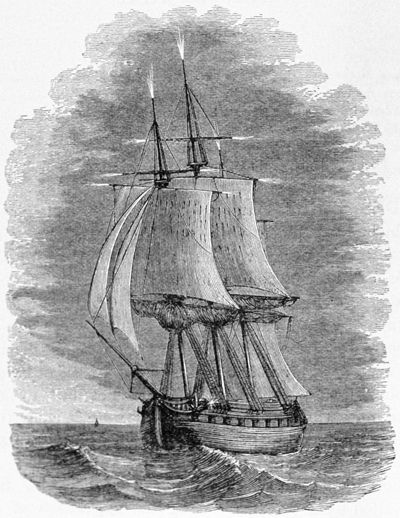
“You’re here at just the right time, Mr Moire.  I’m reading the part where something called ‘the corpusants’ are making lights glow around the Pequod.  Sometimes he calls them lightning, but they don’t seem to come down from the sky like real lightning.  Umm, here it is, he says. ‘All the yard-arms were tipped with pallid fire, and touched at each tri-pointed lightning-rod-end with three tapering white flames, each of the three tall masts was silently burning in that sulphurous air, like three gigantic wax tapers before an altar.’  What’s that about?”St Elmos fire

“That glow is also called ‘St Elmo’s Fire‘ among other things.  It’s often associated with a lightning storm but it’s a completely different phenomenon.  Strictly speaking it’s a concentrated coronal discharge.”

“That doesn’t explain much, sir.”

“Take it one word at a time.  If you pump a lot of electrons into a confined space, they repel each other and sooner or later they’ll find ways to leak away.  That’s literally dis-charging.”

“How do you ‘pump electrons’?”

“Oh, lots of ways.  The ancient Greeks did it by rubbing amber with fur, Volta did it chemically with metals and acid,  Van de Graaff did it with a conveyor belt, Earth does it with winds that transport air between atmospheric layers.  You do it every time you shuffle across a carpet and get shocked when you put your finger near a water pipe or a light switch.”

“That only happens in the wintertime.”

“Actually, carpet-shuffle electron-pumping happens all the time.  In the summer you discharge as quickly as you gain charge because the air’s humidity gives the electrons an easy pathway away from you.  In the winter you’re better insulated and retain the charge until it’s too late.”

“Hm.  Next word.”

Corona, like ‘halo.’  A coronal discharge is the glow you see around an object that gets charged-up past a certain threshold.  In air the glow can be blue or purple, but you can get different colors from other gases.  Basically, the electric field is so intense that it overwhelms the electronic structure of the surrounding atoms and molecules.  The glow is electrons radiating as they return to their normal confined chaos after having been pulled into some stretched-out configuration.”

“But this picture of the corpusants has them just at the mast-heads and yard-arms, not all over the boat.”

“That’s where the ‘concentrated’ word come in.  I puzzled over that, too, when I first looked into the phenomenon.  Made no sense.”

“Yeah.  If the electrons are repelling each other they ought to spread out as much as possible.  So why do they seem pour out of the pointy parts?”

“That was a mystery until the 1880s when Heaviside cleaned up Maxwell’s original set of equations.  The clarified math showed that the key is the electric field’s spread-out-ness, technically known as divergence.”

DivergenceWith my finger I draw in the frost on his gelato cabinet.  “Imagine this is a brass ball, except I’ve pulled one side of it out to a cone.  Someone’s loaded it up with extra electrons so it’s carrying a high negative charge.”

“The electrons have spread themselves evenly over the metal surface, right, including at the pointy part?”

“Yup, that’s why I’m doing my best to make all these electric field arrows the same distance apart at their base.  They’re also supposed to be perpendicular to the surface.  What part of that field will put the most rip-apart stress on the local air molecules?”

“Oh, at the tip, where the field spreads out most abruptly.”

“Bingo.  What makes the glow isn’t the average field strength, it’s how drastically the field varies from one side of a molecule to the other.  That’s what rips them apart.  And you get the greatest divergence at the pointy parts like at the Pequod’s mast-head.”

“And Ahab’s harpoon.”

~~ Rich Olcott

Terzetto for Rubber Ruler

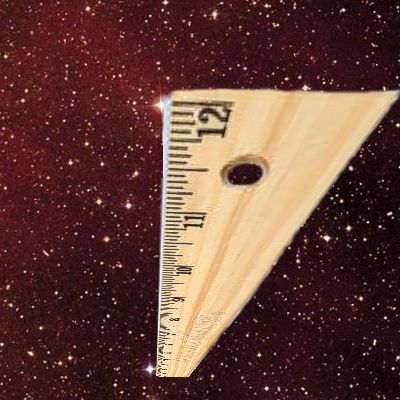
ruler and sodium lines“So you’re telling me, Cathleen, that you can tell how hot a star is by looking at its color?”

“That’s right, Vinnie.  For most stars their continuous spectrum is pretty close to the blackbody equation tying peak wavelength to temperature.”

“But you can’t do that with far-away stars, right, because the further they are, the more stretched-out their lightwaves get.  Won’t that mess up the peak wavelength?”

“The key is Kirchhoff’s other kinds of spectrum.”

“You’re talking the bright-line and dark-line kinds.”

“Exactly.  Each kind of spectrum comes from a different process — each is affected differently by the object in question and the environment it’s embedded in.  A continuous spectrum is all about charged particles moving randomly in response to the heat energy they’re surrounded by.  It doesn’t matter what kind of particles they are or even whether they’re positive or negative.  Whenever a particle changes direction, it twitches the electromagnetic field and gives off a wave.”

“Right — the higher the temperature the less time between twitches; the wave can’t move as far before things change so the wavelength’s shorter; any speed’s possible so you can turn that dial wherever; I got all that.  So what’s different with the bright-line and dark-line spectrums?”

Cathleen and I both blurt out, “Spectra!” at the same time and give each other a look.  We’re grown-ups now.  We don’t say, “Jinx!” to each other any more.

“Alright, spectra.  But how’re they different?”

I pick up the story.  “Like Cathleen said, continuous spectra from same–temperature stuff look identical no matter what kind of stuff’s involved because heat is motion and each particle moves as a unit  The other kinds of spectrum are about transitions within particles so they’re all about which kind of stuff.  A given kind of atom can only absorb certain wavelengths of light and it can only relax by giving off exactly the same wavelengths.  There’s no in-betweens.”

She cuts in.  “Sodium, for instance.  It has two strong lines in the yellow, at 588.995 and 589.592 nanometers.  Whether in a star or a meteor or fireworks, sodium gives off exactly those colors.  Conversely, in an interstellar cloud or in a star’s outermost layers sodium absorbs exactly those colors from any continuous-spectrum light passing through.”

I’m back in.  “And there’s the key to your unmixing question, Vinnie.  We’ve talked about frames, remember?  Your far-away star’s light-generating layers emit a continuous spectrum that describes its temperature.  If we were right next to it, that’s the spectrum we’d see.  But as you say, we’re a long way away and in our frame the light’s been stretched.  It still looks like the black-body curve but it’s red-shifted because of our relative motion.”

Cathleen’s turn.  “But if there are sodium atoms in the star’s upper layers, their absorptions will cut a pair of notches in that emitted spectrum.  It won’t be a smooth curve, there’ll be two sharp dips in it, close together, with the blue-side one twice as strong as the other one.  Easy to recognize and measure the redshift.  The blackbody peak is redshifted by exactly the same amount so with some arithmetic you’ve got the peak’s original wavelength and the star’s temperature.”

Mine.  “See, because we know what the sodium wavelengths were in the star’s frame, we can divide the dip wavelengths we measure by the rest-frame numbers we know about.  The ratios give us the star’s redshift.”

Spectrum with only blackbody and sodium Cathleen turns to her laptop and starts tapping keys.  “Let’s do an example.  Suppose we’re looking at a star’s broadband spectrogram.  The blackbody curve peaks at 720 picometers.  There’s an absorption doublet with just the right relative intensity profile in the near infra-red at 1,060,190 and 1,061,265 picometers.  They’re 1,075 picometers apart.  In the lab, the sodium doublet’s split by 597 picometers.  If the star’s absorption peaks are indeed the sodium doublet then the spectrum has been stretched by a factor of 1075/597=1.80.  Working backward, in the star’s frame its blackbody peak must be at 720/1.80=400 picometers, which corresponds to a temperature of about 6,500 K.”
“Old Reliable calculates from that stretch factor and the Hubble Constant the star’s about ten billion lightyears away and fleeing at 240,000 km/s.”

“All that from three peaks.  Spectroscopy’s pretty powerful, huh?”

Cathleen and me: “For sure!    Jinx!”

~~ Rich Olcott

Zarzuela for Rubber Ruler

“Hey, Cathleen, if the expansion of the Universe stretches light’s wavelengths, how do you know when you see a color in a star what you’re looking at?”

“Excuse me, Professor, but your office-mate said you’d be here at the coffee shop and I have a homework question.”

“Good heavens, look at the time!  It’s my office hours, I should be over there.  Oh well, you’re here, Maria, what’s the question?”

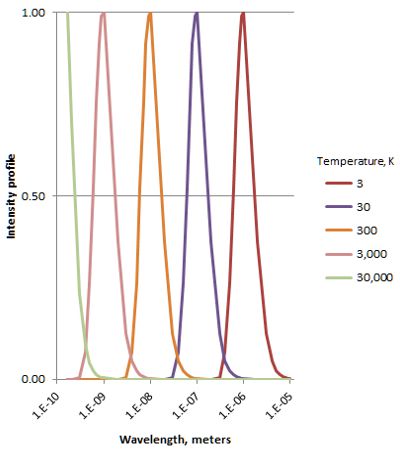
“You showed us this chart and asked us to write an essay on it.  I don’t know where to begin.”Temp and BB peak

“Ah.  Hang on, Vinnie, this bears on your question, too.  OK, Maria, what can you tell me about the chart?”

“Well, there are five peaked curves, labeled with different temperatures.  Can I assume the green curve peaks, too, not continuing straight up?”

“Yes.  What else?”

“The horizontal axis, sorry I don’t know the word —”

“abscissa”

“Oh, we have almost the same word in Spanish!  Anyhow, the abscisa says it shows wavelengths.  It goes from a tenth of a nanometer to maybe 10 micrometers.  The chart must have to do with light, because sound waves can’t get that short.  The … ordinada…?”

“Ordinate”

“Thank you.  The ordinate says ‘Intensity’ so the chart must show light spectra at different temperatures.  But there’s only one peak at each temperature.”

“Is that Kirchhoff’s ‘continuous spectrum,’ Cathleen?”

“Right, Vinnie, a smoothly-varying cascade of every wavelength, photons arising from heat-generated motion of charged particles.”

Ah, ya lo veo — this is blackbody spectra given off by hot objects.  You showed us one in class and here we have several.”

“Good, Maria.  Now —”

“But all the peaks look exactly the same, Cathleen.  The hot objects ought to be brighter.  A really hot flame, you can’t even look at it.  Something’s phony.”

“Good eye, Vinnie.  I divided each curve in the graph by its peak height to put them all on an even footing.  That’s why the axis is labeled ‘Intensity profile‘ instead of ‘Intensity.'”

“I’ve got a different issue, Cathleen.  Hot objects have more energy to play with.  Shouldn’t the hotter peaks spread over a wider wavelength range?  These are all the same width.”

“I think I know the answer to that one, Mr Moire.  In class la profesora showed us how the blackbody curve’s equation has two factors, like B=W*X.  The W factor depends only on wavelength and grows bigger as the wavelength gets smaller.  That’s the ‘ultraviolet catastrophe,’ right, ma’am?”

“Mm-hm.  Go on, Maria.”

“But the X factor gets small real fast as the wavelength gets small.  In fact, it gets small so fast that it overpowers W‘s growth — the W*X product gets small, too.  Do you have that movie you showed us on your laptop there, ma’am?”

“Sure.  Here it is…”Blackbody peaks 1

“OK, the blue line is that W factor.  Oh, by the way, the ordinate scale here is logarithmic, so the value at the left end of the blue line is 1027/106 or about 1021 times bigger than it is at the right end even though it looks like a straight line.  The green line is that temperature-dependent factor.  See how it pulls down the orange lines’ values for cold objects, but practically goes away for very hot objects?”

“Yeah, that shows it real good, right, Sy?  That orange peak moves to the left just like Cathleen’s picture shows.  It answers your question, too.”

“It does, Vinnie?  How so?”

“‘Cause the peaks get broader as they get higher.  It’s like the intensity at the, umm, microwave end hardly changes at all and the whole rest of the curve swings up and out from there.”

“Keep in mind, guys, that we’re talking really large numbers here.  Vinnie’s ‘hardly changes at all’ is actually a factor of 40,000 or so.  Those pretty peaks in my homework chart are only pretty because the spread-out tails are so small relative to the peaks.”

“Alright, Cathleen, but how does Maria’s question tie in with mine?”

“They both hinge on wavelength.  The blackbody equation lets us measure a star’s temperature by looking at its color.  Do you have enough to start on that essay, Maria?”

“Yes, ma’am.  Gracias.”

De nada.  Now run along and get to work on it.”

~~ Rich Olcott

Étude for A Rubber Ruler

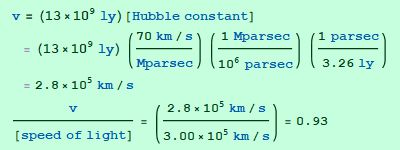
93% redder?  How do you figure that, Sy, and what’s it even mean?”

“Simple arithmetic, Vinnie.  Cathleen said that most-distant galaxy is 13 billion lightyears away.  I primed Old Reliable with Hubble’s Constant to turn that distance into expansion velocity and compare it with lightspeed.  Here’s what came up on its screen.”Old Reliable z calculation“Whoa, Sy.  Do you read the final chapter of a mystery story before you begin the book?”
“Of course not, Cathleen.  That way you don’t know the players and you miss what the clues mean.”

“Which is the second of Vinnie’s questions.  Let’s take it a step at a time.  I’m sure that’ll make Vinnie happier.”

“It sure will.  First step — what’s a parsec?”

“Just another distance unit, like a mile or kilometer but much bigger.  You know that a lightyear is the distance light travels in an Earth year, right?”

“Right, it’s some huge number of miles.”

“About six trillion miles, 9½ trillion kilometers.  Multiply the kilometers by 3.26 to get parsecs.  And no, I’m not going to explain the term, you can look it up.  Astronomers like the unit, other people put it in the historical-interest category with roods and firkins.”

“Is that weird ‘km/sec/Mparsec’ mix another historical thing?”

“Uh-huh.  That’s the way Hubble wrote it in 1929.  It makes more sense if you look at it piecewise.  It says for every million parsecs away from us, the outward speed of things in general increases by 70 kilometers per second.”

“That helps, but it mixes old and new units like saying miles per hour per kilometer.  Ugly.  It’d be prettier if you kept all one system, like (pokes at smartphone screen) … about 2.27 km/sec per 1018 kilometers or … about 8 miles an hour per quadrillion miles.  Which ain’t much now that I look at it.”

“Not much, except it adds up over astronomical distances.  The Andromeda galaxy, for instance, is 15×1018 miles away from us, so by your numbers it’d be moving away from us at 120,000 miles per hour.”

“Wait, Cathleen, I thought Andromeda is going to collide with the Milky Way four billion years from now.”

Opposing motion in a starfield“It is, Sy, and that’s one of the reasons why Hubble’s original number was so far off.  He only looked at about 50 close-by galaxies, some of which are moving toward us and some away.  You only get a view of the general movement when you look at large numbers of galaxies at long distances.  It’s like looking through a window at a snowfall.  If you concentrate on individual flakes you often see one flying upward, even though the fall as a whole is downward.  Andromeda’s 250,000 mph march towards us is against the general expansion.”

“Like if I’m flying a plane and the airspeed indicator says I’m doing 200 but my ground-speed is about 140 then I must be fighting a 60-knot headwind.”

“Exactly, Vinnie.  For Andromeda the ‘headwind’ is the Hubble Flow, that general outward trend.  If Sy’s calculation were valid, which it’s not, then that galaxy 13 billion lightyears from here would indeed be moving further away at  93% of lightspeed.  Someone living in that galaxy could shine a 520-nanometer green laser at us.  At this end we see the beam stretched by 193% to 1000nm.  That’s outside the visible range, well into the near-infrared.  All four visible lines in the hydrogen spectrum would be out there, too.”

“So that’s why ‘old hydrogens’ look different — if they’re far enough away in the Hubble Flow they’re flying away from us so fast all their colors get stretched by the red-shift.”

“Right, Vinnie.”

“Wait, Cathleen, what’s wrong with my calculation?”

“Two things, Sy.  Because the velocities are close to lightspeed, you need to apply a relativistic correction factor.  That velocity ratio Old Reliable reported — call it b.  The proper stretch factor is z=√ [(1+b)/(1–b)].  Relativity takes your 93% stretch down to (taps on laptop keyboard) … about 86%.  The bluest wavelength on hydrogen’s second-down series would be just barely visible in the red at 680nm.”

“What’s the other thing?”Ruler in perspective

“The Hubble Constant can’t be constant.  Suppose you run the movie backwards.  The Universe shrinks steadily at 70 km/sec/Mparsec.  You hit zero hundreds of millions of years before the Big Bang.”

“The expansion must have started slow and then accelerated.”

“Vaster and faster, eh?”

“Funny, Sy.”

~~ Rich Olcott

On Gravity, Charge And Geese

A beautiful April day, far too nice to be inside working.  I’m on a brisk walk toward the lake when I hear puffing behind me.  “Hey, Moire, I got questions!”

“Of course you do, Mr Feder.  Ask away while we hike over to watch the geese.”

“Sure, but slow down , will ya?  I been reading this guy’s blog and he says some things I wanna check on.”

I know better but I ask anyhow.  “Like what?”

“Like maybe the planets have different electrical charges  so if we sent an astronaut they’d get killed by a ginormous lightning flash.”

“That’s unlikely for so many reasons, Mr Feder.  First, it’d be almost impossible for the Solar System to get built that way.  Next, it couldn’t stay that way if it had been.  Third, we know it’s not that way now.”

“One at a time.”

“OK.  We’re pretty sure that the Solar System started as a kink in a whirling cloud of galactic dust.  Gravity spanning the kink pulled that cloud into a swirling disk, then the swirls condensed to form planets.  Suppose dust particles in one of those swirls, for whatever reason, all had the same unbalanced electrical charge.”

“Right, and they came together because of gravity like you say.”

I pull Old Reliable from its holster.  “Think about just two particles, attracted to each other by gravity but repelled by their static charge.  Let’s see which force would win.  Typical interstellar dust particles run about 100 nanometers across.  We’re thinking planets so our particles are silicate.  Old Reliable says they’d weigh about 2×10¹⁸ kg each, so the force of gravity pulling them together would be …  oh, wait, that’d depend on how far apart they are.  But so would the electrostatic force, so let’s keep going.  How much charge do you want to put on each particle?”

“The minimum, one electron’s worth.”

“Loading the dice for gravity, aren’t you?  Only one extra electron per, umm, 22 million silicon atoms.    OK, one electron it is …  Take a look at Old Reliable’s calculation.gravity vs electrostatic calculation Those two electrons push their dust grains apart almost a quintillion times more strongly than gravity pulls them together.  And the distance makes no difference — close together or far apart, push wins.  You can’t use gravity to build a planet from charged particles.”
“Wait, Moire, couldn’t something else push those guys together — magnetic fields, say, or a shock wave?”

“Sure, which is why I said almost impossible.  Now for the second reason the astronaut won’t get lightning-shocked — the solar wind.  It’s been with us since the Sun lit up and it’s loaded with both positive- and negative-charged particles.  Suppose Venus, for instance, had been dealt more than its share of electrons back in the day.  Its net-negative charge would attract the wind’s protons and alpha particles to neutralize the charge imbalance.  By the same physics, a net-positive planet would attract electrons.  After a billion years of that, no problem.”

“All right, what’s the third reason?”

“Simple.  We’ve already sent out orbiters to all the planets.  Descent vehicles have made physical contact with many of them.  No lightning flashes, no fried electronics.  Blows my mind that our Cassini mission to Saturn did seven years of science there after a six-year flight, and everything worked perfectly with no side-trips to the shop.  Our astronauts can skip worrying about high-voltage landings.”

“Hey, I just noticed something.  Those F formulas look the same.”  He picks up a stick and starts scribbling on the dirt in front of us.  “You could add them up like F=(Gm1m2+k0q1q2)/r2.  See how the two pieces can trade off if you take away some mass but add back some charge?  How do we know we’ve got the mass-mass pull right and not mixed in with some charge-charge push?”

Geese and ducks“Good question.  If protons were more positive than electrons, electrostatic repulsion would always be proportional to mass.  We couldn’t separate that force from gravity.  Physicists have separately measured electron and proton charge.  They’re equal (except for sign) to 10 decimal places.  Unfortunately, we’d need another 25 digits of accuracy before we could test your hypothesis.”
“Aw, look, the geese got babies.”

“The small ones are ducks, Mr Feder.”

~~ Rich Olcott

The Speeds of Light

“I don’t give up easy, Sy.”

“I know that, Vinnie.  Still musing about lightwaves and how they’re all an electron’s fault?”

“Yeah.  Hey, can your OVR app on Old Reliable grab a shot from this movie running on my smartphone?”

“We can try … got it.  Now what?”

“I wanna try mixing that with your magnetic field picture.”

“I’ll bring that up … Here, have at it.”

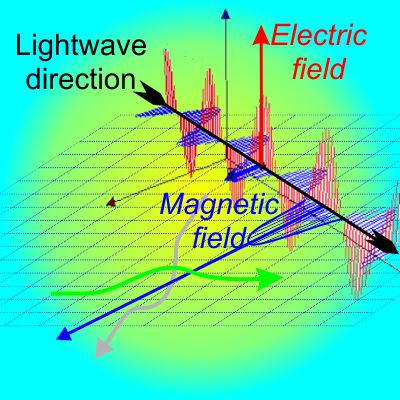
“Umm … Nice app, works very intuitive-like …  OK, see this?”Electrons and lightwave

“Ah.  It’s a bit busy, walk me through what’s in there.”

“OK. First we got the movie’s lightwave.  The ray’s running along that black arrow, see?  Some electron back behind the picture is going up and down to energize the ray and that makes the electric field that’s in red that makes other electrons go up and down, right?”

“That’s the red arrow, hmm?”

“Yeah, that electron got goosed ’cause it was standing in the way.  It follows the electric field’s direction.  Now help me out with the magnetic stuff.”

“Alright.  The blue lines represent the lightwave’s magnetic component.  A lightwave’s magnetic field lines are always perpendicular to its electric field.  Magnetism has no effect on uncharged particles or motionless charged particles.  If you’re a moving charged particle, say an electron, then the field deflects your trajectory.”

“This is what I’m still trying to wrap my head around.  You say that the field’s gonna push the particle perpendicular to the field and to the particle’s own vector.”

“That’s exactly what happens.  The green line, for instance, could represent an electron that crossed the magnetic field.  The field deflected the electron’s path upwards, crossways to the field and the electron’s path.  Then I suppose the electron encountered the reversed field from the lightwave’s following cycle and corrected course again.”

“And the grey line?”

“That’d be an electron crossing more-or-less along the field.  According to the Right Hand Rule it was deflected downward.”

“Wait.  We’ve got two electrons on the same side of the field and they’re deflected in opposite directions then correct back.  Doesn’t that average out to no change?”

“Not quite.  The key word is mostly.  Like gravity fields, electromagnetic fields get weaker with distance.  Each up or down deflection to an electron on an outbound path will be smaller than the previous one so the ‘course corrections’ get less correct.  Inbound electrons get deflected ever more strongly on the way in, of course, but eventually they become outbound electrons and get messed up even more.  All those deflections produce an expanding cone of disturbed electrons along the path of the ray.”

“Hey, but when any electron moves that changes the fields, right?  Wouldn’t there be a cone of disturbed field, too?”

“Absolutely.  The whole process leads to several kinds of dispersion.”

“Like what?”

“The obvious one is simple geometry.  What had been a simple straight-line ray is now an expanding cone of secondary emission.  Suppose you’re an astronomer looking at a planet that’s along that ray, for instance.  Light’s getting to you from throughout the cone, not just from the straight line.  You’re going to get a blurred picture.”

“What’s another kind?”

“Moving those electrons around extracts energy from the wave.  Some fraction of the ray’s original photons get converted to lower-energy ones with lower frequencies.  The net result is that the ray’s spectrum is spread and dispersed towards the red.”

“You said several kinds.”

“The last one’s a doozy — it affects the speeds of light.”

“‘Speeds,’ plural?”ripples in a wave

“There’s the speed of field’s ripples, and there’s the speed of the whole signal, say when a star goes nova.  Here’s a picture I built on Old Reliable.  The gold line is the electric field — see how the ripples make the red electron wobble?  The green dots on the axis give you comparison points that don’t move.  Watch how the ripples move left to right just like the signal does, but at their own speed.”

“Which one’s Einstein’s?”

“The signal.  Its speed is called the group velocity and in space always runs 186,000 mph.  The ripple speed, technically it’s the phase velocity, is slower because of that extracted-and-redistributed-energy process.  Different frequencies get different slowdowns, which gives astronomers clues about the interstellar medium.”

“Clues are good.”

~~ Rich Olcott

They Went That-away. But Why?

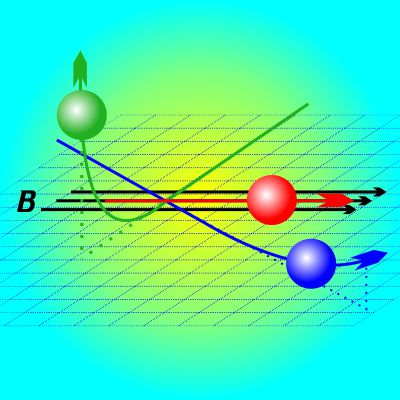
“It’s worse than that, Vinnie.”  I pull out Old Reliable, my math-monster tablet.  “Let me scan in that three-electron drawing of yours.”3 electrons in B-field

“Good enough to keep a record of it?”

“Nope, I want to exercise a new OVR app I just bought.”

“You mean OCR.”

“Uh-uh, this is Original Vector Reconstruction, not Optical Character Recognition.    OCR lets you read a document into a word processor so you can modify it.  OVR does the same thing but with graphics.  Give me a sec … there.  OK, look at this.”3 electrons in B-field revisited

“Cool, you turned my drawing 180°, sort of.  Nice app.  Oh, and you moved the red electron’s path so it’s going opposite to the blue electron instead of parallel to the magnetic field.  Why’d you bother?”

“See the difference between blue and red?”

“Well, yeah, one’s going up, one’s going down.  That’s what I came to you about and you shot down my theory.  Those B-arrows in the magnetic field are going in completely the wrong direction to push things that way.”

“Well, actually, they’re going in exactly the right direction for that, because a magnetic field pushes along perpendiculars.  Ever hear of The Right Hand Rule?”

“You mean like ‘lefty-loosey, righty-tighty’?”

“That works, too, but it’s not the rule I’m talking about.  If you point your thumb in the direction an electron is moving, and your index finger in the direction of the magnetic field, your third finger points in the deflection direction.  Try it.”

“Hurts my wrist when I do it for the blue one, but yeah, the rule works for that.  It’s easier for the red one.  OK, you got this rule, fine, but why does it work?”

“Part of it goes back to the vector math you don’t want me to throw at you.  Let’s just say that there are versions of a Right Hand Rule all over physics.  Many of them are essentially definitions, in the same way that Newton’s Laws of Motion defined force and mass.  Suppose you’re studying the movements directed by some new kind of force.  Typically, you try to define some underlying field in such a way that you can write equations that predict the movement.  You haven’t changed Nature, you’ve just improved our view of how things fit together.”

“So you’re telling me that whoever made that drawing I copied drew the direction those B-arrows pointed just to fit the rule?”

“Almost.  The intensity of the field is whatever it is and the lines minus their pointy parts are wherever they are.  The only thing we can set a rule for is which end of the line gets the arrowhead.  Make sense?”Spiraling electron

“I suppose.  But now I got two questions instead of the one I come in here with.  I can see the deflection twisting that electron’s path into a spiral.  But I don’t see why it spirals upward instead of downward, and I still don’t see how the whole thing works in the first place.”

“I’m afraid you’ve stumbled into a rabbit hole  we don’t generally talk about.  When Newton gave us his Law of Gravity, he didn’t really explain gravity, he just told us how to calculate it.  It took Einstein and General Relativity to get a deeper explanation.  See that really thick book on my shelf over there?  It’s loaded with tables of thermodynamic numbers I can use to calculate chemical reactions, but we didn’t start to understand those numbers until quantum mechanics came along.  Maxwell’s equations let us calculate electricity, magnetism and their interaction — but they don’t tell us why they work.”

“I get the drift.  You’re gonna tell me it goes up because it goes up.”

“That’s pretty much the story.  Electrons are among the simplest particles we know of.  Maxwell and his equations gave us a good handle on how they behave, nothing on why we have a Right Hand Rule instead of a Left Hand Rule.  The parity just falls out of the math.  Left-right asymmetry seems to have something to do with the geometry of the Universe, but we really don’t know.”

“Will string theory help?”

“Physicists have spent 50 years grinding on that without a testable result.  I’m not holding my breath.”

~~ Rich Olcott

Three off The Plane

Rumpus in the hallway.  Vinnie dashes into my office, tablet in hand and trailing paper napkins.  “Sy! Sy! I figured it out!”

“Great!  What did you figure out?”

“You know they talk about light and radio being electromagnetic waves, but I got to wondering.  Radio antennas don’t got magnets so where does the magnetic part come in?”

“19th-Century physicists struggled with that question until Maxwell published his famous equations.  What’s your answer?”

“Well, you know me — I don’t do equations, I do pictures.  I saw a TV program about electricity.  Some Danish scientist named Hans Christian Anderson—”

“Ørsted.”

“Whoever.  Anyway, he found that magnetism happens when an electric current starts or stops.  That’s what gave me my idea.  We got electrons, right, but no magnetrons, right?”

“Mmm, your microwave oven has a vacuum tube called a magnetron in it.”

“C’mon, Sy, you know what I mean.  We got no whatchacallit, ‘fundamental particle’ of magnetism like we got with electrons and electricity.”

“I’ll give you that.  Physicists have searched hard for evidence of magnetic monopoles — no successes so far.  So why’s that important to you?”

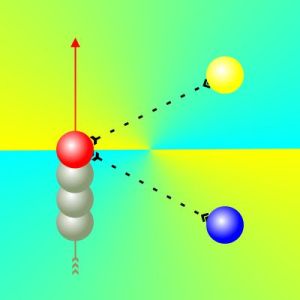
3 electrons moving north“It told me that the magnetism stuff has to come from what electrons do.  And that’s when I came up with this drawing.”  <He shoves a paper napkin at me.>  “See, the three balls are electrons and they’re all negative-negative pushing against each other only I’m just paying attention to what the red one’s doing to the other two.  Got that?”

“Sure.  The arrow means the red electron is traveling upward?”

“Yeah.  Now what’s that moving gonna do to the other two?”

“Well, the red’s getting closer to the yellow.  That increases the repulsive force yellow feels so it’ll move upward to stay away.”

“Uh-huh.  And the force on blue gets less so that one’s free to move upward, too.  Now pretend that the red one starts moving downward.”

“Everything goes the other way, of course.  Where does the magnetism come in?”

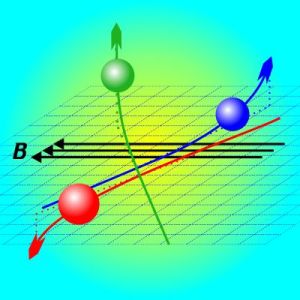
3 electrons in B-field“Well, that was the puzzle.  Here’s a drawing I copied from some book.  The magnetic field is those B arrows and there’s three electrons moving  in the same flat space in different directions.  The red one’s moving along the field and stays that way.  The blue one’s moving slanty across the field and gets pushed upwards.  The green one’s going at right angles to B and gets bent way up.  I’m looking and looking — how come the field forces them to move up?”
“Good question.  To answer it those 19th Century physicists developed vector analysis—”

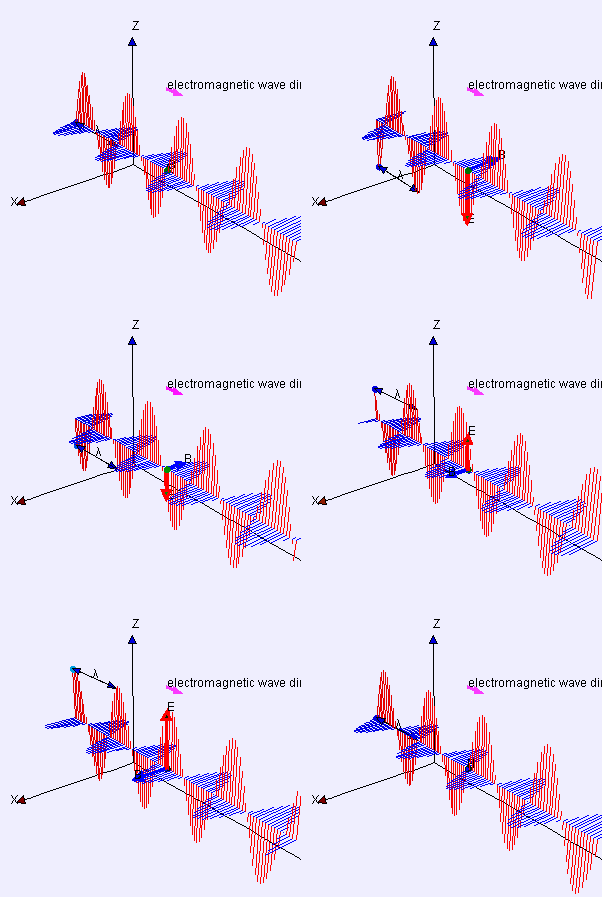
Electromagneticwave3D
Plane-polarized electromagnetic wave
Electric (E) field is red
Magnetic (B) field is blue
(Image by Loo Kang Wee and Fu-Kwun Hwang from Wikimedia Commons)

“Don’t give me equations, Sy, I do pictures.  Anyway, I figured it out, and I did it from a movie I got on my tablet here.  It’s a light wave, see, so it’s got both an electric field and a magnetic field and they’re all sync’ed up together.”

“I see that.”

“What the book’s picture skipped was, where does the B-field come from?  That’s what I figured out.  Actually, I started with where the the light wave came from.”

“Which is…?”

“Way back there into the page, some electron is going up and down, and that creates the electric field whose job is to make other electrons go up and down like in my first picture, right?”

“OK, and …?”

“Then I thought about some other electron coming in to meet the wave.  If it comes in crosswise, its path is gonna get bent upward by the E-field.  That’s what the blue and green electrons did.  So what I think is, the magnetic effect is really from the E-field acting on moving electrons.”

“Nice try, but it doesn’t explain a couple of things.  For instance, there’s the difference between the green and blue paths.  Why does the amount of deflection depend on the angle between the B direction and the incoming path?”

“Dunno.  What’s the other thing?”

“Experiment shows that the faster the electron moves, the greater the magnetic deflection.  Does your theory account for that?”

“Uhh … my idea says less deflection.”

“Sorry, another beautiful theory stumbles on ugly facts.”

~~ Rich Olcott