A Thumbtack in A Needlestack

“What’re the odds?”

“Odds on what, Vinnie?”

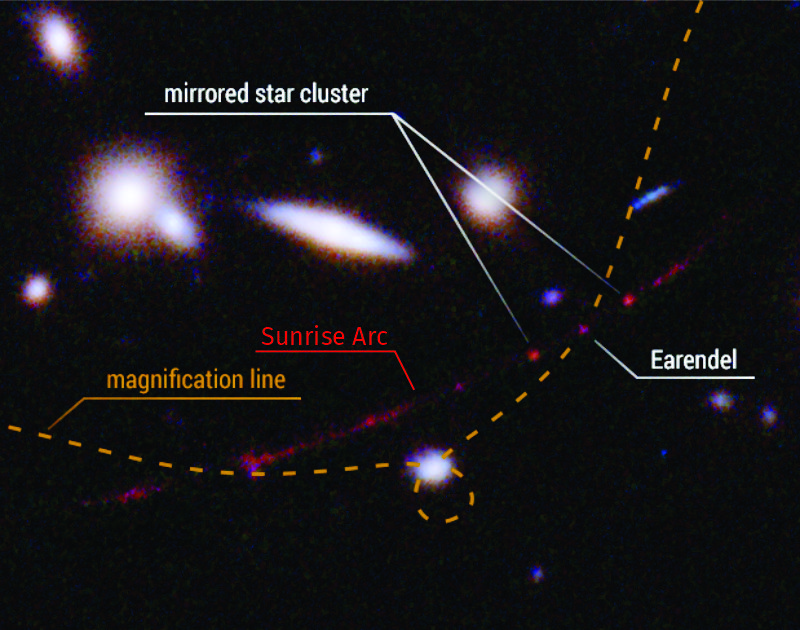
“A gazillion galaxies out there, only 41 lensing galaxy clusters, but one of them shows us a singleton star. I mean, what’s special about that star? What are the odds?”

I can’t help it. “Astronomical, Vinnie.”

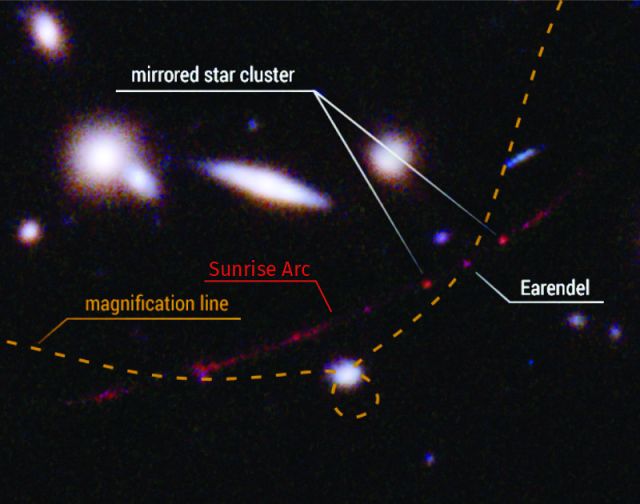
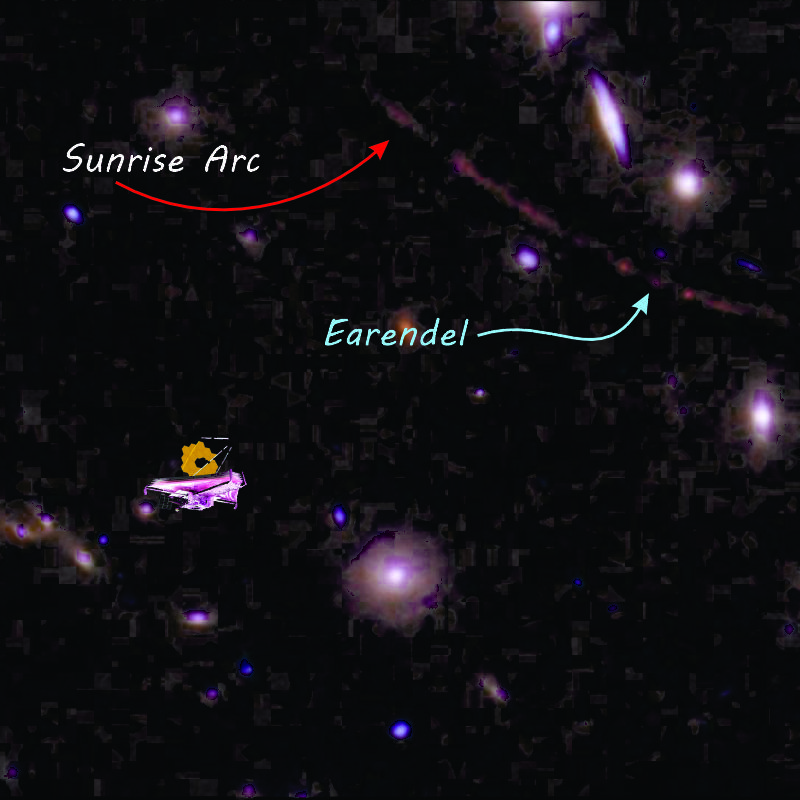
Cathleen punches my shoulder, hard. “Sy Moire, you be ashamed of yourself. That pun was ancient a century ago. Vinnie, the odds are better than they seem. We didn’t just stumble on Earendel and the Sunrise Arc, we found them in a highly targeted Big Data search for things just like that — objects whose light was extremely stretched and also gravitationally bent in our direction. The Arc’s lensing galaxy cluster has a spherical effect, more or less, so it also acts on light from other far-away objects and sends it in other directions. It even bends an image of our Milky Way towards Earendel’s galaxy.”

“I call weaseling — you used ‘more or less‘.”

“Guilty as charged, Vinnie. A nice, spherical black hole is the simplest case of gravitational lensing — just one mass at the center of its simple light‑bending gravity field. Same thing for a single star like our Sun. Clusters are messy. Tens or hundreds of billion‑star galaxies, scattered at random angles and random positions about their common center of mass. The combined gravity field is lumpy, to say the least. Half of that research paper is devoted to techniques for estimating the field and its effects on light in the region around the Arc.”

“I guess they had to get 3D positions for all the galaxies in the cluster. That’d be a lot of work.”

“It would, Al, but that’s beyond what current technology can do. Instead, they used computer models to do — get this, Sy — curve fitting.”

<chuckle> “Good one, Cathleen.”

“What’s so funny?”

“There’s a well-established scientific technique called ‘curve fitting.’ You graph some data and try to find an equation that does a respectable job of running through or at least near your data points. Newton started it, of course. Putting it in modern terms, he’d plot out some artillery data and say, ‘Hmm, that looks like a parabola H=h+v·t+a·t2. I wonder what values of h, v and a make the H-t curve fit those measurements. Hey, a is always 32 feet per second per second. Cool.’ Or something like that. Anyhow, Cathleen’s joke was that the researchers used curve fitting to fit the Sunrise Arc’s curve, right?”

“They did that, Sy. The underlying physical model, something called ‘caustic optics,’ says that—”

“Caustic like caustic soda? I got burnt by that stuff once.”

Image by Heiner Otterstedt,
under the Creative Commons Attribution-Share Alike 3.0 Unported license

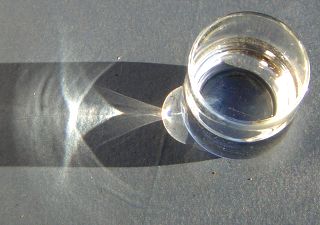
“That’s the old name for sodium hydroxide, Vinnie. It’s a powerful chemical and yeah, it can give you trouble if you’re not careful. That name and caustic optics both come from the Greek word for burning. The optics term goes back to using a lens as a burning glass. See those focused patterns of light next to your water glass? Each pattern is a caustic. The Arc’s lensing cluster’s like any light‑bender, it’s enclosed in a caustic perimeter. Light passing near the perimeter gets split, the two parts going to either side of the perimeter. The Earendel team’s curve‑fitting project asked, ‘Where must the caustic perimeter be to produce these duplicate galaxy images neighboring the Arc?‘ The model even has that bulge from the gravity of a nearby foreground galaxy.”

“And the star?”

“Earendel seems to be smack on top of the perimeter. Any image touching that special line is intensified way beyond what it ought to be given the source’s distance from us. It’s a pretty bright star to begin with, though. Or maybe two stars.”

“Wait, you don’t know?”

“Not yet. This study pushed the boundaries of what Hubble can do for us. We’re going to need JWST‘s infrared instruments to nail things down.”

Al’s in awe. “Wow — that caustic’s sharp enough to pick one star out of a galaxy.”

“Beat the astronomical odds, huh?”

Adapted from a public-domain image.
Credit: Science: NASA / ESA / Brian Welch (JHU) / Dan Coe (STScI); Image processing: NASA / ESA / Alyssa Pagan (STScI)

~~ Rich Olcott

A Needle in A Needlestack

“How’d they find that far-away star, Cathleen? Seems like you’d have to know just where to point your telescope.”

“It’s worse than that, Al, first you’ve got to find that telescope, or more precisely, its lens. We can’t simply swing a black hole or galaxy cluster into position for a good look at something interesting. No, we have to discover lensing objects that magnify good stuff beyond them. The good news is that some of those are out there, but the bad news is that the sky is cluttered with far more objects that don’t play the game we want. This research team appears to have hit paydirt but they did it with humungous power shovels and heavy‑duty panning techniques.”

“Impressive metaphor, Cathleen. Could you un‑metaphor it for us?”

“Sure, Sy. The power shovels are Hubble and Spitzer, both of which piled up beaucoodles of data from decades of infrared observing time.”

“I thought Hubble was designed for visible and UV surveillance.”

“It is, mostly, but since 2009 its instrument suite included WFC3, a camera that’s sensitive out to 1700 nanometers and covers a square 2 arcminutes on a side. That’s a lot, by big‑telescope astronomy standards.”

“Wait, arcminutes?”

“That’s right, Mr Feder. We astronomers have trouble with distances but we’re good at measuring angles. The Moon’s about a degree across. One degree is sixty arcminutes, next step down is sixty arcseconds per arcminute. After that we go semi‑metric, milliarcseconds and so forth. One WFC3 pixel records a patch of sky 130 milliarcseconds across. JWST‘s NIRCam instrument has a resolution twice as sharp. Anyway, Hubble‘s 1700‑nanometer limit is plenty good enough to pick up 120‑nanometer hydrogen light that’s been stretched out by a factor of z=2.8. Distance and stretch correlate; the lens that highlighted Earendel and its Sunrise Arc for NASA and Vinnie is that far away.”

“How far away?”

“It’s tricky to answer that. The spectra we see let us measure an object’s z‑factor, which by way of the Doppler effect tells us how fast the object is moving away. Hubble’s constant ties that to distance, sort of. My convenient rule of thumb is that an object whose z is near 2 is running away at 80% of lightspeed and on the average is about 55 trillion lightyears from us but don’t quote me because relativity complicates matters. Using the same dicey calculation I estimated the lens and Earendel velocities at 87% and 96% of lightspeed, which would put their ‘proper distances‘ around 60 and 66 trillion lightyears away. And no, I’m not going to go into ‘proper distance‘ versus ‘comoving distance‘.”

“Let’s get back to your metaphor, Cathleen. I get that Hubble and Spitzer and such generated a ton of data. What’s the panning part about?”

“Well, in the old days it would have been hired hands and graduate students spending years peering at dots on photographic plates. These days it’s computers, thank Heaven. The research team used a series of programs to filter their digital data. The software had to decide which dots are stars or noise specks and which are galaxies or arcs. Then it picked out the reddest red galaxy images, then clusters of galaxy images at the same redness level that are near each other in space, then clusters with arcs around them. I said that WFC3 covers a square 2 arcminutes on a side, remember? The sky, both hemispheres, contains almost 2½ million squares like that, although the surveys didn’t get all of them. Anyhow, after burning through cubic acres of computer time the team found 41 deep red lensing clusters.”

“Only 41.”

“Yup.”

We ponder that for a minute, then Vinnie pipes up. “Wait, the dots are in color?”

“No, but these images are generally taken through a filter that transmits only a known narrow wavelength range, infrared or whatever. Using relative dot intensity at several different wavelengths you can create ‘false color‘ images. When you find something, you know where to point spectroscopic tools to be sure you’ve found the good stuff.”

“Like a star shining less than a billion years after the Big Bang.”

“Paydirt.”

Image adapted from NASA and STScI

~~ Rich Olcott

When The Stars Are Aligned Right

Cathleen and I are chatting when Vinnie bursts into the coffee shop waving a newspaper. “New news, guys, they’ve just announced Hubble spotted the farthest‑away star. How about that? Think what JWST will be able to do!”

Cathleen raises an eyebrow. “Sounds like press release science. What else do they say?”

“Not a whole lot. Lessee… These guys went through old Hubble data and found a piece of an Einstein ring which I don’t know what that is and partway along the ring is a star and somehow they figured out it’s 50 times heavier than the Sun and 12 billion years old and it’s the farthest star they’ve ever seen and that’s why NASA’s all excited.”

“Do you believe all that?”

“Maybe the NASA PR people do?”

“Maybe. I just read the technical paper behind that announcement. The authors themselves aren’t absolutely sure. The paper’s loaded with supporting evidence and ‘how we did it‘ details but it’s also loaded with caveats. The text includes a string of alternative explanations for their observations, winding up with a typical ‘we await further evidence from JWST‘ statement. Reads a lot more like real science. Besides, we’ve already seen more distant stars but they’re all jumbled together inside their very distant galaxies.”

“Unpack it for me. Start with what’s an Einstein ring?”

“It’s a gravitational lensing effect. Sy, does Old Reliable still have a copy of that graphic you did about gravitational lensing?”

“That was years ago. Let me check… Uh‑huh, here it is.”

“Thanks. Vinnie, you know how a prism changes light’s direction.”

“Sy and me, we talked about how a prism bends light when light crosses from air to glass or the other way ’cause of the different speed it goes in each material. Uhh, if I remember right the light bends toward the slower speed, and you get more bend with shorter wavelengths.”

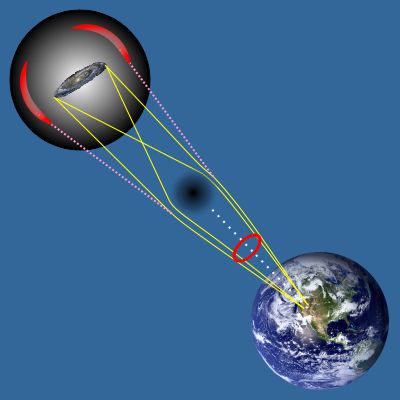
“Bingo, Vinnie. Gravitational lensing also bends light, but the resemblance ends there. The light’s just going through empty space, not different media. What varies is the shape of spacetime itself. Say an object approaches a heavy mass. Because of relativity the space it moves through appears compressed and its time is dilated. Compressed distance divided by dilated time means reduced velocity. Parts of a spread‑out lightwave closest to the mass slow down more than parts further way so the whole wave bends toward the heavy mass. Okay?”

“Hold on. Umm, so in your picture light coming towards us from that galaxy doesn’t get blocked by that black thingy, the light bends around it on both sides and focuses in on us?”

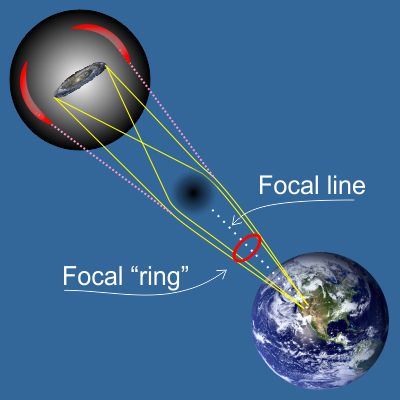
“Exactly. Now carry it further. The diagram cuts a flat 2D slice along round 3D spatial reality. Those yellow lines really are cones. Three‑sixty degrees around the black blob, the galaxy’s light bends by the same amount towards the line between us and the blob. Your Einstein ring is a cut across the cone, assuming that the galaxy, the blob and Earth are all exactly on the same straight line. If the galaxy’s off‑center the picture isn’t as pretty — you only get part of a ring, like those red arcs in Sy’s diagram.”

“A galactic rainbow. That ought to be awesome!”

“Well it would be, but there’s another difference between prisms and blobs. Rainbows happen because prisms and raindrops bend short‑wavelength colors more than longer ones, like you said. Gravitational lensing doesn’t care about wavelength. Wavelengths do shift as light traverses a gravitational well but the outbound red shift cancels the inbound blue shift.. Where gravity generates an Einstein ring, all wavelengths bend through the same angle. Which is a good thing for bleeding‑edge astronomy researchers.”

“Why’s that, Cathleen?”

“If the effect were wavelength‑dependent we’d have aberration, the astronomer’s nemesis. Images would be smeared out. As it is, all the photons from a point hit the same spot on the sensor and we’ve got something to see.”

“Tell him about amplification, Cathleen.”

“Good point, Sy. Each galactic star emits light in every direction. In effect, the blob collects light over its entire surface area and concentrates that light along the focal line. We get the brightest image when the stars are aligned right.”

~~ Rich Olcott

Now And Then And There

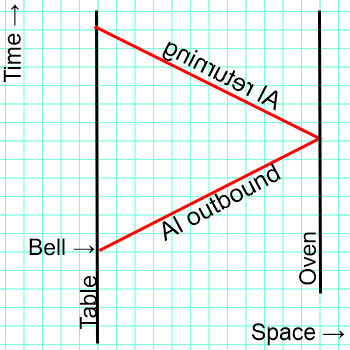
Still at our table in Al’s otherwise empty coffee shop. We’re leading up to how Physics scrambled Now when a bell dings behind the counter. Al dashes over there. Meanwhile, Cathleen scribbles on a paper napkin with her colored pencils. She adds two red lines just as Al comes back with a plate of scones. “Here, Sy, if you’re going to talk Minkowski space this might be useful.”

“Hah, you’re right, Cathleen, this is perfect. Thanks, Al, I’ll have a strawberry one. Mmm, I love ’em fresh like this. OK, guys, take a look at Cathleen’s graphy artwork.”

“So? It’s the tile floor here.”

“Not even close, Mr Feder. Check the labels. The up‑and‑down label is ‘Time’ with later as higher. The diagram covers the period we’ve been sitting here. ‘Now‘ moves up, ‘Here’ goes side‑to‑side. ‘Table‘ and ‘Oven‘, different points in space, are two parallel lines. They’re lines because they both exist during this time period. They’re vertical because neither one moves from its relative spatial position. Okay?”

“Go on, Moire.”
  ”Makes sense to me, Sy.”

“Good. ‘Bell‘ marks an event, a specific point in spacetime. In this case it’s the moment when we here at the table heard the bell. I said ‘spacetime‘ because we’re treating space and time as a combined thing. Okay?”

“Go on, Moire.”
  ”Makes sense to me, Sy.”

“So then Al went to the oven and came back to the table. He traveled a distance, took some time to do that. Distance divided by time equals velocity. ‘Table‘ has zero velocity and its line is vertical. Al’s line would tilt down more if he went faster, okay?”

“Mmmm, got it, Sy.”
  ”Cute how you draw the come-back label backwards, lady. Go on, Moire.”

“I do my best, Mr Feder.”

“Fine, you’ve got the basic ideas. Now imagine all around us there’s graph paper like this — except there’s no paper and it’s a 4‑dimensional grid to account for motion in three spatial dimensions while time proceeds. Al left and returned to the same space point so his spacetime interval is just the time difference. If two events differ in time AND place there’s special arithmetic for calculating the interval.”

“So where’s that get us, Moire?”

“It got 18th and 19th Century Physics very far, indeed. Newton and everyone after him made great progress using math based on a nice stable rectangular space grid crossed with an orderly time line. Then Lorentz and Poincaré and Einstein came along.”

“Who’s Poincaré?”

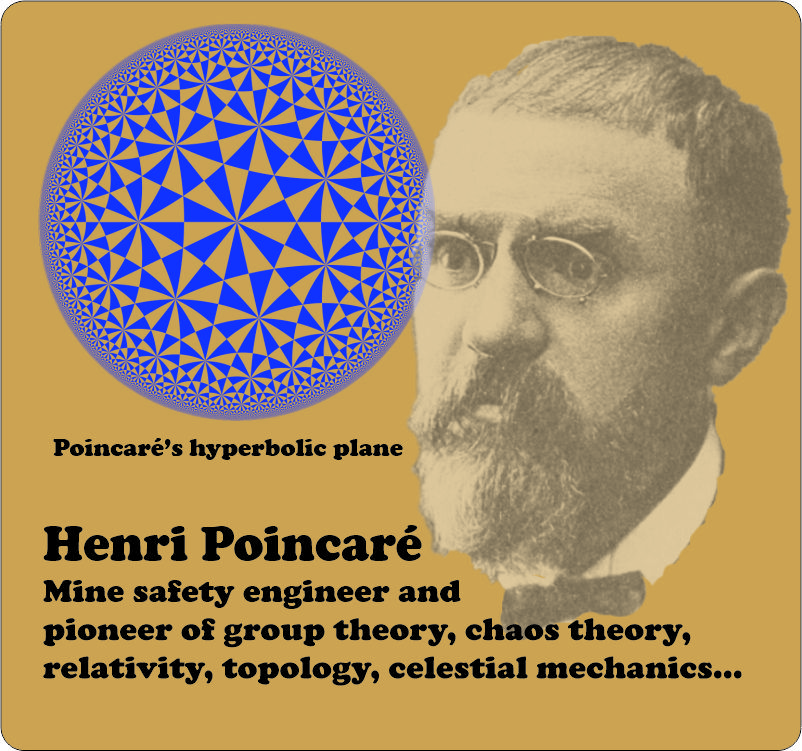
“The foremost mathematician of nineteenth Century France. A mine safety engineer most days and a wide‑ranging thinker the rest of the time — did bleeding‑edge work in many branches of physics and math, even invented a few branches of his own. He put Lorentz’s relativity work on a firm mathematical footing, set the spacetime and gravity stage for Minkowsky and Einstein. All that and a long list of academic and governmental appointments but somehow he found the time to have four kids.”

“A ball of fire, huh? So what’d he do to Newton’s jungle gym?”

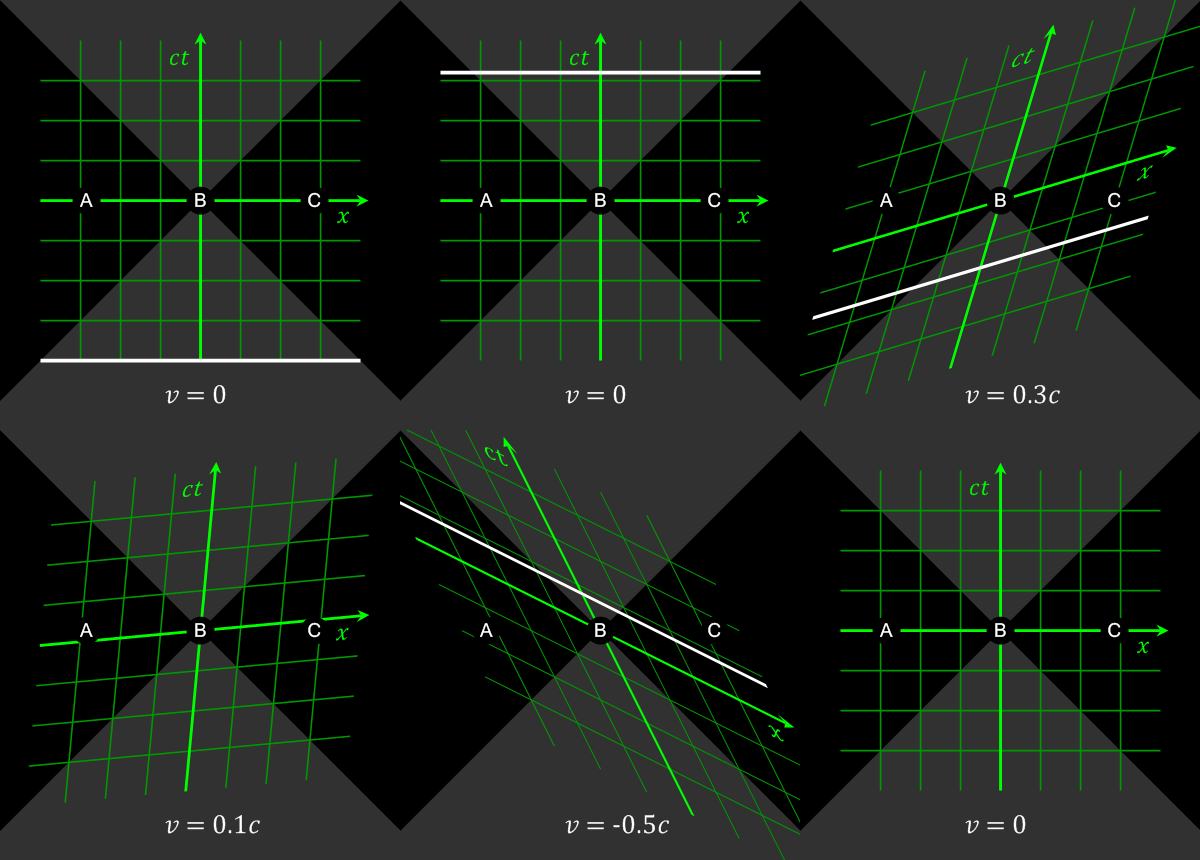
“Turned its steel rod framework into jello. Remember how Cathleen’s Minkowski diagram connected slope with velocity? Einstein showed how Lorentz’s relativity factor sets a speed limit for our Universe. On the diagram, that’d be a minimum slope. Going vertical is okay, that’s standing still in space. Going horizontal isn’t, because that’d be instantaneous travel. This animation tells the ‘Now‘ story better than words can.”

“Whah?”
  ”Whah?”

“We’re looking down on three space travelers and three events. Speeds below lightspeed are within the gray hourglass shape. The white line perpendicular to each traveler’s time line is their personal ‘Now‘. The travelers go at different velocities relative to us so their slopes and ‘Now‘ lines are different. From our point of view, time goes straight up. One traveler is sitting still relative to us so its timeline is marked ‘v=0‘ and parallels ours. We and the v=0 traveler see events A, B and C happening simultaneously. The other travelers don’t agree. ‘Simultaneous‘ is an illusion.”

~~ Rich Olcott

Now And Then

“Alright, I suppose there’s no going down below the Universe’s Year Zero, but what about the other direction? Do you physics guys have a handle on Time’s Top?”

“That’d be Cosmology, Mr Feder. We physicists avoid theorizing about stuff we can’t check against data. Well, except for string theory. The far past leaves clues that astronomers like Cathleen can gather. Sad to say, though, we barely have a handle on Now.”

Cathleen grins. Al and Mr Feder go, “Whaaat?”

“No, really. One of Einstein’s insights was that two observers randomly and independently flying through space won’t be able to agree on whether two external events occurred simultaneously. They can’t even agree on what time it is now.”

“Oh, yeah, I know about that. I’ve read about how the GPS system needs to make corrections to account for what relativity does to the satellite timings.”

“You’re right, Al, but that’s a different issue. Some of that relativistic correction has to do with space compression because of Earth’s mass. The simultaneity problem is strictly about rapid motion and geometry.”

“Wait — geometry?”

“Relativistic geometry, which is a bit different from the kind that Descartes built.”

“Whoa, Sy, slow down there. Descartes was the ‘I think therefore I am‘ guy, right? What’s that got to do with geometry?”

“I guess I got a little ahead of myself there, didn’t I? OK. Yeah, Al, same Descartes. Grew up Catholic in France, was a professional mercenary soldier in the Thirty Years War, wound up fighting first on the Catholic French side and later on fought on the Protestant Dutch side but cross‑over was common, both directions. He realized he was in an ostensibly religious war that was really about who ruled over whom. That may have had something to do with him becoming a professional philosopher who rejected all religious dogmas in favor of what he could learn solely from logic and his own senses. That’s where his famous mantra came from — he started by proving to himself that he existed.”

“Logic led to geometry, I suppose.”

“Indeed, but a new kind, one that required a few innovations that Descartes developed. On the one hand, mathematicians traditionally expressed algebraic problems in words and some of them were doozies, like saying ‘the zenzizenzizenzic‘ where we’d just say x8. We got that simple but <ahem> powerful notation from Descartes. On the geometry side, he’d ditch all the confusing line-ending markers in a diagram like this one. Instead, he’d label the whole line representing a known quantity with a front-of-the-alphabet letter like a or b or c. A line representing an unknown quantity would get its label from the alphabet-trailers like x, y and z. Then he used the same character conventions and his new power notation to write and manipulate algebraic expressions. Those notational inventions were foundational for his bridge between algebraic and geometrical problems. Draw your problem with lines and curves, transform it to algebraic equations, solve that problem exactly, transform it back to geometry and you’re done. Or vice-versa.”

The mesolabe instrument (in red).

“That goes back to Descartes, huh?”

“Mm-hm. His big innovation, though, arose from a borrow from an early Greek gadget called a mesolabe. He proposed an idealized version that would let someone break a line into exact fractions or compare a length against a unit length. That broke the rules of classical Geometry but setting his mesolabe’s Y‑angle to 90° prompted him to name points by their distance along the x– and y‑axes. That’s the nub of the Cartesian coordinate system — a rectangular grid of numbered straight lines that go on forever. Graph paper, right? Wrap the grid around the Earth and you’ve got latitudes and longitudes. Add more numbered grid lines perpendicular to either grid and you’ve got z‑axis coordinates. Three coordinates let you name any point in space. Newton and all the physicists who came after him until the dawn of the 20th Century assumed Descartes’ nice, stable coordinate system.”

“20th Century — that’s when Einstein came on the scene. He broke that system?”

“Sure did. You’ve heard about bent space?”

“Who hasn’t?”

“Well, fasten your seat belts, it’s going to be a fun ride.”

~~ Rich Olcott

The Bottom of Time

“Cathleen, one of my Astronomy magazines had an article, claimed that James Webb Space Telescope can see back to the Big Bang. That doesn’t seem right, right?”

“You’re right, Al, it’s not quite right. By our present state of knowledge JWST‘s infrared perspective goes back only 98% of the way to the Bang. Not quite the Bottom of Time, but close.”

“Whaddaya mean, ‘Bottom of Time‘? I’ve heard people talking about how weird it musta been before the Big Bang. And how can JWST see back in time anyway? Telescopes look across space, not time.”

“So many questions, Mr Feder, and some hiding behind others. That’s his usual mode, Cathleen. Care to tag-team?”

“You’re on, Sy. Well, Mr Feder. The ‘look back in time‘ part comes from light not traveling infinitely fast. We’ve known that for three centuries, ever since Rømer—”

“Roamer?”

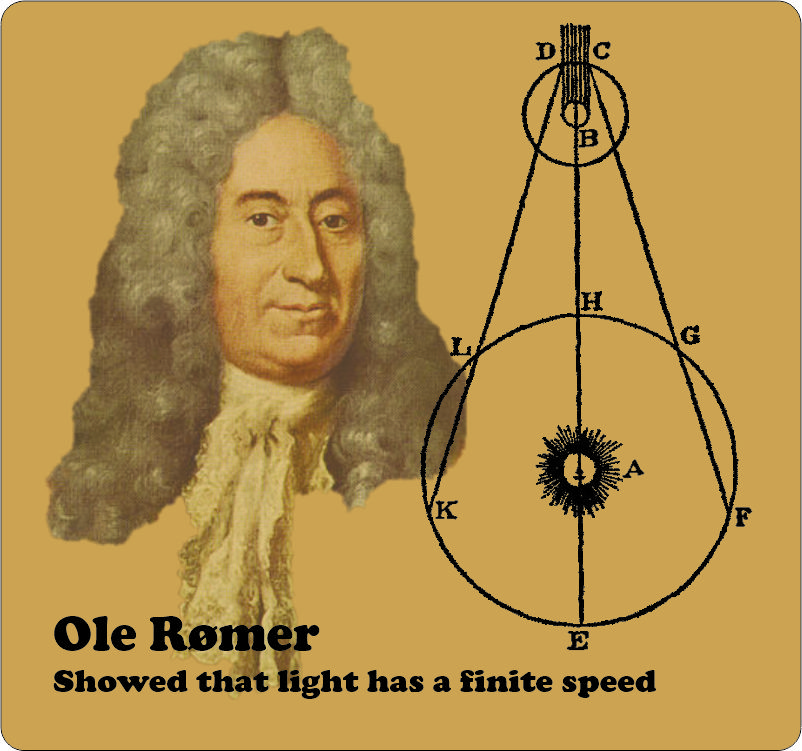
“Ole Rømer, a Danish scientist who lived in Newson’s time. Everyone knew that Jupiter’s innermost large moon Io had a dependably regular orbit, circling Jupiter every 49½ hours like clockwork. Rømer was an astronomer when he wasn’t tutoring the French King’s son or being Copenhagen’s equivalent of Public Safety Commissioner. He watched Io closely, kept notes on exactly when she ducked behind Jupiter and when she reappeared on the other side. His observed timings weren’t quite regular, generally off by a few minutes. Funny thing was, the irregularities correlated with the Earth‑Jupiter distance — up to 3½ minutes earlier than expected when Earth in its orbit was closest to Jupiter, similarly late when they were far apart. There was a lot of argument about how that could be, but Rømer, Huygens, even Newton, all agreed that the best explanation was that we only see Io’s passage events after light has taken its time to travel from there to here.”

“Seems reasonable. Why should people argue about that?”

“The major sticking point was the speed that Huygens calculated from Rømer’s data. We now know it’s 186000 miles or 300000 kilometers or one lightsecond per second. Different ways of stating the same quantity. Huygens came up with a somewhat smaller number but still. The establishment pundits had been okay with light transmission being instantaneous. Given definite numbers, though, they had trouble accepting the idea that anything physical could go that fast.”

“Tag, my turn. Flip that distance per time ratio upside down — for every additional lightsecond of distance we’re looking at events happening one second farther into the past. That’s the key to JWST‘s view into the long‑ago. Al, you got that JWST‘s infrared capabilities will beat Hubble‘s vis‑UV ones for distance. Unless there’s something seriously wrong with Einstein’s assumption that lightspeed’s an absolute constant throughout spacetime, we expect JWST to give us visibility to the oldest free photons in the Universe, just 379000 years upward from the Big Bang.”

“Wait, I heard weaseling there. Free photons? Like you gotta pay for the others?”

“Ha, ha, Mr Feder. During those first 379000‑or‑so years, we think the Universe was so hot and so dense that no photon’s wave had much of a chance to spread out before it encountered a charged something and got absorbed. At last, things cooled down enough for atoms to form and stay in one piece. Atoms are neutral. Quantum rules restrict their interaction to only photons that have certain wavelengths. The rest of the photons, and there’s a huge number of them, were free to roam the expanding Universe until they happen to find a suitable absorber. Maybe someone’s eye or if we’re lucky, a sensor on JWST or some other telescope.”

Thanks for this to George Derenburger

“What about before the 300‑and‑something thousand years? Like, before Year Zero? Musta been weird, huh?”

“Well, there’s a problem with that question. You’re assuming there was a Year Minus‑One, but that’s just not the case.”

“Why not? Arithmetic works that way.”

“But the Universe doesn’t. Stephen Hawking came up with a good way to think about it. What on Earth is south of the South Pole?”

“Eeayahh … nope. Can’t get any further south than that.”

“Well, there you are, so to speak. Time’s bottom is Year Zero and you can’t get any further down than that. We think.”

~~ Rich Olcott

The Red Advantage

“OK, Cathleen, I get that JWST and Hubble rate about the same for sorting out things that are close together in the sky, and I get that they look at different kinds of light so it’s hard to compare sensitivity. Let’s get down to brass tacks. Which one can see farther?”

“An excellent question, Mr Feder. I’ve spent an entire class period on different aspects of it.”

“Narrow it down a little, I ain’t got all day.”

“You asked for it — a quick course on cosmological redshift. Fasten your seat belt. You know what redshift is, right?”

“Yeah, Moire yammers on about it a lot. Waves stretch out from something moving away from you.”

I bristle. “It’s important! And some redshifts don’t have anything to do with motion.”

“Right, Sy. Redshift in general has been a crucial tool for studying everything from planetary motion to the large‑scale structure of the Universe. Your no‑motion redshift — you’re thinking of gravitational redshift, right?”

“Mm-hm. From a distance, space appears to be compressed near a massive object, less compressed further away. Suppose we send a robot to take up a position just outside a black hole’s event horizon. The robot uses a green laser to send us its observations. Space dilates along the beam’s path out of the gravity well. The expanding geometry stretches the signal’s wavelength into the red range even though the robot’s distance from us is constant.”

“So, that’s gravitational redshift and there’s the Doppler redshift that Mr Feder referred to—”

“Is that what its name is? With p‘s? I always heard it as ‘doubler’ effect and wondered where that came from.”

“It came from Christian Doppler’s name, Al. Back in the 1840s he was investigating a star. He noticed that its spectrum was the overlap of two spectra slightly shifted with respect to each other. Using wave theory he proposed that the star was a binary and that the shifted spectra arose from one star coming towards us and the other moving away. Later work confirmed his ideas and the rest is history. So it’s Doppler, not doubler, even though the initial observation was of a stellar doublet.”

“So what’s this cosmo thing?”

“Cosmological redshift. It shows up at large distances. On the average, all galaxies are moving away from us, but they’re moving away from each other, too. That was Hubble’s big discovery. Well, one of them..”

“Wait, how can that be? If I move away from Al, here, I’m moving toward Sy or somebody.”

“We call it the expansion of the universe. Have you ever made raisin bread?”

“Nah, I just eat it.”

“Ok, then, just visualize how it’s made. You start with a flat lump of dough, raisins close together, right? The loaf rises as the yeast generates gas inside the lump. The dough expands and the raisins get further apart, all of them. There’s no pushing away from a center, it’s just that there’s an increasing amount of bubbly dough between each pair of neighboring raisins. That’s a pretty good analogy to galactic motion — the space between galaxies is expanding. The general motion is called Hubble flow.”

“So we see their light as redshifted because of their speed away from us.”

“That’s part of it, Al, but there’s also wave‑stretching because space itself is expanding. Suppose some far‑away galaxy, flying away at 30% of lightspeed, sent out a green photon with a 500‑nanometer wavelength. If the Doppler effect were the only one in play, our relative speeds would shift our measurement of that photon out to about 550 nanometers, into the yellow. Space expansion at intermediate stations along its path can cumulatively dilate the wave by further factors out into the infrared or beyond. Comparing two galaxies, photons from the farther one will traverse a longer path through expanding space and therefor experience greater elongation. Hubble spotted one object near its long‑wavelength limit with a recognizable spectrum feature beyond redshift factor 11.”

“Hey, that’s the answer to Mr Feder’s question!”

“So what’s the answer, smart guy?”

JWST will be able to see farther, because its infrared sensors can pick up distant light that’s been stretched beyond what Hubble can handle.”

~~ Rich Olcott

Lord Rayleigh Resolves

Mr Feder just doesn’t quit. “But why did they make JWST so big? We’re getting perfectly good pictures from Hubble and it’s what, a third the size?”

Al’s brought over a fresh pot and he’s refilling our coffee mugs. “Chalk it up to good old ‘because we can.’ Rockets are bigger than in Hubble‘s day, robots can do more remote stuff by themselves, it all lets us make a bigger scope.”

Cathleen smiles. “There’s more to it than that, Al. It’s really about catching photons. You’re nearly correct, Mr Feder, the diameter ratio is 2.7. But photons aren’t captured by a line across the primary mirror, they’re captured by the mirror’s entire area. The important JSWT:Hubble ratio is between their areas. JWST beats Hubble there by a factor of 7.3. For a given source and the same time interval, we’d expect JWST to be that much more sensitive than Hubble.”

“Well,” I break in, “except that the two use photon detectors that are sensitive to different energy ranges. The two scopes often won’t even be looking at the same kinds of object. Hubble‘s specialized for visible and UV light. It’s easy to design detectors for that range because electrons in solid‑state devices respond readily to the high‑energy photons. The infrared light photons that JWST‘s designed for don’t have enough energy to kick electrons around the same way. Not really a fair comparison, although everything I’ve read says that JWST‘s sensitivity will be way up there.”

Mr Feder is derisive. “‘Way up there.’ Har, har, de-har. I suppose you’re proud of that.”

“Not really, it just happened. But Cathleen, I’m surprised that you as an astronomer didn’t bring up the other reason the designers went big for JWST.”

“True, but it’s more technical. You’re thinking of resolution and Rayleigh’s diffraction limit, aren’t you?”

“Bingo. Except Rayleigh derived that limit from the Airy disk.”

“Disks in the air? We got UFOs now? What’re you guys talking about?”

Portrait of Sir George Airy
licensed under the Creative Commons
Attribution 4.0 International license.

“No UFOs, Mr Feder, I’ll try to be non‑technical. Except for the big close objects like the Sun and its planets, telescopes show heavenly bodies as circular disks accompanied by faint rings. In the early 1800s an astronomer named George Airy proved that the patterns are an illusion produced by the telescope. His math showed that even the best possible apparatus will force lightwaves from any small distant light source to converge to a ringed circular disk, not a point. The disk’s size depends on the ratio between the light’s wavelength and the diameter of the telescope’s light‑gathering aperture. How am I doing, Al?”

“Fine so far.”

“Good. Rayleigh took that one step further. Suppose you’re looking at two stars that are very close together in the sky. You’d expect to see two Airy patterns. However, if the innermost ring from one star overlaps the other star’s disk, you can’t resolve the two images. That’s the basis for Rayleigh’s resolvability criterion — the angle between the star images, measured in arc‑seconds, has to be at least 252000 times the wavelength divided by the diameter.”

After a diagram by cmglee
licensed under the Creative Commons
Attribution 3.0 International license.

“But blue light’s got a shorter wavelength than red light. Doesn’t that say that my scope can resolve close-together blue stars better than red stars?”

“Sure does, except stars don’t emit just one color. In visible light the disk and rings are all rimmed with reddish and bluish fuzz. The principle works just fine when you’re looking at a single wavelength. That gets me to the answer to Mr Feder’s question. It’s buried in this really elegant diagram I just happen to have on my laptop. Going across we’ve got the theoretical minimum angle for resolving two stars. Going up we’ve got aperture diameters, running from the pupil of your eye up to radio telescope coalitions that span continents. The colored diagonal bands are different parts of the electromagnetic spectrum. The red bars mark each scope’s sensor wavelength range. Turns out JWST‘s size compared to Hubble almost exactly compensates for the longer wavelengths it reports on.”

~~ Rich Olcott

E Pluribus

Mr Feder’s a determined fault‑finder. “That gold on James Webb Space Telescope‘s mirror — it’s gonna make all its pictures look funny, yellow‑like instead of whatever the real colors are.”

Cathleen bristles a little. “We astronomers have built our science on recognizing. accounting for and overcoming instrument limitations. Hubble, for instance, went up with a mirror that had been misground so its resolution was a factor of 10 worse than it was supposed to be. It took three years for NASA to install corrective optics. In the meantime we devised a whole catalog of math and computer techniques for pulling usable data out of the mess. Anyway, JWST‘s not designed to make pretty pictures.”

“I thought it was gonna replace Hubble. If it can’t take pictures, what’re we putting it up there for?”

“It’s a successor, not a replacement. JWST is designed to answer a completely different set of questions from the ones that Hubble has been used for. I’m sure we’ll keep using Hubble for as long as it continues to operate. By the way, the Hubble pictures you’ve seen aren’t what Hubble took.”

“Bunk! I’ve seen Hubble shots of the Moon and they look just like what I see through my binocs. Same colors and everything.”

“Not much color in the Moon, Mr Feder. Just different grays except for during a lunar eclipse.”

“That’s true, Al, but the resemblance is no accident. All major telescopes including Hubble, gray‑scale is all they do. Professional and amateur scientists help out by combining and coloring those gray‑scale images.”

“Wait, how do they combine images? Back in the film days I’d forget to wind forward after taking a picture and the double exposures were always a mess.”

“Film and digital are very different technologies, Mr Feder. The sensors in your camera’s film were microscopic silver halide crystals embedded in the coating. Each photon that reached a crystal transformed one silver ion to elemental silver and darkened the image there just a bit. More photons in a particular area, more darkening. There’s no reset, so when you clicked twice on a frame the new darkening supplemented what was already there. Those silver atoms and their location on the film encoded the photos you took.”

<with a sneer> “Wooo — encoded! What’d the processing labs do, count the atoms?”

“In an analog sort of way. Your lab made positive prints by shining light through your negatives onto photosensitive paper that worked the same way as the film. Shadow from the negative’s dark silver atoms prevented silver ion darkening in the corresponding part of the paper. What was bright in the original scene came out bright in the print. And viceversa.”

“But I was taking color photos.”

“Same analog scheme but with fancier chemistry. Your color film had three photosensitive layers. Each layer was designed to record a different set of wavelengths, red, green or blue. Blue photons would darken the bluesensitive layer and so on. From then on the encoding and decoding logic worked the same, color by separate color. Your eyes combine the colors. JWST‘s cameras don’t do any of that.”

“I guess not, it being a million miles away from processing labs.”

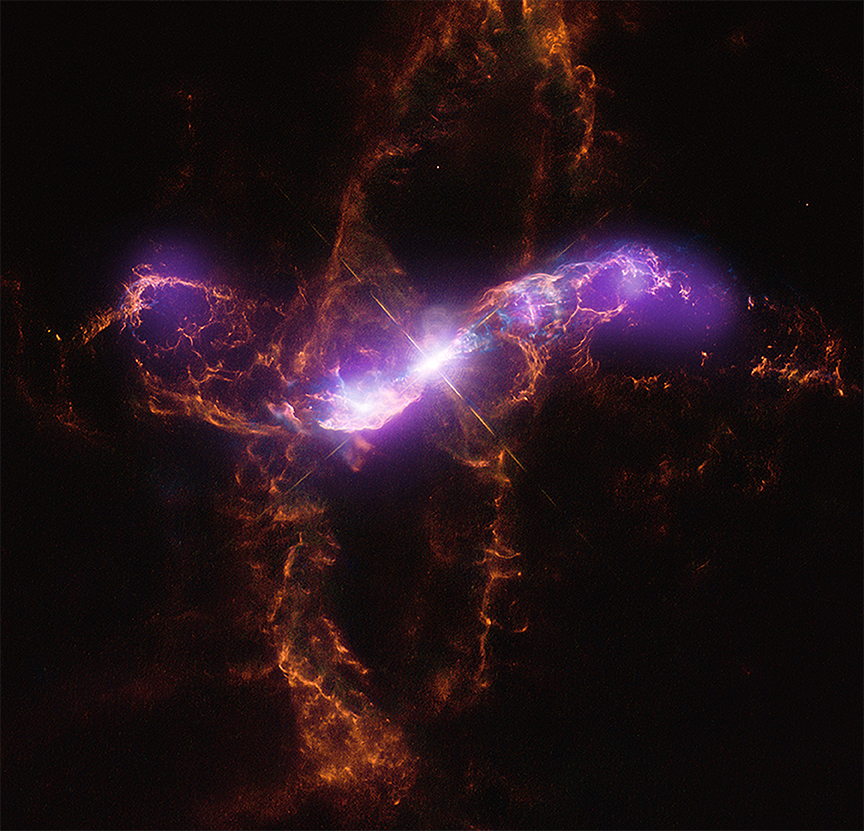
“Right, we can only work with numbers that can be transmitted back to Earth. Modern telescopes use digital sensors, dense grids of transistorsize devices that literally count the photons that strike them. Graph how many photons hit each part of the grid during an interval and you’ve got a picture. Better yet, you can do arithmetic on the counts. That opens up a world of analytical and pictorial opportunities that were tedious or impossible with photographic data.” <opens laptop, taps keys> “Here’s a lovely example I recently received from NASA’s Astronomy Picture of the Day service. Gorgeous, hm?”

Symbiotic R Aquarii” — Image Credit: Optical (red, blue): NASA/ESA/STScI;
X-ray (purple): NASA/CXC/SAO/R. Montez et al.;
Processing: Judy Schmidt (CC BY-NC-SA)

“Wow.”
 ”Wow.”
  ”Wow.”

“Image arithmetic in action. That’s two stars in weird orbits around each other. Ms Schmidt combined two Hubble images with one from Chandra, a separate telescope looking at a different part of the spectrum. Old‑style astrophotography couldn’t do that.”

~~ Rich Olcott

Now You See It, Now You Don’t

Al’s face takes on a far-away smile. “James Webb Space Telescope must look pretty up there — a golden honeycomb on a silver setting, floating in space.”

“Real artistic and all, but how come all that gold? The mirror’s what, 60 feet across. Half of that is 30 for the radius, square it is 900, times 3 plus a little for pi, makes like 3000 square feet. That’s a lot of gold and us taxpayers sent it up to space! Why not make it shiny with something cheaper?”

“Nice on-the-fly math, Mr Feder, but it’s much less gold than you think. Ever play with gold leaf?”

“Yeah, once when my cousin was decorating one of her artsy‑tartsy ceramic pieces. I went to pick up one of her leftover scraps and my breath blew it away.”

“Thin, huh? One of my astronomy magazines had an article, said the gold coating on the JWST‘s dish is only a little thicker than gold leaf, just 1000 atoms top to bottom. They don’t even apply it with a brush like people usually do. Your cousin may have artisan‑level skills but her manual techniques can’t match the precision JWST‘s design demands. The fabricators used a vapor deposition process like the semiconductor people use to make computer chips.”

“So how much gold?”

“Less than three grams per segment. That ring on your finger weighs more. The article said each segment has about $180 worth of gold, pretty small compared to the project’s ten billion dollar price tag.”

“Even so, why gold? Why not something cheaper?”

“I dunno. I see it a lot on different missions. The Insight Mars lander’s below‑deck electronics section was shrouded with gold-covered plastic panels. What’s the story, Sy?”

“Gold’s a special metal, Al. It ranks up with copper and silver for electrical conductivity but unlike them it doesn’t corrode. That’s why so many electrical switches and data cables use a thin layer of it at the contact points. The conductivity comes from the metal’s high concentration of free electrons, like an ocean of them sloshing around the atomic lattice. The free electrons also make gold an efficient reflector for electromagnetic radiation all across the spectrum from UV light way down into the radio range. The engineers for Insight and a lot of other missions put a thin gold layer on those insulation panels to protect the plastic from incoming high‑energy photons that would break up the polymer molecules. JWST needs to send every passing photon into the satellite’s detectors so gold’s high reflectivity made it the obvious candidate for the mirror coating.”

“I wonder if I’ll be able to see that honeycomb through my backyard telescope.”

“We can put numbers to that.” <drawing Old Reliable from its holster and tapping screen‑keys> “Lessee … using the small angle approximation for the sine function, to resolve a grid of 20-foot hexagons a million miles away you’d need an angular resolution of
  (20 feet) / [(106 miles)*(5280 feet/mile)]
   = 3.8×10⁻⁹ radians = 784 micro‑arcseconds

For yellow light’s 570‑nanometer wavelength, Rayleigh’s angular resolution formula gives
  aperture diameter
   =1.22*(wavelength)/(angle in radians) = 1.22*570×10-9/3.8×10-9 = 183 meters.
You’d need a telescope with a 550‑foot front end. If I remember right, Al, that’s almost ten times the width of your yard. You’d need at least a 60‑meter mirror just to see the entire dish as anything more than a yellow speckle.”

“Even with a scope like that Al would have a problem, Sy.”

“What’s that, Cathleen?”

“Viewed from the Sun, JWST‘s orbit looks straightforward — a half‑million‑mile half‑year vertical loop around the Sun‑Earth L2 point that itself circles the Sun once a year. Viewed from Earth, though, it’s a far more complicated motion. Earth’s orbit parallels JWST‘s so half the time JWST leads Earth and half it lags behind. At the extremes, JWST scoots along at twice Earth’s speed or else it appears to stop against the background stars. It’d be a challenging target for a star‑tracker program without a minute‑by‑minute computerized ephemeris.”

“He wouldn’t see the honeycomb even with that scope, Moire. JWST‘s always gonna point away from the Sun and us. The only view we’ll ever get is that pink parasol.”

~~ Rich Olcott