Generation(s) of Stars

“How’re we gonna tell, Mr Moire?”

“Tell what, Jeremy?”

“Those two expanding Universe scenarios. How do we find out whether it’s gonna be the Big Rip or the Big Chill?”

“The Solar System will be recycled long before we’d have firm evidence either way. The weak dark energy we have now is most effective at separating things that are already at a distance. In the Big Rip’s script a brawnier dark energy would show itself first by loosening the gravitational bonds at the largest scale. Galaxies would begin scattering into the voids between the multi‑galactic sheets and filaments we’ve been mapping. Only later would the galaxies themselves release their stars to wander off and dissolve when dark energy gets strong enough to overcome electromagnetism.”

“How soon will we see those things happen?”

“If they happen. Plan on 188 billion years or so, depending on how fast dark energy strengthens. The Rip itself would take about 2 billion years, start to finish. Remember, our Sun will go nova in only five billion years so even the Rip scenario is far, far future. I prefer the slower Chill story where the Cosmological Constant stays constant or at least the w parameter stays on the positive side of minus‑one. Weak dark energy doesn’t mess with large gravitationally‑bound structures. It simply pushes them apart. One by one galaxies and galaxy clusters will disappear beyond the Hubble horizon until our galaxy is the only one in sight. I take comfort in the fact that our observations so far put w so close to minus‑one that we can’t tell if it’s above or below.”

“Why’s that?”

“The closer (w+1) approaches zero, the longer the timeline before we’re alone. We’ll have more time for our stars to complete their life cycles and give rise to new generations of stars.”

“New generations of stars? Wow. Oh, that’s what you meant when you said our Solar System would be recycled.”

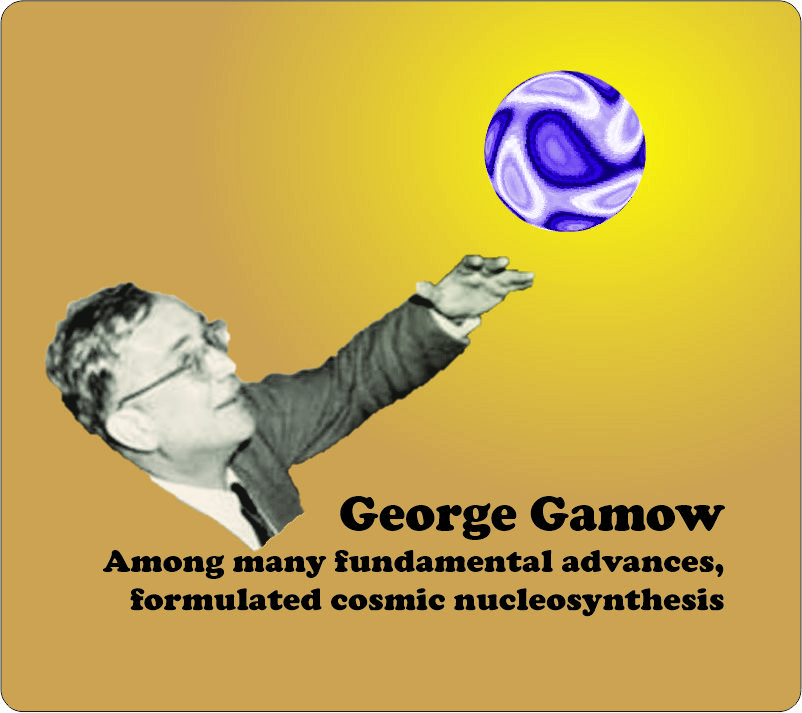
“Mm-hm. Think about it. Back when atoms first coalesced after the Big Bang, they were all either hydrogen or helium with just a smidgeon of lithium for flavor. Where did all the other elements come from? Friedmann’s student George Gamow figured that out, along with lots of other stuff. Fascinating guy, interested in just about everything and good at much of it. Born in Odessa USSR, he and his wife tried twice to defect to the West by kayak. They finally made it in 1933 by leveraging his invitation to Brussels and the Solvay Conference on Physics where Einstein and Bohr had their second big debate. By that time Gamow had produced his ‘liquid drop‘ theory of how heavy atomic nuclei decay by spitting out alpha particles and electrons. He built on that theory to explain how stars serve as breeder reactors.”

“I thought breeder reactors are for turning uranium into plutonium for bombs. Did he have anything to do with that?”

“By the start of the war he was a US citizen as well as a top-flight nuclear theorist but they kept him away from the Manhattan Project. That undoubtedly was because of his Soviet background. During the war years he taught university physics, consulted for the Navy, and thought about how stars work. His atom decay work showed that alpha particles could escape from a nucleus by a process a little like water molecules in a droplet bypassing the droplet’s surface tension. For atoms deep inside the Sun, he suggested that his droplet process could work in reverse. He calculated the temperatures and pressures it would take for gravity to force alpha particles or electrons into different kinds of nuclei. The amazing thing was, his calculations worked.”

“Wait — alpha particles? Where’d they come from if the early stars were just hydrogen and helium?”

“An alpha particle is just a helium atom with the electrons stripped off. Anyway, with Gamow leading the way astrophysicists figured out how much of which elements a given star would create by the time it went nova. Those elements became part of the gas‑dust mix that coalesces to become the next generation of stars. We may have gone through 100 such cycles so far.”

“A hundred generations of stars. Wow.”

~~ Rich Olcott
En Route to Spreading Out

“Gee, Mr Moire, if Einstein and Friedmann are right, some day the Universe will expand exponentially and everything dies. Even Dr Mack says that’s a downer.”

“First, it’s not ‘some day,’ it’s already. We’ve got evidence that exponential expansion became the dominant process five billion years ago. The interesting questions are about what happens during the expansion and what the timeline will be. That’s all controlled by a single weird parameter so naturally the parameter’s conventional symbol is w. Each major component of the Universe has its own value of w and they combine to predict the future course of the Universe.”

“Weird sounds like fun. What is it, another difference like the Cosmological Constant minus that mass‑pressure stuff?”

“Good guess, but it’s not a difference, It’s a ratio, between different flavors of energy.”

“Kinetic and potential, I’ll bet.”

“That split seems to be a common theme in Physics, doesn’t it? In this case, you’re almost right if we stretch things. One of the energy flavors is mass, including both normal and dark matter. If you take the long view, every atom of normal matter will sooner or later break down so you can think of it as a packet of potential energy, pent up and waiting for release. Dark matter, who knows? Anyway, w‘s denominator is mass per unit volume. The numerator’s a little trickier. As you guessed, we need something related to kinetic energy and we slide into that sideways.”

“How so?”

“Well, most of the normal matter is very dilute hydrogen which we can treat like a perfect gas. That’s something we’ve got a good theory for. Per unit volume, gas particle kinetic energy is proportional to pressure and that’s what we use for w‘s numerator. Averaged over the volume of space the pressure‑to‑mass ratio w for matter moving at ordinary speeds is effectively zero.”

“Does dark matter follow the same formula?”

“We pretend it does.”

“How about photons? They don’t have mass so that ratio would be infinity.”

“True, but they do carry momentum and it turns out w is simply ⅓ for photons and neutrinos and anything else traveling at relativistic speeds. Then there’s the Cosmological Constant’s w, which is minus‑one. Since the Big Bang we’ve gone from radiation‑dominated to matter‑dominated to Constant‑dominated; the effective w has shifted from somewhat positive to zero and into negative territory. Thanks to the surviving photons and matter, though, we’re still at least slightly above –1.0.”

“What difference does that make?”

“Minus‑one is the boundary between fates for the Universe. More positive than that, gravity and electromagnetism are guaranteed to be stronger than dark energy. Expansion will move gravity‑bound objects farther away from each other, but the galaxies and each galaxy cluster will stay together. The supply of hydrogen that fuels new stars will peter out. Eventually all the stars will gutter out and disappear into the cold dark as they wait for their constituent atoms to decay. The whole process will take something like 1010¹⁰ years.”

“That’s dark, alright, but at least it’ll take a long time. What happens of w is more negative than minus‑one?”

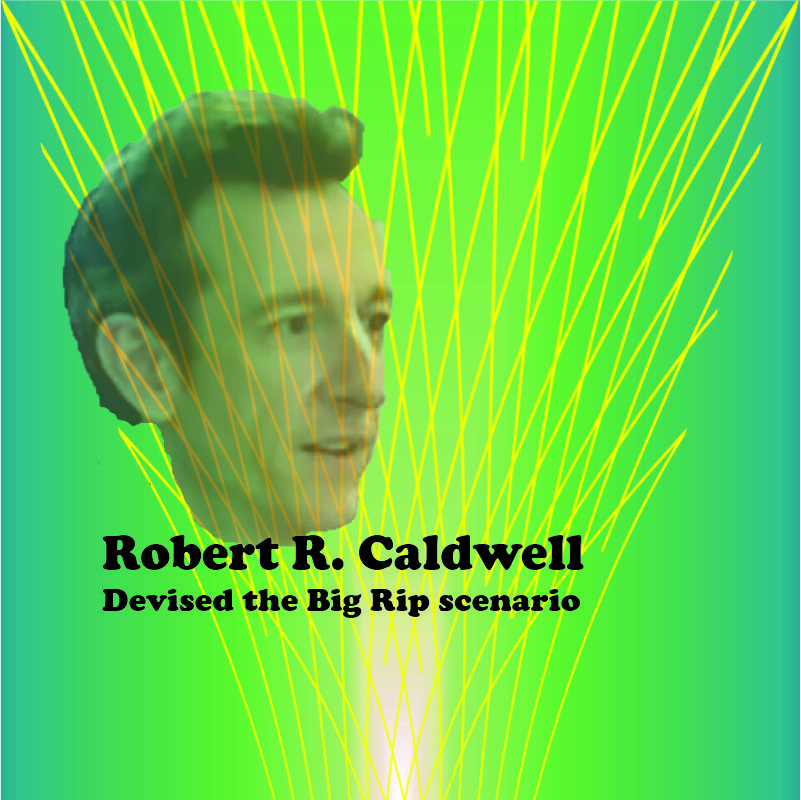
“The Big Rip. If w is more negative than the threshold, dark energy will grow stronger with time. We don’t know of anything that would limit the growth. First dark energy overpowers gravity and allows the galaxies and stars to disperse. Then it overrides the electromagnetism that holds molecules and rocks together. Eventually even the weak and strong nuclear forces will be defeated — no more atoms. Depending on how extreme w is, figure something like 200 billion years, give or take an eon.”

“Wow. But wait, we’ve covered radiation and mass and the Constant and none of them have a w below the threshold. What can have a more negative w?”

“A hypothesis. If there is anything, pretty much all we have is a name, ‘phantom energy,’ which is even more tentative than ‘dark energy.’ People are working to evaluate w with data. Results so far are so close to –1.0 that we can’t tell if it’s above or below the threshold or just teetering on the brink.”

“Two hundred billion years or way more. No worries, hey?”

~~ Rich Olcott

Constant’s Companion

“It’s like Mark Twain said, Jeremy — ‘History may not repeat itself, but it rhymes.‘ Newton identified gravity as a force; Einstein proposed the Cosmological Constant. Newton worked the data to develop his Law of Gravity; Friedmann worked Einstein’s theory to devise his model of an exponentially expanding Universe. Newton was uncomfortable with gravity’s ability to act at a distance; Einstein called the Cosmological Constant ‘his greatest blunder.’ The parallels go on.”

“Why didn’t Einstein like the Constant if it explains how the Universe is expanding?”

“It wasn’t supposed to. Expanding Universes weren’t in fashion a century ago when Einstein wrote that paper. At the time everyone including Einstein thought we live in a steady state universe. His first cut at a General Relativity field equation implied a contracting universe so he added a constant term to balance out the contraction even though it made the dynamics look unstable — the Constant had to have just the right value for stability. A decade later Hubble’s data pointed to expansion and Friedman’s equations showed how that can happen.”

“I guess Einstein was embarrassed about that, huh, Mr Moire?”

“Well, he’d thought all along that the Constant was mathematically inelegant. Besides, the Constant isn’t just a number or a term in an equation, it’s supposed to represent a real process in operation. Like Newton’s problem with gravity, Einstein couldn’t identify a mechanism to power the Constant.”

“Power it to do what?”

“Think about universal constants, like the speed of light or the electron charge. Doesn’t matter where you are or how fast you’re traveling in which inertial frame, they’ve got the same values. If the Constant is indeed a constant, it contributes equally to cosmological dynamics from every position in space, whether inside a star or millions of lightyears from any galaxy. Every point must exert the same outward force in every direction or there’d be swirling. And it multiplies — every instant of general expansion makes new points in between the old points and they’ll exert the same force, too.”

“That’s what makes it exponential, right?”

“Good insight. It’s a pretty weak force per unit volume, weaker than gravity. We know that because galaxies and galaxy cluster structures maintain integrity even as they’re drifting apart from each other. Even so, a smidgeon of force from each unit volume in space adds up to a lot of force. Multiply force by distance traveled — that’s a huge amount of energy spent against gravity. The big puzzle is, what’s the energy source? Most of the astrophysics community nominates dark energy to power the Cosmological Constant but that’s not much help.”

“As Dr Prather says in class, Mr Moire, ‘You sound tentative. Please expound.‘ Why wouldn’t dark energy be the power source?”

“In Physics we use the word ‘energy‘ with a very specific meaning. Yes, it gets heavy use with sloppy meanings in everything from show business to crystal therapy, but in hard science nearly every serious research program since the 18th Century has entailed quantitative energy accounting. The First Law of Thermodynamics is conservation of energy. Whenever we see something heating up, a chemical reaction running or a force being applied along a distance, physicists automatically think about the energy being expended and where that energy is coming from. Energy’s got to balance out. But the Constant breaks that rule — we have no idea what process provides that energy. Calling the source ‘dark energy‘ just gives it a name without explaining it.”

“Isn’t the missing energy source evidence against Friedmann’s and Einstein’s equations?”

“That’s a tempting option and initially a lot of researchers took it. Unfortunately, it seems that dark energy is a thing. Or maybe a lot of little things. Several different lines of evidence say that the Constant constitutes twice as much mass‑energy as all normal and dark matter combined. Worse yet, as the Universe expands that share will increase.”

“Wait, will the dark energy invade normal matter and break us up?”

“People argue about that. Normal matter’s held together by electromagnetic forces which are 1038 times stronger than gravity, far stronger yet than dark energy. Dark matter’s gravity helps to hold galaxies together, but who knows what holds dark matter together?”

~~ ROlcott

Lord Rayleigh Resolves

Mr Feder just doesn’t quit. “But why did they make JWST so big? We’re getting perfectly good pictures from Hubble and it’s what, a third the size?”

Al’s brought over a fresh pot and he’s refilling our coffee mugs. “Chalk it up to good old ‘because we can.’ Rockets are bigger than in Hubble‘s day, robots can do more remote stuff by themselves, it all lets us make a bigger scope.”

Cathleen smiles. “There’s more to it than that, Al. It’s really about catching photons. You’re nearly correct, Mr Feder, the diameter ratio is 2.7. But photons aren’t captured by a line across the primary mirror, they’re captured by the mirror’s entire area. The important JSWT:Hubble ratio is between their areas. JWST beats Hubble there by a factor of 7.3. For a given source and the same time interval, we’d expect JWST to be that much more sensitive than Hubble.”

“Well,” I break in, “except that the two use photon detectors that are sensitive to different energy ranges. The two scopes often won’t even be looking at the same kinds of object. Hubble‘s specialized for visible and UV light. It’s easy to design detectors for that range because electrons in solid‑state devices respond readily to the high‑energy photons. The infrared light photons that JWST‘s designed for don’t have enough energy to kick electrons around the same way. Not really a fair comparison, although everything I’ve read says that JWST‘s sensitivity will be way up there.”

Mr Feder is derisive. “‘Way up there.’ Har, har, de-har. I suppose you’re proud of that.”

“Not really, it just happened. But Cathleen, I’m surprised that you as an astronomer didn’t bring up the other reason the designers went big for JWST.”

“True, but it’s more technical. You’re thinking of resolution and Rayleigh’s diffraction limit, aren’t you?”

“Bingo. Except Rayleigh derived that limit from the Airy disk.”

“Disks in the air? We got UFOs now? What’re you guys talking about?”

Portrait of Sir George Airy
licensed under the Creative Commons
Attribution 4.0 International license.

“No UFOs, Mr Feder, I’ll try to be non‑technical. Except for the big close objects like the Sun and its planets, telescopes show heavenly bodies as circular disks accompanied by faint rings. In the early 1800s an astronomer named George Airy proved that the patterns are an illusion produced by the telescope. His math showed that even the best possible apparatus will force lightwaves from any small distant light source to converge to a ringed circular disk, not a point. The disk’s size depends on the ratio between the light’s wavelength and the diameter of the telescope’s light‑gathering aperture. How am I doing, Al?”

“Fine so far.”

“Good. Rayleigh took that one step further. Suppose you’re looking at two stars that are very close together in the sky. You’d expect to see two Airy patterns. However, if the innermost ring from one star overlaps the other star’s disk, you can’t resolve the two images. That’s the basis for Rayleigh’s resolvability criterion — the angle between the star images, measured in arc‑seconds, has to be at least 252000 times the wavelength divided by the diameter.”

After a diagram by cmglee
licensed under the Creative Commons
Attribution 3.0 International license.

“But blue light’s got a shorter wavelength than red light. Doesn’t that say that my scope can resolve close-together blue stars better than red stars?”

“Sure does, except stars don’t emit just one color. In visible light the disk and rings are all rimmed with reddish and bluish fuzz. The principle works just fine when you’re looking at a single wavelength. That gets me to the answer to Mr Feder’s question. It’s buried in this really elegant diagram I just happen to have on my laptop. Going across we’ve got the theoretical minimum angle for resolving two stars. Going up we’ve got aperture diameters, running from the pupil of your eye up to radio telescope coalitions that span continents. The colored diagonal bands are different parts of the electromagnetic spectrum. The red bars mark each scope’s sensor wavelength range. Turns out JWST‘s size compared to Hubble almost exactly compensates for the longer wavelengths it reports on.”

~~ Rich Olcott

Now You See It, Now You Don’t

Al’s face takes on a far-away smile. “James Webb Space Telescope must look pretty up there — a golden honeycomb on a silver setting, floating in space.”

“Real artistic and all, but how come all that gold? The mirror’s what, 60 feet across. Half of that is 30 for the radius, square it is 900, times 3 plus a little for pi, makes like 3000 square feet. That’s a lot of gold and us taxpayers sent it up to space! Why not make it shiny with something cheaper?”

“Nice on-the-fly math, Mr Feder, but it’s much less gold than you think. Ever play with gold leaf?”

“Yeah, once when my cousin was decorating one of her artsy‑tartsy ceramic pieces. I went to pick up one of her leftover scraps and my breath blew it away.”

“Thin, huh? One of my astronomy magazines had an article, said the gold coating on the JWST‘s dish is only a little thicker than gold leaf, just 1000 atoms top to bottom. They don’t even apply it with a brush like people usually do. Your cousin may have artisan‑level skills but her manual techniques can’t match the precision JWST‘s design demands. The fabricators used a vapor deposition process like the semiconductor people use to make computer chips.”

“So how much gold?”

“Less than three grams per segment. That ring on your finger weighs more. The article said each segment has about $180 worth of gold, pretty small compared to the project’s ten billion dollar price tag.”

“Even so, why gold? Why not something cheaper?”

“I dunno. I see it a lot on different missions. The Insight Mars lander’s below‑deck electronics section was shrouded with gold-covered plastic panels. What’s the story, Sy?”

“Gold’s a special metal, Al. It ranks up with copper and silver for electrical conductivity but unlike them it doesn’t corrode. That’s why so many electrical switches and data cables use a thin layer of it at the contact points. The conductivity comes from the metal’s high concentration of free electrons, like an ocean of them sloshing around the atomic lattice. The free electrons also make gold an efficient reflector for electromagnetic radiation all across the spectrum from UV light way down into the radio range. The engineers for Insight and a lot of other missions put a thin gold layer on those insulation panels to protect the plastic from incoming high‑energy photons that would break up the polymer molecules. JWST needs to send every passing photon into the satellite’s detectors so gold’s high reflectivity made it the obvious candidate for the mirror coating.”

“I wonder if I’ll be able to see that honeycomb through my backyard telescope.”

“We can put numbers to that.” <drawing Old Reliable from its holster and tapping screen‑keys> “Lessee … using the small angle approximation for the sine function, to resolve a grid of 20-foot hexagons a million miles away you’d need an angular resolution of
  (20 feet) / [(106 miles)*(5280 feet/mile)]
   = 3.8×10⁻⁹ radians = 784 micro‑arcseconds

For yellow light’s 570‑nanometer wavelength, Rayleigh’s angular resolution formula gives
  aperture diameter
   =1.22*(wavelength)/(angle in radians) = 1.22*570×10-9/3.8×10-9 = 183 meters.
You’d need a telescope with a 550‑foot front end. If I remember right, Al, that’s almost ten times the width of your yard. You’d need at least a 60‑meter mirror just to see the entire dish as anything more than a yellow speckle.”

“Even with a scope like that Al would have a problem, Sy.”

“What’s that, Cathleen?”

“Viewed from the Sun, JWST‘s orbit looks straightforward — a half‑million‑mile half‑year vertical loop around the Sun‑Earth L2 point that itself circles the Sun once a year. Viewed from Earth, though, it’s a far more complicated motion. Earth’s orbit parallels JWST‘s so half the time JWST leads Earth and half it lags behind. At the extremes, JWST scoots along at twice Earth’s speed or else it appears to stop against the background stars. It’d be a challenging target for a star‑tracker program without a minute‑by‑minute computerized ephemeris.”

“He wouldn’t see the honeycomb even with that scope, Moire. JWST‘s always gonna point away from the Sun and us. The only view we’ll ever get is that pink parasol.”

~~ Rich Olcott

The Gelato Model

“Eddie, this ginger gelato’s delicious — not too sweet and just the right amount of ginger bite.”

“Glad you like it, Anne.”

On the way down here, Sy was telling me about how so many things in the Universe run on the same mathematics if you look at them with the right coordinate system. Sy, how do you pick ‘the right coordinate system?”

“The same way you pick the right property to serve as a momentum in Newton’s Equation of Motion — physical intuition. You look for things that fit the system. Sometimes that puts you on the road to understanding, sometimes not. Eddie, you keep track of your gelato sales by flavor. How are they doing?”

“Pistachio’s always a good seller, Sy, but ginger has been coming on strong this year.”

“In motion terns, pistachio’s momentum is constant but ginger is gaining momentum, right?”

“S’what I said.”

“Measured in dollars or trayfuls?”

“In batches. I make it all in-house. I’m proud of that. Dollars, too, of course, but that’s just total for all flavors.”

“Batches all the same size?”

“Some are, some not, depending. If I had a bigger machine I could make more but I do what I can.”

“There you go, Anne, each gelato flavor is like a separate degree of freedom. Eddie’s tracked sales since he started so we can take that date as the origin. Measuring change along any degree in either batches or dollars we have perfectly respectable coordinates although the money view of the system is fuzzier. Velocity is batches per unit time, there’s even a speed limit, and ginger has accelerated. Sound familiar?”

“Sounds like you’re setting up a Physics model.”

“Call it gelato trend physics, but I don’t think I can push the analogy much further. The next step would be to define a useful momentum like Newton did with his Law of Motion.”

F=ma? That’s about acceleration, isn’t it?”

“Probably not in Newton’s mind. Back in his day they were arguing about which was conserved, energy or momentum. It was a sloppy argument because no‑one agreed on crisp definitions. People could use words like ‘quantity of motion‘ to refer to energy or momentum or even something else. Finally Newton defined momentum as ‘mass times velocity‘, but first he had to define ‘mass‘ as ‘quantity of matter‘ to distinguish it from weight which he showed is a force that’s indirectly related to mass.”

“So is it energy or momentum that’s conserved?”

“Both, once you’ve got good definitions of them. But my point is, our car culture has trained us to emphasize acceleration. Newton’s thinking centered on momentum and its changes. In modern terms he defined force as momentum change per unit time. I’m trying to think of a force‑momentum pair for Eddie’s gelato. That’s a problem because I can’t identify an analog for inertia.”

“Inertia? What’s that got to do with my gelato?”

“Not much, and that’s the problem. Inertia is resistance to force. Who can resist gelato? If it weren’t for inertia, the smallest touch would be enough to send an object at high speed off to forever. The Universe would be filled with dust because stars and planets would never get the chance to form. But here we are, which I consider a good thing. Where does inertia come from? Newton changed his mind a couple of times. To this day we only have maybe‑answers to that question.”

“You know we want to know, Sy.”

“Einstein’s favorite guess was Mach’s Principle. There’s about a dozen different versions of the basic idea but they boil down to matter interacting with the combined gravitational and electromagnetic fields generated by the entire rest of the Universe.”

“Wow. Wait, the stars are far away and the galaxies are much, much further away. Their fields would be so faint, how can they have any effect at all?”

“You’re right, Anne, field intensity per star does drop with distance squared. But the number of stars goes up with distance cubed. The two trends multiply together so the force trends grow linearly. It’s a big Universe and size matters.”

“So what about my gelato?”

“We’ll need more research, Eddie. Another scoop of ginger, Anne?”

~~ Rich Olcott

Deep Symmetry

“Sy, I can understand mathematicians getting seriously into symmetry. They love patterns and I suppose they’ve even found patterns in the patterns.”

“They have, Anne. There’s a whole field called ‘Group Theory‘ devoted to classifying symmetries and then classifying the classifications. The split between discrete and continuous varieties is just the first step.”

“You say ‘symmetry‘ like it’s a thing rather than a quality.”

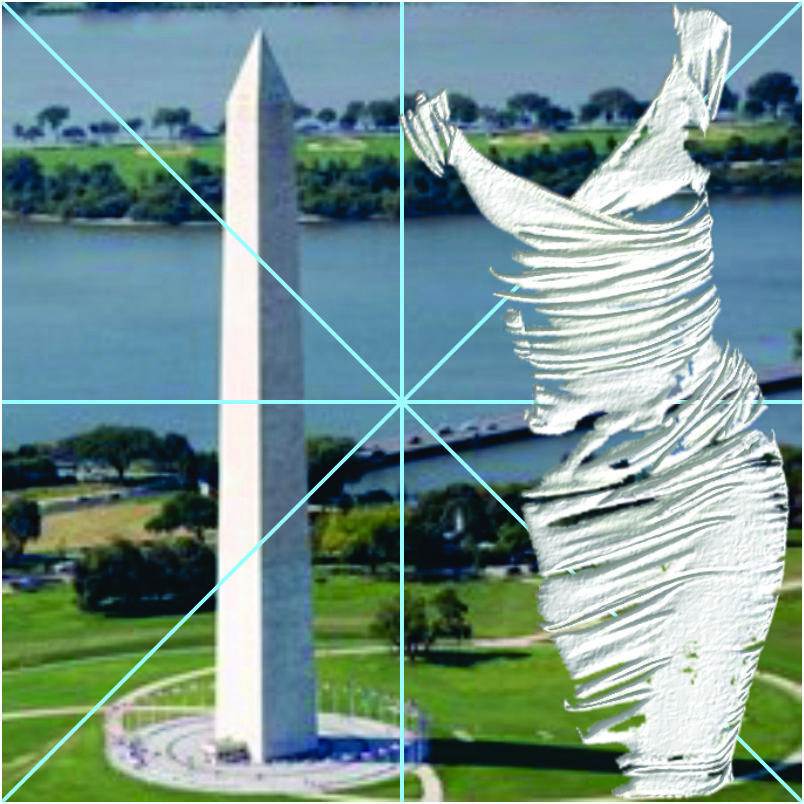
“Nice observation. In this context, it is. Something may be symmetrical, that’s a quality. Or it may be subject to a symmetry operation, say a reflection across its midline. Or it may be subject to a whole collection of operations that match the operations of some other object, say a square. In that case we say our object has the symmetry of a square. It turns out that there’s a limited number of discrete symmetries, few enough that they’ve been given names. Squares, for instance, have D4 symmetry. So do four-leaf clovers and the Washington Monument.”

“OK, the ‘4’ must be in there because you can turn it four times and each time it looks the same. What’s the ‘D‘ about?”

Dihedral, two‑sided, like two appearances on either side of a reflection. That’s opposed to ‘C‘ which comes from ‘Cyclic’ like 1‑2‑3‑4‑1‑2‑3‑4. My lawn sprinkler has C4 symmetry, no mirrors, but add one mirror and bang! you’ve got eight mirrors and D4 symmetry.”

“Eight, not just four?”

“Eight. Two mirrors at 90° generate another one 45° between them. That’s the thing with symmetry operations, they combine and multiply. That’s also why there’s a limited number of symmetries. You think you’ve got a new one but when you work out all the relationships it turns out to be an old one looked at from a different angle. Cubes, for instance — who knew they have a three‑fold rotation axis along each body diagonal, but they do.”

“I guess symmetry can make physics calculations simpler because you only have to do one symmetric piece and then spread the results around. But other than that, why do the physicists care?”

“Actually they don’t care much about most of the discrete symmetries but they care a whole lot about the continuous kind. A century ago, a young German mathematician named Emmy Noether proved that within certain restrictions, every continuous symmetry comes along with a conserved quantity. That proof suddenly tied together a bunch of Physics specialties that had grown up separately — cosmology, relativity, thermodynamics, electromagnetism, optics, classical Newtonian mechanics, fluid mechanics, nuclear physics, even string theory—”

“Very large to very small, I get that, but how can one theory have that range? And what’s a conserved quantity?”

“It’s theorem, not theory, and it capped two centuries of theoretical development. Conserved quantities are properties that don’t change while a system evolves from one state to another. Newton’s First Law of Motion was about linear momentum as a conserved quantity. His Second Law, F=ma, connected force with momentum change, letting us understand how a straight‑line system evolves with time. F=ma was our first Equation of Motion. It was a short step from there to rotational motion where we found a second conserved quantity, angular momentum, and an Equation of Motion that had exactly the same form as Newton’s first one, once you converted from linear to angular coordinates.”

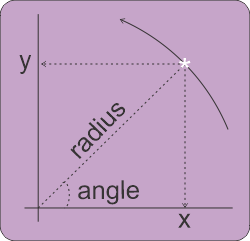
“Converting from x-y to radius-angle, I take it.”

“Exactly, Anne, with torque serving as F. That generalization was the first of many as physicists learned how to choose the right generalized coordinates for a given system and an appropriate property to serve as the momentum. The amazing thing was that so many phenomena follow very similar Equations of Motion — at a fundamental level, photons and galaxies obey the same mathematics. Different details but the same form, like a snowflake rotated by 60 degrees.”

“Ooo, lovely, a really deep symmetry!”

“Mm-hm, and that’s where Noether came in. She showed that for a large class of important systems, smooth continuous symmetry along some coordinate necessarily entails a conserved quantity. Space‑shift symmetry implies conservation of momentum, time‑shift symmetry implies conservation of energy, other symmetries lock in a collection of subatomic quantities.”

“Symmetry explains a lot, mm-hm.”

~~ Rich Olcott

Things That Won’t Work

Vinnie gets a far-away look in his eye. I wait. “Ya know, Sy, there oughtta be a way.”

“A way to what?”

“I ain’t giving up on this faster-than-light communication stuff. I know Einstein said it couldn’t happen because it’d flip cause and effect and he didn’t like that, but that feels too much like philosophy books I’ve read that boil down to, ‘This thing can’t be true because I don’t want it to be.’ Maybe there’s something we ain’t thought of yet.”

“Lots of people have played with that challenge for decades. Do you have any fresh ideas?”

“A couple possibles. Lessee if I’ve got this straight. We’ve got two separate message channels going — one that works instant-like for information between entangled quantum thingies, and one for everything else that’s stuck at lightspeed or less. Suppose I’ve got two entangled pizzas— nah, we’re really talking quantum stuff like electrons and photons so I’ll just say particles. Suppose I’ve got two entangled particles that are some ugly mix of red and green but we know when they’re de-linked they’ll be opposite. I send one to you the regular way but they’re still linked. I look at the one I still got and it’s red, say. The same moment, yours instantly went green but you don’t know that yet until you look or you get status information from me through the not‑instant channel. So the problem is getting information to leak between the two channels, right?”

“That’s about the size of it.”

“OK, try this one. How about I use a magnetic field or something to force mine to red? And maybe a set time later I make it green to confirm I’m in control and it’s a real signal.”

“Sorry, as soon as you manipulate properties in part of an entangled system you break the entanglement and the other part is free to do whatever it wants to. Next?”

“Uhh … time synchronization. How about you and me set a certain time for me to look at mine? You can watch yours and when it flips or not you’ll know.”

“All that does is move the manipulation to the other end of the setup. Me looking at my particle resets yours to whatever color mine isn’t and that breaks the entanglement. Next?”

“Maybe something with a bunch of particles all entangled together? How about—”

“Nup, can’t base a strategy on that. Like everything else quantum, entanglement is statistical. There’s no guarantee that even in our two‑particle system I’ll see green if you see red — the odds are high but not 100%. There’s a proven theorem that says if two particles are ‘maximally entangled,’ adding a third to the system reduces the odds that any two will coordinate their behaviors. A bunch of particles would be even less stable. It’s called the monogamy theorem, care to guess why?”

“Physics fun with metaphors again, cute, but I can see this is a good one. You got anything?”

“Not having to do with entanglement, but I have been playing with a different idea, sort of a blank‑sky approach.”

“You mean blue‑sky.”

“Uh-uh, blank. Think about a sky made of dark matter. Dark matter’s subject to gravity but so far as we know it has absolutely no interaction with electromagnetism of any kind — doesn’t play with electrons, light waves, nothing. Einstein based part of his relativity work on Maxwell’s electromagnetism equations. In fact, that’s where the idea came from that ‘c‘ was the speed limit for the Universe. It was a good idea and there’s a huge amount of evidence that he was right. Everything in our Standard Model except the photon is subject to the Lorentz factor. Both light and gravity acting on normal matter travel at c‑speed. Well, maybe the value of c has something to do with how quarks work. Dark matter doesn’t have quarks. What if dark matter has a different speed limit, maybe a lot higher than c or even no limit at all? Maybe we could exploit that property somehow. How about a dark‑matter telegraph?”

“I’m thinking of my Grampa’s recipe for rabbit stew. ‘First you gotta catch your rabbit,’ he used to say,”

~~ Rich Olcott

The Edge of Pinkness

Susan Kim takes a sip of her mocha latte. eyes me over the rim. “That’s quite a set of patterns you’ve gathered together, Sy, but you’ve left out a few important ones.”

“Patterns?”

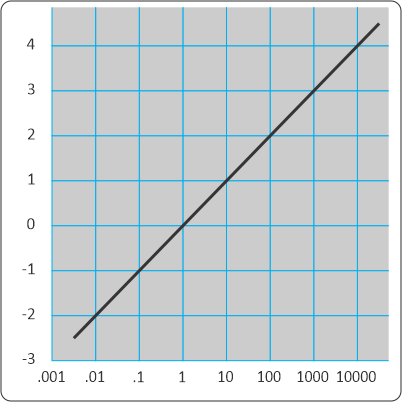
A log-linear plot

“Regularities we’ve discovered in Nature. You’ve written about linear and exponential growth, the Logistic Curve that describes density‑limited growth, sine waves that wobble up and down, maybe a couple of others down‑stack, but Chemistry has a couple I haven’t seen featured in your blog.”

“Such as?”

“Log-linear relationships are a biggie. We techies use them a lot to handle phenomena with a wide range. Rather than write 1,000,000,000 or 109, we sometimes just write 9, the base‑10 logarithm. The pH scale for acid concentration is my favorite example. It goes from one mole per liter down to ten micro‑nanomoles per liter. That’s 100 to 10-14. We just drop the minus sign and use numbers between 0 and 14. Fifteen powers of ten. Does Physics have any measurements that cover a range like that?”

“A handful, maybe, in theory. The limitation is in confirming the theory across a billion-fold range or wider. Atomic clocks that are good down to the nanosecond are our standards for precision, but they aren’t set up to count years. Mmmm … the Stefan‑Boltzmann Law that links an object’s electromagnetic radiation curve to its temperature — our measurements cover maybe six or seven powers of ten and that’s considered pretty good.”

“Pikers.” <but I like the way she grins when she says it>

“I took those Chemistry labs long ago. All I remember was acids were colorless and bases were pink. Or maybe the other way around.”

“You’ve got it right for the classic phenolphthalein indicator, but there are dozens of other indicators that have different colors at different acidities. I’ll tell you a secret — phenolphthalein doesn’t kick over right at pH 7, the neutral point. It doesn’t turn pink until the solution’s about ten times less acidic, near pH 8.”

Adapted from this file by Damitr, CC BY-SA 4.0

“So all my titrations were off by a factor of ten?”

“Oh, no, that’s not how it works. I’m going to use round numbers here, and I’ll skip a couple of things like the distinction between concentration and activity. Student lab exercises generally use acid and base concentrations on the order of one molar. For most organic acids, that’d give a starting pH near 1 or 2, way over on the sour side. In your titration you’d add base, drop by drop, until the indicator flips color. At that point you conclude the amounts of acid and base are equivalent, not by weight but by moles. If you know the base concentration you can calculate the acid.”

“That’s about what I recall, right.”

“Now consider that last drop. One drop is about 50 microliters. With a one‑molar base solution, that drop holds 50 nanomoles. OK?”

<I scribble on a paper napkin> “Mm-hm, that looks right.”

“Suppose there’s about 50 milliliters of solution in the flask. Because we’re considering the last drop, the solution in the flask must have become nearly neutral, say pH 6. That means the un‑neutralized acid concentration was 10-6 moles per liter, or one micromolar. Fifty milliliters at one micromolar concentration is, guess what, 50 nanomoles. Your final drop neutralizes the last of the acid sample.”

“So the acid concentration goes to zero?”

“Water’s not that cooperative. Water molecules themselves act like acids and bases. An H2O molecule can snag a hydrogen from another H2O giving an H3O+ and an OH. Doesn’t happen often, but with 55½ moles of water per liter and 6×10²³ molecules per mole there’s always a few of those guys hanging around. Neutral water runs 10-7 moles per liter of each, which is why neutral pH is 7. Better yet, the product of H3O+ and OH concentrations is always 10-14 so if you find one you can calculate the other. Take our titration for example. One additional drop adds 50 nanomoles more base. In 50 milliliters of solution that’s roughly 10-6+10-7 molar OH. Call it 1.1×10⁻⁶, which implies 0.9×10⁻⁸ molar H3O+. Log of that and drop the minus sign, you’re a bit beyond pH 8 which sends phenolphthalein into the pink side. Your titration’s good.”

I eye her over my mug of black mud. “A gratifying indication.”

~~ Rich Olcott

Hysteresis Everywhere

“We’ve known each other for a long time, ain’t we, Sy?”

“That we have, Vinnie.”

“So I get suspicious when we’ve specific been talking about a magnetic field making something else magnetic and you keep using general words like ‘driver‘ and ‘deviation‘. You playing games?”

“You caught me. The hysteresis idea spreads a lot farther than magnetism. It addresses an entire dimension Newton was too busy to think about — time.”

“Wait a minute. Newton was all about velocity and acceleration and both of them are something‑per‑time. It’s right there in the units. Twice for acceleration.”

“True, but each is really about brief time intervals. Say you’re riding a roller‑coaster. Your velocity and acceleration change second‑by‑second as forces come at you. Every force changes your net acceleration immediately, not ten minutes from now. Hysteresis is about change that happens because of a cause some time in the past. Newton didn’t tackle time‑offset problems, I suppose mostly because the effects weren’t detectable with the technology of his time.”

“They had magnets.”

“Permanent ones, not electromagnets they could control and measure the effects of. Electromagnetic hysteresis generates effects that Newton couldn’t have known about. Fahrenheit didn’t invent temperature measurement until two years before Newton died, so science hadn’t yet discovered temperature‑dependent hysteresis effects. The microscope had been around for a half‑century or so but in Newton’s day people were still arguing about whether cells were a necessary part of a living organism. Newton’s world didn’t have an inkling of cellular biophysics, much less biophysical hysteresis. At human scale, country‑level economic data if it existed at all was a military secret — not a good environment for studying cases of economic hysteresis.”

“So what you’re saying is that Newton couldn’t have tackled those even if he’d wanted to. Got it. But that’s a pretty broad list of situations. How can you say they’re all hystereseseses, … loopy things?”

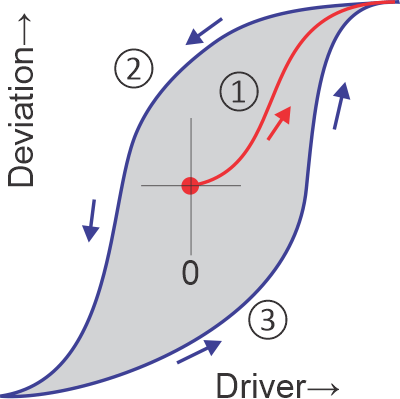
“They’ve all got a set of characteristics that you can fit into similar mathematical models. They’re all about some statistical summary of a complex system. The system is under the influence of some outside driver, could be a physical force or something more abstract. The driver can work in either of two opposing directions, and the system can respond to the driver to change in either of two opposing ways. Oh, and a crucial characteristic is that the system has a buffer of some sort that saves a memory of what the driver did and serves it up some time later.”

“Wait, lemme see if I can match those pieces to my magnetic nail. OK, the driver is the outside magnetic field, that’s easy, the system is the magnetic iron atoms, and the summary is the nail’s field. The driver can point north‑to‑south or south‑to‑north and the atoms can, too. Ah, and the memory is the domains ’cause the big ones hold onto the direction the field pointed last. How’d I do?”

“Perfect.”

“Goody for me. So why are those guys on the radio saying the economy is hysterical, ‘scuse, has hysteresis? What’s which part?”

“Economies are complex beasts, with a lot of separate but interacting hysteresis loops. These guys, what were they discussing at the time?”

“Unemployment, if I remember right. They said the job market is sticky, whatever that means.”

“Good example. Here’s our basic hysteresis loop with some relabeling. Running across we’ve got our driver, the velocity of money, which claims to measure all the buying and selling. Up‑and‑down we’ve got total employment. The red dot is the initial equilibrium, some intermediate level where there’s just enough cash flowing around that some but not all people have jobs. Then a new industry, say cellphones, comes in. Suddenly there’s people making cellphones, selling cellphones, repairing cellphones –“

“I get the idea. More activity, money flows faster, more jobs and people are happy. OK, then the pandemic comes along, money slows down, jobs cut back and around we go. But where’s the stickiness?”

“In people’s heads. If they get into Depression thinking, everyone holds onto cash even if there’s a wonderful new cellphone out there. People have to start thinking that conditions will improve before conditions can improve. That’s the delay factor.”

“Hysterical, all right.”

~~ Rich Olcott