The Sound of Money

<chirp, chirp> “Moire, here, there’ll be a late-night surcharge for this call.”

“Hiya, Sy, it’s me, Vinnie. Got a minute? I wanna run something past you.”

“Sure, if it’s interesting enough to keep me awake.”

“It’s that Physics-money hobby horse you’ve been riding. I think I’ve got another angle on it for you.”

“Really? Shoot.”

“OK, a while ago you and me and Richard Feder talked about waves and how light waves and sound waves are different because light waves make things go up-and-down while the waves go forward but sound waves go back-and-forth.”

“Transverse waves versus compression waves, uh-huh.”

“Yeah and when you look close at a sound wave what you see is individual molecules don’t travel. What happens is like in a pool game where one ball bumps another ball and it stops but the bumped ball moves forward and the first ball maybe even moves back a little.”

“The compression momentum carries forward even though the particles don’t, right.”

“And that means that sound waves only travel as fast as the air molecules can move back and forth which is a lot slower than light waves which move by shaking the electric field. I got that, but why doesn’t sound move a lot faster in something like iron where the atoms don’t have to move?”

“Oh, it does, something like 200 times faster than in air. There’s a couple of factors in play. It all goes back to Newton —”

“Geez, he had a hand in everything Physics, didn’t he?”

“Except for electromagnetism and nuclear stuff. The available technology was just too primitive to let him experiment in those areas. Anyway, Newton discovered a formula connecting the speed of sound in a medium to its density. Like his Law of Gravity, it worked but he didn’t know why it worked. Also like gravity, we’ve got a better idea now.”

“What’s the better idea?”

“The key notions weren’t even invented until decades after Newton’s Principia was published. The magic words are the particulate nature of matter and intermolecular stiffness.”

“Hah?”

“One at a time. Newton was a particle guy to an extent. He believed that light is made of particles, but he didn’t take the next step to thinking of all matter as being made of particles. But it is, and the particles interact with each other. Think of it as stickiness. How effective the stickiness is depends on the temperature and which molecules you’re talking about. Gas molecules have so much kinetic energy relative to their sticky that they mostly just bounce off each other. In liquids and solids the molecules stay close enough together that the stickiness acts like springs. The springs may be more or less stiff depending on which molecules or ions or atoms are involved.”

“I see where you’re going. Stuff with stiffer springs doesn’t move as much as looser stuff at the same temperature; sound goes faster through a solid than through a liquid or gas. That’s what Newton figured out, huh?”

“No, he just measured and said, basically, ‘here’s the formula.‘ Just like with gravity, he didn’t suggest why the numbers were what they were. <yawn> So, you called with an idea about sound and money physics.”

“Right. Got off the track there, but this was helpful. What got me started was some newscaster saying how the Paycheck Protection Program is dumping money into the economy during the pandemic. My first thought was, ‘Haw, that’s gotta be a splash!‘ Then I imagined this pulse of money sloshing back and forth like a wave and that led me to sound waves and then I kept going. No dollar bill moves around that much, but when people spend them that’s like the compression wave moving out.”

“Interesting idea, Vinnie. From a Physics perspective, the question is, ‘How fast does the wave move?’ It’s another temperature‑versus‑stickiness thing.”

“Yeah, I figure money velocity measures the economy like temperature measures molecule motion. Money velocity goes up with inflation. If the velocity’s high people spend their money because why not.”

“Yup. From the government’s perspective the whole purpose of economic stimulation is getting the cash flowing again. Their problem is locating the money velocity kickover point.”

~~ Rich Olcott

Sisyphus on A Sand Dune

I’m walking the park’s paths on a lovely early Spring day when, “There you are, Moire. I got a question!”

“As you always do, Mr Feder. What’s your question this time?”

“OK, this guy’s saying that life is all about fighting entropy but entropy always increases anyway. I seen nothing in the news about us fighting entropy so where’s he get that? Why even bother if we’re gonna lose anyway? Where’s it coming from? Can we plug the holes?”

“That’s 4½ questions with a lot of other stuff hiding behind them. You’re going to owe me pizza at Eddie’s AND a double-dip gelato.”

“You drive a hard bargain, Moire, but you’re on.”

“Deal. Let’s start by clearing away some underbrush. You seem to have the idea that entropy’s a thing, like water, that it flows around and somehow seeps into our Universe. None of that’s true.”

“That makes no sense. How can what we’ve got here increase if it doesn’t come from somewhere?”

“Ah, I see the problem — conservation. Physicists say there are two kinds of quantities in the Universe — conserved and non‑conserved. The number of cards in a deck is is a conserved quantity because it’s always 52, right?”

“Unless you’re in a game with Eddie.”

“You’ve learned that lesson, too, eh? With Eddie the system’s not closed because he occasionally adds or removes a card. Unless we catch him at it and that’s when the shouting starts. So — cards are non-conserved if Eddie’s in the game. Anyway, energy’s a conserved quantity. We can change energy from one form to another but we can’t create or extinguish energy, OK?”

“I heard about that. Sure would be nice if we could, though — electricity outta nothing would save the planet.”

“It would certainly help, and so would making discarded plastic just disappear. Unfortunately, mass is another conserved quantity unless you’re doing subatomic stuff. Physicists have searched for other conserved quantities because they make calculations simpler. Momentum‘s one, if you’re careful how you define it. There’s about a dozen more. The mass of water coming out of a pipe exactly matches the mass that went in.”

“What if the pipe leaks?”

“Doesn’t matter where the water comes out. If you measure the leaked mass and the mass at the pipe’s designed exit point the total outflow equals the inflow. But that gets me to the next bit of underbrush. Energy’s conserved, that’s one of our bedrock rules, but energy always leaks and that’s another bedrock rule. The same rule also says that matter always breaks into smaller pieces if you give it a chance though that’s harder to calculate. We measure both leakages as entropy. Wherever you look, any process that converts energy or matter from one form to another diverts some fraction into bits of matter in random motion and that’s an increase of entropy. One kind of entropy, anyway.”

“Fine, but what’s all this got to do with life?”

“It’s all to get us to where we can talk about entropy in context. You’re alive, right?”

“Last I looked.”

“Ever break a bone?”

<taps his arm> “Sure, hasn’t everybody one time or another?”

“Healed up pretty well, I see. Congratulations. Right after the break that arm could have gone in lots of directions it’s not supposed to — a high entropy situation. So you wore a cast while your bone cells worked hard to knit you together again and lower that entropy. Meanwhile, the rest of your body kept those cells supplied with energy and swept away waste products. You see my point?”

“So what you’re saying is that mending a broken part uses up energy and creates entropy somewhere even though the broken part is less random. I got that.”

“Oh, it goes deeper than that. If you could tag one molecule inside a living cell you’d see it bouncing all over the place until it happens to move where something grabs it to do something useful. Entropy pushes towards chaos, but the cell’s pattern of organized activity keeps chaos in check. Like picnicking on a windy day — only constant vigilance maintains order. That’s the battle.”

“Hey, lookit, Eddie’s ain’t open. I’ll owe you.”

“Pizza AND double-dip gelato.”

~~ Rich Olcott

Disentangling 3-D Plaid

Our lake-side jog has slowed to a walk and suddenly Mr Feder swerves off the path to thud onto a park bench. “I’m beat.”

Meanwhile, heavy footsteps from behind on the gravel path and a familiar voice. “Hey, Sy, you guys talking physics?”

“Well, we were, Vinnie. Waves, to be exact, but Feder’s faded and anyway his walk wasn’t fast enough to warm me up.”

“I’ll pace you. What’d I miss?”

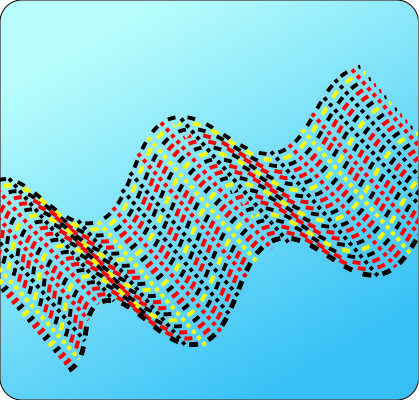
“Not a whole lot. So many different kinds of waves but physicists have abstracted them down to a common theme — a pattern that moves through space.”

“Haw — flying plaid.”

“That image would work if each fiber color carried specific values of energy and momentum and the cross-fibers somehow add together and there’s lots of waves coming from all different directions so it’s 3-D.”

“Sounds complicated.”

“As complicated as the sound from a symphony.”

“I prefer dixieland.”

“Same principle. Trumpet, trombone, clarinet, banjo — many layers of harmony but you can choose to tune in on just one line. That’s a clue to how physicists un-complicate waves.”

“How so?”

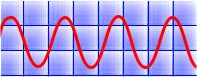
“Back in the early 19th century, Fourier showed that you can think about any continuous variation stream, no matter how complicated, in terms of a sum of very simple variations called sine waves. You’ve seen pictures of a sine wave — just a series of Ss laid on their sides and linked together head-to-tail.”

“Your basic wiggly line.”

“Mm-hm, except these wiggles are perfectly regular — evenly spaced peaks, all with the same height. The regularity is why sine waves are so popular. Show a physicist something that looks even vaguely periodic and they’ll immediately start thinking sine wave frequencies. Pythagoras did that for sound waves 2500 years ago.”

“Nah, he couldn’t have — he died long before Fourier.”

“Good point. Pythagoras didn’t know about sine waves, but he did figure out how sounds relate to spatial frequencies. Pluck a longer bowstring, get a lower note. Pinch the middle of a vibrating string. The strongest remaining vibration in the string sounds like the note from a string that’s half as long. Pythagoras worked out length relationships for the whole musical scale.”

“You said ‘spacial frequency’ like there’s some other kind.”

“There is, though they’re closely related. Your ear doesn’t sense the space frequency, the distance between peaks. You sense the time between peaks, the time frequency, which is the space frequency, peaks per meter, times how fast the wave travels, meters per second. See how the units work out?”

“Cute. Does that space frequency/time frequency pair-up work for all kinds of waves?”

“Mostly. It doesn’t work for standing waves. Their energy’s trapped between reflectors or some other way and they just march in place. Their time frequency is zero peaks per second whatever their peaks per meter space frequency may be. Interesting effects can happen if the wave velocity changes, say if the wave path crosses from air to water or if there’s drastic temperature changes along the path.”

“Hah! Mirages! Wait, that’s light getting deflected after bouncing off a hot surface into cool air. Does sound do mirages, too?”

“Sure. Our hearing’s not sharp enough to notice sonic deflection by thermal layering in air, but it’s a well-known issue for sonar specialists. Echoes from oceanic cold/warm interfaces play hob with sonar echolocation. I’ll bet dolphins play games with it when the cold layer’s close enough to the surface.”

“Those guys will find fun in anything. <pause> So Pythagoras figured sound frequencies playing with a bow. Who did it for light?”

“Who else? Newton, though he didn’t realize it. In his day people thought that light was colorless, that color was a property of objects. Newton used the rainbow images from prisms to show that color belonged to light. But he was a particle guy. He maintained that every color was a different kind of particle. His ideas held sway for over 150 years until Fresnel convinced the science community that lightwaves are a thing and their frequencies determine their color. Among other things Fresnel came up with the math that explained some phenomena that Newton had just handwaved past.”

“Fresnel was more colorful than Newton?”

“Uh-uh. Compared to Newton, Fresnel was pastel.”

~~ Rich Olcott

Wave As You Go By

A winter day, a bit nippy and windy enough to raise scattered whitecaps on the park lake. Apparently neither the geese nor Mr Richard Feder (of Fort Lee, NJ) enjoy that — the geese are standing on the shore and he’s huddled down on a bench as I pass. “Hey Moire, I gotta question.”

“Mr Feder. I’m trying to keep warm. If you want answers you’ll have to jog along.”

“Oh, alright <oof>. OK, watching those waves got me thinking. They keep going because the wind pushes on ’em, right? So what pushes on sound waves and light waves? If something pushes hard enough on a sound wave does it speed up enough to be a light wave?”

“So many questions. Are you sure you’ve got enough wind?”

“Ha, ha. I’ve been working out a little.”

“We’ll see. Well, first, nothing needs to push on a wave once it’s started. They travel on their own momentum.”

“Then why do these waves die away when the wind stops?”

“You’ve got two things going on there, on different time scales. When the wind stops blowing it stops making new waves. Actually, winds rarely stop all at once, they taper off. It looks like waves are dying away but really you just see smaller and smaller waves. Inside a single wave, though, friction takes its toll.”

“Friction? Waves rub against each other? That’s not what’s going on here — they keep their distance unless different groups run crosswise and then they all just keep going.”

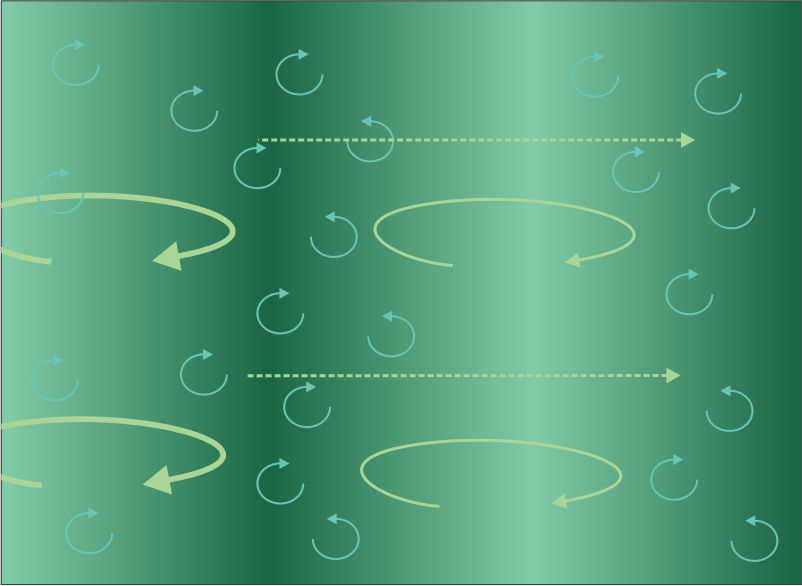
Turbulence in a water wave

“Not friction between waves, friction within a wave. There’s a lot of turbulence inside a water wave — the wind piles up surface molecules on one side, gravity and surface tension move the other side’s molecules downward, and the ones inside are pulled in every direction. All that helter-skelter motion randomizes the wave’s momentum and converts the wave’s energy to heat. When that’s gone, the wave’s gone.”

“So how’s sound different from that?”

“Lots of ways. To begin with, wind and gravity move molecules up and down perpendicular to the wave’s direction of travel. Sound waves aren’t affected by gravity. They move molecules back and forth parallel to the wave’s direction.”

“But they still die out, right? Turn to heat and all that?”

“Absolutely, Mr Feder. How fast a wave dies out depends on what heat-conversion processes are in play. In a water wave gravity and surface tension work together to smooth things out. Neither’s active in sound waves. The only way a sound wave can lose energy is through random collisions between molecules that aren’t in sync with the wave. Could be the wave hits a mushy object or maybe it just gets buried in other waves.”

“Like at a football game, when everyone’s shouting but all you hear is the roar.”

“Pretty good example, Mr Feder.”

“So how’s a light wave different?”

“Light waves don’t even need molecules. The electromagnetic field near a particle is the net effect of all the attractions and repulsions it feels from all other charged particles everywhere in the Universe. When some charged particle somewhere moves, that changes the field. The change is transmitted throughout the field as a wave traveling at the speed of light.”

“What makes it die away?”

“It doesn’t. On a dark, clear night your eyes can see stars a quintillion miles away. Astronomers with their instruments can detect objects millions of times further away.”

“No smoothing out? How come?”

“That’s a very deep question, Mr Feder, one that really bothered Einstein. You’d think a photon’s wave would get fainter the further it spreads. In fact, it delivers all its energy to the first charged particle it can interact with, no matter how far it had traveled. Weird, huh?”

“Weird, all right. So we got these three very different things — they start different, they push different, they got different speeds, they die different, but we call them all waves. Why’s that?”

“They’re all waves because they’re all patterns that transmit energy and momentum across space. Physicists have found general rules that apply to the patterns, whatever the wave type. Equations that work for one kind work for many others, too.”

Gravity waves?”

“And gravitational waves.”

~~ Rich Olcott

The Top Choice

Al grabs me as I step into his coffee shop. “Sy, ya gotta stop Vinnie, he’s using up paper napkins again, and he’s making a mess!”

Sure enough, there’s Vinnie at his usual table by the door. He’s got a kid’s top, a big one, spinning on a little stand. He’s methodically dropping crumpled-up paper wads onto it and watching them fly off onto the floor. “Hey, Vinnie, what’s the project?”

“Hi, Sy. I’m trying to figure how come these paper balls are doing a circle but when they fly off they always go in a straight line, at least at first. They got going-around momentum, right, so how come they don’t make a spiral like stars in a galaxy?”

Astronomy professor Cathleen’s standing in the scone line. She never misses an opportunity to correct a misconception. “Galaxy stars don’t spray out of the center in a spiral, Vinnie. Like planets going around a star, stars generally follow elliptical orbits around the galactic center. A star that’s between spiral arms now could be buried in one ten million years from now. The spiral arms appear because of how the orbits work. One theory is that the innermost star orbits rotate their ellipse axes more quickly than the outer ones and the spirals form where the ellipses pile up. Other theories have to do with increased star formation or increased gravitational attraction within the pile-up regions. Probably all three contribute to the structures. Anyhow, spirals don’t form from the center outward.”

My cue for some physics. “What happens in a galaxy is controlled by gravity, Vinnie, and gravity doesn’t enter into what you’re doing. Except for all that paper falling onto Al’s floor. There’s no in-plane gravitational or electromagnetic attraction in play when your paper wads leave the toy. Newton would say there’s no force acting to make them follow anything other than straight lines once they break free.”

“What about momentum? They’ve got going-around momentum, right, shouldn’t that keep them moving spirally?”

I haul out Old Reliable for a diagram. “Thing is, your ‘going-around momentum,’ also known as ‘angular momentum,’ doesn’t exist. Calm down, Vinnie, I mean it’s a ‘fictitious force‘ that depends on how you look at it.”

“Is this gonna be frames again?”

“Yup. Frames are one of our most important analytical tools in Physics. Here’s your toy and just for grins I’ve got it going around counterclockwise. That little white circle is one of your paper wads. In the room’s frame that wad in its path is constantly converting linear momentum between the x-direction and the y-direction, right?”

“East-West to North-South and back, yeah, I get that.”

“Such a mess to calculate. Let’s make it easier. Switch to the perspective of a frame locked to the toy. In that frame the wad can move in two directions. It can fly away along the radial direction I’ve called r, or it can ride along sideways in the s-direction.”

“So why hasn’t it flown away?”

“Because you put some spit on it to make it stick — don’t deny it, I saw you. While it’s stuck, does it travel in the r direction?”

“Nope, only in the s direction. Which should make it spiral like I said.”

“I’m not done yet. One of Newton’s major innovations was the idea of infinitesimal changes, also known as little-bits. The s-direction is straight, not curved, but it shifts around little-bit by little-bit as the top rotates. Newton’s Laws say force is required to alter momentum. What force influences the wad’s s-momentum?”

“Umm … that line you’ve marked c.”

“Which is the your spit’s adhesive force between the paper and the top. The wad stays stuck until the spit dries out and no more adhesion so no more c-force. Then what happens?”

“It flies off.”

“In which direction?”

“Huh! In the r-direction.”

“And in a straight line, just like Newton said. What you called ‘going-around momentum’ becomes ‘radial momentum’ and there’s no spiraling, right?”

“I guess you’re right, but I miss spirals.”

Al comes over with a broom. “Now that’s settled, Vinnie, clean up!”

~~ Rich Olcott

  • Thanks for the question, Jen Keeler. Stay tuned.

Should These Three Be Alike?

“What’s all the hubbub in the back room, Al? I’m a little early for my afternoon coffee break and your shop’s usually pretty quiet about now.”

“It’s Cathleen’s Astronomy class, Sy. The department double-booked their seminar room so she asked to use my space until it’s straightened out.”

“Think I’ll eavesdrop.” I slide in just as she’s getting started.

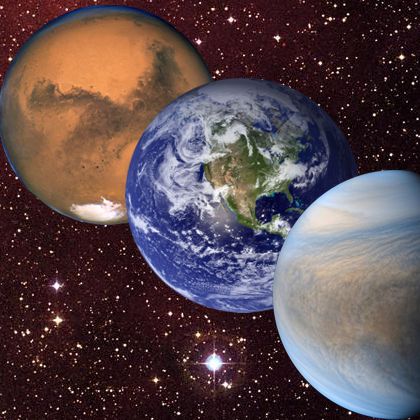
“OK, folks, settle. Last class I challenged you with a question. Venus and Mars both have atmospheres that are dominated by carbon dioxide with a little bit of nitrogen. Earth is right in between them. How come its atmosphere is so different? I gave each of you a piece of that to research. Jeremy, you had the null question. Should we expect Earth’s atmosphere to be about the same as the other two?”

Venus coudtops image by Damia Bouic
JAXA / ISAS / DARTS / Damia Bouic

“I think so, ma’am, on the basis of the protosolar nebula hypothesis. The –“

“Wait a minute, Jeremy. Sy, I saw you sneak in. Jeremy, explain that term to him.”

“Yes’m. Uh, a nebula is a cloud of gas and dust out in space. It could be what got shot out of an exploding star or it could be just a twist in a stream of stuff drifting through the Galaxy. If the twist kinks up, gravity pulls the material on either side of the kink towards the middle and you get a rotating disk. Most of what’s in the disk falls towards its center. The accumulated mass at the center lights up to be a star. Meanwhile, what’s left in the disk keeps most of the original angular momentum but it doesn’t whirl smoothly. There’s going to be local vortices and they attract more stuff and grow up to be planets. That’s what we think happens, anyway.”

“Good summary. So what does that mean for Mars, Venus and the Earth?”

“Their orbits are pretty close together, relative to the disk’s radius, so they ought to have encountered about the same mixture of heavy particles and light ones while they were getting up to size. The light ones would be gas atoms, mostly hydrogen and helium. Half the other atoms are oxygen and they’d react to produce oxides — water, carbon monoxide, grains of silica and iron oxide. And oxygen and nitrogen molecules, of course.”

“Of course. Was gravity the only actor in play there?”

“No-o-o, once the star lit up its photons and solar wind would have pushed against gravity.”

“So three actors. Would photons and solar wind have the same effect? Anybody?”

Silence, until astrophysicist-in-training Newt Barnes speaks up. “No, they’d have different effects. The solar wind is heavy artillery — electrons, protons, alpha particles. They’ll transfer momentum to anything they hit, but they’re more likely to hit a large particle like a dust grain than a small one like an atom. On average, the big particles would be pushed away more.”

“And the photons?”

“A photon is selective — it can only transfer momentum to an atom or molecule that can absorb exactly the photon’s energy. But each kind of atom has its own set of emission and absorption energies. Most light emitted by transitions within hydrogen atoms won’t be absorbed by anything but another hydrogen atom. Same thing for helium. The Sun’s virtually all hydrogen and helium. The photons they emit would move just those disk atoms and leave the heavier stuff in place.”

“That’s only part of the photon story.”

“Oh? Oh, yeah. The Sun’s continuous spectrum. The Sun is hot. Heat jiggles whole ions. Those moving charges produce electromagnetic waves just like charge moving within an atom, but heat-generated waves can have any wavelength and interact with anything. They can bake dust particles and decompose compounds that contain volatile atoms. Then those atoms get swept away in the general rush.”

“Which has the greater effect, solar wind or photons?”

“Hard to say without doing the numbers, but I’d bet on the photons. The metal-and-silicate terrestrial planets are close to the Sun, but the mostly-hydrogen giants are further out.”

“All that said, Jeremy, what’s your conclusion?”

“It sure looks like Earth’s atmosphere should be intermediate between Mars and Venus. How come it’s not?”

~~ Rich Olcott

Fly High, Silver Bird

“TANSTAAFL!” Vinnie’s still unhappy with spacecraft that aren’t rocket-powered. “There Ain’t No Such Thing As A Free Lunch!”

“Ah, good, you’ve read Heinlein. So what’s your problem with Lightsail 2?”

“It can’t work, Sy. Mostly it can’t work. Sails operate fine where there’s air and wind, but there’s none of that in space, just solar wind which if I remember right is just barely not a vacuum.”

Astronomer-in-training Jim speaks up. “You’re right about that, Vinnie. The solar wind’s fast, on the order of a million miles per hour, but it’s only about 10-14 atmospheres. That thin, it’s probably not a significant power source for your sailcraft, Al.”

“I keep telling you folks, it’s not wind-powered, it’s light-powered. There’s oodles of sunlight photons out there!”

“Sure, Al, but photons got zero mass. No mass, no momentum, right?”

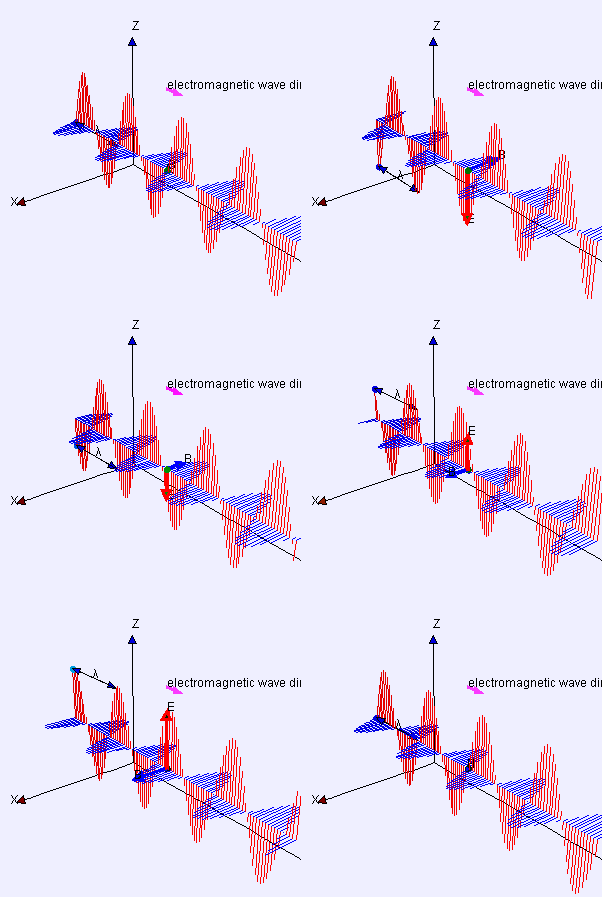
Plane-polarized electromagnetic wave in motion
Plane-polarized electromagnetic wave
Electric (E) field is red
Magnetic (B) field is blue
(Image by Loo Kang Wee and Fu-Kwun Hwang from Wikimedia Commons)

My cue to enter. “Not right, Vinnie. Experimental demonstrations going back more than a century show light exerting pressure. That implies non-zero momentum. On the theory side … you remember when we talked about light waves and the right-hand rule?”

“That was a long time ago, Sy. Remind me.”

“… Ah, I still have the diagram on Old Reliable. See here? The light wave is coming out of the screen and its electric field moves electrons vertically. Meanwhile, the magnetic field perpendicular to the electric field twists moving charges to scoot them along a helical path. So there’s your momentum, in the interaction between the two fields. The wave’s combined action delivers force to whatever it hits, giving it momentum in the wave’s direction of travel. No photons in this picture.”

Astrophysicist-in-training Newt Barnes dives in. “When you think photons and electrons, Vinnie, think Einstein. His Nobel prize was for his explanation of the photoelectric effect. Think about some really high-speed particle flying through space. I’m watching it from Earth and you’re watching it from a spaceship moving along with it so we’ve each got our own frame of reference.”

“Frames, awright! Sy and me, we’ve talked about them a lot. When you say ‘high-speed’ you’re talking near light-speed, right?”

“Of course, because that’s when relativity gets significant. If we each measure the particle’s speed, do we get the same answer?”

“Nope, because you on Earth would see me and the particle moving through compressed space and dilated time so the speed I’d measure would be more than the speed you’d measure.”

“Mm-hm. And using ENewton=mv² you’d assign it a larger energy than I would. We need a relativistic version of Newton’s formula. Einstein said that rest mass is what it is, independent of the observer’s frame, and we should calculate energy from EEinstein²=(pc)²+(mc²)², where p is the momentum. If the momentum is zero because the velocity is zero, we get the familiar EEinstein=mc² equation.”

“I see where you’re going, Newt. If you got no mass OR energy then you got nothing at all. But if something’s got zero mass but non-zero energy like a photon does, then it’s got to have momentum from p=EEinstein/c.”

“You got it, Vinnie. So either way you look at it, wave or particle, light carries momentum and can power Lightsail 2.”

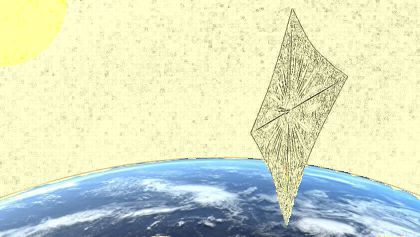
Lightsail 2 flying over Earth, against a yellow background
Adapted from image by Josh Spradling / The Planetary Society

“Question is, can sunlight give it enough momentum to get anywhere?”

“Now you’re getting quantitative. Sy, start up Old Reliable again.”

“OK, Newt, now what?”

“How much power can Lightsail 2 harvest from the Sun? That’ll be the solar constant in joules per second per square meter, times the sail’s area, 32 square meters, times a 90% efficiency factor.”

“Got it — 39.2 kilojoules per second.”

“That’s the supply, now for the demand. Lightsail 2 masses 5 kilograms and starts at 720 kilometers up. Ask Old Reliable to use the standard circular orbit equations to see how long it would take to harvest enough energy to raise the craft to another orbit 200 kilometers higher.”

“Combining potential and kinetic energies, I get 3.85 megajoules between orbits. That’s only 98 seconds-worth. I’m ignoring atmospheric drag and such, but net-net, Lightsail 2‘s got joules to burn.”

“Case closed, Vinnie.”

~~ Rich Olcott

Sail On, Silver Bird

Big excitement in Al’s coffee shop. “What’s the fuss, Al?”

Lightsail 2, Sy. The Planetary Society’s Sun-powered spacecraft. Ten years of work and some luck and it’s up there, way above Hubble and the ISS, boosting itself higher every day and using no fuel to do it. Is that cool or what?”

“Sun-powered? Like with a huge set of solar panels and an electric engine?”

“No, that’s the thing. It’s got a couple of little panels to power its electronics and all, but propulsion is all direct from the Sun and that doesn’t stop. Steady as she goes, Skipper, Earth to Mars in weeks, not months. Woo-hoo!”

Image by Josh Spradling / The Planetary Society

Never the rah-rah type, Big Vinnie throws shade from his usual table by the door. “It didn’t get there by itself, Al. SpaceX’s Falcon Heavy rocket did the hard work, getting Lightsail 2 and about 20 other thingies up to orbit. Takes a lot of thrust to get out of Earth’s gravity well. Chemical rockets can do that, puny little ion drives and lightsails can’t.”

“Yeah, Vinnie, but those ‘puny’ guys could lead us to a totally different travel strategy.” A voice from the crowd, astrophysicist-in-training Newt Barnes. “Your big brawny rocket has to burn a lot of delta-v just to boost its own fuel. That’s a problem.”

Al looks puzzled. “Delta-v?”

“It’s how you figure rocket propellant, Al. With a car you think about miles per gallon because if you take your foot off the gas you eventually stop. In space you just keep going with whatever momentum you’ve got. What’s important is how much you can change momentum — speed up, slow down, change direction — and that depends on the propellant you’re using and the engine you’re putting it through. All you’ve got is what’s in the tanks.”

Al still looks puzzled. I fill in the connection. “Delta means difference, Al, and v is velocity which covers both speed and direction so delta-v means — “

“Got it, Sy. So Vinnie likes big hardware but bigger makes for harder to get off the ground and Newt’s suggesting there’s a limit somewhere.”

“Yup, it’s gotten to the point that the SpaceX people chase an extra few percent performance by chilling their propellants so they can cram more into the size tanks they use. I don’t know what the limit is but we may be getting close.”

Newt’s back in. “Which is where strategy comes in, Vinnie. Up to now we’re mostly using a ballistic strategy to get to off-Earth destinations, treating the vehicle like a projectile that gets all its momentum at the beginning of the trip. But there’s really three phases to the trip, right? You climb out of a gravity well, you travel to your target, and maybe you make a controlled landing you hope. With the ballistic strategy you burn your fuel in phase one while you’re getting yourself into a transfer orbit. Then you coast on momentum through phase two.”

“You got a better strategy?”

“In some ways, yeah. How about applying continuous acceleration throughout phase two instead of just coasting? The Dawn spacecraft, for example, was rocket-launched out of Earth’s gravity well but used a xenon-ion engine in continuous-burn mode to get to Mars and then on to Vesta and Ceres. Worked just fine.”

“But they’re such low-thrust –“

“Hey, Vinnie, taking a long time to build up speed’s no problem when you’re on a long trip anyway. Dawn‘s motor averaged 1.8 kilometer per second of delta-v — that works out to … about 4,000 miles per hour of increased speed for every hour you keep the motor running. Adds up.”

“OK, I’ll give you the ion motor’s more efficient than a chemical system, but still, you need that xenon reaction mass to get your delta-v. You still gotta boost it up out of the well. All you’re doing with that strategy is extend the limit.”

Al dives back in. “That’s the beauty of Lightsail, guys. No delta-v at all. Just put it up there and light-pressure from the Sun provides the energy. Look, I got this slick video that shows how it works.”

Video courtesy of The Planetary Society.

~~ Rich Olcott

Conversation of Energy

Teena’s next dash is for the slide, the high one, of course. “Ha-ha, Uncle Sy, beat you here. Look at me climbing up and getting potential energy!”

“You certainly did and you certainly are.”

“Now I’m sliding down all kinetic energy, wheee!” <thump, followed by thoughtful pause> “Uncle Sy, I’m all mixed up. You said momentum and energy are like cousins and we can’t create or destroy either one but I just started momentum coming down and then it stopped and where did my kinetic energy go? Did I break Mr Newton’s rule?”

“My goodness, those are good questions. They had physicists stumped for hundreds of years. You didn’t break Mr Newton’s Conservation of Momentum rule, you just did something his rule doesn’t cover. I did say there are important exceptions, remember.”

“Yeah, but you didn’t say what they are.”

“And you want to know, eh? Mmm, one exception is that the objects have to be big enough to see. Really tiny things follow quantum rules that have something like momentum but it’s different. Uhh, another exception is the objects can’t be moving too fast, like near the speed of light. But for us the most important exception is that the rule only applies when all the energy to make things move comes from objects that are already moving.”

“Like my marbles banging into each other on the floor?”

“An excellent example. Mr Newton was starting a new way of doing science. He had to work with very simple systems and and so his rules were very simple. One Sun and one planet, or one or two marbles rolling on a flat floor. His rules were all about forces and momentum, which is a combination of mass and speed. He said the only way to change something’s momentum was to push it with a force. Suppose when you push on a marble it goes a foot in one second and has a certain momentum. If you push it twice as hard it goes two feet in one second and has twice the momentum.”

“What if I’ve got a bigger marble?”

“If you have a marble that’s twice as heavy and you give it the one-foot-per-second speed, it has twice the momentum. Once there’s a certain amount of momentum in one of Mr Newton’s simple systems, that’s that.”

“Oh, that’s why I’ve got to snap my steelie harder than the glass marbles ’cause it’s heavier. Oh!Oh!And when it hits a glass one, that goes faster than the steelie did ’cause it’s lighter but it gets the momentum that the steelie had.”

“Perfect. You Mommie will be so proud of you for that thinking.”

“Yay! So how are momentum and energy cousins?”

“Cous… Oh. What I said was they’re related. Both momentum and kinetic energy depend on both mass and speed, but in different ways. If you double something’s speed you give it twice the momentum but four times the amount of kinetic energy. The thing is, there’s only a few kinds of momentum but there are lots of kinds of energy. Mr Newton’s Conservation of Momentum rule is limited to only certain situations but the Conservation of Energy rule works everywhere.”

“Energy is bigger than momentum?”

“That’s one way of putting it. Let’s say the idea of energy is bigger. You can get electrical energy from generators or batteries, chemical energy from your muscles, gravitational energy from, um, gravity –“

“Atomic energy from atoms, wind energy from the wind, solar energy from the Sun –“

“Cloud energy from clouds –“

“Wait, what?”

“Just kidding. The point is that energy comes in many varieties and they can be converted into one another and the total amount of energy never changes.”

“Then what happened to my kinetic energy coming down the slide? I didn’t give energy to anything else to make it start moving.”

“Didn’t you notice the seat of your pants getting hotter while you were slowing down? Heat is energy, too — atoms and molecules just bouncing around in place. In fact, one of the really good rules is that sooner or later, every kind of energy turns into heat.”

“Big me moving little atoms around?”

“Lots and lots of them.”

~~ Rich Olcott

Conversation of Momentum

Teena bounces out of the sandbox, races over to the playground’s little merry-go-round and shoves it into motion. “Come help turn this, Uncle Sy, I wanna go fast!” She leaps onto the moving wheel and of course she promptly falls off. The good news is that she rolls with the fall like I taught her to do.

“Why can’t I stay on, Uncle Sy?”

“What’s your new favorite word again?”

“Mmmo-MMENN-tumm. But that had to do with swings.”

“Swings and lots of other stuff, including merry-go-rounds and even why you should roll with the fall. Which, by the way, you did very well and I’m glad about that because we don’t want you getting hurt on the playground.”

“Well, it does hurt a little on my elbow, see?”

“Let me look … ah, no bleeding, things only bend where they’re supposed to … I think no damage done but you can ask your Mommie to kiss it if it still hurts when we get home. But you wanted to know why you fell off so let’s go back to the sandbox to figure that out.”

<scamper!> “I beat you here!”

“Of course you did. OK, let’s draw a big arc and pretend that’s looking down on part of the merry-go-round. I’ll add some lines for the spokes and handles. Now I’ll add some dots and arrows to show what I saw from over here. See, the merry-go-round is turning like this curvy arrow shows. You started at this dot and jumped onto this dot which moved along and then you fell off over here. Poor Teena. So you and your momentum mostly went left-to-right.”

“But that’s not what happened, Uncle Sy. Here, I’ll draw it. I jumped on but something tried to push me off and then I did fall off and then I rolled. Poor me. Hey, my arm doesn’t hurt any more!”

“How about that? I’ve often found that thinking about something else makes hurts go away. So what do you think was trying to push you off? I’ll give you a hint with these extra arrows on the arc.”

“That looks like Mr Newton’s new directions, the in-and-out direction and the going-around one. Oh! I fell off along the in-and-out direction! Like I was a planet and the Sun wasn’t holding me in my orbit! Is that what happened, I had out-momentum?”

“Good thinking, Teena. Mr Newton would say that you got that momentum from a force in the out-direction. He’d also say that if you want to stand steady you need all the forces around you to balance each other. What does that tell you about what you need to do to stay on the merry-go-round?”

“I need an in-direction force … Hah, that’s what I did wrong! I jumped on but I didn’t grab the handles.”

“Lesson learned. Good.”

“But what about the rolling?”

“Well, in general when you fall it’s nearly always good to roll the way your body’s spinning and only try to slow it down. People who put out an arm or leg to stop a fall often stress it and and maybe even tear or break something.”

“That’s what you’ve told me. But what made me spin?”

“One of Mr Newton’s basic principles was a rule called ‘Conservation of Momentum.’ It says that you can transfer momentum from one thing to another but you can’t create it or destroy it. There are some important exceptions but it’s a pretty good rule for the cases he studied. Your adventure was one of them. Look back at the picture I drew. You’d built up a lot of going-around momentum from pushing the merry-go-round to get it started. You still had momentum in that direction when you fell off. Sure enough, that’s the direction you rolled.”

“Is that the ‘Conversation of Energy’ thing that you and Mommie were talking about?”

“Conservation. It’s not the same but it’s closely related.”

“Why does it even work?”

“Ah, that’s such a deep question that most physicists don’t even think about it. Like gravity, Mr Newton described what inertia and momentum do, but not how they work. Einstein explained gravity, but I’m not convinced that we understand mass yet.”

~~ Rich Olcott