Taming The Elephant

Suddenly they were all on the attack.  Anne got in the first lick.  “C’mon, Sy, you’re comparing apples and orange peel.  Your hydrogen sphere would be on the inside of the black hole’s event horizon, and Jeremy’s virtual particles are on the outside.”

[If you’ve not read my prior post, do that now and this’ll make more sense.  Go ahead, I’ll wait here.]white satin and 5 elephantsJennie’s turn — “Didn’t the chemists define away a whole lot of entropy when they said that pure elements have zero entropy at absolute zero temperature?”

Then Vinnie took a shot.  “If you’re counting maybe-particles per square whatever for the surface, shouldn’t you oughta count maybe-atoms or something per cubic whatever for the sphere?”

Jeremy posed the deepest questions. “But Mr Moire, aren’t those two different definitions for entropy?  What does heat capacity have to do with counting, anyhow?”

Al brought over mugs of coffee and a plate of scones.  “This I gotta hear.”

“Whew, but this is good ’cause we’re getting down to the nub.  First to Jennie’s point — Under the covers, Hawking’s evaluation is just as arbitrary as the chemists’.  Vinnie’s ‘whatever’ is the Planck length, lP=1.616×10⁻³⁵ meter.  It’s the square root of such a simple combination of fundamental constants that many physicists think that lP2=2.611×10-70 m², is the ‘quantum of area.’  But that’s just a convenient assumption with no supporting evidence behind it.”

“Ah, so Hawking’s ABH=4πrs2 and SBH=ABH/4 formulation with rs measured in Planck-lengths, just counts the number of area-quanta on the event horizon’s surface.”

“Exactly, Jennie.  If there really is a least possible area, which a lot of physicists doubt, and if its size doesn’t happen to equal lP2, then the black hole entropy gets recalculated to match.”

“So what’s wrong with cubic those-things?”

“Nothing, Vinnie, except that volumes measured in lP3 don’t apply to a black hole because the interior’s really four-dimensional with time scrambled into the distance formulas.  Besides, Hawking proved that the entropy varies with half-diameter squared, not half-diameter cubed.”

“But you could still measure your hydrogen sphere with them and that’d get rid of that 1033 discrepancy between the two entropies.”

“Not really, Vinnie.  Old Reliable calculated solid hydrogen’s entropy for a certain mass, not a volume.”

“Hawking can make his arbitrary choice, Sy, he’s Hawking, but that doesn’t let the chemists off the scaffold.  How did they get away with arbitrarily defining a zero for entropy?”

“Because it worked, Jennie.  They were only concerned with changes — the difference between a system’s state at the end of a process, versus its state at the beginning.  It was only the entropy difference that counted, not its absolute value.”

“Hey, like altitude differences in potential energy.”

“Absolutely, Vinnie, and that’ll be important when we get to Jeremy’s question.  So, Jennie, if you’re only interested in chemical reactions and if it’s still in the 19th Century and the world doesn’t know about isotopes yet, is there a problem with defining zero entropy to be at a convenient set of conditions?”

“Well, but Vinnie’s Second Law says you can never get down to absolute zero so that’s not convenient.”

“Good point, but the Ideal Gas Law and other tools let scientists extrapolate experimentally measured properties down to extremely low temperatures.  In fact, the very notion of absolute zero temperature came from experiments where the volume of a  hydrogen or helium gas sample appears to decrease linearly towards zero at that temperature, at least until the sample condenses to a liquid.  With properly calibrated thermometers, physical chemists knocked themselves out measuring heat capacities and entropies at different temperatures for every substance they could lay hands on.”

“What about isotopes, Mr Moire?  Isn’t chlorine’s atomic weight something-and-a-half so there’s gotta be several of kinds of chlorine atoms so any sample you’ve got is a mixture and that’s random and that has to have a non-zero entropy even at absolute zero.”

“It’s 35.4, two stable isotopes, Jeremy, but we know how to account for entropy of mixing and anyway, the isotope mix rarely changes in chemical processes.”

“But my apples and orange peels, Sy — what does the entropy elephant do about them?”

~~ Rich Olcott
The Battle of The Entropies

(the coffee-shop saga continues)  “Wait on, Sy, a black hole is a hollow sphere?”

I hadn’t noticed her arrival but there was Jennie, standing by Vinnie’s table and eyeing Jeremy who was sill eyeing Anne in her white satin.white satin and 2 elephants“That’s not quite what I said, Jennie.  Old Reliable’s software and and I worked up a hollow-shell model and to my surprise it’s consistent with one of Stephen Hawking’s results.  That’s a long way from saying that’s what a black hole is.”

“But you said some physicists say that.  Have they aught to stand on?”

“Sort of.  It’s a perfect case of ‘depends on where you’re standing.'”

Vinnie looked up.  “It’s frames again, ain’t it?”

“With black holes it’s always frames, Vinnie.  Hey, Jeremy, is a black hole something you could stand on?”

“Nosir, we said the hole’s event horizon is like Earth’s orbit, just a mathematical marker.  Except for the gravity and  the  three  Perils  Jennie and you and me talked about, I’d slide right through without feeling anything weird, right?”

“Good memory and just so.  In your frame of reference there’s nothing special about that surface — you wouldn’t experience scale changes in space or time when you encounter it.  In other frames, though, it’s special.  Suppose we’re standing a thousand miles away from a solar-size black hole and Jeremy throws a clock and a yardstick into it.  What would we see?”

“This is where those space compression and time dilation effects happen, innit?”

“You bet, Jennie.  Do you remember the formula?”

“I wrote it in my daybook … Ah, here it is —Schwarzchild factorMy notes say D is the black hole’s diameter and d is another object’s distance from its center.  One second in the falling object’s frame would look like f seconds to us.  But one mile would look like 1/f miles.  The event horizon is where d equals the half-diameter and f goes infinite.  The formula only works where the object stays outside the horizon.”

“And as your clock approaches the horizon, Jeremy…?”

“You’ll see my clock go slower and slower until it sto —.  Oh.  Oh!  That’s why those physicists think all the infalling mass is at the horizon, the stuff falls towards it forever and never makes it through.”

“Exactly.”

“Hey, waitaminute!  If all that mass never gets inside, how’d the black hole get started in the first place?”

“That’s why it’s only some physicists, Vinnie.  The rest don’t think we understand the formation process well enough to make guesses in public.”

“Wait, that formula’s crazy, Sy.  If something ever does get to where d is less than D/2, then what’s inside the square root becomes negative.  A clock would show imaginary time and a yardstick would go imaginary, too.  What’s that about?”

“Good eye, Anne, but no worries, the derivation of that formula explicitly assumes a weak gravitational field.  That’s not what we’ve got inside or even close to the event horizon.”

“Mmm, OK, but I want to get back to the entropy elephant.  Does black hole entropy have any connection to the other kinds?”

Strutural, mostly.  The numbers certainly don’t play well together.  Here’s an example I ran up recently on Old Reliable.  Say we’ve got a black hole twice the mass of the Sun, and it’s at the Hawking temperature for its mass, 12 billionths of a Kelvin.  Just for grins, let’s say it’s made of solid hydrogen.  Old Reliable calculated two entropies for that thing, one based on classical thermodynamics and the other based on the Bekenstein-Hawking formulation.”Entropy calculations“Wow, Old Reliable looks up stuff and takes care of unit conversions automatically?”

“Slick, eh, Jeremy?  That calculation up top for Schem is classical chemical thermodynamics.  A pure sample of any element at absolute zero temperature is defined to have zero entropy.  Chemical entropy is cumulative heat capacity as the sample warms up.  The Hawking temperature is so close to zero I could treat heat capacity as a constant.

“In the middle section I calculated the object’s surface area in square Planck-lengths lP², and in the bottom section I used Hawking’s formula to convert area to B-H entropy, SBH.  They disagree by a factor of 1033.”

A moment of shocked silence, and then…

~~ Rich Olcott

Rockfall

<continued>  The coffee shop crowd had gotten rowdy in response to my sloppy physics, but everyone hushed when I reached for my holster and drew out Old Reliable.  All had heard of it, some had seen it in action — a maxed-out tablet with customized math apps on speed-dial.

“Let’s take this nice and slow.  Suppose we’ve got an non-charged, non-spinning solar-mass black hole.  Inside its event horizon the radius gets weird but let’s pretend we can treat the object like a simple sphere.  The horizon’s half-diameter, we’ll call it the radius, is rs=2G·M/c²G is Newton’s gravitational constant, M is the object’s mass and c is the speed of light.  Old Reliable says … about 3 kilometers.  Question is, what happens when we throw a rock in there?  To keep things simple, I’m going to model dropping the rock gentle-like, dead-center and with negligible velocity relative to the hole, OK?”

<crickets>

“Say the rock has the mass of the Earth, almost exactly 3×10⁻⁶ the Sun’s mass.  The gravitational potential energy released when the rock hits the event horizon from far, far away would be E=G·M·m/rs, which works out to be … 2.6874×1041 joules.  What happens to that energy?”falling rock and black hole

rs depends on mass, Mr Moire, so the object will expand.  Won’t that push on what’s around it?”

“You’re thinking it’d act like a spherical piston, Jeremy, pushing out in all directions?”

“Yeah, sorta.”

“After we throw in a rock with mass m, the radius expands from rs to rp=2G·(M+m)/c².  I set m to Earth’s mass and Old Reliable says the new radius is … 3.000009 kilometers.  Granted the event horizon is only an abstract math construct, but suppose it’s a solid membrane like a balloon’s skin.  When it expands by that 9 millimeters, what’s there to push against?  The accretion disk?  Those rings might look solid but they’re probably like Saturn’s rings — a collection of independent chunks of stuff with an occasional gas molecule in-between.  Their chaotic orbits don’t have a hard-edged boundary and wouldn’t notice the 9-millimeter difference.  Inward of the disk you’ve got vacuum.  A piston pushing on vacuum expends zero energy.  With no pressure-volume work getting done that can’t be where the infall energy goes.”

“How about lift-a-weight work against the hole’s own gravity?”

“That’s a possibility, Vinnie.  Some physicists maintain that a black hole’s mass is concentrated in a shell right at the event horizon.  Old Reliable here can figure how much energy it would take to expand the shell that extra 9 millimeters.  Imagine that simple Newtonian physics applies — no relativistic weirdness.  Newton proved that a uniform spherical shell’s gravitational attraction is the same as what you’d get from having the same mass sitting at the shell’s geometric center.  The gravitational pull the shell exerts on itself originally was E=G·M²/rs.  Lifting the new mass from rs to rp will cost ΔE=G·(M+m)²/r– G·M²/rs.  When I plug in the numbers…  That’s interesting.”

Vinnie’s known me long enough to realize “That’s interesting” meant “Whoa, I certainly didn’t expect THAT!

“So what didja expect and whatcha got?”

“What I expected was that lift-it-up work would also be just a small fraction of the infall energy and the rest would go to heat.  What I got for ΔE here was 2.6874×1041 joules, exactly 100% of the input.  I wonder what happens if I use a bigger planet.  Gimme a second … OK, let’s plot a range …  How ’bout that, it’s linear!”ep-es

“Alright, show us!”

All the infall energy goes to move the shell’s combined mass outward to match the expanded size of the event horizon.  I’m amazed that such a simple classical model produces a reasonable result.”

“Like Miss Plenum says, Mr Moire, sometimes the best science comes from surprises.”

“I wouldn’t show it around, Jeremy, except that it’s consistent with Hawking’s quantum-physics result.”

“How’s that?”

“Remember, he showed that a black hole’s temperature varies as 1/M.  We know that temperature is ΔE/ΔS, where the entropy change ΔS varies as .  We’ve just found that ΔE varies as M.  The ΔE/ΔS ratio varies as M/M²=1/M, just like Hawking said.”

Then Jennie got into the conversation.

~~ Rich Olcott

Red Harvest

<continued> Al’s coffee shop was filling up as word got around about Anne in her white satin.  I saw a few selfie-takers in the physics crowd surreptitiously edge over to get her into their background.  She was busy thinking so she didn’t notice.  “The entropy-elephant picture is starting to come together, Sy.  We started out with entropy measuring accumulated heat capacity in a steam engine.”

“That’s where Carnot started, yes.”

“But when Jeremy threw that hot rock into the black hole” <several in the astronomy crew threw startled looks at Jeremy>, “its heat energy added to the black hole’s mass, but it should have added to the black hole’s entropy, too.  ‘Cause of Vinnie’s Second Law.”white satin and black hole 3

Vinnie looked up.  “Ain’t my Second Law, it’s thermodynamics’ Second Law.  Besides, my version was ‘energy’s always wasted.’  Sy’s the one who turned that into ‘entropy always increases.'”

“So anyway, black holes can’t have zero entropy like people used to think.  But if entropy also has to do with counting possibilities, than how does that apply to black holes?  They have only one state.”

“That’s where Hawking got subtle.  Jeremy, we’ve talked about how the black hole’s event horizon is a mathematical abstraction, infinitely thin and perfectly smooth and all that.”

“Yessir.”

“Hawking moved one step away from that abstraction.  In essence he said the  event horizon is surrounded by a thin shell of virtual particles.  Remember them, Jeremy?”

“Uh-huh, that was on my quest to the event horizon.  Pairs of equal and opposite virtual particles randomly appear and disappear everywhere in space and because they appear together they’re entangled and if one of them dips into the event horizon then it doesn’t annihilate its twin which — Oh!  Random!  So what’s inside the event horizon may have only one state, so far as we know, but right outside the horizon any point may or may not be hosting, can I call it an orphan particle?  I’ll bet that uncertainty give rise to the entropy, right?”

<finger-snaps of approval from the physics side of the room>

“Well done, Jeremy!  ‘Orphan’ isn’t the conventional term but it gets the idea across.”

“Wait, Sy.  You mentioned that surface area and entropy go together and now I see why.  The larger the area, the more room there is for those poor orphans.  When Jeremy’s rock hit the event horizon and increased the black hole’s mass, did the surface area increase enough to allow for the additional entropy?” <more finger-snapping>

“Sure did, Anne.  According to Hawking’s calculation, it grew by exactly the right amount.  Mass and area both grow as the square of the diameter.”

“How come not the radius?”

“Well , Vinnie, the word ‘radius‘ is tricky when you’re discussing black holes.  The event horizon is spherical and has a definite diameter — you could measure it from the outside.  But the sphere’s radius extends down to the singularity and is kind of infinite and isn’t even strictly speaking a distance.  Space-time is twisted in there, remember, and that radial vector is mostly time near its far end.  On the other hand, you could use ‘radius‘ to mean ‘half the diameter‘ and you’d be good for calculating effects outside the event horizon.”

“OK, that’s the entropy-area connection, but how does temperature tie in with surface gravity?”

“They’re both inversely dependent on the black hole’s mass.  Let’s take surface gravity first, and here when I say ‘r‘ I’m talking ‘half-diameter,‘ OK?”

“Sure.”

“Good.  Newton taught us that an object with mass M has a gravitational attraction proportional to M/r².  That still holds if you’re not inside the event horizon.  Now, the event horizon’s r is also proportional to the object’s mass so you’ve got M/M² which comes to 1/M.  With me?”

“Yeah.”

“Hawking used quantum physics to figure the temperature thing, but here’s a sloppy short-cut.  Anne, remember how we said that entropy is approximately heat capacity divided by temperature?”

“Mm-hmm.”

“The shell’s energy is mostly heat and proportional to M.  We’ve seen the shell’s entropy is proportional to .  The temperature is heat divided by entropy.  That’s proportional to M/M² which is the same 1/M as surface gravity.” <boos from all sides>. “Hey, I said it was sloppy.”

~~ Rich Olcott

Rockin’ Round The Elephant

<continued…>  “That’s what who said?  And why’d he say that?”

“That’s what Hawking said, Al.  He’s the guy who first applied thermodynamic analysis to black holes.  Anyone happen to know the Three Laws of Thermodynamics?”

Vinnie pipes up from his table by the coffee shop door.  “You can’t win.  You can’t even break even.  But you’ll never go broke.”

“Well, that’s one version, Vinnie, but keep in mind all three of those focus on energy.  The First Law is Conservation of Energy—no process can create or destroy energy, only  transform it, so you can’t come out ahead.  The Second Law is really about entropy—”

“Ooo, the elephant!”white satin and black hole 2

“Right, Anne.  You usually see the Second Law stated in terms of energy efficiency—no process can convert energy to another form without wasting some of it. No breaking even.  But an equivalent statement of that same law is that any process must increase the entropy of the Universe.”

“The elephant always gets bigger.”

“Absolutely.  When Bekenstein and Hawking thought about what would happen if a black hole absorbed more matter, worst case another black hole, they realized that the black hole’s surface area had to follow the same ‘Never decrease‘ rule.”

“Oh, that Hawking!  Hawking radiation Hawking!  The part I didn’t understand, well one of the parts, in that “Black Holes” Wikipedia article!  It had to do with entangled particles, didn’t it?”

“Just caught up with us, eh, Jeremy?  Yes, Stephen Hawking.  He and Jacob Bekenstein found parallels between what we can know about black holes on the one hand and thermodynamic quantities on the other.  Surface area and entropy, like we said, and a black hole’s mass acts mathematically like energy in thermodynamics.  The correlations were provocative ”

“Mmm, provocative.”

“You like that word, eh, Anne?  Physicists knew that Bekenstein and Hawking had a good analogy going, but was there a tight linkage in there somewhere?  It seemed doubtful.”

“Nothin’ to count.”

“Wow, Vinnie.  You’ve been reading my posts?”

“Sure, and I remember the no-hair thing.  If the only things the Universe can know about a black hole are its mass, spin and charge, then there’s nothing to figure probabilities on.”

“Exactly.  The logic sequence went, ‘Entropy is proportional to the logarithm of state count, there’s only one state, log(1) equals zero,  so the entropy is zero.’  But that breaks the Third Law.  Vinnie’s energy-oriented Third Law says that no object can cool to absolute zero temperature.  But an equivalent statement is that no object can have zero entropy.”

“So there’s something wrong with black hole theory, huh?”

“Which is where our guys started, Vinnie.  Being physicists, they said, ‘Suppose you were to throw an object into a black hole.  What would change?’

“Its mass, for one.”

“For sure, Jeremy.  Anything else?”

“It might not change the spin, if you throw right.”

“Spoken like a trained baseball pitcher.  Turns out its mass governs pretty much everything about a black hole, including its temperature but not spin or charge.  Once you know the mass you can calculate its entropy, diameter, surface area, surface gravity, maximum spin, all of that.  Weird, though, you can’t easily calculate its volume or density — spatial distortion gets in the way.”

“So what happens to all those things when the mass increases?”

“As you might expect, they change.  What’s interesting is how each of them change and how they’re linked together.  Temperature, for instance, is inversely proportional to the mass and vice-versa.  Suppose, Jeremy, that you threw two big rocks, both the same size, into a black hole.  The first rock is at room temperature and the other’s a really hot one, say at a million degrees.   What would each do?”

“The first one adds mass so from what you said it’d drop the temperature.  The second one has the same mass, so I don’t see, wait, temperature’s average kinetic energy so the hot rock has more energy than the other one and Einstein says that energy and mass are the same thing so the black hole gets more mass from the hot rock than from the cold one so its temperature goes down … more?  Really?”

“Yup.  Weird, huh?”

“How’s that work?”

“That’s what they asked.”

~~ Rich Olcott

Schrödinger’s Elephant

Al’s coffee shop sits right between the Astronomy and Physics buildings, which is good because he’s a big Science fan.  He and Jeremy are in an excited discussion when Anne and I walk in.  “Two croissants, Al, and two coffees, black.”

“Comin’ up, Sy.  Hey, you see the news?  Big days for gravitational astronomy.”

Jeremy breaks in.  “There’s a Nobel Prize been announced —”

“Kip Thorne the theorist and Barry Barish the management guy —”

“and Rainer Weiss the instrumentation wizard —”

“shared the Physics prize for getting LIGO to work —”

“and it saw the first signal of a black hole collision in 2015 —”

“and two more since —”

“and confirmed more predictions from relativity theory —”

“and Italy’s got their Virgo gravitational wave detector up and running —”

“And Virgo and our two LIGOs, —”

“Well, they’re both aLIGOs now, being upgraded and all —”

“all three saw the same new wave —”

“and it’s another collision between black holes with weird masses that we can’t account for.  Who’s the lady?”

“Al, this is Anne.  Jeremy, close your mouth, you’ll catch a fly.”  (Jeremy blushes, Anne twinkles.)  “Anne and I are chasing an elephant.”

“Pleased to meetcha, Anne.  But no livestock in here, Sy, the Health Department would throw a fit!”

I grin.  “That’s exactly what Eddie said.  It’s an abstract elephant, Al.  We’ve been discussing entropy. Which is an elephant because it’s got so many aspects no-one can agree on what it is.  It’s got something to do with heat capacity, something to do with possibilities you can’t rule out, something to do with signals and information.  And Hawking showed that entropy also has something to do with black holes.”

“Which I don’t know much about, fellows, so someone will have to explain.”

Jeremy leaps in.  “I can help with that, Miss Anne, I just wrote a paper on them.”

“Just give us the short version, son, she can ask questions if she wants a detail.”

“Yessir.  OK, suppose you took all the Sun’s mass and squeezed it into a ball just a few miles across.  Its density would be so high that escape velocity is faster than the speed of light so an outbound photon just falls back inward and that’s why it’s black.  Is that a good summary, Mr Moire?”

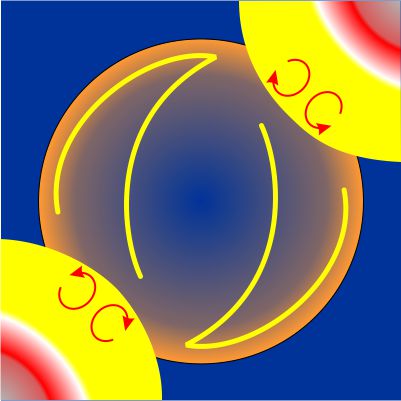
“Well, it might be good enough for an Internet blog but it wouldn’t pass inspection for a respectable science journal.  Photons don’t have mass so the whole notion of escape velocity doesn’t apply.  You do have some essential elements right, though.  Black holes are regions of extreme mass density, we think more dense than anywhere else in the Universe.  A black hole’s mass bends space so tightly around itself that nearby light waves are forced to orbit its region or even spiral inward.  The orbiting happens right at the black hole’s event horizon, its thin shell that encloses the space where things get really weird.  And Anne, the elephant stands on that shell.”white satin and black hole“Wait, Mr Moire, we said that the event horizon’s just a mathematical construct, not something I could stand on.”
“And that’s true, Jeremy.  But the elephant’s an abstract construct, too.  So abstract we’re still trying to figure out what’s under the abstraction.”

“I’m trying to figure out why you said the elephant’s standing there.”

“Anne, it goes back to the event horizon’s being a mathematical object, not a real one.  Its spherical surface marks the boundary of the ultimate terra incognita.  Lightwaves can’t pass outward from it, nor can anything material, not even any kind of a signal.  For at least some kinds of black hole, physicists have proven that the only things we can know about one are its mass, spin and charge.  From those we can calculate some other things like its temperature, but black holes are actually pretty simple.”

“So?”

“So there’s a collision with Quantum Theory.  One of QT’s fundamental assumptions is that in principle we can use a particle’s current wave function to predict probabilities for its future.  But the wave function information disappears if the particle encounters an event horizon.  Things are even worse if the particle’s entangled with another one.”

“Information, entropy, elephant … it’s starting to come together.”

“That’s what he said.”

~~ Rich Olcott

Gozer, The Stay Puft Black Hole

We’re downstairs at Eddie’s Pizza.  Vinnie orders his usual pepperoni.  In memory of Sam Panapoulos, I order a Hawaiian.  Then we’re back to talking black holes.

“I been thinking, Sy.  These regular-size black holes, the ones close to the Sun’s mass, we got a lot of ’em?”

“I’ve seen an estimate of 50,000 in the Milky Way Galaxy so you could say they’re common.  That’s one way to look at it.  The other way is to compare 50,000 with the 250 billion stars in the galaxy.  One out of 5,000,000 is a black hole, so they’re rare.  Your choice, Vinnie.”

“But all three confirmed LIGO signals were the next bigger size range, maybe 10 to 30 solar masses; two of ’em hittin’ each other and they’ve all been more than a billion lightyears away.  How come LIGO doesn’t see the little guys that are close to us?”

“Darn good question.  Lessee… OK, I’ve got several possibilities.  Maybe the close-in little guys do collide, but the signal’s too weak for us to detect.  But we can put numbers to that.  In each LIGO event we’ve seen, the collision released about 10% of their 40-to-60-Sun total mass-energy in the form of gravitational waves.  LIGO’s just barely able to detect that, right?”

“They were excited they could, yeah.”

“So if a pair of little-guy black holes collided they’d release about 10% of two makes 0.2 solar masses worth of energy.  That’d be way below our detection threshold if the collision is a billion light-years away.  But we’re asking about collisions inside the Milky Way.  Suppose the collision happened near the center, about 26,000 lightyears from us.  Signal strength grows as the square of how close the source is, so multiply that ‘too weak to detect’ wave by (1 billion/26000)² =15×1012, fifteen quadrillion.  LIGO’d be deafened by a signal that strong.”

“But LIGO’s OK, so we can rule that out.  Next guess.”

“Maybe the signal’s coming in at the wrong frequency.  The equations say that just before a big-guy collision the two objects circle each other hundreds of times a second.  That frequency is in the lower portion of the 20-20,000 cycles-per-second human audio range.  LIGO’s instrumentation was tuned to pick up gravitational waves between 30 and 7,000.  Sure enough, LIGO recorded chirps that were heard around the world.”

“So what frequency should LIGO be tuned to to pick up little-guy collisions?”

“We can put numbers to that, too.  Physics says that at a given orbit radius, revolution frequency varies inversely with the square root of the mass.   The big-guy collisions generated chirps between 100 and 400 cps.  Little guy frequencies would be f2/f50=√(50/2)=5 times higher, between 500 and 2000 cps.  Well within LIGO’s range.”

“We don’t hear those tweets so that idea’s out, too.  What’s your third try?”

“Actually I like this one best.  Maybe the little guys just don’t collide.”

“Why would you like that one?”

“Because maybe it’s telling us something.  It could be that they don’t collide simply because they’re surrounded by so many other stars that they never meet up.  But it also could be that binary black holes, the ones that are fated to collide with each other, are the only ones that can grow beyond 10 solar masses.  And I’ve got a guess about how that could happen.”

“Alright, give.”

“Let’s start with how to grow a big guy.  Upstairs we talked about making little guys.  When a star’s core uses up one fuel, like hydrogen, there’s an explosive collapse that sets off a hotter fuel, like helium, until you get to iron which doesn’t play.  At each step, unburnt fuel outside the core gets blown away.  If the final core’s mass is greater than about three times the Sun’s you wind up with a black hole.  But how about if you don’t run out of fuel?”

“How can that happen?  The star’s got what it’s got.”Binary protoBHs

“Not if it’s got close neighbors that also expel unburnt fuel in their own burn-collapse cycles.  Grab their cast-off fuel and your core can get heavier before you do your next collapse.  Not impossible in a binary or cluster where all the stars are roughly the same age.  Visualize kids tossing marshmallows into each other’s mouths.”

“Or paying for each other’s pizzas.  And it’s your turn.”

~~ Rich Olcott

Prelude to A Waltz

An excited knock, but one I recognize.  In comes Vinnie, waving his fresh copy of The New York Times.

LIGO‘s done it again!  They’ve seen another black hole collision!”

“Yeah, Vinnie, I’ve read the Abbott-and-a-thousand paper.  Three catastrophic collisions detected in less than two years.  The Universe is starting to look like a pretty busy place, isn’t it?”

“And they all involve really big black holes — 15, 20, even 30 times heavier than the Sun.  Didn’t you once say black holes that size couldn’t exist?”

“Well, apparently they do.  Of course the physicists are busily theorizing how that can happen.  What do you know about how stars work, Vinnie?”

“They get energy from fusing hydrogen atoms to make helium atoms.”

“So far, so good, but then what happens when the hydrogen’s used up?”

“They go out, I guess.”

“Oh, it’s a lot more exciting than that. Does the fusion reaction happen everywhere in the star?”

“I woulda said, ‘Yes,’ but since you’re asking I’ll bet the answer is,  ‘No.'”

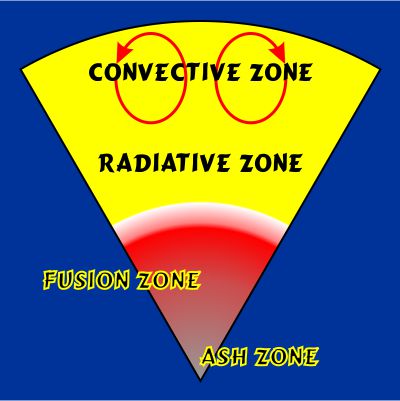
“Properly suspicious, and you’re right.  It takes a lot of heat and pressure to force a couple of positive nuclei close enough to fuse together despite charge repulsion.  Pressures near the outer layers are way too low for that.  For our Sun, for instance, you need to be 70% of the way to the center before fusion really kicks in.  So you’ve got radiation pressure from the fusion pushing everything outward and gravity pulling everything toward the center.  But what’s down there?  Here’s a hint — hydrogen’s atomic weight is 1, helium’s is 4.”

“You’re telling me that the heavier atoms sink to the center?”

“I am.”

“So the center builds up a lot of helium.  Oh, wait, helium atoms got two protons in there so it’s got to be harder to mash them together than mashing hydrogens, right?”Star zones
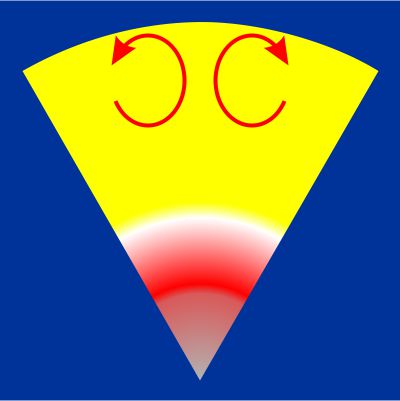
“And that’s why that region’s marked ash zone in this sketch.  Wherever conditions are right for hydrogen fusion, helium’s basically inert.  Like ash in a campfire it just sinks out of the way.  Now the fire goes out.  What would you expect next?”

“Radiation pressure’s gone but gravity’s still there … everything must slam inwards.”

Slam is an excellent word choice, even though the star’s radius is measured in thousands of miles.  What’s the slam going to do to the helium atoms?”

“Is it strong enough to start helium fusion?”

“That’s where I’m going.  The star starts fusing helium at its core.  That’s a much hotter reaction than hydrogen’s.  When convective zone hydrogen that’s still falling inward meets fresh outbound radiation pressure, most of the hydrogen gets blasted away.”

“Fusing helium – that’s a new one on me.  What’s that make?”

“Carbon and oxygen, mostly.  They’re as inert during the helium-fusion phase as helium was when hydrogen was doing its thing.”

“So will the star do another nova cycle?”

“Maybe.  Depends on the core’s mass.  Its gravity may not be intense enough to fuse helium’s ashes.  In that case you wind up with a white dwarf, which just sits there cooling off for billions of years.  That’s what the Sun will do.”

“But suppose the star’s heavy enough to burn those ashes…”

“The core’s fresh light-up blows away infalling convective zone material.  The core makes even heavier atoms.  Given enough fuel, the sequence repeats, cycling faster and faster until it gets to iron.  At each stage the star has less mass than before its explosion but the residual core is more dense and its gravity field is more intense.  The process may stop at a neutron star, but if there was enough fuel to start with, you get a black hole.”

“That’s the theory that accounts for the Sun-size black holes?”

“Pretty much.  I’ve left out lots of details, of course.  But it doesn’t account for black holes the size of 30 Suns — really big stars go supernova and throw away so much of their mass they miss the black-hole sweet spot and terminate as a neutron star or white dwarf.  That’s where the new LIGO observation comes in.  It may have clued us in on how those big guys happen.”

“That sketch looks like a pizza slice.”

“You’re thinking dinner, right?”

“Yeah, and it’s your turn to buy.”

~~ Rich Olcott

Three Perils for a Quest(ion), Part 3

“Things are finally slowing down.  You folks got an interesting talk going, mind if I join you?  I got biscotti.”

“Pull up a chair, Eddie.  You know everybody?”

“You and Jeremy, yeah, but the young lady’s new here.”

“I’m Jennie, visiting from England.”

“Pleased to meetcha.  So from what I overheard, we got Jeremy on some kinda Quest to a black hole’s crust.  He’s passed two Perils.  There’s a final one got something to do with a Firewall.”

“One minor correction, Eddie.  He’s not going to a crust, because a black hole doesn’t have one.  Nothing to stand on or crash into, anyway.  He’s headed to its Event Horizon, which is the next best thing.  If you’re headed inward, the Horizon marks the beginning of where it’s physically impossible to get out.”

“Hotel California, eh?”

“You could say that.  The first two Perils had to do with the black hole’s intense gravitational field.  The one ahead has to do with entangled virtual particles.”

“Entangled is the Lucy-and-Ethel thing you said where two particles coordinate instant-like no matter how far apart they are?”

“Good job of overhearing, there, Eddie.  Jeremy, tell him abut virtual particles.”

“Umm, Mr Moire and I talked about a virtual particle snapping into and out of existence in empty space so quickly that the long-time zero average energy isn’t affected.”

“What we didn’t mention then is that when a virtual pair is created, they’re entangled.  Furthermore, they’re anti-particles, which means that each is the opposite of the other — opposite charge, opposite spin, opposite several other things.  Usually they don’t last long — they just meet each other again and annihilate, which is how the average energy stays at zero.  Now think about creating a pair of virtual particles in the black hole’s intense gravitational field where the creation event sends them in opposite directions.”Astronaut and semi-biscotto
“Umm… if they’re on opposite paths then one’s probably headed into the Horizon and the other is outbound. Is the outbound one Hawking radiation?  Hey, if they’re entangled that means the inbound one still has a quantum connection with the one that escaped!”

“Wait on.  If they’re entangled and something happening to one instantaneously affects its twin, but the gravity difference gives each a different rate of time dilation, how does that work then?”

“Paradox, Jennie!  That’s part of what the Firewall is about.  But it gets worse.  You’d think that inbound particle would add mass to the black hole, right?”

“Surely.”

“But it doesn’t.  In fact, it reduces the object’s mass by exactly each particle’s mass.  That ‘long-time zero average energy‘ rule comes into play here.  If the two are separated and can’t annihilate, then one must have positive energy and the other must have negative energy.  Negative energy means negative mass, because of Einstein’s mass-energy equivalence.  The positive-mass twin escapes as Hawking radiation while the negative-mass twin joins the black hole, shrinks it, and by the way, increases its temperature.”

“Surely not, Sy.  Temperature is average kinetic energy.  Adding negative energy to something has to decrease its temperature.”

“Unless the something is a black hole, Jennie.  Hawking showed that a black hole’s temperature is inversely dependent on its mass.  Reduce the mass, raise the temperature, which is why a very small black hole radiates more intensely than a big one.  Chalk up another paradox.”

“Two paradoxes.  Negative mass makes no sense.  I can’t make a pizza with negative cheese.  People would laugh.”

“Right.  Here’s another.  Suppose you drop some highly-structured object, say a diamond, into a black hole.  Sooner or later, much later really, that diamond’s mass-energy will be radiated back out.  But there’s no relationship between the structure that went in and the randomized particles that come out.  Information loss, which is totally forbidden by thermodynamics.  Another paradox.”

“The Firewall resolves all these paradoxes then?”

“Not really, Jennie.  The notion is that there’s this thin layer of insanely intense energetic interactions, the Firewall, just outside of the Event Horizon.  That energy is supposed to break everything apart — entanglements, pre-existing structures, quantum propagators (don’t ask), everything, so what gets through the horizon is mush.  Many physicists think that’s bogus and a cop-out.”

“So no Firewall Peril?”

“Wanna take the chance?”

~~ Rich Olcott

Three Perils for a Quest(ion), Part 2

Eddie came over to our table.  “Either you folks order something else or I’ll have to charge you rent.”  Typical Eddie.

“Banana splits sound good to you two?”

[Jeremy and Jennie] “Sure.”

“OK, Eddie, two banana splits, plus a coffee, black, for me.  And an almond biscotti.”

“You want one, that’s a biscotto.”

“OK, a biscotto, Eddie.  The desserts are on my tab.”

“Thanks, Mr Moire.”

“Thanks, Sy.  I know you want to get on to the third Peril on Jeremy’s Quest for black hole evaporation, but how does he get past the Photon Sphere?”

“Yeah, how?”

“Frankly, Jeremy, the only way I can think of is to accept a little risk and go through it really fast.  At 2/3 lightspeed, for instance, you and your two-meter-tall suit would transit that zero-thickness boundary in about 10 nanoseconds.  In such a short time your atoms won’t get much out of position before the electromagnetic fields that hold your molecules together kick back in again.”

“OK, I’ve passed through.  On to the Firewall … but what is it?”

“An object of contention, for one thing.  A lot of physicists don’t believe it exists, but some claim there’s evidence for it in the 2015 LIGO observations.  It was proposed a few years ago as a way out of some paradoxes.”

“Ooo, Paradoxes — loverly.  What’re the paradoxes then?”

“Collisions between some of the fundamental principles of Physics-As-We-Know-It.  One goes back to the Greeks — the idea that the same thing can’t be in two places at once.”

“Tell me about it.  Here’s your desserts.”

“Thanks, Eddie.  The place keeping you busy, eh?”

“Oh, yeah.  Gotta be in the kitchen, gotta be runnin’ tables, all the time.”

“I could do wait-staff, Mr G.  I’m thinking of dropping track anyway, Mr Moire, 5K’s don’t have much in common with base running which is what I care about.  How about I show up for work on Monday, Mr G?”

“Kid calls me ‘Mr’ — already I like him.  You’re on, Jeremy.”

“Woo-hoo!  So what’s the link between the Firewall and the Greeks?”

Link is the right word, though the technical term is entanglement.  If you create two particles in a single event they seem to be linked together in a way that really bothered Einstein.”

“For example?”Astronaut and biscotti
“Polarizing sunglasses.  They depend on a light wave’s crosswise electric field running either up-and-down or side-to-side.  Light bouncing off water or road surface is predominately side-to-side polarized, so sunglasses are designed to block that kind.  Imagine doing an experiment that creates a pair of photons named Lucy and Ethel.  Because of how the experiment is set up, the two must have complementary polarizations.  You confront Lucy with a side-to-side filter.  That photon gets through, therefore Ethel should be blocked by a side-to-side filter but should go through an up-and-down filter.  That’s what happens, no surprise.  But suppose your test let Lucy pass an up-and-down filter.  Ethel would pass a side-to-side filter.”

“But Sy, isn’t that because each photon has a specific polarization?”

“Yeah, Jennie, but here’s the weird part — they don’t.  Suppose you confront Lucy with a filter set at some random angle.  There’s only the one photon, no half-way passing, so either it passes or it doesn’t.  Whenever Lucy chooses to pass, Ethel usually passes a filter perpendicular to that one.  It’s like Ethel hears from Lucy what the deal was — and with zero delay, no matter how far away the second test is executed.  It’s as though Lucy and Ethel are a single particle that occupies two different locations.  In fact, that’s exactly how quantum mechanics models the situation.  Quite contrary to the Greeks’ thinking.”

“You said that Einstein didn’t like entanglement, either.  How come?”

“Einstein published the original entanglement mathematics in the 30s as a counterexample against Bohr’s quantum mechanics.  The root of his relativity theories is that the speed of light is a universal speed limit.  If nothing can go faster than light, instantaneous effects like this can’t happen.  Unfortunately, recent experiments proved him wrong.  Somehow, both Relativity and Quantum Mechanics are right, even though they seem to be incompatible.”

“And this collision is why there’s a problem with black hole evaporation?”

“It’s one of the collisions.”

“There’s more?  Loverly.”

~~ Rich Olcott