LIGO And NANOGrav

Afternoon coffee time, but Al’s place is a little noisier than usual. “Hey, Sy, come here and settle this.”

“Settle what, Al? Hi, Vinnie.”

<waves magazine> “This NANOGrav thing, they claim it’s a brand‑new kind of gravity wave. What’s that about?”

“Does it really say, ‘gravity wave‘? Let me see that. … <sigh> Press release journalism at its finest. ‘Gravity waves’ and ‘gravitational waves’ are two entirely different things.”

“I kinda remember you wrote about that, but it was so long ago I forget how they’re different.”

“Gravity waves happen in a fluid, like air or the ocean. Some disturbance, like a heat spike or an underwater landslide, pushes part of the fluid upward relative to a center of gravity. Gravity acts to pull that part down again but in the meantime the fluid’s own internal forces spread the initial up‑shift outwards. Adjacent fluid segments pull each other up and down and that’s a gravity wave. The whole process keeps going until friction dissipates the energy.”

“Gravitational waves don’t do that?”

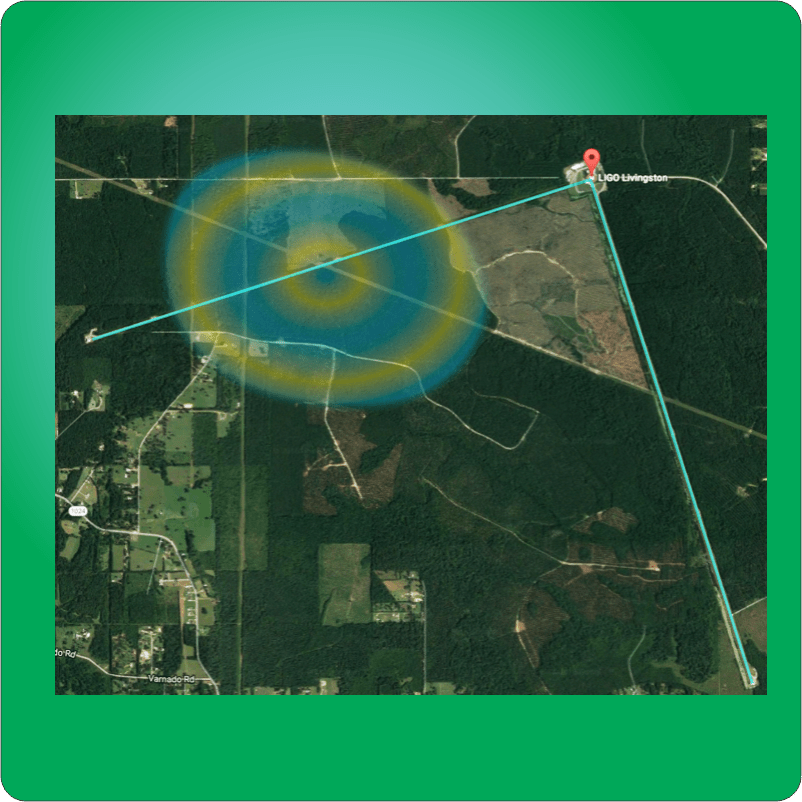
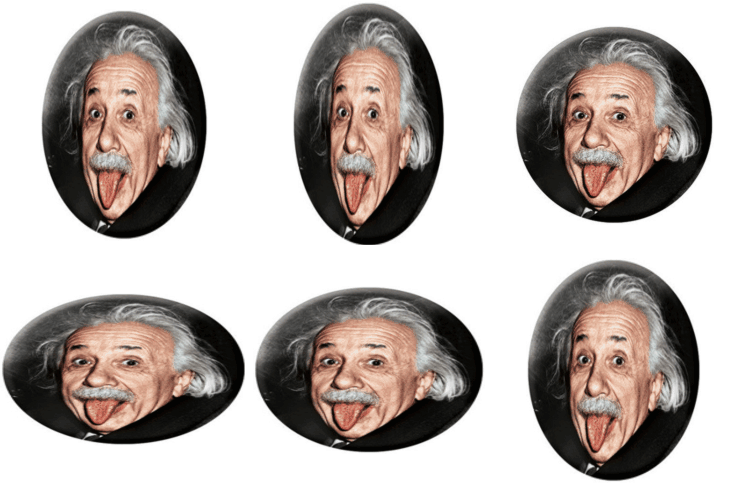
“No, because gravitational waves temporarily modify the shape of space itself. The center doesn’t go up and down, it…” <showing a file on Old Reliable> “Here, see for yourself what happens. It’s called quadrupolar distortion. Mind you, the effects are tiny percentagewise which is why the LIGO apparatus had to be built kilometer‑scale in order to measure sub‑femtometer variations. The LIGO engineers took serious precautions to prevent gravity waves from masquerading as gravitational waves.”

“Alright, so now we’ve almost got used to LIGO machines catching these waves from colliding black holes and such. How are NANOGrav waves different?”

“Is infrared light different from visible light?”

“The Hubble sees visible but the Webb sees infrared.”

“Figures you’d have that cold, Al. What I think Sy’s getting at is they’re both electromagnetic even though we only see one of them. You’re gonna say the same for these new gravitational waves, right, Sy?”

“Got it in one, Vinnie. There’s only one electromagnetic field in the Universe but lots of waves running through it. Visible light is about moving charge between energy levels in atoms or molecules which is how the visual proteins in our eyes pick it up. Infrared can’t excite electrons. It can only waggle molecule parts which is why we feel it as heat. Same way, there’s only one gravitational field but lots of waves running through it. The LIGO devices are tuned to pick up drastic changes like the <ahem> massive energy release from a black hole collision.”

“You said ‘tuned‘. Gravitational waves got frequencies?”

“Sure. And just like light, high frequencies reflect high‑energy processes. LIGO detects waves in the kilohertz range, thousands of peaks per second. NANOGrav’s detection range is sub‑nanohertz, where one cycle can take years to complete. Amazingly low energy.”

“How can they detect anything that slow?”

“With really good clocks and a great deal of patience. The new reports are based on fifteen years of data, half a billion seconds counted out in nanoseconds.”

“Hey, wait a minute. LIGO’s only half‑a‑dozen years old. Where’d they get the extra data from, the future?”

“Of course not. Do you remember us working out how LIGO works? The center sends out a laser pulse along two perpendicular arms, then compares the two travel times when the pulse is reflected back. Light’s distance‑per‑time is constant, right? When a passing gravitational wave squeezes space along one arm, the pulse in that arm completes its round trip faster. The two times don’t match any more and everyone gets excited.”

“Sounds familiar.”

“Good. NANOGrav also uses a timing‑based strategy, but it depends on pulsars instead of lasers. Before you ask, a pulsar is a rotating neutron star that blasts a beam of electromagnetic radiation. What makes it a pulsar is that the beam points away from the rotation axis. We only catch a pulse when the beam points straight at us like a lighthouse or airport beacon. Radio and X‑ray observatories have been watching these beasts for half a century but it’s only in the past 15 years that our clocks have gotten good enough to register timing hiccups when a gravitational wave passes between us and a pulsar.”

~ Rich Olcott

Reflection, Rotation And Spacetime

“Afternoon, Al.”

“Hiya, Sy. Hey, which of these two scones d’ya like better?”

“”Mm … this oniony one, sorta. The other is too vegetable for me ‑ grass, I think, and maybe asparagus? What’s going on?”

“Experimenting, Sy, experimenting. I’m going for ‘Taste of Spring.’ The first one was spring onion, the second was fiddlehead ferns. I picked ’em myself.”

“Very seasonal, but I’m afraid neither goes well with coffee. I’ll take a caramel scone, please, plus a mug of my usual mud.”

“Aw, Sy, caramel’s a winter flavor. Here you go. Say, while you’re here, maybe you could clear up something for me?”

“I can try. What’s the something?”

“After your multiverse series I got out my astronomy magazines to read up on the Big Bang. Several of the articles said that we’ve gone through several … um, I think they said ‘epochs‘ … separated by episodes of symmetry breaking. What’s that all about?”

“It’s about a central notion in modern Physics. Name me some kinds of symmetry.”

“Mmm, there’s left‑right, of course, and the turning kind like a snowflake has. Come to think — I like listening to Bach and Vivaldi when I’m planet‑watching. I don’t know why but their stuff reminds me of geometry and feels like symmetry.”

“Would it help to know that the word comes from the Greek for ‘same measure‘? Symmetry is about transformations, like your mirror and rotation operations, that affect a system but don’t significantly change to its measurable properties. Rotate that snowflake 60° and it looks exactly the same. Both the geometric symmetries you named are two‑dimensional but the principle applies all over the place. Bach and the whole Baroque era were just saturated with symmetry. His music was so regular it even looked good on the page. Even buildings and artworks back then were planned to look balanced, as much mass and structure on the left as on the right.”

“I don’t read music, just listen to it. Why does Bach sound symmetric?”

“There’s another kind of symmetry, called a ‘translation‘ don’t ask why, where the transformation moves something along a line within some larger structure. That paper napkin dispenser, for instance. It’s got a stack of napkins that all look alike. I pull one off, napkins move up one unit but the stack doesn’t look any different.”

“Except I gotta refill it when it runs low, but I get your drift. You’re saying Bach takes a phrase and repeats it over and over and that sounds like translational symmetry along the music’s timeline.”

“Yup, maybe up or down a few tones, maybe a different register or instrument. The repeats are the thing. Play his Third Brandenberg Concerto next time you’re at your telescope, you’ll see what I mean.”

“Symmetry’s not just math then.”

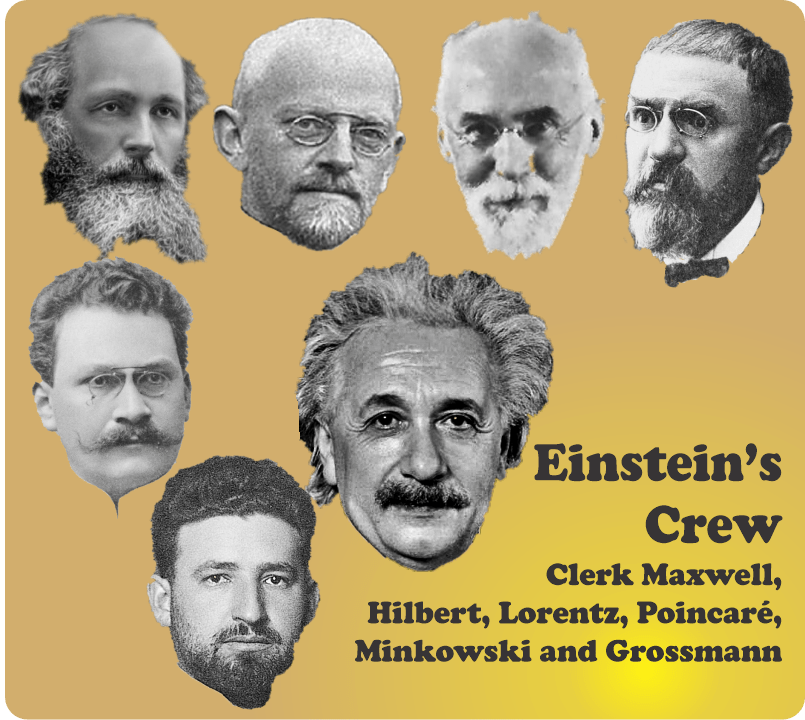
“Like I said, it’s everywhere. You’ve seen diagrams of DNA’s spiral staircase. It combines translation with rotation symmetry, does about 10 translation steps per turn, over and over. The Universe has a symmetry you don’t see at all. No‑one did until Lorentz and Poincaré revised Heaviside’s version of Maxwell’s electromagnetism equations for Minkowski space. Einstein, Hilbert and Grossman used that work to give us and the Universe a new symmetry.”

“Einstein didn’t do the math?”

“The crew I just named were world‑class in math, he wasn’t. Einstein’s strengths were his physical intuition and his ability to pick problems his math buddies would find interesting. Look, Newton’s Universe depends on absolute space and time. The distance between two objects at a given time is always the same, no matter who’s measuring it or how fast anyone is moving. All observers measure the same duration between two incidents regardless. Follow me?”

“Makes sense. That’s how things work hereabouts, anyway.”

“That’s how they work everywhere until you get to high speeds or high gravity. Lorentz proved that the distances and durations you measure depend on your velocity relative to what you’re measuring. Extreme cases lead to inconsistent numbers. Newton’s absolute space and time are pliable. To Einstein such instability was an abomination. Physics needs a firm foundation, a symmetry between all observers to support consistent measurements throughout the Universe. Einstein’s Relativity Theory rescued Physics with symmetrical mathematical transformations that enforce consistency.”

~~ Rich Olcott

Metrological Extremes

Al’s coffee shop smells festive. “Hiya, Sy. Can I interest you in a peppermint latte this morning?”

Adapted from a YouTube video contributed by NPL(UK)

“You know me better than that, Al. My usual black mud, please. Hmm… What flavor’s hiding under the chocolate frosting on the scone rack?”

“Strawberry.”

“In that case I’ll take two. Your latest artwork behind the cash register is more a scroll than a poster.”

“You noticed. Yeah, it’s very cool but I don’t understand a couple things.”

“Oh? Like what?”

“Like what’s NPL, for starters, but mostly what the poster’s even about. I get that it’s science-y and my Physics and Astronomy customers chuckle at it, but…”

“Well, for starters, NPL is the United Kingdom’s National Physical Laboratory. In USA terms they’re a little bit like a mixture of NIST and what used to be Bell Labs with a side order of DARPA. They were early supporters of high‑precision instrumentation, computer and network tech, lots of cutting‑edge stuff until they were privatized and the company that mostly bought them lost a whole lot of money. Now they’re back to a government plus academy structure but they’re still a going concern, one of the major drivers behind the SI conventions.”

“You wrote about that a while ago, din’tcha?”

“Did a whole series that started with revising the official mass standard and wound up at the full set of Système International basic and derived units. Pretty boring until you realize that precise measurement has been crucial to practically all manufacturing since the introduction of mass production. And it’s important to use a consistent set of units. One of NASA’s worst black eyes was the Mars Climate Orbiter failure when one team used Imperial feet‑and‑pounds units and everyone else was on the metric system.”

“I gotta use both sets. Most of my baking supplies come in pounds, but the coffee beans and some of the flavorings come in kilograms. I gotta use my computer to resize a recipe.”

“That’s the thing with the metric system. It’s all about powers of ten. No dividing by 12 or is it 16 or even 5280 to get to a different size range — just move the decimal and you’re done. I don’t know why people have so much trouble with it.”

“It’s something new, Sy.”

“Yeah, but it’s not been new since the 1800s. It’s a long time since doctors prescribed by the scruple or minim. All there’s been for generations is milligrams and microliters. Gas prices being what they are these days I’m surprised the oil companies haven’t been pushing to sell by the liter — price per unit volume would drop by nearly a quarter.”

“I see ‘milli’ and ‘micro’ ornaments on one of those Christmas trees. Is that what they’re about?”

“That’s the ‘divide by a thousand’ tree. You already know ‘milli’ as the first cut‑down from grams or whatever the unit is. Divide by another thousand, you’ve got ‘micro’, which is one millionth or 10‑6. You’ve seen the ‘nano’ prefix by now — it’s 10‑9 and I like the nano‑nine connection. The ornaments on that tree display the prefixes for smaller and smaller subdivisions. The gold ones near the bottom are new this year. ‘Quecto’ is 10‑30, which would take you 30 digits if you wrote the number out.”

“So I guess the other tree is ‘multiply by a thousand.‘ Yup, there’s the ‘kilo’ for a thousand grams. Someone once told me I get about ten thousand beans in a kilogram bag.”

“Ten beans to a gram, then. That makes each bean a tenth of a gram or 100 milligrams. See how easy? Try figuring that in ounces.”

“Nice. Hey, I recognize ‘mega’ next to … a million. Counting’s hard without the commas in there.”

“Some people use spaces. You probably remember ‘giga’ and ‘tera’ from gigabytes and terabytes, you being a computer user.”

“Gigabucks, too. I read the news, you know. Politicians and CEOs play in the billions. But who needs numbers as big as ‘quetta’? That’s what, 1030?”

“Scientists and computer storage managers, mostly. Jupiter’s just shy of two quettagrams, and civilization’s on the path to generating a ronnabyte of data.”

~~ Rich Olcott

Cause, Effect And Time

We’re still at Vinnie’s table by the door of Al’s coffee shop. “Long as we’re talking about black holes, Sy, I read in one of my astronomy magazines that an Event Horizon traps information the same way it traps light. I understand how gravity makes escape velocity for photons go beyond lightspeed, but how does that trap information?”

“Well, to start with, Al, you understand wrong. The whole idea of escape velocity applies to massive objects like rockets that feel the force of gravity. Going up they trade kinetic energy for potential energy; given enough kinetic energy they escape. Photons have zero mass — the only way gravity influences them is by bending the spacetime they fly through.”

“Does the bending also affect information or is that something else?”

Minkowski’s spacetime diagram…

“Fair question, but it’ll take some background to answer it. Good thing I’ve got Old Reliable and my graphics files along. Let’s start with this one. Vinnie’s seen a lot of spacetime graphs like this, Al, but I don’t think you have. Time runs upward, distance runs sideward, okay? Naming a specific time and location specifies an event, just like a calendar entry. Draw a line between two events; the slope is the speed you have to go to get from one to the other.”

“Just the distance, you’re not worrying about direction?”

“Good question. You’re thinking space is 3D and this picture shows only one space dimension. Einstein’s spacetime equations take account of all four dimensions mixing together, which is one reason they’re so hard to solve except in special cases. For where we’re going, distance will be enough, okay?”

“Not gonna argue.”

… compartmentalized by Einstein’s speed limit …

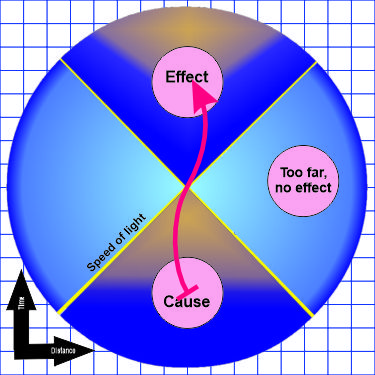
“Now we roll in Einstein’s speed limit. Relativity says that nothing can go faster than light. On a Minkowski diagram like this we draw the lightspeed slope at a 45″ angle. Any physical motion has a slope more vertical than that.”

“Huh?”

“See, Al, you’re going one second per second along time, right? If you’re not making much progress distance‑wise, you don’t do much on Sy’s sideways axis. You move mostly up.”

“Exactly, Vinnie. The bottom and top sections are called ‘timelike‘ because, well, they’re mostly like time.”

“Are the other two sections spacelike?”

“Absolutely. You can’t get from ‘Here & Now‘ to the ‘Too far to see‘ event without going faster than light. Einstein said that’s a no‑no. Suppose that event’s a nova, ‘Now‘ but far away. Astronomers will have to just wait until the nova’s light reaches them at ‘Here‘ but at a later ‘Now.’ Okay, Vinnie, here’s a graphic you haven’t seen yet.”

… and re-interpreted in terms of causality.

“Looks pretty much the same, except for that arrow. What’s cause and effect got to do with time?”

“I don’t want to get into the metaphysical weeds here. There’s a gazillion theories about time — the Universe is expanding and that drives time; entropy always increases and that drives time; time is an emergent property of the underlying structure of the Universe, whatever that means. From an atomic, molecular, mechanical physics point of view, time is the result of causes driving effects. Causes always come first. Your finger bleeds after you cut it, not before. Cause‑effect runs along the time axis. Einstein showed us that cause‑effect can’t travel any faster than lightspeed.”

“That’s a new one. How’d he figure that?”

“Objects move objects to make things happen. They can’t move faster than lightspeed because of the relativity factor.”

“What if the objects are already touching?”

“Your hand and that cup are both made of atoms and it’s really their electric fields that touch. Shifting fields are limited by lightspeed, too.”

“So you’re saying that cause-effect is timelike.”

“Got it in one. Einstein would say causality is not only timelike, but exactly along the time axis. That’s one big reason he was so uncomfortable about action at a distance — a cause ‘Here‘ having an effect ‘There‘ with zero time elapsed would be a horizontal line, pure spacelike, on Minkowski’s graph. Einstein invented the principle of entanglement as a counterexample, thinking it impossible. He’d probably be shocked and distressed to see that today we have experimental proof of entanglement.”

~~ Rich Olcott

Holes in A Hole?

Mid-afternoon coffee break time so I head over to Al’s coffee shop. Vinnie’s at his usual table by the door, fiddling with some spilled coffee on the table top. I notice he’s pulled some of it into a ring around a central blob. He looks at it for a moment. His mental gears whirl then he looks up at me. “Hey Sy! Can you have a black hole inside another black hole?”

“That’s an interesting question. Quick answer is, ‘No.’ Longer answer is, ‘Sort of, maybe, but not the way you’re thinking.’ You good with that, Vinnie?”

“You know me better than that, Sy. Pull up a chair and give.”

I wave at Al, who brings me a mug of my usual black mud. “Thanks, Al. You heard Vinnie’s question?”

“Everyone on campus did, Sy. Why the wishy-washy?”

“Depends on your definition of black hole.”

Sky-watcher Al is quick with a response. “It’s a star that collapsed denser than a neutron star.”

Vinne knows me and black holes better than that. “It’s someplace where gravity’s so strong that nothing can get out, not even light.”

“Both right, as far as they go, but neither goes deep enough for Vinnie’s question.”

“You got a better one, I suppose?”

“I do, Vinnie. My definitition is that a black hole is a region of spacetime with such intense gravitation that it wraps an Event Horizon around itself. Al’s collapsed star is one way to create one, but that probably doesn’t account for the Event Horizons around supermassive black holes lurking in galactic cores. Your ‘nothing escapes‘ doesn’t say anything about conditions inside.”

“Thought we couldn’t know what happens inside.”

“Mostly correct, which is why your question is as problematical as you knew it was. Best I can do is lay out possibilities, okay? First possibility is that the outer black hole forms around a pre-existing inner one.”

“Can they do that?”

“In principle. What makes a black hole is having enough mass gathered in close proximity. Suppose you have a black hole floating our there in space, call it Fred, and a neutron star comes sidling by. If the two bodies approach closely enough, the total amount of mass could be large enough to generate a second Event Horizon shell enclosing both of them. How long that’d last is another matter.”

“The outer shell’d go away?”

“No chance of that. Once the shell’s created, the mass is in there and the star is doomed … unless the star’s closest approach matches Fred’s ISCO. That’s Innermost Stable Circular Orbit, about three times Fred’s Event Horizon’s half-diameter if Fred’s not rotating. Then the two bodies might go into orbit around their common center of gravity.”

“How’s rotation come into this?”

“If the mass is spinning, then you’ve got a Kerr black hole, frame-dragging and an ISCO each along and against the spin direction. Oh, wait, I forgot about tidal effects.”

“Like spaghettification, right.”

“Like that but it could be worse. Depending on how tightly neutronium holds itself together, which we don’t know, that close approach might be inside the Roche limit. Fred’s gravity gradient might simply shred the star to grow the black hole’s accretion disk.”

“Grim. You said there’s other possibilities?”

“Sorta like the first one, but suppose the total mass comes from two existing black holes, like the collision that LIGO picked up accidentally back in 2014. Suppose each one is aimed just outside the other’s ISCO. Roche fragmentation wouldn’t happen, I think, because each body’s contents are protected inside its own personal Event Horizon. Uhh … darn, that scheme won’t work and neither will the other one.”

“Why not?”
 ”Why not?”

“Because the diameter of an Event Horizon is proportional to the enclosed mass. The outer horizon’s diameter for the case with two black holes would be exactly the sum of the diameters of the embedded holes. If they’re at ISCO distances apart they’re can’t be close enough to form the outer horizon. For the same reason, I don’t think a neutron star could get close enough, either.”

“No hole in a hole, huh?”

“I’m afraid not.”

~~ Rich Olcott

  • Thanks to Alex and Xander, who asked the question.

A Match Game

<chirp chirp> “Lab C-324, Susan Kim speaking.”

<hoarsely> “Hi Susan, it’s Sy. Fair warning. The at‑home test I just ran says I’ve got Covid. I’ve had all four shots but it looks like some new variant dodged in anyway. We had coffee together at Al’s yesterday so I wanted to warn you. Better stock up on cough medicine and such.”

“Ooh. Thanks, Sy, sorry to hear that. If it’s any consolation, you’re not alone. About half the lab’s empty today because of Covid. I’m just waiting for this last extraction to complete and then I’m outta here myself. There’s chicken soup going in the slow‑cooker at home.”

“Ah, yes, a Jewish mother’s universal remedy.”

“Korean mothers, too, Sy, except we use more garlic. Chicken soup’s a standard all over the world — soothing, easy on the stomach and loaded with protein.”

“While you’re in wait mode, maybe you could explain something to me.”

“I can try. What is it?”

“How do these tests work? I swabbed my nose, swirled the yuck with the liquid in the little vial and put three drops into the ‘sample port‘ window. In the next few minutes fluid crept across the display window next to the port and I saw dark bars at the T and C markers. What’s that all about?”

“Miracles of modern immunochemistry, Sy, stuff we wouldn’t have been able to execute fifty years ago. What do you know about antibodies?”

“Not much. I’ve read a little about immunology but I always get the antibodies confused with the antigens and then my understanding goes south.”

“Ignore the ‘anti‘ parts — an antigen is usually a part of something from outside that generates an immune response. As part of the response, cells in your body build antibodies, targeted proteins that stick to specific antigens. Each unique antibody is produced by just a few of your cells. When you’re under a disease attack, your antibodies that match the attacker’s antigens lock onto the attacker to signal your defender cells what needs chewing up. About half‑a‑dozen Nobel Prizes went to researchers who figured out how to get a lab‑grown cell to react to a given antigen and then how to clone enough copies of that cell to make industrial quantities of the corresponding antibody. You follow?”

“So far, so good.”

“One more layer of detail. All antibodies are medium-sized proteins with the same structure like a letter Y. There’s a unique targeting bit at the end of each upper arm. An antigen can be anything — a fragment of protein or carbohydrate, a fatty acid, even some minerals.”

“Wait. If a protein can be an antigen, does that mean that an antibody can be an antigen, too?”

“Indeed, that’s the key for your test kit’s operation. The case holds a strip of porous plastic like filter paper that’s been treated with two narrow colorless stripes and a dot. The T stripe contains immobilized antibody for some fragment of the virus. The C stripe contains immobilized antibody antibody.”

“Hold on — an antibody that targets another antibody like maybe the bottom of the Y?”

“Exactly. That’s the control indicator. The dot holds virus antibodies that can move and they’re linked to tiny particles of gold. Each gold particle is way too small to see, but a bunch of them gathered together looks red‑brown. Okay, you put a few drops of yuckified liquid on top of the dot and the mixture migrates along the porous material. You tell me what happens.”

“Wait, what’s in that liquid?”

“It’s standard pH-buffered saline, keeps the proteins healthy.”

“Hmm. Alright, the dot’s gold‑labeled virus antibody grabs virus in my yuck and swims downstream. The T stripe’s virus antibody snags the virus‑antigen combination particles and I see red‑brown there. Or not, if there’s no virus. Meanwhile, the creeping liquid sweeps other gold‑labeled antibodies, virus‑bound or not, until they hit the C stripe and turn it red‑brown if things are working right. Uhhh, how much gold are we talking about?”

“Colloidal gold particles are typically balls maybe 50 nanometers across. Stripe area’s about 1 mm2, times 50 nanometers, density 19.32 kg/m3, gold’s $55 per gram today … about 5 microcents worth.”

~~ Rich Olcott

Shadow Plays

“A strawberry scone and my usual black, Al.”

“Sure thing, Sy, comin– Hiya, Cathleen, see my new poster? Event Horizon Telescope pictures of the two big‑guy black holes we’ve actually seen so far. Those white-hot blobs buried in those red rings. Ain’t it a beaut? What’ll you have?”

“They’re certainly wonderful graphics, Al. I’ll have a caramel latte, please, with a plain scone.” I’m waiting for it, because Cathleen never passes up a teachable moment. Sure enough — “Of course, neither one actually looks like that or represents what you think. Those images were created from radio waves, not visible light or even infrared. The yellows and whites don’t represent heat, and that darkness in the middle isn’t the black hole.”

“Whoa, don’t harsh Al’s happy, Cathleen. Maybe just go at it a step at a time?”

<sigh> “You’re right, Sy. Sorry, Al, I just get frustrated when press‑agent science gets in the way of the real stuff which is already interesting on its own. For instance, I haven’t seen anything in the pop‑sci press about the EHT people using the same 2017 data to produce both images, even though the two objects are almost 90° apart in the sky. I think about our optical telescopes and the huge high-tech motors it takes to point them in the right direction. These guys just re-work their data and they’re good for another round.”

“It’s a cute trick, alright, Cathleen, steering a distributed telescope with arithmetic.”

“OK, you guys are over my head — distributed telescope?”

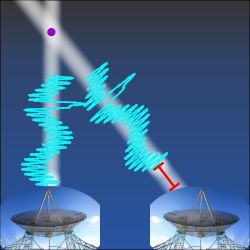
“The EHT Collaboration works with eight radio telescopes scattered across the world. The signal from any point in the sky has a different time offset at each telescope depending on the angle to the point. If you know the baseline between each pair of scopes and you’ve got really good clocks keeping track of time at each location, when you combine the data from all eight locations it’s just arithmetic to pick out matching signals at the right set of offsets for any point of origin.”

“A lot of arithmetic, Cathleen.”

“I’ll give you that, Sy. Al, it took the researchers and some hefty compute facilities two years to boil down the data for the M87 monster. In principle, when they wanted to inspect the Milky Way’s beast all they had to do was run through the same data selecting for signal matches at the offsets pointing to Sgr A*. Awesome tech, huh?”

“Awesome, yeah, but if the colors aren’t heat, what are they?”

“Electron density, mostly. Your red‑and‑yellow Jupiter poster over there is like most heat maps. Researchers figure a pixel’s temperature by comparing data from multiple wavelengths with the Planck curve or some other calibrated standard. These images, though, came from a single wavelength, 1.3 millimeters. Light at shorter wavelengths can’t get past the dust, longer wavelengths can’t give us the image resolution. Millimeters waves are in the radio part of the spectrum — too low‑energy to detect moving charge inside atoms or between molecule components. The only thing that can give off those photons is free‑floating electrons. The brightest pixels have the most electrons.”

“So the hole isn’t the black hole?”

“Depends on your definition, I suppose. Everyone visualizes that black sphere, the event horizon, when they think ‘black hole.’ That’s not what the dark patches are. By my definition, though, a ‘black hole‘ is the whole package — central mass, event horizon, ergosphere if it’s spinning, a jet maybe and everything else that’s associated with the mass. It’s as much a collection of processes as a thing. Anyhow, the bright stuff in these images does come from accretion disks.”

“The dark patch is the disk’s inside edge?”

“Nope, it’s the shadow of the photon sphere. Before you ask, that’s a light‑trapping shell 1½ times the horizon’s diameter. Depending on its angle of approach, a photon that touches the sphere either spirals inward, orbits forever, or swerves outward. Going straight doesn’t happen. The shadow memorializes Earth‑bound photons that bounced away from us.”

“I guess my happy’s back, Cathleen, but it’s different.”

“You’re welcome, Al. Now how about the coffee and scones we asked for?”

~~ Rich Olcott

Credit: Event Horizon Telescope Collaboration
Image: Lia Medeiros, ISA, EHTC

When The Stars Are Aligned Right

Cathleen and I are chatting when Vinnie bursts into the coffee shop waving a newspaper. “New news, guys, they’ve just announced Hubble spotted the farthest‑away star. How about that? Think what JWST will be able to do!”

Cathleen raises an eyebrow. “Sounds like press release science. What else do they say?”

“Not a whole lot. Lessee… These guys went through old Hubble data and found a piece of an Einstein ring which I don’t know what that is and partway along the ring is a star and somehow they figured out it’s 50 times heavier than the Sun and 12 billion years old and it’s the farthest star they’ve ever seen and that’s why NASA’s all excited.”

“Do you believe all that?”

“Maybe the NASA PR people do?”

“Maybe. I just read the technical paper behind that announcement. The authors themselves aren’t absolutely sure. The paper’s loaded with supporting evidence and ‘how we did it‘ details but it’s also loaded with caveats. The text includes a string of alternative explanations for their observations, winding up with a typical ‘we await further evidence from JWST‘ statement. Reads a lot more like real science. Besides, we’ve already seen more distant stars but they’re all jumbled together inside their very distant galaxies.”

“Unpack it for me. Start with what’s an Einstein ring?”

“It’s a gravitational lensing effect. Sy, does Old Reliable still have a copy of that graphic you did about gravitational lensing?”

“That was years ago. Let me check… Uh‑huh, here it is.”

“Thanks. Vinnie, you know how a prism changes light’s direction.”

“Sy and me, we talked about how a prism bends light when light crosses from air to glass or the other way ’cause of the different speed it goes in each material. Uhh, if I remember right the light bends toward the slower speed, and you get more bend with shorter wavelengths.”

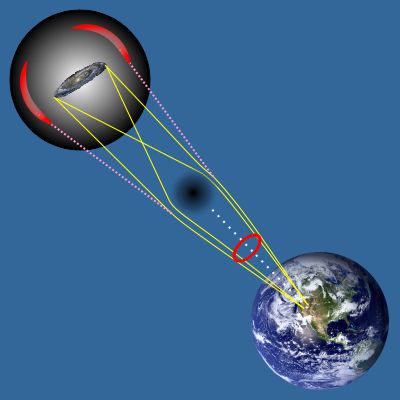
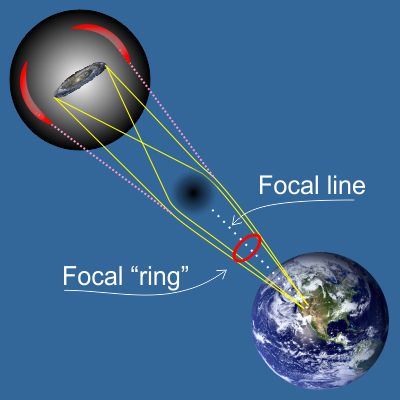
“Bingo, Vinnie. Gravitational lensing also bends light, but the resemblance ends there. The light’s just going through empty space, not different media. What varies is the shape of spacetime itself. Say an object approaches a heavy mass. Because of relativity the space it moves through appears compressed and its time is dilated. Compressed distance divided by dilated time means reduced velocity. Parts of a spread‑out lightwave closest to the mass slow down more than parts further way so the whole wave bends toward the heavy mass. Okay?”

“Hold on. Umm, so in your picture light coming towards us from that galaxy doesn’t get blocked by that black thingy, the light bends around it on both sides and focuses in on us?”

“Exactly. Now carry it further. The diagram cuts a flat 2D slice along round 3D spatial reality. Those yellow lines really are cones. Three‑sixty degrees around the black blob, the galaxy’s light bends by the same amount towards the line between us and the blob. Your Einstein ring is a cut across the cone, assuming that the galaxy, the blob and Earth are all exactly on the same straight line. If the galaxy’s off‑center the picture isn’t as pretty — you only get part of a ring, like those red arcs in Sy’s diagram.”

“A galactic rainbow. That ought to be awesome!”

“Well it would be, but there’s another difference between prisms and blobs. Rainbows happen because prisms and raindrops bend short‑wavelength colors more than longer ones, like you said. Gravitational lensing doesn’t care about wavelength. Wavelengths do shift as light traverses a gravitational well but the outbound red shift cancels the inbound blue shift.. Where gravity generates an Einstein ring, all wavelengths bend through the same angle. Which is a good thing for bleeding‑edge astronomy researchers.”

“Why’s that, Cathleen?”

“If the effect were wavelength‑dependent we’d have aberration, the astronomer’s nemesis. Images would be smeared out. As it is, all the photons from a point hit the same spot on the sensor and we’ve got something to see.”

“Tell him about amplification, Cathleen.”

“Good point, Sy. Each galactic star emits light in every direction. In effect, the blob collects light over its entire surface area and concentrates that light along the focal line. We get the brightest image when the stars are aligned right.”

~~ Rich Olcott
Now And Then And There

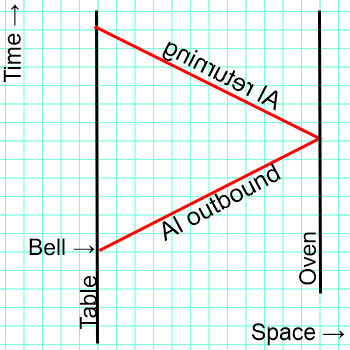
Still at our table in Al’s otherwise empty coffee shop. We’re leading up to how Physics scrambled Now when a bell dings behind the counter. Al dashes over there. Meanwhile, Cathleen scribbles on a paper napkin with her colored pencils. She adds two red lines just as Al comes back with a plate of scones. “Here, Sy, if you’re going to talk Minkowski space this might be useful.”

“Hah, you’re right, Cathleen, this is perfect. Thanks, Al, I’ll have a strawberry one. Mmm, I love ’em fresh like this. OK, guys, take a look at Cathleen’s graphy artwork.”

“So? It’s the tile floor here.”

“Not even close, Mr Feder. Check the labels. The up‑and‑down label is ‘Time’ with later as higher. The diagram covers the period we’ve been sitting here. ‘Now‘ moves up, ‘Here’ goes side‑to‑side. ‘Table‘ and ‘Oven‘, different points in space, are two parallel lines. They’re lines because they both exist during this time period. They’re vertical because neither one moves from its relative spatial position. Okay?”

“Go on, Moire.”
  ”Makes sense to me, Sy.”

“Good. ‘Bell‘ marks an event, a specific point in spacetime. In this case it’s the moment when we here at the table heard the bell. I said ‘spacetime‘ because we’re treating space and time as a combined thing. Okay?”

“Go on, Moire.”
  ”Makes sense to me, Sy.”

“So then Al went to the oven and came back to the table. He traveled a distance, took some time to do that. Distance divided by time equals velocity. ‘Table‘ has zero velocity and its line is vertical. Al’s line would tilt down more if he went faster, okay?”

“Mmmm, got it, Sy.”
  ”Cute how you draw the come-back label backwards, lady. Go on, Moire.”

“I do my best, Mr Feder.”

“Fine, you’ve got the basic ideas. Now imagine all around us there’s graph paper like this — except there’s no paper and it’s a 4‑dimensional grid to account for motion in three spatial dimensions while time proceeds. Al left and returned to the same space point so his spacetime interval is just the time difference. If two events differ in time AND place there’s special arithmetic for calculating the interval.”

“So where’s that get us, Moire?”

“It got 18th and 19th Century Physics very far, indeed. Newton and everyone after him made great progress using math based on a nice stable rectangular space grid crossed with an orderly time line. Then Lorentz and Poincaré and Einstein came along.”

“Who’s Poincaré?”

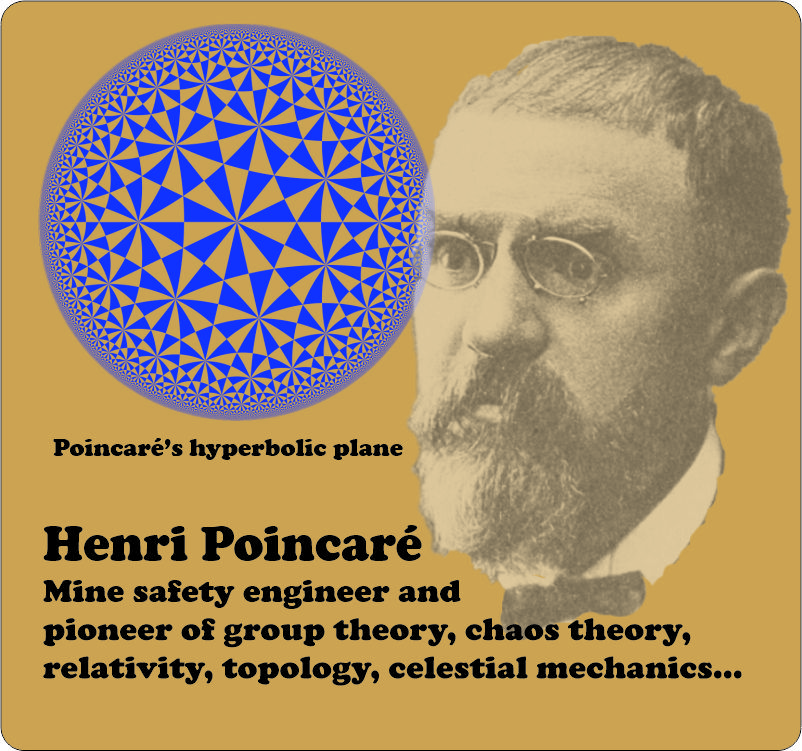
“The foremost mathematician of nineteenth Century France. A mine safety engineer most days and a wide‑ranging thinker the rest of the time — did bleeding‑edge work in many branches of physics and math, even invented a few branches of his own. He put Lorentz’s relativity work on a firm mathematical footing, set the spacetime and gravity stage for Minkowsky and Einstein. All that and a long list of academic and governmental appointments but somehow he found the time to have four kids.”

“A ball of fire, huh? So what’d he do to Newton’s jungle gym?”

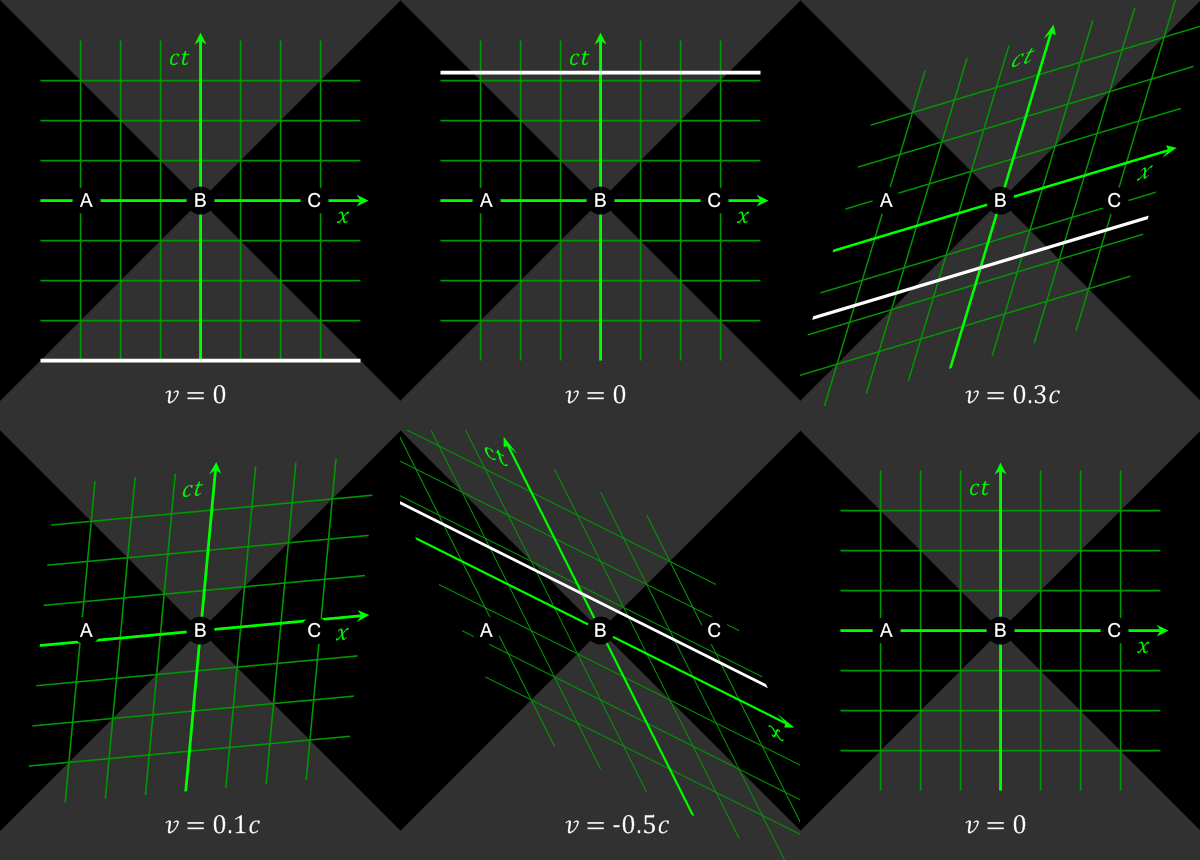
“Turned its steel rod framework into jello. Remember how Cathleen’s Minkowski diagram connected slope with velocity? Einstein showed how Lorentz’s relativity factor sets a speed limit for our Universe. On the diagram, that’d be a minimum slope. Going vertical is okay, that’s standing still in space. Going horizontal isn’t, because that’d be instantaneous travel. This animation tells the ‘Now‘ story better than words can.”

“Whah?”
  ”Whah?”

“We’re looking down on three space travelers and three events. Speeds below lightspeed are within the gray hourglass shape. The white line perpendicular to each traveler’s time line is their personal ‘Now‘. The travelers go at different velocities relative to us so their slopes and ‘Now‘ lines are different. From our point of view, time goes straight up. One traveler is sitting still relative to us so its timeline is marked ‘v=0‘ and parallels ours. We and the v=0 traveler see events A, B and C happening simultaneously. The other travelers don’t agree. ‘Simultaneous‘ is an illusion.”

~~ Rich Olcott

Lord Rayleigh Resolves

Mr Feder just doesn’t quit. “But why did they make JWST so big? We’re getting perfectly good pictures from Hubble and it’s what, a third the size?”

Al’s brought over a fresh pot and he’s refilling our coffee mugs. “Chalk it up to good old ‘because we can.’ Rockets are bigger than in Hubble‘s day, robots can do more remote stuff by themselves, it all lets us make a bigger scope.”

Cathleen smiles. “There’s more to it than that, Al. It’s really about catching photons. You’re nearly correct, Mr Feder, the diameter ratio is 2.7. But photons aren’t captured by a line across the primary mirror, they’re captured by the mirror’s entire area. The important JSWT:Hubble ratio is between their areas. JWST beats Hubble there by a factor of 7.3. For a given source and the same time interval, we’d expect JWST to be that much more sensitive than Hubble.”

“Well,” I break in, “except that the two use photon detectors that are sensitive to different energy ranges. The two scopes often won’t even be looking at the same kinds of object. Hubble‘s specialized for visible and UV light. It’s easy to design detectors for that range because electrons in solid‑state devices respond readily to the high‑energy photons. The infrared light photons that JWST‘s designed for don’t have enough energy to kick electrons around the same way. Not really a fair comparison, although everything I’ve read says that JWST‘s sensitivity will be way up there.”

Mr Feder is derisive. “‘Way up there.’ Har, har, de-har. I suppose you’re proud of that.”

“Not really, it just happened. But Cathleen, I’m surprised that you as an astronomer didn’t bring up the other reason the designers went big for JWST.”

“True, but it’s more technical. You’re thinking of resolution and Rayleigh’s diffraction limit, aren’t you?”

“Bingo. Except Rayleigh derived that limit from the Airy disk.”

“Disks in the air? We got UFOs now? What’re you guys talking about?”

Portrait of Sir George Airy
licensed under the Creative Commons
Attribution 4.0 International license.

“No UFOs, Mr Feder, I’ll try to be non‑technical. Except for the big close objects like the Sun and its planets, telescopes show heavenly bodies as circular disks accompanied by faint rings. In the early 1800s an astronomer named George Airy proved that the patterns are an illusion produced by the telescope. His math showed that even the best possible apparatus will force lightwaves from any small distant light source to converge to a ringed circular disk, not a point. The disk’s size depends on the ratio between the light’s wavelength and the diameter of the telescope’s light‑gathering aperture. How am I doing, Al?”

“Fine so far.”

“Good. Rayleigh took that one step further. Suppose you’re looking at two stars that are very close together in the sky. You’d expect to see two Airy patterns. However, if the innermost ring from one star overlaps the other star’s disk, you can’t resolve the two images. That’s the basis for Rayleigh’s resolvability criterion — the angle between the star images, measured in arc‑seconds, has to be at least 252000 times the wavelength divided by the diameter.”

After a diagram by cmglee
licensed under the Creative Commons
Attribution 3.0 International license.

“But blue light’s got a shorter wavelength than red light. Doesn’t that say that my scope can resolve close-together blue stars better than red stars?”

“Sure does, except stars don’t emit just one color. In visible light the disk and rings are all rimmed with reddish and bluish fuzz. The principle works just fine when you’re looking at a single wavelength. That gets me to the answer to Mr Feder’s question. It’s buried in this really elegant diagram I just happen to have on my laptop. Going across we’ve got the theoretical minimum angle for resolving two stars. Going up we’ve got aperture diameters, running from the pupil of your eye up to radio telescope coalitions that span continents. The colored diagonal bands are different parts of the electromagnetic spectrum. The red bars mark each scope’s sensor wavelength range. Turns out JWST‘s size compared to Hubble almost exactly compensates for the longer wavelengths it reports on.”

~~ Rich Olcott