Red And Blue Enigmas

“All that cloud stuff goes on in Jupiter’s tissue-paper outer layer. What’s the rest of the planet doing, Cathleen?”

“You’re not going to like this, Vinnie, but all we’ve got so far is broad‑brush averages. The Galileo atmosphere probe penetrated less than 0.2% of the way to the center. The good news is that the Juno probe has been sending us oodles of data about Jupiter’s gravity and magnetic fields. That’s great for planet‑wide theorizing, not quite as useful for weather prediction.”

“Can the data explain the Great Red Spot?”

“Well, it ruled out some ideas. Back in the day we thought the Spot was a deep whirlpool opening a view into the interior. Nope. Juno‘s measurements revealed that the Spot is actually a dome rising hundreds of kilometers above the white cloud‑tops. When one window closes, another one opens, I suppose. The fact that the Spot’s a dome says down below there’s an immense energy source lifting the gases above it. We don’t know what it is or why it’s there or how for two centuries it’s mostly held position in a completely fluid environment.”

“Weird. You’d expect something like that at a special location, like at one of the poles, but the Spot isn’t even on the planet’s equator.”

“Right, Sy. Its latitude is 22° south.”

“Hey, that’s the Tropic of Capricorn.”

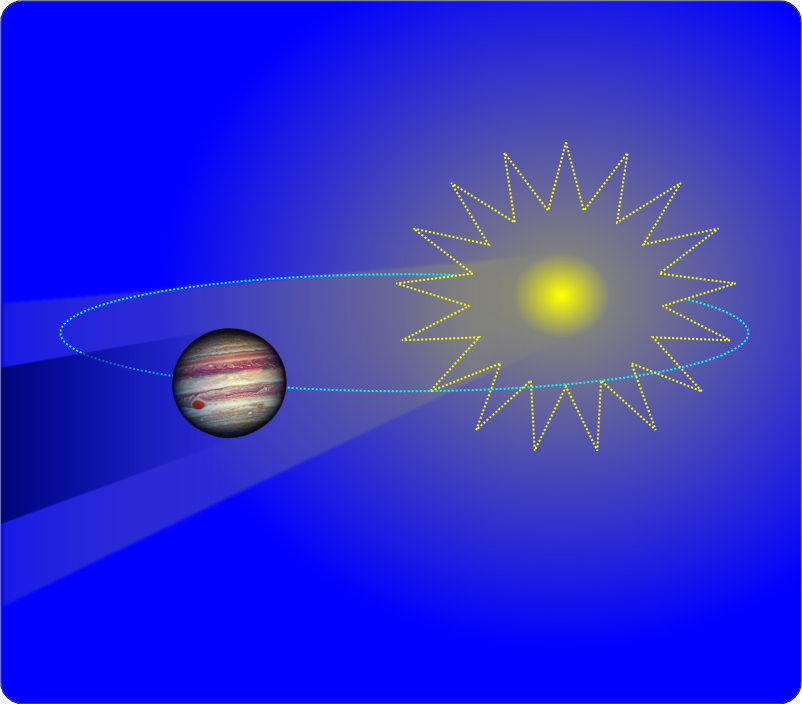
“Almost, Vinnie, but not relevant. Earth’s two Tropics are at 23½° north and south. If the Earth’s rotational axis were perpendicular to its solar orbit, the Sun’s highest position would always be directly over the Equator. But Earth’s axis is tilted at 23½° to our orbital plane. To see the noon Sun at the zenith you’d have to be 23½° north of the Equator in June, 23½° south of the Equator in December. Jupiter’s rotational axis is tilted, too, but by only 3°. That rules out significant seasonality on Jupiter, but it also says that on Jupiter there’s nothing special about 22° except that it’s where the Spot hangs out.”

“How about longitude?”

“Longitude on Jupiter is an embarrassing topic. Zero longitude on Earth, our Prime Meridian, runs through Greenwich Observatory in London, right? I don’t want to get into the history behind that. On a completely gaseous planet like Jupiter, there’s no stable physical object to tag with a zero. Jupiter’s cloud‑tops rotate faster near its equator than at its poles. Neither rotation syncs with Jupiter’s magnetic field which is like Earth’s except it’s much more intense and it points in the opposite direction. Oh, and it’s offset from the center of the planet and it’s lumpy. For lack of a better alternative, astronomers arbitrarily thumbtacked Jupiter’s Prime Meridian to its magnetic field. They selected the magnetic longitudinal line that pointed directly towards Earth at a particular moment in 1965. Given a good clock and the field’s rate of rotation you can calculate where that line will be at any other time.”

“Sounds like that ephemeris strategy Sy told me about in our elevator adventure. Why’s that embarrassing?”

“Well, back in 1965 the tool of choice for studying Jupiter’s rotating magnetic field was radio spectroscopy. Technology wasn’t as good as we have now and they … didn’t get a completely accurate rate of rotation. We’re stuck with a standard coordinate system where the Prime Meridian slips about 3° every year relative to the magnetic field. Even the Great Red Spot slips a little.”

“Cathleen, I’ve read that Juno uncovered a region of particularly intense magnetic activity they’re calling Jupiter’s Great Blue Spot. Does it have any connection to the Red Spot?”

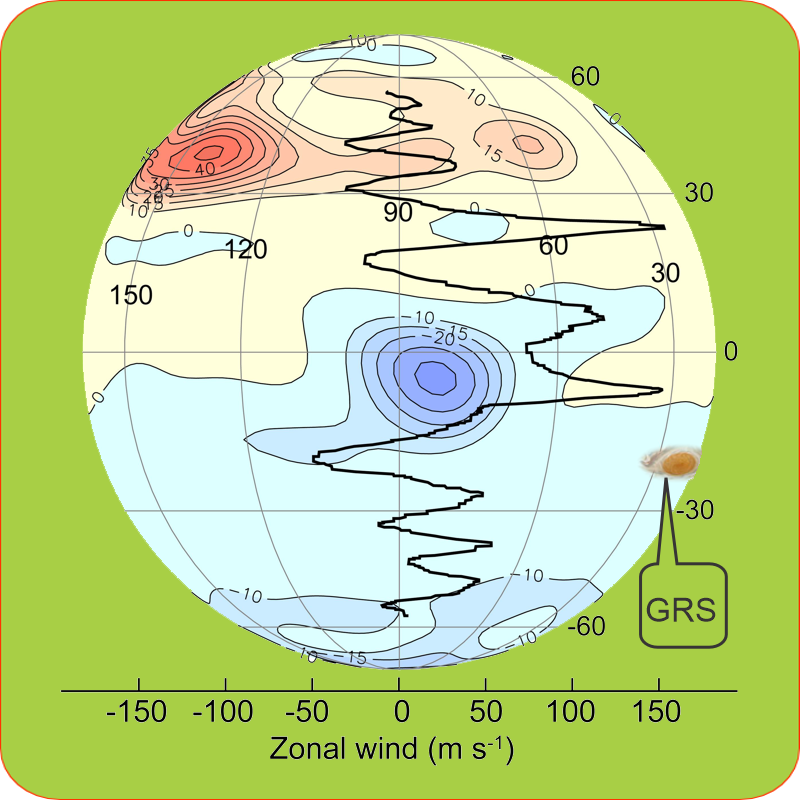
Magnetism and wind map by NASA/JPL-Caltech/SwRI/John E. Connerney. Great Red Spot image added by the author.

“Probably not, Sy, the Red Spot’s 15° south and 60° east of the Blue. But with Jupiter who knows?”

“Got any other interesting averages?”

“Extreme wind speeds. There’s a jet stream between each pair of Jupiter’s stripes, eastbound on the poleward side of a white zone, westbound in the other side. Look at the zig‑zag graph on this chart. 75 meters/second is 167 miles per hour is a Category 5 hurricane here on Earth. At latitudes near Jupiter’s equator average winds are double that.”

~~ Rich Olcott

Clouds From Both Sides Now

I don’t usually see Vinnie in a pensive mood. Moody, occasionally, but there he is at his usual table by the door, staring at the astronomy poster behind Al’s cash register. “Have a scone, Vinnie. What’s on your mind?”

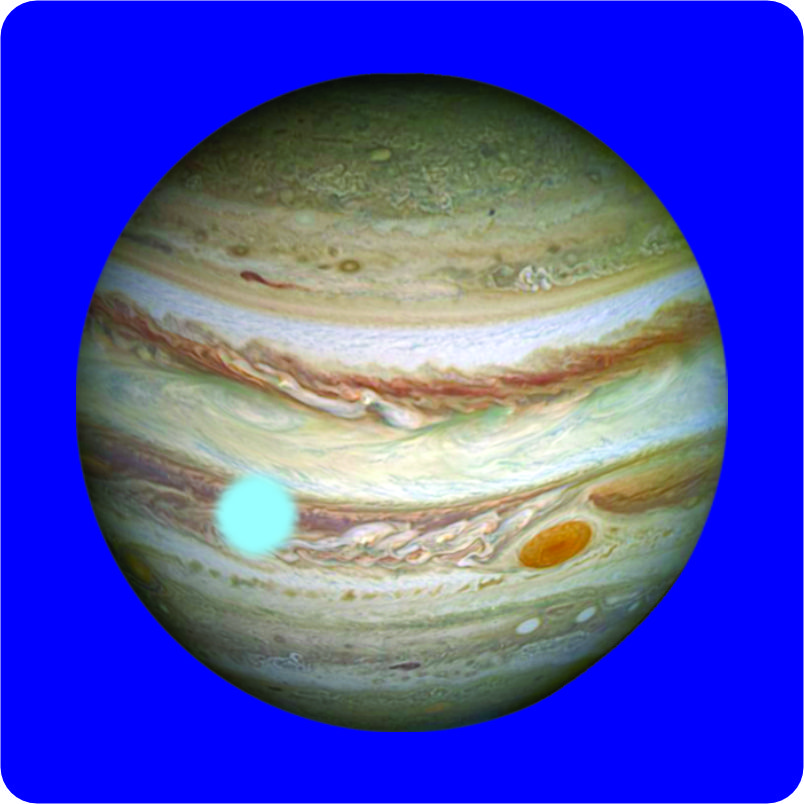
“Thanks, Sy. Welcome back, Cathleen. What’s bugging me is the hard edges on that picture of Jupiter. It looks like those stripes are painted on. Everyone says Jupiter’s not really solid so how come the planet looks so smooth?”

“Cathleen, this is definitely in your astronomer baliwick.”

“I suppose. It’s a matter of scale, Vinnie. The white zones mark updrafts. The whiteness is clouds that rise a couple hundred kilometers above a brownish lower layer. The downdraft belts on either side are transparent enough to let us see the next lower layer. ‘A couple hundred kilometers‘ sounds like a lot, but that’s only a tenth of a percent of Jupiter’s radius. If Jupiter were a foot‑wide ball floating in front of us, the altitude difference would be as thin as a piece of tissue paper. You might be able to feel the ridges and valleys but you’d have a hard time seeing them.”

“But why does the updraft stop so sharp? Is there like a cap on the atmosphere?”

“The clouds stop, but the updrafts don’t. The cloud tops aren’t even close to the top of Jupiter’s atmosphere, any more than Earth clouds reach the top of ours. C’mon, Vinnie, you’re a pilot. Surely you’ve noticed that most thunderheads top out at about the same altitude. Isn’t the sky still blue above them?”

“That’s higher than the planes I fly are cleared for, but I wouldn’t want to get above one anyway. I know a guy who flew over one that was just getting started. He said it’s a bumpy ride but yeah, there’s still kind of a dark blue sky above.”

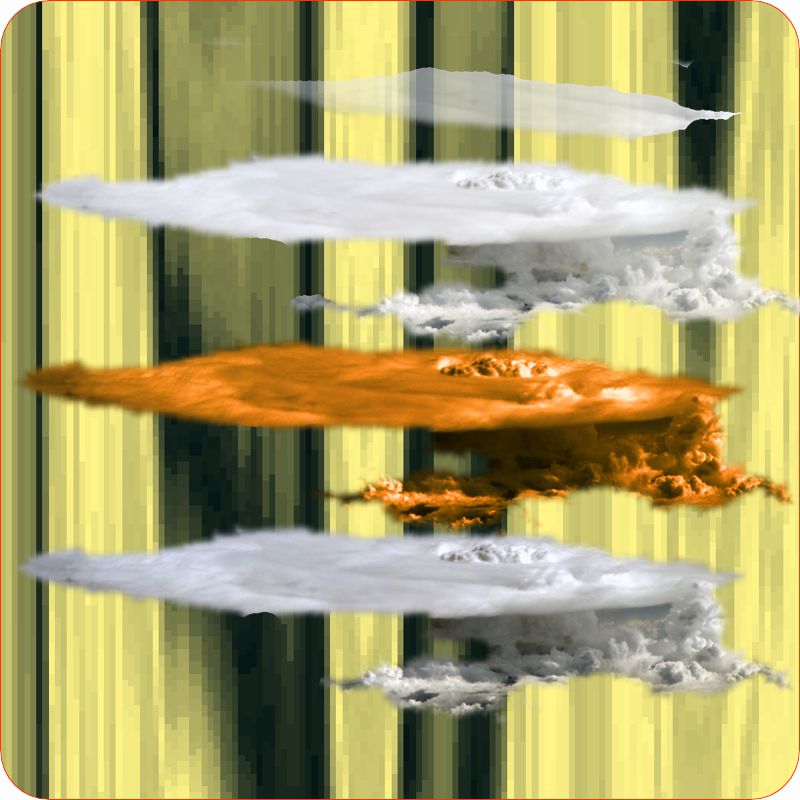
“All of that makes my point — our atmosphere doesn’t stop at the tropospheric boundary where the clouds do. Beyond that you’ve got another 40‑or‑so kilometers of stratosphere. Jupiter’s the same way, clouds go up only partway. For that matter, Jupiter has at least four separate cloud decks.”

“Wait, Cathleen — four? I know how Earth clouds work. Warm humid air rises, expanding and cooling as it goes. When its temperature falls below the dew point or freezing point, its humidity condenses to water droplets or ice crystals and that’s the cloud. I suppose if that same bucketful of air keeps rising far enough the pressure gets so low the water evaporates again and that’s the top of the cloud. How can that happen multiple times?”

“It doesn’t, Sy. In Jupiter’s complicated atmosphere each deck is formed from a different gas. Top layer is a wispy white hydrocarbon fog. The white zone clouds next down are ices of ammonia, which has to get a lot colder than water before it condenses. Water ice probably has a layer much farther down.”

“What’s the brownish layer?”

“There’s one or maybe two of them, each a complex mixture of ammonium ions with various sulfide species. The variety of colors in there make the visible light spectroscopy an opaque muddle.”

“Hey, if the brownish layers block what we can see, how do we even know lower layers are a thing?”

“Good question, Vinnie. Actually, we can do spectroscopy in the middle infrared. That gives us some clues. We’d hoped that the Galileo mission’s deep‑diver probe would sense the lower layers directly but unfortunately it dove into a hot spot where the upwelling heat messes up the layering. Our last resort is modeling. We have an inventory of lab data on thousands of compounds containing the chemical elements we’ve detected on Jupiter. We also have a pretty good temperature‑pressure profile of the atmosphere from the planet’s stratosphere down nearly to the core. Put the two together and we can paint a broad‑brush picture of what compounds should be stable in what physical state at every altitude.”

“Those ‘broad‑brush‘ and ‘should‘ weasel‑words say you’re working with averages like Einstein didn’t like with quantum mechanics. Those vertical winds mix things up pretty good, I’ll bet.”

“Fair objection, Vinnie, but we do what we can.”

~~ Rich Olcott

Visionaries Old And New

Cathleen’s back at the mic. “Let’s have a round of applause for Maria, Jeremy, Madison and C‑J. Thank you all. We have a few minutes left for questions… Paul, you’re first.”

“Thanks, Cathleen. A comment, not a question. As you know, archeoastronomy is my specialty so I applaud Jeremy’s advocacy for the field. I agree with his notion that the Colorado Plateau’s dry, thin air generally lets us see more stars than sea‑level Greeks do. When I go to a good dark sky site, it can be difficult to see the main stars that define a constellation because of all the background dimmer stars. However, I don’t think that additional stars would change the pictures we project into the sky. Most constellations are outlined from only the brightest stars up there. Dimmer stars may confuse the issue, but I very much doubt they would have altered the makeup of the constellations a culture defines. Each culture uses their own myths and history when finding figures among the stars.”

“Thanks for the confirmation from personal experience, Paul. Yes, Sy?”

“Another comment not a question. I’m struck by how Maria’s Doppler technique and Jeremy’s Astrometry complement each other Think of a distant stellar system like a spinning plate balanced on a stick. Doppler can tell you how long the stick is. Astrometry can tell you how wide the plate is. Both can tell you how fast it’s spinning. The strongest Doppler signal comes from systems that are edge‑on to us. The strongest Astrometry signal comes from systems we see face‑on. Those are the extreme cases, of course. Most systems are be at some in‑between angle and give us intermediate signals.”

“That’s a useful classification, Sy. Madison’s and C‑J’s transit technique also fits the edge‑on category. Jim, I can see you’re about to bust. What do you have to tell us about?”

“How about a technique that lets you characterize exoplanets inside a galaxy we see as only a blurry blob? This paper I just read blew me away.”

“Go ahead, you have the floor.”

“Great. Does everyone know about Earendel?” <blank looks from half the audience, mutters about ‘Lord Of The Rings?’ from several> “OK, quick refresher. Earendel is the name astronomers gave to the farthest individual star we’ve ever discovered. It’s either 13 or 28 billion lightyears away, depending on how you define distance. We only spotted it because of an incredible coincidence — the star happens to be passing through an extremely small region of space where light in our general direction is concentrated thousands‑fold into a beam towards us. Earendel may be embedded in a galaxy, but the amplification region is so narrow we can’t see stars that might be right next to it.”

<Feder’s voice> “Ya gonna tell us what makes the region?”

“Only very generally, because it’s complicated. You know what a magnifying lens does in sunlight.”

“Sure. I’ve burnt ants that way.”

“… Right. So what you did was take all the light energy hitting the entire surface of your lens and concentrate it on a miniscule spot. The concentration factor was controlled by the Sun‑to‑lens‑to‑spot distances and the surface area of the lens. Now bring that picture up to cosmological distances. The lens is the combined gravitational field of an entire galaxy cluster, billions of lightyears away from us, focusing light from Earendel’s galaxy billions of lightyears farther away. Really small spots at both ends of the light path and that’s what isolated that star.”

“That’s what got you excited?”

“That’s the start of it. This new paper goes in the other direction. The scientists used brilliant X‑ray light from an extremely distant quasar to probe for exoplanets inside a galaxy’s gravitational lens. Like one of your ants analyzing sunlight’s glare to assess dust flecks on your lens. Or at least their averaged properties. A lens integrates all the light hitting it so your ant can’t see individual grains. What it can do, though, is estimate numbers and size ranges. This paper suggests the lensing galaxy is cluttered with 2000 free‑floating planets per main‑sequence star — stars too far for us to see.”

~~ Rich Olcott

  • Thanks to Dave Martinez and Dr Ka Chun Yu for their informative comments.

Significant Twinkles

Cathleen’s got a bit of fire in her eye. “Good exposition, Jeremy, but only just barely on‑assignment. You squeezed in your exoplanet search material at the very end. <sigh> Okay, for our next presentation we have two of our freshmen, Madison and C‑J.”

“Hello, everybody, I’m Madison. I fell in love with Science while watching Nova and Star Trek with my family. Doctor O’Meara’s Astronomy class is my first step into the real thing. C‑J?”

“Hi, I’m C‑J, like she said. What started me on Astronomy was just looking at the night sky. My family’s ranch is officially in dark sky country, but really it’s so not dark. Jeremy’s also from the High Plateau and we got to talking. We see a gazillion stars up there, probably more stars than the Greeks did because they were looking up through humid sea-level air. On a still night our dry air’s so clear you can read by the light of those stars. I want to know what’s up there.”

“Me, too, but I’m even more interested in who‘s up there living on some exoplanet somewhere. How do we find them? We’ve just heard about spectroscopy and astrometry. C‑J and I will be talking about photometry, measuring the total light from something. You can use it even with light sources that are too dim to pick out a spectrum. Photometry is especially useful for finding transits.”

“A transit is basically an eclipse, an exoplanet getting between us and its star—”

“Like the one we had in 2017. It was so awesome when that happened. All the bird and bug noises hushed and the corona showed all around where the Sun was hiding. I was only 12 then but it changed my Universe when they showed us on TV how the Moon is exactly the right size and distance to cover the Sun.”

“Incredible coincidence, right? Almost exactly 100% occultation. If the Moon were much bigger or closer to us we’d never see the corona’s complicated structure. We wouldn’t have that evidence and we’d know so much less about how the Sun works. But even with JWST technology we can’t get near that much detail from other stars.”

“Think of trying to read a blog post on your computer, but your only tool is a light meter that gives you one number for the whole screen. Our nearest star, Alpha Centauri, is 20% larger than our Sun but it’s 4.3 lightyears away. I worked out that at that distance its image would be about 8½ milliarcseconds across. C‑J found that JWST’s cameras can’t resolve details any finer than 8 times that. All we can see of that star or any star is the light the whole system gives off.”

“So here’s where we’re going. We can’t see exoplanets because they’re way too small and too far away, but if an exoplanet transits a star we’re studying, it’ll block some of the light. The question is, how much, and the answer is, not very. Exoplanets block starlight according to their silhouette area. Jupiter’s diameter is about a tenth the Sun’s so it’s area is 1% of the Sun’s. When Jupiter transits the Sun‑‑‑”

“From the viewpoint of some other solar system, of course—”

“Doesn’t matter. Jupiter could get in between the Sun and Saturn; the arithmetic works out the same. The maximum fraction of light Jupiter could block would be its area against the Sun’s area and that’s still 1%.”

“Well, it does matter, because of perspective. If size was the only variable, the Moon is so much smaller than the Sun we’d never see a total eclipse. The star‑planet distance has to be much smaller than the star‑us distance, okay?”

“Alright, but that’s always the way with exoplanets. Even with a big planet and a small star, we don’t expect to measure more than a few percent change. You need really good photometry to even detect that.”

“And really good conditions. Everyone knows how atmospheric turbulence makes star images twinkle—”

“Can’t get 1% accuracy on an image that’s flickering by 50%—”

“And that’s why we had to get stable observatories outside the atmosphere before we could find exoplanets photometrically.”

~~ Rich Olcott

Astrometers Are Wobble-Watchers

letter A Hi, Sy, what’s going on in Cathleen’s seminar?

You were right, Al.
It’s about exoplanets and how to find them.
Jeremy’s pitching astrometry.
That’s about measuring star locations in the sky.
I’ll fill you in later.

“So that’s my cultural colonialism rant, thanks for listening. On to the real presentation. Maria showed us how to look for exoplanets when they wobble along our line of sight. But what if they wobble perpendicular to that? Careful measurement should show that, right? The ancients thought that holy forces had permanently set the positions of all the stars except for the planets so they didn’t measure that close. Tycho Brahe took meticulous measurements with room‑sized instruments—”

<voice from the back> “Room‑sized? What difference does that make?”

“What if I told you that two stars are 3 millimeters apart in the sky?”

<another voice> “How far out’s your ruler? Sky stuff, you need to talk angles because that’s all you got.”

“Well there you go. That’s why Tycho went for maximum angle‑measuring accuracy. He built a sextant with a 5‑foot radius. He used an entire north‑south wall as a quadrant. His primary instrument was an armillary sphere three yards across.”

<first voice again> “Wait, a sphere, like a big bubble? Why north‑south? What’s a quadrant?”

  • I give him a nudge. “He’s just a kid, Mr Feder. Be nice. One question at a time.”
  • “But I got so many!”

“Think about Tycho’s goal. Like astrometers before him, he wanted to build an accurate map of the heavens. Native Americans a thousand years or more ago carved free‑hand star maps on cave ceilings and turtle shells. Tycho followed the Arabic and Chinese quantitative mapping traditions. There’s two ways to do that. One is to measure and map the visual angles between many pairs of stars. That strategy fails quickly because errors accumulate. Four or five steps along the way you’re plotting the same star in two different locations.”

<Feder’s voice again> “There’s a better way?”

“Yessir. Measure and map each star relative to a standard coordinate system. If your system’s a good one, errors tend to average out. The latitude‑longitude system works well for locating places on Earth. Two thousand years ago the Babylonians used something similar for places in the crystal sphere they thought supported the stars above us. Where the equinoctial Sun rose on the horizon was a special direction. Their buildings celebrated it. Starting from that direction the horizontal angle to a star was its longitude. The star’s latitude was its angle up from the horizon towards the zenith straight above. But those map coordinates don’t work for another part of the world. Astrometers needed something better.”

<Feder again> “So what did they do already?”

“They may or may not have believed the Earth itself is round, but they recognized the Pole Star’s steady position that the rest of the sky revolved around. They also noticed that as each month went by the constellations played ring‑a‑rosie in a plane perpendicular to the north‑south axis. Call that the Plane of The Ecliptic. Pick a star, measure its angle away from the Ecliptic and you’ve got an ecliptic latitude. Measure its angle around the Ecliptic away from a reference star and you’ve got a ecliptic longitude. Tycho’s instruments were designed to measure star coordinates. His quadrant was a 90° bronze arc he embedded in that north‑south wall, let him measure a star’s latitude as it crossed his meridian. His ‘Sphere’ was simply a pair of calibrated metal rings on a gimbal mounting so he could point to target and reference stars and measure the angle between them. If his calibration used degree markings they’d be about 25 millimeters apart. His work was the best of his time but the limit of his accuracy was a few dozen arcseconds.”

“Is that bad?”

“It is if you’re looking for exoplanets by watching for stellar wobble. Maria’s Jupiter example showed the Sun wobbling by 1½ million kilometers. I worked this example with a bigger wobble and a star that would be mid‑range for most of our constellations. Best case, we’d see its image jiggling by about 90 microarcseconds. Tycho’s instruments weren’t good enough for wobbles.”

~~ Rich Olcott

Useful Eccentricity

“Hi, Al. What’s the hubbub in the back room?”

“Cathleen’s doing another astronomy class group seminar. This one’s about exoplanets. I’d like to listen in but I’ve got to tend the cash register here. Take notes, okay?”

“Sure, no problem.”

Professor Cathleen’s at the podium. “Okay, class, settle down. I hope everyone’s ready with their presentations. Maria, you’ve got a good topic to start us off.”

“Thank you. Everyone here knows I’ve been interested in spectroscopy since I was a student intern at Arecibo. It is such a powerful thing to know that a particular kind of atom, anywhere in the Universe, absorbs or gives off exactly the same pattern of light frequencies. Suppose you are looking at the spectrum of a star or a galaxy and you recognize a pattern, like sodium’s yellow doublet or hydrogen’s Lyman series. The pattern won’t be at its normal frequencies because of the Doppler effect. That’s good because the amount of blue‑shift or red‑shift tells us how quick the object is moving toward or away from us. That was how Dr Hubble proved that most other galaxies are flying away.”

<casts a slide to Al’s video screen> “I’ll begin with a review of some class material. The spectroscopy we see in the sky is light that was emitted at some peak wavelength lambda. Lambda with the little ‘o‘ is what we see for the same emission or absorption process in the laboratory. The wavelength difference between sky and laboratory is the absolute shift. Divide that by the laboratory wavelength to get the relative shift, the z‑scale. All the light from one object should have the same z value. It is important that z also gives us the object’s velocity if we multiply by the speed of light.”

<voice from the rear> “What’s the ‘fe ka‘ stuff about?”

“I was getting to that. Those two lines describe a doublet, a pair of peaks that always appear together. This is in the X‑ray spectrum of iron which is Fe for the chemists. K-alpha is a certain process inside the iron atom. Astronomers like to use that doublet because it’s easy to identify. Yes, profesora?”

“Two additional reasons, Maria. Iron’s normally the heaviest element in a star because stellar nuclear fusion processes don’t have enough energy to make anything heavier than that. Furthermore, although every element heavier than neon generates a K-alpha doublet, the peak‑to‑peak split increases with atomic mass. Iron’s doublet is the widest we see from a normal star.”

“Thank you. So, the arithmetic on the rest of the slide shows how Dr Hubble might have calculated the speed of a galaxy. But that’s steady motion. Exoplanets orbiting a star appear to speed ahead then fall behind the star, yes? We need to think about how a planet affects its star. This next slide talks about that. My example uses numbers for the Sun and Jupiter. We say Jupiter goes around the Sun, but really, they both go around their common center of gravity, their barycenter. You see how it’s calculated here — MP is the planet’s mass, MS is the star’s mass, dSP is the star-to-planet distance and dB is the distance from the star’s center to the barycenter. I’ve plugged in the numbers. The barycenter is actually ten thousand kilometers outside the Sun!”

“So you could say that our Sun counterbalances Jupiter by going in a tight circle around that point.”

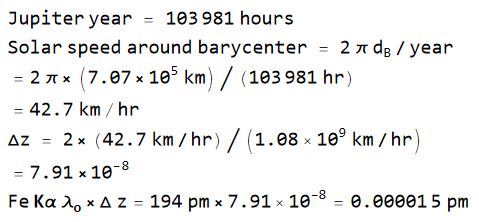
“Exactly! For my third slide I worked out whether a distant astronomer could use Doppler logic to detect Sun‑Jupiter motion. The first few lines calculate the size of the Sun’s circle and than how fast the Sun flies around it. Each Jupiter year’s blue shift to red shift totals only 79 parts per billion. The Sun’s iron K‑alpha1 wavelength varies only between 193.9980015 and 193.9979985 picometers. This is far too small a change to measure, yes?”

<dramatic pause> “I summarize. To make a good Doppler signal, a star must have a massive exoplanet that’s close enough to push its star fast around the barycenter but far enough away to pull the barycenter outside of the star.”

“Thank you, Maria.”

“X” marks the barycenter

~~ Rich Olcott

Time Is Where You Find It

A familiar footstep in the hall outside my office, “C’mon in, Vinnie, the door’s open.”

“Got a few minutes, Sy?”

More than just “a minute.” This sounds serious so I push my keyboard aside. “Sure, what’s up?”

“I’ve been thinking about different things, putting ’em together different ways. I came up with something, sorta, that I wanted to run past you before I brought it to one of Cathleen’s ‘Crazy Theories‘ parties.”

“Why, Vinnie, you’re being downright diffident. Spill it.”

“Well, it’s all fuzzy. First part goes way back to years ago when you wrote that there’s zero time between when a photon gets created and when it gets used up. But that means that create and use-up are simultaneous and that goes against Einstein’s ‘No simultaneity‘ thing which I wonder if you couldn’t get around it using time tick signals to sync up two space clocks.”

“That’s quite a mix and I see why you say it’s fuzzy. Would you be surprised if I used the word ‘frame‘ while clarifying it?”

“I’ve known you long enough it wouldn’t surprise me. Go ahead.”

“Let’s start with the synchronization idea. You’re not the first to come up with that suggestion. It can work, but only if the two clocks are flying in formation, exactly parallel course and speed.”

“Hah, that goes back to our first talk with the frame thing. You’re saying the clocks have to share the same frame like me and that other pilot.”

“Exactly. If the ships are zooming along in different inertial frames, each will measure time dilation in the other. How much depends on their relative velocities.”

“Wait, that was another conversation. We were pretending we’re in two spaceships like we’re talking about here and your clock ran slower than mine and my clock ran slower than yours which is weird. You explained it with equations but I’ve never been good with equations. You got a diagram?”

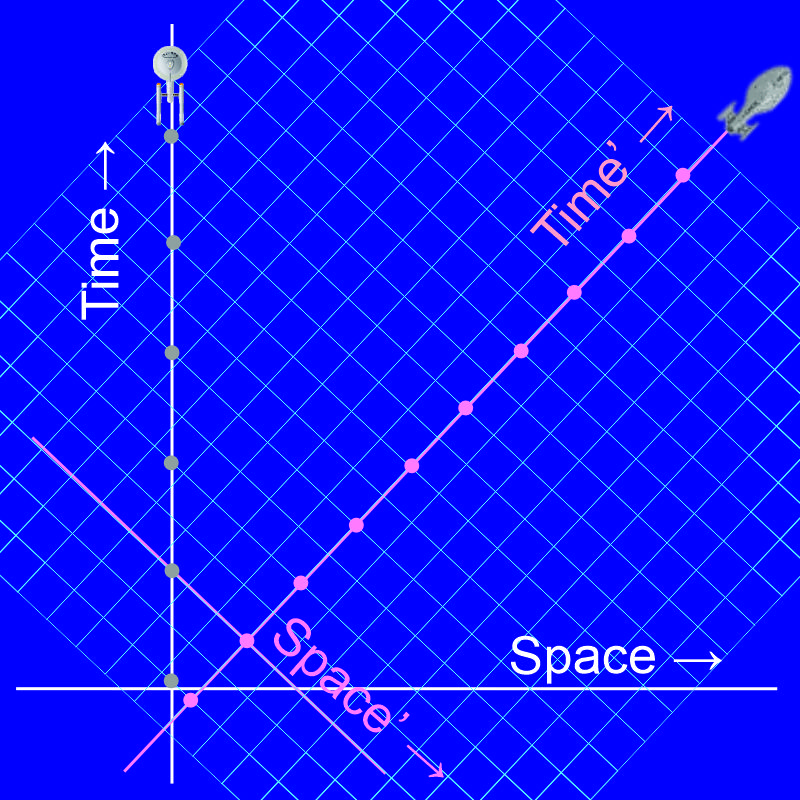
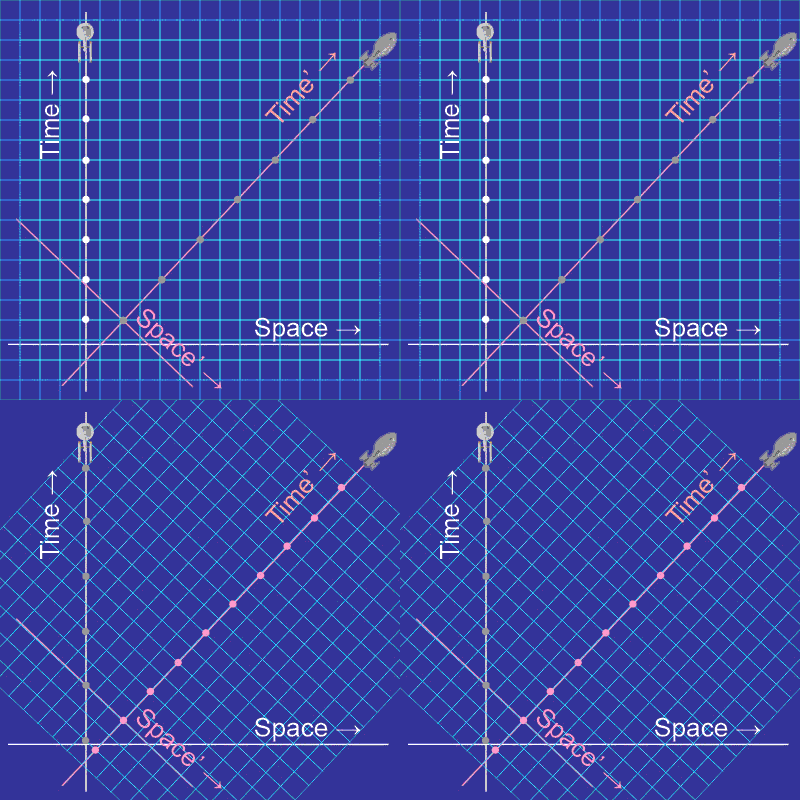
“Better than that, I’ve got a video. It flips back and forth between inertial frames for Enterprise and Voyager. We’ll pretend that they sync their clocks at the point where their tracks cross. I drew the Enterprise timeline vertical because Enterprise doesn’t move in space relative to Enterprise. The white dots are the pings it sends out every second. Meanwhile, Voyager is on a different course with its own timeline so its inertial frame is rotated relative to Enterprise‘s. The gray dots on Voyager‘s track show when that ship receives the Enterprise pings. On the Voyager timeline the pings arrive farther apart than they are on the Enterprise timeline so Voyager perceives that Enterprise is falling farther and farther behind.”

“Gimme a sec … so Voyager says Enterprise‘s timer is going slow, huh?”

“That’s it exactly. Now look at the rotated frame. The pink dots show when Voyager sends out its pings. The gray dots on Enterprise‘s track show when the pings arrive.”

“And Enterprise thinks that Voyager‘s clock is slow, just backwards of the other crew. OK, I see you can’t use sync pulses to match up clocks, but it’s still weird.”

“Which is where Lorentz and Minkowski and Einstein come into the picture. Their basic position was that physical events are real and there should be a way to measure them that doesn’t depend on an observer’s frame of reference. Minkowski’s ‘interval‘ metric qualifies. After converting time and location measurements to intervals, both crews would measure identical spacetime separations. Unfortunately, that wouldn’t help with clock synchronization because spacetime mixes time with space.”

“How about the photons?”

“Ah, that’s a misquotation. I didn’t say the time is zero, I said ‘proper time‘ and that’s different. An object’s proper time is measured by its clock in its inertial frame while traveling time t and distance d between two events. Anyone could measure t and d in their inertial frame. Minkowski’s interval is defined as s=[(ct)²‑d²]. Proper time is s/c. Intuitively I think of s/c as light’s travel time after it’s done traversing distance d. In space, photons always travel at lightspeed so their interval and proper time are always zero.”

“Photon create and use-up aren’t simultaneous then.”

“Only to photons.”

~~ Rich Olcott

Shadow Plays

“A strawberry scone and my usual black, Al.”

“Sure thing, Sy, comin– Hiya, Cathleen, see my new poster? Event Horizon Telescope pictures of the two big‑guy black holes we’ve actually seen so far. Those white-hot blobs buried in those red rings. Ain’t it a beaut? What’ll you have?”

“They’re certainly wonderful graphics, Al. I’ll have a caramel latte, please, with a plain scone.” I’m waiting for it, because Cathleen never passes up a teachable moment. Sure enough — “Of course, neither one actually looks like that or represents what you think. Those images were created from radio waves, not visible light or even infrared. The yellows and whites don’t represent heat, and that darkness in the middle isn’t the black hole.”

“Whoa, don’t harsh Al’s happy, Cathleen. Maybe just go at it a step at a time?”

<sigh> “You’re right, Sy. Sorry, Al, I just get frustrated when press‑agent science gets in the way of the real stuff which is already interesting on its own. For instance, I haven’t seen anything in the pop‑sci press about the EHT people using the same 2017 data to produce both images, even though the two objects are almost 90° apart in the sky. I think about our optical telescopes and the huge high-tech motors it takes to point them in the right direction. These guys just re-work their data and they’re good for another round.”

“It’s a cute trick, alright, Cathleen, steering a distributed telescope with arithmetic.”

“OK, you guys are over my head — distributed telescope?”

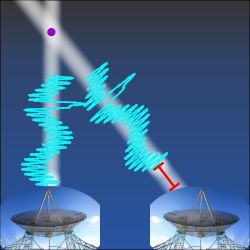
“The EHT Collaboration works with eight radio telescopes scattered across the world. The signal from any point in the sky has a different time offset at each telescope depending on the angle to the point. If you know the baseline between each pair of scopes and you’ve got really good clocks keeping track of time at each location, when you combine the data from all eight locations it’s just arithmetic to pick out matching signals at the right set of offsets for any point of origin.”

“A lot of arithmetic, Cathleen.”

“I’ll give you that, Sy. Al, it took the researchers and some hefty compute facilities two years to boil down the data for the M87 monster. In principle, when they wanted to inspect the Milky Way’s beast all they had to do was run through the same data selecting for signal matches at the offsets pointing to Sgr A*. Awesome tech, huh?”

“Awesome, yeah, but if the colors aren’t heat, what are they?”

“Electron density, mostly. Your red‑and‑yellow Jupiter poster over there is like most heat maps. Researchers figure a pixel’s temperature by comparing data from multiple wavelengths with the Planck curve or some other calibrated standard. These images, though, came from a single wavelength, 1.3 millimeters. Light at shorter wavelengths can’t get past the dust, longer wavelengths can’t give us the image resolution. Millimeters waves are in the radio part of the spectrum — too low‑energy to detect moving charge inside atoms or between molecule components. The only thing that can give off those photons is free‑floating electrons. The brightest pixels have the most electrons.”

“So the hole isn’t the black hole?”

“Depends on your definition, I suppose. Everyone visualizes that black sphere, the event horizon, when they think ‘black hole.’ That’s not what the dark patches are. By my definition, though, a ‘black hole‘ is the whole package — central mass, event horizon, ergosphere if it’s spinning, a jet maybe and everything else that’s associated with the mass. It’s as much a collection of processes as a thing. Anyhow, the bright stuff in these images does come from accretion disks.”

“The dark patch is the disk’s inside edge?”

“Nope, it’s the shadow of the photon sphere. Before you ask, that’s a light‑trapping shell 1½ times the horizon’s diameter. Depending on its angle of approach, a photon that touches the sphere either spirals inward, orbits forever, or swerves outward. Going straight doesn’t happen. The shadow memorializes Earth‑bound photons that bounced away from us.”

“I guess my happy’s back, Cathleen, but it’s different.”

“You’re welcome, Al. Now how about the coffee and scones we asked for?”

~~ Rich Olcott

Credit: Event Horizon Telescope Collaboration
Image: Lia Medeiros, ISA, EHTC

Why I Never Know What Time It Is

It’s always fun watching Richard Feder (of Fort Lee, NJ) as he puts two and two together. He gets a gleam in his eye and one corner of his mouth twitches. On a good day with the wind behind him I’ve seen his total get as high as 6½. “I wanna get back to that ‘everybody has their own time‘ monkey‑business where if you’re moving fast your clock slows down. What about the stardates on Star Trek? Those guys go zooming through space at all different angles and speeds. How do they keep their calendars in synch?”

Trekkie and Astronomy fan Al takes the bait. “Artistic license, Mr Feder. The writers can make anything happen, subject to budgets and producer approval. The first Star Trek series, they just used random four‑digit numbers for stardates. That was OK because the network aired the episodes in random order anyway so no‑one cared about story arc continuity. Things were more formal on Captain Picard’s Enterprise, as you’d expect — five‑digit stardates, first digit always ‘4‘ for 24th Century, thousands digit was ‘1‘ for season one, ‘2‘ for season two and so on. Working up the other way, the digit right of the decimal point was tenths of a standard day, the units place counted days within an episode and the tens and hundreds they just picked random numbers.”

“I suppose that’s what they did, but how could they make it work? You guys yammer on about time dilation. Say a ship’s running at Warp Whoop‑de‑doo, relativity should slow its calendar to a crawl. You couldn’t get a whole fleet into battle position when some of the ships had to get started years ahead of time. And that’s just the dilation slow-down, travel time’s on top of that.”

“Travel time measured how, Mr Feder, and from where?”

“Well, there you go, Cathleen, that’s what I’m talking about!”

“You know that Arthur C Clarke quote, ‘Any sufficiently advanced technology is indistinguishable from magic‘? The Enterprise crew’s always communicating with ‘sub‑space radio’, which sure looks like magic to me. They could send sync pulses through there along with chatter. When you drop out of warp space, your clocks catch the pulses and sync up, I suppose.”

“There’s a deeper issue than that, guys.”

“What’s that, Sy?”

“You’re talking like universal time is a thing, which it isn’t. Hasn’t been since Einstein’s Special Relativity used Minkowski’s math to stir space and time together. General Relativity scrambles things even worse, especially close to a strong gravity center. You remember about gravity forcing spacetime to curve, right? The curvature inside a black hole’s event horizon gets so tight that time rotates toward the geometric center. No, I can’t imagine what that looks like, either. The net of it, though, is that a black hole is a funnel into its personal future. Nothing that happens inside one horizon can affect anything inside another one so different holes could even have different time rates. We’ve got something like 25000 or more stellar black holes scattered through the Milky Way, plus that big one in the center, and that’s just one galaxy out of billions. Lots of independent futures out there.”

“What about the past, Sy? I’d think the Big Bang would provide a firm zero for time going forward and it’s been one second per second since then.”

“Nup. Black holes are an extreme case. Any mass slows down time in its vicinity, the closer the slower. That multi‑galaxy gravitational lens that lets us see Earendel? It works because the parts of Earth‑bound light waves closest to the center of mass see more time dilation than the parts farther away and that bends the beam toward our line of sight.”

“Hey, that reminds me of prisms bending light waves.”

“Similar effect, Vinnie, but the geometry’s different. Prisms and conventional lenses change light paths abruptly at their surfaces. Gravitational lenses bend light incrementally along the entire path. Anyhow, time briefly hits light’s brakes wherever it’s near a galaxy cluster, galaxy or anything.”

“So a ship’s clock can fidget depending on what gravity it’s seen recently?”

“Mm-hm. Time does ripples on its ripples. ‘Universal Time‘ is an egregious example of terminology overreach.”

~~ Rich Olcott

Pushing It Too Far

It’s like he’s been taking notes. Mr Feder’s got a gleam in his eye and the corner of his mouth is atwitch. “You’re not getting off that easy, Cathleen. You said that Earendell star’s 66 trillion lightyears away. Can’t be, if the Universe’s only 14 billion years old. What’s going on?”

“Oops, did I say trillion? I meant billion, of course, 109 not 1012. A trillion lightyears would be twenty times further than the edge of our observable universe.”

“Hmph. Even with that fix it’s goofy. Sixty-six billion is still what, five times that 14 billion year age you guys keep touting. I thought light couldn’t travel that far in that time.”

“I thought the Universe is 93 billion light years across.”
  ”That’s diameter, and it’s just the observable universe.”
    ”Forty-seven billion radially outward from us.”
      ”None of that jibes with 14 billion years unless ya got stuff goin’ faster than light.”

“Guys, guys, one thing at a time. About that calculation, I literally did it on the back of an envelope, let’s see if it’s still in my purse … Nope, must be on my office desk. Anyhow, distance is the trickiest part of astronomy. The only distance‑related thing we can measure directly is z, that redshift stretch factor. Locate a familiar pattern in an object’s spectrum and see where its wavelength lies relative to the laboratory values. The go‑to pattern is hydrogen’s Lyman series whose longest wavelength is 121 nanometers. If you see the Lyman pattern start at 242 nanometers, you’ve got z=2. The report says that the lens is at z=2.8 and Earendel’s galaxy is at z=6.2. We’d love to tie those back to distance, but it’s not as easy as we’d like.”

“It’s like radar guns, right? The bigger the stretch, the faster away from us — you should make an equation outta that.”

“They have, Mr Feder, but Doppler’s simple linear relationship is only good for small z, near zero. If z‘s greater than 0.1 or so, relativity’s in play and things get complicated.”

“Wait, the Hubble constant ties distance to speed. That was Hubble’s other big discovery. Old Reliable here says it’s something like 70 kilometers per second for every megaparsec distance. What’s that in normal language? <tapping keys> Whoa, so for every lightyear additional distance, things fly away from us about an inch per second faster. That’s not much.”

“True, Sy, but remember we’re talking distant, barely observable galaxies that are billions of lightyears away. Billions of inches add up. Like with the Doppler calculation, you get startling numbers if you push a simple linear relation like this too far. As an extreme example, your Hubble rule says that light from a galaxy 15 billion lightyears away will never reach us because Hubble Flow moves them away faster than photons fly toward us. We don’t know if that’s true. We think Hubble’s number changes with time. Researchers have built a bucketful of different expansion models for how that can happen; each of them makes different predictions. I’m sure my 66 came from one of those. Anyhow, most people nowadays don’t call it the Hubble constant, it’s the Hubble parameter.”

“Sixty-six or forty-seven or whatever, those diameters still don’t jibe with how long the light’s had a chance to travel.”

“Sy, care to take this? It’s more in your field than mine.”

“Sure, Cathleen. The ‘edge of the observable universe‘ isn’t a shell with a fixed diameter, it simply marks the take-off points for the oldest photons to reach us so far. Suppose Earendel sent us a photon about 13 billion years ago. The JWST caught it last night, but in those 13 billion years the universe expanded enough to insert twenty or thirty billion lightyears of new space between between here and Earendel. The edge is now that much farther away than when the photon’s journey started. A year from now we’ll be seeing photons that are another year older, but the stars they came from will have flown even farther away. Make sense?”

“A two-way stretch.”

“You could say that.”

~~ Rich Olcott

  • Thanks to my brother Neil, who pointed out the error and asked the question.