Fly High, Silver Bird

“TANSTAAFL!” Vinnie’s still unhappy with spacecraft that aren’t rocket-powered. “There Ain’t No Such Thing As A Free Lunch!”

“Ah, good, you’ve read Heinlein. So what’s your problem with Lightsail 2?”

“It can’t work, Sy. Mostly it can’t work. Sails operate fine where there’s air and wind, but there’s none of that in space, just solar wind which if I remember right is just barely not a vacuum.”

Astronomer-in-training Jim speaks up. “You’re right about that, Vinnie. The solar wind’s fast, on the order of a million miles per hour, but it’s only about 10-14 atmospheres. That thin, it’s probably not a significant power source for your sailcraft, Al.”

“I keep telling you folks, it’s not wind-powered, it’s light-powered. There’s oodles of sunlight photons out there!”

“Sure, Al, but photons got zero mass. No mass, no momentum, right?”
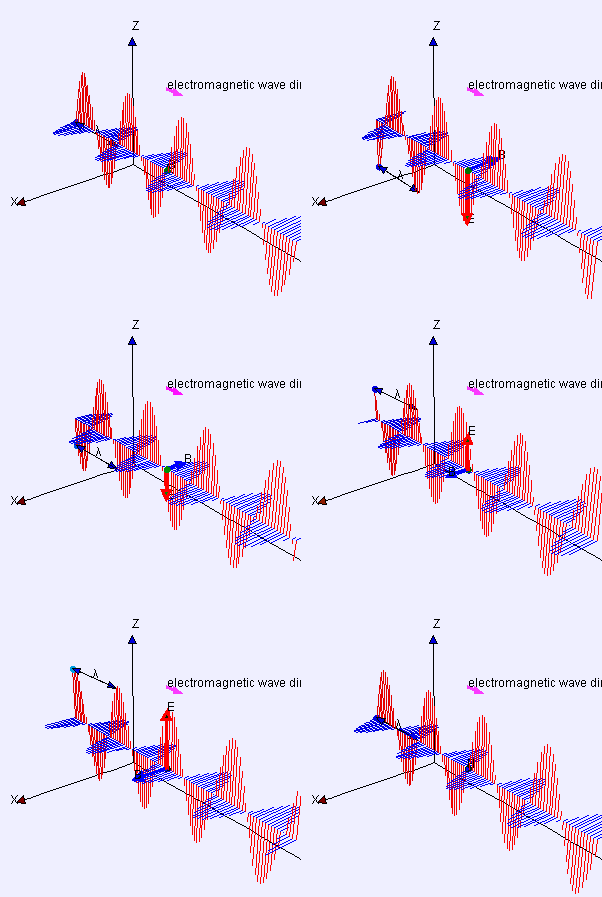
Plane-polarized electromagnetic wave in motion
Plane-polarized electromagnetic wave
Electric (E) field is red
Magnetic (B) field is blue
(Image by Loo Kang Wee and Fu-Kwun Hwang from Wikimedia Commons)

My cue to enter. “Not right, Vinnie. Experimental demonstrations going back more than a century show light exerting pressure. That implies non-zero momentum. On the theory side … you remember when we talked about light waves and the right-hand rule?”

“That was a long time ago, Sy. Remind me.”

“… Ah, I still have the diagram on Old Reliable. See here? The light wave is coming out of the screen and its electric field moves electrons vertically. Meanwhile, the magnetic field perpendicular to the electric field twists moving charges to scoot them along a helical path. So there’s your momentum, in the interaction between the two fields. The wave’s combined action delivers force to whatever it hits, giving it momentum in the wave’s direction of travel. No photons in this picture.”

Astrophysicist-in-training Newt Barnes dives in. “When you think photons and electrons, Vinnie, think Einstein. His Nobel prize was for his explanation of the photoelectric effect. Think about some really high-speed particle flying through space. I’m watching it from Earth and you’re watching it from a spaceship moving along with it so we’ve each got our own frame of reference.”

“Frames, awright! Sy and me, we’ve talked about them a lot. When you say ‘high-speed’ you’re talking near light-speed, right?”

“Of course, because that’s when relativity gets significant. If we each measure the particle’s speed, do we get the same answer?”

“Nope, because you on Earth would see me and the particle moving through compressed space and dilated time so the speed I’d measure would be more than the speed you’d measure.”

“Mm-hm. And using ENewton=mv² you’d assign it a larger energy than I would. We need a relativistic version of Newton’s formula. Einstein said that rest mass is what it is, independent of the observer’s frame, and we should calculate energy from EEinstein²=(pc)²+(mc²)², where p is the momentum. If the momentum is zero because the velocity is zero, we get the familiar EEinstein=mc² equation.”

“I see where you’re going, Newt. If you got no mass OR energy then you got nothing at all. But if something’s got zero mass but non-zero energy like a photon does, then it’s got to have momentum from p=EEinstein/c.”

“You got it, Vinnie. So either way you look at it, wave or particle, light carries momentum and can power Lightsail 2.”

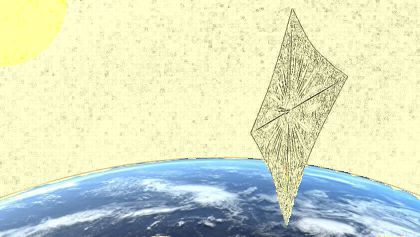
Lightsail 2 flying over Earth, against a yellow background
Adapted from image by Josh Spradling / The Planetary Society

“Question is, can sunlight give it enough momentum to get anywhere?”

“Now you’re getting quantitative. Sy, start up Old Reliable again.”

“OK, Newt, now what?”

“How much power can Lightsail 2 harvest from the Sun? That’ll be the solar constant in joules per second per square meter, times the sail’s area, 32 square meters, times a 90% efficiency factor.”

“Got it — 39.2 kilojoules per second.”

“That’s the supply, now for the demand. Lightsail 2 masses 5 kilograms and starts at 720 kilometers up. Ask Old Reliable to use the standard circular orbit equations to see how long it would take to harvest enough energy to raise the craft to another orbit 200 kilometers higher.”

“Combining potential and kinetic energies, I get 3.85 megajoules between orbits. That’s only 98 seconds-worth. I’m ignoring atmospheric drag and such, but net-net, Lightsail 2‘s got joules to burn.”

“Case closed, Vinnie.”

~~ Rich Olcott
Seesaw to The Stars

I look around the playground. “Where’s the seesaw, Teena?”

“They took it away. That’s good ’cause I hated that thing!”

“Why’s that, Sweetie?”

“I never could play right on it. Almost never. Sometimes there’d be a kid my size on the other end and that worked OK, but a lot of times a big kid got on the other end and bounced me up in the air. The first time I even fell off and they laughed.”

“Well, I can understand that. I’m sure you’ve been nicer than that to the littler kids.”

“Uh-huh, except for Bratty Brian, but he liked it when I bounced him. He called it ‘going to the Moon’.”

“I can understand that, too. If things go just right you come off your seat and float like an astronaut for a moment. I bet he held onto the handles tight.”

“Yeah, I just wasn’t ready for it the first time.”

“Y’know, there’s another way that Brian’s bounces were like a rocket trip to somewhere. They went through the same phases of acceleration and deceleration.”

“Uncle Sy, you know you’re not allowed to use words like that around me without ‘splaining them.”

“Mmm, they both have to do with changing speed. Suppose you’re standing still. Your speed is zero, right? When you start moving your speed isn’t zero any more and we say you’ve accelerated. When you slow down again we say you’re decelerating. Make sense?”

“So when Bratty Brian gets on the low end of the seesaw he’s zero. When I squinch down at my end he accelerates –“

“Right, that’s like the boost phase of a rocket trip.”

“… And when he’s floating at the very top –“

“Like astronauts when they’re coasting, sort of but not really.”

“… And then they decelerate when they land. Bratty Brian did, too. I guess deceleration is like acceleration backwards. But why such fancy words?”

“No-one paid much attention to acceleration until Mr Newton did. He changed Physics forever when he said that all accelerations involve a force of some kind. That thought led him to the whole idea of gravity as a force. Ever since then, when physicists see something being accelerated they look for the force that caused it and then they look for what generated the force. That’s how we learned about electromagnetism and the forces that hold atoms together and even dark matter which is ultra-mysterious.”

“Ooo, I love mysteries! What did Mr Newton tell us about this one?”

“Nothing, directly, but his laws gave us a clue about what to look for. Tell me what forces were in play during Brian’s ‘moon flight’.”

“Let’s see. He accelerated up and then he accelerated down. I guess while he was on the seesaw seat at the beginning the up-acceleration came from an up-force from his end of the board. And the down-acceleration came from gravity’s force. But the gravity force is there all along, isn’t it?”

“Good point. What made the difference is that your initial force was greater than gravity’s so Brian went up. When your force stopped, gravity’s force was all that mattered so Brian came back down again.”

“So it’s like a tug-of-war, first I won then gravity won.”

“Exactly. Now how about the forces when you were on the merry-go-round?”

“OK. Gravity’s always there so it was pulling down on me. The merry-go-round was pushing up?”

“Absolutely. A lot of people think that’s weird, but whatever we stand on pushes up exactly as hard as gravity pulls us down. Otherwise we’d sink into the ground or fly off into space. What about other forces?”

“Oh, yeah, Mr Newton’s outward force pushed me off until … holding the handles made the inward force to keep me on!”

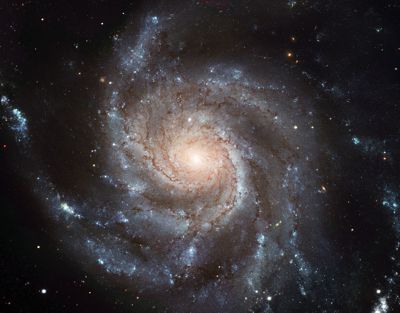
“Nice job! Now think about a galaxy, millions of stars orbiting around like on a merry-go-round. They feel an outward force like you did, and they feel an inward force from gravity so they all stay together instead of flying apart. But…”

“But?”

“Mr Newton’s rules tell us how much gravity the stars need to stay together. The astronomers tell us that there aren’t enough stars to make that much gravity. Dark matter supplies the extra.”

~~ Rich Olcott

Conversation of Energy

Teena’s next dash is for the slide, the high one, of course. “Ha-ha, Uncle Sy, beat you here. Look at me climbing up and getting potential energy!”

“You certainly did and you certainly are.”

“Now I’m sliding down all kinetic energy, wheee!” <thump, followed by thoughtful pause> “Uncle Sy, I’m all mixed up. You said momentum and energy are like cousins and we can’t create or destroy either one but I just started momentum coming down and then it stopped and where did my kinetic energy go? Did I break Mr Newton’s rule?”

“My goodness, those are good questions. They had physicists stumped for hundreds of years. You didn’t break Mr Newton’s Conservation of Momentum rule, you just did something his rule doesn’t cover. I did say there are important exceptions, remember.”

“Yeah, but you didn’t say what they are.”

“And you want to know, eh? Mmm, one exception is that the objects have to be big enough to see. Really tiny things follow quantum rules that have something like momentum but it’s different. Uhh, another exception is the objects can’t be moving too fast, like near the speed of light. But for us the most important exception is that the rule only applies when all the energy to make things move comes from objects that are already moving.”

“Like my marbles banging into each other on the floor?”

“An excellent example. Mr Newton was starting a new way of doing science. He had to work with very simple systems and and so his rules were very simple. One Sun and one planet, or one or two marbles rolling on a flat floor. His rules were all about forces and momentum, which is a combination of mass and speed. He said the only way to change something’s momentum was to push it with a force. Suppose when you push on a marble it goes a foot in one second and has a certain momentum. If you push it twice as hard it goes two feet in one second and has twice the momentum.”

“What if I’ve got a bigger marble?”

“If you have a marble that’s twice as heavy and you give it the one-foot-per-second speed, it has twice the momentum. Once there’s a certain amount of momentum in one of Mr Newton’s simple systems, that’s that.”

“Oh, that’s why I’ve got to snap my steelie harder than the glass marbles ’cause it’s heavier. Oh!Oh!And when it hits a glass one, that goes faster than the steelie did ’cause it’s lighter but it gets the momentum that the steelie had.”

“Perfect. You Mommie will be so proud of you for that thinking.”

“Yay! So how are momentum and energy cousins?”

“Cous… Oh. What I said was they’re related. Both momentum and kinetic energy depend on both mass and speed, but in different ways. If you double something’s speed you give it twice the momentum but four times the amount of kinetic energy. The thing is, there’s only a few kinds of momentum but there are lots of kinds of energy. Mr Newton’s Conservation of Momentum rule is limited to only certain situations but the Conservation of Energy rule works everywhere.”

“Energy is bigger than momentum?”

“That’s one way of putting it. Let’s say the idea of energy is bigger. You can get electrical energy from generators or batteries, chemical energy from your muscles, gravitational energy from, um, gravity –“

“Atomic energy from atoms, wind energy from the wind, solar energy from the Sun –“

“Cloud energy from clouds –“

“Wait, what?”

“Just kidding. The point is that energy comes in many varieties and they can be converted into one another and the total amount of energy never changes.”

“Then what happened to my kinetic energy coming down the slide? I didn’t give energy to anything else to make it start moving.”

“Didn’t you notice the seat of your pants getting hotter while you were slowing down? Heat is energy, too — atoms and molecules just bouncing around in place. In fact, one of the really good rules is that sooner or later, every kind of energy turns into heat.”

“Big me moving little atoms around?”

“Lots and lots of them.”

~~ Rich Olcott

Conversation of Momentum

Teena bounces out of the sandbox, races over to the playground’s little merry-go-round and shoves it into motion. “Come help turn this, Uncle Sy, I wanna go fast!” She leaps onto the moving wheel and of course she promptly falls off. The good news is that she rolls with the fall like I taught her to do.

“Why can’t I stay on, Uncle Sy?”

“What’s your new favorite word again?”

“Mmmo-MMENN-tumm. But that had to do with swings.”

“Swings and lots of other stuff, including merry-go-rounds and even why you should roll with the fall. Which, by the way, you did very well and I’m glad about that because we don’t want you getting hurt on the playground.”

“Well, it does hurt a little on my elbow, see?”

“Let me look … ah, no bleeding, things only bend where they’re supposed to … I think no damage done but you can ask your Mommie to kiss it if it still hurts when we get home. But you wanted to know why you fell off so let’s go back to the sandbox to figure that out.”

<scamper!> “I beat you here!”

“Of course you did. OK, let’s draw a big arc and pretend that’s looking down on part of the merry-go-round. I’ll add some lines for the spokes and handles. Now I’ll add some dots and arrows to show what I saw from over here. See, the merry-go-round is turning like this curvy arrow shows. You started at this dot and jumped onto this dot which moved along and then you fell off over here. Poor Teena. So you and your momentum mostly went left-to-right.”

“But that’s not what happened, Uncle Sy. Here, I’ll draw it. I jumped on but something tried to push me off and then I did fall off and then I rolled. Poor me. Hey, my arm doesn’t hurt any more!”

“How about that? I’ve often found that thinking about something else makes hurts go away. So what do you think was trying to push you off? I’ll give you a hint with these extra arrows on the arc.”

“That looks like Mr Newton’s new directions, the in-and-out direction and the going-around one. Oh! I fell off along the in-and-out direction! Like I was a planet and the Sun wasn’t holding me in my orbit! Is that what happened, I had out-momentum?”

“Good thinking, Teena. Mr Newton would say that you got that momentum from a force in the out-direction. He’d also say that if you want to stand steady you need all the forces around you to balance each other. What does that tell you about what you need to do to stay on the merry-go-round?”

“I need an in-direction force … Hah, that’s what I did wrong! I jumped on but I didn’t grab the handles.”

“Lesson learned. Good.”

“But what about the rolling?”

“Well, in general when you fall it’s nearly always good to roll the way your body’s spinning and only try to slow it down. People who put out an arm or leg to stop a fall often stress it and and maybe even tear or break something.”

“That’s what you’ve told me. But what made me spin?”

“One of Mr Newton’s basic principles was a rule called ‘Conservation of Momentum.’ It says that you can transfer momentum from one thing to another but you can’t create it or destroy it. There are some important exceptions but it’s a pretty good rule for the cases he studied. Your adventure was one of them. Look back at the picture I drew. You’d built up a lot of going-around momentum from pushing the merry-go-round to get it started. You still had momentum in that direction when you fell off. Sure enough, that’s the direction you rolled.”

“Is that the ‘Conversation of Energy’ thing that you and Mommie were talking about?”

“Conservation. It’s not the same but it’s closely related.”

“Why does it even work?”

“Ah, that’s such a deep question that most physicists don’t even think about it. Like gravity, Mr Newton described what inertia and momentum do, but not how they work. Einstein explained gravity, but I’m not convinced that we understand mass yet.”

~~ Rich Olcott

A Momentous Occasion

<creak> Teena’s enjoying her new-found power in the swings. “Hey, Uncle Sy? <creak> Why doesn’t the Earth fall into the Sun?”

“What in the world got you thinking about that on such a lovely day?”

“The Sun gets in my eyes when I swing forward <creak> and that reminded me of the time we saw the eclipse <creak> and that reminded of how the planets and moons are all floating in space <creak> and the Sun’s gravity’s holding them together but if <creak> the Sun’s pulling on us why don’t we just fall in?” <creak>

“An excellent question, young lady. Isaac Newton thought about it long and hard back when he was inventing Physics.”

“Isaac Newton? Is he the one with all the hair and a long, skinny nose and William Tell shot an arrow off his head?”

“Well, you’ve described his picture, but you’ve mixed up two different stories. William Tell’s apple story was hundreds of years before Newton. Isaac’s apple story had the fruit falling onto his head, not being shot off of it. That apple got him thinking about gravity and how Earth’s gravity pulling on the apple was like the Sun’s gravity pulling on the planets. When he was done explaining planet orbits, he’d also explained how your swing works.”

“My swing works like a planet? No, my swing goes back and forth, but planets go round and round.”

“Jump down and we can draw pictures over there in the sandbox.”

<thump!! scamper!> “I beat you here!”

“Of course you did. OK, what’s your new M-word?”

“Mmmo-MMENN-tummm!”

“Right. Mr Newton’s Law of Inertia is about momentum. It says that things go in a straight line unless something interferes. It’s momentum that keeps your swing going.”

“B-u-u-t, I wasn’t going in a straight line, I was going in part of a circle.”

“Good observing, Teena, that’s exactly right. Mr Newton’s trick was that a really small piece of a circle looks like a straight line. Look here. I’ll draw a circle … and inside it I’ll put a triangle… and between them I’ll put a hexagon — see how it has an extra point halfway between each of the triangle’s points? — and up top I’ll put the top part of whatever has 12 sides. See how the 12-thing’s sides are almost on the circle?”

“Ooo, that’s pretty! Can we do that with a square, too?”

“Sure. Here’s the circle … and the square … and an octagon … and a 16-thing. See, that’s even closer to being a circle.”

“Ha-ha — ‘octagon’ — that’s like ‘octopus’.”

“For good reason. An octopus has eight arms and an octagon has eight sides. ‘Octo-‘ means ‘eight.’ So anyway, Mr Newton realized that his momentum law would apply to something moving along that tiny straight line on a circle. But then he had another idea — you can move in two directions at once so you can have momentum in two directions at once.”

“That’s silly, Uncle Sy. There’s only one of me so I can’t move in two directions at once.”

“Can you move North?”

“Uh-huh.”

“Can you move East?”

“Sure.”

“Can you move Northeast?”

“Oh … does that count as two?”

“It can for some situations, like planets in orbit or you swinging on a swing. You move side-to-side and up-and-down at the same time, right?”

“Uh-huh.”

“When you’re at either end of the trip and as far up as you can get, you stop for that little moment and you have no momentum. When you’re at the bottom, you’ve got a lot of side-to-side momentum across the ground. Anywhere in between, you’ve got up-down momentum and side-to-side momentum. One kind turns into the other and back again.”

“So complicated.”

“Well, it is. Newton simplified things with revised directions — one’s in-or-out from the center, the other’s the going-around angle. Each has its own momentum. The swing’s ropes don’t change length so your in-out momentum is always zero. Your angle-momentum is what keeps you going past your swing’s bottom point. Planets don’t have much in-out momentum, either — they stay about their favorite distance from the Sun.”

“Earth’s angle-momentum is why we don’t fall in?”

“Yep, we’ve got so much that we’re always falling past the Sun.”

~~ Rich Olcott

The Pretty-good Twenty-nine

Time for coffee and a scone. As I step into Al’s coffee shop he’s taking his Jupiter poster down from behind the cash register.

“Hey, Al, I liked that poster. You decide you prefer plain wall?”

“Nah, Sy, I got a new one here. Help me get it up over the hook.”

A voice from behind us. “Ya got it two degrees outta plumb, clockwise.” Vinnie, of course. Al taps the frame to true it up.

Teachers, click here to download a large-format printable copy.

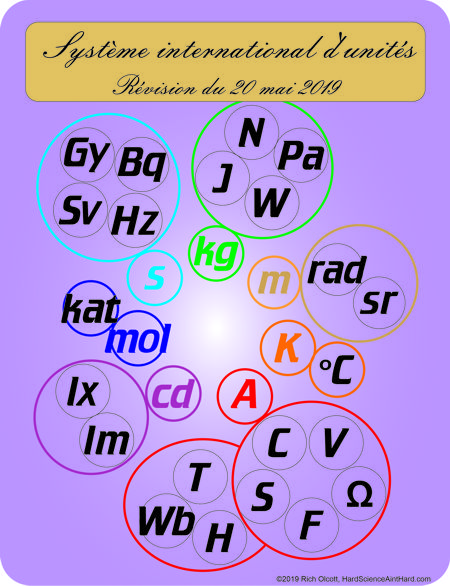
“Hey, Sy, in the middle, that’s the same seven units we just finished talking about — amps for electric current, kelvins for temperature, meters for length, kilograms for mass, seconds for time, moles for counting atoms and such, and that candela one you don’t like. What’s all the other bubbles about? For that matter, what’s the poster about, Al?”

“What it’s about, Vinnie, is on May 20 the whole world goes to a new set of measurement standards, thanks to some international bureau.”

Le Bureau International des Poids et Mesures.” It’s Newt Barnes in from the Physics building. “The bubbles in that central ring are the BIPM’s selections for fundamental standards. Each one’s fixed by precisely defined values of one or more universal physical constants. For instance, a ruler calibrated on Earth will match up perfectly with one calibrated on Mars because both calibrations depend on the wavelength of radiation from a cesium-based laser and that’s the same everywhere.”

“How about the other bubbles and the rings around them?”

“They’re all derived quantities, simple combinations of the fundamental standards.”

“Hey, I see one I recognize. That °C has gotta be degrees centigrade ’cause it’s right next to kelvins. Centigrade’s the same as kelvins plus , uh, 273?”

“There you go, Al. What’s ‘rad’ and ‘sr’, Newt?”

“Symbols for radian and steradian, Vinnie. They both measure angles like degrees do, but they fit the BIPM model because they’re ratios of lengths and length is one of the fundamentals. Divide a circle’s circumference by its radius and what do you get?”

“Twice pi.”

“Right, call it 2π radians and that’s a full circle. Half a circle is π radians, a right angle is π/2 radians and so on. Works for any size circle, right? Anyone remember the formula for the area of a sphere?”

“4πr2, right?”

“Exactly. If you divide any sphere’s area by the square of its radius you get 4π steradians. Any hemisphere is 2π steradians and so on. Steradians are handy for figuring things like light and gravity that decrease as the square of the distance.”

Something occurs to me. “I’m looking at those bigger bubbles that enclose the derived quantities. Seems to me that each one covers a major area of physical science. The green one with newtons for force, pascals for pressure, joules for energy and watts for power — that’d be Newtonian physics. The red circle with volts plus coulombs for charge, ohms for resistance, farads for capacitance, siemens for electrical conductance — all that’s electronics. Add in henries for inductance, webers for magnetic flux and teslas for flux density and you’ve got Maxwellian electromagnetism.”

“You’re on to something, Sy. Chemistry’s there with moles and katals, also known as moles per second, for catalytic activity. How does your idea fit the cluster attached to seconds?”

“They’re all per-second rates, Newt. The hertz is waves per second for periodic things like sound or light-as-a-wave. The other three are about radioactivity — bequerels is fissions per second; grays and sieverts are measures of radiation exposure per kilogram.”

“Vinnie says you don’t like candelas, so you probably don’t like lumens or luxes either. What’s your gripe with them?”

“All three are supposed to quantify visible light from a source, as opposed to the total emission at all wavelengths. But the definition of ‘visible’ zeros in on one wavelength in the green because that’s where most people are most sensitive. Candelas aren’t valid for a person who’s color-blind in the green, nor for something like a red laser that has no green lightwaves. I call bogosity, and lumens and luxes are both candela-based.”

“These 29 standards are as good on Mars as they are here on Earth?”

“That’s the plan.”

~~ Rich Olcott

Beautiful Realization

“Whaddaya mean, Sy, ‘charge and resistance and voltage all playing beautiful together‘? How’s that beautiful?”

“It is when they play together in a Kibble Balance, Vinnie. That beautifully-designed device solved the realization problem for two of the revised fundamental standards of measurement. Here’s the one for electricity.”

“That’s odd. It says ‘electric current’ but the number’s about charge. And I don’t see anything in there about voltage or resistance.”

“True. The electronic charge e is one of our universal constants. It and the speed of light and Planck’s constant h are the same on Mars as they are here on Earth. Take a cesium-based laser from Earth to Mars and its frequency doesn’t change. That’s why the revisions are measure-anywhere standards, no need to carry something to Paris to compare it to a physical object.”

“This is another one of those definition tricks, isn’t it? Like the cesium frequency — we defined the second by saying it’s the time required for so-and-so many waves of that light beam. Here, it’s not like someone measured the charge in coulombs, it’s we’re gonna make the coulomb exactly big enough so when we do measure an electron it’ll match up.”

“You’re not wrong, Vinnie, but it’s not quite that arbitrary. Lots of people did measure the electron against the old standard. This number represents the most accurate estimate across all the measurements. The standards board just froze it there. It’s the same strategy they took with the other six fundamental standards — each of them sits on top of a well-known constant.”

“Like Newton’s gravitational constant?”

“Sorry, Al, not that one. It’s universal, alright, but it’s only known to four significant figures, nowhere near the 8-or-better level the metrologists demand.”

“So tell us about the beauty part, Sy.”

I grab some paper napkins from the dispenser at our table. Al gives me a look. In his opinion Vinnie uses way too many of those and he doesn’t want it to spread. “Just using what I need to make a point, Al. Vinnie, I know you like pictures better than algebra but bear with me.”

“Yeah, you went through the kilogram thing pretty quick what with the garlic and all.”

“Oooh, yeah.” <scribbling on the first napkin> “Well anyway, here’s a sketch of the Kibble Balance rigged for weighing but let’s just pay attention to the parts in the dark blue oval. That zig-zag line labeled RK is a resistor that exploits the quantum Hall effect. Quantum math says its resistance is given by RK=h/e2. That’s exactly 25812.80756 ohms.”

“That a lot more digits than gravity.”

“Nice catch, Al. Now the second component in the oval is a quantum voltmeter. If you put a voltage V across it, the Josephson junction inside passes an alternating current whose frequency is f=V/CJ, where CJ=h/2e.” <scribbling on the second napkin> “Put another way. the frequency tells you the voltage from V=f×CJ and that’s the same as V=f×h/2e.” <scribbling on the third napkin> “The current iW going through RK is V/RK and that’s going to be iW=(f×CJ)/(RK)=f×(CJ/RK)=f×(h/2e)/(h/e2)=(f/2)×e. You with me?”

“Gimme a minute… You’re saying that the current is going to be half some frequency, which we can measure, times the charge on an electron. Yeah, that makes sense, ’cause the current is electrons and you got us counting electrons. Hey, wait, what happened to the h?”

“Canceled out in the fraction, just the way that e canceled out in the fraction for the kilogram.”

“Cute.”

“Better than cute, it’s beautiful. The same equipment, the Kibble Balance plus a gravimeter, gives you the realization of a kilogram depending only on h, AND the realization of the ampere depending only on e. Once you know the standards for time, which depends only on that cesium frequency, and for length, which depends only on time and the speed of light, you can get standards for mass and electric current in the NIST lab here on Earth or up on Mars or anywhere.”

“Almost anywhere.”

“What’s your exception?”

“In space, where there’s no gravity.”

“Einstein covered that with his Equivalence Principle.”

~~ Rich Olcott

An Official Mass Movement

A December nip’s in the air.  I’m in my office trying to persuade the heating system to be more generous, when Vinnie wanders in carrying a magazine.  “I been reading about how a pound won’t be a pound any more.”

This takes me a moment to work out.  “Ah, you’re talking kilograms, not pounds, right?”

“Pound, kilogram, same difference, they’re both weights.”

“No, they’re not.  A kilogram at the bottom of the sea would still be a kilogram at the top of a mountain, but a pound high up weighs less than a pound lower down.”

“In what alternate universe does that make sense?”

“In any universe where Galileo’s observations and Newton’s equations are valid.  Thanks to them we know the difference between weight and mass.”

“Which is…?”

“That’s where things get subtle and it took Newton to tease them apart.  It’s the difference between quantifying something with a spring scale and quantifying it with a balance.  Say you put a heavy object on a scale.  It pulls down on the spring and the spring pulls up on the object.  When everything stops moving, the upward and downward forces are equal.  Given the spring’s stretch-per-pound relationship, you can measure the stretch and figure out how many pounds of force the object exerts.”

“Yeah, so…?”

“So now you put the same object on one pan of a balance.  You put kilogram blocks on the other pan until the balance beam levels out.  The beam goes level because the two sides of the balance carry the same mass.  Count the blocks and you know your object’s mass in kilograms.”

“Like I said, same difference.”

“Nope, because you’ve done two different operations.  On a balance your object will match up with the same number of blocks wherever you go with them.  Balance measurements are all about mass.  With the spring scale you compared gravity’s force against some other kind of force.  If you go somewhere else where gravity’s weaker, say to the top of Mt Everest, the scale will show a different weight even though the mass hasn’t changed.”

“How much different?”

“Not much for most purposes — about two pounds per ton between sea-level and Mt Everest’s peak.  But that’s a huge variation for physicists who look for clues to the Universe in the 5th or 6th decimal place.  High tech science and engineering need measurements, like mass, that are precise, stable and reproducible in many labs.  You noticed that both of my example measurements are too approximate for the techs.”

“Sure, the scale thing can be off because the spring can get wonky with use.  Um, and you can only measure the stretch within a percent or so probably.  But you can count the kilogram blocks — that ought to be a pretty good number.”

“Count-based metrics are indeed the most precise, but they’re problematic in their own way.  For one thing, maybe the object isn’t an exact number of kilograms.  Best you can do is say it’s between and n+1 kilograms.  But it’s worse than that.  The kilogram blocks can get wonky, too — finger-marks, corrosion, all of that.”

“But you can counter that by comparing the daily-use blocks with a standard you don’t use much.”

“Which sooner or later gets wonky with use so you have re-calibrate it to a whole chain of calibration blocks going back to a lovingly preserved great-grandmaster standard block, but what do we do when we get to Mars where it’d be difficult to get the local standard back to Earth for a re-calibration?”

“I see the problem.  Is that why a kilogram won’t be a kilogram any more?”

“Well, that’s why The Kilogram won’t be Le grand K, the great-grandmaster standard — a carefully monitored hunk of platinum-iridium that’s actually kept in a guarded, climate-controlled vault in a Paris basement.  It’s taken out only once every few years to compare with its kin.  Even so it appears to have lost 50 micrograms since 1889.  We think.  So they’re demoting it.” 

“What’re they replacing it with?  Not another lump of metal, then?”

“Oh, no, they need something that’s precisely reproducible anywhere, preferably something that’s count-based.  The new standard will be official soon.  It’s a great physics story.”

~~ Rich Olcott

Rhythm Method

A warm Summer day.  I’m under a shady tree by the lake, watching the geese and doing some math on Old Reliable.  Suddenly a text-message window opens up on its screen.  The header bar says 710-555-1701.  Old Reliable has never held a messaging app, that’s not what I use it for.  The whole thing doesn’t add up.  I type in, Hello?

Hello, Mr Moire.  Remember me?

Suddenly I do.  That sultry knowing stare, those pointed ears.  It’s been a yearHello, Ms Baird.  What can I do for you?

Another tip for you, Mr Moire.  One of my favorite star systems — the view as you approach it at near-lightspeed is so ... meaningful.  Your astronomers call it PSR J0337+1715.

So of course I head over to Al’s coffee shop after erasing everything but that astronomical designation.  As I hoped, Cathleen and a few of her astronomy students are on their mid-morning break.  Cathleen winces a little when she sees me coming.  “Now what, Sy?  You’re going to ask about blazars and neutrinos?”

I show her Old Reliable’s screen.  “Afraid not, Cathleen, I’ll have to save that for later.  I just got a message about this star system.  Recognize it?”

“Why, Sy, is that a clue or something?  And why is the lettering in orange?”

“Long story.  But what can you tell me about this star system?”

“Well, it’s probably one of the most compact multi-component systems we’re ever going to run across.  You know what compact objects are?”

“Sure.  When a star the size of our Sun exhausts most of its hydrogen fuel, gravity wins its battle against heat.  The star collapses down to a white dwarf, a Sun-full of mass packed into a planet-size body.  If the star’s a bit bigger it collapses even further, down to a neutron star just a few miles across.  The next step would be a black hole, but that’s not really a star, is it?”

“No, it’s not.  Jim, why not?”

“Because by definition a black hole doesn’t emit light.  A black hole’s accretion disk or polar jets might, but not the object itself.”

“Mm-hm.  Sy, your ‘object’ is actually three compact objects orbiting  around each other.  There’s a neutron star with a white dwarf going around it, and another white dwarf swinging around the pair of them.  Vivian, does that sound familiar?”

“That’s a three-body system, like the Moon going around the Earth and both going around the Sun.  Mmm, except really both white dwarfs would go around the neutron star because it’s heaviest and we can calculate the motion like we do the Solar System.”

“Not quite.  We can treat the Sun as motionless because it has 99% of the mass.  J0337+1715’s neutron star doesn’t dominate its system as much as the Sun does ours.  That outermost dwarf has 20% of its system’s mass.  Phil, what does that suggest to you?”

“It’d be like Pluto and Charon.  Charon’s got 10% of their combined mass and so Pluto and Charon both orbit a point 10% of the way out from Pluto.  From Earth we see Pluto wobbling side to side around that point.  So the neutron star must wobble around the point 20% outward towards the heavy dwarf.  Hey, star-wobble is how we find exoplanets.  Is that what this is about, Mr Moire?  Did someone measure its red-shift behavior?”PSR J0337+1715Cathleen saves me from answering.  “Not quite.  The study Sy’s chasing is actually a cute variation on red-shift measurements.  That ‘PSR‘ designation means the neutron star is a pulsar.  Those things emit electromagnetic radiation pulses with astounding precision, generally regular within a few dozen nanoseconds.  If we receive slowed-down pulses then the object’s going away; sped-up and it’s approaching, just like with red-shifting.  The researchers  derived orbital parameters for all three bodies from the between-pulse durations.  The heavy dwarf is 200 times further out than the light one, for instance.  Not an easy experiment, but it yielded an important result.”

My ears perk up.  “Which was…?”

“The gravitational force between the pulsar and each dwarf was within six parts per million of what Newton’s Laws prescribe.  That observation rules out whole classes of theories that tried to explain galaxies and galaxy clusters without invoking dark matter.”

Cool, huh?

Uh-huh.

~~ Rich Olcott

They Went That-away. But Why?

“It’s worse than that, Vinnie.”  I pull out Old Reliable, my math-monster tablet.  “Let me scan in that three-electron drawing of yours.”3 electrons in B-field

“Good enough to keep a record of it?”

“Nope, I want to exercise a new OVR app I just bought.”

“You mean OCR.”

“Uh-uh, this is Original Vector Reconstruction, not Optical Character Recognition.    OCR lets you read a document into a word processor so you can modify it.  OVR does the same thing but with graphics.  Give me a sec … there.  OK, look at this.”3 electrons in B-field revisited

“Cool, you turned my drawing 180°, sort of.  Nice app.  Oh, and you moved the red electron’s path so it’s going opposite to the blue electron instead of parallel to the magnetic field.  Why’d you bother?”

“See the difference between blue and red?”

“Well, yeah, one’s going up, one’s going down.  That’s what I came to you about and you shot down my theory.  Those B-arrows in the magnetic field are going in completely the wrong direction to push things that way.”

“Well, actually, they’re going in exactly the right direction for that, because a magnetic field pushes along perpendiculars.  Ever hear of The Right Hand Rule?”

“You mean like ‘lefty-loosey, righty-tighty’?”

“That works, too, but it’s not the rule I’m talking about.  If you point your thumb in the direction an electron is moving, and your index finger in the direction of the magnetic field, your third finger points in the deflection direction.  Try it.”

“Hurts my wrist when I do it for the blue one, but yeah, the rule works for that.  It’s easier for the red one.  OK, you got this rule, fine, but why does it work?”

“Part of it goes back to the vector math you don’t want me to throw at you.  Let’s just say that there are versions of a Right Hand Rule all over physics.  Many of them are essentially definitions, in the same way that Newton’s Laws of Motion defined force and mass.  Suppose you’re studying the movements directed by some new kind of force.  Typically, you try to define some underlying field in such a way that you can write equations that predict the movement.  You haven’t changed Nature, you’ve just improved our view of how things fit together.”

“So you’re telling me that whoever made that drawing I copied drew the direction those B-arrows pointed just to fit the rule?”

“Almost.  The intensity of the field is whatever it is and the lines minus their pointy parts are wherever they are.  The only thing we can set a rule for is which end of the line gets the arrowhead.  Make sense?”Spiraling electron

“I suppose.  But now I got two questions instead of the one I come in here with.  I can see the deflection twisting that electron’s path into a spiral.  But I don’t see why it spirals upward instead of downward, and I still don’t see how the whole thing works in the first place.”

“I’m afraid you’ve stumbled into a rabbit hole  we don’t generally talk about.  When Newton gave us his Law of Gravity, he didn’t really explain gravity, he just told us how to calculate it.  It took Einstein and General Relativity to get a deeper explanation.  See that really thick book on my shelf over there?  It’s loaded with tables of thermodynamic numbers I can use to calculate chemical reactions, but we didn’t start to understand those numbers until quantum mechanics came along.  Maxwell’s equations let us calculate electricity, magnetism and their interaction — but they don’t tell us why they work.”

“I get the drift.  You’re gonna tell me it goes up because it goes up.”

“That’s pretty much the story.  Electrons are among the simplest particles we know of.  Maxwell and his equations gave us a good handle on how they behave, nothing on why we have a Right Hand Rule instead of a Left Hand Rule.  The parity just falls out of the math.  Left-right asymmetry seems to have something to do with the geometry of the Universe, but we really don’t know.”

“Will string theory help?”

“Physicists have spent 50 years grinding on that without a testable result.  I’m not holding my breath.”

~~ Rich Olcott