Should These Three Be Alike?

“What’s all the hubbub in the back room, Al? I’m a little early for my afternoon coffee break and your shop’s usually pretty quiet about now.”

“It’s Cathleen’s Astronomy class, Sy. The department double-booked their seminar room so she asked to use my space until it’s straightened out.”

“Think I’ll eavesdrop.” I slide in just as she’s getting started.

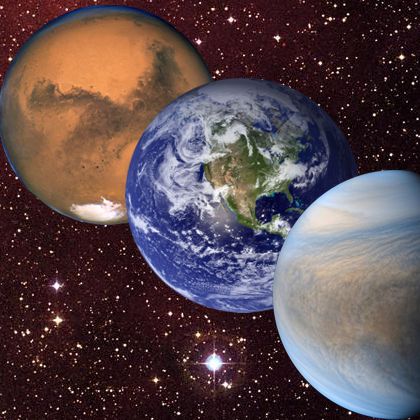
“OK, folks, settle. Last class I challenged you with a question. Venus and Mars both have atmospheres that are dominated by carbon dioxide with a little bit of nitrogen. Earth is right in between them. How come its atmosphere is so different? I gave each of you a piece of that to research. Jeremy, you had the null question. Should we expect Earth’s atmosphere to be about the same as the other two?”
Venus coudtops image by Damia Bouic
JAXA / ISAS / DARTS / Damia Bouic

“I think so, ma’am, on the basis of the protosolar nebula hypothesis. The –“

“Wait a minute, Jeremy. Sy, I saw you sneak in. Jeremy, explain that term to him.”

“Yes’m. Uh, a nebula is a cloud of gas and dust out in space. It could be what got shot out of an exploding star or it could be just a twist in a stream of stuff drifting through the Galaxy. If the twist kinks up, gravity pulls the material on either side of the kink towards the middle and you get a rotating disk. Most of what’s in the disk falls towards its center. The accumulated mass at the center lights up to be a star. Meanwhile, what’s left in the disk keeps most of the original angular momentum but it doesn’t whirl smoothly. There’s going to be local vortices and they attract more stuff and grow up to be planets. That’s what we think happens, anyway.”

“Good summary. So what does that mean for Mars, Venus and the Earth?”

“Their orbits are pretty close together, relative to the disk’s radius, so they ought to have encountered about the same mixture of heavy particles and light ones while they were getting up to size. The light ones would be gas atoms, mostly hydrogen and helium. Half the other atoms are oxygen and they’d react to produce oxides — water, carbon monoxide, grains of silica and iron oxide. And oxygen and nitrogen molecules, of course.”

“Of course. Was gravity the only actor in play there?”

“No-o-o, once the star lit up its photons and solar wind would have pushed against gravity.”

“So three actors. Would photons and solar wind have the same effect? Anybody?”

Silence, until astrophysicist-in-training Newt Barnes speaks up. “No, they’d have different effects. The solar wind is heavy artillery — electrons, protons, alpha particles. They’ll transfer momentum to anything they hit, but they’re more likely to hit a large particle like a dust grain than a small one like an atom. On average, the big particles would be pushed away more.”

“And the photons?”

“A photon is selective — it can only transfer momentum to an atom or molecule that can absorb exactly the photon’s energy. But each kind of atom has its own set of emission and absorption energies. Most light emitted by transitions within hydrogen atoms won’t be absorbed by anything but another hydrogen atom. Same thing for helium. The Sun’s virtually all hydrogen and helium. The photons they emit would move just those disk atoms and leave the heavier stuff in place.”

“That’s only part of the photon story.”

“Oh? Oh, yeah. The Sun’s continuous spectrum. The Sun is hot. Heat jiggles whole ions. Those moving charges produce electromagnetic waves just like charge moving within an atom, but heat-generated waves can have any wavelength and interact with anything. They can bake dust particles and decompose compounds that contain volatile atoms. Then those atoms get swept away in the general rush.”

“Which has the greater effect, solar wind or photons?”

“Hard to say without doing the numbers, but I’d bet on the photons. The metal-and-silicate terrestrial planets are close to the Sun, but the mostly-hydrogen giants are further out.”

“All that said, Jeremy, what’s your conclusion?”

“It sure looks like Earth’s atmosphere should be intermediate between Mars and Venus. How come it’s not?”

~~ Rich Olcott
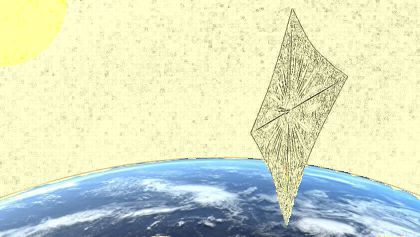
Fly High, Silver Bird

“TANSTAAFL!” Vinnie’s still unhappy with spacecraft that aren’t rocket-powered. “There Ain’t No Such Thing As A Free Lunch!”

“Ah, good, you’ve read Heinlein. So what’s your problem with Lightsail 2?”

“It can’t work, Sy. Mostly it can’t work. Sails operate fine where there’s air and wind, but there’s none of that in space, just solar wind which if I remember right is just barely not a vacuum.”

Astronomer-in-training Jim speaks up. “You’re right about that, Vinnie. The solar wind’s fast, on the order of a million miles per hour, but it’s only about 10-14 atmospheres. That thin, it’s probably not a significant power source for your sailcraft, Al.”

“I keep telling you folks, it’s not wind-powered, it’s light-powered. There’s oodles of sunlight photons out there!”

“Sure, Al, but photons got zero mass. No mass, no momentum, right?”

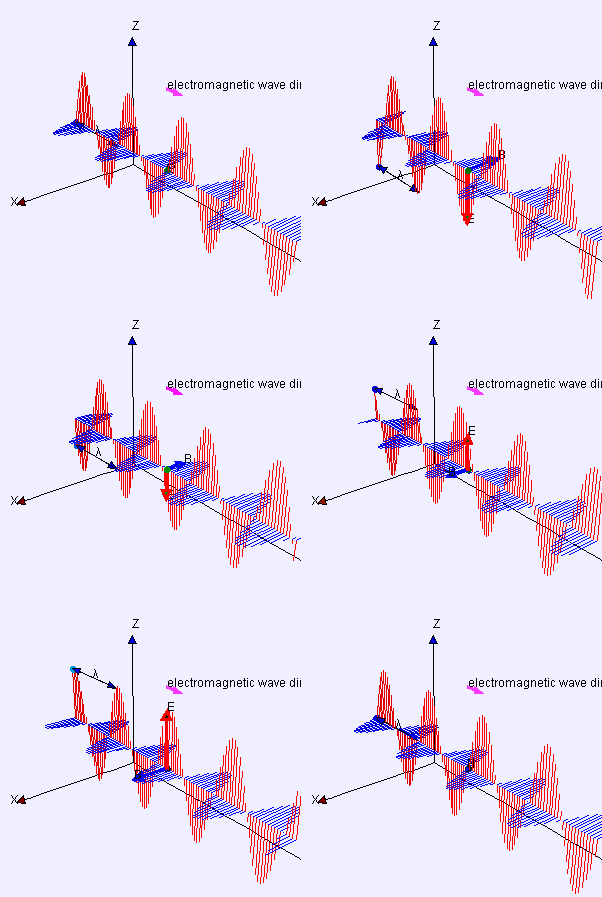
Plane-polarized electromagnetic wave in motion
Plane-polarized electromagnetic wave
Electric (E) field is red
Magnetic (B) field is blue
(Image by Loo Kang Wee and Fu-Kwun Hwang from Wikimedia Commons)

My cue to enter. “Not right, Vinnie. Experimental demonstrations going back more than a century show light exerting pressure. That implies non-zero momentum. On the theory side … you remember when we talked about light waves and the right-hand rule?”

“That was a long time ago, Sy. Remind me.”

“… Ah, I still have the diagram on Old Reliable. See here? The light wave is coming out of the screen and its electric field moves electrons vertically. Meanwhile, the magnetic field perpendicular to the electric field twists moving charges to scoot them along a helical path. So there’s your momentum, in the interaction between the two fields. The wave’s combined action delivers force to whatever it hits, giving it momentum in the wave’s direction of travel. No photons in this picture.”

Astrophysicist-in-training Newt Barnes dives in. “When you think photons and electrons, Vinnie, think Einstein. His Nobel prize was for his explanation of the photoelectric effect. Think about some really high-speed particle flying through space. I’m watching it from Earth and you’re watching it from a spaceship moving along with it so we’ve each got our own frame of reference.”

“Frames, awright! Sy and me, we’ve talked about them a lot. When you say ‘high-speed’ you’re talking near light-speed, right?”

“Of course, because that’s when relativity gets significant. If we each measure the particle’s speed, do we get the same answer?”

“Nope, because you on Earth would see me and the particle moving through compressed space and dilated time so the speed I’d measure would be more than the speed you’d measure.”

“Mm-hm. And using ENewton=mv² you’d assign it a larger energy than I would. We need a relativistic version of Newton’s formula. Einstein said that rest mass is what it is, independent of the observer’s frame, and we should calculate energy from EEinstein²=(pc)²+(mc²)², where p is the momentum. If the momentum is zero because the velocity is zero, we get the familiar EEinstein=mc² equation.”

“I see where you’re going, Newt. If you got no mass OR energy then you got nothing at all. But if something’s got zero mass but non-zero energy like a photon does, then it’s got to have momentum from p=EEinstein/c.”

“You got it, Vinnie. So either way you look at it, wave or particle, light carries momentum and can power Lightsail 2.”

Lightsail 2 flying over Earth, against a yellow background
Adapted from image by Josh Spradling / The Planetary Society

“Question is, can sunlight give it enough momentum to get anywhere?”

“Now you’re getting quantitative. Sy, start up Old Reliable again.”

“OK, Newt, now what?”

“How much power can Lightsail 2 harvest from the Sun? That’ll be the solar constant in joules per second per square meter, times the sail’s area, 32 square meters, times a 90% efficiency factor.”

“Got it — 39.2 kilojoules per second.”

“That’s the supply, now for the demand. Lightsail 2 masses 5 kilograms and starts at 720 kilometers up. Ask Old Reliable to use the standard circular orbit equations to see how long it would take to harvest enough energy to raise the craft to another orbit 200 kilometers higher.”

“Combining potential and kinetic energies, I get 3.85 megajoules between orbits. That’s only 98 seconds-worth. I’m ignoring atmospheric drag and such, but net-net, Lightsail 2‘s got joules to burn.”

“Case closed, Vinnie.”

~~ Rich Olcott

Seesaw to The Stars

I look around the playground. “Where’s the seesaw, Teena?”

“They took it away. That’s good ’cause I hated that thing!”

“Why’s that, Sweetie?”

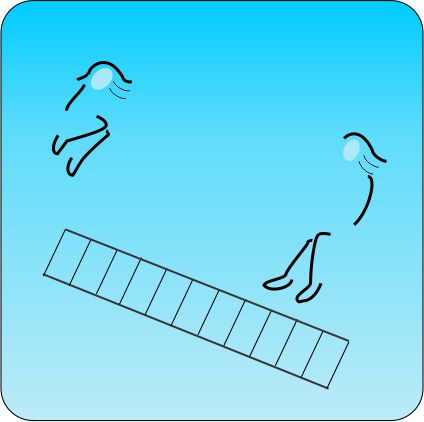
“I never could play right on it. Almost never. Sometimes there’d be a kid my size on the other end and that worked OK, but a lot of times a big kid got on the other end and bounced me up in the air. The first time I even fell off and they laughed.”

“Well, I can understand that. I’m sure you’ve been nicer than that to the littler kids.”

“Uh-huh, except for Bratty Brian, but he liked it when I bounced him. He called it ‘going to the Moon’.”

“I can understand that, too. If things go just right you come off your seat and float like an astronaut for a moment. I bet he held onto the handles tight.”

“Yeah, I just wasn’t ready for it the first time.”

“Y’know, there’s another way that Brian’s bounces were like a rocket trip to somewhere. They went through the same phases of acceleration and deceleration.”

“Uncle Sy, you know you’re not allowed to use words like that around me without ‘splaining them.”

“Mmm, they both have to do with changing speed. Suppose you’re standing still. Your speed is zero, right? When you start moving your speed isn’t zero any more and we say you’ve accelerated. When you slow down again we say you’re decelerating. Make sense?”

“So when Bratty Brian gets on the low end of the seesaw he’s zero. When I squinch down at my end he accelerates –“

“Right, that’s like the boost phase of a rocket trip.”

“… And when he’s floating at the very top –“

“Like astronauts when they’re coasting, sort of but not really.”

“… And then they decelerate when they land. Bratty Brian did, too. I guess deceleration is like acceleration backwards. But why such fancy words?”

“No-one paid much attention to acceleration until Mr Newton did. He changed Physics forever when he said that all accelerations involve a force of some kind. That thought led him to the whole idea of gravity as a force. Ever since then, when physicists see something being accelerated they look for the force that caused it and then they look for what generated the force. That’s how we learned about electromagnetism and the forces that hold atoms together and even dark matter which is ultra-mysterious.”

“Ooo, I love mysteries! What did Mr Newton tell us about this one?”

“Nothing, directly, but his laws gave us a clue about what to look for. Tell me what forces were in play during Brian’s ‘moon flight’.”

“Let’s see. He accelerated up and then he accelerated down. I guess while he was on the seesaw seat at the beginning the up-acceleration came from an up-force from his end of the board. And the down-acceleration came from gravity’s force. But the gravity force is there all along, isn’t it?”

“Good point. What made the difference is that your initial force was greater than gravity’s so Brian went up. When your force stopped, gravity’s force was all that mattered so Brian came back down again.”

“So it’s like a tug-of-war, first I won then gravity won.”

“Exactly. Now how about the forces when you were on the merry-go-round?”

“OK. Gravity’s always there so it was pulling down on me. The merry-go-round was pushing up?”

“Absolutely. A lot of people think that’s weird, but whatever we stand on pushes up exactly as hard as gravity pulls us down. Otherwise we’d sink into the ground or fly off into space. What about other forces?”

“Oh, yeah, Mr Newton’s outward force pushed me off until … holding the handles made the inward force to keep me on!”

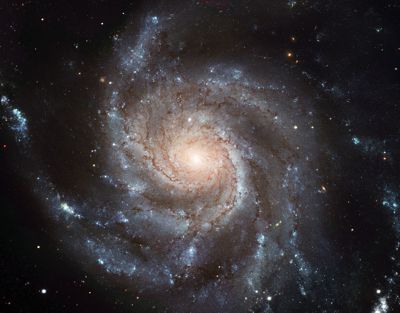
“Nice job! Now think about a galaxy, millions of stars orbiting around like on a merry-go-round. They feel an outward force like you did, and they feel an inward force from gravity so they all stay together instead of flying apart. But…”

“But?”

“Mr Newton’s rules tell us how much gravity the stars need to stay together. The astronomers tell us that there aren’t enough stars to make that much gravity. Dark matter supplies the extra.”

~~ Rich Olcott

Three Shades of Dark

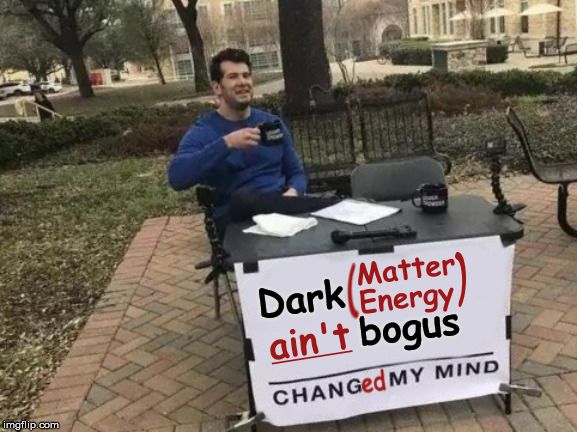
The guy’s got class, I’ll give him that. Astronomer-in-training Jim and Physicist-in-training Newt met his challenges so Change-me Charlie amiably updates his sign.

But he’s not done. “If dark matter’s a thing, how’s it different from dark energy? Mass and energy are the same thing, right, so dark energy’s gotta be just another kind of dark matter. Maybe dark energy’s what happens when real matter that fell into a black hole gets squeezed so hard its energy turns inside out.”

Jim and Newt just look at each other. Even Cap’n Mike’s boggled. Someone has to start somewhere so I speak up. “You’re comparing apples, cabbages and fruitcake. Yeah, all three are food except maybe for fruitcake, but they’re grossly different. Same thing for black holes, dark matter and dark energy — we can’t see any of them directly but they’re grossly different.”

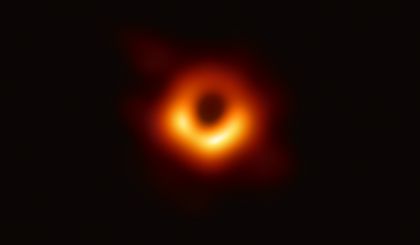
EHT's image of the black hole at the center of the Messier 87 galaxy
Black hole and accretion disk, image by the Event Horizon Telescope Collaboration

Vinnie’s been listening off to one side but black holes are one of his hobbies. “A black hole’s dark ’cause its singularity’s buried inside its event horizon. Whatever’s outside and somehow gets past the horizon is doomed to fall towards the singularity inside. The singularity itself might be burn-your-eyes bright but who knows, ’cause the photons’re trapped. The accretion disk is really the only lit-up thing showing in that new EHT picture. The black in the middle is the shadow of the horizon, not the hole.”

Jim picks up the tale. “Dark matter’s dark because it doesn’t care about electromagnetism and vice-versa. Light’s an electromagnetic wave — it starts when a charged particle wobbles and it finishes by wobbling another charged particle. Normal matter’s all charged particles — negative electrons and positive nuclei — so normal matter and light have a lot to say to each other. Dark matter, whatever it is, doesn’t have electrical charges so it doesn’t do light at all.”

“Couldn’t a black hole have dark matter in it?”

“From what little we know about dark matter or the inside of a black hole, I see no reason it couldn’t.”

“How about normal matter falls in and the squeezing cooks it, mashes the pluses and minuses together and that’s what makes dark matter?”

“Great idea with a few things wrong with it. The dark matter we’ve found mostly exists in enormous spherical shells surrounding normal-matter galaxies. Your compressed dark matter is in the wrong place. It can’t escape from the black hole’s gravity field, much less get all the way out to those shells. Even if it did escape, decompression would let it revert to normal matter. Besides, we know from element abundance data that there can’t ever have been enough normal matter in the Universe to account for all the dark matter.”

Newt’s been waiting for a chance to cut in. “Dark energy’s dark, too, but it works in the opposite direction from the other two. Gravity from normal matter, black holes or otherwise, pulls things together. So does gravity from dark matter which is how we even learned that it exists. Dark energy’s negative pressure pulls things apart.”

“Could dark energy pull apart a black hole or dark matter?”

Big Cap’n Mike barges in. “Depends on if dark matter’s particles. Particles are localized and if they’re small enough they do quantum stuff. If that’s what dark matter is, dark energy can move the particles apart. My theory is dark matter’s just ripples across large volumes of space so dark energy can change how dark matter’s spread around but it can’t break it into pieces.”

Vinnie stands up for his hobby. “Dark energy can move black holes around, heck it moves galaxies, but like Sy showed us with Old Reliable it’s way too weak to break up black holes. They’re here for the duration.”

Newt pops him one. “The duration of what?”

“Like, forever.”

“Sorry, Hawking showed that black holes evaporate. Really slowly and the big ones slower than the little ones and the temperature of the Universe has to cool down a bit more before that starts to get significant, but not even the black holes are forever.”

“How long we got?”

“Something like 10106 years.”

“That won’t be dark energy’s fault, though.”

~~ Rich Olcott

Dark Shadows

Change-me Charlie’s still badgering Astronomer-in-training Jim and Physicist-in-training Newt about “Dark Stuff,” though he’s switched his target from dark matter to dark energy. “OK, the expansion of the Universe is speeding up. How does dark energy do that?”

Jim steps up to bat. “At this point dark energy’s just a name. We frankly have no idea what the name represents, although it seems appropriate.”

“Why’s that?”

“Gravity pulls things together, right, and we have evidence that galaxies are flying away from each other. When you pick something up your muscles give it gravitational potential energy that becomes kinetic energy when you let go and it drops. In space, a galaxy moving away from its neighbors gains gravitational potential energy relative to them. If the Energy Conservation Law holds, that energy has to come from somewhere. ‘Dark energy’ is what we call the somewhere, but naming something and understanding it are two different things.”

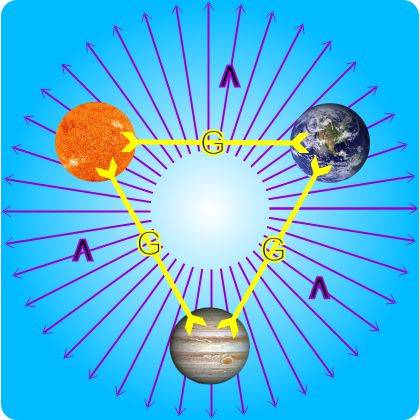
Newt chips in. “Einstein came at it from a different direction. His General Relativity field equations contained two numbers for observation to fill in — G, Newton’s gravitational constant, and lambda (Λ), which we now call the Cosmological Constant. Lambda measures the energy density of empty space. The equations say the balance between lambda and gravity controls whether the Universe expands, contracts or stays static. Lambda‘s just a little bit positive so the universe is expanding.”

“Same conclusion, different name. Neither one says where the energy comes from.”

That’s my cue. “True, but Einstein’s work goes deeper. Newtonian physics maps the Universe onto a stable grid of straight lines. In General Relativity those lines are deformed and twisted under the influence of massive objects. Vinnie and I talked about how gravity’s a fictitious force arising from that deformation. Like John Wheeler said, ‘Mass tells space-time how to curve, and space-time tells mass how to move.’ Anyway, when you throw dark energy’s lambda into the mix, the grid lines themselves go into motion. Dark energy torques the spacetime fabric that pulls galaxies together.”

“So dark energy pulls things apart by spreading out the grid they’re built on? If that’s so how come I’m still in one piece?”

“Nothing personal, but you’re too small and dense to notice. So am I, so is the Earth.”

“Why should that make a difference?”

“Time for a thought experiment. Think of the Sun. The atoms inside its surface are trying to get out, right? What’s holding them in?”

“The Sun’s gravity.”

“Just like pressure on the skin of a balloon. In either case, as long as things are stable the pressure on an enclosing real or mathematical surface rises and falls with the amount of enclosed energy density and it doesn’t matter which we talk about. Energy density’s easier to think about. With me so far?”

“I guess.”

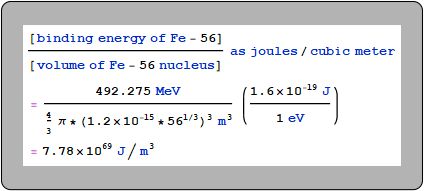
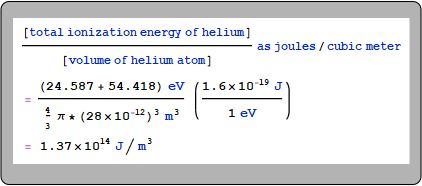
“Let’s run a few horseback numbers on Old Reliable here. Start with protons and neutrons trying to leave an atomic nucleus. Here’s the total binding energy of an iron-56 nucleus divided by its volume…”

“… so the nuclear particles would fly apart except for the inward pressure exerted by the nuclear forces. Now we’ll go up a level and consider electrons trying to leave a helium atom. They’re held in by the electromagnetic force…”

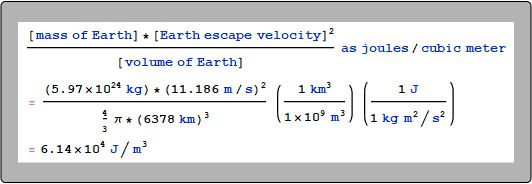
“Still a lot of inward pressure but less than nuclear by fifty-five powers of ten. Gravity next. That’s what keeps us from flying off into space. I’ll use Earth’s escape velocity to cheat-quantify it…”

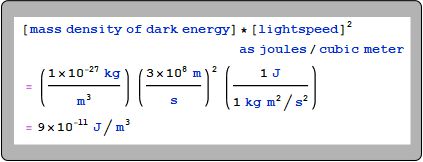
“Ten billion times weaker than the electromagnetism that holds our atoms and molecules together. Dark energy’s mass density is estimated to be about 10-27 kilograms per cubic meter. I’ll use that and Einstein’s E=mc2to calculate its pull-us-apart pressure.”

“A quintillion times weaker still.”

“So what you’re saying is, dark energy tries to pull everything apart by stretching out that spacetime grid, but it’s too weak to actually do anything to stuff that’s held together by gravity, electromagnetism or the two nuclear forces.”

“Mostly. Nuclear forces are short-range so distance doesn’t matter. Gravity and electromagnetism get weaker with the square of the distance. Dark energy only gets competitive working on objects that are separated much further than even neighboring galaxies. You’re not gonna get pulled apart.”

~~ Rich Olcott

Dark Horizon

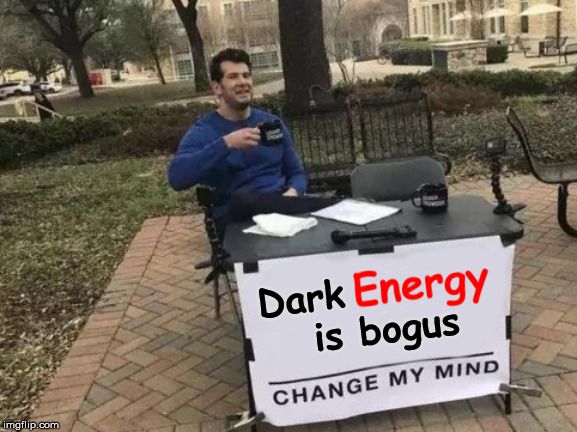
Charlie's table sign says "Dark Energy is bogus"

Change-me Charlie attacks his sign with a rag and a marker, rubbing out “Matter” and writing in “Energy.” Turns out his sign is a roll-up dry-erase display and he can update it on site. Cool. I guess with his rotating-topic strategy he needs that. “OK, maybe dark matter’s a thing, but dark energy ain’t. No evidence, someone just made that one up to get famous!”

And of course Physicist-in-training Newt comes back at him. “Lots of evidence. You know about the Universe expanding?”

“Prove it.” At least he’s consistent.

<sigh> “You know how no two snowflakes are exactly alike but they can come close? It applies to stars, too. Stars are fairly simple in a complicated way. If you tell me a star’s mass, age and how much iron it has, I can do a pretty good job of computing how bright it is, how hot it is, its past and future life history, all sort of things. As many stars as there are, we’re pretty much guaranteed that there’s a bunch of them with very similar fundamentals.”

“So?”

“So when a star undergoes a major change like becoming a white dwarf or a neutron star or switching from hydrogen fusion to burning something else, any other star that has the same fundamentals will behave pretty much the same way. They’d all flare with about the same luminosity, pulsate with about the same frequency —”

“Wait. Pulsate?”

“Yeah. You’ve seen campfires where one bit of flame coming out of a hotspot flares up and dies back and flares up and dies back and you get this pulsation —”

“Yeah. I figured that happens with a sappy log where the heat gasifies a little sap then the spot cools off when outside air gets pulled in then the cycle goes again.”

“That could be how it works, depending. Anyhow, a star in the verge of mode change can go through the same kind of process — burn one kind of atom in the core until heat expansion pushes fuel up out of the fusion zone; that cools things down until fuel floods back in and off we go again. The point is, that kind of behavior isn’t unique to a single star. We’ve known about variable stars for two centuries, but it wasn’t until 1908 that Henrietta Swan Leavitt told us how to determine a particular kind of variable star’s luminosity from its pulsation frequency.”

“Who cares?”

“Edwin Hubble cared. Brightness dies off with the distance squared. If you compare the star’s intrinsic luminosity with how bright the star appears here on Earth, it’s simple to calculate how far away the star is. Hubble did that for a couple dozen galaxies and showed they had to be far outside the Milky Way. He plotted red-shift velocity data against those distances and found that the farther away a galaxy is from us, the faster it’s flying away even further.”

“A couple dozen galaxies ain’t much.”

“That was for starters. Since the 1930s we’ve built a whole series of ‘standard candles,’ different kinds of objects whose luminosities we can convert to distances out to 400 million lightyears. They all agree that the Universe is expanding.”

“Well, you gotta expect that, everything going ballistic from the Big Bang.”

“They don’t go the steady speed you’re thinking. As we got better at making really long-distance measurements, we learned that the expansion is accelerating.”

“Wait. I remember my high-school physics. If there’s an acceleration, there’s gotta be a force pushing it. Especially if it’s fighting the force of gravity.”

“Well there you go. Energy is force times distance and you’ve just identified dark energy. But standard candles aren’t the only kind of evidence.”

“There’s more?”

“Sure — ‘standard sirens‘ and ‘standard rulers.’ The sirens are events that generate gravitational waves we pick up with LIGO facilities. The shape and amplitude of the LIGO signals tell us how far away the source was — and that information is completely immune to electromagnetic distortions.”

“And the rulers?”

“They’re objects, like spiral galaxies and intergalactic voids, that we have independent methods for connecting apparent size to distance.”

“And the candles and rulers and sirens all agree that acceleration and dark energy are real?”

“Yessir.”

~~ Rich Olcott

Dancing in The Dark

Change-me Charlie at his argument table

The impromptu seminar at Change-me Charlie’s “Change My Mind” table is still going strong, but it looks like Physicist-in-training Newt and Astronomer-in-training Jim have met his challenge. He’s switched from arguing that dark matter doesn’t exist to asking how it worked in the Bullet Cluster’s massive collision between two collections of galaxies with their clouds of plasma and dark matter. “OK, the individual galaxies are so spread out they slide past each other without slowing down but the plasma clouds obstruct each other by friction. Wouldn’t friction in the dark matter hold things back, too?”

Jim’s still standing in front of the table. “Now that’s an interesting question, so interesting that research groups have burned a bazillion computer cycles trying to answer it.”

“Interesting, yes, but that interesting?”

“For sure. What we know about dark matter is mostly what it doesn’t do. It doesn’t give off light, it doesn’t absorb light, it doesn’t seem to participate in the strong or weak nuclear forces or interact with normal matter by any means other than gravity, and no identifiable dark matter particles have been detected by bleeding-edge experiments like IceCube and the Large Hadron Collider. So people wonder, does dark matter even interact with itself? If we could answer that question one way or the other, that ought to tell us something about what dark matter is.”

“How’re we gonna do that?”

Newt’s still perched on Charlie’s oppo chair. “By using computers and every theory tool on the shelf to run what-if? simulations. From what we can tell, nearly everywhere in the Universe normal matter is embedded in a shell of dark matter. The Bullet Cluster and a few other objects out there appear to break that rule and give us a wonderful check on the theory work.”

The Bullet Cluster, 1E 0657-56 (NASA image)

“Like for instance.”

“Simple case. What would the collision would looked like if dark matter wasn’t involved? Some researchers built a simulation program and loaded it with a million pretend plasma particles in two cluster-sized regions moving towards each other from 13 million pretend lightyears apart. They also loaded in position and momentum data for the other stars and galaxies shown in the NASA image. The simulation tracked them all as pretend-time marched along stepwise. At each time-step the program applied known or assumed laws of physics to compute every object’s new pretend position and momentum since the prior step. Whenever two pretend-particles entered the same small region of pretend-space, the program calculated a pretend probability for their collision. The program’s output video marked each successful collision with a pink pixel so pinkness means proton-electron plasma. Here’s the video for this simulation.”

“Doesn’t look much like the NASA picture. The gas just spreads out, no arc or cone to the sides.”

“Sure not, which rules out virtually all models that don’t include dark matter. So now the team went to a more complicated model. They added a million dark matter particles that they positioned to match the observed excess gravity distribution. Those’re marked with blue pixels in the videos. Dark matter particles in the model were allowed to scatter each other, too, under control of a self-interaction parameter. The researchers ran the simulations with a whole range of parameter values, from no-friction zero up to about twice what other studies have estimated. Here’s the too-much case.”

“Things hold together better with all that additional gravity, but it’s not a good match either.”

“Right, and here’s the other end of the range — no friction between dark matter particles. Robertson, the video’s author/director, paused the simulation in the middle to insert NASA’s original image so we could compare.”

“Now we’re getting somewhere.”

“It’s not a perfect match. Here’s an image I created by subtracting a just-after-impact simulation frame from the NASA image, then amplifying the red. There’s too much left-over plasma at the outskirts, suggesting that maybe no-friction overstates the case and maybe dark matter particles interact, very slightly, beyond what a pure-gravity theory predicts.”

“Wait, if the particles don’t use gravity, electromagnetism or the nuclear forces on each other, maybe there’s a fifth force!”

“New Physics!”

A roar from Cap’n Mike — “Or they’re not particles!”

~~ Rich Olcott

The Pretty-good Twenty-nine

Time for coffee and a scone. As I step into Al’s coffee shop he’s taking his Jupiter poster down from behind the cash register.

“Hey, Al, I liked that poster. You decide you prefer plain wall?”

“Nah, Sy, I got a new one here. Help me get it up over the hook.”

A voice from behind us. “Ya got it two degrees outta plumb, clockwise.” Vinnie, of course. Al taps the frame to true it up.

Teachers, click here to download a large-format printable copy.

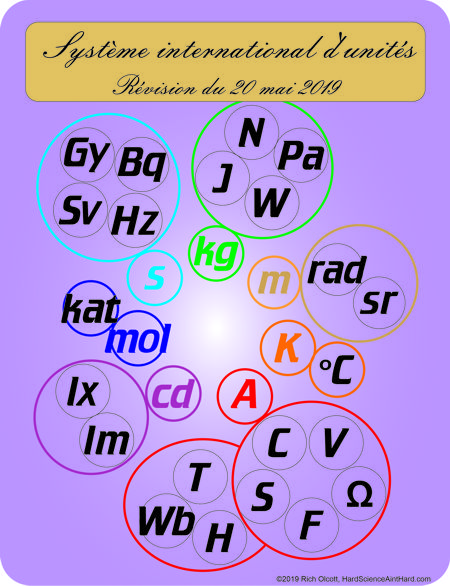
“Hey, Sy, in the middle, that’s the same seven units we just finished talking about — amps for electric current, kelvins for temperature, meters for length, kilograms for mass, seconds for time, moles for counting atoms and such, and that candela one you don’t like. What’s all the other bubbles about? For that matter, what’s the poster about, Al?”

“What it’s about, Vinnie, is on May 20 the whole world goes to a new set of measurement standards, thanks to some international bureau.”

Le Bureau International des Poids et Mesures.” It’s Newt Barnes in from the Physics building. “The bubbles in that central ring are the BIPM’s selections for fundamental standards. Each one’s fixed by precisely defined values of one or more universal physical constants. For instance, a ruler calibrated on Earth will match up perfectly with one calibrated on Mars because both calibrations depend on the wavelength of radiation from a cesium-based laser and that’s the same everywhere.”

“How about the other bubbles and the rings around them?”

“They’re all derived quantities, simple combinations of the fundamental standards.”

“Hey, I see one I recognize. That °C has gotta be degrees centigrade ’cause it’s right next to kelvins. Centigrade’s the same as kelvins plus , uh, 273?”

“There you go, Al. What’s ‘rad’ and ‘sr’, Newt?”

“Symbols for radian and steradian, Vinnie. They both measure angles like degrees do, but they fit the BIPM model because they’re ratios of lengths and length is one of the fundamentals. Divide a circle’s circumference by its radius and what do you get?”

“Twice pi.”

“Right, call it 2π radians and that’s a full circle. Half a circle is π radians, a right angle is π/2 radians and so on. Works for any size circle, right? Anyone remember the formula for the area of a sphere?”

“4πr2, right?”

“Exactly. If you divide any sphere’s area by the square of its radius you get 4π steradians. Any hemisphere is 2π steradians and so on. Steradians are handy for figuring things like light and gravity that decrease as the square of the distance.”

Something occurs to me. “I’m looking at those bigger bubbles that enclose the derived quantities. Seems to me that each one covers a major area of physical science. The green one with newtons for force, pascals for pressure, joules for energy and watts for power — that’d be Newtonian physics. The red circle with volts plus coulombs for charge, ohms for resistance, farads for capacitance, siemens for electrical conductance — all that’s electronics. Add in henries for inductance, webers for magnetic flux and teslas for flux density and you’ve got Maxwellian electromagnetism.”

“You’re on to something, Sy. Chemistry’s there with moles and katals, also known as moles per second, for catalytic activity. How does your idea fit the cluster attached to seconds?”

“They’re all per-second rates, Newt. The hertz is waves per second for periodic things like sound or light-as-a-wave. The other three are about radioactivity — bequerels is fissions per second; grays and sieverts are measures of radiation exposure per kilogram.”

“Vinnie says you don’t like candelas, so you probably don’t like lumens or luxes either. What’s your gripe with them?”

“All three are supposed to quantify visible light from a source, as opposed to the total emission at all wavelengths. But the definition of ‘visible’ zeros in on one wavelength in the green because that’s where most people are most sensitive. Candelas aren’t valid for a person who’s color-blind in the green, nor for something like a red laser that has no green lightwaves. I call bogosity, and lumens and luxes are both candela-based.”

“These 29 standards are as good on Mars as they are here on Earth?”

“That’s the plan.”

~~ Rich Olcott

The Currant Affair

Al has a new sign up at his coffee shop, “Scone of the day — Current.” He chuckles when I quietly point out the spelling error. “I know how to spell currant, Sy. I’m just gonna enjoy telling people that whatever I’m taking from the oven is the current flavor.” I’m high-fiving him for that, just as Vinnie slams in and yells out, “Hey, Al, you got your sign spelled wrong. Got any cranberry ones in there?”

Al gives me a look. I shrug. Vinnie starts in on me. “Hey, Sy, that was pretty slick what that Kibble guy did. All the measurements and calculations had the mass standard depending on three universal constants but then suddenly there was only two.”

Al pricks up his ears. “Universal constants, Sy?”

“We think so. Einstein said that the speed of light c is the same everywhere. That claim has withstood a century of testing so the International Bureau of Weights and Measures took that as their basis when they redefined the meter as the standard of length. Planck’s constant h is sometimes called the quantum of action. It shows up everywhere in quantum-related phenomena and appears to be fundamental to the way the Universe works. Bryan Kibble’s team created a practical way to have a measure-anywhere standard of mass and it just happens to depend only on having good values for c and h.”

“What’s the one that Vinnie said dropped out?”

“I knew you’d ask that, Al. It’s e, the charge on an electron. The proton and every other sub-atomic particle we’ve measured has a charge that’s some integer multiple of e. Sometimes the multiplier is one, sometimes it’s zero, sometimes it’s a negative, but e appears to be a universal quantum of charge. Millikan’s oil drop experiment is the classic example. He measured the charge on hundreds of ionized droplets floating in an electric field between charged plates. Every droplet held some integer multiple between 1 and 150 of 1.6×10⁻¹⁹ Coulomb.”

“That’s a teeny bit of electricity. I remember from Ms Kendall’s class that one coulomb is one ampere flowing for one second. Then a microampere flowing for a microsecond is, uhh, 6 million electrons. How did they make that countable?”

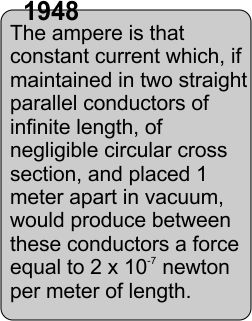
“Ah, you’ve just touched on the ‘realization problem,’ which is not about getting an idea but about making something real, turning a definition into a practical measurement. Electrical current is a good example. Here’s the official definition from 60 years ago. See any problems with it, Vinnie?”

“Infinitely long wires that are infinitely thin? Can’t do it. That’s almost as goofy as that 1960 definition of a second. And how does the force happen anyway?”

“The force comes from electrons moving in each wire electromagnetically pushing on the electrons in the other wire, and that’s a whole other story. The question here is, how could you turn those infinities into a real measurement?”

“Lemme guess. In the 1960 time standard they did a math trick to model a fake Sun and based the second on how the fake Sun moves. Is this like that, with fake wires?”

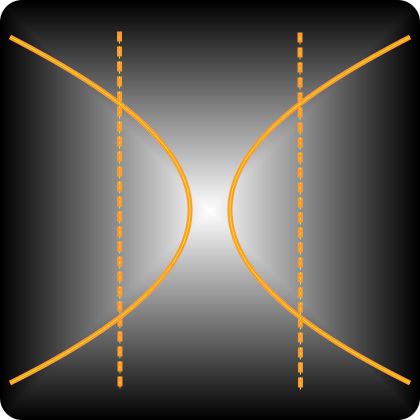
“Nice shot, Vinnie. One of the methods worked like that — take a pair of wires with a known resistance, bend them along a pair of parabolas or some other known curve set close together, apply a voltage and measure the force. Then you use Maxwell’s equations to ‘correct’ the force to what it would have been with the infinite wires the right distance apart. Nobody was comfortable with that.”

“Not surprised — too many ways to do it wrong, and besides, that’s an awfully small force to measure.”

“Absolutely. Which is why there were so many competing standards, some dating back to the 1860s when we were still trying to figure out what electricity is. Some people used a standard resistor R and the voltage V from a standard chemical cell. Then they defined their standard current I from I=V/R. Some measured power P and calculated I2=P/R. Other people standardized charge from the electrostatic force F=q1q2/r2 between two charged objects; they defined current as charge passed per second. It was a huge debate.”

“Who won?”

“Charge and R and V, all playing together and it’s beautiful.”

~~ Rich Olcott

A Force-to-Force Meeting

The Crazy Theory contest is still going strong in the back room at Al’s coffee shop. I gather from the score board scribbles that Jim’s Mars idea (one mark-up says “2 possible 2 B crazy!“) is way behind Amanda’s “green blood” theory.  There’s some milling about, then a guy next to me says, “I got this, hold my coffee,” and steps up to the mic.  Big fellow, don’t recognize him but some of the Physics students do — “Hey, it’s Cap’n Mike at the mic.  Whatcha got for us this time?”

“I got the absence of a theory, how’s that?  It’s about the Four Forces.”

Someone in the crowd yells out, “Charm, Persuasiveness, Chaos and Bloody-mindedness.”

“Nah, Jennie, that’s Terry Pratchett’s Theory of Historical Narrative.  We’re doing Physics here.  The right answer is Weak and Strong Nuclear Forces, Electromagnetism, and Gravity, with me?  Question is, how do they compare?”

Another voice from the crowd. “Depends on distance!”

“Well yeah, but let’s look at cases.  Weak Nuclear Force first.  It works on the quarks that form massive particles like protons.  It’s a really short-range force because it depends on force-carrier particles that have very short lifetimes.  If a Weak Force carrier leaves its home particle even at the speed of light which they’re way too heavy to do, it can only fly a small fraction of a proton radius before it expires without affecting anything.  So, ineffective anywhere outside a massive particle.”

It’s a raucous crowd.  “How about the Strong Force, Mike?”

.  <chorus of “HOO-wah!”>

“Semper fi that.  OK, the carriers of the Strong Force —”

.  <“Naa-VY!  Naaa-VY!”>

.  <“Hush up, guys, let him finish.”>

“Thanks, Amanda.  The Strong Force carriers have no mass so they fly at lightspeed, but the force itself is short range, falls off rapidly beyond the nuclear radius.  It keeps each trio of quarks inside their own proton or neutron.  And it’s powerful enough to corral positively-charged particles within the nucleus.  That means it’s way stronger inside the nucleus than the Electromagnetic force that pushes positive charges away from each other.”

“How about outside the nucleus?”

“Out there it’s much weaker than Electromagnetism’s photons that go flying about —”

.  <“Air Force!”>

.  <“You guys!”>

“As I was saying…  OK, the Electromagnetic Force is like the nuclear forces because it’s carried by particles and quantum mechanics applies.  But it’s different from the nuclear forces because of its inverse-square distance dependence.  Its range is infinite if you’re willing to wait a while to sense it because light has finite speed.  The really different force is the fourth one, Gravity —”

.  <“Yo Army!  Ground-pounders rock!”>

“I was expecting that.  In some ways Gravity’s like Electromagnetism.  It travels at the same speed and has the same inverse-square distance law.  But at any given distance, Gravity’s a factor of 1038 punier and we’ve never been able to detect a force-carrier for it.  Worse, a century of math work hasn’t been able to forge an acceptable connection between the really good Relativity theory we have for Gravity and the really good Standard Model we have for the other three forces.  So here’s my Crazy Theory Number One — maybe there is no connection.”

.  <sudden dead silence>

“All the theory work I’ve seen — string theory, whatever — assumes that Gravity is somehow subject to quantum-based laws of some sort and our challenge is to tie Gravity’s quanta to the rules that govern the Standard Model.  That’s the way we’d like the Universe to work, but is there any firm evidence that Gravity actually is quantized?”

.  <more silence>

“Right.  So now for my Even Crazier Theories.  Maybe there’s a Fifth Force, also non-quantized, even weaker than Gravity, and not bound by the speed of light.  Something like that could explain entanglement and solve Einstein’s Bubble problem.”

.  <even more silence>

“OK, I’ll get crazier.  Many of us have had what I’ll call spooky experiences that known Physics can’t explain.  Maybe stupid-good gambling luck or ‘just knowing’ when someone died, stuff like that.  Maybe we’re using the Fifth Force in action.”

.  <complete pandemonium>
four forces plus 1

~ Rich Olcott


Note to my readers with connections to the US National Guard, Coast Guard, Merchant Marine and/or Public Health Service — Yeah, I know, but one can only stretch a metaphor so far.