A Non-political Polarizing Topic

Vinnie gets the deck next, but first thing he does is plop a sheet of paper onto the table. “Topic is black holes, of course. Everybody’s seen this, right?”
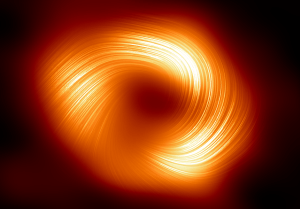
“Sure, it’s the new view of the Milky Way’s super-massive black hole with the extra lines. So deal already.”

“Hold your horses, Cal.” <Vinnie starts dealing.> “I’m looking for explanations. Where’d those lines come from? They swirl across the accretion disk like so much rope, right? Why aren’t they just going straight in orderly‑like? The whole thing just don’t make sense to me.”

Susan bets a few chips. “I saw a similar pop‑sci article, Vinnie. It said the lines trace out polarization in the light waves the Event Horizon Telescope captured. Okay, radio waves — same thing just longer wavelength. Polarized radio waves. I’ve measured concentrations of sugar and amino acid solutions by how much the liquid rotates polarized light, but the light first went through a polarizing filter. How does a black hole make polarized waves?”

Kareem matches Susan’s bet. “Mm‑hm. We use polarized light passing through thin sections of the rocks we sample to characterize the minerals in them. But like Susan says, we don’t make polarized light, we use a filter to subtract out the polarization we don’t want. You’re the physicist, Sy, how does the black hole do the filtering?”
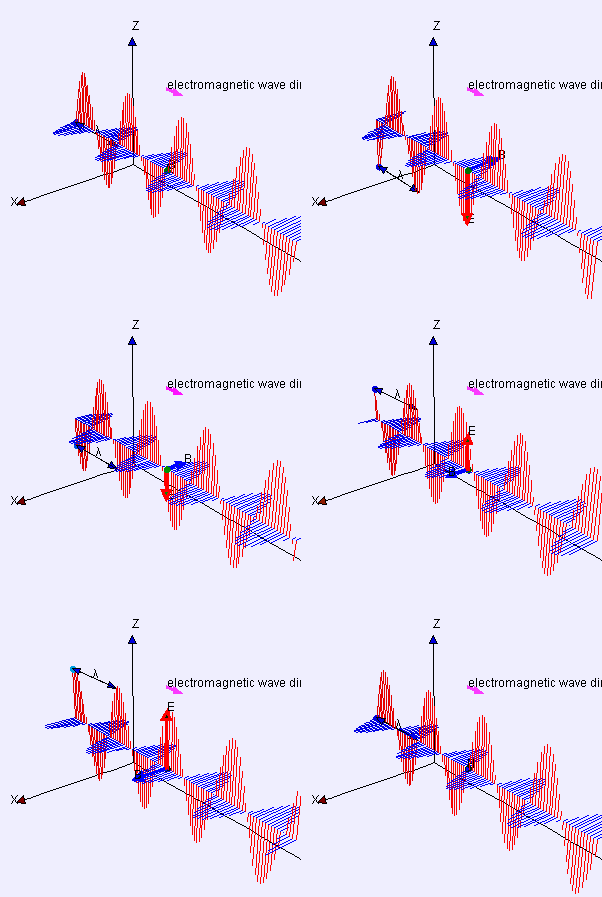
Plane‑polarized electromagnetic wave
 Electric (E) field is red
 Magnetic (B) field is blue
(Image by Loo Kang Wee and Fu-Kwun Hwang from Wikimedia Commons)

My hand’s good so I match the current ante. “It doesn’t. There’s no filtering, the light just comes out that way. I’d better start with the fundamentals.” <displaying Old Reliable> “Does this look familiar, Vinnie?”

“Yeah, Sy, you’ve used it a lot. That blue dot in the back’s an electron, call it Alice, bobbing straight up and down. That’s the polarization it’s puttin’ on the waves. The red lines are the force that another electron, call it Bob, feels at whatever distance away. Negative‑negative is repelling that so Bob goes down where the red line goes up but you get the basic idea.”

“The blue lines are important here.”

“I’m still hazy on those. They twist things, right?”

“That’s one way to put it. Hendrik Lorentz put it better when he wrote that Bob in this situation experiences one force with two components. There’s the red‑line charge‑dependent component, plus the blue‑line component that depends on the charge and Bob’s motion relative to Alice. If the two are moving in parallel—”

“The same frame, then. I knew frames would get into this somehow.”

“It’s hard to avoid frames when motion’s the subject. Anyway, if the two electrons are moving in parallel, the blue‑line component has zero effect. If the two are moving in different directions, the blue‑line component rotates Bob’s motion perpendicular to Alice’s red‑line polarization plane. How much rotation depends on the angle between the two headings — it’s a maximum when Bob’s moving perpendicular to Alice’s motion.”

“Wait, if this is about relative motion, then Bob thinks Alice is twisting, too. If she thinks he’s being rotated down, then he thinks she’s being rotated up, right? Action‑reaction?”

“Absolutely, Vinnie. Now let’s add Carl to the cast.”

“Carl?”
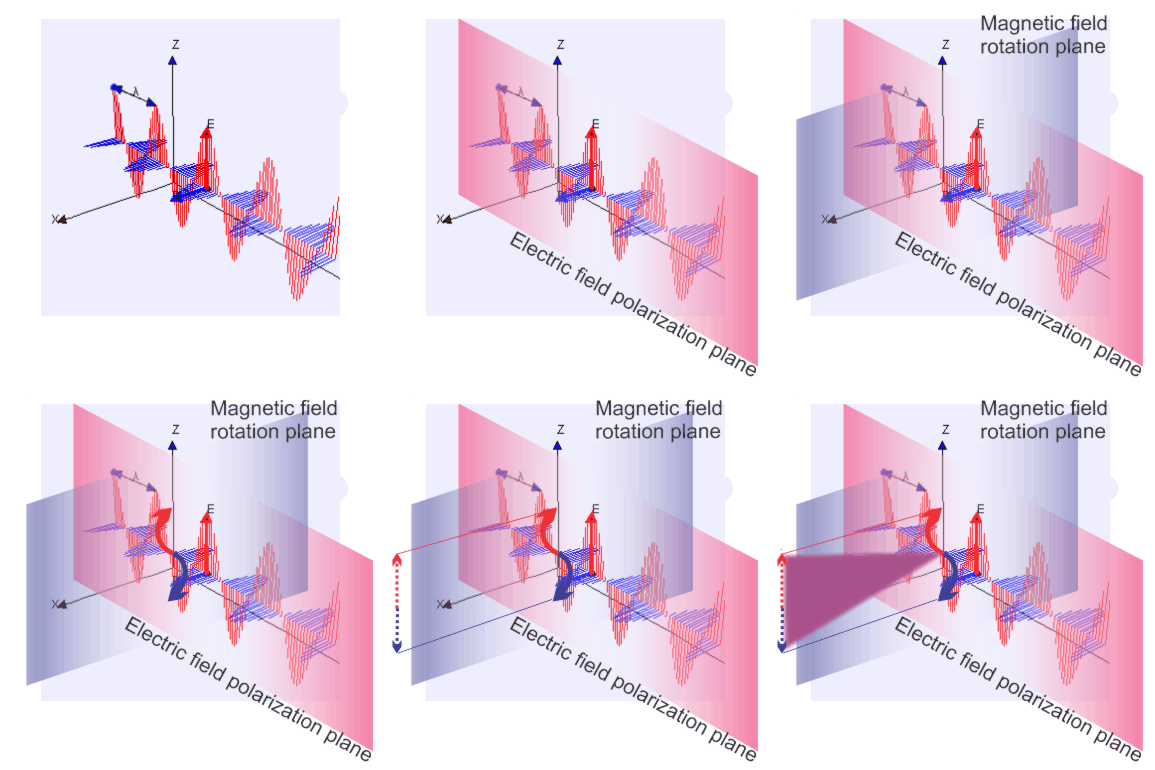
Alice and Bob’s electromagnetic interaction
begets motion that generates new polarized light.

“Distant observer at right angles to Alice’s polarization plane. From Carl’s point of view both electrons are just tracking vertically. Charges in motion generate lightwaves so Carl sees light polarized in that plane.”

Cathleen’s getting impatient, makes her bet with a rattle of chips. “What’s all this got to do with the lines in the EHT image?”
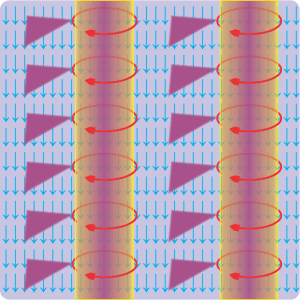
“The hole’s magnetic field herds charged particles into rotating circular columns. Faraday would say each column centers on a line of force. Alice and a lot of other charged particles race around some column. Bob and a lot of other particles vibrate along the column and emit polarized light which shows up as bright lines in the EHT image.”

“But why are the columns twisted?”

“Orbit speed in the accretion disk increases toward its center. I’d bet that’s what distorts the columns. Also, I’ve got four kings.”

“That takes this pot, Sy.”

~~ Rich Olcott

Sounds, Harsh And Informative

Vinnie’s frowning. “Wait, Sy. I get how molecules bumping into each other can carry a sound wave across space if the frequency’s low enough and that can maybe account for galaxies having spiral arms. So what’s that got to do with the Sonication Project?”

Now Jeremy’s frowning. “What’s sonication got to do with Astronomy? One of my girl friends uses sonication in Biology lab when she’s studying metabolism in plant cells.”

“Whoa! Sonification, not sonication — they could have called it soundify‑cation but sonification‘s classier. ‘Sonication‘ uses high‑intensity ultrasound to jiggle a sample so roughly that cell walls can’t take the stress. They break open and spill the cell’s internal soup out where your friend’s probes can get to it. Tammy, the chemist down the hall from my lab, uses sonication, too.”

“Whoa, Susan, wouldn’t sonication break up molecules?”

“Depends on the frequency and intensity, Vinnie. Sonication can mess up big floppy proteins and DNA, but chemists who play with little peptides and such don’t care. Tammy does solid‑state chemistry. She’s looking for superconductors and she actually does want to break things. The field’s hot category these days is complex copper oxides doped with other metals. You synthesize those compositions by sintering a mix of oxide powders. To maximize contact for a good reaction you need really fine‑grained powders. Sonication does a great job of shattering brittle oxide grains down to bits just a few‑score atoms wide. But Tammy’s technique is even more elegant than that.”

“Elegant sneezes from the powder?”

Susan wallops my shoulder. “No, Sy, the powders are so small they’d be a lung hazard and some of them are toxic. Everything’s done behind respiratory protection.” <Susan doesn’t joke about lab safety.> “There’s evidence that some of these materials are only superconductive if they have the right kind of layered structure. Turns out that if Tammy has her sonicator setup just right when she preps a sample for sintering, the sound wave peaks and valleys inside the machine make the shattered particles settle out in interesting layers.”

“Like Chladni figures.”

“Oh, you know about them.”

“Yeah, I wrote about them a few years ago. Waves do surprising things.”

Vinnie’s getting impatient. “So what’s sonification then?”

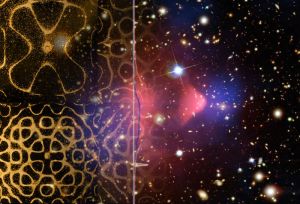
Tinkly music bursts from Cathleen’s tablet. “This one’s listenable, Susan, and it’s a nice demonstration of what sonification’s about and how arbitrary it can be. You start with complicated multi‑dimensional data and use some process to turn it into audible signals. The process algorithm can use any sound characteristics you like — loudness, pitch, timbre, whatever. This example started with the famous Bullet Cluster image that most people accept as the first direct confirmation of dark matter. All the white‑ish thingies are galaxies except for the ones with pointy artifacts — those are stars. The pink haze is X‑ray light from the same region. The blue haze comes from a point‑by‑point assessment of how badly the galaxy images have been distorted by gravitational lensing — that’s an estimate of the dark matter mass between us and that region of sky. Got all that?”

“And that vertical line is like a scan going across the picture?”

“It’s not like a scan, it is a scan. Imagine a collection of tiny multi‑spectral cameras arranged along a carrier bar. As the bar travels across the picture, each camera emits three signals proportional to the amount of white, pink and blue light it sees. If you look close, just to the right of the line, you’ll see moving white, red and blue line‑charts of the respective signals.”

“That’s fine, but what’s with the sound effects?”

“The Project’s sonification processing generated hiss and rumble sounds whose loudness is proportional to the red and blue signals. Each white‑ish peak became a ping whose pitch indicates position along that bar.”

“Why go to all that trouble?”

“The sounds encode the picture for vision‑challenged people. Beyond that, the Project participants hope that with the right algorithms, their music will reveal things the pictures don’t.”

“They should avoid screamy sounds.”

~~ Rich Olcott

Screams And Thunders

Coffee time. I step into Cal’s shop and he’s all over me. ”Sy, have you heard about the the NASA sonification project?”

Susan puts down her mocha latte. “I didn’t like some of what they’ve released. Sounds too much like people screaming.”

Jeremy looks up from the textbook he’s reading. ”In space, no-one can hear you scream.”

Vinnie rumbles from his usual table by the door. “Any of these got anything to do with the Cosmic Hum?”

“They have nothing to do with each other, except they do. Spiral galaxies, too.”

“Huh?”
 ”Huh?”
  ”Huh?”
   ”Huh?”

“A mug of my usual, Cal, please, and a strawberry scone.”

“Sure, Sy, here ya go, but you can’t say something like that around here without you tellin’ us how come.”

“Does the name Bishop Berkeley ring a bell with anyone?”

Vinnie’s on it. ”That the ‘If a tree falls in the forest…‘ guy, right? Claimed there’s no sound unless somebody’s there to hear it?”

“And by extension, no sound outside human hearing range.”

“But bats and them use sound we can’t hear.”
 ”So do elephants and whales.”

“Well there you go. So are we agreed that he was wrong?”

“Not quite, Mr Moire. His definition of ‘sound‘ was different from one you’d like. He was a philosopher theorizing about perception, but you’re a physicist. You two don’t even define reality the same way.”

Vinnie’s rumble. ”Good shot, Jeremy. Sound is waves. Sy and me, we talked about them a lot. One molecule bangs into the next one and so on. The molecules don’t move forward, mostly, but the banging does. Sy showed me a video once. So yeah, people listening or not, that tree made a sound. There’s molecules up in space, so there’s sound up there, too, right, Sy?”

“Mmm, depends on where you are. And what sounds you’re equipped to listen for. The mechanism still works, things advancing a wave by bouncing off each other, but the wave’s length has to be longer than the average distance between the things.” <drawing Old Reliable, pulling up display> “Here’s that video Vinnie saw. I’ve marked two of the particles. You see them moving back and forth over about a wavelength. Suppose a much shorter wave comes along.”

“Umm… Each one would get a forward kick before they got back into position. They wouldn’t oscillate, they’d just keep moving in that direction. No sound wave, just a whoosh.”

“Right, Jeremy. Each out‑of‑sync interaction converts some of the wave’s oscillating energy into one‑way motion. The wave doesn’t get energy back. A dozen wavelengths along, no more wave. So the average distance between particles, we call it the mean free path, sets limits to the length and frequency of a viable wave. Our ears would say it filters out the treble.”

“Space ain’t quite empty so it still has a few atoms to bump together. What kinds of limits do we get out there?”

“Well, there’s degrees of empty. Interplanetary space has more atoms per cubic meter than interstellar which is more crowded than intergalactic. Nebulae and molecular clouds can be even less empty. Huge range, but in general we’re talking wavelengths longer than a million kilometers. Frequencies measured in months or years — low even for your voice, Vinnie.”

Jeremy gets a look on his face. ”One of my girlfriends is a soprano. We tested her in the audio lab and she could hit a note just under two kilohertz, that’s two thousand cycles per second. My top screech was below half that. I could scream in space, but I guess not low enough to be heard.”

“Yeah, keep that spacesuit helmet closed and be sure your radio intercom’s working.”

“Wait, what about screaming over the radio?”

“Radio operates with electromagnetic waves, not bumping atoms. Mean free path limits don’t apply. Radio’s frequency range is around a hundred megahertz, screeching’s no problem. Your broadcast equipment’s response range would set your limits.”

“Sy, those screamy sounds I objected to — you say they can’t have traveled across space as sound waves. Was that a radio transmission?”

“Maybe, Susan. From what I’ve read, we’ve picked up beaucoodles of radio sources, all different types and all over the sky. Each broadcasts a spectrum of different radio frequencies. Some of them are constant radiators, some vary at different rates. You may have heard a recording of a kilohertz variable source.”

<shudder> “All nasty treble, no bass or harmony.”

~~ Rich Olcott
  • Thanks to Alex, who raised several questions.

LIGO And NANOGrav

Afternoon coffee time, but Al’s place is a little noisier than usual. “Hey, Sy, come here and settle this.”

“Settle what, Al? Hi, Vinnie.”

<waves magazine> “This NANOGrav thing, they claim it’s a brand‑new kind of gravity wave. What’s that about?”

“Does it really say, ‘gravity wave‘? Let me see that. … <sigh> Press release journalism at its finest. ‘Gravity waves’ and ‘gravitational waves’ are two entirely different things.”

“I kinda remember you wrote about that, but it was so long ago I forget how they’re different.”

“Gravity waves happen in a fluid, like air or the ocean. Some disturbance, like a heat spike or an underwater landslide, pushes part of the fluid upward relative to a center of gravity. Gravity acts to pull that part down again but in the meantime the fluid’s own internal forces spread the initial up‑shift outwards. Adjacent fluid segments pull each other up and down and that’s a gravity wave. The whole process keeps going until friction dissipates the energy.”

“Gravitational waves don’t do that?”

“No, because gravitational waves temporarily modify the shape of space itself. The center doesn’t go up and down, it…” <showing a file on Old Reliable> “Here, see for yourself what happens. It’s called quadrupolar distortion. Mind you, the effects are tiny percentagewise which is why the LIGO apparatus had to be built kilometer‑scale in order to measure sub‑femtometer variations. The LIGO engineers took serious precautions to prevent gravity waves from masquerading as gravitational waves.”

“Alright, so now we’ve almost got used to LIGO machines catching these waves from colliding black holes and such. How are NANOGrav waves different?”

“Is infrared light different from visible light?”

“The Hubble sees visible but the Webb sees infrared.”

“Figures you’d have that cold, Al. What I think Sy’s getting at is they’re both electromagnetic even though we only see one of them. You’re gonna say the same for these new gravitational waves, right, Sy?”

“Got it in one, Vinnie. There’s only one electromagnetic field in the Universe but lots of waves running through it. Visible light is about moving charge between energy levels in atoms or molecules which is how the visual proteins in our eyes pick it up. Infrared can’t excite electrons. It can only waggle molecule parts which is why we feel it as heat. Same way, there’s only one gravitational field but lots of waves running through it. The LIGO devices are tuned to pick up drastic changes like the <ahem> massive energy release from a black hole collision.”

“You said ‘tuned‘. Gravitational waves got frequencies?”

“Sure. And just like light, high frequencies reflect high‑energy processes. LIGO detects waves in the kilohertz range, thousands of peaks per second. NANOGrav’s detection range is sub‑nanohertz, where one cycle can take years to complete. Amazingly low energy.”

“How can they detect anything that slow?”

“With really good clocks and a great deal of patience. The new reports are based on fifteen years of data, half a billion seconds counted out in nanoseconds.”

“Hey, wait a minute. LIGO’s only half‑a‑dozen years old. Where’d they get the extra data from, the future?”

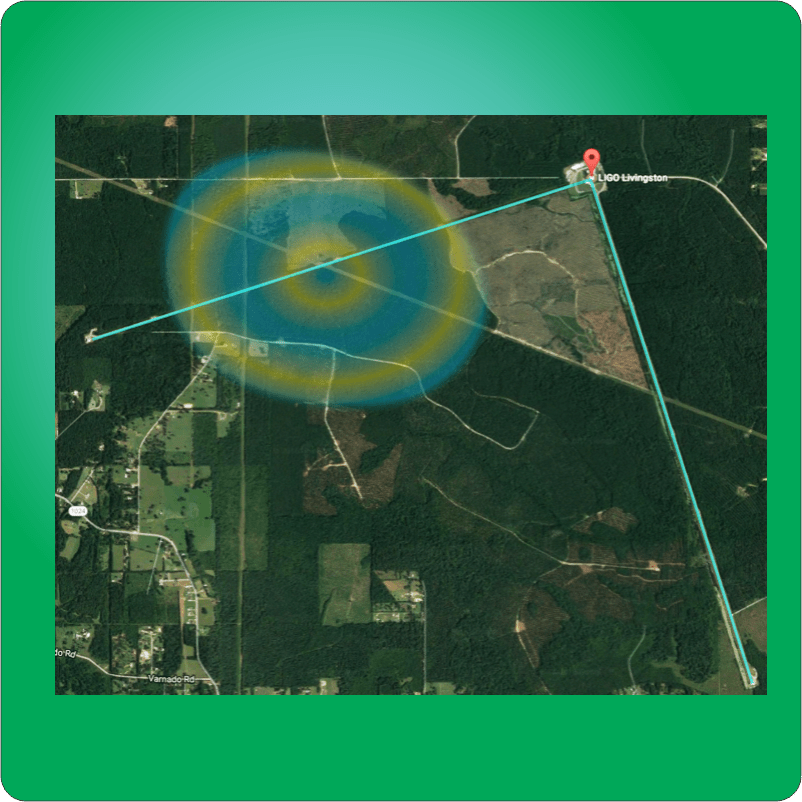
“Of course not. Do you remember us working out how LIGO works? The center sends out a laser pulse along two perpendicular arms, then compares the two travel times when the pulse is reflected back. Light’s distance‑per‑time is constant, right? When a passing gravitational wave squeezes space along one arm, the pulse in that arm completes its round trip faster. The two times don’t match any more and everyone gets excited.”

“Sounds familiar.”

“Good. NANOGrav also uses a timing‑based strategy, but it depends on pulsars instead of lasers. Before you ask, a pulsar is a rotating neutron star that blasts a beam of electromagnetic radiation. What makes it a pulsar is that the beam points away from the rotation axis. We only catch a pulse when the beam points straight at us like a lighthouse or airport beacon. Radio and X‑ray observatories have been watching these beasts for half a century but it’s only in the past 15 years that our clocks have gotten good enough to register timing hiccups when a gravitational wave passes between us and a pulsar.”

~ Rich Olcott

Useful Eccentricity

“Hi, Al. What’s the hubbub in the back room?”

“Cathleen’s doing another astronomy class group seminar. This one’s about exoplanets. I’d like to listen in but I’ve got to tend the cash register here. Take notes, okay?”

“Sure, no problem.”

Professor Cathleen’s at the podium. “Okay, class, settle down. I hope everyone’s ready with their presentations. Maria, you’ve got a good topic to start us off.”

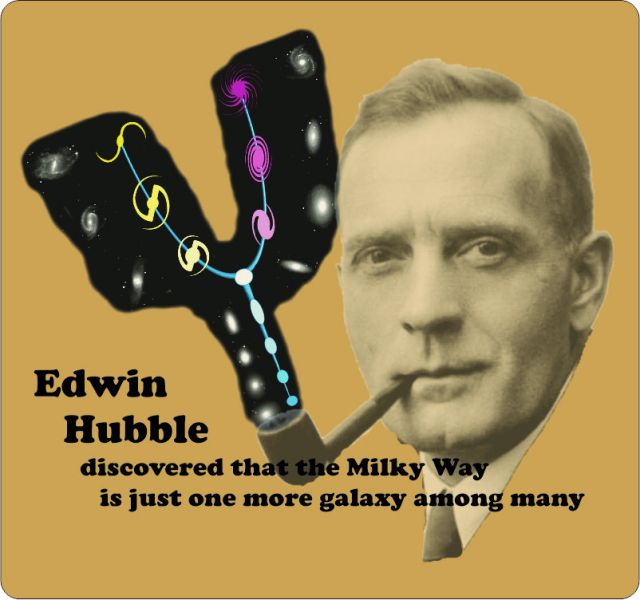
“Thank you. Everyone here knows I’ve been interested in spectroscopy since I was a student intern at Arecibo. It is such a powerful thing to know that a particular kind of atom, anywhere in the Universe, absorbs or gives off exactly the same pattern of light frequencies. Suppose you are looking at the spectrum of a star or a galaxy and you recognize a pattern, like sodium’s yellow doublet or hydrogen’s Lyman series. The pattern won’t be at its normal frequencies because of the Doppler effect. That’s good because the amount of blue‑shift or red‑shift tells us how quick the object is moving toward or away from us. That was how Dr Hubble proved that most other galaxies are flying away.”

<casts a slide to Al’s video screen> “I’ll begin with a review of some class material. The spectroscopy we see in the sky is light that was emitted at some peak wavelength lambda. Lambda with the little ‘o‘ is what we see for the same emission or absorption process in the laboratory. The wavelength difference between sky and laboratory is the absolute shift. Divide that by the laboratory wavelength to get the relative shift, the z‑scale. All the light from one object should have the same z value. It is important that z also gives us the object’s velocity if we multiply by the speed of light.”

<voice from the rear> “What’s the ‘fe ka‘ stuff about?”

“I was getting to that. Those two lines describe a doublet, a pair of peaks that always appear together. This is in the X‑ray spectrum of iron which is Fe for the chemists. K-alpha is a certain process inside the iron atom. Astronomers like to use that doublet because it’s easy to identify. Yes, profesora?”

“Two additional reasons, Maria. Iron’s normally the heaviest element in a star because stellar nuclear fusion processes don’t have enough energy to make anything heavier than that. Furthermore, although every element heavier than neon generates a K-alpha doublet, the peak‑to‑peak split increases with atomic mass. Iron’s doublet is the widest we see from a normal star.”

“Thank you. So, the arithmetic on the rest of the slide shows how Dr Hubble might have calculated the speed of a galaxy. But that’s steady motion. Exoplanets orbiting a star appear to speed ahead then fall behind the star, yes? We need to think about how a planet affects its star. This next slide talks about that. My example uses numbers for the Sun and Jupiter. We say Jupiter goes around the Sun, but really, they both go around their common center of gravity, their barycenter. You see how it’s calculated here — MP is the planet’s mass, MS is the star’s mass, dSP is the star-to-planet distance and dB is the distance from the star’s center to the barycenter. I’ve plugged in the numbers. The barycenter is actually ten thousand kilometers outside the Sun!”

“So you could say that our Sun counterbalances Jupiter by going in a tight circle around that point.”

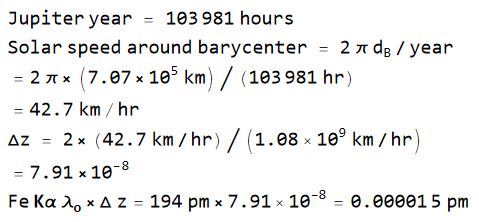
“Exactly! For my third slide I worked out whether a distant astronomer could use Doppler logic to detect Sun‑Jupiter motion. The first few lines calculate the size of the Sun’s circle and than how fast the Sun flies around it. Each Jupiter year’s blue shift to red shift totals only 79 parts per billion. The Sun’s iron K‑alpha1 wavelength varies only between 193.9980015 and 193.9979985 picometers. This is far too small a change to measure, yes?”

<dramatic pause> “I summarize. To make a good Doppler signal, a star must have a massive exoplanet that’s close enough to push its star fast around the barycenter but far enough away to pull the barycenter outside of the star.”

“Thank you, Maria.”

“X” marks the barycenter

~~ Rich Olcott

Shadow Plays

“A strawberry scone and my usual black, Al.”

“Sure thing, Sy, comin– Hiya, Cathleen, see my new poster? Event Horizon Telescope pictures of the two big‑guy black holes we’ve actually seen so far. Those white-hot blobs buried in those red rings. Ain’t it a beaut? What’ll you have?”

“They’re certainly wonderful graphics, Al. I’ll have a caramel latte, please, with a plain scone.” I’m waiting for it, because Cathleen never passes up a teachable moment. Sure enough — “Of course, neither one actually looks like that or represents what you think. Those images were created from radio waves, not visible light or even infrared. The yellows and whites don’t represent heat, and that darkness in the middle isn’t the black hole.”

“Whoa, don’t harsh Al’s happy, Cathleen. Maybe just go at it a step at a time?”

<sigh> “You’re right, Sy. Sorry, Al, I just get frustrated when press‑agent science gets in the way of the real stuff which is already interesting on its own. For instance, I haven’t seen anything in the pop‑sci press about the EHT people using the same 2017 data to produce both images, even though the two objects are almost 90° apart in the sky. I think about our optical telescopes and the huge high-tech motors it takes to point them in the right direction. These guys just re-work their data and they’re good for another round.”

“It’s a cute trick, alright, Cathleen, steering a distributed telescope with arithmetic.”

“OK, you guys are over my head — distributed telescope?”

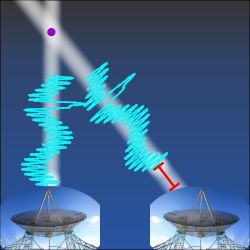
“The EHT Collaboration works with eight radio telescopes scattered across the world. The signal from any point in the sky has a different time offset at each telescope depending on the angle to the point. If you know the baseline between each pair of scopes and you’ve got really good clocks keeping track of time at each location, when you combine the data from all eight locations it’s just arithmetic to pick out matching signals at the right set of offsets for any point of origin.”

“A lot of arithmetic, Cathleen.”

“I’ll give you that, Sy. Al, it took the researchers and some hefty compute facilities two years to boil down the data for the M87 monster. In principle, when they wanted to inspect the Milky Way’s beast all they had to do was run through the same data selecting for signal matches at the offsets pointing to Sgr A*. Awesome tech, huh?”

“Awesome, yeah, but if the colors aren’t heat, what are they?”

“Electron density, mostly. Your red‑and‑yellow Jupiter poster over there is like most heat maps. Researchers figure a pixel’s temperature by comparing data from multiple wavelengths with the Planck curve or some other calibrated standard. These images, though, came from a single wavelength, 1.3 millimeters. Light at shorter wavelengths can’t get past the dust, longer wavelengths can’t give us the image resolution. Millimeters waves are in the radio part of the spectrum — too low‑energy to detect moving charge inside atoms or between molecule components. The only thing that can give off those photons is free‑floating electrons. The brightest pixels have the most electrons.”

“So the hole isn’t the black hole?”

“Depends on your definition, I suppose. Everyone visualizes that black sphere, the event horizon, when they think ‘black hole.’ That’s not what the dark patches are. By my definition, though, a ‘black hole‘ is the whole package — central mass, event horizon, ergosphere if it’s spinning, a jet maybe and everything else that’s associated with the mass. It’s as much a collection of processes as a thing. Anyhow, the bright stuff in these images does come from accretion disks.”

“The dark patch is the disk’s inside edge?”

“Nope, it’s the shadow of the photon sphere. Before you ask, that’s a light‑trapping shell 1½ times the horizon’s diameter. Depending on its angle of approach, a photon that touches the sphere either spirals inward, orbits forever, or swerves outward. Going straight doesn’t happen. The shadow memorializes Earth‑bound photons that bounced away from us.”

“I guess my happy’s back, Cathleen, but it’s different.”

“You’re welcome, Al. Now how about the coffee and scones we asked for?”

~~ Rich Olcott

Credit: Event Horizon Telescope Collaboration
Image: Lia Medeiros, ISA, EHTC

Pushing It Too Far

It’s like he’s been taking notes. Mr Feder’s got a gleam in his eye and the corner of his mouth is atwitch. “You’re not getting off that easy, Cathleen. You said that Earendell star’s 66 trillion lightyears away. Can’t be, if the Universe’s only 14 billion years old. What’s going on?”

“Oops, did I say trillion? I meant billion, of course, 109 not 1012. A trillion lightyears would be twenty times further than the edge of our observable universe.”

“Hmph. Even with that fix it’s goofy. Sixty-six billion is still what, five times that 14 billion year age you guys keep touting. I thought light couldn’t travel that far in that time.”

“I thought the Universe is 93 billion light years across.”
  ”That’s diameter, and it’s just the observable universe.”
    ”Forty-seven billion radially outward from us.”
      ”None of that jibes with 14 billion years unless ya got stuff goin’ faster than light.”

“Guys, guys, one thing at a time. About that calculation, I literally did it on the back of an envelope, let’s see if it’s still in my purse … Nope, must be on my office desk. Anyhow, distance is the trickiest part of astronomy. The only distance‑related thing we can measure directly is z, that redshift stretch factor. Locate a familiar pattern in an object’s spectrum and see where its wavelength lies relative to the laboratory values. The go‑to pattern is hydrogen’s Lyman series whose longest wavelength is 121 nanometers. If you see the Lyman pattern start at 242 nanometers, you’ve got z=2. The report says that the lens is at z=2.8 and Earendel’s galaxy is at z=6.2. We’d love to tie those back to distance, but it’s not as easy as we’d like.”

“It’s like radar guns, right? The bigger the stretch, the faster away from us — you should make an equation outta that.”

“They have, Mr Feder, but Doppler’s simple linear relationship is only good for small z, near zero. If z‘s greater than 0.1 or so, relativity’s in play and things get complicated.”

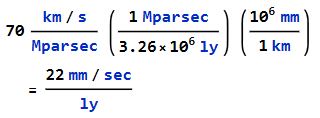
“Wait, the Hubble constant ties distance to speed. That was Hubble’s other big discovery. Old Reliable here says it’s something like 70 kilometers per second for every megaparsec distance. What’s that in normal language? <tapping keys> Whoa, so for every lightyear additional distance, things fly away from us about an inch per second faster. That’s not much.”

“True, Sy, but remember we’re talking distant, barely observable galaxies that are billions of lightyears away. Billions of inches add up. Like with the Doppler calculation, you get startling numbers if you push a simple linear relation like this too far. As an extreme example, your Hubble rule says that light from a galaxy 15 billion lightyears away will never reach us because Hubble Flow moves them away faster than photons fly toward us. We don’t know if that’s true. We think Hubble’s number changes with time. Researchers have built a bucketful of different expansion models for how that can happen; each of them makes different predictions. I’m sure my 66 came from one of those. Anyhow, most people nowadays don’t call it the Hubble constant, it’s the Hubble parameter.”

“Sixty-six or forty-seven or whatever, those diameters still don’t jibe with how long the light’s had a chance to travel.”

“Sy, care to take this? It’s more in your field than mine.”

“Sure, Cathleen. The ‘edge of the observable universe‘ isn’t a shell with a fixed diameter, it simply marks the take-off points for the oldest photons to reach us so far. Suppose Earendel sent us a photon about 13 billion years ago. The JWST caught it last night, but in those 13 billion years the universe expanded enough to insert twenty or thirty billion lightyears of new space between between here and Earendel. The edge is now that much farther away than when the photon’s journey started. A year from now we’ll be seeing photons that are another year older, but the stars they came from will have flown even farther away. Make sense?”

“A two-way stretch.”

“You could say that.”

~~ Rich Olcott
  • Thanks to my brother Neil, who pointed out the error and asked the question.

A Thumbtack in A Needlestack

“What’re the odds?”

“Odds on what, Vinnie?”

“A gazillion galaxies out there, only 41 lensing galaxy clusters, but one of them shows us a singleton star. I mean, what’s special about that star? What are the odds?”

I can’t help it. “Astronomical, Vinnie.”

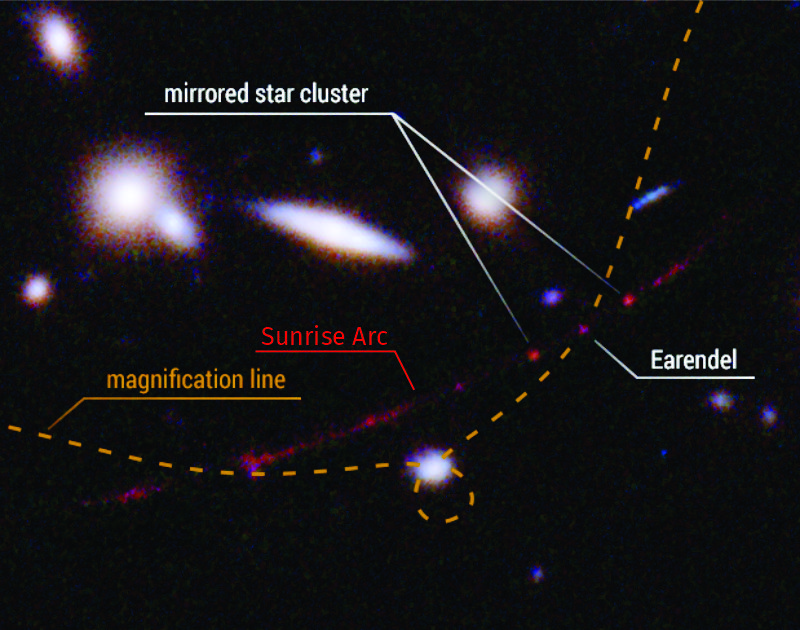
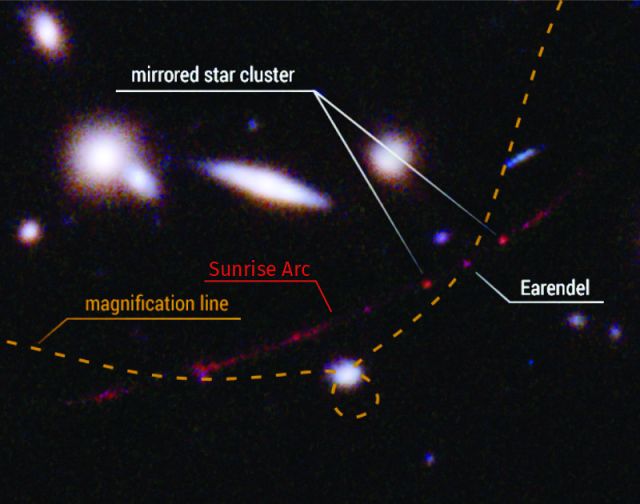
Cathleen punches my shoulder, hard. “Sy Moire, you be ashamed of yourself. That pun was ancient a century ago. Vinnie, the odds are better than they seem. We didn’t just stumble on Earendel and the Sunrise Arc, we found them in a highly targeted Big Data search for things just like that — objects whose light was extremely stretched and also gravitationally bent in our direction. The Arc’s lensing galaxy cluster has a spherical effect, more or less, so it also acts on light from other far-away objects and sends it in other directions. It even bends an image of our Milky Way towards Earendel’s galaxy.”

“I call weaseling — you used ‘more or less‘.”

“Guilty as charged, Vinnie. A nice, spherical black hole is the simplest case of gravitational lensing — just one mass at the center of its simple light‑bending gravity field. Same thing for a single star like our Sun. Clusters are messy. Tens or hundreds of billion‑star galaxies, scattered at random angles and random positions about their common center of mass. The combined gravity field is lumpy, to say the least. Half of that research paper is devoted to techniques for estimating the field and its effects on light in the region around the Arc.”

“I guess they had to get 3D positions for all the galaxies in the cluster. That’d be a lot of work.”

“It would, Al, but that’s beyond what current technology can do. Instead, they used computer models to do — get this, Sy — curve fitting.”

<chuckle> “Good one, Cathleen.”

“What’s so funny?”

“There’s a well-established scientific technique called ‘curve fitting.’ You graph some data and try to find an equation that does a respectable job of running through or at least near your data points. Newton started it, of course. Putting it in modern terms, he’d plot out some artillery data and say, ‘Hmm, that looks like a parabola H=h+v·t+a·t2. I wonder what values of h, v and a make the H-t curve fit those measurements. Hey, a is always 32 feet per second per second. Cool.’ Or something like that. Anyhow, Cathleen’s joke was that the researchers used curve fitting to fit the Sunrise Arc’s curve, right?”

“They did that, Sy. The underlying physical model, something called ‘caustic optics,’ says that—”

“Caustic like caustic soda? I got burnt by that stuff once.”

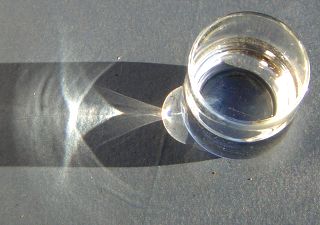
Image by Heiner Otterstedt,
under the Creative Commons Attribution-Share Alike 3.0 Unported license

“That’s the old name for sodium hydroxide, Vinnie. It’s a powerful chemical and yeah, it can give you trouble if you’re not careful. That name and caustic optics both come from the Greek word for burning. The optics term goes back to using a lens as a burning glass. See those focused patterns of light next to your water glass? Each pattern is a caustic. The Arc’s lensing cluster’s like any light‑bender, it’s enclosed in a caustic perimeter. Light passing near the perimeter gets split, the two parts going to either side of the perimeter. The Earendel team’s curve‑fitting project asked, ‘Where must the caustic perimeter be to produce these duplicate galaxy images neighboring the Arc?‘ The model even has that bulge from the gravity of a nearby foreground galaxy.”

“And the star?”

“Earendel seems to be smack on top of the perimeter. Any image touching that special line is intensified way beyond what it ought to be given the source’s distance from us. It’s a pretty bright star to begin with, though. Or maybe two stars.”

“Wait, you don’t know?”

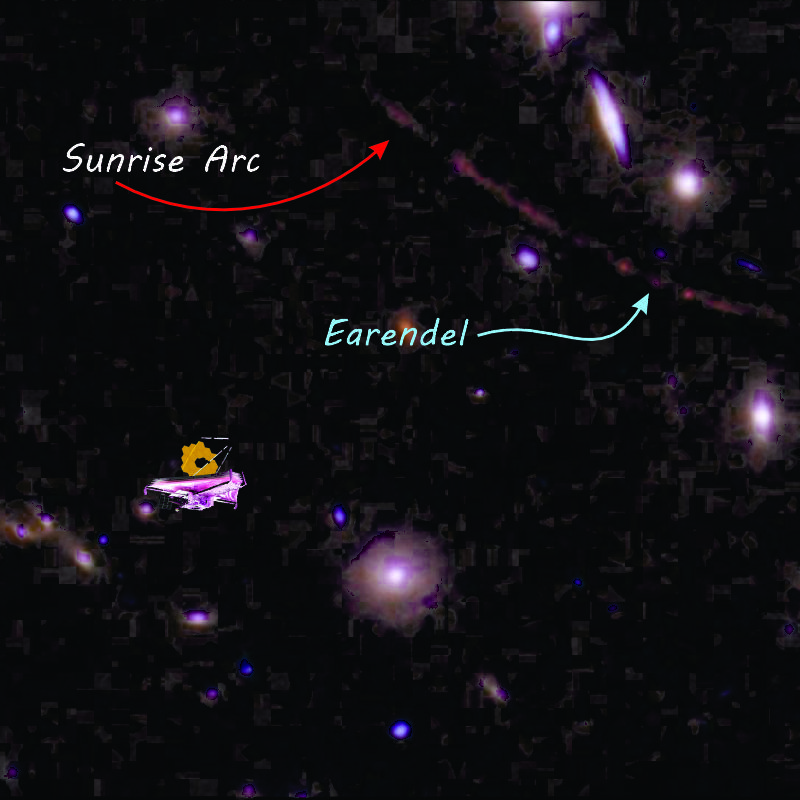
“Not yet. This study pushed the boundaries of what Hubble can do for us. We’re going to need JWST‘s infrared instruments to nail things down.”

Al’s in awe. “Wow — that caustic’s sharp enough to pick one star out of a galaxy.”

“Beat the astronomical odds, huh?”

Adapted from a public-domain image.
Credit: Science: NASA / ESA / Brian Welch (JHU) / Dan Coe (STScI); Image processing: NASA / ESA / Alyssa Pagan (STScI)

~~ Rich Olcott

A Needle in A Needlestack

“How’d they find that far-away star, Cathleen? Seems like you’d have to know just where to point your telescope.”

“It’s worse than that, Al, first you’ve got to find that telescope, or more precisely, its lens. We can’t simply swing a black hole or galaxy cluster into position for a good look at something interesting. No, we have to discover lensing objects that magnify good stuff beyond them. The good news is that some of those are out there, but the bad news is that the sky is cluttered with far more objects that don’t play the game we want. This research team appears to have hit paydirt but they did it with humungous power shovels and heavy‑duty panning techniques.”

“Impressive metaphor, Cathleen. Could you un‑metaphor it for us?”

“Sure, Sy. The power shovels are Hubble and Spitzer, both of which piled up beaucoodles of data from decades of infrared observing time.”

“I thought Hubble was designed for visible and UV surveillance.”

“It is, mostly, but since 2009 its instrument suite included WFC3, a camera that’s sensitive out to 1700 nanometers and covers a square 2 arcminutes on a side. That’s a lot, by big‑telescope astronomy standards.”

“Wait, arcminutes?”

“That’s right, Mr Feder. We astronomers have trouble with distances but we’re good at measuring angles. The Moon’s about a degree across. One degree is sixty arcminutes, next step down is sixty arcseconds per arcminute. After that we go semi‑metric, milliarcseconds and so forth. One WFC3 pixel records a patch of sky 130 milliarcseconds across. JWST‘s NIRCam instrument has a resolution twice as sharp. Anyway, Hubble‘s 1700‑nanometer limit is plenty good enough to pick up 120‑nanometer hydrogen light that’s been stretched out by a factor of z=2.8. Distance and stretch correlate; the lens that highlighted Earendel and its Sunrise Arc for NASA and Vinnie is that far away.”

“How far away?”

“It’s tricky to answer that. The spectra we see let us measure an object’s z‑factor, which by way of the Doppler effect tells us how fast the object is moving away. Hubble’s constant ties that to distance, sort of. My convenient rule of thumb is that an object whose z is near 2 is running away at 80% of lightspeed and on the average is about 55 trillion lightyears from us but don’t quote me because relativity complicates matters. Using the same dicey calculation I estimated the lens and Earendel velocities at 87% and 96% of lightspeed, which would put their ‘proper distances‘ around 60 and 66 trillion lightyears away. And no, I’m not going to go into ‘proper distance‘ versus ‘comoving distance‘.”

“Let’s get back to your metaphor, Cathleen. I get that Hubble and Spitzer and such generated a ton of data. What’s the panning part about?”

“Well, in the old days it would have been hired hands and graduate students spending years peering at dots on photographic plates. These days it’s computers, thank Heaven. The research team used a series of programs to filter their digital data. The software had to decide which dots are stars or noise specks and which are galaxies or arcs. Then it picked out the reddest red galaxy images, then clusters of galaxy images at the same redness level that are near each other in space, then clusters with arcs around them. I said that WFC3 covers a square 2 arcminutes on a side, remember? The sky, both hemispheres, contains almost 2½ million squares like that, although the surveys didn’t get all of them. Anyhow, after burning through cubic acres of computer time the team found 41 deep red lensing clusters.”

“Only 41.”

“Yup.”

We ponder that for a minute, then Vinnie pipes up. “Wait, the dots are in color?”

“No, but these images are generally taken through a filter that transmits only a known narrow wavelength range, infrared or whatever. Using relative dot intensity at several different wavelengths you can create ‘false color‘ images. When you find something, you know where to point spectroscopic tools to be sure you’ve found the good stuff.”

“Like a star shining less than a billion years after the Big Bang.”

“Paydirt.”

Image adapted from NASA and STScI

~~ Rich Olcott

When The Stars Are Aligned Right

Cathleen and I are chatting when Vinnie bursts into the coffee shop waving a newspaper. “New news, guys, they’ve just announced Hubble spotted the farthest‑away star. How about that? Think what JWST will be able to do!”

Cathleen raises an eyebrow. “Sounds like press release science. What else do they say?”

“Not a whole lot. Lessee… These guys went through old Hubble data and found a piece of an Einstein ring which I don’t know what that is and partway along the ring is a star and somehow they figured out it’s 50 times heavier than the Sun and 12 billion years old and it’s the farthest star they’ve ever seen and that’s why NASA’s all excited.”

“Do you believe all that?”

“Maybe the NASA PR people do?”

“Maybe. I just read the technical paper behind that announcement. The authors themselves aren’t absolutely sure. The paper’s loaded with supporting evidence and ‘how we did it‘ details but it’s also loaded with caveats. The text includes a string of alternative explanations for their observations, winding up with a typical ‘we await further evidence from JWST‘ statement. Reads a lot more like real science. Besides, we’ve already seen more distant stars but they’re all jumbled together inside their very distant galaxies.”

“Unpack it for me. Start with what’s an Einstein ring?”

“It’s a gravitational lensing effect. Sy, does Old Reliable still have a copy of that graphic you did about gravitational lensing?”

“That was years ago. Let me check… Uh‑huh, here it is.”

“Thanks. Vinnie, you know how a prism changes light’s direction.”

“Sy and me, we talked about how a prism bends light when light crosses from air to glass or the other way ’cause of the different speed it goes in each material. Uhh, if I remember right the light bends toward the slower speed, and you get more bend with shorter wavelengths.”

“Bingo, Vinnie. Gravitational lensing also bends light, but the resemblance ends there. The light’s just going through empty space, not different media. What varies is the shape of spacetime itself. Say an object approaches a heavy mass. Because of relativity the space it moves through appears compressed and its time is dilated. Compressed distance divided by dilated time means reduced velocity. Parts of a spread‑out lightwave closest to the mass slow down more than parts further way so the whole wave bends toward the heavy mass. Okay?”

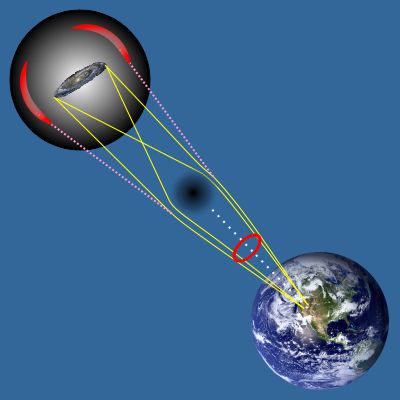
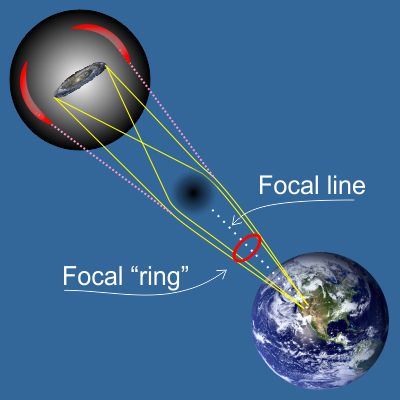
“Hold on. Umm, so in your picture light coming towards us from that galaxy doesn’t get blocked by that black thingy, the light bends around it on both sides and focuses in on us?”

“Exactly. Now carry it further. The diagram cuts a flat 2D slice along round 3D spatial reality. Those yellow lines really are cones. Three‑sixty degrees around the black blob, the galaxy’s light bends by the same amount towards the line between us and the blob. Your Einstein ring is a cut across the cone, assuming that the galaxy, the blob and Earth are all exactly on the same straight line. If the galaxy’s off‑center the picture isn’t as pretty — you only get part of a ring, like those red arcs in Sy’s diagram.”

“A galactic rainbow. That ought to be awesome!”

“Well it would be, but there’s another difference between prisms and blobs. Rainbows happen because prisms and raindrops bend short‑wavelength colors more than longer ones, like you said. Gravitational lensing doesn’t care about wavelength. Wavelengths do shift as light traverses a gravitational well but the outbound red shift cancels the inbound blue shift.. Where gravity generates an Einstein ring, all wavelengths bend through the same angle. Which is a good thing for bleeding‑edge astronomy researchers.”

“Why’s that, Cathleen?”

“If the effect were wavelength‑dependent we’d have aberration, the astronomer’s nemesis. Images would be smeared out. As it is, all the photons from a point hit the same spot on the sensor and we’ve got something to see.”

“Tell him about amplification, Cathleen.”

“Good point, Sy. Each galactic star emits light in every direction. In effect, the blob collects light over its entire surface area and concentrates that light along the focal line. We get the brightest image when the stars are aligned right.”

~~ Rich Olcott